





Karsten Wenzlaff, Advisor
August 26th, 2025
Karsten Wenzlaff is a Crowdfunding and Fintech Expert from Germany. He is Secretary-General of Digit[...]


Release | Feb 21, 2024

Image: Freepik
TORONTO – February 20, 2024 – Round13 Digital Asset Fund (DAF), a native crypto fund in Canada with an innovative open-ended structure, announced yesterday gains exceeding 40% since its inception in April 2022, despite the turbulent market backdrop. This achievement underscores the Fund's exceptional ability to outperform major cryptocurrencies, with a 30% lead over BTC and a 60% advantage against ETH.
Leveraging strategic investments in 20 portfolio companies across pivotal stages such as Seed and Series A, with investments ranging from $250,000 to $5 million, Round13 DAF has curated a diverse and impressive portfolio. These companies are pioneering advancements across crucial crypto market segments, including AI, gaming and Metaverse, identity, and infrastructure. Noteworthy portfolio companies include Wombo, Improbable, Confirm, and ChainSafe.
Several portfolio entities have successfully secured funding at significantly enhanced valuations, demonstrating resilience and growth potential. A notable aspect of the Fund's portfolio is the presence of token projects poised for native token launches this year, further enriching the investment landscape. Round13 DAF remains optimistic about the prospect of additional liquidity events from its venture deals in the next three years.
Established by Round13 Capital, a venture and growth-stage investment firm co-founded by Bruce Croxon and John Eckert, Round13 DAF is focused on blockchain innovation and digital asset markets. The Fund's structured approach to onboarding new investors quarterly, coupled with its steadfast resilience and innovation, sets it apart in the fast-paced digital asset domain.
With an eye on the next 12-24 months, Round13 DAF's confidence in the digital asset market is stronger than ever. The U.S.'s recent approval of Spot Bitcoin ETFs marks a new era of growth and institutional adoption for BTC and ETH. This optimism is anchored in the belief that the digital asset market is on the cusp of significant expansion and mainstream finance integration.
Satraj Bambra, Managing Partner and CIO at Round13 DAF:
"Our dual focus on crypto capital markets and venture capital has been fundamental to our strategy. This approach has enabled us to adeptly navigate varying market conditions, including the recent downturns and market uncertainties post-FTX collapse. Our vision is to continue leading in the digital asset space, driving innovation, stability, and growth. With the market poised for monumental shifts, our strategic positioning enables us to capitalize on the upcoming value surge, with BTC projected to exceed $150,000 and ETH to surpass $10,000 in the next two years."
NCFA got in touch with Round13's Digital Asset Fund, Managing Partner, Khaled Verjee to answer some additional questions.
Q: Given the impressive performance of Round13 DAF amidst a turbulent crypto market, what specific criteria or evaluation process does the fund use to select portfolio companies?
A: Our selection of portfolio companies is underpinned by an evaluation process that emphasizes several key criteria. Firstly, Round13 DAF prioritizes companies that have secured enough capital to sustain operations for at least a three-year runway. This criterion underscores the importance of financial stability and resilience, ensuring that the company can navigate market volatilities without the immediate need for additional funding. Companies also need to have solid fundamentals and a robust business model, demonstrated by an established performance track record which includes clear revenue models, customer acquisition strategies, and scalable operations.
We look for a strong technical founder – which is crucial for driving innovation and technical excellence, especially in the rapidly evolving crypto and blockchain sector. We also look for a second or third time CEO as these leaders bring proven track records of navigating startups to success, learning from past experiences, and applying those lessons to avoid common pitfalls and accelerate growth.
Given the technical complexity of blockchain technology, the Fund emphasizes the importance of a strong user interface and ease of use. The portfolio companies we invest in make blockchain technology easy to use and accessible, essentially making the complexity of blockchain invisible to the user. This focus ensures that products and services can achieve wider adoption by being user-friendly and intuitive.
Q: How does Round13 DAF differentiate its investment strategy from other crypto funds, particularly in terms of portfolio diversification and risk management?
We understand that narratives play a big role in how the market moves. Round13DAF distinguishes its investment strategy from other crypto funds through a nuanced approach to portfolio diversification and risk management, and our ability to strategically rotate in and out of assets based on our analysis of market narratives – which both protects investments from undue volatility and also maximizes returns by entering and exiting positions at opportune times. This agility is a critical differentiator.
Q: A lot has been written about the mashup of AI integration into the crypto sector. What are your thoughts on the future?
AI integration into the crypto sector is a natural intersection where both technologies complement each other and drive efficiencies. For instance, the ability to verify AI-generated images or videos as true copies highlights how the blockchain can enhance the credibility and security of digital content. Additionally, by aggregating latent computing power from devices like mobile phones, computers, and gaming machines, the crypto sector can offer a cost-effective and accessible means to power AI models. This not only democratizes access to AI by reducing costs but also leverages the decentralized nature of blockchain technology for training AI models.
 The National Crowdfunding & Fintech Association (NCFA Canada) is a financial innovation ecosystem that provides education, market intelligence, industry stewardship, networking and funding opportunities and services to thousands of community members and works closely with industry, government, partners and affiliates to create a vibrant and innovative fintech and funding industry in Canada. Decentralized and distributed, NCFA is engaged with global stakeholders and helps incubate projects and investment in fintech, alternative finance, crowdfunding, peer-to-peer finance, payments, digital assets and tokens, artificial intelligence, blockchain, cryptocurrency, regtech, and insurtech sectors. Join Canada's Fintech & Funding Community today FREE! Or become a contributing member and get perks. For more information, please visit: www.ncfacanada.org
 |  |  |
|---|---|---|
 |  |  |
Feb 12, 2024

Image by rawpixel.com on Freepik
Financial technology has made business in the 21st century considerably easier, as it ensures secure financial transactions and the transfer of funds. The capability of the fintech industry is widespread and can be seen in many businesses, like hotels, online stores, Asian bookies, and others. Despite the usefulness of this technology, it has failed to fully penetrate the African continent. Some fintech firms trying to rectify this are SR FINANZMANN and KoinKoin, and they recently acquired private funding to this effect.
SR FINANZMANN is a finance consulting company in Nigeria and the United Kingdom. KoinKoin is a cryptocurrency exchange where Europeans and Africans can come to trade and purchase digital coins. These two firms were founded by the same person, Ola Atose.
Ola Atose is a former career banker who became enamored with the fintech future of cryptocurrency in 2015. At the time, he wanted to purchase Bitcoin online but discovered it involved very tiresome procedures.
From then on, he decided to create an easy way for others to access cryptocurrencies across multiple fiat currencies. KoinKoin was later established in 2017, providing a solution for many African firms facing problems with cross-border payments. SR FINANZMANN also came along to push the goal of delivering timely foreign exchange for corporations and institutions in emerging markets.
Although SR FINANZMANN and KoinKoin have doubled their financial revenue, rising from £72 million to £150 million, this cannot fund their expansion plans. The growing African market is significant for these fintech companies, as they want to support retail consumers and corporations.
Hence, their desire for external funding and the plans they’ve mapped out for these funds include:
So, this $2 million in private funding will go a long way toward fostering these ambitious growth plans. With SR FINANZMANN being recognized as a Nigerian-licenced Bureau de Change, it’ll be easier to secure a foothold in the region.
Both companies have also made changes to their customer onboarding process to make it more seamless and effective for new clients. This shows their commitment to thriving in the African market and fostering inclusive regional growth.
After careful consideration, SR FINANZMANN and KoinKoin have concluded that fresh leadership is needed to pioneer their expansion plans. So, they appointed Mimi Kufuor as the COO to drive this expansion.
The new Chief Operating Officer is hyped about all the moves made in 2024. She sees the investment as an opportunity to propel both firms to more significant growth and success.
It’s a known fact that foreign exchange has always been a fundamental issue in Africa. However, Mimi believes that SR FINANZMANN and KoinKoin have all it takes to serve retail and corporate African clients in this area.
SR FINANZMANN and KoinKoin have big plans for Africa in 2024, so they pursued this $2 million funding. They hope to promote financial innovation in Africa, emphasizing the technical FX domain. There will also be moves made to make G3 currencies more accessible in the region while conveniently doubling company revenue.
The National Crowdfunding & Fintech Association (NCFA Canada) is a financial innovation ecosystem that provides education, market intelligence, industry stewardship, networking and funding opportunities and services to thousands of community members and works closely with industry, government, partners and affiliates to create a vibrant and innovative fintech and funding industry in Canada. Decentralized and distributed, NCFA is engaged with global stakeholders and helps incubate projects and investment in fintech, alternative finance, crowdfunding, peer-to-peer finance, payments, digital assets and tokens, artificial intelligence, blockchain, cryptocurrency, regtech, and insurtech sectors. Join Canada's Fintech & Funding Community today FREE! Or become a contributing member and get perks. For more information, please visit: www.ncfacanada.org
| | |
|---|---|---|
| | |
Investing | Jan 25, 2024

Image by jcomp on Freepik
These changes, primarily affecting the definition of High Net Worth Individuals (HNWIs) and sophisticated investors, could have profound implications on the ability of private startups to secure capital.
Under the new framework, the criteria to qualify as an HNWI have been notably raised. Individuals are now required to have a minimum annual income of £170,000 and net assets worth at least £430,000. This represents a significant jump from the previous thresholds of £100,000 for income and £250,000 for net assets. The intention behind these amendments is to align the exemptions with current economic, social, and technological realities, a necessary update since their last revision in 2005.

Image: Sifted, The impact of the new rules on qualifying as a High Net Worth Individual (HNWI). Research by Marla Shapiro (HERmesa) and Roxane Sanguinetti (Alma Angels) using data from the Survey of Personal Income 2020-2021.
Additionally, The Financial Conduct Authority (FCA) has introduced a new regime requiring authorized firms to obtain formal FCA approval to approve financial promotions. This change is designed to ensure that promotional material is clear, fair, and suitable for the type of investor targeted.
The financial promotion restriction now also covers 'qualifying cryptoassets.' This means that financial promotions relating to these assets can only be communicated by an FCA authorized firm or an unauthorised firm where the communication is approved by an authorized firm.
All of these changes could lead to a narrower pool of eligible angel investors, potentially affecting the diversity and volume of investment in startups, especially in sectors reliant on early-stage funding.
The revised rules could disproportionately impact women and investors outside London, potentially widening gender and regional investment disparities.
As highlighted in the Sifted article, to understand the implications of the new UK angel investing regulations, consider two hypothetical scenarios:
These examples highlight potential disparities and unintended consequences arising from the new regulations, demonstrating how they might restrict experienced investors while allowing less experienced individuals to participate in startup investments.
In response to these changes, over 500 firms and investors have expressed opposition, underlining the potential adverse effects on the UK's vibrant startup ecosystem. There is an ongoing advocacy effort, including an open letter to the Chancellor, urging for immediate action before the new regulations take full effect and potentially transform the investment landscape.
The National Crowdfunding & Fintech Association (NCFA Canada) is a financial innovation ecosystem that provides education, market intelligence, industry stewardship, networking and funding opportunities and services to thousands of community members and works closely with industry, government, partners and affiliates to create a vibrant and innovative fintech and funding industry in Canada. Decentralized and distributed, NCFA is engaged with global stakeholders and helps incubate projects and investment in fintech, alternative finance, crowdfunding, peer-to-peer finance, payments, digital assets and tokens, artificial intelligence, blockchain, cryptocurrency, regtech, and insurtech sectors. Join Canada's Fintech & Funding Community today FREE! Or become a contributing member and get perks. For more information, please visit: www.ncfacanada.org
| | |
|---|---|---|
| | |
Venture Funding | Jan 22, 2024

Image by storyset on Freepik
This initiative, starting with the ProVen VCTs managed by Beringea, marks a significant shift in the venture capital landscape, offering new opportunities for investors interested in high-growth companies.
Since their inception in 1995, Venture Capital Trusts have been instrumental in establishing the UK as a hub for entrepreneurship and venture capital. VCTs are a closed-end fund created by the U.K. government in the 1990s to help direct investment into local private businesses.
With over £6 billion managed by VCTs, supporting more than 1,100 startups and scale-ups, these trusts have fueled success stories like Depop, Zoopla, and Quantexa. VCTs offer investors tax reliefs and potential for healthy returns, with the ten largest VCT managers delivering an average net asset value total return of 81.4% over the past decade.
Historically, VCTs have catered to an older demographic, with the average VCT investor being 56 years old. Seedrs aims to change this by opening up VCTs to younger and more diverse demographics. This aligns with Seedrs' mission to democratize venture capital, making it accessible to a wider range of investors. The ProVen VCTs, with over £330 million under management, offer a diversified portfolio across emerging technologies and established industries.
Seedrs is making VCTs accessible to smaller investors, with a minimum investment threshold of just £500. This is a significant development as it opens up opportunities for a broader range of investors to participate in venture capital investments. Seedrs is not the first crowdfunding platform to offer VCTs. Crowdcube, in partnership with Octopus, also offers shares in VCTs with a similar minimum investment of £500.
Investors in VCTs can claim immediate tax relief of 30% up to £200,000 each year, along with tax relief on dividends and exemption from capital gains tax when shares are sold.
VCT structure, along with the SEIS and EIS schemes in the UK, are effective in encouraging investment in early-stage firms, a policy that could be beneficial if replicated in other countries like the US.
Seedrs' announcement is a sign of the changing times in venture capital and investment. For those in the NCFA Canada community, staying informed about these developments is key to capitalizing on the changing landscape of finance and entrepreneurship. It's important for investors to conduct thorough due diligence and consider consulting with financial advisors before investing in these funds.
The National Crowdfunding & Fintech Association (NCFA Canada) is a financial innovation ecosystem that provides education, market intelligence, industry stewardship, networking and funding opportunities and services to thousands of community members and works closely with industry, government, partners and affiliates to create a vibrant and innovative fintech and funding industry in Canada. Decentralized and distributed, NCFA is engaged with global stakeholders and helps incubate projects and investment in fintech, alternative finance, crowdfunding, peer-to-peer finance, payments, digital assets and tokens, artificial intelligence, blockchain, cryptocurrency, regtech, and insurtech sectors. Join Canada's Fintech & Funding Community today FREE! Or become a contributing member and get perks. For more information, please visit: www.ncfacanada.org
| | |
|---|---|---|
| | |
Dec 25, 2026

Cryptocurrency turned out to be the perfect missing piece in the world of online gambling. The idea of Bitcoin, Ethereum, or other blockchain currencies is to ease and quicken the transfer of funds, which makes it one of the best things that have ever happened to the iGaming industry.
This form of financial transaction offers several benefits for casino players as long as it aligns with Canadian gambling laws, for example, improved security, faster and higher payouts, anonymity, and low fees. Cryptocurrency is highly portable, signifying that customers can conveniently access their funds regardless of their global location. Gambling operators also benefit tenfold from these benefits, so they may offer special rewards for using cryptocurrency, such as the crypto casino no deposit bonus or the $5 deposit.
Canadian online gambling is a heavily regulated industry with strict laws and legal repercussions for not keeping up with them. Because of this harshness on domestic casinos, crypto casinos Canada need to be very particular about compliance with gambling laws in Canada in order to keep functioning. As said by Stan Magidson, CSA Chair and Chair and CEO of the Alberta Securities Commission: “We encourage stakeholders to review this guidance to better understand our expectations of public crypto asset funds. It is important for such funds to clearly understand their existing regulatory obligations given recent events in the crypto market.”
The market size of the Canadian gambling industry was valued at US$12.5 billion in 2022. But this market is just a tiny speck in the significantly larger global industry, predicted to reach US$912 billion by 2027. The global mobile gambling market has a considerable chunk of this value, projected at $123.6 billion for 2027. These growing numbers signify that Canadian gambling laws may get more stringent from here onward to facilitate the security of the exponentially increasing player count.
Within Canada, 48% of people agree that online betting should be allowed, and 74% of gambling businesses want to focus on improving data usage to deliver better services. All of these ventures will only be possible with adequate gambling laws in Canada, which can ensure the upkeep of quality standards. This article will look in-depth into the Canadian online gambling laws that make iGaming possible in the region.
• In 1982, the Canadian Criminal Code banned all forms of gambling, and it was not until the 1900s that Canadian gambling laws permitted these games again.
• In the earlier days of gaming laws legalizing gambling in Canada, only a few variations of the games were allowed. Lotteries and raffles were legalized as well, but they could only be used for charitable purposes.
• Bets on horse racing were allowed in 1910 and are still a big part of the Canadian gambling industry today.
• In 1970, the gambling laws in Canada were amended to provide provinces with the authority to set up their own rules and regulations surrounding the gambling industry.
If anyone wants to dig deeper into the technicalities of whether online gambling is legal in Canada, the Canada Criminal Code is one of the first places to look at. It forms the basis for other gambling laws in Canada and has several critical sections pertaining to gambling in Canada.
Section 201: This section criminalizes being found in a common betting house or running one yourself.
Section 203: This section of the Code makes it a criminal offence to place bets on behalf of another person or conduct a business of placing bets. The crime is punishable with a jail time of up to two years.
Section 205: This section talks about the lawful punishment for lotteries, raffles and other games of chance. Certain variations, such as dice games, are exempted from this ban, as are fairs and exhibitions.
Section 207: This particular section refers to the entities and individuals who do have the right to conduct lotteries legally. It outlines a proper framework these entities must employ for this purpose.
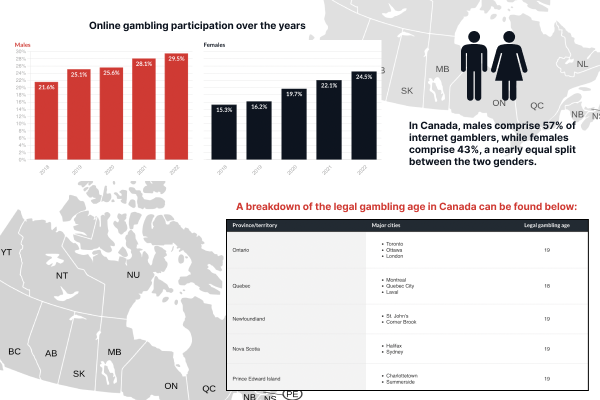
Gambling participation for both males and females has increased over the years, with the current player base comprising 57% males and 43% females. According to most Canadian gambling laws, the legal age of gambling in Canada is 19. The only exception to this lower limit rule are lotteries, some of which may accept any player 18 or above. This is also why almost 65% of Canadian gamblers place their bets on lottery tickets, and it is one of Canada's most popular forms of gambling.
On the other hand, in the Quebec, Alberta, and Winnipeg regions, the legal gambling age is 18. Winnipeg is also the first Canadian city where an in-person casino was opened back in 1989, which makes it highly significant for the Canadian gambling industry. The proliferation of casinos since those early years, combined with the advent of AI technology, is bringing more and more players and casino providers to the gambling scene every day, increasing the need for adequate gambling laws in Canada to be implemented in all provinces.
Authentic licensing is hands-down the most crucial element of running a casino, online or in-person. There are several renowned gambling licensing agencies throughout the country, which also ensure compliance with Canadian gambling laws, in addition to licensing casinos.
The Alberta Gaming, Liquor, and Cannabis Commission was first established in 1996 and is responsible for providing gambling licenses in Alberta. It only offers these licenses to religious and charitable organizations.
The Gaming Policy and Enforcement Branch of the Ministry of Finance regulates online gambling in British Columbia. The organization is responsible for upholding all standards within the gambling industry while mitigating risk and preventing money laundering.
In Manitoba, the Liquor Gaming and Cannabis Authority of Manitoba regulates all three activities. The organization has been around since the 1920s, but it was only in 2014 that liquor and gaming regulations were merged.
The New Brunswick Lotteries and Gaming Corporation regulates all casinos in the province per the Canadian online gambling laws set out in the Criminal Code. The organization was established in 2008, and the Canadian online gambling laws it follows are laid out in the Gaming Control Act.
In Ontario, the Alcohol and Gaming Commission of Ontario regulates the online gambling market, which was legalized in 2022. All the sites are closely monitored for integrity and player protection standards.
Like these entities, each province has its own gambling laws in Canada, which are regulated by authorities particular to that province. While there may be slight differences in the implemented laws, the bottom line is that all the authorities have the same goal - ensuring that the online gambling industry functions with the highest level of integrity.
Is gambling illegal in Canada? The answer to that depends on the province you’re in. Each province follows a different set of Canadian gambling laws, and the games offered nationwide can differ.
Alberta: Gambling became legal in Alberta in 1970, with the legal gambling age being 18. The Alberta Gaming, Liquor, and Cannabis Commission has regulated the industry since 1996.
British Columbia: The British Columbia Lottery Corporation regulates casinos, bingo, and horse racing in the province. The legal age is 19. British Columbia was the first Canadian province to introduce online gambling back in 2004.
Manitoba: The Liquor, Gaming and Cannabis Authority of Manitoba regulates Canadian online gambling laws in Manitoba, following a legal gambling age of 18.
New Brunswick: Gambling is regulated by the New Brunswick Lotteries and Gaming Corporation. The legal age is 19, and the Atlantic Lottery Corporation is the only legal online gambling provider.
Ontario: Online gambling became legal only in 2022 and is regulated by the Alcohol and Gaming Commission of Ontario. The legal age to play is 19, which is the most common one based on gambling laws in Canada throughout the country.
Quebec: Loto-Québec regulates online gambling in Quebec and has been doing so since 1969. 18 is the legal age to gamble, and players have the option to play lottery, bingo, as well as other games.
The other provinces have online gambling regulations that follow a similar pattern, with the legal age being 18 or 19.
As seen by recent trends, Canadian gambling laws permit the use of cryptocurrency within Canadian casinos. While some casino providers find it challenging to adopt cryptocurrency due to the difficulty in regulating it, every crypto casino in Canada follows the same rules as apply to brick-and-mortar casinos in the country. The concept of bitcoin gambling Canada is still new to many players but is widely accepted due to its hardcore advantages.
According to Canadian gambling laws, all online crypto gambling will be regulated by similar rules as are applied to traditional gambling. However, because most laws don’t explicitly reference gambling with Bitcoin or other cryptocurrencies, enforcement exists in a grey area and is complex.
Because there is no specific Bitcoin gambling protocol laid out within gambling laws in Canada, most players wonder if crypto gambling is even legal. The answer is yes. Any online casino with a proper license, obtained after delivering all required documents and fees, can adopt cryptocurrency as a method of transaction. The licensing requirements are the same as for any casino that utilizes traditional money.

For those who are put off by all the stringent gambling laws in Canada, the good news is that there is no tax on gambling winnings in Canada. In countries like the US, gambling winnings can be fully taxable; however, in Canada, the Canadian gambling laws recognize that because iGaming cannot be counted as a business transaction, there will be no taxes on gambling winnings in Canada. The only time a traditional or crypto casino in Canada will be levied with a Canadian gambling tax is when those winnings are received in the context of a business transaction.
Ever since people discovered that Canadian gambling laws permit the use of cryptocurrency, they have been searching for the best crypto casino in Canada. Here are some of the top ones:
IZZI Casino: IZZI Casino offers a selection of over 5,000 games, bonuses upon the first four deposits and an excellent range of banking options.
EnergyCasino: EnergyCasino is one of Canada's best casinos for crypto betting, offering a welcome bonus of up to C$200.
LV BET: LV BET is most known for its massive range of game providers, as well as its transparency, which is facilitated further by Bitcoin gambling Canada.
Cherry Spins Casino: Cherry Spins Casino has high withdrawal limits, which makes this casino a premium choice for many gambling enthusiasts.
HighRoller Casino: HighRoller Casino is a market leader in table games, providing multiple variations of roulette, blackjack, and baccarat, among others.
What types of cryptocurrencies are most commonly accepted in Canadian crypto casinos?
The most commonly accepted types of cryptocurrencies in Canadian Crypto Casinos include Bitcoin, Ethereum, Tether, Litecoin, etc., all permitted by Canadian gambling laws.
What is the future outlook for crypto casinos in Canada?
The future outlook for crypto casinos in Canada is brilliant, with more and more casinos adopting this mode of payment. Gambling laws in Canada ensure that the process is carried out smoothly.
What are the typical bonuses offered by crypto casinos in Canada?
The typical bonuses offered by crypto casinos in Canada include a welcome bonus, no deposit bonus, free spins bonus, multiplier bonus, etc.
The National Crowdfunding & Fintech Association (NCFA Canada) is a financial innovation ecosystem that provides education, market intelligence, industry stewardship, networking and funding opportunities and services to thousands of community members and works closely with industry, government, partners and affiliates to create a vibrant and innovative fintech and funding industry in Canada. Decentralized and distributed, NCFA is engaged with global stakeholders and helps incubate projects and investment in fintech, alternative finance, crowdfunding, peer-to-peer finance, payments, digital assets and tokens, artificial intelligence, blockchain, cryptocurrency, regtech, and insurtech sectors. Join Canada's Fintech & Funding Community today FREE! Or become a contributing member and get perks. For more information, please visit: www.ncfacanada.org
| | |
|---|---|---|
| | |
Fundraising | Dec 21, 2023

The "Capital for the Community" campaign by FrontFundr started on December 1st and ended on December 15th. This timeframe was specifically chosen for the campaign, focusing on a period of 15 days, which they referred to as the "15 Days of Christmas" During this period, FrontFundr committed to donating 2% of the value of all investments made in eligible community campaigns to Covenant House, a non-profit organization supporting youth experiencing homelessness. The campaign, a first of its kind, not only set a new precedent in community-focused investment but also illuminated the path for future endeavors in social impact investing.
The campaign's success story is one for the books. With an impressive completion of 133 investments, FrontFundr has injected $309,503 into promising companies, fostering growth and innovation. But the impact doesn't stop there.
The campaign also facilitated a generous donation of $4,390 to Covenant House Vancouver. Thanks to a triple matching campaign provided by the generosity of Kim and Bryan James, a total of $8,780 was collectively raised enabling Covenant House to:
Campaign funding was also provided to Covenant House Toronto. In Toronto, Frontfundr is collaborating with Kits for a Cause to assemble and provide essential kits for young people facing homelessness. These kits, thoughtfully curated with practical items, are designed to offer comfort and warmth during challenging times.
Take, for instance, the Winter Warmth Kit – it's packed with necessities like gloves or mittens, thermal socks, a polar fleece blanket, an emergency blanket, a cozy winter hat or toque, a fleece scarf, lip balm, body lotion, and a sleeping bag. Each item in these kits is carefully selected to provide maximum comfort and protection against the harsh winter elements.
As we edge closer to 2024, FrontFundr's message of gratitude resonates deeply within the community. This campaign was a collaborative effort with support from investors, entrepreneurs, partners, and the community at large.
The 'Capital for the Community' campaign is a pioneering model in social impact investing. By donating 2% of the value of all investments in eligible community campaigns, FrontFundr ensured that each investment not only supported a company but also contributed to a noble cause. This innovative approach has set a new standard in the intersection of business and social responsibility.
The collective support has been a lifeline, enabling Covenant House to offer meals, safe spaces, medical support, and warmth during harsh winters. The total impact of $8,780 is a testament to what can be achieved when compassion and investment go hand in hand.
As we applaud FrontFundr's remarkable achievements, let's also take this as a call to action. Let's be inspired to invest not just in businesses, but in communities, in people, and in our collective future. The 'Capital for the Community' campaign is a movement. A shift in how we perceive the power of investment. Let's carry this torch forward, illuminating paths of hope, change, and community solidarity.
The National Crowdfunding & Fintech Association (NCFA Canada) is a financial innovation ecosystem that provides education, market intelligence, industry stewardship, networking and funding opportunities and services to thousands of community members and works closely with industry, government, partners and affiliates to create a vibrant and innovative fintech and funding industry in Canada. Decentralized and distributed, NCFA is engaged with global stakeholders and helps incubate projects and investment in fintech, alternative finance, crowdfunding, peer-to-peer finance, payments, digital assets and tokens, artificial intelligence, blockchain, cryptocurrency, regtech, and insurtech sectors. Join Canada's Fintech & Funding Community today FREE! Or become a contributing member and get perks. For more information, please visit: www.ncfacanada.org
| | |
|---|---|---|
| | |
Accredited Investors | Dec 19, 2023

Image by freepic.diller on Freepik
This development is of great interest to the financial community, including Canadian investors and market participants.
Although the SEC is calling for public feedback, there is skepticism about the influence of public opinion on the final decision. For example, entities like the SEC Small Business Capital Formation Advisory Committee (SBCFAC) have repeatedly urged the Commission to broaden the definition, yet their recommendations have often been disregarded.
The current SEC leadership appears to favor a more regulated approach, potentially increasing the barriers to participating in private offerings. This stance contrasts with the public's desire for more inclusive investment opportunities.
This review, amidst debates over investor sophistication and market inclusivity, reflects a cautious regulatory approach that may heighten barriers to private market participation. Key considerations include the possible exclusion of retirement accounts in net worth assessments and adjustments of income and wealth thresholds for inflation. The outcome of this review will be crucial for investors and market participants, balancing the need for protection with the desire for broader investment opportunities.
The National Crowdfunding & Fintech Association (NCFA Canada) is a financial innovation ecosystem that provides education, market intelligence, industry stewardship, networking and funding opportunities and services to thousands of community members and works closely with industry, government, partners and affiliates to create a vibrant and innovative fintech and funding industry in Canada. Decentralized and distributed, NCFA is engaged with global stakeholders and helps incubate projects and investment in fintech, alternative finance, crowdfunding, peer-to-peer finance, payments, digital assets and tokens, artificial intelligence, blockchain, cryptocurrency, regtech, and insurtech sectors. Join Canada's Fintech & Funding Community today FREE! Or become a contributing member and get perks. For more information, please visit: www.ncfacanada.org
| | |
|---|---|---|
| | |



August 26th, 2025

January 4th, 2024

June 1st, 2021

September 9th, 2020

July 9th, 2018

January 3rd, 2018

September 25th, 2017

June 20th, 2017

May 10th, 2017

December 14th, 2016
