





Karsten Wenzlaff, Advisor
August 26th, 2025
Karsten Wenzlaff is a Crowdfunding and Fintech Expert from Germany. He is Secretary-General of Digit[...]


May 29, 2026 | NCFA Fintech Market Activity | Digital Assets Blockchain And Tokenization, Capital Markets And Market Infrastructure, Risk Compliance And Regtech
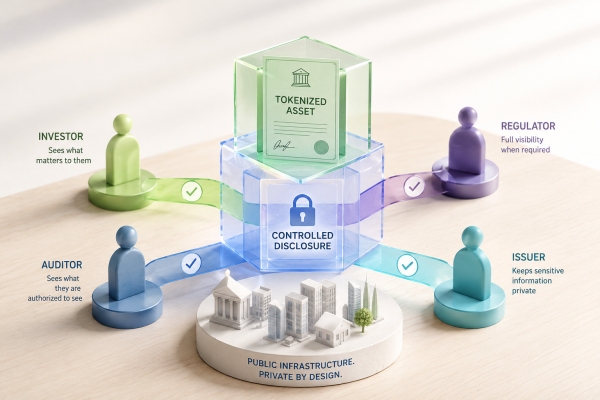
On May 27, 2026, Toronto based Polymath launched Confidential Assets on Polymesh, a protocol level privacy feature for tokenized securities and real world assets. It uses zero knowledge cryptography to keep transaction details private while preserving access for regulators, auditors, and authorized parties.
Privacy solves a practical market problem. Public blockchains can expose positions, client data, and transaction flows. Private chains can protect confidentiality, but they can also silo activity inside closed systems. Confidential Assets is Polymath aim to give regulated asset markets privacy without giving up public permissioned infrastructure.
Martin Halford, CEO, Polymath:
“The question the market has been asking is not whether assets can be tokenized -- they can. The question is whether tokenization can be done at an institutional scale, with the privacy and compliance standards that real financial infrastructure demands. Confidential Assets is our answer to that question.”
The stronger use case isn't about keeping secrets, but rather controlled disclosure. Issuers, investors, and asset managers need privacy around holdings and transfers. Yet a wide range of stakeholders from regulators to auditors, custodians, and compliance teams still need access when rules require it.
Confidential Assets is built into the Polymesh protocol, not added through a third party tool or Layer 2 solution. This allows privacy to work within the same system that handles compliance, governance, and settlement. A fund, private credit issuer, real estate platform, or broker dealer could use the feature to complete a compliant transfer without exposing position size or counterparty details to the broader market.
The ultimate goal and impact is the right mix of privacy and oversight. If Polymath gets that balance right, Confidential Assets could make Polymesh more useful for real capital markets activity, not just token issuance.
Confidential Assets is available immediately to institutions building on Polymesh. Polymath has been building regulated asset infrastructure since 2017 and contributed the ERC 1400 security token standard. Polymesh achieved SOC 2 Type 1 compliance in 2025. Polymath also says a post quantum ready version of Confidential Assets is in development for long term assets that may remain on chain for decades.
For Canadian capital markets and fintech firms, controlled disclosure is becoming core infrastructure for tokenized assets. Platforms that manage who can see what, and when, will become harder to replace in digital securities markets, over time.
Can tokenized markets reach institutional scale without protocol level privacy, or will controlled disclosure become a core requirement for regulated digital assets?
 The National Crowdfunding & Fintech Association (NCFA Canada) is a financial innovation ecosystem that provides education, market intelligence, industry stewardship, networking and funding opportunities and services to thousands of community members and works closely with industry, government, partners and affiliates to create a vibrant and innovative fintech and funding industry in Canada. Decentralized and distributed, NCFA is engaged with global stakeholders and helps incubate projects and investment in fintech, alternative finance, crowdfunding, peer-to-peer finance, payments, digital assets and tokens, artificial intelligence, blockchain, cryptocurrency, regtech, and insurtech sectors. Join Canada's Fintech & Funding Community today FREE! Or become a contributing member and get perks. For more information, please visit: www.ncfacanada.org
 |  |  |
|---|---|---|
 |  |  |
May 25, 2026 | NCFA Fintech Market Activity | Digital Assets Blockchain And Tokenization

On May 20, 2026, 3iQ selected Anchorage Digital as the infrastructure and custody partner for its Canadian product suite. Subject to regulatory approvals and required prospectus or offering document amendments, 3iQ intends to migrate a significant portion of assets under management across six TSX listed exchange traded products to Anchorage Digital.
3iQ is a Canadian digital asset investment manager with a regulated public product suite. Anchorage Digital became the first OCC approved national crypto bank in the U.S. Canada has qualified digital asset custodians, but not an equivalent national crypto bank structure at Anchorage’s scale. The decision puts a hard question in front of Canada’s digital asset sector. Can Canadian infrastructure win large institutional mandates when issuers need custody, settlement, staking support, and regulatory comfort at scale?
The warning is now showing up in market activity. Canada has already debated whether domestic digital asset infrastructure can compete with larger U.S. regulated platforms. That issue became more visible when Balance applied for a Canadian special purpose trust structure to build institutional digital asset custody capacity at home.
If Canada approves digital asset products but doesn't build trusted infrastructure at home, more of the work, jobs, and revenue may migrate south. In this case, 3iQ keeps the Canadian listed products while Anchorage Digital captures more of the custody and infrastructure work behind them.
That choice is commercial, not patriotic. Large issuers choose the stack that lowers operating risk and helps them launch better products. That’s the reality test Canadian infrastructure providers now face.
3iQ says Anchorage Digital lets funds settle trades from cold storage without relying on hot wallets. Its Atlas network also lets 3iQ settle directly with trading counterparties and remove extra wallet steps. It means custody now affects much more than safekeeping. It affects how funds trade, settle, manage risk, support staking, and protect investors.
The partnership is also expected to support 3iQ’s expanded staking capabilities. That raises the stakes. Staking needs more than token custody. It needs validator access, clean reporting, strong controls, and regulatory comfort. The right custody partner can give a fund more room to build. The wrong one can hold it back.
Tommaso Mancuso, President and CIO of 3iQ:
"3iQ needs infrastructure providers that meet “the highest standards for security, flexibility, and regulatory alignment.”
That is the standard Canadian infrastructure has to meet now. Canada has digital asset talent, regulated products, custody ambition, and a real institutional market. But the operating stack behind those products still needs more depth, if they want to compete. Fund issuers need platforms that can handle scale, connect cleanly to trading counterparties, support approved product features, and satisfy regulators without adding friction.
Canadian policymakers should treat this as a competitiveness warning. Product approvals aren't enough if the custody, settlement, staking, and fund operations work scales outside Canada. The goal should be to keep more trusted digital asset infrastructure, jobs, and revenue at home.
The National Crowdfunding & Fintech Association (NCFA Canada) is a financial innovation ecosystem that provides education, market intelligence, industry stewardship, networking and funding opportunities and services to thousands of community members and works closely with industry, government, partners and affiliates to create a vibrant and innovative fintech and funding industry in Canada. Decentralized and distributed, NCFA is engaged with global stakeholders and helps incubate projects and investment in fintech, alternative finance, crowdfunding, peer-to-peer finance, payments, digital assets and tokens, artificial intelligence, blockchain, cryptocurrency, regtech, and insurtech sectors. Join Canada's Fintech & Funding Community today FREE! Or become a contributing member and get perks. For more information, please visit: www.ncfacanada.org
| | |
|---|---|---|
| | |
May 22, 2026 | NCFA Fintech Market Activity | Digital Assets Blockchain And Tokenization, Payments And Money Movement

On May 21, 2026, Montreal based Shakepay opened the waitlist for its physical Shakepay Visa Prepaid Card and launched a 21 day campaign that turns everyday card payments into bitcoin rewards for customers and participating local businesses. The campaign builds on Shakepay’s Virtual Card, which the company says thousands of Canadians already use every week to earn bitcoin rewards on purchases.
Here’s how it works. Customers tap the Virtual Shakepay Card in store and earn points toward early access to the physical card. Those payments can also place local businesses on Shakepay’s campaign map. Businesses that sign up for Shakepay for Business during the campaign can claim bitcoin rewards after verification.
Shakepay is using rewards, merchants, and local campaign mechanics to push bitcoin into daily payment behaviour without asking customers or businesses to use bitcoin at checkout.
Jean Amiouny, CEO, Shakepay:
“Most rewards programs give people points they can only use inside someone else's system. We think Canadians should be able to earn an asset they can actually own,”
Shakepay is reframing rewards around ownership. Customers spend from their cash balance and earn rewards paid in bitcoin. That differs from closed loyalty points, which usually keep value inside one retailer, issuer, or rewards system.
Small businesses can explore bitcoin reserves without rebuilding payment acceptance or asking customers to pay with crypto. The bitcoin reward is tied to campaign activity and business onboarding, not direct bitcoin checkout.
The top 21,000 customers on the waitlist will receive early access to the physical card. The top 2,100 will be eligible for a Launch Edition card engraved with their waitlist rank. That gamified structure gives Shakepay a way to measure demand before full rollout.
The company says it helps more than 1.5 million Canadians access and use bitcoin through everyday financial products. Shakepay is a CIRO member, an Investment Dealer registered with the AMF, and a FINTRAC registered Money Service Business. They also recently became a member of Payments Canada. The Shakepay Visa Prepaid Card is issued by Peoples Trust Company under licence from Visa International Service Association.
Shakepay is testing whether bitcoin rewards can become a daily payments wedge in Canada. If the model works, bitcoin doesn't need to replace card rails to gain utility. It can ride on top of card spending, rewards, and small business treasury behaviour.
Will bitcoin adoption in Canada grow through direct crypto payments, or through familiar card and rewards products that make bitcoin part of everyday spending?
The National Crowdfunding & Fintech Association (NCFA Canada) is a financial innovation ecosystem that provides education, market intelligence, industry stewardship, networking and funding opportunities and services to thousands of community members and works closely with industry, government, partners and affiliates to create a vibrant and innovative fintech and funding industry in Canada. Decentralized and distributed, NCFA is engaged with global stakeholders and helps incubate projects and investment in fintech, alternative finance, crowdfunding, peer-to-peer finance, payments, digital assets and tokens, artificial intelligence, blockchain, cryptocurrency, regtech, and insurtech sectors. Join Canada's Fintech & Funding Community today FREE! Or become a contributing member and get perks. For more information, please visit: www.ncfacanada.org
| | |
|---|---|---|
| | |
May 22, 2026 | NCFA Fintech Market Activity | Digital Assets Blockchain And Tokenization, Payments And Money Movement, Capital Markets And Market Infrastructure

On May 21, 2026, Toronto based Cycles raised $6.4 million to build an open, privacy preserving clearing network for crypto markets and stablecoin payments. Blockchange Ventures led the round, with participation from Coinbase Ventures, Compound VC, Primitive Ventures, and angel investors. The round brings Cycles’ total funding to $8.7 million, following a $2.3 million pre seed in 2025.
Cycles is targeting one of the least glamorous but most important parts of financial infrastructure: clearing. In traditional markets, clearing reduces how much money has to move between counterparties by offsetting obligations first. Cycles wants to bring that function to on chain finance, where trading and payment flows still often require too much prefunding and too much gross settlement.
The first institutional product is Cycles Prime, which lets trading firms privately net OTC obligations across the network. Cycles says this can reduce liquidity requirements and counterparty exposure without requiring collateral, asset movement, or a change in counterparties. Cycles Prime is launching with Lynq and FalconX as anchor partners.
Ethan Buchman, Co Founder and CEO, Cycles:
“Clearing is a financial superpower that has historically only been available to large financial institutions,”
Without clearing, firms often move full payments back and forth instead of only settling the difference. That ties up capital and can increase risk when markets move quickly.
The release points to October 10, 2025, when more than $19 billion in crypto leverage was liquidated in roughly one day, with 70% of forced liquidations occurring in just 40 minutes. Cycles uses that event to show why capital efficiency matters. When markets rely on gross settlement and heavy prefunding, stress can move fast.
Cycles is betting that multilateral clearing can reduce that pressure. Meaning, many obligations can be matched against each other so less money has to move. If it works, trading firms may keep less idle capital parked across venues and counterparties.
The second product is Cycles Pay, a stablecoin payments app for individuals and businesses. Payments are routed through Cycles’ clearing engine, which nets obligations across participants to minimize capital movement. The product also includes invoicing and expense management with credit planned.
Stablecoins already help move value across networks. Clearing can make those flows more capital efficient. For businesses, the value isn't only faster payment. It's fewer trapped balances, better cash flow, and more private settlement.
Rob Schmults, General Partner at Blockchange Ventures:
"Clearing is the cornerstone of capital-efficient markets like foreign exchange allowing the movement of massive volumes of value without crippling liquidity requirements. We see Cycles providing an essential coordination layer to bring the efficiency and effectiveness of clearing to new markets. Doing this will allow businesses to clear and settle payments privately, optimize capital flow, and reduce the need for idle capital. As global adoption accelerates, Cycles can become a category defining standard for how value is settled and netted across entire ecosystems and markets."
If stablecoins are becoming payment rails, will clearing become the missing layer that turns on chain settlement from fast movement into capital efficient market infrastructure?
The National Crowdfunding & Fintech Association (NCFA Canada) is a financial innovation ecosystem that provides education, market intelligence, industry stewardship, networking and funding opportunities and services to thousands of community members and works closely with industry, government, partners and affiliates to create a vibrant and innovative fintech and funding industry in Canada. Decentralized and distributed, NCFA is engaged with global stakeholders and helps incubate projects and investment in fintech, alternative finance, crowdfunding, peer-to-peer finance, payments, digital assets and tokens, artificial intelligence, blockchain, cryptocurrency, regtech, and insurtech sectors. Join Canada's Fintech & Funding Community today FREE! Or become a contributing member and get perks. For more information, please visit: www.ncfacanada.org
| | |
|---|---|---|
| | |
May 21, 2026 | NCFA Fintech Market Activity | Artificial Intelligence And Data, Risk Compliance And Regtech, Banking And Credit Infrastructure

On May 20, 2026, National Bank of Canada partnered with Sardine to strengthen digital banking security and improve fraud operations. National Bank selected Sardine after a live evaluation where the platform improved fraud detection and reduced false positives.
The bank will deploy Sardine’s device intelligence and real time risk scoring across retail, commercial, and wealth solutions. Fraud controls are no longer only a back office defense. They now also affect onboarding, payment approvals, customer friction, and trust across the full digital banking relationship. National Bank serves approximately 2.7 million clients globally and reported $606 billion in assets as at January 31, 2026.
National Bank is also leading a $25 million Series C extension in Sardine, bringing Sardine’s total funding to $170 million. That makes this a commercial partnership with one of Canada’s six systemically important banks.
Soups Ranjan, CEO and co-founder of Sardine:
“Sardine was built for banks that need to stop fraud without slowing down their loyal customers,”
Banks need to stop attacks without blocking good customers. False positives creates unwanted friction, cost, abandoned journeys, and damages trust. Sardine’s platform combines device intelligence, real time risk scoring, fraud controls, and financial crime automation.
It also uses a fraud consortium, a shared risk network built from activity across many customers and channels. That network spans more than 6 billion profiled devices, 800 million consumers, and 3 million businesses worldwide. For banks, outside risk data can help spot suspicious behaviour faster than internal data alone.
Fraud infrastructure is evolving from rule based screening toward live risk decisions across the customer journey. The optimum systems will reduce losses without punishing legitimate customers.
Sardine describes itself as an agentic risk platform for fighting financial crime. That means software that helps risk teams detect fraud, score behaviour, and automate parts of fraud and AML operations. National Bank’s release also references agentic AI in the risk and compliance sector.
The need for AI in banking is now well beyond customer service chatbots and internal productivity tools. Some of the strongest use cases are within risk operations, where firms need speed, evidence, and better decisions under pressure.
Joshuah Lebacq, Partner, NAventures, National Bank of Canada's corporate venture capital arm:
“After closely following Sardine’s growth and hearing strong feedback from existing customers, we decided to conduct an extensive evaluation of their platform. The results gave us confidence to make Sardine a strong addition to our financial crime prevention operations and expand our commercial relationship.
We’re excited about the potential of agentic AI, especially in the risk and compliance sphere, and Sardine’s financial crime agents are setting the standard for the category,”
The release didn't disclosure any loss reduction or false positive reduction rates from their evaluation, so keep your eyes out for those metrics in the future.
As AI driven fraud systems enter deeper into banking, will the best institutions win by blocking more bad actors, or by approving more good customers with less friction?
The National Crowdfunding & Fintech Association (NCFA Canada) is a financial innovation ecosystem that provides education, market intelligence, industry stewardship, networking and funding opportunities and services to thousands of community members and works closely with industry, government, partners and affiliates to create a vibrant and innovative fintech and funding industry in Canada. Decentralized and distributed, NCFA is engaged with global stakeholders and helps incubate projects and investment in fintech, alternative finance, crowdfunding, peer-to-peer finance, payments, digital assets and tokens, artificial intelligence, blockchain, cryptocurrency, regtech, and insurtech sectors. Join Canada's Fintech & Funding Community today FREE! Or become a contributing member and get perks. For more information, please visit: www.ncfacanada.org
| | |
|---|---|---|
| | |
May 21, 2026 | NCFA Insight | Capital Markets And Market Infrastructure, Digital Assets Blockchain And Tokenization

On May 19, 2026, Polymarket launched prediction markets tied to private company milestones, using Nasdaq Private Market data to resolve the contracts. Users can trade on events such as valuation milestones, IPO timing, and secondary market activity.
This isn't a gamble on private company ownership, since traders don't get shares, voting or information rights, or access to a company’s cap table. They get a tradable contract with a public price that reflects the market’s view of whether a specific private company event will happen. While the product doesn't open up private equity to everyone. It enables the public to take odds around private market outcomes.
Nasdaq Private Market says nearly 1,600 global unicorns now hold more than USD $5 trillion in combined value, while access remains mostly limited to institutions and high net worth investors. Private markets keep getting larger. Public visibility still lags.
Shayne Coplan, Founder and CEO, Polymarket:
“Prediction markets are one of the most powerful tools we have for democratizing access to financial information and opportunity.”
Private market pricing often arrives late. A funding round may show what investors paid albeit months ago. A tender may show one clearing point for one group of sellers. A secondary trade may reflect scarcity, transfer limits, or a specific share class. But the fact is none of those inputs gives the public a continuous read on what people think will happen next.
A contract price shows the market’s view of a future event, not the company’s fair value. If a contract trades near 70 cents, traders are roughly pricing a 70% chance that the event occurs. That doesn't necessarily make the odds right, but it makes the belief visible.
That in itself could move the needle for founders, employees, late stage investors, secondaries desks, and allocators. A live probability can show:
The Nasdaq Private Market (NPM) brings private market data from primary and secondary market activity, which gives the contracts a stronger reference point than rumours, social posts, or loose valuation chatter.
NPM also brings scale, and with that trust. The company says it's executed nearly USD $80 billion in secondary liquidity for more than 200,000 eligible employee shareholders and investors across more than 1,000 company sponsored liquidity programs. It's an important point because typically private market data is thin and opaque:
Prediction odds will be strongest where the underlying data is deep, current, and easy to verify. Or as Tom Callahan, CEO, Nasdaq Private Market puts it, “When retail participants enter any market, high-integrity data matters.”
This product could make private valuations harder to ignore and harder to defend. If a company carries a high valuation but prediction odds show weak confidence in a future valuation milestone, investors begin to lose confidence or ask sharper questions. If odds move right after a fundraise, product launch, regulatory event, or IPO rumour, the market gets a faster read on sentiment.
Secondaries may feel the effect first.
Prediction market odds don't replace diligence. But they add a public probability signal to a market that still depends on financials, contracts, board materials, customer data, and negotiated access.
One of the risks of course is a false signal. A small market can falsely produce a strong probability that rests on weak liquidity. A contract price may reflect a few motivated traders, not a deep view of private company value.
Information gaps also matter. Employees, early investors, brokers, lawyers, customers, and suppliers may know more than the public. As private company prediction markets grow, market integrity will become a bigger issue. Volume, open interest, spreads, trader concentration, and resolution rules will matter as much as the headline odds.
Regulators will be watching. These contracts straddle several policy lines at once, such as derivatives, gambling, securities, consumer protection, and private company information. The more these odds affect private market behaviour, the more scrutiny they will attract.
The strongest use case is private market intelligence. Prediction odds could augment traditional signals, such as secondary market data, valuations and company reported events. Together, the combined inputs may give investors a better view of timing, sentiment, and confidence before an IPO or liquidity event.
Private market infrastructure is becoming more transparent and data driven. Platforms that help investors understand price, risk, liquidity, and timing will have an advantage.
For founders, it adds a new pressure point to manage. Once the public can trade on company milestones, valuation becomes a public narrative before a public listing. That can create attention. It can also expose weak communication, inflated expectations, or a gap between private marks and public belief.
Bottom line: More companies are staying private longer, and more value is being created before public investors can participate. Prediction markets won't fix access on their own. But they may push the market toward better pricing tools, cleaner data, and more honest conversations about private company value.
If the odds become liquid enough, will private marks start answering to public probability signals?
The National Crowdfunding & Fintech Association (NCFA Canada) is a financial innovation ecosystem that provides education, market intelligence, industry stewardship, networking and funding opportunities and services to thousands of community members and works closely with industry, government, partners and affiliates to create a vibrant and innovative fintech and funding industry in Canada. Decentralized and distributed, NCFA is engaged with global stakeholders and helps incubate projects and investment in fintech, alternative finance, crowdfunding, peer-to-peer finance, payments, digital assets and tokens, artificial intelligence, blockchain, cryptocurrency, regtech, and insurtech sectors. Join Canada's Fintech & Funding Community today FREE! Or become a contributing member and get perks. For more information, please visit: www.ncfacanada.org
| | |
|---|---|---|
| | |
May 19, 2026 | NCFA Fintech Market Activity | SME Finance And Business Banking, Capital Markets And Funding

On May 19, 2026, Toronto founded fintech scaleup Relay secured $50 million in growth financing from General Catalyst’s Customer Value Fund. Relay serves U.S. small businesses with banking and money management tools. The financing is meant to accelerate customer acquisition while Relay keeps existing investment focused on product development.
Relay now supports more than 150,000 small business customers and oversees more than $1.3 billion in managed customer deposits through Thread Bank, Member FDIC. Since its $32.2 million Series B in May 2024, Relay says it is on track to grow revenue by 3.2x by the end of 2026.
The funding isn't a traditional equity round, since the General Catalyst’s Customer Value Fund gives Relay capital for customer acquisition. That lets the company spend on growth without pulling the same dollars away from product, compliance, support, and reliability.
Yoseph West, Co Founder and CEO, Relay:
“Every dollar invested in Relay supports passionate folks who work hard to build their businesses and realize their ambitions. This investment is a vote of confidence in the true value we deliver to those self-made entrepreneurs, so they can put every dollar to work,”
Relay already has customer scale, deposit traction, and a clear revenue growth target. The investor question is whether paid acquisition can keep working as Relay expands its brand footprint in the U.S. small business market?
Growth can damage a financial product if the operating base isn't ready. Small businesses need stable banking access, clear cash flow views, reliable support, and simple money movement. If acquisition gets ahead of service quality, trust can break quickly.
Andrew Ziperski, Partner, General Catalyst, Customer Value Fund:
“Relay has proven its deep understanding of what small business owners actually need to succeed, with a product that clearly resonates based on the strength of its customer acquisition machine.”
Relay is trying to own more of the small business finance workflow, not just the bank account. Its platform brings together accounts, cards, bills, invoices, capital, and other money tools. That gives owners a clearer view of cash coming in, cash going out, and what they can safely spend.
Recent product activity supports that strategy. Relay’s site now highlights receivables tools for invoices and payments, while its support pages show invoice tracking, accepted payment options, automatic reminders, and recurring invoices. Relay has also added Relay Capital term loans, offering small business lending alongside the same platform where owners already manage money.
That's where SMB banking is heading. Cash flow clarity helps them decide when to pay bills, hire, buy inventory, chase receivables, or seek financing. Relay’s strategy is to turn that daily operating pressure into the product.
Important caveat is that Relay's a financial technology company, not an FDIC insured bank. Banking services not related to Relay Capital term loans are provided by Thread Bank, Member FDIC.
Relay Capital term loans are provided through Fundbox, with business loans originated by Lead Bank. That partner model is common in U.S. fintech, but it puts pressure on compliance, disclosures, customer experience, and operational control.
SMB finance remains a large market, but the winning product is no longer just an account. It's the operating system that helps owners see cash, move money, access capital, and make faster decisions when conditions get messy.
If customer acquisition can be funded separately from core product investment, do stronger platforms gain an edge by scaling distribution without weakening banking reliability, support, and product depth?
The National Crowdfunding & Fintech Association (NCFA Canada) is a financial innovation ecosystem that provides education, market intelligence, industry stewardship, networking and funding opportunities and services to thousands of community members and works closely with industry, government, partners and affiliates to create a vibrant and innovative fintech and funding industry in Canada. Decentralized and distributed, NCFA is engaged with global stakeholders and helps incubate projects and investment in fintech, alternative finance, crowdfunding, peer-to-peer finance, payments, digital assets and tokens, artificial intelligence, blockchain, cryptocurrency, regtech, and insurtech sectors. Join Canada's Fintech & Funding Community today FREE! Or become a contributing member and get perks. For more information, please visit: www.ncfacanada.org
| | |
|---|---|---|
| | |



August 26th, 2025

January 4th, 2024

June 1st, 2021

September 9th, 2020

July 9th, 2018

January 3rd, 2018

September 25th, 2017

June 20th, 2017

May 10th, 2017

December 14th, 2016
