




Karsten Wenzlaff, Advisor
August 26th, 2025
Karsten Wenzlaff is a Crowdfunding and Fintech Expert from Germany. He is Secretary-General of Digit[...]


Feb 23, 2026 | NCFA Market Activity | DAOs

On February 22 2026, Jupiter DAO closes the Net Zero Emissions option vote, moving JUP toward a supply tightening direction and a buyback first treasury posture. On chain reporting shows about 75% support for the Net Zero Emissions option and states the vote concluded at 7:00 PM ET. During the voting window, on chain analysis reports more than 24.5k votes recorded within the first 48 hours, with more than 13k individual voters backing the Proceed with Jupuary option by raw voter count, while the Net Zero Emissions option leads by voting weight at more than 73.9% during that same early period, on a voting distribution analysis that breaks down wallet counts and voting weight.
The proposal says net new emissions move from about 1.2B JUP to effectively zero, if the DAO approves the package. The proposal also states it postpones Jupuary and returns 700M tokens to the Community Cold Multisig, and it states Jupiter routes 50% of on chain revenues to open market buybacks. Jupiter already burns 3B tokens and it states founders lock tokens, including a founder lock to 2030.
Legacy allocations shape why the DAO focuses on offsets. On chain analysis reports Mercurial stakeholders receive 5% of total supply or 350m tokens, with about 182m vested by February 2026 and 168m remaining to unlock, also on the voting distribution analysis that quantifies the Mercurial allocation and vesting status.
Maker uses surplus auctions where the system auctions surplus Dai for MKR and then burns the MKR received from the winning bid, which contracts MKR supply, as described in Maker Protocol documentation on the Flapper surplus auction mechanism.
Aave documentation states the Aave DAO operates a buyback program funded by protocol revenue with a $50 million annual budget and weekly purchases that range from $250,000 to $1.75 million, with tokens sent to the DAO Ecosystem Reserve rather than burned, on Aave protocol documentation describing the buyback program budget and execution.
The proposal turns token governance into capital policy that stakeholders can measure. It targets a defined dilution outcome by moving net new emissions from about 1.2B JUP to effectively zero, and it pairs that supply stance with a stated rule that routes 50% of on chain revenues to buybacks. That combination gives the market a simple scoreboard, emissions near zero plus ongoing buy pressure funded by revenue, not inflation.
Early vote analysis shows more than 24.5k votes within 48 hours and it shows a divergence where the Jupuary option leads by raw voter count while Net Zero Emissions leads by voting weight. Token weighted voting aligns outcomes with economic exposure, but it can widen the gap between how many people show up and who decides. Fintech builders can reduce that gap with delegation tooling, transparent quorum logic, and reporting practices that make governance outcomes feel earned.
Offsets move sell pressure from the open market to treasury management. The proposal describes a treasury approach that aims to neutralize known future sell flows tied to vesting and distribution decisions, which creates a new execution test, the treasury must manage price, timing, and credibility in public. That's the same category of operational accountability that capital markets packaging requires.
Canada adds a practical lens because Canadian fintechs increasingly package products for institutional distribution where buyers demand explicit mechanics and predictable governance. Ledn’s Bitcoin backed ABS deal entering institutional markets shows how an institutional wrapper forces defined rules and clear investor expectations. Tokenized finance teams can apply that same discipline to emissions rules, treasury authority, and public reporting so partners can underwrite the model rather than debate it.
If a token stops emitting, who pays for growth and liquidity next, users through fees, builders through treasury, or the market through higher risk premiums?
 The National Crowdfunding & Fintech Association (NCFA Canada) is a financial innovation ecosystem that provides education, market intelligence, industry stewardship, networking and funding opportunities and services to thousands of community members and works closely with industry, government, partners and affiliates to create a vibrant and innovative fintech and funding industry in Canada. Decentralized and distributed, NCFA is engaged with global stakeholders and helps incubate projects and investment in fintech, alternative finance, crowdfunding, peer-to-peer finance, payments, digital assets and tokens, artificial intelligence, blockchain, cryptocurrency, regtech, and insurtech sectors. Join Canada's Fintech & Funding Community today FREE! Or become a contributing member and get perks. For more information, please visit: www.ncfacanada.org
 |  |  |
|---|---|---|
 |  |  |
February 23, 2026 | NCFA Market Activity | Artificial Intelligence And Data

On February 21, 2026, B.C.’s premier says police are pursuing preservation orders for potential evidence held by digital services companies, including social media platforms and AI companies, after media reports tied OpenAI to the case. This isn't a new fintech policy just yet, but it puts evidence readiness into the open. If a partner asks what you can preserve and produce under lawful process, you can’t appear like a 'deer in headlights'. You need a working path.
BC Government, Office of the Premier, Media Relations:
“Reports that allege OpenAI had related intelligence before the shootings in Tumbler Ridge took place are profoundly disturbing for the victims’ families and all British Columbians. We will use all powers of government to ensure that police have the tools they need to investigate every aspect of this horrific tragedy.”
RCMP report said that the active shooter call came in at about 1:20 p.m. on February 10 and the public alert ended at 5:45 p.m. Six victims were found deceased inside the school, two victims were airlifted with serious or life threatening injuries, a third victim died during transport, and about 25 others were assessed for non life threatening injuries. RCMP also reports two additional victims were found deceased at a connected residence.
On February 13, RCMP reports more than 80 interviews took place with students, educators, and first responders, while forensic teams continued processing two scenes and a vehicle connected to the suspect. The investigative update also reported digital evidence work including witness images and videos, CCTV, and body worn camera video, and it says RCMP launched an online portal to collect more evidence, including phone footage captured inside the school.
In a BBC report, OpenAI spokesperson said that they didn't alert authorities about the account because its usage didn't meet its threshold of credible or imminent plan for serious physical harm to others...
"In June 2025, we proactively identified an account associated with this individual [Jesse Van Rootselaar] via our abuse detection and enforcement efforts, which include automated tools and human investigations to identify misuses of our models in furtherance of violent activities."
Evan Solomon, Minister of Artificial Intelligence and Digital Innovation per Globe and Mail reporting:
"Canadians expect online platforms, including OpenAI, to have robust safety protocols and escalation practices in place to protect online safety and ensure law enforcement are warned about potential violence,"
This story turns AI governance into an evidence workflow. If your product runs AI in onboarding, fraud triage, collections, or support, partners need clear answers on what the system records, what it retains, who can access it, and how the team preserves and produces records under lawful process without breaking integrity. A stakeholder may accept model error but they won’t accept uncertainty about records, access, and escalation ownership when scrutiny rises.
Financial technology companies should define escalation triggers in plain language. Name an accountable owner and a backup. Restrict log access. Set retention windows you can defend. Test a short runbook for preservation and production so the team can execute it without debate when the question lands, an be sure to provide suitable ongoing training.
If preservation orders become a more common tool when AI enters an incident, does Canada need a shared baseline for AI logging, retention, and escalation handoffs so every regulated buyer does not rebuild the same checklist from scratch?
Reuters reported that OpenAI reps have been summoned to Ottawa urgently to discuss AI safety.
Update per CTV article: Following the meeting in Ottawa with OpenAI safety leaders, federal officials said they were “deeply disturbed” and ultimately “disappointed” that warning signals tied to the Tumbler Ridge shooter were not escalated to police earlier, with AI Minister Evan Solomon stressing Canadians expect platforms to maintain “robust safety protocols and escalation practices.” OpenAI is cooperating with the RCMP but produced no immediate new safeguards, leaving ministers to seek concrete follow-up proposals.
The National Crowdfunding & Fintech Association (NCFA Canada) is a financial innovation ecosystem that provides education, market intelligence, industry stewardship, networking and funding opportunities and services to thousands of community members and works closely with industry, government, partners and affiliates to create a vibrant and innovative fintech and funding industry in Canada. Decentralized and distributed, NCFA is engaged with global stakeholders and helps incubate projects and investment in fintech, alternative finance, crowdfunding, peer-to-peer finance, payments, digital assets and tokens, artificial intelligence, blockchain, cryptocurrency, regtech, and insurtech sectors. Join Canada's Fintech & Funding Community today FREE! Or become a contributing member and get perks. For more information, please visit: www.ncfacanada.org
| | |
|---|---|---|
| | |
Feb 23, 2026 | NCFA Fintech Market Activity | Digital Assets Blockchain And Tokenization

On February 20 2026, Ledn announced the first ever investment grade asset backed securities transaction in the digital asset industry, placing Bitcoin secured consumer loans into a capital markets format designed for institutional fixed income buyers.
Reporting on presale ratings and collateral detail indicates the transaction totalled about $188M and referenced a collateral pool of 5,441 Bitcoin backed consumer loans secured by 4,078.87 Bitcoin with an aggregate presale collateral value near $330M. S&P Global Ratings assigned preliminary ratings to two tranches, signalling that crypto secured loan performance can be assessed within traditional credit frameworks.
An asset backed security (ABS) pools loans and converts expected borrower payments into tradable bonds. In this structure, the underlying assets are Bitcoin collateralized consumer loans, which places operational emphasis on custody safeguards, liquidation triggers, valuation discipline, and reporting transparency.
For additional background on how crypto backed loans operate at the borrower level, this Fintech Fridays episode, Bitcoin backed loans and putting your crypto to work, provides context with Ledn Co-founder Mauricio Di Bartolomeo.
The Ledn issuance positions securitization as a funding diversification path. Instead of relying only on balance sheet capital or warehouse facilities, loan originators can distribute credit risk to bond investors, expanding lending capacity without requiring traditional bank balance sheet support.
Structure changes market access. A crypto lending desk can fund loans directly, but a rated ABS wrapper introduces buyers who operate under fixed income mandates and portfolio risk frameworks. That development moves crypto secured credit closer to mainstream credit market infrastructure.
The transaction also reinforces operational expectations. Securitization forces clarity around collateral custody, margin maintenance, liquidation speed, valuation timing, and stress scenario performance. If these controls prove reliable in market cycles, securitized crypto credit could evolve into a recognized institutional allocation sleeve.
Ledn represents a Canadian founded crypto finance platform now operating globally. Prior milestones include Tether investing in Ledn to expand crypto credit access and Ledn receiving VASP regulatory approval in the Cayman Islands, which together strengthen its institutional positioning and reporting posture.
If institutional investors begin treating crypto secured ABS pools as a defined allocation sleeve, Canadian originated platforms that demonstrate transparent collateral management and disciplined underwriting could gain access to funding channels that operate beyond domestic banking constraints.
If securitized crypto credit continues to mature, the competitive edge may hinge less on yield and more on collateral governance, transparency, and investor distribution relationships.
Crypto secured lending is beginning to compete not only on returns, but on structure, reporting discipline, and institutional investability.
The National Crowdfunding & Fintech Association (NCFA Canada) is a financial innovation ecosystem that provides education, market intelligence, industry stewardship, networking and funding opportunities and services to thousands of community members and works closely with industry, government, partners and affiliates to create a vibrant and innovative fintech and funding industry in Canada. Decentralized and distributed, NCFA is engaged with global stakeholders and helps incubate projects and investment in fintech, alternative finance, crowdfunding, peer-to-peer finance, payments, digital assets and tokens, artificial intelligence, blockchain, cryptocurrency, regtech, and insurtech sectors. Join Canada's Fintech & Funding Community today FREE! Or become a contributing member and get perks. For more information, please visit: www.ncfacanada.org
| | |
|---|---|---|
| | |
February 20, 2026 | NCFA Fintech Whisperer Weekly Intelligence | Regulation And Policy, Artificial Intelligence And Data, Payments And Money Movement, Digital Assets Blockchain And Tokenization, Risk Compliance And Regtech

Image: Freepik
This live weekly NCFA intelligence page tracks financial technology developments that significantly affect how fintechs build, sell, raise capital, and operate under scrutiny. Coverage prioritizes Canada and includes global events that directly influence competitive conditions, market access, and execution realities across fintech sectors. This page will be updated throughout the week with market movers in a live format and then each week we'll close the prior week's contents in prep for the upcoming week, and continue on a rolling basis. (Missed prior week's Fintech Whisperer? (December 6-12, 2025, December 13-19, 2025, January 1-9, 2026, January 10-16, 2026, January 17-23, 2026, January 24-30, 2026, January 31-February 6, 2026, February 7-13, 2026).
This is a procurement and capital boost for defence not seen in decades. Fintechs that help defence suppliers get paid faster, manage cash under milestone contracts, and prove tight controls on funds and data have a generational opportunity with real distribution next quarter. See defence push: Montreal joins provincial bids for global DSR bank platform
This is a money and proof moment for insurtech. Founders selling automation into carriers and brokers should expect buyers to ask for hard baseline metrics, verified before and after results, and fast integration plans this quarter because the market now funds teams that tie automation to combined ratio math and measurable cost takeout.
The UK is embedding crypto firms inside the existing Financial Services and Markets Act framework used for banks, investment firms, and other regulated financial institutions. Firms will likely need stronger governance, clearer business models, defined senior management accountability, and enough financial resources to pass a full authorisation assessment. This tends to favour well capitalized firms that can build institutional grade compliance and risk management from the start.
Tariff volatility shouldn't come as a surprise to anyone and still important to note that this does not take tariffs off the table. Founders and investors should assume trade cost risk still moves through other statutes and policy tools, so the teams that win next quarter make cash forecasting, FX, and settlement controls easier to run when pricing and demand change overnight.
This locks in the timeline banks plan around. Founders selling credit, underwriting, treasury, capital markets, or risk tooling into federally regulated institutions should expect earlier capital impact questions and tighter evidence requests in the next quarter because partners align product decisions to November 2026 and January 2027 effective dates long before final publication.
BoC's action should put every payments and wallet provider on notice. Partners should ask sharper questions about where customer funds sit, who controls access, how fast you can prove balances, and how you recover when something breaks. Teams that can answer those questions with evidence keep distribution moving when scrutiny rises. Feb 27, 2026 Update: The Bank of Canada issues a revised order that allows XTM to resume retail payment activities under court supervised monitoring (a controlled restart).
This can open practical opportunities into German buyers and programs, but only for teams that can pass strict security and governance reviews. Fintechs using AI should expect tougher diligence on where models run, how data moves, how vendors get controlled, and how incidents get handled. If you can show that evidence quickly, you may shorten procurement cycles and avoid months of back and forth. Large buyers tend to follow the standards governments back when they buy software at scale.
This is how stablecoins get real distribution, through bank grade plumbing that owns the hard parts. The next quarter gets more competitive for cross border payments and FX because buyers will compare everyone against always on settlement plus clean, provable books, not just a faster rail.
This is what a real time payments stack looks like when a credit union commits to execution. Vendors selling into credit unions should plan for tighter requirements on open APIs, core and digital banking integration, automated balancing, and exception handling in the next quarter because buyers now expect one platform to run multiple rails without adding operational headcount.
This partnership puts telecom scale on the same path as regulated payouts. If you want in, plan for a buyer that starts by stress testing your operations, not your pitch. Bring evidence you can trace every $ end to end, spot problems fast, reverse or recover cleanly, and keep service levels steady when volume spikes or fraud pressure rises. The teams that win make risk controls feel invisible to users while giving partners real time confidence that money moves exactly as promised.
Founders selling treasury and payments infrastructure should expect tougher questions on reconciliation, exception handling, and control ownership in the next quarter because a bundled PSP sets a higher baseline for speed and operational calm.
This is a real bridge into institutional credit rails. Founders building crypto credit, collateral, custody, and risk tooling should expect tougher questions next quarter on liquidation rules, collateral segregation, reporting, and investor grade controls, because rated structures pull crypto lending into the same discipline set as mainstream ABS.
This tightens delivery expectations for banks and their vendors. Payments and onboarding fintechs should expect stricter timelines and stronger evidence demands next quarter because partial coverage can trigger enforcement.
This week shows the market continuing to get stricter and more operational. OSFI closes the CAR 2027 consultation and puts bank capital planning on a fixed runway. The Bank of Canada order against XTM puts wallets and payments providers back under a microscope on safeguarding and access controls. Modern Treasury pushes more buyers toward one provider that owns rails, reporting, and controls. Desert Financial’s move into FedNow, RTP, and Visa Direct shows how fast credit unions now expect real time payments to work at scale. mea Platform’s $50M round reinforces that capital still rewards insurance automation when it ties directly to combined ratio math. The PSR fine in the UK makes clear that payments safety controls ship on deadline, or regulators step in.
NCFA offers various curated resources to help founders and investors stay current on developments that impact fintech markets, subscribe to NCFA weekly newsletter updates, view a rundown of current fintech news and insights, or dive into the latest fintech industry research.
The National Crowdfunding & Fintech Association (NCFA Canada) is a financial innovation ecosystem that provides education, market intelligence, industry stewardship, networking and funding opportunities and services to thousands of community members and works closely with industry, government, partners and affiliates to create a vibrant and innovative fintech and funding industry in Canada. Decentralized and distributed, NCFA is engaged with global stakeholders and helps incubate projects and investment in fintech, alternative finance, crowdfunding, peer-to-peer finance, payments, digital assets and tokens, artificial intelligence, blockchain, cryptocurrency, regtech, and insurtech sectors. Join Canada's Fintech & Funding Community today FREE! Or become a contributing member and get perks. For more information, please visit: www.ncfacanada.org
| | |
|---|---|---|
| | |
February 20, 2026 | NCFA Market Activity | Policy and Regulation
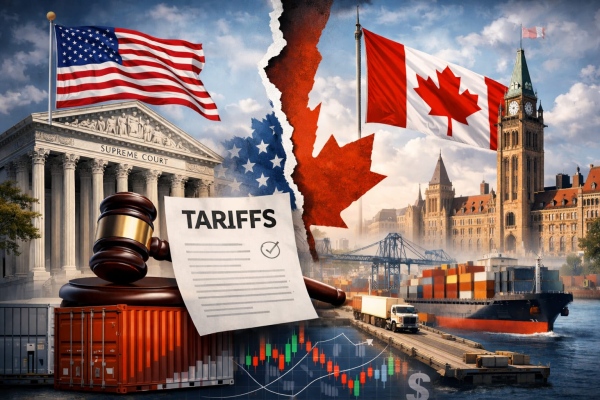
On February 20 2026, the U.S. Supreme Court tariff ruling found President Trump overstepped authority when invoking emergency powers to impose tariffs, delivering a 6 to 3 decision that impacts trade policy expectations across North America.
The ruling removes one of the most aggressive tariff pathways by confirming that emergency powers cannot serve as a broad trade policy tool. However, other legal authorities remain available, meaning tariff risk does not disappear. Policymakers in Ottawa have already begun reviewing the decision’s implications as cross border supply chains remain exposed to policy shifts.
Canada has already experienced tariff volatility during earlier policy cycles. April 2025 tariff impacts on Canadian businesses highlights how sudden trade actions disrupted pricing, inventory planning, and SME financing decisions. Separate analysis of Canada’s tariff trade tensions and economic spillovers shows how cross border friction affects supply chains and investment confidence even when exemptions exist.
The latest ruling may remove one legal foundation for tariffs, but uncertainty remains as governments retain alternative tools. For Canadian exporters and importers, planning risk continues to dominate strategic decision making.
Recent trade data reflects tariff driven disruption across the Canada United States corridor. Statistics Canada indicators show softening export volumes and declining imports during escalation periods, spotlighting how policy uncertainty can translate into pricing pressure, inventory swings, and capital allocation challenges for businesses operating internationally.
If tariff policy remains unpredictable despite judicial limits, will exporters accelerate adoption of embedded treasury, automated FX, and digital trade finance tools as core resilience infrastructure?
Tariffs apply to goods, yet financial effects surface across payments, FX settlement, and liquidity management. Companies facing trade uncertainty typically increase hedging activity, rely more heavily on short term working capital, and demand faster reconciliation to manage cash exposure.
The Supreme Court decision restores an important legal boundary but doesn't end tariff uncertainty. Political pressure around industrial policy and trade protection remains elevated, suggesting continued volatility in cross border commerce.
For Canada’s fintech ecosystem, the news may strengthens the role of fintech platforms focused on cross border payments, FX automation, trade finance digitization, and SME liquidity tools. Firms that help businesses forecast cash flow, manage currency risk, and access capital faster become operational buffers against geopolitical volatility.
You may also like:
Canada Confronts a Changing World at Davos 2026
Does CUSMA Support Fintech Services Across Borders?
The National Crowdfunding & Fintech Association (NCFA Canada) is a financial innovation ecosystem that provides education, market intelligence, industry stewardship, networking and funding opportunities and services to thousands of community members and works closely with industry, government, partners and affiliates to create a vibrant and innovative fintech and funding industry in Canada. Decentralized and distributed, NCFA is engaged with global stakeholders and helps incubate projects and investment in fintech, alternative finance, crowdfunding, peer-to-peer finance, payments, digital assets and tokens, artificial intelligence, blockchain, cryptocurrency, regtech, and insurtech sectors. Join Canada's Fintech & Funding Community today FREE! Or become a contributing member and get perks. For more information, please visit: www.ncfacanada.org
| | |
|---|---|---|
| | |
February 20, 2026 | Global Fintech Funding Research

Image: Freepik
On February 18, 2026, KPMG released Pulse of Fintech H2 2025 reporting global fintech investment reached $116B in 2025, up from $95.5B in 2024, while total deal count fell to 4,719, the lowest level in eight years. That combo tells the real story. More money shows up, but it doesn’t spread out. It stacks into fewer companies, fewer rounds, and more pressure on proof.
KPMG’s regional totals show how concentrated 2025 really was. The Americas pulled in $66.5B across 2,409 deals, with the United States at $56.6B across 1,977 deals. Canada sits inside the Americas corridor where the biggest pools of capital live, but that also means Canadian fintechs compete head to head with scaled US plays for the same investor attention.
The report shows Canadian venture capital fintech investment dropped from $9.9B in 2024 to $2.4B in 2025. A few large late stage rounds can dominate totals in a smaller market, so timing matters. Still, perception isn't great and Canada can’t rely on one breakout year to carry credibility and market confidence.
EMEA recorded $29.2B across 1,484 deals.
ASPAC came in at $9.3B across 763 deals.
Exit value more than doubled to $104.4B in 2025 from $46.8B in 2024, and exit deal count rose to 486 from 438. Stronger exits recycle capital and resets valuation benchmarks. It won’t lift every company but it can improve the mood for 2026 if momentum holds.
KPMG shows payments investment totals $19.2B in 2025 compared with $20.4B in 2024, while deal count falls from 655 to 542. The segment stayed large, but investors picked winners.
The report also flags continued payments traction in emerging markets in H2 2025, with South America standing out, supported by instant payments regimes such as Brazil’s Pix and Argentina’s Transferencias 3.
For Canadian payments firms, this isn’t about chasing every corridor. It’s about owning a clear wedge. If you can show strong fraud outcomes, fast settlement, clean reconciliation, and deep enterprise integration, you stand a chance in a market that rewards proof. If you can’t, you’ll get stuck in the crowded middle.
Digital assets and currencies investment rose from $11.2B across 1,584 deals in 2024 to $19.1B across 1,199 deals in 2025. Dollars r0se while deals fell, which usually means institutions backed fewer, larger infrastructure outcomes. KPMG points to stablecoins, corporate participation, and regulatory clarity as drivers going into 2026. KPMG also highlights growing interest in asset tokenization, including money market funds and real estate.
Canada’s opportunity sits in the infrastructure layer. Regulated custody, compliant settlement, strong controls, and enterprise tokenization tooling can travel across borders. Delays cost builders time, and time costs them market position and money.
Investment in AI driven fintech rose from $12.1B in 2024 to $16.8B in 2025, while deal count rose from 1,183 to 1,334. This is one of the few areas where both dollars and deal flow grew. Still, KPMG notes corporates often partner directly with large tech and AI providers, which raises the bar for specialist fintechs.
Canadian AI fintech teams can’t just say they use AI. They’ve got to show what it changes. Lower fraud losses, faster underwriting, better collections, fewer false positives, and lower service cost. If the numbers don’t move, the story won’t land with investors/buyers.
Insurtech rebounded from $2.9B in 2024 to $8.6B in 2025 while deal volume slipped to a 10 year low of 291 deals. KPMG linked much of the rebound to two outlier transactions, including the $2.6B acquisition of Next Insurance and the $2.5B take private of Sapiens International. That’s the lesson. A handful of transactions can drive the headline while most companies still fight for small checks.
Cybersecurity investment fell to $0.7B in 2025 from $0.9B in 2024, and deal count fell to 72 from 93. At the same time, rapid change driven by AI is increasing the focus on data security because automation depends on trusted data. Banks are consolidating data into protected lakes to support advanced automation and exploring new security models to reduce operating cost while improving outcomes.
This funding dip means larger buyers and platforms are taking more control. Canadian security focused fintechs need to sell enterprise outcomes that tie directly to risk reduction and operational cost.
Regtech investment dropped from $6.8B in 2024 to $4.9B in 2025 while deal count rose from 431 to 519. That pattern often means smaller rounds and cautious checks. The report also describes large banks investing more in internal AI driven compliance tools, which can reduce third party budgets for point solutions.
Canadian regtech firms should focus on selling what banks can’t build quickly, such as shared utilities, cross institution data networks, workflow embedded reporting, and tooling that reduces total compliance cost at scale.
Wealthtech investment fell to $1.4B in 2025 from $4.9B in 2024 while deal count stayed almost flat at 57 in 2025 versus 58 in 2024. KPMG highlights a Canadian bright spot in Wealthsimple who secured about US $538M (CAD $750M) in an equity funding round in H2 2025, and was just awarded CIX Summit's 2026 Innovator of the Year award. That shows global capital still backs Canadian category leaders when they reach scale and earn trust.
Canada faces the challenge of global capital concentrating while Canada’s totals reset from $9.9B to $2.4B. That creates a narrative risk if Canada doesn’t produce repeatable scale outcomes. The upside sits in the same places global capital is leaning into. Payments still attracts large dollars even as investors consolidate. Digital assets funding returns through stablecoins and tokenization infrastructure. AI fintech attracts both dollars and deal flow when it improves real operating results.
Canada needs to stay focused and practical. Build infrastructure grade companies, prove measurable outcomes early, and tie growth to regulated adoption. That’s where the bigger checks go when fewer companies are getting funded.
The National Crowdfunding & Fintech Association (NCFA Canada) is a financial innovation ecosystem that provides education, market intelligence, industry stewardship, networking and funding opportunities and services to thousands of community members and works closely with industry, government, partners and affiliates to create a vibrant and innovative fintech and funding industry in Canada. Decentralized and distributed, NCFA is engaged with global stakeholders and helps incubate projects and investment in fintech, alternative finance, crowdfunding, peer-to-peer finance, payments, digital assets and tokens, artificial intelligence, blockchain, cryptocurrency, regtech, and insurtech sectors. Join Canada's Fintech & Funding Community today FREE! Or become a contributing member and get perks. For more information, please visit: www.ncfacanada.org
| | |
|---|---|---|
| | |
February 20, 2026

Image: Freepik/DC Studio
Along with the rest of the world, Canada's citizens are facing new cybersecurity threats. This can make it hard to feel confident online. The real-world result can lead to financial loss, sensitive data being available to all, and a wider impact on the economy.
Here are some of the issues you could encounter, as well as measures to protect yourself.
One of the newest types of issues is AI-powered scams, or deepfakes. Criminals use AI to create personalized social engineering attacks. This could be in the form of fake videos of celebrities "talking" to you or as a romance scam.
Always verify the person you are speaking to independently, especially if they ask for money or passwords. Remember, celebrities will never do this, so it is an immediate red flag.
Check any videos carefully. If you watch, you will be able to spot weird movements that break the AI illusion, such as words not matching with mouth movements.
Malicious websites are selling compromised credentials such as passwords, user logins and personal information, which can lead to account takeovers.
Avoid your accounts being at risk by manually requesting removal from major broker sites. There are legitimate companies you can pay to do this, as it is time-consuming.
Try to practise good online hygiene. Make sure you have strong passwords that you change regularly. Do not open strange emails, as they could be links to harvest your data. Importantly, if you do think someone has information they shouldn’t, report it to the relevant body in Canada.
As a small to medium-sized business owner, your company is important to your personal life. You may notice that your business is targeted by scammers to gain access to secure networks. This puts any personal data in your care at risk.
Implement rigorous vendor risk management, as well as mapping the supply chain for any vulnerabilities. Make it part of your policy to conduct regular manual checks as well as employ software to monitor your network continuously.
Ransomware remains the top cybersecurity threat. It works by infiltrating your systems and network, rendering your data inaccessible. This enables fewer technical criminals to launch attacks against both individuals and businesses.
Make sure you have system backups offline and regularly check for and apply security patches to all systems. Consider using a VPN free to encrypt your data, making it harder for criminals to access and read.
The National Crowdfunding & Fintech Association (NCFA Canada) is a financial innovation ecosystem that provides education, market intelligence, industry stewardship, networking and funding opportunities and services to thousands of community members and works closely with industry, government, partners and affiliates to create a vibrant and innovative fintech and funding industry in Canada. Decentralized and distributed, NCFA is engaged with global stakeholders and helps incubate projects and investment in fintech, alternative finance, crowdfunding, peer-to-peer finance, payments, digital assets and tokens, artificial intelligence, blockchain, cryptocurrency, regtech, and insurtech sectors. Join Canada's Fintech & Funding Community today FREE! Or become a contributing member and get perks. For more information, please visit: www.ncfacanada.org
| | |
|---|---|---|
| | |


August 26th, 2025

January 4th, 2024

June 1st, 2021

September 9th, 2020

July 9th, 2018

January 3rd, 2018

September 25th, 2017

June 20th, 2017

May 10th, 2017

December 14th, 2016