




Karsten Wenzlaff, Advisor
August 26th, 2025
Karsten Wenzlaff is a Crowdfunding and Fintech Expert from Germany. He is Secretary-General of Digit[...]


June 1, 2026 | NCFA Fintech Market Activity | Risk Compliance And Regtech, Artificial Intelligence And Data

On May 27, 2026, Fredericton based cybersecurity scaleup Lastwall raised $16 million in a round led by BDC Capital’s StrongNorth Fund, See Isabelle Hudon, President and CEO BDC's LinkedIn announcement. The round also included the New Brunswick Innovation Foundation, Frostbite Capital, Blue Bear Capital, BlueWing Ventures, and 18West.
It's a Canadian cybersecurity story, not a military procurement story. Lastwall works in defence, government, and critical infrastructure environments, but the announcement is about growth capital for identity first security, zero trust access, and quantum resilient protection. For NBIF, it's the largest single investment in its history through the round.
Karl Holmqvist, Founder and CEO, Lastwall:
“We proved our model in the world’s most demanding federal market. We earned FedRAMP Moderate Authorization, secured U.S. government systems, and built a platform for the realities of modern cyber warfare. Now, we’re bringing those trusted capabilities home to help strengthen Canada’s cyber resilience at a defining moment for national security.”
Lastwall secures access across cloud, hybrid, disconnected, and low bandwidth environments. It's important for energy, telecom, transportation, defence, government, and public sector systems where a failed login layer can become an operational risk.
The product focus is identity, authentication, credential protection, privileged access, and zero trust controls. Lastwall also says quantum resilient protection is built into the platform, which is key for systems that need to stay secure beyond the current threat cycle.
For fintechs and financial institutions, digital identity and access control are now resilience infrastructure. Fraud, account takeover, insider risk, cloud access, vendor access, and critical system protection all depend on knowing who is connecting, from where, and under what conditions.
Peter Dawe, BDC’s Vice President of Defence Strategy and a recently retired Major General, joined Lastwall’s board as part of the financing. That gives the company closer defence and sovereign capability expertise as Canada looks for more domestic cyber capacity.
Canada’s cyber resilience gap isn't only about monitoring threats. It's also about securing access to the systems that run public services, financial infrastructure, energy, communications, and national security. Canada’s new cyber law and PSP oversight are already raising the bar for security, resilience, and vendor accountability. Lastwall’s funding shows Canadian capital is starting to treat identity security as a sovereign capability, not just another software category.
Can Canadian cybersecurity firms turn U.S. federal proof into domestic critical infrastructure adoption before cyber resilience becomes a procurement emergency?
 The National Crowdfunding & Fintech Association (NCFA Canada) is a financial innovation ecosystem that provides education, market intelligence, industry stewardship, networking and funding opportunities and services to thousands of community members and works closely with industry, government, partners and affiliates to create a vibrant and innovative fintech and funding industry in Canada. Decentralized and distributed, NCFA is engaged with global stakeholders and helps incubate projects and investment in fintech, alternative finance, crowdfunding, peer-to-peer finance, payments, digital assets and tokens, artificial intelligence, blockchain, cryptocurrency, regtech, and insurtech sectors. Join Canada's Fintech & Funding Community today FREE! Or become a contributing member and get perks. For more information, please visit: www.ncfacanada.org
 |  |  |
|---|---|---|
 |  |  |
June 1, 2026 | NCFA Market Activity | Artificial Intelligence And Data, Risk Compliance And Regtech, Lending Consumer Credit And BNPL, Open Banking Open Finance And Data Sharing

On May 28, 2026, Saris announced a $28.8M USD Series A to scale its agentic workflow platform for banks and credit unions. 8VC led the round, with participation from Audacious Ventures, Homebrew, Btech Consortium, and Service Ventures. Saris builds AI agents for lending, compliance, and operations, where financial institutions still spend staff time on document review, data validation, exception handling, and repetitive back office work.
Saris is a Canadian and US based AI fintech, not a Canada only vendor. The company’s hiring page describes a Canada and US hiring footprint, with hybrid workspace options in Montréal, Toronto, and San Francisco. This affects the business model. Saris can draw from Canadian AI and fintech talent while selling into the larger US banking market, where 8VC and enterprise partners can help open doors.
The Canadian link also sits in the founder story. Danial Jameel, Alice Dinu, and James Dang previously built Oohlala Mobile, later Ready Education, which Y Combinator lists in its Summer 2016 batch with a Montréal location. That history gives Saris a stronger base than a typical first time AI startup. Selling workflow software into regulated institutions takes trust, implementation discipline, and patience.
Saris now has more capital to compete in the US banking market, deepen integrations with Fiserv, Encompass, and MeridianLink, and grow the team that trains and deploys its AI agents. The strategic question for Canada is how much of that growth, talent, and customer expansion stays connected to the domestic fintech ecosystem.
Saris trains agents on each institution’s workflows and systems, then applies them to repeatable tasks across lending and operations under human supervision. Based on company reported figures, Saris’ agentic workflows automate up to 70% of consumer, mortgage, and commercial lending tasks and reduce costs by up to 35%. The platform also more than doubles output without adding headcount.
MeridianLink’s partner page says Saris works directly inside MeridianLink to automate document review, field validation, discrepancy remediation, post closing QA, and fraud alert resolution across consumer lending, DL4, and quality control workflows. MeridianLink also reports 99.8% field accuracy, 10x faster file review, and 3x underwriter and loan officer capacity, with one customer clearing a 600 loan backlog in four days.
So how does Saris stack up to competitors. Its target market extends beyond Canadian financial institutions, and its product fits banks and credit unions that already use systems such as Fiserv, Encompass, and MeridianLink.
US founded nCino brings global platform scale. More than 2,700 customers globally use nCino’s platform, including enterprise banks, regional banks, community banks, credit unions, challenger banks, building societies, and independent mortgage banks. That scale gives nCino a distribution advantage with institutions that want a broad cloud banking platform across lending, account opening, portfolio workflows, and customer engagement.
Saris does not need to replace the full operating platform. Its opening is file review, document checks, exception handling, and throughput inside systems institutions already use. That gives Saris a more focused sale where banks and credit unions already run core platforms or loan origination systems but still rely on staff to clear repetitive work.
Canadian based thirdstream is more domestic and onboarding focused. More than 50 financial institutions use thirdstream’s onboarding platform, including banks, credit unions, brokerages, and trust companies. Its strength is in Canadian account origination, identity verification, automated decisioning, real time account funding, and document management.
Toronto based Boss Insights sits closer to lending data infrastructure. Its platform gives financial institutions business lending data infrastructure across accounting, sales, banking, payroll, tax, analytics, monitoring, and customer portal capabilities. Boss Insights lists 1 API and 1,000 plus integrations, which places it closer to open finance, borrower data, and commercial lending intelligence than Saris’ document and workflow automation layer.
Saris looks strongest where banks and credit unions want targeted AI automation without a full platform replacement. Saris can draw from Canadian talent and a Montréal founder history while selling into larger US banking budgets. The question is whether customer relationships, implementation teams, and product leadership stay connected to Canada as the company grows.
Danial Jameel, cofounder and CEO of Saris:
“Our vision is a future where humans and AI work side by side in financial services.”
Saris’ raise shows financial AI moving into the parts of banking where cost, controls, and customer turnaround times get measured. AI can lower operating costs, but financial firms still need evidence that models remain fair, secure, monitored, and accountable. That operating pressure also runs through AI compliance and governance costs.
Should Canadian AI funding and fintech policy focus more on regulated proof points inside banks, credit unions, payments, lending, compliance, and capital markets rather than broad AI adoption metrics?
The National Crowdfunding & Fintech Association (NCFA Canada) is a financial innovation ecosystem that provides education, market intelligence, industry stewardship, networking and funding opportunities and services to thousands of community members and works closely with industry, government, partners and affiliates to create a vibrant and innovative fintech and funding industry in Canada. Decentralized and distributed, NCFA is engaged with global stakeholders and helps incubate projects and investment in fintech, alternative finance, crowdfunding, peer-to-peer finance, payments, digital assets and tokens, artificial intelligence, blockchain, cryptocurrency, regtech, and insurtech sectors. Join Canada's Fintech & Funding Community today FREE! Or become a contributing member and get perks. For more information, please visit: www.ncfacanada.org
| | |
|---|---|---|
| | |
May 29, 2026 | NCFA Fintech Whisperer Weekly Intelligence | Payments And Market Infrastructure, Artificial Intelligence And Data, Digital Assets Blockchain And Tokenization, Capital Markets And Market Infrastructure

Image: Freepik
This live weekly NCFA intelligence page tracks financial technology developments that significantly affect how fintechs build, sell, raise capital, and operate under scrutiny. Coverage prioritizes Canada and includes global events that directly influence competitive conditions, market access, and execution realities across fintech sectors. This page will be updated throughout the week with market movers in a live format and then each week we'll close the prior week's contents in prep for the upcoming week, and continue on a rolling basis. (Missed prior week's Fintech Whisperer? (December 6-12, 2025, December 13-19, 2025, January 1-9, 2026, January 10-16, 2026, January 17-23, 2026, January 24-30, 2026, January 31-February 6, 2026, February 7-13, 2026, February 14-20, 2026, February 21-27, 2026, February 28-March 6, 2026, March 7-13, 2026, March 14-20, 2026, March 21-27, 2026, March 28-April 3, 2026, April 4-10, 2026, April 11-17, 2026, April 18-24, 2026, April 25-May 1, 2026, May 2-8, 2026, May 9-15, 2026, May 16-22, 2026).
AI compliance is moving from broad principles into operating guidance for agents, automated decisions, procurement, and personal data use. Fintechs, banks, insurers, regtech firms, and AI vendors should track how privacy rules shape AI product design, governance, and customer trust.
Project Agorá's focus is not retail crypto speculation. It is wholesale financial infrastructure, cross border settlement efficiency, programmable payments, and institutional control over tokenized money movement. Go deeper, visit NCFA's curated fintech reports and research library, where the BIS Project Agorá report is listed.
This is not open access to the Fed system. It is a narrower settlement pathway for legally eligible firms operating outside the traditional bank model. Stablecoin issuers, PSPs, crypto firms, tokenization platforms, and embedded finance providers should track whether limited Reserve Bank account access becomes a practical alternative to sponsor bank dependence. This connects to NCFA’s analysis of Fed Payment Accounts and fintech settlement access.
Onchain finance needs shared coordination standards before institutional adoption can scale cleanly. Banks, wallets, PSPs, exchanges, tokenization platforms, and agentic payment builders should track whether identity, messaging, and transaction standards become competitive infrastructure rather than optional middleware.
Large payment networks are adding regulated digital asset permissions to support stablecoin, tokenized settlement, and digital asset infrastructure at institutional scale. Banks, PSPs, exchanges, custodians, and fintech platforms should track which firms secure licences that let crypto services connect with mainstream payment networks.
Stablecoins are moving deeper into consumer banking distribution, not just crypto infrastructure. Banks, fintechs, PSPs, and regulators should watch whether regulated bank issued stablecoins begin competing directly with cards, deposits, remittance products, and embedded payment flows. Also supports this analysis of stablecoins becoming payment infrastructure.
National currency stablecoins are expanding beyond major economies. Stablecoin issuers, banks, PSPs, regulators, and treasury teams should track how smaller jurisdictions use digital fiat infrastructure to compete for payment flows, fintech investment, and cross border settlement.
Climate disclosure is moving back toward company specific materiality rather than a dedicated SEC climate reporting regime. Public companies, fintech lenders, ESG data providers, regtech firms, investors, and capital markets platforms should track how climate risk reporting moves across U.S. federal rules, state rules, EU requirements, and voluntary investor expectations.
Bank charter strategy is becoming part of digital asset and payment infrastructure competition. Banks, fintechs, stablecoin firms, custodians, and compliance teams should track which institutions secure federal supervision, stronger operating permissions, and clearer access to national banking infrastructure.
MiCA is moving from licensing theory into enforcement risk. Crypto exchanges, custodians, wallet providers, brokers, and compliance teams should treat EU authorization, local regulator engagement, and operating perimeter checks as immediate market access priorities.
Prediction markets are moving deeper into conflict with gambling, derivatives, and securities frameworks. Exchanges, fintechs, tokenization firms, and prediction market operators should expect more pressure around licensing, market surveillance, consumer protection, and jurisdictional authority as these platforms expand globally.
USMCA risk is now back inside Canada’s competitiveness file. Fintech lenders, payment firms, investors, marketplaces, and platforms serving SMEs should watch how tariff uncertainty affects customer margins, capital demand, foreign exchange exposure, supplier payments, and cross border expansion.
Crypto sanctions enforcement now reaches deeper into financial infrastructure networks, not just individual wallets or isolated actors. Exchanges, custodians, PSPs, banks, compliance teams, and blockchain monitoring firms should expect more scrutiny around transaction tracing, counterparty checks, and sanctions controls tied to digital asset flows.
Post trading rules are becoming more important as Europe modernizes settlement operations, CSD messaging, and market infrastructure controls. CSDs, brokers, banks, custodians, tokenization platforms, and compliance teams should track how messaging standards affect settlement efficiency, operational risk, and future market infrastructure integration.
Blockchain based settlement is moving into formal U.S. market infrastructure permissions. Brokers, custodians, tokenization platforms, exchanges, and asset managers should track how SEC registered clearing models affect securities settlement, custody design, and tokenized market structure.
Retail investing scale increasingly depends on back end clearing and custody infrastructure. Fintech platforms, brokers, clearing firms, embedded finance providers, and regulators should track how large consumer apps choose clearing partners that can support faster launches, broader products, and stronger operational controls.
This week was less about crypto adoption and more about who gets trusted access to the pipes. The Fed tested a narrow settlement account, Paxos received SEC clearing agency registration, Mastercard secured a BitLicense, SoFi launched a bank issued stablecoin, and Project Agorá moved wholesale tokenized settlement into deeper testing. The fresh lesson is that access is becoming tiered. Firms won’t all get the same rails, licences, or settlement rights.
NCFA offers various curated resources to help founders and investors stay current on developments that impact fintech markets, subscribe to NCFA weekly newsletter updates, view a rundown of current fintech news and insights, or dive into the latest fintech industry research.
The National Crowdfunding & Fintech Association (NCFA Canada) is a financial innovation ecosystem that provides education, market intelligence, industry stewardship, networking and funding opportunities and services to thousands of community members and works closely with industry, government, partners and affiliates to create a vibrant and innovative fintech and funding industry in Canada. Decentralized and distributed, NCFA is engaged with global stakeholders and helps incubate projects and investment in fintech, alternative finance, crowdfunding, peer-to-peer finance, payments, digital assets and tokens, artificial intelligence, blockchain, cryptocurrency, regtech, and insurtech sectors. Join Canada's Fintech & Funding Community today FREE! Or become a contributing member and get perks. For more information, please visit: www.ncfacanada.org
| | |
|---|---|---|
| | |

Last Updated: May 29, 2026
Status: Strengthening
Organizations: Bank of Canada, FCA, APRA, UK Parliament Treasury Committee, European Council, Microsoft, Google, Mastercard, Florida Attorney General
The answer is yes, but the burden is not only regulatory paperwork. AI is creating new costs around model governance, board oversight, vendor control, data quality, fraud prevention, customer fairness, audit trails, human review, and incident response. Financial firms can still gain productivity and better customer service, but the cost of using AI responsibly is rising.
This is why the AI finance question is no longer just about productivity. NCFA analyzed this tension in AI spending and workforce cost resets. The same pressure now extends into compliance. If AI lowers cost per decision, firms still need to prove those decisions remain fair, secure, monitored, and accountable.
It is about whether firms can use AI at scale without losing control. The compliance burden grows when AI starts impacting decisions, communications, onboarding, payments, fraud detection, research, advice, and customer journeys.
That control problem becomes even more acute in AI payments and liability, where consent, authorization, and accountability need to work before autonomous transactions can scale.
The firms to watch are the ones that can turn AI controls into operating discipline. That means clear ownership, tested models, clean data, human escalation, vendor oversight, audit evidence, and governance that works before a regulator asks for proof.
Strategic Takeaway
AI can lower costs and improve service, but it also raises the control bar. The strongest financial firms will not be the ones that use AI everywhere. They will be the ones that know where AI belongs, where humans stay accountable, and how to prove the system works.
Click each item to expand
The Bank of Canada says AI may support productivity growth, but financial firms still need to manage model risk, job changes, data quality, cyber exposure, and financial stability concerns.
The FCA selected eight firms for its second AI Live Testing cohort, including Barclays, Experian, Lloyds Banking Group, and UBS. The focus is safe and responsible deployment, not AI experimentation in isolation.
Mastercard’s Agent Pay Acceptance Framework shows why AI creates a new control layer in payments. If an AI agent can help initiate or complete a transaction, firms need controls over identity, authorization, tokenized credentials, consent, limits, and disputes.
Microsoft says financial firms need to embed governance and security into AI transformation. This includes identity based access, audit trails, adaptive risk controls, and monitoring.
Google’s Gemini Deep Research Agent can plan, execute, and synthesize multi step research tasks. That kind of tool is useful in finance, but it raises questions about source quality, review, recordkeeping, and responsibility for output.
Click each item to expand
APRA told industry it is finalizing its forward plan for AI supervision and will continue monitoring AI use for prudential risks. This is a clear sign that AI governance is entering prudential oversight.
The UK Parliament Treasury Committee reported that 75% of UK financial services firms use AI and called for clearer regulatory direction. That makes the compliance burden visible at sector scale.
The Council and European Parliament agreed to simplify and streamline parts of the AI Act timeline. Even with timing relief, firms still need to prepare for high risk AI obligations, synthetic content rules, documentation, and governance requirements.
The FCA’s Mills Review call for input said AI may enable more sophisticated financial crime, fraud, and manipulation. That makes AI a compliance and fraud control issue, not only a technology choice.
Florida’s Attorney General opened a criminal investigation into OpenAI related to ChatGPT and the Florida State University shooting. The facts are outside financial services, but the compliance lesson is relevant for any firm deploying AI into high risk workflows.
Do you agree the evidence is strengthening?
 3

The National Crowdfunding & Fintech Association (NCFA Canada) is a financial innovation ecosystem that provides education, market intelligence, industry stewardship, networking and funding opportunities and services to thousands of community members and works closely with industry, government, partners and affiliates to create a vibrant and innovative fintech and funding industry in Canada. Decentralized and distributed, NCFA is engaged with global stakeholders and helps incubate projects and investment in fintech, alternative finance, crowdfunding, peer-to-peer finance, payments, digital assets and tokens, artificial intelligence, blockchain, cryptocurrency, regtech, and insurtech sectors. Join Canada's Fintech & Funding Community today FREE! Or become a contributing member and get perks. For more information, please visit: www.ncfacanada.org
| | |
|---|---|---|
| | |
May 29, 2026 | NCFA Fintech Market Activity | Digital Assets Blockchain And Tokenization, Capital Markets And Market Infrastructure, Risk Compliance And Regtech
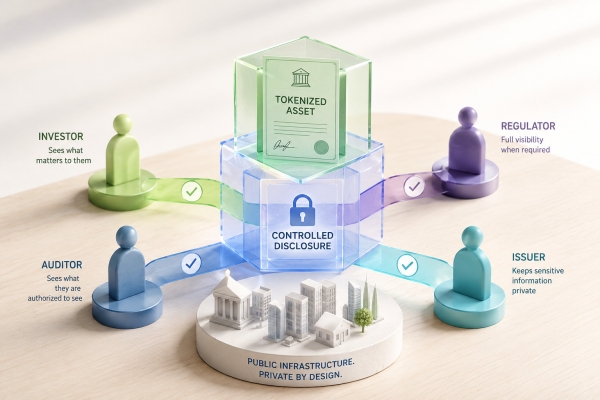
On May 27, 2026, Toronto based Polymath launched Confidential Assets on Polymesh, a protocol level privacy feature for tokenized securities and real world assets. It uses zero knowledge cryptography to keep transaction details private while preserving access for regulators, auditors, and authorized parties.
Privacy solves a practical market problem. Public blockchains can expose positions, client data, and transaction flows. Private chains can protect confidentiality, but they can also silo activity inside closed systems. Confidential Assets is Polymath aim to give regulated asset markets privacy without giving up public permissioned infrastructure.
Martin Halford, CEO, Polymath:
“The question the market has been asking is not whether assets can be tokenized -- they can. The question is whether tokenization can be done at an institutional scale, with the privacy and compliance standards that real financial infrastructure demands. Confidential Assets is our answer to that question.”
The stronger use case isn't about keeping secrets, but rather controlled disclosure. Issuers, investors, and asset managers need privacy around holdings and transfers. Yet a wide range of stakeholders from regulators to auditors, custodians, and compliance teams still need access when rules require it.
Confidential Assets is built into the Polymesh protocol, not added through a third party tool or Layer 2 solution. This allows privacy to work within the same system that handles compliance, governance, and settlement. A fund, private credit issuer, real estate platform, or broker dealer could use the feature to complete a compliant transfer without exposing position size or counterparty details to the broader market.
The ultimate goal and impact is the right mix of privacy and oversight. If Polymath gets that balance right, Confidential Assets could make Polymesh more useful for real capital markets activity, not just token issuance.
Confidential Assets is available immediately to institutions building on Polymesh. Polymath has been building regulated asset infrastructure since 2017 and contributed the ERC 1400 security token standard. Polymesh achieved SOC 2 Type 1 compliance in 2025. Polymath also says a post quantum ready version of Confidential Assets is in development for long term assets that may remain on chain for decades.
For Canadian capital markets and fintech firms, controlled disclosure is becoming core infrastructure for tokenized assets. Platforms that manage who can see what, and when, will become harder to replace in digital securities markets, over time.
Can tokenized markets reach institutional scale without protocol level privacy, or will controlled disclosure become a core requirement for regulated digital assets?
The National Crowdfunding & Fintech Association (NCFA Canada) is a financial innovation ecosystem that provides education, market intelligence, industry stewardship, networking and funding opportunities and services to thousands of community members and works closely with industry, government, partners and affiliates to create a vibrant and innovative fintech and funding industry in Canada. Decentralized and distributed, NCFA is engaged with global stakeholders and helps incubate projects and investment in fintech, alternative finance, crowdfunding, peer-to-peer finance, payments, digital assets and tokens, artificial intelligence, blockchain, cryptocurrency, regtech, and insurtech sectors. Join Canada's Fintech & Funding Community today FREE! Or become a contributing member and get perks. For more information, please visit: www.ncfacanada.org
| | |
|---|---|---|
| | |
May 29, 2026

Most businesses don't struggle to find digital marketing agencies. They struggle to find one that actually understands their industry, reports honestly, and ties every dollar spent back to real revenue. After reviewing dozens of Canadian agencies across service depth, client results, and transparency, a clear pattern emerged: the ones worth your budget are the ones that treat return on investment as a must-have, not a nice-to-have. This guide breaks down the top five agencies in Canada worth serious consideration heading into 2026.
The research approach for this ranking
Every agency on this list was assessed using publicly available sources: Clutch profiles, client testimonials, published case studies, award records, and official service pages. The focus stayed on agencies with a verifiable track record in digital marketing, not just strong website copy or a polished pitch deck.
-> See the full research breakdown
Picking the wrong agency doesn't just waste budget. It sets your business back months while competitors pull ahead.
The real challenge isn't finding an agency that offers services. It's finding one that genuinely understands your industry, can trace every lead back to a specific campaign, and gives you reporting you can actually trust.
Specialized agencies tend to produce better outcomes because they already know the ad platform policies, the content angles that convert, and the audience behavior patterns that matter in your space. That kind of focused experience usually shows up directly in your numbers, whether you're tracking Return on Ad Spend (ROAS), Customer Acquisition Cost (CAC), or Cost Per Lead (CPL).
The right fit doesn't just run campaigns. It moves your business forward.
Note: All data in this table is sourced from review platforms and the official websites of the listed companies.
| Company Name | Years Operating | Headquartered In | Rating |
| dNovo Group | Est. 2011 | Toronto, ON, Canada | 5/5 (Clutch) |
| Dialekta | Est. 2010 | Montreal, Toronto, and Paris | Not listed |
| Major Tom | Est. 2018 | Vancouver, British Columbia | Not listed |
| Kinex Media | Est. 2008 | Mississauga, Ontario, Canada | Not listed |
| Marvel Marketing | Est. 2014 | Calgary, AB | Not listed |

What Does dNovo Group Do?
dNovo Group is a Toronto-based boutique agency founded in 2011, built around legal and healthcare marketing. They cover SEO, Local SEO, AI Search Optimization, Google Ads, web design, and content marketing for law firms and medical practices across personal injury, criminal defense, immigration, family law, and more. What sets them apart is the fully in-house team structure. Every campaign is built and managed internally, which means accountability stays in one place and results don't get lost between vendors.
Why dNovo Group Stands Out for Digital Marketing:
The agency fills a specific gap for law firms and healthcare practices that need a marketing partner who already understands their industry's advertising restrictions and client acquisition dynamics. From what the case study data shows, that kind of sector-specific focus tends to produce results that general agencies struggle to replicate at the same pace.
Summary of Real User Reviews:
dNovo Group holds a 5/5 rating across 66 reviews on Clutch, which is honestly rare at that volume. Clients consistently point to measurable outcomes, including 150% increases in qualified leads and website visitors driven by campaigns and 180% gains in client acquisition. The recognition as a Top SEO, Top Advertising, and Top Web Design company on Clutch, plus a Netty Award nomination, backs up what the client feedback is already saying.

What Does Dialekta Do?
Dialekta is a Montreal-based performance marketing agency founded in 2010, and they've grown considerably since then. They cover SEM, SEO, analytics, conversion rate optimization (CRO), media planning, and business intelligence. What makes them interesting compared to others on this list is their move into traditional media in 2020 and their 2024 acquisition of Varibase, which deepened their data and loyalty marketing capabilities. They serve major Canadian brands including Vidéotron, Bell Media, Intact Insurance, and Desjardins Group (not a small client list by any measure).
Why Dialekta Stands Out for Digital Marketing:
Dialekta addresses a real challenge for mid-to-large businesses that need a single partner to connect digital and traditional media without losing performance accountability across channels. Their data activation work, built out further through the Varibase acquisition, gives clients a clearer picture of how campaigns are actually driving discovery call to signed retainer conversion, not just surface-level impressions.
Summary of Real User Reviews:
Dialekta's industry reputation carries weight, especially the Google recognition as one of six most forward-thinking companies worldwide in Search Innovation. Their client retention rates are reported as among the highest in the Canadian agency market, which suggests the results are holding up long after the initial campaign launch. Multiple Infopresse awards round out a track record that's hard to ignore for enterprise-level marketing buyers.
What Does Major Tom Do?
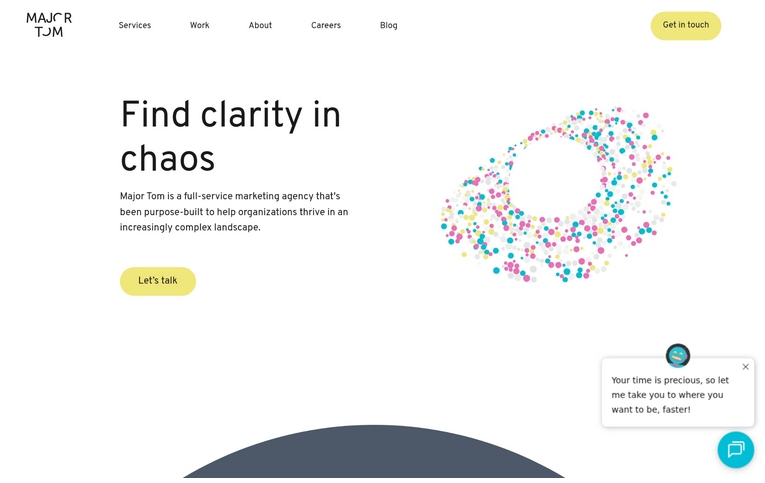
Major Tom is a Vancouver-based full-service agency formed in 2018 through the merger of 6S Marketing and Drive Digital, two respected names in Canadian digital marketing. They cover strategy consulting, web development, creative design, SEO, paid media, ecommerce, social media, content marketing, and marketing automation. Think of them as a shop that can take a brand from broad strategy all the way through to live campaign execution. Their client list includes PepsiCo, SAP, and DoorDash, which shows they can operate at serious scale.
Why Major Tom Stands Out for Digital Marketing:
The agency solves a specific problem for growing businesses that need strategy and execution under one roof, without bouncing between a consulting firm and a production agency. That merger background means their teams are genuinely skilled at both the planning side and the technical delivery, which is a combination that's harder to find than it sounds.
Summary of Real User Reviews:
Major Tom has earned recognition through the Canadian Search Awards for ecommerce work, which points to real performance in a competitive category. The combined heritage of two established agencies gives them a credibility base that newer firms can't replicate overnight. And honestly, the strength of their client portfolio across major global brands says a lot about the trust they've built with marketing buyers at scale.
What Does Kinex Media Do?
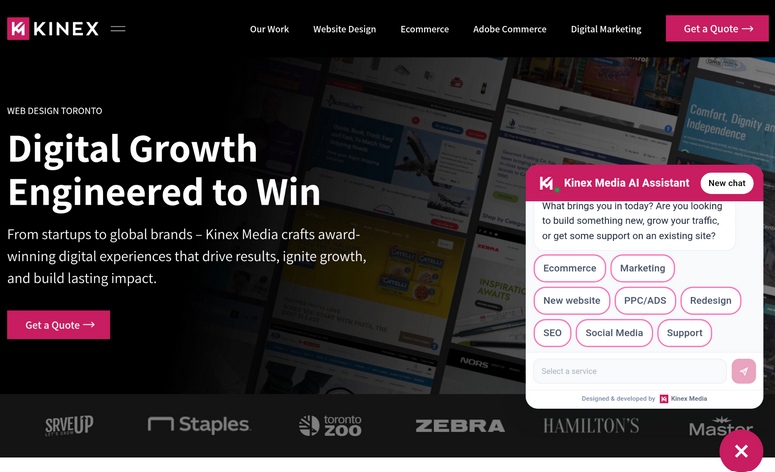
Kinex Media is a Mississauga-based agency founded in 2008, giving them over 15 years of active work in the digital space. They focus on website design and development, Magento ecommerce, SEO, SEM, and print services. What stands out about their approach is the experiment-driven model. Rather than applying a standard playbook, they test strategies on a per-client basis and adjust based on what the data shows. They've worked with more than 2,000 businesses, from early-stage startups to Fortune 500 companies (not a small range by any measure).
Why Kinex Media Stands Out for Digital Marketing:
Kinex Media addresses the frustration businesses face when agencies apply cookie-cutter strategies regardless of industry or business model. Their testing-first mindset means campaigns are shaped by actual performance signals, not assumptions carried over from a previous client in a different vertical.
Summary of Real User Reviews:
The Globe and Mail named Kinex Media one of Canada's top companies for multiple consecutive years, and they ranked #298 on The Americas' Fastest Growing Companies list in 2023. Clutch also places them among Toronto's top web design and development firms. That kind of consistent external recognition across different platforms suggests the client experience is holding up well beyond just the initial project launch.

What Does Marvel Marketing Do?
Marvel Marketing is a Calgary-based full-service agency founded in 2014, with offices in Toronto and Vancouver. They cover web design, SEO, social media marketing, PPC, content strategy, brand development, ecommerce, local SEO, and email marketing. They work across B2B, legal, real estate, automotive, franchise, trades, healthcare, and sports sectors. The thing that makes them genuinely different is their "NO RESULTS, NO PAYMENT" guarantee combined with a strict limit of three new clients per month. That kind of intentional capacity cap is rare and signals they're serious about delivering, not just scaling.
Why Marvel Marketing Stands Out for Digital Marketing:
Marvel Marketing directly addresses the anxiety businesses feel when signing long-term agency contracts without knowing if results will follow. Their human-in-the-loop execution model (no reliance on public AI models for strategic decisions) combined with SOC-2 and GDPR data compliance builds trust with clients in regulated industries who can't afford data handling mistakes.
Summary of Real User Reviews:
Detailed third-party review data for Marvel Marketing isn't as widely published as some other agencies on this list, so drawing direct comparisons is harder. That said, their model speaks for itself. The combination of a results-backed guarantee and deliberate client limits suggests a team that would rather do fewer things exceptionally well than take on volume at the expense of quality.
The starting point was a broad sweep of agencies operating across Canada, pulled from directories like Clutch, UpCity, agency-specific review platforms, and Google Business listings. The goal at this stage was building a wide longlist, not filtering yet. Agencies were flagged based on their presence in Canadian markets, the range of digital marketing services listed on their official sites, and whether they had any documented client history.
From that longlist, agencies without verifiable client results or independently published review records were set aside. The shortlisting process focused on identifying patterns across multiple signals: Were the reviews consistent? Did the agency's stated services match what clients actually described receiving? Agencies with thin public footprints or unverified claims were removed before deeper evaluation began.
Each agency's website claims were cross-referenced against third-party sources. If a firm claimed a specific award or recognition, that recognition was confirmed through the awarding organization's published records. Case study numbers (such as percentage increases in client acquisition or campaign performance improvements) were checked against what was publicly available on Clutch profiles and the agencies' own published materials. Claims that couldn't be traced to a source were discounted in the scoring.
Beyond standard service verification, each agency was assessed for its broader standing in the industry. This included award histories, mentions in recognized Canadian business publications, Google Partner or platform certifications, and any original research or published commentary the agency had produced. Recognition from credible external sources (like Google's global Search Innovation ranking for Dialekta or Globe and Mail top-company recognition for Kinex Media) added weight to an agency's overall assessment.
The final layer focused on digital marketing depth. Each agency needed dedicated, clearly defined service pages (not just a general "digital marketing" label), verified client reviews that referenced specific campaign types and measurable outcomes, and case studies that demonstrated performance across relevant channels. Agencies that only operated in one narrow service area without broader digital marketing capabilities were excluded from the final list, keeping the focus on firms that can genuinely support a business's full marketing needs.
Choosing an agency isn't just about who has the best website. The right fit depends on how well their strengths line up with what your business actually needs right now.
Here's what to look at before signing anything:
Canada has no shortage of digital marketing agencies, but the ones worth your budget share a few things in common: real industry experience, honest reporting, and results you can trace back to actual campaigns. Whether you need niche legal marketing like dNovo Group offers, enterprise-level performance work like Dialekta delivers, or a full-service setup like Major Tom provides, the best agency is the one built for your specific business stage and goals.
The National Crowdfunding & Fintech Association (NCFA Canada) is a financial innovation ecosystem that provides education, market intelligence, industry stewardship, networking and funding opportunities and services to thousands of community members and works closely with industry, government, partners and affiliates to create a vibrant and innovative fintech and funding industry in Canada. Decentralized and distributed, NCFA is engaged with global stakeholders and helps incubate projects and investment in fintech, alternative finance, crowdfunding, peer-to-peer finance, payments, digital assets and tokens, artificial intelligence, blockchain, cryptocurrency, regtech, and insurtech sectors. Join Canada's Fintech & Funding Community today FREE! Or become a contributing member and get perks. For more information, please visit: www.ncfacanada.org
| | |
|---|---|---|
| | |
Last Updated: May 28, 2026
Status: Strengthening
Organizations: Bank of Canada, DTCC, Broadridge, NYSE, Securitize, FCA, LSEG, BIS
The answer is yes, but only in the right legal and market structure. Tokenized real world assets are becoming usable where regulators connect them to securities, custody, fund, settlement, collateral, payment, and investor protection rules. The strongest evidence is not speculative token launches. It is regulated infrastructure that can support bonds, Treasuries, funds, repo, collateral, transfer agency, and settlement.
The practical question is not whether RWAs can be tokenized. They can. NCFA has tracked this progression from experimentation to execution. Earlier evidence showed how tokenization started looking like financial infrastructure, while more recent developments show tokenization finding scale in collateral and cash. European policymakers are also advancing a roadmap for tokenized finance infrastructure, reinforcing the view that tokenization is increasingly being evaluated as market infrastructure rather than a standalone asset class.
The firms to watch are the ones building the boring middle layer. That means custody, transfer agency, collateral management, settlement links, reporting, governance, and legal certainty. RWA growth depends on trust and operating proof, not marketing.
Strategic Takeaway
Tokenized RWAs are becoming market infrastructure where legal rights, custody, settlement, collateral, and investor protections connect. The opportunity is not just putting assets on chain. It is making regulated assets easier to hold, move, finance, and reconcile inside trusted financial systems.
Click each item to expand
The Bank of Canada, Export Development Canada, RBC, TD, and RBC Investor Services completed a tokenized bond experiment using distributed ledger technology. This gives Canada a credible domestic proof point for tokenized securities infrastructure.
DTCC is preparing tokenized real world asset services for production use. This is important because DTCC sits inside regulated post trade infrastructure, not outside the system.
Broadridge’s Distributed Ledger Repo platform shows tokenization already operating in a serious institutional workflow. Repo is market plumbing tied to collateral, liquidity, and funding.
NYSE and Securitize agreed to support tokenized securities infrastructure, including standards for digital transfer agents and tokenization agents.
The UK FCA published rules and guidance for fund tokenisation, giving asset managers a practical framework for tokenized fund operations.
Project Agorá, led by the BIS with central banks and commercial banks, tests tokenized deposits and wholesale central bank money for cross border settlement. This matters because tokenized assets need a reliable cash leg.
Do you agree the evidence is strengthening?
2
The National Crowdfunding & Fintech Association (NCFA Canada) is a financial innovation ecosystem that provides education, market intelligence, industry stewardship, networking and funding opportunities and services to thousands of community members and works closely with industry, government, partners and affiliates to create a vibrant and innovative fintech and funding industry in Canada. Decentralized and distributed, NCFA is engaged with global stakeholders and helps incubate projects and investment in fintech, alternative finance, crowdfunding, peer-to-peer finance, payments, digital assets and tokens, artificial intelligence, blockchain, cryptocurrency, regtech, and insurtech sectors. Join Canada's Fintech & Funding Community today FREE! Or become a contributing member and get perks. For more information, please visit: www.ncfacanada.org
| | |
|---|---|---|
| | |


August 26th, 2025

January 4th, 2024

June 1st, 2021

September 9th, 2020

July 9th, 2018

January 3rd, 2018

September 25th, 2017

June 20th, 2017

May 10th, 2017

December 14th, 2016