




Karsten Wenzlaff, Advisor
August 26th, 2025
Karsten Wenzlaff is a Crowdfunding and Fintech Expert from Germany. He is Secretary-General of Digit[...]


Mar 18, 2026 | NCFA Insight | Digital Assets And Tokenization
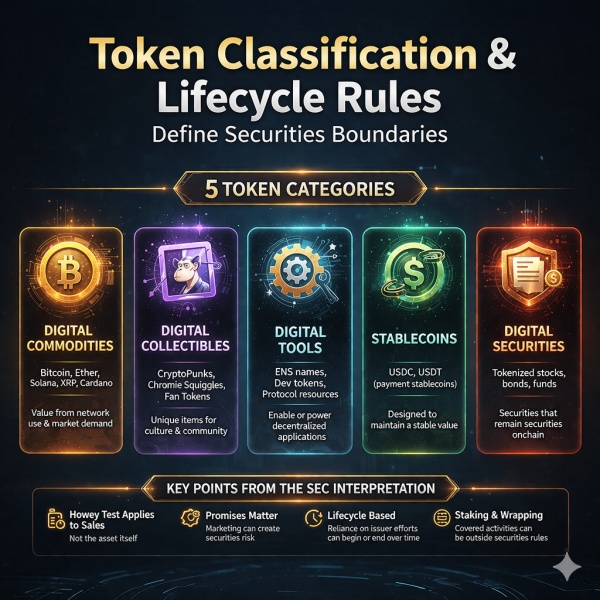
On Mar 17, 2026, the U.S. Securities and Exchange Commission issued a formal interpretation on how federal securities laws apply to certain crypto assets and certain crypto asset transactions with aligned support from the CFTC read the SEC’s March 17 press release on the joint crypto interpretation (and Fact Sheet).
This is a significant U.S. digital asset policy interpretation because it gives the market something it's lacked for a long time: a public classification system, a public lifecycle test, and public treatment of core activities such as staking, wrapping, and airdrops.
The old question of 'is it a security?' no longer sits only at the token level.
The SEC now says the answer can depend on the category of asset, the way it is sold, the promises around it, and whether those promises still matter later in the market.
The release classifies crypto assets into five categories based on characteristics, uses, and functions: (1) digital commodities, (2) digital collectibles, (3) digital tools, (4) stablecoins, and (5) digital securities. It's a framework that crypto firms can actually use in product design, listing review, and compliance planning.
Some of the examples are worth noting. In the published interpretation, the SEC lists Aptos, Avalanche, Bitcoin, Bitcoin Cash, Cardano, Chainlink, Dogecoin, Ether, Hedera, Litecoin, Polkadot, Shiba Inu, Solana, Stellar, Tezos, and XRP as examples of digital commodities. It says these assets gain value from how the network operates and from market supply and demand, not from a team whose efforts drive profit expectations.
On collectibles, it points to CryptoPunks, Chromie Squiggles, Fan Tokens, WIF, and VCOIN.
On tools, it cites Ethereum Name Service domain names and CoinDesk’s Microcosms NFT Consensus Ticket.
The point is not that every asset that looks similar gets a free pass, and the SEC is now saying publicly that many crypto assets are not securities in themselves.
The SEC separates the token from how it is sold. It applies the Howey test to the transaction, not just the asset. A token that is not a security can still be sold as part of an investment contract if a team’s promises create an expectation of profit.
The interpretation then separates the asset from the contract and explains how that link can end. A non security token is no longer subject to an investment contract once buyers no longer rely on the issuer’s promises.
This can happen in two ways. The issuer fulfills what it said it would build, such as delivering functionality or completing roadmap milestones. Or the issuer abandons those efforts, making it unreasonable for the market to keep relying on them. In both cases, the investment contract can fall away, even though the issuer may still face anti fraud liability for earlier statements.
This directly addresses the secondary market problem. A token’s status in later trading does not depend only on how it was launched. It also depends on whether buyers still rely on the issuer’s promises at that point in time.
The SEC ties securities treatment directly to what issuers say. Statements in agreements, websites, whitepapers, and social media can create a reasonable expectation of profit.
That risk increases when issuers make explicit promises tied to roadmaps, milestones, funding plans, and how their work will drive value.
Token design and marketing cannot be separated. If the sales narrative links price appreciation to team execution, the offering can be treated as an investment contract.
For founders and counsel, that is the message. Product design, legal design, and communications design now need to be built together from day one.
The SEC says covered protocol staking activities don't involve securities transactions when structured as described. It covers self staking, custodial and non custodial staking, delegated and nominated staking, and liquid staking.
The interpretation is that rewards and penalties come from protocol rules, not from a team managing profits. That includes liquid staking models where users receive tokens tied to their staked position. If returns come from how the network operates, not from a promoter’s decisions, the activity is less likely to be treated as a securities transaction. That gives exchanges, custodians, and staking providers clearer ground for product design.
The SEC also says wrapping a non security crypto asset doesn't create a security when the wrapped token is redeemable one for one, the underlying asset stays locked for the holder, and value comes from that underlying asset. This supports cross chain use, custody design, and token mobility.
It also confirms that certain airdrops do not involve an investment of money under the Howey Test when recipients do not give anything in return. Common uses include rewarding early users, supporting governance, and building network participation. This does not make all airdrops safe, but it gives builders a clearer framework to separate distribution from securities risk.
The SEC aligns its position on stablecoins with the GENIUS Act. It says qualifying payment stablecoins issued by permitted issuers will not be securities once the law is in force. It also states that some covered stablecoins already fall outside securities treatment under its interpretation. This gives issuers and institutions clearer direction on how stablecoins are treated at the federal level.
Tokenized securities get a clear boundary. A security remains a security whether it is issued offchain or onchain. The SEC describes both issuer led tokenization and third party tokenization of existing assets. In both cases, moving an asset onchain may improve issuance and settlement, but it does not change its legal status.
This interpretation affects different parts of the market in different ways.
This interpretation shows what a more usable framework looks like in practice. While it doesn't solve every unanswered question, it's helpful and moves the debate from slogans to structure. Markets develop faster when participants can classify assets, model lifecycle risk, and design products in lie with public rules instead of trying to read the regulator’s mind from old enforcement cases.
The SEC doesn't replace the Howey Test but it makes Howey more operational for crypto markets. That's the real change. The release gives the industry a public map for classification, a public test for when securities treatment begins and ends, and public treatment of activities that sit at the center of token network design. If you're looking for more of a legal analysis here.
 The National Crowdfunding & Fintech Association (NCFA Canada) is a financial innovation ecosystem that provides education, market intelligence, industry stewardship, networking and funding opportunities and services to thousands of community members and works closely with industry, government, partners and affiliates to create a vibrant and innovative fintech and funding industry in Canada. Decentralized and distributed, NCFA is engaged with global stakeholders and helps incubate projects and investment in fintech, alternative finance, crowdfunding, peer-to-peer finance, payments, digital assets and tokens, artificial intelligence, blockchain, cryptocurrency, regtech, and insurtech sectors. Join Canada's Fintech & Funding Community today FREE! Or become a contributing member and get perks. For more information, please visit: www.ncfacanada.org
 |  |  |
|---|---|---|
 |  |  |
Mar 5, 2026 | NCFA Fintech Market Insight | Digital Assets And Policy And Regulation

On January 29 2026, at the joint SEC CFTC event in Washington titled CFTC SEC Harmonization U.S. Financial Leadership in the Crypto Era.
CFTC Chair Michael S. Selig’s remarks laid out a detailed US policy direction for crypto market structure. The speech goes past broad support for innovation and points to specific rule work on tokenized collateral, perpetual derivatives, software safe harbours, retail leveraged crypto trading, and event contracts.
SEC Chair Paul S. Atkins’ remarks support the same direction from the SEC side, which is part Project Crypto.
“Fragmented regulation in an integrated market is not a safeguard for investors so much as a source of confusion among them.”
That line from Atkins defines the problem. Unclear boundaries change how firms structure products, where they launch, and how much they spend on compliance before they can scale.
“Project Crypto recognizes that crypto markets span across our agencies’ respective regulatory boundaries.”
Selig starts from the point that crypto products don't fit neatly into older lines between agencies. Clearer lines are needed to cut the cost of operating in uncertainty.
“I have directed CFTC staff to develop rules to enable the responsible deployment of additional forms of eligible tokenized collateral.”
Eligible collateral is what a trading venue accepts to back positions. It decides how much margin traders need, how fast funds move, and how safely trades settle. If the CFTC allows more tokenized assets to count as eligible collateral, more crypto trading can happen inside regulated U.S. markets, but custody and collateral movement will need tighter controls and clearer proof that assets are protected and available when they are needed.
“The CFTC will use the tools at its disposal to onshore perpetual and other novel derivative products so that they can flourish across both centralized and decentralized markets, subject to appropriate safeguards.”
Perpetuals are a popular kind of crypto futures that many platforms offer outside the U.S. If U.S. rules start allowing them in a regulated way, more trading, market making, and new product builds can move onshore. That would also make it harder for offshore exchanges to keep growing just because the U.S. has no clear legal path today.
“The CFTC will explore ways in which the agency can encourage innovation in software development and support builders as they work toward product market fit, including by assessing whether an innovation exemption may be appropriate in certain circumstances.”
This targets a hard issue in crypto regulation. Wallets, interfaces, and on chain software do not fit cleanly into rules built around centralized intermediaries. If the CFTC creates clearer room for software development and early stage testing, legal uncertainty will be reduced for teams building core infrastructure.
“As part of this harmonization effort, we will examine whether substituted compliance can achieve equivalent or better regulatory outcomes at lower costs for market participants.”
This is about cost, duplication, and speed. Overlapping requirements can turn compliance into a barrier to entry. Substituted compliance can cut repeated work where two regimes are trying to solve the same control problem.
“Within the bounds of the law and where appropriate, market participants should be able to offer multiple products through a single platform without navigating an inefficient patchwork of registrations and overlapping regulatory regimes.”
This points to a model where firms can run more of their product stack under one platform instead of splitting activity across separate legal and operational silos. That can improve operating leverage for exchanges, brokers, and infrastructure firms that want to offer more than one regulated product. Also see broader SEC direction in Atkins crypto rules testimony.
“I have directed CFTC staff to begin drafting rules clarifying when leveraged, margined, or financed retail commodity transactions in crypto may be offered off-exchange under an ‘actual delivery’ exception.”
Retail users can already get leveraged crypto in some places, but U.S. rules have left big gaps in what is clearly allowed. If the CFTC writes clearer rules, firms will know which leverage products they can offer, which ones are off limits, and what steps they must follow to stay compliant.
“I have directed CFTC staff to explore the creation of a new category of DCM registration that is tailored specifically to retail leveraged, margined, or financed crypto asset trading.”
This suggests the CFTC may create a new kind of regulated exchange category built specifically for retail leveraged crypto trading. If it does, firms will be able to design products and go to market using a clearer venue rulebook, and exchanges will compete on who can offer the best compliant access and distribution.
“First, I have directed CFTC staff to withdraw the 2024 event contracts rule proposal that would prohibit political and sports-related event contracts and the 2025 staff advisory.”
This removes a major source of uncertainty around prediction markets.
“Second, looking ahead, and in the spirit of markets that trade on expectations, I have directed CFTC staff to move forward with drafting an event contracts rulemaking.”
Withdrawing the old proposal reduces near term uncertainty, but new event contract regulations would spell out which event-based contracts are allowed, what monitoring and controls platforms must run, and how firms can build prediction style products without guessing where the line is.
These speech commitments point to a practical attempt to aggregate more products, more liquidity, and more infrastructure into regulated US channels. Tokenized collateral, perpetuals, retail leveraged crypto, and event contracts are all in the spotlight with real market share potential. Companies that can meet the bar for custody, risk controls, disclosures, and auditable operations can begin building onshore products more confidentially than they could before.
The CFTC and SEC discussion focuses on market structure, but tokenized collateral and onshore crypto venues still rely on a settlement instrument that can hold up under supervision. That is why the stablecoin perimeter matters.
On February 25, 2026, the OCC issued a notice of proposed rulemaking (See: OCC stablecoin NPRM) to implement the GENIUS Act (Guiding and Establishing National Innovation for U.S. Stablecoins Act) for payment stablecoin issuance and related activities under OCC jurisdiction, including national banks and their subsidiaries, federal savings associations and their subsidiaries, federal branches and their subsidiaries, and foreign payment stablecoin issuers, along with entities approved as federal qualified payment stablecoin issuers and certain state qualified issuers. The OCC points to a new 12 CFR 15 that covers reserve assets, redemption, risk management, audits and supervision, custody, applications and registrations, examination of foreign issuers, and a capital and operational backstop.
While the OCC moves ahead with rulemaking under the GENIUS Act, the legislative framework for crypto market structure is still contested in Washington. A Reuters report from March 5, 2026 on the crypto bill impasse in Congress describes renewed disagreement over stablecoin related customer rewards and whether they could draw deposits away from banks. The dispute shows that even as regulators move ahead with rules for trading infrastructure, tokenized collateral, and stablecoin issuance, Congress is still debating how far crypto firms should be allowed to compete with the traditional deposit system.
If the CFTC and SEC push tokenized collateral, perpetuals, and event contracts into regulated channels while the OCC pushes stablecoin issuance into a bank style rulebook, does the next U.S. advantage move to firms that can run both market structure and the cash leg under supervision?
The National Crowdfunding & Fintech Association (NCFA Canada) is a financial innovation ecosystem that provides education, market intelligence, industry stewardship, networking and funding opportunities and services to thousands of community members and works closely with industry, government, partners and affiliates to create a vibrant and innovative fintech and funding industry in Canada. Decentralized and distributed, NCFA is engaged with global stakeholders and helps incubate projects and investment in fintech, alternative finance, crowdfunding, peer-to-peer finance, payments, digital assets and tokens, artificial intelligence, blockchain, cryptocurrency, regtech, and insurtech sectors. Join Canada's Fintech & Funding Community today FREE! Or become a contributing member and get perks. For more information, please visit: www.ncfacanada.org
| | |
|---|---|---|
| | |
Mar 4, 2026 | NCFA Fintech Market Insight | Digital Assets And Policy And Regulation

Image: Freepik/diana.grytsku
On February 27 2026, the FCA set the application window for UK cryptoasset permission under the Financial Services and Markets Act 2000. The window opens on September 30 2026 and closes on February 28 2027. FCA webinar guidance also points to October 25 2027 as the date the new regime goes live.
This confirms the UK is moving crypto firms into the same permissioned structure used across traditional financial services (UK draft crypto rules). A firm that already operates under anti money laundering registration now faces a full authorisation process, a narrower transition path, and a higher standard on governance, controls, safeguarding, financial resources, and senior accountability.
The UK model prioritizes integration with established financial regulation. It raises the operating bar and can favour firms with stronger compliance infrastructure, clearer ownership structures, and the capital to support ongoing supervision. That can improve institutional credibility, but it also increases readiness cost and raises the threshold for smaller firms.
The EU model is different. MiCA creates a dedicated crypto rulebook, and that structure supports cross border expansion through one member state authorisation and EU passporting. One licence can open access across the single market. NCFA has already covered that operating advantage in MiCA licence unlocks EU access.
Canada has a domestic passport framework, but it's not the same as EU style passporting across sovereign countries inside a single massively connected market. CSA regulatory cooperation reduces duplication across participating provinces and territories, but Ontario does has not formally adopted the passport rule despite Canada's need to reduce duplication and regulatory burden. Ontario's passport status still emains outside MI 11-102, with Ontario using an interface and reliance model instead.
A Canadian crypto platform can use the passport process to expand across much of Canada, but of course it doesn't get the scale benefit that MiCA passporting provides across the EU with market access to 450 million. The compliance cost can still be high, while the addressable market remains much smaller. Canada also continues to raise the operating bar through supervision and custody expectations, including CIRO’s digital asset custody framework. See: NCFA’s Weekly Fintech Intelligence Jan 31-Feb 6, 2026.
Collectively this puts Canada's approach to crypto regulation closer to the UK on operating discipline than to the EU on market scale. Also worth noting varying consumer differences between UK and Canada crypto consumers.
These models now reward different business strategies. The UK offers deeper integration with traditional financial supervision and may suit firms that want institutional positioning, bank grade credibility, and a tighter regulatory perimeter.
The EU offers faster regional scale through passporting and may suit firms that need broader customer reach across multiple markets.
Canada offers a more controlled path, but one that can be slower to scale and more operationally demanding relative to market size.
For exchanges, brokerages, wallets, custody providers, and compliance firms, this is now a jurisdiction choice with direct consequences for licensing cost, expansion speed, product sequencing, and capital planning. For investors, it changes where operating leverage may be easiest to achieve. The question is not whether crypto gets regulated. The question is which regulatory architecture creates the best conditions for durable growth.
When the UK raises the authorisation bar, the EU offers passporting scale, and Canada keeps a tighter supervised path, which model attracts more builders, more capital, and more long term market share?
The National Crowdfunding & Fintech Association (NCFA Canada) is a financial innovation ecosystem that provides education, market intelligence, industry stewardship, networking and funding opportunities and services to thousands of community members and works closely with industry, government, partners and affiliates to create a vibrant and innovative fintech and funding industry in Canada. Decentralized and distributed, NCFA is engaged with global stakeholders and helps incubate projects and investment in fintech, alternative finance, crowdfunding, peer-to-peer finance, payments, digital assets and tokens, artificial intelligence, blockchain, cryptocurrency, regtech, and insurtech sectors. Join Canada's Fintech & Funding Community today FREE! Or become a contributing member and get perks. For more information, please visit: www.ncfacanada.org
| | |
|---|---|---|
| | |
Mar 2, 2026 | NCFA Fintech Market Activity | Digital Assets And Market Structure

On February 28 2026, Coincheck completed its 3iQ acquisition, taking about 99.8% beneficial ownership of the Ontario based digital asset manager and turning an announced January 3iQ agreement into a finished cross-border ownership change with direct Canadian relevance.
Coincheck Group is the holding company of Coincheck, one of Japan’s largest crypto asset exchanges. Monex Group remains the controlling shareholder of Coincheck Group and was also the seller in the 3iQ transaction. That fact makes this deal more than just a portfolio add, and moves a Canadian digital asset manager into a larger international platform that already spans exchange access, brokerage, staking, and institutional client distribution.
3iQ brings a regulated product track record that already has market credibility in Canada. 3iQ product history includes becoming Canada’s first regulated digital asset investment fund manager in 2017, launching one of the first diversified crypto funds in 2018, and bringing major exchange listed Bitcoin and Ether funds to the Toronto Stock Exchange in 2020. More recent expansion added managed accounts, Ethereum staking products, a Solana staking ETF, and a spot based XRP ETF. That mix gives Coincheck immediate reach into regulated investment wrappers that already matter to institutional allocators.
Coincheck’s institutional buildout now includes 3iQ in Canada, Aplo in France (Oct 2025), and Next Finance in staking infrastructure (Apr 2025). Digital asset firms are consolidating beyond single product competition and toward control of a wider institutional stack. Distribution, regulated wrappers, staking capability, and client relationships carry more strategic value when the market shifts from retail access to institutional scale.
For Canada, this is a reminder that proven digital asset platforms continue to attract global buyers. Leading digital assets companies may be the groups that control more of the full client path, from exchange access and staking to regulated investment products and institutional distribution.
As crypto firms consolidate across exchanges, staking, brokerage, and regulated funds, does long term value move to the groups that control more of the institutional stack?
The National Crowdfunding & Fintech Association (NCFA Canada) is a financial innovation ecosystem that provides education, market intelligence, industry stewardship, networking and funding opportunities and services to thousands of community members and works closely with industry, government, partners and affiliates to create a vibrant and innovative fintech and funding industry in Canada. Decentralized and distributed, NCFA is engaged with global stakeholders and helps incubate projects and investment in fintech, alternative finance, crowdfunding, peer-to-peer finance, payments, digital assets and tokens, artificial intelligence, blockchain, cryptocurrency, regtech, and insurtech sectors. Join Canada's Fintech & Funding Community today FREE! Or become a contributing member and get perks. For more information, please visit: www.ncfacanada.org
| | |
|---|---|---|
| | |
Feb 27, 2026 | NCFA Fintech Market Activity | Capital Markets And Market Structure
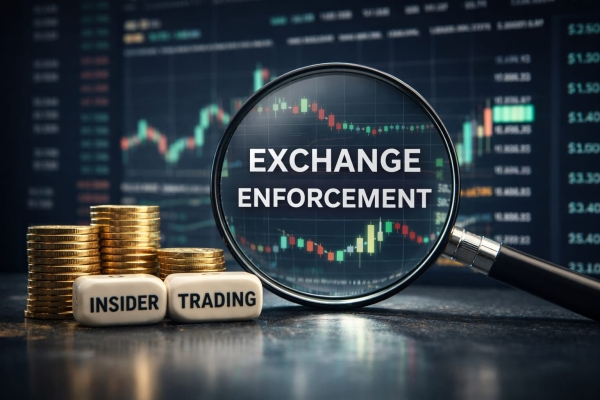
On February 25 2026, prediction market Kalshi disclosed two closed insider trading cases, including one tied to a YouTube editor linked to MrBeast content and one tied to a California political candidate. The same post records 200 investigations in the past year, with more than a dozen active cases.
The CFTC’s enforcement division confirmed the penalties, stating that illegal trading on prediction markets listed on designated contract markets falls within federal derivatives enforcement. Insider trading, misuse of non-public information, and market abuse now sit inside a framework that looks much closer to mainstream market oversight than novelty betting.
1. The MrBeast YouTube editor case carries a $20,397.58 financial penalty and a 2 year suspension from direct or indirect access to Kalshi.
The enforcement post describes trading tied to a popular creator’s videos. Kalshi’s surveillance tools flagged near perfect results in low odds markets, and user reports flagged the same account. The record concludes there was enough evidence to close the matter as an insider trading case and freeze the account.
2. The political candidate case carries a $2,246.36 financial penalty and a 5 year suspension
The second case covers a California political candidate who traded on his own election. The enforcement record treats that conduct as a direct rule breach. Public promotion of those trades made the violation even more visible.
For operators, the takeaway is direct. Once a platform lists contracts tied to events, information control becomes core infrastructure. Monitoring, escalation, account freezes, documented penalties, and regulator coordination all move from compliance overhead to essential operating systems.
For investors, the numbers point to the real test. Volume can scale fast, but conduct failures can damage credibility even faster. The platforms that manage to sustain long term value will be required to run a fair market, enforce their own rules, and stay inside a clear regulatory perimeter. Prediction markets already price geopolitics. The next hurdle is showing they can police information risk with the same seriousness as any other exchange.
When a prediction market issues fines, suspensions, and CFTC backed enforcement over insider trading, does it still trade as a betting product, or does it start operating like exchange infrastructure?
The National Crowdfunding & Fintech Association (NCFA Canada) is a financial innovation ecosystem that provides education, market intelligence, industry stewardship, networking and funding opportunities and services to thousands of community members and works closely with industry, government, partners and affiliates to create a vibrant and innovative fintech and funding industry in Canada. Decentralized and distributed, NCFA is engaged with global stakeholders and helps incubate projects and investment in fintech, alternative finance, crowdfunding, peer-to-peer finance, payments, digital assets and tokens, artificial intelligence, blockchain, cryptocurrency, regtech, and insurtech sectors. Join Canada's Fintech & Funding Community today FREE! Or become a contributing member and get perks. For more information, please visit: www.ncfacanada.org
| | |
|---|---|---|
| | |
Feb 27, 2026 | NCFA Fintech Market Activity | Digital Assets And Market Structure

On February 24 2026, a complaint filed in the Southern District of New York (83 page PDF) by Terraform plan administrator Todd R. Snyder accuses Jane Street and named employees of insider trading, fraud, and market manipulation tied to the May 2022 collapse of the Terra ecosystem.
The filing names Jane Street Group, Jane Street Capital, Bryce Pratt, Robert Granieri, and Michael Huang as defendants. It alleges that Jane Street used confidential information from Terraform insiders, including communications in a group chat identified in the complaint as “Bryce’s Secret”, to gather material non-public information and trade ahead of the UST depeg.
Do Kwon’s guilty plea on fraud charges thrust Terraform in the legal spotlight and forced the scale of the TerraUSD collapse. This lawsuit goes beyond Terraform’s own conduct and asks whether outside trading activity also helped deepen the damage.
The plan administrator was appointed through Terraform’s wind down to pursue recovery claims and maximize value for creditors. The complaint states that the administrator has authority to bring claims on behalf of Terraform, the wind down trust, Luna Foundation Guard, and certain individual victims who assigned claims tied to the collapse. This is a recovery action. The plaintiff is seeking disgorgement and other remedies from parties alleged to have profited from, and contributed to, Terraform’s collapse.
This case now tests whether a major trading firm used information and timing to reduce its own risk while the broader market absorbed the losses.
The complaint alleges that Jane Street sold UST on May 7 2022 after gaining an information edge, then benefited as UST lost its $1 peg within hours and the Terraform ecosystem entered a death spiral. It says those trades allowed Jane Street to unwind hundreds of millions of dollars of potential exposure at a critical point in the collapse.
The filing also points to the scale of emergency support during the crisis. It says Terraform bought more than 250 million UST on May 7, more than 200 million UST on May 8, and more than 1.9 billion UST between May 8 and May 10. It also says Luna Foundation Guard and third parties acting on its behalf used reserves to buy additional UST as the peg failed.
This case puts one of the best known trading firms in global markets into a fresh crypto market integrity fight tied to one of the sector’s biggest failures. If the case moves forward and more evidence enters the public record, scrutiny may increase around how large market makers operate in digital assets, how private information moves between token issuers and trading firms, and how courts apply insider trading and market manipulation theories to crypto markets.
The complaint also underlines the scale of the defendant it targets. It describes Jane Street as responsible for more than 10% of all equity trades in North America and says net trading revenue rose above $24 billion in the first three quarters of 2025. Those figures are allegations in the filing, not court findings, but they help explain why this lawsuit will draw attention well beyond crypto.
For exchanges, brokers, lenders, and digital asset platforms, the immediate issue is control. A case built on alleged private chats, relationship networks, and trade timing puts information barriers, surveillance, and counterparty oversight back at the center of market risk.
If crypto markets face more lawsuits built on insider trading and manipulation claims, does the next major pressure point move from token design to trading conduct?
For investors, the Terra collapse already changed how the market views stablecoins. This lawsuit may force more attention toward trading conduct, information asymmetry, and whether crypto market structure is ready for the same legal standards applied in traditional markets.
The National Crowdfunding & Fintech Association (NCFA Canada) is a financial innovation ecosystem that provides education, market intelligence, industry stewardship, networking and funding opportunities and services to thousands of community members and works closely with industry, government, partners and affiliates to create a vibrant and innovative fintech and funding industry in Canada. Decentralized and distributed, NCFA is engaged with global stakeholders and helps incubate projects and investment in fintech, alternative finance, crowdfunding, peer-to-peer finance, payments, digital assets and tokens, artificial intelligence, blockchain, cryptocurrency, regtech, and insurtech sectors. Join Canada's Fintech & Funding Community today FREE! Or become a contributing member and get perks. For more information, please visit: www.ncfacanada.org
| | |
|---|---|---|
| | |
Feb 27, 2026 | NCFA Fintech Market Activity | Digital Assets And Token Economics

On February 24 2026, Flow Foundation completed a 50,343,896.87 FLOW buyback and burn, equal to about 3% of total supply (approx CAD $2.7M), and committed to buy at least another 50,000,000 FLOW over the coming months for treasury holdings.
The burn took place on February 23 at 12:00 PM PT. The tokens came from a mix of open market purchases and treasury funds collected between December 27 2025 and February 22 2026. The Foundation says the burn is permanent, irreversible, and verifiable on chain.
The next part of the plan is just as important. Flow says it will keep buying tokens in the open market and is working on better liquidity support and market making partnerships across multiple platforms. So, this isn't a one time burn. The Foundation is putting more treasury capital behind the token through 2026.
Three figures drive the story. First, roughly 3% of total supply is removed from circulation. Second, at least 50,000,000 more tokens are now part of the stated treasury buying plan. Third, Flow says the network is built to become net deflationary at a sustained 250 transactions per second, the point where fees collected rise above new tokens issued for staking rewards.
Flow also says staking rewards stay unchanged at about 9% APY and that token holders do not need to take any action. It's important because the Foundation is trying to reduce supply pressure without changing the current staking setup for users.
Earlier this month, 40 million users and 950 million transactions gave Flow a stronger scale story heading into this treasury move. Meaning the Foundation is supporting a token tied to a network with real usage, not just future plans.
Flow is also pushing a speed and utility case. In a recent developer update, 4 second soft finality and 10 second hard finality became part of its case for more serious onchain apps that need faster confirmation and less settlement uncertainty.
Also another update pegs Flow moving beyond earlier collectibles identity to consumer DeFi infrastructure. Taken together, the buyback, burn, liquidity support, faster settlement, and DeFi positioning all point in the same direction. Flow is trying to tighten supply while backing a larger push for deeper usage.
It is a direct treasury move backed by clear numbers and a longer runway. Flow is reducing circulating supply now, adding another minimum purchase target, and pointing to a fee model that aims to lower inflation as network usage rises. That gives the market a clearer picture of how the Foundation wants to support the token.
For builders and investors, the takeaway is simple. Token value does not depend only on ecosystem growth. It also depends on how clearly a foundation manages supply, supports trading conditions, and explains the path to a more durable network economy. In this case, Flow is putting real treasury capital behind that message.
When a blockchain foundation burns 3% of supply and commits to buy at least 50,000,000 more tokens, does treasury policy start to matter as much as product growth?
The National Crowdfunding & Fintech Association (NCFA Canada) is a financial innovation ecosystem that provides education, market intelligence, industry stewardship, networking and funding opportunities and services to thousands of community members and works closely with industry, government, partners and affiliates to create a vibrant and innovative fintech and funding industry in Canada. Decentralized and distributed, NCFA is engaged with global stakeholders and helps incubate projects and investment in fintech, alternative finance, crowdfunding, peer-to-peer finance, payments, digital assets and tokens, artificial intelligence, blockchain, cryptocurrency, regtech, and insurtech sectors. Join Canada's Fintech & Funding Community today FREE! Or become a contributing member and get perks. For more information, please visit: www.ncfacanada.org
| | |
|---|---|---|
| | |


August 26th, 2025

January 4th, 2024

June 1st, 2021

September 9th, 2020

July 9th, 2018

January 3rd, 2018

September 25th, 2017

June 20th, 2017

May 10th, 2017

December 14th, 2016
