




Karsten Wenzlaff, Advisor
August 26th, 2025
Karsten Wenzlaff is a Crowdfunding and Fintech Expert from Germany. He is Secretary-General of Digit[...]


Apr 3, 2026 | NCFA Insight | Digital Assets, Blockchain And Tokenization

On Mar 31, 2026, Google Quantum AI published new research on crypto security that says future quantum computers may break the elliptic curve cryptography used by cryptocurrencies with fewer qubits and gates than many people expected.
The research follows a recent hardware breakthrough of Google’s Willow quantum chip with a more practical claim about what future hardware could mean for today’s crypto security. Google’s research looks at the hard math that protects the public and private keys used by Bitcoin and Ethereum. It compiled two attack circuits, one using fewer than 1,200 logical qubits and 90 million Toffoli gates, and another using fewer than 1,450 logical qubits and 70 million Toffoli gates.
Based on the paper’s assumptions, Google estimates those circuits could run in a few minutes on a machine with fewer than 500,000 physical qubits, which is about 20 times less than earlier estimates. Google is saying the hardware threshold for breaking the cryptography behind today’s crypto keys may be much lower than the industry thought.
Bottom line is that the crypto industry may have less time than it thought to get ready for Quantum.
The paper doesn't treat every chain the same. Google says Bitcoin is more exposed to an attack during a transaction because public keys can become visible before settlement is final and the network approx. 10 minutes block gives an attacker more time to act. While Ethereum’s shorter block timing makes that specific early path less practical under the same assumptions.
The takeaway is that quantum pressure will hit networks differently, with exposure depending on key handling, wallet design, settlement timing, and how hard it is for a chain to coordinate an upgrade once the clock starts ticking.
Digital asset exchanges, custodians, wallet firms, and infrastructure providers can’t swap out cryptography overnight. They’ll need code changes, testing, governance, user education, and in some cases a messy transition across older systems that were never built for this kind of change.
Some firms have a much harder job than others. A Bitcoin holder reusing addresses and sitting on older wallet structures faces a different migration problem from a user operating through newer wallet tooling and faster transaction environments.
A custodian protecting large balances across older signing infrastructure has a bigger operational problem than a newer platform with cleaner architecture and fewer legacy constraints.
None of that is glamorous. However, it's the kind of work that determines who is will adapt clearly versus scrambling later on when the heat turns up at the risk of a user or investor base.
Google is already working towards a 2030 post quantum migration across its own systems. Google isn't getting their crystal ball out with a specific deadline for the crypto threat, but they do show it's no longer a distant research file for major infrastructure players. Teams that start early will have options. Teams that wait may end up trying to fix cryptography, user migration, and governance at the same time.
 The National Crowdfunding & Fintech Association (NCFA Canada) is a financial innovation ecosystem that provides education, market intelligence, industry stewardship, networking and funding opportunities and services to thousands of community members and works closely with industry, government, partners and affiliates to create a vibrant and innovative fintech and funding industry in Canada. Decentralized and distributed, NCFA is engaged with global stakeholders and helps incubate projects and investment in fintech, alternative finance, crowdfunding, peer-to-peer finance, payments, digital assets and tokens, artificial intelligence, blockchain, cryptocurrency, regtech, and insurtech sectors. Join Canada's Fintech & Funding Community today FREE! Or become a contributing member and get perks. For more information, please visit: www.ncfacanada.org
 |  |  |
|---|---|---|
 |  |  |
Apr 3, 2026 | NCFA Fintech Market Insight | Digital Assets Blockchain And Tokenization
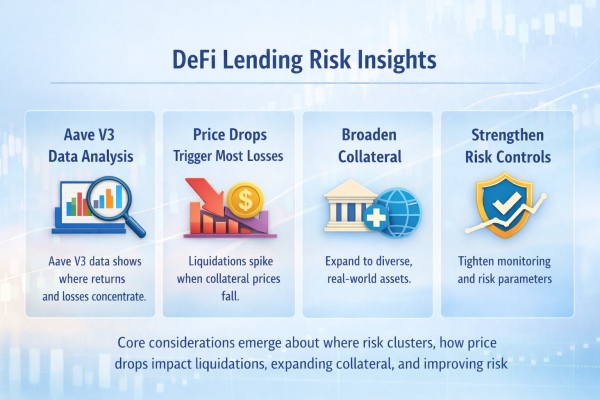
On April 2, 2026, a DeFi lending risk analysis using Aave V3 data from the Bank of Canada analyzes transaction data on Ethereum to find a market that works operationally, but depends on narrow revenue pools, heavy overcollateralization, and fast liquidation when collateral prices fall.
The paper focuses on Aave V3 because it is the largest decentralized lending protocol by total value locked. It cites about $34 billion secured in smart contracts, roughly 25% of all DeFi TVL and about 50% of lending sector TVL. The data analyzed runs from January 27, 2023 to May 6, 2025, which gives the study enough depth to study how the model behaves in live market conditions and not just theory.
The earnings base is much narrower than the deposit base. On Aave V3, WETH, USDT, and USDC generate nearly 83% of total protocol earning in the sample. That doesn't mean the same pattern holds across the entire DeFi lending market, but it does show the largest lending protocol still relies heavily on a small set of assets to produce revenue.
Supply alone does not tell you much. Utilization does. A token can hold a large share of deposits and still contribute very little if borrowing demand stays weak. So careful about judging a lending model by total deposits alone. Look at it by which assets actually generate borrow demand, spread income, and recurring usage.
The comparison with banking makes the constraint clearer. In 2024, Aave V3 posts an estimated 0.64% net interest margin, versus 2.48% for major US banks and 1.69% for major Canadian banks.
Aave V3 also shows a 40.0% loan to deposit ratio, compared with 61.2% for major US banks and 74.2% for major Canadian banks. The model runs with lower overhead, but it also runs with tighter economics and lower capital efficiency.
Repeated borrowing and redepositing of the same collateral accounts for about 20.46% of total borrowed volume and 8.20% of borrowing transactions on Aave V3.
Only about 2% of active users engage in this behaviour, but that small group borrows more often, takes larger positions, uses more flash loans, and runs closer to liquidation.
Risk isn't evenly spread across the user base, but with a relatively small group of sophisticated users who amplify exposure through repeated borrow and redeposit loops. A protocol can look healthy at the aggregate level while vulnerability builds inside a small cluster of accounts.
The largest liquidation wave in the sample reached about $258 million, and the top ten waves account for roughly 80% of total liquidated volume.
WETH, wstETH, WBTC, and weETH account for about 90% of total liquidated value. Collateral diversity on paper is not the same as resilience in practice. When account stress rises, losses still cluster around a small set of core assets.
For all liquidated users, 84.40% of health factor deterioration comes from collateral price declines. For the largest borrowers, that rises to 97.28%. Interest rate changes play only a minor role in the hour before liquidation. So do borrower actions like repaying, withdrawing, borrowing, or supplying more assets.
Immediate risk is mostly market driven. If collateral drops hard enough, the position breaks. Everything else is secondary.
Liquidation fees range from about 5% to 10% of liquidated value. When missed upside from post liquidation price recovery is added, combined borrower losses can reach roughly 10% to 30%.
Automation protects lenders and preserves solvency, but it forces borrowers out at the worst possible time. That raises a harder design question. How do you reduce forced exits before volatility does the damage?
The authors highlight tokenized real world assets as a way to broaden the collateral base and improve stability. They point to decentralized identity frameworks to support better underwriting.
They also raise the question of prudential tools such as leverage limits, capital requirements, or liquidity thresholds.
Concentration risk in DeFi isn't just exposure to a single token. It's dependence on a narrow collateral base, a narrow earnings base, and a narrow set of highly leveraged users. Broader collateral, stronger underwriting signals, and tighter limits can each address a different part of that problem.
Focus on where revenue actually comes from. If earnings depend on a small number of assets, growth is more fragile than it looks.
Track who drives leverage, not just how many users exist. A small group can shape downside risk.
Improve collateral quality, not just collateral variety. Adding assets does not reduce risk if stress still runs through the same core tokens.
Build liquidation buffers into the product. Earlier warnings, better position visibility, and automated risk controls can reduce forced selling.
The strategic takeaway is DeFi lending demand isn't the issue, but rather risk concentration is. The platforms that stand out will spread exposure across better collateral, reduce reliance on highly leveraged users, and design systems that hold up when prices drop. That's how the model can mature from access to durable growth.
The National Crowdfunding & Fintech Association (NCFA Canada) is a financial innovation ecosystem that provides education, market intelligence, industry stewardship, networking and funding opportunities and services to thousands of community members and works closely with industry, government, partners and affiliates to create a vibrant and innovative fintech and funding industry in Canada. Decentralized and distributed, NCFA is engaged with global stakeholders and helps incubate projects and investment in fintech, alternative finance, crowdfunding, peer-to-peer finance, payments, digital assets and tokens, artificial intelligence, blockchain, cryptocurrency, regtech, and insurtech sectors. Join Canada's Fintech & Funding Community today FREE! Or become a contributing member and get perks. For more information, please visit: www.ncfacanada.org
| | |
|---|---|---|
| | |
Mar 26, 2026 | NCFA Feature | Digital Assets Blockchain And Tokenization
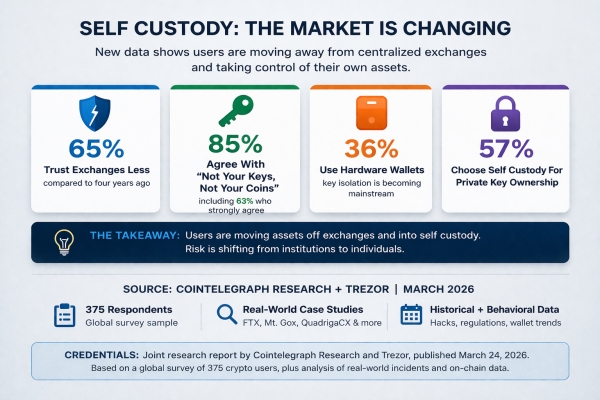
On March 24 2026, a Cointelegraph Research and Trezor report on self custody behaviour put hard numbers behind the trend that's been building for years. Trust in centralized platforms keeps falling. At the same time, self custody is moving out of the expert corner of crypto and into the mainstream for serious users.
The report draws on 375 survey responses and pairs that data with real world exchange failures, wallet design analysis, and a sober look at where users still get hurt. People have watched enough platforms fail, and now they're changing how they hold assets.
A combined 65% of respondents say they trust centralized exchanges less than they did four years ago. Of that group, 45% say they trust them much less and 20% say they trust them a bit less
33% point to exchange hacks as the main driver. 27% point to collapses such as FTX. Another 26% point to regulatory restrictions.
The trend matches the market’s recent history. FTX exposed an estimated $8B hole in customer funds. QuadrigaCX collapsed amid fraud and broken internal controls. Mt. Gox lost about 850,000 BTC after years of theft and system failures.
The deeper issue is structural. Centralized platforms gather large pools of assets behind a small number of operational and administrative control points. That concentration makes them efficient in good times, but it also makes them attractive targets when something goes wrong. One breach, one fraud, one breakdown in controls, and the damage can spread fast.
Users aren't just frustrated. They're acting on it.
A striking 85% of respondents agree with the phrase “not your keys, not your coins.” That includes 63% who strongly agree. It's becoming standard thinking for people who want lasting control over digital assets.
When asked why they use self custody, 57% say private key ownership is the main reason. Another 24% say maximum security drives the decision.
Most respondents say they would not leave assets on a custodial exchange for more than one month, even without an immediate panic event. In practice, exchanges are starting to look less like vaults and more like temporary access points.
One of the clearest data points in the report is that 36% of respondents actively use hardware wallets.
A hardware wallet keeps your private keys off your phone or computer. You set up a transaction on your device, then confirm and sign it on the hardware wallet. The keys never leave the wallet. This lowers the risk of malware, hacks, and common theft methods.
Hardware wallets protect your keys, but they don’t protect your decisions. They can confirm a transaction comes from your device, but they can’t always tell if you fully understand what you’re approving.
Phishing is still one of the biggest risks. Attackers copy real wallet brands, fake support messages, and trick users into giving up their recovery phrase. Once that’s exposed, the funds are usually gone.
Blind signing is another major issue, especially with smart contracts. Users approve transactions without fully understanding what they do. The report highlights a real case where a malicious approval led to a $1.4B loss. That alone shows self custody is not just about buying a device and feeling safe.
Supply chain risk is also real. Some people buy wallets from unofficial sellers and receive devices that have been tampered with or come with preset seed phrases. It compromises the user before self custody even begins.
Physical security is becoming more serious as well. The report cites 74 publicly reported physical attacks on crypto holders in 2025, with at least 9 already recorded in January 2026. These are real world attacks tied to visible holdings and weak operational privacy.
Then there is the quieter problem that rarely gets enough attention, which is backup failure. The report estimates that roughly 10% of circulating Bitcoin supply may already be lost because users mismanage recovery material or lose access entirely. It reminds the market that the biggest long term risk in self custody may not be theft alone. It may be preventable self inflicted loss.
Another useful part of the report is its treatment of regulatory risk. Users are not only responding to hacks and insolvencies. They are also responding to the fact that access to funds can be interrupted, such as payment rail seizures, exchange shutdowns, withdrawal suspensions, and enforcement actions that cut off access to custodial accounts. Different cases arise from different legal and operational reasons.
Users who worry about counterparty exposure, platform freezes, or policy driven restrictions increasingly want a self custody setup they can control directly.

Digital wallets are becoming core control layers in digital asset finance. That assumes customers will keep meaningful balances on platform for long periods of time.
The next real product gap is not only stronger key storage, but clearer intent verification. Users need to know what they are signing, why they are signing it, and what will happen next. That means readable transaction flows, better simulation tools, stronger warnings, clearer address handling, and far less dependence on users interpreting raw contract data on the fly.
Security is central to the user experience. The firms that reduce confusion, expose hidden risk, and make recovery practices easier to manage will offer a match better product experience than companies that assume security begins and ends with cryptography.
Finally, distribution and engagement models will keep changing as assets move off centralized platforms and into user controlled environments. Markets are evolving toward wallet centered ecosystems, service layers, and infrastructure that works with user sovereignty rather than around it.
Ownership does not create security on its own. Security comes from repeated good practice. Users need to verify transactions carefully, protect recovery material, source devices properly, and think through physical as well as digital threat models. Put differently, self custody is not a static product state. It is an operating discipline.
Self custody is no longer a niche behaviour reserved for maximalists, techies, and power users. It is becoming a natural response to broken trust in centralized custody. It moves responsibility away from institutions and toward individuals, which means the next generation of financial products must do more than secure assets. They must help people operate safely in a digital finance world.
The National Crowdfunding & Fintech Association (NCFA Canada) is a financial innovation ecosystem that provides education, market intelligence, industry stewardship, networking and funding opportunities and services to thousands of community members and works closely with industry, government, partners and affiliates to create a vibrant and innovative fintech and funding industry in Canada. Decentralized and distributed, NCFA is engaged with global stakeholders and helps incubate projects and investment in fintech, alternative finance, crowdfunding, peer-to-peer finance, payments, digital assets and tokens, artificial intelligence, blockchain, cryptocurrency, regtech, and insurtech sectors. Join Canada's Fintech & Funding Community today FREE! Or become a contributing member and get perks. For more information, please visit: www.ncfacanada.org
| | |
|---|---|---|
| | |
Mar 26, 2026 | NCFA Fintech Market Activity | Banking And Credit, Digital Assets And Tokenization

On March 26, 2026, Better and Coinbase launched the first token backed conforming mortgage. Qualified borrowers can pledge Bitcoin or USDC to fund a cash down payment while still taking out a standard mortgage that meets Fannie Mae rules. The structure lets borrowers use digital assets without selling them first and without automatically triggering a taxable sale event.
The product targets a large and growing borrower base. Better and Coinbase put the addressable market at 52 million Americans who own digital assets, equal to 20% of American adults. They also mention quite an age split, with 45% of younger investors holding crypto versus 18% of older investors. That age gap means it's much harder for younger buyers to meet traditional down payment cash requirements, yet many already hold part of their savings in digital assets.
There are no margin calls and no required top ups if Bitcoin falls in value. Price moves alone do not trigger liquidation. Collateral comes into play only if a borrower becomes 60 days delinquent, under the same treatment applied to standard conforming mortgages. Borrowers using USDC can also earn rewards on pledged balances, which may offset mortgage payments and lower the net effective rate.
The buyer profile is also broader than a luxury crypto niche. Better and Coinbase said 67% of token holders are 45 or younger and 26% earn less than US $75,000 a year. They also pointed to Redfin data showing 12.7% of Gen Z and Millennial homebuyers have already sold tokenized assets to fund a down payment, versus 3.5% of Gen X and 0.5% of Baby Boomers.
Digital assets are now included in standard mortgage structure, not just a trading or investment account. Token holdings now help fund a conforming mortgage down payment without forcing a sale first. As this model grows, digital assets will look less like something borrowers need to liquidate and more like collateral lenders may be willing to work with.
Better and Coinbase also plan to expand eligible collateral over time to include tokenized equities, fixed income, and tokenized real estate assets. If that happens, the story will not stop at mortgages. It will continue to proliferate into which consumer lending products can absorb token backed collateral and under what terms.
If digital assets can now help fund a conforming mortgage, which standard lending products could be next to accept token backed collateral?
The National Crowdfunding & Fintech Association (NCFA Canada) is a financial innovation ecosystem that provides education, market intelligence, industry stewardship, networking and funding opportunities and services to thousands of community members and works closely with industry, government, partners and affiliates to create a vibrant and innovative fintech and funding industry in Canada. Decentralized and distributed, NCFA is engaged with global stakeholders and helps incubate projects and investment in fintech, alternative finance, crowdfunding, peer-to-peer finance, payments, digital assets and tokens, artificial intelligence, blockchain, cryptocurrency, regtech, and insurtech sectors. Join Canada's Fintech & Funding Community today FREE! Or become a contributing member and get perks. For more information, please visit: www.ncfacanada.org
| | |
|---|---|---|
| | |
Mar 25, 2026 | NCFA Fintech Market Activity | Digital Assets And Tokenization

On March 25, 2026, BitGo added qualified custody support for USDCx and cBTC on the Canton Network. This expands its role on Canton beyond Canton Coin and into CIP-56 assets, the token format Canton uses for regulated financial markets.
The CIP-56 token standard supports private transactions, built in KYC and AML controls, delivery versus payment settlement, and final settlement within seconds. Those features give institutions the controls they need to use tokenized assets in real collateral and settlement workflows.
Canton describes itself as a privacy enabled blockchain network for institutional assets, with about 600 validators live and more than 15 million monthly transactions using Canton Coin in their flows. That's why BitGo's expansion is interesting because it plugs additional assets into a network that's already being built for regulated financial activity, not retail token trading.
USDCx already serves as the settlement currency for out of hours repo settlement and tokenized collateral workflows on Canton. It is issued through Circle’s xReserve framework. cBTC adds bitcoin backed liquidity to the same environment, giving firms another asset they can use across collateral and settlement activity. This isn't just broader token support. It makes the settlement layer more usable.
Qualified custody for Canton Coin launched in October 2025, and token support followed in less than six months. The work is no longer just about putting assets onchain. It is about building the custody, collateral, and settlement stack that institutions need around them.
Canton is also drawing in more institutional infrastructure, including tokenized money market fund infrastructure from Goldman Sachs and BNY. This BitGo move adds another piece to the same buildout. If tokenized finance is going to work at scale, firms need more than issuance. They need custody that institutions trust, settlement assets they can use, and compliant rails that hold up under real volume. That's where commercial value is starting to concentrate.
As tokenized markets add stablecoin settlement, bitcoin backed liquidity, and qualified custody, which firms become hardest to replace?
The National Crowdfunding & Fintech Association (NCFA Canada) is a financial innovation ecosystem that provides education, market intelligence, industry stewardship, networking and funding opportunities and services to thousands of community members and works closely with industry, government, partners and affiliates to create a vibrant and innovative fintech and funding industry in Canada. Decentralized and distributed, NCFA is engaged with global stakeholders and helps incubate projects and investment in fintech, alternative finance, crowdfunding, peer-to-peer finance, payments, digital assets and tokens, artificial intelligence, blockchain, cryptocurrency, regtech, and insurtech sectors. Join Canada's Fintech & Funding Community today FREE! Or become a contributing member and get perks. For more information, please visit: www.ncfacanada.org
| | |
|---|---|---|
| | |
Mar 20, 2026 | NCFA Market Activity | Quantum Security And Digital Finance

Image: Pixabay/geralt
On Mar 18, 2026, the 2025 ACM A.M. Turing Award recognized Gilles Brassard and Charles H. Bennett for foundational work in quantum information science, including the development of quantum cryptography. The award carries a $1 million prize and marks one of the highest global honours in computing.
Brassard’s work established early methods for secure communication using quantum mechanics, a field now directly tied to the future of encryption. While he didn't develop today’s post quantum standards, his research helped define how information can be secured against quantum-enabled attacks. That body of work went from advanced research to execution in August 2024 when NIST finalized the first post quantum cryptography standards for encryption and digital signatures used across financial systems.
As ACM President Yannis Ioannidis stated:
“Their work is an important foundation for the field of quantum computing and has fundamentally changed how we process, transmit, and secure information.”
Post quantum cryptography (PQC) refers to new encryption methods designed to remain secure even if future quantum computers can break today’s widely used systems today, such as RSA and elliptic curve cryptography that currently protect payments, digital identity, secure messaging, APIs, and financial data.
On Aug 13, 2024, NIST finalized three post quantum cryptography standards and announced that organizations should begin transitioning to them as soon as possible. NIST states these standards support encryption and digital signatures used to secure electronic information, including financial transactions and sensitive data.
NIST also states that no one knows exactly when a cryptographically relevant quantum computer will arrive, but some experts estimate it could be possible in less than 10 years. That uncertainty increases the risk because encrypted data can be collected today and targeted for future decryption under the harvest now, decrypt later threat model.
Canada has already set execution timelines. The Canadian roadmap for post quantum cryptography migration requires departments to begin planning in April 2026, report progress annually, transition high priority systems by the end of 2031, and complete remaining migration by the end of 2035. Canada’s national strategy for quantum communication and cryptography states that advances in quantum computing could undermine current encryption and threaten digital systems and data security.
For financial services, encryption now affects what gets built and what gets bought. Payments, identity, onboarding, APIs, messaging, custody, and long term data all rely on encryption that may need to be replaced or upgraded.
Quantum also reaches into blockchain based finance like stablecoins, tokenized deposits, wallet infrastructure, custody controls, and smart contract connected payment flows all depend on digital signatures and key management. NCFA’s earlier coverage of quantum safe stablecoins points to a market approaching US$250 billion and highlights how quantum safe controls are already being added to stablecoin settlement systems.
Buyers are starting to ask direct questions. Where is encryption used in the product. Which parts rely on current standards. What is the plan to upgrade. These questions and decisions are part of core financial workflows now and show up across payments messaging, identity systems, API access, document signing, custody, and stored data.
Vendors that can clearly show where encryption sits in their systems and how they plan to upgrade it will have an advantage as requirements tighten.
NIST standards are finalized and Canada has set migration timelines starting in April 2026, with high priority systems due by the end of 2031 and full migration by the end of 2035. That puts a clock on encryption used across payments, identity, APIs, messaging, custody, and long term data.
The National Crowdfunding & Fintech Association (NCFA Canada) is a financial innovation ecosystem that provides education, market intelligence, industry stewardship, networking and funding opportunities and services to thousands of community members and works closely with industry, government, partners and affiliates to create a vibrant and innovative fintech and funding industry in Canada. Decentralized and distributed, NCFA is engaged with global stakeholders and helps incubate projects and investment in fintech, alternative finance, crowdfunding, peer-to-peer finance, payments, digital assets and tokens, artificial intelligence, blockchain, cryptocurrency, regtech, and insurtech sectors. Join Canada's Fintech & Funding Community today FREE! Or become a contributing member and get perks. For more information, please visit: www.ncfacanada.org
| | |
|---|---|---|
| | |
Mar 19, 2026 | NCFA Market Activity | Digital Assets

On Mar 18, 2026, licensed S&P 500 perpetual trading went live on Hyperliquid through Trade[XYZ]. The product gives eligible non US investors 24/7 access to leveraged long or short S&P 500 exposure without expiry. A core global equity benchmark now trades onchain 24/7.
S&P says its linked ecosystem drives $1T daily trading across futures, options, ETFs, and structured products. Moving that benchmark into a perpetual format allows liquidity to form before traditional sessions open. Early demand for the product already looks real. Decrypt reported $10M open interest shortly after launch, while S&P’s release says Trade[XYZ] markets on Hyperliquid have already cleared $100B volume since October 2025 and are running at more than $600B annualized.
Price discovery no longer has to wait for markets to open. If more benchmark trading starts off hours on crypto venues, traditional exchanges risk following market moves instead of leading them. Even a modest change in where liquidity shows up first can change how volatility spreads across markets.
Investors now have a route to benchmark exposure at any hour, across borders, on a venue built for continuous trading. That changes expectations around access, monitoring, and response time for exchanges, brokerages, data analytics and risk teams. It also raises risk with reports that the product can offer leverage up to 50 times, which means off hours trading can bring sharper liquidations and sweeping moves when order books are thin.
The global implication is bigger than one listing. A major index owner has opened a new channel for benchmark access on chain. That puts pressure on incumbents that still depend on fixed sessions, regional access, and legacy infrastructure. If this model gains traction, exchanges will need to defend their role not just on liquidity depth, but on speed, availability, and product reach.
Canadian fintechs, dealers, market infrastructure firms, and regulators should pay attention to how benchmark access is changing. If clients start expecting round the clock exposure and faster market response, organizations that stay tied to old windows may lose ground. Firms that build around new access patterns, stronger risk tools, and better market visibility will have a chance to capture more of the next layer.
This is not just a crypto wrapper on a known index. It is an early sign that benchmark distribution is starting to move onto new rails. The firms that adapt early can help shape where liquidity, data, and customer activity go next.
The next phase will depend on where liquidity builds and how quickly institutions respond. If trading depth increases on these venues, more benchmarks, sectors, and asset classes will follow into perpetual formats. That would push exchanges, clearing systems, and regulators to respond to a market that no longer operates in sessions. However, if liquidity remains thin, these products will stay a niche trading layer. The open question is how fast global capital markets will adjust to always on access?
The National Crowdfunding & Fintech Association (NCFA Canada) is a financial innovation ecosystem that provides education, market intelligence, industry stewardship, networking and funding opportunities and services to thousands of community members and works closely with industry, government, partners and affiliates to create a vibrant and innovative fintech and funding industry in Canada. Decentralized and distributed, NCFA is engaged with global stakeholders and helps incubate projects and investment in fintech, alternative finance, crowdfunding, peer-to-peer finance, payments, digital assets and tokens, artificial intelligence, blockchain, cryptocurrency, regtech, and insurtech sectors. Join Canada's Fintech & Funding Community today FREE! Or become a contributing member and get perks. For more information, please visit: www.ncfacanada.org
| | |
|---|---|---|
| | |


August 26th, 2025

January 4th, 2024

June 1st, 2021

September 9th, 2020

July 9th, 2018

January 3rd, 2018

September 25th, 2017

June 20th, 2017

May 10th, 2017

December 14th, 2016
