





Karsten Wenzlaff, Advisor
August 26th, 2025
Karsten Wenzlaff is a Crowdfunding and Fintech Expert from Germany. He is Secretary-General of Digit[...]


Feb 4, 2026 | NCFA Fintech Market Activity | Regulation and Digital Assets

On February 3 2026, Nevada filed a civil enforcement action against Coinbase prediction markets in court alleging Coinbase offered sports-linked event contracts without a required Nevada gaming licence.
The regulator argues that the contracts available through Coinbase’s prediction markets are considered wagering activity under Nevada law and therefore requires state authorization. The filing seeks a temporary restraining order and preliminary injunction to prevent Coinbase from operating these markets in Nevada while the case proceeds.
Coinbase launched its prediction markets nationally in all 50 states in late January through a partnership with Kalshi, a derivatives exchange registered with the U.S. Commodity Futures Trading Commission. Users can trade yes or no contracts on real world outcomes, including professional sports events, directly inside the Coinbase app. NCFA has previously examined how prediction markets begin pricing geopolitical and financial outcomes across traditional and digital finance.
This case highlights a growing regulatory conflict. Coinbase maintains that prediction markets fall under federal derivatives oversight through the CFTC. Nevada’s regulator treats the same product as sports wagering that falls under state gaming law. That difference creates immediate compliance risk for fintech platforms offering event-based contracts across multiple jurisdictions.
Several other U.S. states have already taken steps to restrict or challenge similar markets tied to sports outcomes. Nevada’s action is the first to move into formal court proceedings against Coinbase’s implementation.
When prediction markets sit between derivatives law and gaming law, how should fintech platforms design licensing, governance, and market access controls across jurisdictions?
This case forces a legal definition of where and when prediction markets belong inside financial regulation and whether digital platforms can rely solely on federal derivatives oversight when states interpret the same contracts as wagering.

The National Crowdfunding & Fintech Association (NCFA Canada) is a financial innovation ecosystem that provides education, market intelligence, industry stewardship, networking and funding opportunities and services to thousands of community members and works closely with industry, government, partners and affiliates to create a vibrant and innovative fintech and funding industry in Canada. Decentralized and distributed, NCFA is engaged with global stakeholders and helps incubate projects and investment in fintech, alternative finance, crowdfunding, peer-to-peer finance, payments, digital assets and tokens, artificial intelligence, blockchain, cryptocurrency, regtech, and insurtech sectors. Join Canada’s Fintech & Funding Community today FREE! Or become a contributing member and get perks. For more information, please visit: www.ncfacanada.org
 |  |  |
|---|---|---|
 |  |  |
January 30, 2026 | NCFA Fintech Whisperer Weekly Intelligence | Payments And Money Movement, Artificial Intelligence And Data, Capital Markets And Market Infrastructure, Digital Assets Blockchain And Tokenization, Open Banking Open Finance And Data Sharing

Image: Freepik
This live weekly NCFA intelligence page tracks financial technology developments that significantly affect how fintechs build, sell, raise capital, and operate under scrutiny. Coverage prioritizes Canada and includes global events that directly influence competitive conditions, market access, and execution realities across fintech sectors. This page will be updated throughout the week with market movers in a live format and then each week we'll close the prior week's contents in prep for the upcoming week, and continue on a rolling basis. (Missed prior week's Fintech Whisperer? (December 6-12, 2025, December 13-19, 2025, January 1-9, 2026, January 10-16, 2026, January 17-23, 2026)
Payment activity, API demand and recurring use increased while system performance remained stable. The figures establish an operating benchmark for countries building open banking around data access, payment initiation and commercial services. The later one billion payment milestone shows how quickly that base continued to expand.
Once a PSP can join the payments club directly, it can cut onboarding friction, tighten settlement and reconciliation, and show stronger operational maturity to banks, enterprise buyers, and regulators. Founders that treat membership readiness as an operating system will move faster when big partners demand proof. Investors should watch which PSPs turn access into volume and repeatable unit economics, not just press.
This is a planning signal for how the UK approaches AI in retail finance. Firms that sell into regulated buyers win time if they can show who owns outcomes, how models get tested, and how controls work across vendors and data flows. Teams that cannot evidence that quickly will find AI work slows down at the point of trust, not the point of build.
This matters to fintechs that sell into regulated buyers because coordination changes the buyer checklist. The winners standardize controls and reporting across spot, derivatives, custody, and settlement workflows so they do not rebuild the stack every time definitions and boundaries tighten.
This takes tokenization out of the hype lane and into build discipline. If you sell tokenized security rails to real institutions, you win deals when you answer the hard questions fast, who controls the record, how transfers stay legally effective, and where the product plugs into broker dealer, transfer agent, and clearing and settlement expectations.
This move embeds regulated stablecoin issuance directly into a global payments platform instead of leaving it at the edge. When stablecoins sit inside licensed EMI rails, settlement, liquidity management, and compliance become part of the core payments stack. Founders building wallets, FX, treasury, or cross border infrastructure should expect buyers to favor platforms that combine regulated issuance with distribution at scale.
A federal trust structure offers nationwide reach, clearer supervision, and stronger institutional credibility. Fintechs selling custody, settlement, compliance, or risk tooling should prepare for customers that operate under bank grade expectations. Investors should watch which applicants can survive the supervision burden that comes with federal status.
This pulls crypto compliance into product planning. Teams that want UK market access move faster when they convert these rule areas into workflows early, especially safeguarding, reporting, and accountable ownership across senior roles.
Payments access expands in Canada while regulators in the UK and US push firms toward clearer accountability in AI, crypto, and tokenized securities. The common thread is execution readiness. Buyers now ask who owns the record, who controls outcomes, and how a platform proves it can operate under supervision without slowing down. Fintechs that build for audit, governance, and market access early earn trust faster and avoid costly rebuilds when rules tighten around custody, settlement, and consumer outcomes. NCFA offers various curated resources to help founders and investors stay current on developments that impact fintech markets, subscribe to NCFA’s weekly newsletter, view a rundown of current fintech news and insights, or dive into the latest fintech industry research.
The National Crowdfunding & Fintech Association (NCFA Canada) is a financial innovation ecosystem that provides education, market intelligence, industry stewardship, networking and funding opportunities and services to thousands of community members and works closely with industry, government, partners and affiliates to create a vibrant and innovative fintech and funding industry in Canada. Decentralized and distributed, NCFA is engaged with global stakeholders and helps incubate projects and investment in fintech, alternative finance, crowdfunding, peer-to-peer finance, payments, digital assets and tokens, artificial intelligence, blockchain, cryptocurrency, regtech, and insurtech sectors. Join Canada's Fintech & Funding Community today FREE! Or become a contributing member and get perks. For more information, please visit: www.ncfacanada.org
| | |
|---|---|---|
| | |
January 23, 2026 | NCFA Fintech Whisperer Weekly Intelligence | Artificial Intelligence And Data, Payments And Money Movement, Digital Assets Blockchain And Tokenization, Open Banking Open Finance And Data Sharing, Risk Compliance And Regtech
Image: Freepik
This live weekly NCFA intelligence page tracks financial technology developments that significantly affect how fintechs build, sell, raise capital, and operate under scrutiny. Coverage prioritizes Canada and includes global events that directly influence competitive conditions, market access, and execution realities across fintech sectors. This page will be updated throughout the week with market movers in a live format and then each week we'll close the prior week's contents in prep for the upcoming week, and continue on a rolling basis. (Missed prior week's Fintech Whisperer? (December 6-12, 2025, December 13-19, 2025, January 1-9, 2026, January 10-16, 2026)
This lands in the middle of a problem every operator knows. AI stops being a feature once it touches credit, pricing, advice, fraud decisions, or customer outcomes. Buyers and supervisors ask one thing first. Can you prove how it behaves, who owns the decision, and what happens when it fails. Founders who build strong logs, clear accountability, and testable controls keep momentum when scrutiny rises. Investors should back teams that can ship AI inside regulated environments without betting on fuzzy governance.
Travel payments stay messy because suppliers, currencies, fraud controls, and reconciliation collide in one workflow. When a travel platform embeds issuing plus FX plus collections, it turns payments into a default layer that buyers adopt without a separate vendor decision. Fintechs that sell cards, FX, or payables into travel win faster when they integrate into the platforms that already control inventory and supplier routing, and when they ship audit ready controls that finance teams can trust at scale.
Private bank adoption changes buyer expectations fast. Once a top tier wealth manager treats crypto as an investable asset inside the core private bank, every crypto vendor selling into wealth has to meet private bank standards on suitability, controls, reporting, and operational discipline. Founders that sell custody, execution, portfolio reporting, or risk tooling should expect tougher diligence and longer lists of required evidence. Investors should watch for picks and shovels that fit inside existing wealth compliance rather than products that need new rules to work.
Cross border CBDC linkage puts sovereign governed interoperability back on the table as an operating roadmap. Fintechs that sell wallets, settlement tooling, compliance rails, and treasury workflows should plan for rule dense governance, shared operating standards, and audit grade traceability that can survive multi jurisdiction scrutiny.
A serious push for a US banking licence tells the market Revolut wants durable US distribution, not a light footprint. Once a global fintech commits to supervised rails in the United States, competitors face a tighter clock on product depth, compliance maturity, and funding strategy. Founders that sell infrastructure into banks and fintechs should expect more demand for audit ready controls, clean reporting, and resilient operations that hold up under US supervision.
Public markets put custody under a harsher light than private capital. Reporting cadence, risk controls, and operational proof start becoming the product. Founders selling into custody, compliance, and settlement stacks should expect tighter vendor scrutiny and cleaner evidence demands. Investors can treat this as a live benchmark for how the market values regulated digital asset infrastructure once it sits in plain view.
This deal pulls a modern fintech spend platform directly inside a large US bank instead of leaving it at the partnership layer. Once a bank owns the full card, payments, and spend stack, pricing pressure increases and distribution advantages compound fast. Founders building expense management, treasury, or commercial card tooling should expect tougher competition from vertically integrated banks. Investors should treat this as another signal that late stage fintech exits increasingly come through acquisition by incumbents that want product control, not just vendor relationships.
Tokenization stops looking like a side experiment once a core exchange puts its matching engine and brand behind it. The winners don't come from who talks loudest about crypto. The winners come from who can run clean market structure under supervision, with settlement, custody, funding, and controls that broker dealers and clearing members can defend. Founders building post trade, custody, reconciliation, collateral, and stablecoin treasury tooling should treat this as a buyer signal. Regulated infrastructure buyers want fewer moving parts, stronger audit trails, and reliable operating hours that match global capital flows.
Data modernization rarely feels exciting until it hits production. When a supervisor modernizes filing rails, every regulated team ends up rewriting workflows, data mapping, controls, and audit evidence. Fintechs that sell reporting, data, regtech, or infrastructure should treat this as a near term buying trigger. Institutions will pick vendors that reduce change risk and make compliance proof simple, not vendors that add another layer of complexity.
Charter expansion at scale. When a global fintech pursues full licenses market by market, it raises the competitive bar on compliance execution, local product depth, and funding strategy. Competitors feel pressure through faster distribution, tighter pricing room, and regulators expecting stronger controls across the category.
The firms that win are the ones that control where money moves and can prove they run a tight and compliant shop. Payments and treasury are getting built into the software people already live in, not sold as a separate product. Big fintechs keep chasing full licenses so they can offer more, price tighter, and rely less on partners. Governments keep pushing cross border settlement ideas that bring more rules, more reporting, and more scrutiny.
Founders should treat three things as product work. First, build evidence into the workflow so every action leaves a trace you can explain. Second, design for partner and regulator questions before they show up, not after. Third, sell into distribution points that already own the customer and the switching moment, because that's where adoption actually happens. Investors can use the same filter. Back teams that reduce operating risk while keeping shipping speed. Avoid models that need regulatory fog, fragile partners, or perfect market timing. The upside concentrates in infrastructure and platforms that buyers can trust at scale.
NCFA offers various curated resources to help founders and investors stay current on developments that impact fintech markets, subscribe to NCFA’s weekly newsletter, view a rundown of current fintech news and insights, or dive into the latest fintech industry research.
The National Crowdfunding & Fintech Association (NCFA Canada) is a financial innovation ecosystem that provides education, market intelligence, industry stewardship, networking and funding opportunities and services to thousands of community members and works closely with industry, government, partners and affiliates to create a vibrant and innovative fintech and funding industry in Canada. Decentralized and distributed, NCFA is engaged with global stakeholders and helps incubate projects and investment in fintech, alternative finance, crowdfunding, peer-to-peer finance, payments, digital assets and tokens, artificial intelligence, blockchain, cryptocurrency, regtech, and insurtech sectors. Join Canada's Fintech & Funding Community today FREE! Or become a contributing member and get perks. For more information, please visit: www.ncfacanada.org
| | |
|---|---|---|
| | |
Stablecoins | January 20, 2026
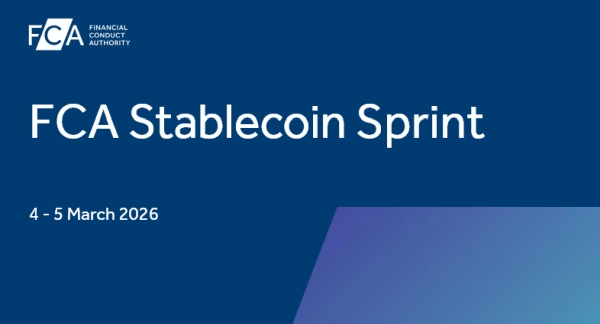
Image: FCA Stablecoin sprint participation pack, March 4-5, 2026
The UK Financial Conduct Authority is hosting a Stablecoin Sprint on March 4 and 5, 2026 in London. Applications are open until February 4, 2026. The Sprint feeds directly into the FCA’s work to finalize stablecoin payment rules later in 2026 and focuses on retail payments and remittances, including point of sale payments, ecommerce, domestic transfers, and cross border payments. A smaller roundtable planned for May will focus on trade payments, including trade finance and B2B payment flows.
The Stablecoin Sprint follows a series of FCA consultations in 2025 covering stablecoin issuance, safeguarding of cryptoassets, prudential capital and liquidity requirements, disclosure for UK issued qualifying stablecoins, and application of the FCA Handbook to regulated crypto activities. The FCA has also opened a stablecoins cohort within its Regulatory Sandbox to allow issuers to test UK issued stablecoins.
The FCA has structured the Sprint around three policy questions that go directly to how stablecoin payments would operate in practice. Full details are set out in the 16 page PDF, FCA Stablecoin Sprint participation pack.
The first problem statement asks what business models firms could use to deliver stablecoin payment use cases. Participants are expected to map payment flows end to end and explain how roles and responsibilities sit across issuers, wallets, payment providers, banks, and infrastructure firms.
The second problem statement examines where opportunities and risks arise within those models. This includes identifying where consumer harm, financial crime exposure, operational failure, or business weakness could appear, as well as where stablecoin payments could offer real improvements over existing payment systems.
The third problem statement focuses on priorities. Participants are asked to consider what regulation is needed, what may not be needed, and where risks could be addressed through business practices or technical design rather than new rules.
Across all three problem statements, the FCA asks participants to test stablecoin payment models against cost, speed, interoperability, certainty of settlement, and consumer protection.
Canadian regulators have already consulted publicly on payment functions through the Retail Payment Activities Act and on stablecoins through federal and securities frameworks. What the FCA Sprint adds is a use case driven exercise that brings those questions together around live payment flows. For Canadian fintechs, it offers a clear view of the practical issues regulators may still need to address as stablecoins move from trading into everyday payments.
As stablecoins move from trading and settlement into everyday payment use, regulators are under pressure to explain how these models fit within existing payment rules. The FCA Stablecoin Sprint shows that key questions around business models, risk ownership, and consumer protection remain open. For fintechs, payment firms, and infrastructure providers, the Sprint offers a clear view of where policy attention now sits and where practical clarity will matter most as stablecoin payment rules take shape. Apply Now
The National Crowdfunding & Fintech Association (NCFA Canada) is a financial innovation ecosystem that provides education, market intelligence, industry stewardship, networking and funding opportunities and services to thousands of community members and works closely with industry, government, partners and affiliates to create a vibrant and innovative fintech and funding industry in Canada. Decentralized and distributed, NCFA is engaged with global stakeholders and helps incubate projects and investment in fintech, alternative finance, crowdfunding, peer-to-peer finance, payments, digital assets and tokens, artificial intelligence, blockchain, cryptocurrency, regtech, and insurtech sectors. Join Canada's Fintech & Funding Community today FREE! Or become a contributing member and get perks. For more information, please visit: www.ncfacanada.org
| | |
|---|---|---|
| | |
Stablecoins | Jan 19, 2026

January 2026 finds stablecoins firmly inside the regulatory process. Governments are writing rules that determine how these instruments can operate within payment systems. In Canada, draft federal legislation is now under review, as outlined in Canada releases the first draft of the Stablecoin Act. In the United States, policymakers and industry groups are focused on a narrower question: whether regulators should treat rewards offered by third party platforms the same way they treat interest paid by stablecoin issuers?
Canada’s draft framework draws a clear line at issuer behaviour. The draft rules prohibit stablecoin issuers from paying interest or yield, reinforcing the view that stablecoins should function as payment instruments rather than deposit substitutes. The draft does not yet spell out how regulators will treat rewards offered by wallets, exchanges, or other platforms once those rules take effect. The above open question explains why the US debate has relevance in Canada. Incentive design often becomes the point regulators use to decide whether a product remains within payments or moves closer to deposit like treatment, even when the user experience appears unchanged.
In Washington, the argument doesn't focus on issuer paid interest. That restriction is largely settled. The disagreement is whether third-party platforms should be allowed to offer rewards that encourage people to hold or use stablecoins.
Banking groups argue that rewards tied to balances could draw funds away from traditional deposits and weaken lending models.
Crypto and fintech advocates respond that platform funded rewards resemble familiar payment incentives such as card rebates or loyalty programs and do not create a claim on the stablecoin issuer. The analysis of whether third party stablecoin rewards should be banned walks through how lawmakers are weighing whether issuer interest bans should also capture platform rewards.
For Canada, the point is how regulators separate issuer obligations from platform competition when incentives sit on top of a payment instrument.
Canada’s draft framework concentrates on issuer conduct. Issuers would need to meet requirements around reserves, redemption, governance, and risk management, and they would be barred from paying interest or yield. This keeps stablecoins from being marketed as savings products. What the draft does not spell out is how independently funded rewards offered by wallets, exchanges, or other platforms would be treated in practice. NCFA has previously noted how regulatory tolerance tightens as stablecoins move closer to core payments infrastructure.
As of the time of publishing, neither the Bank of Canada nor Finance Canada has published summaries of stakeholder submissions on the draft stablecoin rules (although some may have been directly published), and no further official public guidance on platform rewards or inducements has been released yet.
Stablecoins now fall within the scope of Canada’s payments modernization process, even though final rules are still pending. Regulators classify stablecoins as payment instruments that intersect with payment service providers, real time settlement, and retail payments supervision. NCFA walks through how this plays out in Stablecoin payments have wings, showing how digital payment instruments move from edge cases into everyday payment design.
How regulators handle rewards on stablecoins will influence how other payment products using rebates, credits, or embedded incentives are treated. This goes beyond crypto and into the design of future payment services.
Once stablecoins sit inside everyday payments, regulators have to decide whether usage based incentives fit within a payments framework or whether they push products toward deposit like treatment. That decision will affect not only stablecoin products, but also other payment models that rely on incentives to drive adoption.
For Canadian fintechs, incentive design now carries regulatory weight. Who pays the reward, how it’s described, whether it remains discretionary, and how custody is structured could influence how a product is classified. This isn’t a narrow crypto issue. It’s part of how Canada decides what belongs inside payments regulation and what doesn’t.
The National Crowdfunding & Fintech Association (NCFA Canada) is a financial innovation ecosystem that provides education, market intelligence, industry stewardship, networking and funding opportunities and services to thousands of community members and works closely with industry, government, partners and affiliates to create a vibrant and innovative fintech and funding industry in Canada. Decentralized and distributed, NCFA is engaged with global stakeholders and helps incubate projects and investment in fintech, alternative finance, crowdfunding, peer-to-peer finance, payments, digital assets and tokens, artificial intelligence, blockchain, cryptocurrency, regtech, and insurtech sectors. Join Canada's Fintech & Funding Community today FREE! Or become a contributing member and get perks. For more information, please visit: www.ncfacanada.org
| | |
|---|---|---|
| | |
January 16, 2026 | NCFA Fintech Whisperer Weekly Intelligence | Regulation And Policy, Payments And Market Infrastructure, Lending Consumer Credit And BNPL, Digital Assets Blockchain And Tokenization
Image: Freepik
This live weekly NCFA intelligence page tracks financial technology developments that significantly affect how fintechs build, sell, raise capital, and operate under scrutiny. Coverage prioritizes Canada and includes global events that directly influence competitive conditions, market access, and execution realities across fintech sectors. This page will be updated throughout the week with market movers in a live format and then each week we'll close the prior week's contents in prep for the upcoming week, and continue on a rolling basis. (Missed prior week's Fintech Whisperer? (December 6-12, 2025, December 13-19, 2025, January 1-9, 2026)
Cross border payments still break down in the same places. Too many handoffs, too much reconciliation, and too much time and cost hiding in the middle. When central banks and major banks test a shared settlement model together, they start setting expectations for speed, data standards, and risk controls. Fintechs that sell treasury, compliance, and payment operations tooling should prepare for buyers that demand cleaner audit trails and tighter settlement logic as the new baseline.
This places SME lending market structure under direct policy scrutiny rather than access narratives alone. For fintech lenders, the signal favours models that reduce switching friction, improve transparency, or introduce credible competitive pressure. For incumbents, the risk sits in policy driven changes that reshape pricing power and distribution over time.
Crypto and stablecoin distribution is tied to unresolved legislative design choices rather than settled rules. Platforms planning to scale under supervision must design operating models that handle changes in incentive treatment, oversight jurisdiction, and compliance expectations without disrupting delivery. Capital and distribution advantage increasingly favour teams that can adapt quickly as market structure rules evolve. US Crypto Week to Impact Global Policy
The UK is putting stablecoin payments into hands on market design, not only policy debate. Builders that want UK distribution should treat this as a signal to get practical fast on consumer protection, complaint handling, safeguarding, and settlement controls. The teams that show working flows, clean reporting, and clear accountability win mindshare early and they tend to shape what becomes normal later.
Clear rules increasingly define who can scale in crypto and stablecoin markets. Platforms that rely on regulatory ambiguity face shrinking room to operate, while firms built for supervision gain an advantage. Founders should plan for explicit role separation, auditable controls, and regulator ready operating models across exchanges, custody, and wallets. Investors should expect value to concentrate in businesses that can grow inside defined rules without slowing product execution.
Supporting links:
Congressional Research Service overview
MiCA turns EU market access into a deadline with real exit risk. Crypto firms that sell into Europe now need licensing readiness and an orderly wind down plan partners can accept, because regulators are already mapping who intends to comply and who intends to leave.
Stablecoin settlement is turning into a control point, not a feature. When a platform owns more of the settlement stack, it can ship faster, price tighter, and negotiate from strength with banks and distribution partners. Founders should treat integration readiness, reconciliation, and audit grade controls as table stakes. Investors should expect the best outcomes to cluster around teams that control settlement plus compliance plus distribution.
Legislative work in the United States and platform moves to control settlement and compliance show where the market is heading, and growth will favour firms that can run clean operations, manage risk inside regulated environments, and still move fast. Investors should focus on teams that can scale without relying on regulatory gaps or temporary structures. NCFA offers various curated resources to help founders and investors stay current on developments that impact fintech markets, subscribe to NCFA’s weekly newsletter, view a rundown of current fintech news and insights, or dive into the latest fintech industry research.
The National Crowdfunding & Fintech Association (NCFA Canada) is a financial innovation ecosystem that provides education, market intelligence, industry stewardship, networking and funding opportunities and services to thousands of community members and works closely with industry, government, partners and affiliates to create a vibrant and innovative fintech and funding industry in Canada. Decentralized and distributed, NCFA is engaged with global stakeholders and helps incubate projects and investment in fintech, alternative finance, crowdfunding, peer-to-peer finance, payments, digital assets and tokens, artificial intelligence, blockchain, cryptocurrency, regtech, and insurtech sectors. Join Canada's Fintech & Funding Community today FREE! Or become a contributing member and get perks. For more information, please visit: www.ncfacanada.org
| | |
|---|---|---|
| | |
Crypto | Jan 15, 2026

Image: Freepik/fabrikasimf
On January 9, 2026, the Ontario Superior Court ordered Binance to pay $261,900 in legal costs after finding that its attempt to force a Hong Kong arbitration was abusive and aimed at intimidating Canadian investors. The ruling issued in Lochan v. Binance Holdings Limited, 2026 ONSC 194 didn't decide whether Binance ultimately violated securities law, but it delivered a clear rebuke of litigation tactics designed to undermine a certified Canadian class action.
The case was brought by Christopher Lochan and Jeremy Leeder, two Canadian investors acting as representative plaintiffs on behalf of other Canadians who used Binance’s platform. They allege that Binance allowed Canadians to trade crypto products that fall under Ontario securities law without registering or providing a compliant prospectus, contrary to the Ontario Securities Act.
NCFA first covered the lawsuit when Canadian investors led a class action against Binance Canada, highlighting why the case raised broader questions about how crypto platforms operate in Canada. The Ontario court later certified the case as a class action in 2024, allowing it to proceed on behalf of affected users rather than as individual claims.
Binance attempted to block the lawsuit by relying on an arbitration clause in its standard user agreement that required disputes to be resolved in Hong Kong. Ontario courts rejected that strategy. In 2023, the court found the clause unenforceable, concluding that the cost and structure of the arbitration process would make it unrealistic for ordinary Canadians to pursue claims and would place Binance beyond the reach of Canadian courts.
NCFA later examined this turning point in Ontario court blocks Binance’s costly arbitration clause. Those findings were upheld on appeal, confirming that the arbitration clause was void as contrary to public policy.
Despite those rulings, Binance later began arbitration proceedings in Hong Kong through a related offshore entity. That arbitration targeted Lochan and Leeder personally and claimed they breached their contract simply by starting the Ontario lawsuit.
The court found that the offshore entity was an alter ego of Binance and that the arbitration was a direct attempt to sidestep earlier Ontario decisions. In 2025, Justice Morgan issued an anti-suit injunction restricting Binance and its affiliates from continuing the Hong Kong arbitration.
As Justice Morgan put it,
“That approach by the Defendants appeared to me to have been aimed not at building a meritorious argument, but at, frankly, scaring the Plaintiffs away from their claim.”
In January 2026, the court said Binance’s conduct crossed a line. The judge found that the company used litigation tactics that were abusive and unfair, and that they exposed the representative plaintiffs to personal financial risk simply for bringing a certified class action on behalf of other Canadians.
Although the court hearing itself was brief, the judge made clear that the work behind it was not. The plaintiffs had to respond quickly to a complicated cross-border legal move that threatened to derail a case the court had already approved to proceed. Because of that effort, the court ordered Binance to pay $261,900 to cover the plaintiffs’ legal costs.
The Ontario court's decision draws a clear line for global fintech and crypto platforms operating in Canada. Once a Canadian court takes jurisdiction, companies are expected to deal with the case directly and in good faith. Contract clauses and offshore tactics cannot be used to pressure individual plaintiffs or shut down class actions.
The National Crowdfunding & Fintech Association (NCFA Canada) is a financial innovation ecosystem that provides education, market intelligence, industry stewardship, networking and funding opportunities and services to thousands of community members and works closely with industry, government, partners and affiliates to create a vibrant and innovative fintech and funding industry in Canada. Decentralized and distributed, NCFA is engaged with global stakeholders and helps incubate projects and investment in fintech, alternative finance, crowdfunding, peer-to-peer finance, payments, digital assets and tokens, artificial intelligence, blockchain, cryptocurrency, regtech, and insurtech sectors. Join Canada's Fintech & Funding Community today FREE! Or become a contributing member and get perks. For more information, please visit: www.ncfacanada.org
| | |
|---|---|---|
| | |



August 26th, 2025

January 4th, 2024

June 1st, 2021

September 9th, 2020

July 9th, 2018

January 3rd, 2018

September 25th, 2017

June 20th, 2017

May 10th, 2017

December 14th, 2016
