





Karsten Wenzlaff, Advisor
August 26th, 2025
Karsten Wenzlaff is a Crowdfunding and Fintech Expert from Germany. He is Secretary-General of Digit[...]


Crypto Asset Policy | Oct 15, 2025

Image: Freepik AI
In August 2025, Quebec’s Financial Markets Administrative Tribunal issued its decision in AMF v. Gagnon et al. that examined whether tokens linked to a crypto trading signal subscription service were investment contracts under Quebec’s Securities Act or not. The respondents ran an online business that sold memberships through social media and a Telegram group, offering automated buy and sell recommendations for digital currencies such as bitcoin. Investors paid recurring fees to receive trading alerts and access private chat rooms.
The tribunal found that the respondents misled subscribers and exaggerated claims about profit potential without proper registration. However, it also ruled that the tokens and the trading signals themselves weren't securities. Investors acted independently (i.e., placing their own trades), and there was no pooling of funds or shared enterprise that would meet the legal test for an investment contract in Quebec.
It's an important ruling because it draws a clear line between activities that require securities registration and those that do not. The decision has prompted discussion across Canada about how regulators should evaluate crypto asset business models (subscription required).
The tribunal focused on how the Gagnon business actually worked, not how the business is described or the types of tokens involved. The respondents sold subscriptions to a crypto signal service through social media and Telegram. Members paid recurring fees (usually in crypto) to access automated trading alerts and private discussion groups. The tribunal found that subscribers of the service acted independently because they placed their own trades, used their own accounts, and there was no pooling of funds or shared enterprise.
Because the respondents did not issue tokens, manage capital, or control investor profits, the activity did not meet the legal test for an investment contract. The tribunal said speculation alone does not make a trading service or token a security.
David Durand, Founder Durand Lawyers and NCFA Advisor, was interviewed for the Law360 article on legal classification of crypto assets, who argued that each crypto asset and business model must be assessed on its economic reality, not through one universal rule.
“The fact that securities regulations would have scant effect in protecting users on decentralized networks makes it evident that defining crypto assets as a security would provide ineffective regulatory enforcement in this respect. "[Overreaching securities regulation on the crypto asset regime would] likely create a system where onerous requirements are placed on users of such assets, with an end result of suppressing innovation [in financial technology and financial capital to leave Canada seeking more favourable environments]."
“The important point here is that the tribunal says a crypto asset is not an investment contract. However, when we criticize the act of trading an asset, we are referring to the investment contract in relation to the person and not the object or the very nature of the crypto asset. The implications are that we are moving in the right direction in terms of the fact that crypto assets were not an investment contract.”
Although the decision applies only in Quebec, its reasoning may influence regulators across Canada. The Canadian Securities Administrators have been moving toward coordinated rules for crypto trading platforms, but this ruling highlights the limits of the CSAs current approach when activities vary so widely in design.
The tribunal also said regulators need stronger evidence before using enforcement tools like freezing orders. It ruled that authorities must show clear proof before stopping a business from operating. This could set a new standard for fairness in future crypto cases.
For fintech founders, the ruling gives clearer guidance on what falls inside or outside securities law. Businesses that offer decentralized tools, such as trading signal services, software systems, or network platforms are less likely to be treated as securities, if users of those tools remain in control of their own money and avoid profit sharing and collective investment components.
For regulators, the case is a reminder to focus on real misconduct instead of labelling all crypto activity as securities by default.
The Gagnon reasoning parallels the SEC v. Ripple Labs decision in the United States, where a U.S. court drew a line between tokens sold directly by a company and those traded later on the open market. The court said that how and where a token is sold makes a difference. When people buy directly from the issuer based on its efforts, the sale can fall under securities law, but trades between independent buyers and sellers on exchanges may not.
Europe’s Markets in Crypto-Assets (MiCA) regulation offers another useful example. MiCA builds specific legal categories for utility tokens, payment tokens, and asset-referenced tokens, instead of applying one framework to all.
Canada has yet to create a similar set of purpose-based rules, leaving courts and tribunals to fill the gaps through case law.
The Quebec tribunal ruling strengthens NCFA's call for a coordinated national digital asset framework that distinguishes between token types and activities. Further, Canada can draw from both MiCA’s structured taxonomy and the functional reasoning used in Ripple and Gagnon. NCFA continues to recommend that policymakers should now focus on:
The Gagnon ruling challenges Canada’s regulatory system to evolve beyond the one-size-fits-all treatment of crypto assets. The tribunal recognized that each digital asset and business model carries distinct risks and economic activities.
One brush does not fit all. Crypto assets differ in structure, function, and purpose. Regulation must be designed for growth, not just enforcement. As NCFA recently argued in “Regulating for Growth by Understanding Innovation”, good regulation should reward experimentation, promote competition, and provide safe entry points for new entrants, not block innovators out of fear.
If Canada wants to compete in digital finance, it must build laws that reflect how crypto businesses actually work, support new ideas, and focus on misconduct, not label everything a security first.
 The National Crowdfunding & Fintech Association (NCFA Canada) is a financial innovation ecosystem that provides education, market intelligence, industry stewardship, networking and funding opportunities and services to thousands of community members and works closely with industry, government, partners and affiliates to create aa vibrant and innovative fintech and funding industry in Canada. Decentralized and distributed, NCFA is engaged with global stakeholders and helps incubate projects and investment in fintech, alternative finance, crowdfunding, peer-to-peer finance, payments, digital assets and tokens, artificial intelligence, blockchain, cryptocurrency, regtech, and insurtech sectors. Join Canada's Fintech & Funding Community today FREE! Or become a contributing member and get perks. For more information, please visit: www.ncfacanada.org
 |  |  |
|---|---|---|
 |  |  |
CZ | Oct 14, 2025

Image: Freepik/wirestock
Changpeng Zhao (known as CZ) pleaded guilty in November 2023 to a single count of violating the Bank Secrecy Act after U.S. authorities found Binance had failed to maintain effective anti-money laundering controls. He stepped down as CEO and was sentenced in April 2024 to four months in federal prison while paying a $50 million fine. Binance also paid $4.3 billion to settle related charges with the Department of Justice and other agencies.
In May 2025, Zhao stated publicly that he had applied for a presidential pardon from Donald Trump. The U.S. Senate Banking Committee confirmed the filing’s existence in a letter dated May 15, 2025, asking the Department of Justice and the White House to clarify whether the request was being considered. The senators cited potential conflicts of interest tied to Trump family business ventures connected to crypto ventures associated with Binance.
On October 10, 2025, journalist Charles Gasparino reported on X that White House discussions about a possible pardon were “heating up.” The New York Post followed with a story two days later describing alleged internal debates over optics as the Trump administration manages several crypto-related policy files.
The article references unnamed sources close to both Zhao and Trump, who claim the president is sympathetic to Zhao’s case but mindful of potential conflicts due to family business interests in the crypto sector.
No formal statement from the White House, the Department of Justice, Binance, or Zhao’s legal team has confirmed these discussions. The White House press office maintains a standard position of not commenting on active or potential pardons. Therefore, these claims remain based only on Gasparino's report and subsequent media coverage.
Even without confirmation, the story matters because a pardon could erase Zhao’s criminal record, reopening the possibility for U.S. financial institutions to engage with Binance or its affiliates under less restrictive compliance terms.
It could also influence broader perceptions of how the U.S. balances enforcement with innovation across the $4 trillion global digital asset market. The Senate Banking Committee’s letter highlights bipartisan concern about transparency in how executive clemency intersects with crypto business interests, and spotlights growing concerns between pro-market reform vs accountability for compliance gaps in digital finance.
As of October 14, 2025, verified information is limited to Zhao’s conviction, sentencing, fines, and his publicly acknowledged pardon petition. Otherwise, there is no public record or filing in the Office of the Pardon Attorney showing that any pardon has been granted or is under formal review.
Until official confirmation appears, the case stands as a reminder that anonymous political reporting must be treated cautiously, especially if it could affect markets and trust in financial governance.
The National Crowdfunding & Fintech Association (NCFA Canada) is a financial innovation ecosystem that provides education, market intelligence, industry stewardship, networking and funding opportunities and services to thousands of community members and works closely with industry, government, partners and affiliates to create aa vibrant and innovative fintech and funding industry in Canada. Decentralized and distributed, NCFA is engaged with global stakeholders and helps incubate projects and investment in fintech, alternative finance, crowdfunding, peer-to-peer finance, payments, digital assets and tokens, artificial intelligence, blockchain, cryptocurrency, regtech, and insurtech sectors. Join Canada's Fintech & Funding Community today FREE! Or become a contributing member and get perks. For more information, please visit: www.ncfacanada.org
| | |
|---|---|---|
| | |
Digital Asset Regulation | Oct 1, 2025

Image: Freepik
On September 29, 2025, the U.S. Securities and Exchange Commission (SEC, Corporate Finance Division) issued a no action letter for DoubleZero that addresses how decentralized physical infrastructure networks (DePIN) should be treated under securities law.
The SEC's staff concluded that tokens earned by providing infrastructure services did not need to be registered as securities. Commissioner Hester Peirce reinforced this position in a follow-up statement, where she described DePIN tokens as rewards for real work rather than investments reliant on others’ managerial efforts.
DePIN refers to decentralized physical infrastructure networks where people contribute bandwidth, storage, mapping, or energy and receive tokens in return. These networks create open marketplaces for infrastructure and reduce reliance on centralized ownership.
Peirce (aka Crypto mom) described this approach as a new way to organize services using blockchain technology. She argued that tokens functioning as rewards for services are economically distinct from securities and that forcing all blockchain models into securities law could suppress innovation.
DoubleZero avoided the pitfalls of speculative fundraising from token sales marketed with profit expectations. Instead of pre-selling tokens to investors, its 2Z token was earned by participants who contributed infrastructure services, such as bandwidth, storage, and node operation.
The SEC staff stated that it would not recommend enforcement if tokens were distributed under the programmatic model presented by counsel. The relief granted was narrow and applied only to the programmatic model where tokens were distributed automatically to contributors per present conditions.
The letter also made clear that different facts could lead to a different outcome. You can read DoubleZero's response to the no-action letter here.
In the vein of avoiding token fundraising and keeping distributions tied to real services, networks that reward participants for sharing unused internet bandwidth, provide hard drive capacity, or feed energy into microgrids could potentially align with this reasoning. Other applications might include mapping and geospatial services, where users are rewarded for validated data contributions.
By contrast, projects that conduct presales or ICOs with promises of speculative returns, rely heavily on centralized managerial efforts, or direct most tokens to investors rather than active participants are less likely to qualify. The SEC emphasized that the economic reality must be compensation for work or services, not profit expectations.
While Canada hasn't yet issued specific guidance for DePIN tokens, the DoubleZero letter offers a comparison that Canadian entrepreneurs and policymakers can evaluate when distinguishing between functional reward tokens and investment contracts.
It's another clear acknowledgement from the SEC that not all tokens should be treated as securities. For builders, it shows how models tied to infrastructure participation can be designed to avoid speculative classification.
The National Crowdfunding & Fintech Association (NCFA Canada) is a financial innovation ecosystem that provides education, market intelligence, industry stewardship, networking and funding opportunities and services to thousands of community members and works closely with industry, government, partners and affiliates to create aa vibrant and innovative fintech and funding industry in Canada. Decentralized and distributed, NCFA is engaged with global stakeholders and helps incubate projects and investment in fintech, alternative finance, crowdfunding, peer-to-peer finance, payments, digital assets and tokens, artificial intelligence, blockchain, cryptocurrency, regtech, and insurtech sectors. Join Canada's Fintech & Funding Community today FREE! Or become a contributing member and get perks. For more information, please visit: www.ncfacanada.org
| | |
|---|---|---|
| | |
Stablecoin Research | Sep 23, 2025
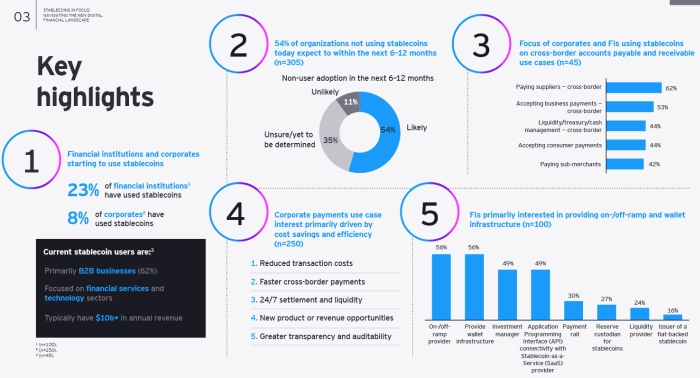
Image: Stablecoin Survey Research Highlights (EY Parthenon Sep 2025)
On September 15, 2025, EY-Parthenon released its latest stablecoin survey results, "Stablecoins: Adoption, Optimism, and Regulatory Clarity" (download 31 page PDF), covering 350 executives from corporates and financial institutions across the US, EMEA and other regions. Research takeaways confirm adoption is picking up speed, supposed by regulatory clarity by the GENIUS Act, recently signed into law.
Why is this happening? Approval of the U.S. GENIUS Act is a regulatory catalyst. Further, pilots are proving real value and corporate treasurers are under pressure to improve efficiency. The thinking is that organizations delaying adoption risk losing ground to competitors who are moving forward and benefiting from the lower cost and faster transactions of stablecoin technologies.
Why is everyone saving money by using stablecoins? The reason is straightforward. Traditional cross border payments involve multiple intermediaries, each adding fees and time. Stablecoins bypass these frictions and settles instantly, so the cost savings are structural (not incremental). For fintech providers, there's a growing opportunity to provide integration and risk management tools to help corporates adopt/use stablecoins and measure their effectiveness.
The reality is that we live and function in a global economy where delays can disrupt supply chains, so it's not surprising that corporates will adopt stablecoins for faster and more streamlined and predictable settlement solutions. This means that stablecoin adoption will likely strong and swift among B2B supplier and trade finance flows before expanding more widely into consumer payments.
In Canada, regulatory inaction is catching up with market momentum. On September 19, 2025, regulators like OSFI have warned the Prime Minister Mark Carney that Canada should accelerate federal stablecoin rules to avoid falling behind global peers. The Bank of Canada has echoed this call, saying stablecoins should be as safe and stable as the balance in your bank account. OSFI is already drafting a new framework to regulate stablecoin issuers, while domestic momentum is building as Tetra Digital Group secured $10M from Canadian banks and fintechs to launch a CAD stablecoin in 2026. Observers including investor John Ruffolo warn in his Looming Stablecoin Storm substack that without clear domestic rules, Canada risks ceding innovation, competitiveness and monetary sovereignty to jurisdictions that move faster.
Canadian corporates and fintechs need to plan not just for current global trends, but for a new local regulatory stablecoin framework. Firms are advised to engage with policymakers to create the right environment, build compliance ready infrastructure now and position for interoperability with USD pegged tokens and domestic stablecoin initiatives.Waiting could result in higher compliance costs, restricted access, and eventually a decline in market share.
Bottom line is banks understand that clients will demand stablecoin services and that failure to provide them risks their disintermediation. There's an intensifying race between traditional institutions and fintech challengers to capture stablecoin transaction flows.
Hybrid build and partner strategy. Corporates are demanding trust and compliance, while financial institutions know they cannot deliver the full stack alone. This means that partnerships between fintechs, banks and technology providers will determine how quickly stablecoin adoption scales.
Stablecoins are moving from pilot projects into enterprise strategy. Corporates see real cost savings and competitive advantage, while financial institutions are preparing to build services at scale to meet client demand. Regulation is beginning to catch up, led by the GENIUS Act in the US, but the global landscape is unbalanced while Canada’s fintech ecosystem is calling on the federal government to create and regulate a stablecoin framework to remain aligned and competitive.
The National Crowdfunding & Fintech Association (NCFA Canada) is a financial innovation ecosystem that provides education, market intelligence, industry stewardship, networking and funding opportunities and services to thousands of community members and works closely with industry, government, partners and affiliates to create aa vibrant and innovative fintech and funding industry in Canada. Decentralized and distributed, NCFA is engaged with global stakeholders and helps incubate projects and investment in fintech, alternative finance, crowdfunding, peer-to-peer finance, payments, digital assets and tokens, artificial intelligence, blockchain, cryptocurrency, regtech, and insurtech sectors. Join Canada's Fintech & Funding Community today FREE! Or become a contributing member and get perks. For more information, please visit: www.ncfacanada.org
| | |
|---|---|---|
| | |
Regulation | Sep 18, 2025
On September 17, 2025, the U.S. Securities and Exchange Commission (SEC) approved generic exchange listing standards for Commodity-Based Trust Shares. This decision means that exchanges can now list new products without filing for case by case approvals, including those backed by digital assets.
This policy update is arguably the most significant since the SEC’s approval of spot bitcoin ETFs earlier this year, and is anticipated to accelerate the rollout of digital asset funds across U.S. markets.
Commodity Based Trust Shares are exchange traded products that hold physical assets like metals or digital assets, instead of being regulated under the Investment Company Act of 1940. Under the new rules, this means that digital assets can be listed more quickly if they meet certain standards.
The new framework effectively creates a fast track for digital asset ETFs. Before every product required a Section 19(b) filing with reviews that could stretch for months.
To qualify, the product must either track an asset traded on a market that is part of the Intermarket Surveillance Group with data sharing agreements, be linked to a regulated futures contract that has been trading for at least six months, or have at least 40% of its portfolio in a single commodity already covered by another listed product.
The SEC stressed that even though these products are not investment companies, they must still publish key disclosures, including their holdings and daily net asset value, similar to ETFs.
In addition to the new generic listing standards, the SEC also approved two specific applications that will give investors more ways to gain regulated exposure to crypto assets:
Not all commissioners agreed. Commissioner Caroline Crenshaw warned that generic standards could change responsibility for investor protection. Read the formal statement 'Passing the Buck' by Commissioner Caroline Crenshaw for her concerns about speed and scrutiny in volatile markets.
Market observers expect a wave of new filings.
For investors, more products mean greater choice and a need to understand custody, valuation, and disclosures.
For fintechs and asset managers, shorter timelines create room for innovation in fund design, multi asset strategies, and derivatives.
Commissioner Hester Peirce welcomed the decision as overdue. In her statement on the approval , she noted that generic listing standards “eliminate the need for prior SEC approval under Section 19(b)” and would reduce time and resources required to bring new products to market. Peirce acknowledged past delays and court rulings that pushed the SEC to open a path for spot crypto ETPs, and she emphasized that the new rules provide alternative eligibility criteria beyond surveillance sharing agreements. She argued that the streamlined process will benefit investors, issuers, market participants, and the Commission itself by increasing predictability and efficiency.
Canada approved the first spot bitcoin ETF in 2021, but most digital asset funds are still reviewed case by case. By approving new generic exchange listing standards, the United States has adopted a scalable model that could influence regulators globally.
If Canada doesn't modernize its framework, fintech innovators and investor capital could drain south where products can launch faster. Aligning with an efficient standard could help maintain Canada’s leadership in fintech while ensuring investor protections.
The National Crowdfunding & Fintech Association (NCFA Canada) is a financial innovation ecosystem that provides education, market intelligence, industry stewardship, networking and funding opportunities and services to thousands of community members and works closely with industry, government, partners and affiliates to create aa vibrant and innovative fintech and funding industry in Canada. Decentralized and distributed, NCFA is engaged with global stakeholders and helps incubate projects and investment in fintech, alternative finance, crowdfunding, peer-to-peer finance, payments, digital assets and tokens, artificial intelligence, blockchain, cryptocurrency, regtech, and insurtech sectors. Join Canada's Fintech & Funding Community today FREE! Or become a contributing member and get perks. For more information, please visit: www.ncfacanada.org
| | |
|---|---|---|
| | |
Regulation | Sep 15, 2025

Image: Paul Atkins, SEC Chair
On September 10, 2025, SEC Chair Paul S. Atkins delivered a keynote address in Paris at the OECD Roundtable on Global Financial Markets, resetting the tone for U.S. capital markets. His speech positioned the SEC not as an adversary to entrepreneurs but as an enabler of growth, advancing Project Crypto, a broad modernization initiative aimed at bringing securities regulation into the blockchain era.
Paul S. Atkins, SEC Chair:
“It is a new day at the SEC. Policy will no longer be set by ad hoc enforcement actions. We will provide clear, predictable rules of the road so that innovators can thrive in the United States.”
One of the most significant parts of Atkins' remarks was his (the SEC's) endorsement of “super-app” platforms. This vision is a welcomed 180 after years of a type of regulate by enforcement approach that drove many U.S. crypto companies overseas.
For fintechs, it means a future where integrated platforms can grow under clear oversight, with investors able to choose from multiple custody models.
For Canadian innovators and regulators, it further raises urgent questions about how Canada will remain competitive if the U.S. creates a friendlier landscape for capital formation and digital asset services.
“We must allow for ‘super-app’ trading platform innovation that increases choice for market participants. Platforms should be able to offer trading, lending, and staking under a single regulatory umbrella.”
Atkins acknowledged that Europe has already moved ahead with the Markets in Crypto Assets regulation, praising the framework as a first attempt at comprehensive digital asset oversight while stressing that the U.S. will not fall behind. By declaring that America must be “second to none” in fostering innovation, he more or less confirmed that the competitive race was on.
For Canadian fintechs, this accelerates the competition challenge with Europe and the U.S. both moving towards clarity, while Canada’s rules remain relatively limited. This moment calls for proportionate approaches to policy that reduce friction for innovators while protecting investors, as highlighted in NCFA’s Canadian Banks and Fintechs Back Regulated Stablecoin post.
Beyond crypto, Atkins described the changes coming in the era of “agentic finance” where autonomous AI agents execute trades, allocate capital, and manage risk with compliance built directly into their code.
Coupled with blockchain, he argued, AI could democratize access to advanced strategies and lower costs for individuals.
The challenge for regulators is to install commonsense guardrails without overreacting.
Fintech builders heard that AI in finance is not only here to stay but will be supported if developed responsibly.
Atkins’ Paris keynote can be taken as a statement of intent. He placed crypto super apps, AI finance, and tokenized markets front and center of U.S. strategy. Fintechs and investors have immediate takeaways. That is regulatory clarity is coming, and the players and markets that adapt quickly will benefit most.
As U.S. and Europe continue to advance crypto regulatory frameworks, it's more critical than ever that Canada expeditiously create proportionate regulation, double down on enabling frameworks, and collaborate with global peers. Canada would benefit from positioning itself as a jurisdiction that rewards responsible experimentation. As Atkins put it, “crypto’s time has come.”
The National Crowdfunding & Fintech Association (NCFA Canada) is a financial innovation ecosystem that provides education, market intelligence, industry stewardship, networking and funding opportunities and services to thousands of community members and works closely with industry, government, partners and affiliates to create aa vibrant and innovative fintech and funding industry in Canada. Decentralized and distributed, NCFA is engaged with global stakeholders and helps incubate projects and investment in fintech, alternative finance, crowdfunding, peer-to-peer finance, payments, digital assets and tokens, artificial intelligence, blockchain, cryptocurrency, regtech, and insurtech sectors. Join Canada's Fintech & Funding Community today FREE! Or become a contributing member and get perks. For more information, please visit: www.ncfacanada.org
| | |
|---|---|---|
| | |
Crypto | Sep 9, 2025
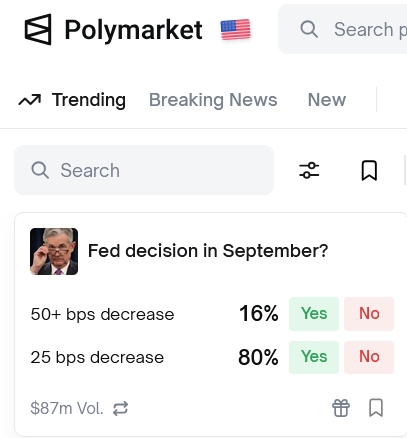
Image from Polymarket website
Polymarket has regained the ability to operate in the United States after acquiring a CFTC regulated and licensed derivatives exchange QCEX for $112 million in July 2025. Soon after the acquisition the Commodity Futures Trading Commission issued a no action letter that relaxed certain reporting and recordkeeping rules tied to event contracts, clearing the way for Polymarket to relaunch in the U.S. after being blocked since 2022 and paying a $1.4 million fine for operating without registration as part of a settlement with the CFTC.
Chief Executive Shayne Coplan highlighted the speed of the approval, writing on X that the green light from the CFTC had been 'accomplished in record timing.'
Polymarket has been given the green light to go live in the USA by the @CFTC.
Credit to the Commission and Staff for their impressive work. This process has been accomplished in record timing.
Stay tuned https://t.co/NVziTixpqO
— Shayne Coplan 🦅 (@shayne_coplan) September 3, 2025
The relaunch it seems was in a politically charged setting. Days before the approval, Donald Trump Jr. disclosed that he had invested through 1789 Capital and accepted an advisory role. The timing of Trump Jr.’s advisory role at Polymarket has raised questions about the influence of politics in a market that depends on regulatory relief.
Not all regulators support the path taken. Outgoing Commissioner Kristin Johnson argued that retail traders face significant risks and that the agency should move beyond case by case exemptions. In her view, the CFTC should create formal rules on which event contracts are permissible instead of leaving gaps in oversight.
Polymarket’s value comes from what people trade. Its most recent markets show how diverse those bets can be.
Traders currently assign about a 7% chance that Donald Trump will leave office before the end of 2025.
At the start of 2025, Polymarket listed more than 65% odds of a U.S. recession. By mid summer, that figure had fallen to 20% after a pause in new tariffs lowered fears. Economists note that these contracts reflect sentiment rather than guaranteed outcomes.
Social and sports betting examples are also trendy, such as the Taylor Swift and Travis Kelce engagement market. A trader turned $12,000 into $50,000 after betting on the couple’s announcement. Another user invested just over $2,000 the day before and made about $3,100 in profit. The odds jumped from 24% to 41% within a single day. No different in how the odds shift around in an in play betting app.
Unexpected outcomes can produce even larger returns or losses. During the papal conclave in May, Cardinal Robert Prevost was trading at only 1%. A bettor who backed him turned $1,059 into more than $63,000 after he became Pope Leo XIV. Total volume on papal betting markets reached about $40 million across Polymarket and Kalshi, another prediction marketplace.
Polymarket’s journey from fine to license shows how quickly a fintech can move from penalty to legitimacy once regulators are engaged, and the importance of building on licensed infrastructure. The markets themselves are worth monitoring, as they mirror real time sentiment. While not perfect market predictors, they are increasingly visible and sometimes a useful barometer for policymakers, investors, and punters alike.
The National Crowdfunding & Fintech Association (NCFA Canada) is a financial innovation ecosystem that provides education, market intelligence, industry stewardship, networking and funding opportunities and services to thousands of community members and works closely with industry, government, partners and affiliates to create aa vibrant and innovative fintech and funding industry in Canada. Decentralized and distributed, NCFA is engaged with global stakeholders and helps incubate projects and investment in fintech, alternative finance, crowdfunding, peer-to-peer finance, payments, digital assets and tokens, artificial intelligence, blockchain, cryptocurrency, regtech, and insurtech sectors. Join Canada's Fintech & Funding Community today FREE! Or become a contributing member and get perks. For more information, please visit: www.ncfacanada.org
| | |
|---|---|---|
| | |



August 26th, 2025

January 4th, 2024

June 1st, 2021

September 9th, 2020

July 9th, 2018

January 3rd, 2018

September 25th, 2017

June 20th, 2017

May 10th, 2017

December 14th, 2016
