




Karsten Wenzlaff, Advisor
August 26th, 2025
Karsten Wenzlaff is a Crowdfunding and Fintech Expert from Germany. He is Secretary-General of Digit[...]


July 2, 2026 | NCFA Fintech Market Activity | Digital Assets Blockchain And Crypto, Wealthtech, Capital Markets And Funding, Fintech And Innovation

On June 30, 2026, Webull Canada Crypto announced it will begin offering cryptocurrency trading after receiving approval from the Canadian Investment Regulatory Organization.
The approval gives Webull another asset class inside its Canadian investing platform, which already supports U.S. and Canadian stocks, ETFs, options, margin accounts, cash accounts, TFSAs, and RRSPs through Webull Securities Canada.
Beta access for selected clients is expected to start soon, with a wider rollout planned in the coming weeks. Webull says the crypto experience will include 24/7 trading for assets such as Bitcoin, Ethereum, Solana, XRP, Cardano, and Litecoin.
This is another regulated online brokerage aligning digital assets among the same customer experience as traditional investing.
Webull Canada Crypto Limited is regulated by CIRO. Webull Securities Canada Limited is also regulated by CIRO and is a member of CIPF.
That structure is important because crypto trading and traditional securities accounts don't carry the same investor protections. Webull's disclosure says crypto assets are not protected by CIPF, although CIPF protection may be available for eligible cash held in a crypto trading account, subject to applicable limits and policy terms.
The approval arrives after Canadian regulators spent several years moving crypto platforms toward dealer registration and CIRO membership, custody expectations, risk disclosure, and stronger client asset controls.
Regulated access is becoming the path for retail crypto distribution in Canada.
When Webull expanded brokerage services to Canada in early 2024, the initial story was low cost access to Canadian and U.S. listed equities.
The platform has since expanded around commission free trading, advanced charting, market data, options access, registered accounts, and now crypto.
Webull is building toward a multi asset retail investing platform where users can fund accounts, monitor portfolios, review reporting, and trade across asset classes without leaving the ecosystem.
Crypto increasingly looks less like a standalone destination and more like another investing capability inside regulated financial apps.
Canadian online brokers used to compete heavily on commissions, execution, research tools, and account access. In 2026, competition is about platform depth as investors want fewer disconnected accounts. Platforms want more customer activity, better retention, more data, and a wider share of the investor relationship, and eventually more personalized portfolio features.
Webull is entering a market where Wealthsimple already combines investing, crypto, cash, tax, and other financial services. KOHO adding regulated crypto trading inside its money app flashing the same pattern from a consumer finance angle.
The Canadian crypto market has gone through enforcement, registration pressure, custody scrutiny, stablecoin restrictions, and platform exits. Yet regulated distribution keeps expanding.
Canada hasn't treated retail crypto as an unregulated free for all. It also hasn't eliminated retail access. Oversight of the market is evolving toward regulated firms, clearer disclosures, tighter custody controls, and platforms that can operate within securities rules.
Webull's entry adds another regulated access point for Canadian investors and increases pressure on every platform that wants to be a primary investing destination.
The approval gives Webull permission to compete, but it doesn't guarantee adoption.
Crypto also brings higher volatility, suitability questions, security expectations, and investor education demands. A smooth user experience can't hide the risk profile of the asset class.
The advantage for Webull is that crypto can now be offered alongside the rest of its investing platform. The challenge is that investors will compare the experience not only with crypto exchanges, but with every brokerage and fintech app trying to become the main place Canadians manage investments.
Crypto trading platforms moving toward CIRO oversight shows how Canadian regulation is reshaping digital asset distribution.
Crypto custody rules are becoming a core operating issue for dealer members and digital asset platforms.
KOHO's regulated crypto rollout shows digital assets moving into broader consumer finance platforms.
Tokenization becoming a measurable business shows how digital assets are moving deeper into regulated capital markets infrastructure.
NCFA's Financial Innovation Map tracks digital assets, wealthtech, brokerage competition, capital markets infrastructure, custody, and investor access opportunities.
If every major investing platform eventually offers stocks, ETFs, options, registered accounts, and crypto, what becomes the next competitive advantage?
 The National Crowdfunding & Fintech Association (NCFA Canada) is a financial innovation ecosystem that provides education, market intelligence, industry stewardship, networking and funding opportunities and services to thousands of community members and works closely with industry, government, partners and affiliates to create a vibrant and innovative fintech and funding industry in Canada. Decentralized and distributed, NCFA is engaged with global stakeholders and helps incubate projects and investment in fintech, alternative finance, crowdfunding, peer-to-peer finance, payments, digital assets and tokens, artificial intelligence, blockchain, cryptocurrency, regtech, and insurtech sectors. Join Canada's Fintech & Funding Community today FREE! Or become a contributing member and get perks. For more information, please visit: www.ncfacanada.org
 |  |  |
|---|---|---|
 |  |  |
July 1, 2026 | NCFA Fintech Market Activity | Capital Markets And Funding, Consumer Finance And Lending, SME Finance And Business Banking, Fintech And Innovation

On June 25, 2026, Financeit closed a C$201 million term ABS transaction backed by home improvement loans, issuing Series 2026-1 notes through Financeit Securitization Limited Partnership.
Financeit says the deal is the first Canadian term asset backed securitization backed by home improvement loans. Morningstar DBRS rated the notes from AAA(sf) to BBB(low)(sf). Goldman Sachs acted as structuring and joint lead placement agent, CIBC Capital Markets acted as joint lead placement agent, and BMO Capital Markets acted as co manager.
The transaction is a capital markets milestone for Canadian fintech lending. Financeit is turning point of sale home improvement loans into rated institutional paper, giving the company another funding channel as annual loan originations approach C$2 billion.
Financeit already had warehouse and lending facilities. The new ABS deal adds longer term institutional funding to support loan growth.
VersaBank's real time funding pilot with Financeit showed how point of sale receivables can be funded closer to origination, while this ABS transaction moves the loan book into rated capital markets paper.
The company says the transaction, combined with existing lending facilities, gives it approximately C$2.5 billion in annual loan funding capacity, a reliable volume of capital.
Casper Wong, co founder and CEO of Financeit, said the transaction reflects the scale and performance of the platform:
"Over the last four years, we have grown at a 33% compounded annual growth rate, fueled by strong execution in our home improvement business and continued expansion across multiple verticals."
Home improvement lending is at the intersection of consumer finance, merchant finance, and household infrastructure spending. Borrowers want payment flexibility. Contractors and dealers want higher close rates. Lenders need repeatable underwriting, servicing, funding, and loss performance.
Financeit built its model through merchant and dealer networks rather than a branch based lending channel. The company says it has funded more than C$10 billion in loans since inception, serves nearly one million Canadians, and works with more than 10,000 dealers across Canada.
That scale gives securitization investors a pool of receivables large enough to analyze. It also gives Financeit a path to recycle capital more efficiently as originations rise.
Securitization rewards platforms that can show repeatable underwriting, clean servicing, predictable cash flows, and enough data for rating agencies and institutional buyers.
The ABS market gives lenders access to deeper capital, but it also increases scrutiny. Investors will watch delinquencies, prepayments, losses, dealer performance, borrower quality, and whether loan growth stays disciplined.
For Canadian fintech lenders, that scrutiny is healthy. It separates platforms that can originate loans from platforms that can fund, service, monitor, and report credit at institutional scale.
Float's $85 million Series C shows Canadian business finance platforms raising growth capital to expand payments, cash management, credit, and AI finance workflows.
Conexus backing JUDI.AI highlights how AI cash flow underwriting is entering credit union and community bank lending.
EQ Bank's Business Card launch shows digital banking moving deeper into business spending, cash flow, and operating accounts.
Better banking options for Canadian SMEs remain a live competition issue as businesses seek faster credit, lower friction, and more useful financial tools.
NCFA's Financial Innovation Map tracks lending, securitization, capital formation, SME finance, embedded finance, and credit infrastructure opportunities.
If Canadian fintech lenders can turn specialized loan books into rated ABS transactions, which lending categories become large enough for institutional capital next?
The National Crowdfunding & Fintech Association (NCFA Canada) is a financial innovation ecosystem that provides education, market intelligence, industry stewardship, networking and funding opportunities and services to thousands of community members and works closely with industry, government, partners and affiliates to create a vibrant and innovative fintech and funding industry in Canada. Decentralized and distributed, NCFA is engaged with global stakeholders and helps incubate projects and investment in fintech, alternative finance, crowdfunding, peer-to-peer finance, payments, digital assets and tokens, artificial intelligence, blockchain, cryptocurrency, regtech, and insurtech sectors. Join Canada's Fintech & Funding Community today FREE! Or become a contributing member and get perks. For more information, please visit: www.ncfacanada.org
| | |
|---|---|---|
| | |
Jun 29, 2026 | NCFA Resource | Open Banking Open Finance, Regulation And Policy
Last updated: September 11, 2026

NCFA has published a new Regulatory Intelligence guide to Canada Open Banking and Consumer Driven Banking Rules. The interactive resource organizes the proposed regulations, implementation requirements, consultation questions and strategic issues shaping Canada’s regulated open banking framework.
For a broader view of Open Banking and Consumer-Driven Finance, including the Canadian market map, 146 learning modules, company intelligence, global benchmarks and interactive discussions, explore NCFA Open Banking & Consumer-Driven Finance Interactive Intelligence.
The guide tracks accreditation, data scope, consent, authentication, security, technical standards, liability, reporting, complaints, national security review, fees and administrative monetary penalties. It also explains why consumer trust, fraud prevention and clear accountability are central to implementation. For further analysis, see Canada's Open Banking Strategy Starts With Trust.
The resource gives readers a structured way to understand what the proposed Consumer Driven Banking Regulations would require before final rules are published.
Instead of treating the regulations as one long legal document, the guide breaks them into operating topics. Each section separates regulatory requirements, implementation work, consultation considerations and NCFA’s strategic perspective.
Canada’s open banking framework is progressing from policy design into regulatory implementation. Firms need to understand more than API access. They need to prepare evidence for accreditation, consumer consent flows, registry checks, authentication records, security safeguards, breach response, complaint procedures, service standards, reporting obligations and board level accountability.
The 60-day Canada Gazette consultation closed on August 26, 2026. The proposed regulations remain subject to finalization, while firms continue preparing for accreditation, supervision, data-sharing, consent, security and operational requirements.
This resource is useful for fintech founders, open banking platforms, financial institutions, credit unions, payment service providers, data aggregators, regtech providers, compliance teams, investors, policymakers and industry associations.
It is especially useful for organizations assessing accreditation, product design, consent architecture, data sharing duties, technical standards, cybersecurity, consumer protection and implementation costs.
The strength of this resource is its focus on regulatory readiness. It converts the proposed Consumer Driven Banking Regulations into a practical intelligence layer that can support planning, consultation, product design and ecosystem coordination.
The guide connects the proposed regulations to Canada’s policy objectives, including stronger consumer protection, fraud mitigation, secure financial data sharing, competition and confidence in the open banking framework.
It also connects regulation to commercial opportunity. The guide identifies where read access, data portability, identity and income verification, cash flow analysis, embedded workflows, write access and open finance may create future product and infrastructure demand.
The regulations remain proposed and may change following consultation. Readers should use the guide for ecosystem intelligence and planning, not as legal, financial, investment, compliance or professional advice.
Canada Open Banking and Consumer Driven Banking Rules (primary NCFA Regulatory Intelligence guide)
NCFA Open Banking & Consumer-Driven Finance Interactive Intelligence (market map, 146 learning modules, company intelligence, discussions and global benchmarks)
Canada's Open Banking Strategy Starts With Trust (consumer protection and fraud readiness)
Open Banking In Canada Opportunity Brief (commercial opportunity layer)
NCFA Financial Innovation Map (ecosystem context)
Proposed Consumer-Driven Banking Regulations (official Canada Gazette source)
The National Crowdfunding & Fintech Association (NCFA Canada) is a financial innovation ecosystem that provides education, market intelligence, industry stewardship, networking and funding opportunities and services to thousands of community members and works closely with industry, government, partners and affiliates to create a vibrant and innovative fintech and funding industry in Canada. Decentralized and distributed, NCFA is engaged with global stakeholders and helps incubate projects and investment in fintech, alternative finance, crowdfunding, peer-to-peer finance, payments, digital assets and tokens, artificial intelligence, blockchain, cryptocurrency, regtech, and insurtech sectors. Join Canada's Fintech & Funding Community today FREE! Or become a contributing member and get perks. For more information, please visit: www.ncfacanada.org
| | |
|---|---|---|
| | |
June 26, 2026 | NCFA Fintech Whisperer | Digital Assets Blockchain And Tokenization, Capital Markets And Market Infrastructure, Artificial Intelligence And Data, Lending Consumer Credit And BNPL, Risk Compliance And Regtech, Payments And Market Infrastructure, Regulation And Policy, Treasury Liquidity And Cash Management

Image: Freepik
This live weekly NCFA intelligence page tracks financial technology developments that significantly affect how fintechs build, sell, raise capital, and operate under scrutiny. Coverage prioritizes Canada and includes global events that directly influence competitive conditions, market access, and execution realities across fintech sectors. This page will be updated throughout the week with market movers in a live format and then each week we'll close the prior week's contents in prep for the upcoming week, and continue on a rolling basis. (Missed prior week's Fintech Whisperer? (December 6-12, 2025, December 13-19, 2025, January 1-9, 2026, January 10-16, 2026, January 17-23, 2026, January 24-30, 2026, January 31-February 6, 2026, February 7-13, 2026, February 14-20, 2026, February 21-27, 2026, February 28-March 6, 2026, March 7-13, 2026, March 14-20, 2026, March 21-27, 2026, March 28-April 3, 2026, April 4-10, 2026, April 11-17, 2026, April 18-24, 2026, April 25-May 1, 2026, May 2-8, 2026, May 9-15, 2026, May 16-22, 2026, May 23-29, 2026, May 30-Jun 5, 2026, Jun 6-12, 2026, Jun 13-19, 2026).
Credit unions now have a clearer way to test stablecoins, tokenized deposits and digital asset accounts inside member owned financial institutions. Banks, core providers, payments firms, fintechs and regulators should watch whether these early programmes become production deployments for real time settlement, deposit tokens and broader member access to digital assets.
Stablecoin issuer regulation is becoming an AML and identity control issue, not only a reserve or redemption issue. Issuers, banks, custodians, wallets, exchanges and compliance teams should prepare for customer identification, verification, recordkeeping and risk controls as payment stablecoin frameworks mature.
Stablecoin regulation is moving from policy design into operating rules for payment infrastructure. Issuers, banks, custodians, payment firms, exchanges, and fintechs should watch how reserve design, redemption rights, safeguarding, and systemic supervision shape market access for regulated digital money.
Tokenization platforms are entering public capital markets. Asset managers, broker dealers, transfer agents, custodians, exchanges and investors should watch how public company access, regulated ATS infrastructure and cross border digital securities permissions shape the next phase of tokenized fund and real world asset distribution.
Event contract markets are facing a sharper boundary test. Exchanges, brokers, prediction market platforms, sports leagues, tribal gaming authorities and regulators should watch whether Congress narrows the line between federally regulated event contracts and state regulated gambling.
Private market trading infrastructure needs audit rules that firms can apply before transactions scale. Companies, auditors, advisers, venues and investors should watch how PISCES treatment affects independence checks, audit committee planning, transaction readiness and the operating model for periodic private share trading.
Canadian issuer disclosure is becoming more digital by default. Public companies, transfer agents, investor relations teams, legal advisers and compliance staff need to adjust delivery controls, SEDAR+ workflows, investor notices and request handling before the new access model takes effect.
Canadian equity market structure remains tied to US implementation timelines. Trading venues, brokers, market makers, and technology teams need more time to adjust routing logic, fee models, tick increments, compliance controls, and systems that support trading in interlisted securities.
Tokenization is moving closer to regulated market infrastructure. Exchanges, brokers, clearing firms, custodians, digital asset platforms, and regulators should watch how traditional market operators and crypto venues build permissioned pathways for tokenized securities, futures access, custody, execution, and compliance. Similar infrastructure questions are also emerging in event contract markets as new regulated venues, distribution channels, and contract frameworks develop.
Bank AI adoption is moving from pilots to operating metrics. Financial institutions, fintech vendors, compliance teams, investors, and regulators should watch how large banks measure AI value, scale employee access, govern automation agents, and connect AI deployment to fraud control, onboarding, productivity, risk operations, and compute infrastructure markets.
Cross border payments are becoming a regulated corridor strategy. Exporters, payment firms, banks, compliance teams and fintechs should watch how RPAA registration, money services business obligations, local payout capability and bank account connectivity affect competition in Canada India payment flows.
Digital euro policy is becoming payment infrastructure design. The next test is how offline use, privacy controls, holding limits, fees, PSP distribution, and cash protection fit into a system that has to work across public money, private payment providers, and existing rails.
Mortgage distribution is becoming a stronger fraud, licensing, and consumer protection issue. Brokers, lenders, fintech mortgage platforms, compliance teams, and investors should watch how higher penalties, clearer licensing rules, and stronger supervision reshape risk controls in mortgage services.
Financial crime detection no longer depends only on what individual institutions can see. Banks, credit unions, payment service providers, securities dealers, fintechs and other reporting entities can now strengthen risk detection by sharing designated information, creating new opportunities for collaborative fraud controls, network analysis and anti money laundering investigations.
Regulatory enforcement is becoming more incentive driven. Banks, insurers, investment firms, credit unions and compliance teams should review how early investigation strategy, breach assessment, remediation evidence and senior accountability affect enforcement outcomes.
Audit reporting is becoming more focused on useful disclosure, controls evidence and investor readability. Companies, audit committees, auditors, governance advisers and compliance teams should prepare for updated report content, Provision 29 controls statements and revised audit workflows before the December effective date.
Firms need to know where encryption is used, which vendors are exposed, which systems protect high value data, and how long migration will take. Crypto inventory, procurement language, vendor assurance, and roadmap planning should start before compliance dates become delivery pressure.
A regulated operating company is using a tokenized money market fund for its own liquidity rather than presenting it as a future client product. That moves tokenization into daily treasury operations, where continuous access, settlement speed, custody controls and balance-sheet utility can be tested against conventional cash-management infrastructure.
Approval processes are becoming more transparent and predictable for eligible applicants entering or expanding within Canada's federally regulated financial sector. Banks, fintechs, federal credit union applicants and regulated financial institutions should watch how the framework affects application timelines, market entry, organizational changes and future supervisory expectations. For background, see NCFA's earlier coverage of the Streamlined Approvals Framework proposal.
Manitoba has put AI governance and cybersecurity inside the same statutory control structure for the public sector. The next test is implementation. Regulations will determine how far the province goes on human oversight, technical standards, incident reporting and vendor procurement, and whether those requirements become a practical benchmark for other Canadian governments.
Every week brings hundreds of announcements. Only a small number signal meaningful change. This week's developments point to new opportunities across payments, digital assets, AI, capital markets and regulation that could influence where innovation accelerates, investment flows and new business models emerge next.
NCFA offers various curated resources to help founders and investors stay current on developments that impact fintech markets, subscribe to NCFA weekly newsletter updates, view the latest fintech insights, industry research, or launch into emerging financial innovation opportunities.
The National Crowdfunding & Fintech Association (NCFA Canada) is a financial innovation ecosystem that provides education, market intelligence, industry stewardship, networking and funding opportunities and services to thousands of community members and works closely with industry, government, partners and affiliates to create a vibrant and innovative fintech and funding industry in Canada. Decentralized and distributed, NCFA is engaged with global stakeholders and helps incubate projects and investment in fintech, alternative finance, crowdfunding, peer-to-peer finance, payments, digital assets and tokens, artificial intelligence, blockchain, cryptocurrency, regtech, and insurtech sectors. Join Canada's Fintech & Funding Community today FREE! Or become a contributing member and get perks. For more information, please visit: www.ncfacanada.org
| | |
|---|---|---|
| | |
June 25, 2026 | NCFA Fintech Market Activity | Capital Markets And Funding, Wealthtech, Fintech And Innovation

On June 25, 2026, TD Securities and Luma Financial Technologies announced a partnership to bring Luma's structured products platform to Canadian investment professionals. The rollout gives advisors a better way to monitor structured notes, track key events, review performance, and manage reporting after the trade.
Structured notes can help advisors build specific risk and return outcomes for clients, but they're not simple set and forget products. Advisors need to know what clients own, how each note is performing, when events occur, and what needs attention before maturity.
The first phase focuses on TD Securities structured notes. Later updates are expected to add advanced reporting, customized education, stronger order management, and broader access through Luma's Creation Hub and Marketplace.
Structured products become harder to manage when advisors work across multiple issuer portals, spreadsheets, email alerts, and manual reminders. Better workflow gives advisors one place to monitor client holdings, product events, and reporting after the trade.
For TD Securities, the partnership strengthens the service layer around its structured note business. Product choice matters. So does the ability to monitor, explain, and manage those products throughout their lifecycle.
Luma CEO and co-founder Tim Bonacci said the partnership reflects "a new level of support for Canadian advisors." Will better monitoring, education, reporting, and order management help advisors use structured products with more confidence and less manual work?
Questrade's Custom Indexing platform puts portfolio construction directly into investors' hands, giving self directed investors new tools to build, customize, and rebalance portfolios.
Tetrix's AI platform targets private market reporting and investment data infrastructure.
RBC's investment in d1g1t reflects continued demand for analytics and portfolio reporting across wealth and asset management.
NCFA's Financial Innovation Map tracks innovation across wealthtech, capital markets infrastructure, portfolio management, and investment technology.
If structured notes become easier to monitor and manage, will advisor adoption depend more on product design or workflow confidence?
The National Crowdfunding & Fintech Association (NCFA Canada) is a financial innovation ecosystem that provides education, market intelligence, industry stewardship, networking and funding opportunities and services to thousands of community members and works closely with industry, government, partners and affiliates to create a vibrant and innovative fintech and funding industry in Canada. Decentralized and distributed, NCFA is engaged with global stakeholders and helps incubate projects and investment in fintech, alternative finance, crowdfunding, peer-to-peer finance, payments, digital assets and tokens, artificial intelligence, blockchain, cryptocurrency, regtech, and insurtech sectors. Join Canada's Fintech & Funding Community today FREE! Or become a contributing member and get perks. For more information, please visit: www.ncfacanada.org
| | |
|---|---|---|
| | |
June 24, 2026 | NCFA Insight | Capital Markets And Funding, Venture Funding And Building, Fintech And Innovation
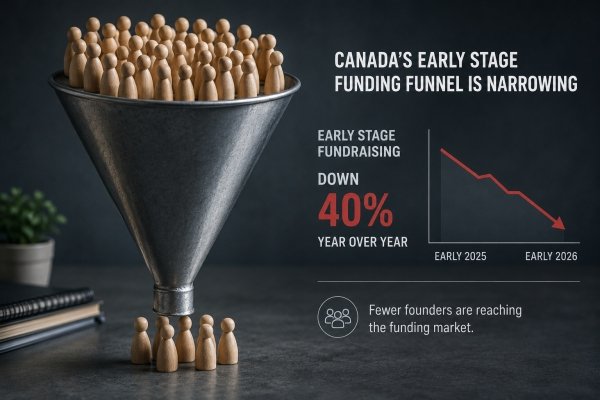
On June 24, 2026, RBCx published its Canadian VC 2026 Mid-Year report, showing that Canada’s early stage funding squeeze at venture funds is now also a startup company reality. RBCx says its Early Stage Banking team works with more than 1,200 pre seed and seed stage companies headquartered in Canada each year, and its current dataset covers more than 2,100 founder conversations.
The figures report that not only less capital is being raised, but fewer founders appear to be reaching the market at all. RBCx tracked 162 companies raising a combined $510.7 million in January 2025. By March 2026, only 61 companies were actively raising, with total capital sought down to about $189.8 million.
Average raise size held near $3 million from September 2024 to March 2026. That makes the data more troubling, not less. The market is not simply producing smaller seed rounds. It appears to be producing fewer founders who can raise them.
RBCx’s data suggests that early stage capital, which is often treated as the entry point into the venture system, is becoming harder to reach.
If fewer pre seed and seed companies are actively raising while average round size holds steady, the impact affects breadth of market.
Stronger or better connected founders may still complete rounds, but the number of companies entering the funding conversation appears to be shrinking.
A smaller early stage funnel means fewer companies get the chance to test markets, build traction, reach Series A, or become future scaleups. The risk is not only lower fundraising volume. It is a thinner innovation pipeline.
The company level data also connects back to the fund level pressure NCFA covered earlier this year in Canadian VC Fundraising Contracts And Concentrates In 2025. RBCx previously found that Canadian venture firms raised just over $2 billion in 2025, while the top five funds captured 83% of total capital raised.
RBCx’s mid year update says the top five funds captured 80% of total capital raised by 2025, while all other funds combined dropped from $4.5 billion at the 2021 peak to $444 million, close to a 90% decline.
When capital concentrates around fewer funds, founders face fewer decision makers, narrower investor funnels, and less room for non consensus ideas. That is especially important at the earliest stages, where conviction often depends on relationships, sector belief, and willingness to take risk before the metrics are obvious.
RBCx estimates that emerging managers raised about $2.8 billion over the past three years, compared with an expected $4.3 billion based on historical averages. That leaves a 36% funding shortfall.
Matt Roberts, Managing Director, Venture Coverage at RBCx, described the issue directly:
“Emerging managers are the engine of early-stage innovation in Canada. They’re willing to take on the riskier bets by backing first-time founders solving problems the market hasn’t fully recognized yet.”
His quote explains why this is a capital formation issue, not only a venture industry issue. Emerging managers often fund the companies that don't yet fit the pattern recognition of larger funds. When those managers cannot raise successor funds, Canada loses part of the market that is most willing to back first time founders, new categories, and early signals.
Canadian VC fundraising contracted and concentrated in 2025, with less new capital available for initial investments.
A built in Canada startup moved to the U.S., showing how capital access, customer depth, and market scale can influence where promising companies choose to grow.
Canada’s productivity challenge increasingly connects to capital formation, innovation scale, and the ability to turn new companies into durable economic output.
Targeted entrepreneurship funding remains an active policy tool as Canada tries to close founder capital gaps across underrepresented groups.
NCFA’s Financial Innovation Map tracks capital formation, alternative funding, venture infrastructure, and founder financing opportunities across Canada’s innovation ecosystem.
If Canada rebuilds early stage breadth, more founders can test markets, attract first capital, and create the next set of Series A candidates. That requires more than headline capital. It requires LP support for emerging managers, stronger growth stage confidence, and funding pathways that let founders raise before they fit the safest investor pattern.
Fewer funded companies may improve selectivity, but it can also remove the messy experimentation that produces outlier companies. If the ecosystem only funds the obvious companies, Canada may reduce failure rates while also reducing the number of breakout opportunities.
If average seed rounds remain stable but far fewer founders are raising, is Canada becoming more selective or simply losing the breadth and risk appetite needed to build the next generation of scaleups?
The National Crowdfunding & Fintech Association (NCFA Canada) is a financial innovation ecosystem that provides education, market intelligence, industry stewardship, networking and funding opportunities and services to thousands of community members and works closely with industry, government, partners and affiliates to create a vibrant and innovative fintech and funding industry in Canada. Decentralized and distributed, NCFA is engaged with global stakeholders and helps incubate projects and investment in fintech, alternative finance, crowdfunding, peer-to-peer finance, payments, digital assets and tokens, artificial intelligence, blockchain, cryptocurrency, regtech, and insurtech sectors. Join Canada's Fintech & Funding Community today FREE! Or become a contributing member and get perks. For more information, please visit: www.ncfacanada.org
| | |
|---|---|---|
| | |
June 23, 2026 | NCFA Fintech Market Activity | Capital Markets And Funding, SME Finance And Business Banking, Regulation And Policy

On June 22, 2026, Minister Rechie Valdez announced $173.7 million in renewed funding for the Women Entrepreneurship Strategy. The funding supports women entrepreneurs across Canada through the Women Entrepreneurship Loan Fund, the WES Ecosystem Fund, the Women Entrepreneurship Knowledge Hub, and program operations.
Capital gaps only disappear when financing, networks, and support actually reach the founders who face the gaps. The announcement isn't just another program renewal. It shows that Ottawa still sees access to capital, networks, data, and growth support for women entrepreneurs as an active market gap rather than a solved policy file.
The new funding includes $59 million for the Women Entrepreneurship Loan Fund, which supports partner organizations delivering loans of up to $50,000 to women business owners and entrepreneurs. It also includes $100 million for the WES Ecosystem Fund, $7 million for the Women Entrepreneurship Knowledge Hub, and nearly $8 million over five years for program operations.
The Loan Fund has already delivered more than 1,600 loans through partner organizations. Since its 2018 launch, the broader WES initiative has supported more than 500,000 women entrepreneurs. The federal WES program page also notes that only 17.8% of Canadian small and medium sized businesses are owned by women.
Those numbers give the announcement its real weight. The funding isn't meant to be only a social inclusion measure. It's capital infrastructure for a founder segment still underrepresented in business ownership, financing access, and growth networks.
Minister Valdez said women entrepreneurs “create jobs, strengthen communities and contribute to a Canada that is strong for everyone.” That is the public message. The operating issue is more specific: growth requires more than a loan.
Women founders need access to credit, but they also need buyers, mentors, procurement routes, export support, investor relationships, and data that helps programs see what is working. That's why the WES package includes ecosystem funding and the Women Entrepreneurship Knowledge Hub alongside loan capital.
This connects directly to NCFA’s long running focus on women partners, women entrepreneurs, and capital access. When women are missing from capital decision making, financing gaps can persist even when the quality of founders isn't the problem.
BDC launched a $250 million inclusive entrepreneurship initiative to support entrepreneurs facing systemic barriers, including women, Indigenous, and Black led firms.
Canada renewed the $189 million Black Entrepreneurship Program as a separate targeted initiative for Black entrepreneurs and Black owned businesses.
BKR Capital raised a $20 million first close for Black Innovation Fund II, targeting a $50 million final close.
J.P. Morgan’s women powered business report showed rising women led growth companies, equity investment, exits, and crowdfunding activity in the U.K.
Research on female entrepreneurship has long pointed to financial capital, human capital, and network access as connected growth constraints.
If WES funding reaches women entrepreneurs with real growth potential, the payoff may go beyond business starts. It could strengthen regional innovation pipelines, improve founder diversity in high growth sectors, and give more women led companies access to the networks they need to scale.
The challenge is execution. Loan capital can help, but it doesn't automatically solve procurement access, export readiness, investor networks, revenue growth, or later stage financing. The strongest test is whether renewed WES funding helps more women owned businesses move from support programs into durable commercial growth.
If targeted entrepreneurship funding continues, how should Canada measure whether women founders are gaining growth capital, not just program access?
The National Crowdfunding & Fintech Association (NCFA Canada) is a financial innovation ecosystem that provides education, market intelligence, industry stewardship, networking and funding opportunities and services to thousands of community members and works closely with industry, government, partners and affiliates to create a vibrant and innovative fintech and funding industry in Canada. Decentralized and distributed, NCFA is engaged with global stakeholders and helps incubate projects and investment in fintech, alternative finance, crowdfunding, peer-to-peer finance, payments, digital assets and tokens, artificial intelligence, blockchain, cryptocurrency, regtech, and insurtech sectors. Join Canada's Fintech & Funding Community today FREE! Or become a contributing member and get perks. For more information, please visit: www.ncfacanada.org
| | |
|---|---|---|
| | |


August 26th, 2025

January 4th, 2024

June 1st, 2021

September 9th, 2020

July 9th, 2018

January 3rd, 2018

September 25th, 2017

June 20th, 2017

May 10th, 2017

December 14th, 2016