




Karsten Wenzlaff, Advisor
August 26th, 2025
Karsten Wenzlaff is a Crowdfunding and Fintech Expert from Germany. He is Secretary-General of Digit[...]


AI | May 9, 2025

Image: Freepik/iconicbestiary
On May 8, 2025 during a U.S. Senate testimony on 'Winning the AI Race', Microsoft Vice Chair Brad Smith said the company blocked employees from using the DeepSeek AI app because of the app’s data collection practices, risks of propaganda, and Chinese state censorship. Smith confirmed that DeepSeek “is not available on the Microsoft store” and cannot be used by staff. The full hearing coverage can be found at TechCrunch.
But at the same time Microsoft continues to offer DeepSeek’s open source AI models through its Azure cloud platform, raising questions for both the public and business users alike. According to Dataconomy, Microsoft claims that it has audited, changed, and sandboxed the models before release to remove parts they deem are risky or unsafe.
This mixed approach has raised some concerns since the AI model can be used by others without Microsoft's internal protections. Some smaller companies may also not have the tools or awareness to even evaluate these risks, whether they be related to security or reputation.
It's the same underlying tech. Even if Microsoft tweaks the model, the core code base still comes from DeepSeek, so any unknown, unspottable, or embedded risk could still be present.
The open source models that Microsoft offers via its Azure cloud platform, could have been adversely modified by bad actors for risks like surveillance, disinformation or phishing campaigns.
It's a double standard for Microsoft to say it's unsafe for employees but okay for customers to use it. It sends a mixed message and in certain cases a reputational or regulatory risk could grow for companies that adopt it.
If governments and regulator tighten controls around AI supply chains, especially foreign ones from China, then companies could face compliance, or import/export restrictions in the the future. The State of New York has already banned DeepSeek on official devices earlier this year due to data privacy and censorship concerns.
Fintechs and financial institutions need to verify AI model origins and audit what is under the hood, and understand how its being deployed while staying aware of compliance risks. Microsoft’s internal controls may reduce risk for its own teams, but the public and smaller firms are left more exposed.
 The National Crowdfunding & Fintech Association (NCFA Canada) is a financial innovation ecosystem that provides education, market intelligence, industry stewardship, networking and funding opportunities and services to thousands of community members and works closely with industry, government, partners and affiliates to create a vibrant and innovative fintech and funding industry in Canada. Decentralized and distributed, NCFA is engaged with global stakeholders and helps incubate projects and investment in fintech, alternative finance, crowdfunding, peer-to-peer finance, payments, digital assets and tokens, artificial intelligence, blockchain, cryptocurrency, regtech, and insurtech sectors. Join Canada's Fintech & Funding Community today FREE! Or become a contributing member and get perks. For more information, please visit: www.ncfacanada.org
 |  |  |
|---|---|---|
 |  |  |
Consensus Toronto | May 9, 2025

The financial world is changing fast, and Consensus 2025 Toronto is where proactive, leading advisors will be. On May 15, CoinDesk is hosting Wealth Management Day as part of its flagship conference at the Metro Toronto Convention Centre. It's a dedicated one day program specifically for professional wealth managers and financial advisors who want to understand how digital assets, tokenization, AI, and macro forces are changing investment portfolios now and in the future.
Approved advisors will receive a complimentary Platinum Pass, for full 3-day access to Consensus 2025 from May 14–16, including all general programming, high-level networking, and private meetings with industry leaders.
Wealth Management Day offers a full morning of advisor focused content followed by roundtable networking in the afternoon. Topics include:
Speakers come from leading firms like Coinbase, T. Rowe Price, Evolve ETFs, CMCC Global, and Cambrian Asset Management. Government regulators and fintech founders will also join for candid conversations about what's happening today, what's coming next, and what advisors need to prepare for.
Below are just a few of the speakers presenting on Wealth Management Day at Consensus on May 15:
Globally and in Canada too, investors are looking for advisors who can offer informed, compliant, and proactive strategies and advice. Wealth Management Day is where crypto and the investment ecosystem intersect, from startups to global firms, regulators to entrepreneurs.
For advisors, Wealth Management Day is a low risk, high reward way to plug in, and it’s free for those who qualify.
"With ETFs and tokenized funds on the rise, advisors who ignore digital assets risk being left behind, not by the technology but by their clients who want to drive the future. "
The National Crowdfunding & Fintech Association (NCFA Canada) is a financial innovation ecosystem that provides education, market intelligence, industry stewardship, networking and funding opportunities and services to thousands of community members and works closely with industry, government, partners and affiliates to create a vibrant and innovative fintech and funding industry in Canada. Decentralized and distributed, NCFA is engaged with global stakeholders and helps incubate projects and investment in fintech, alternative finance, crowdfunding, peer-to-peer finance, payments, digital assets and tokens, artificial intelligence, blockchain, cryptocurrency, regtech, and insurtech sectors. Join Canada's Fintech & Funding Community today FREE! Or become a contributing member and get perks. For more information, please visit: www.ncfacanada.org
| | |
|---|---|---|
| | |
Digital Banking | May 9, 2025
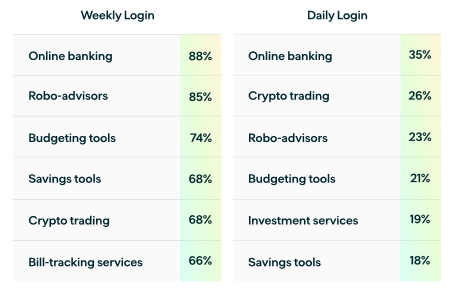
Image: Frequency of Use (Plaid x YouGov Money Talks survey report)
Between August 20-26th 2024, Plaid commissioned a national survey through the YouGov platform to understand how U.S. consumers bank, pay, and invest. The survey reveals insights of consumer preferences in digital finance, including trust in financial providers, app usage, payment methods, credit attitudes, and investment habits, based on weighted responses from 2,077 adults. Fintechs, digital finance platforms, and financial institutions need to stay up to date with the latest retail digital banking trends if they want to compete for consumer loyalty. Read 'Money Talks' (28 page PDF) report explaining these trends. Below we break-down key insights for NCFA's readers. Not yet subscribed? Sign-up for NCFA's weekly newsletter here.
Consumers continue to trust traditional banking institutions more than 100% digital platforms:
Trust and security go hand and hand, and overall, trust comes from perceived care and protection:
Consumers also shared who they rely on for financial well-being. The takeaway is that fintechs and advisory services must do more to be seen as helpful and caring, a useful partner in people’s financial lives.
Online banking is the most widely used financial tool: 99% percent of consumers are familiar with it, and 74% use it weekly.
Other commonly used tools include savings apps (68% weekly or daily), budgeting tools (85%), and peer-to-peer payment apps like Venmo or Zelle (used weekly by 50% of users). Roboadvisors are accessed more than once per week by (80%) of their users but only 1% of all consumers report using them regularly.
When asked what improvements they want most in financial apps:
60% of respondents said it is important to link their bank account with the financial apps they use.
Takeaway: Apps that are integrated, responsive, and secure are the most likely to be used often. Fintechs and banks that overcomplicate services or create friction in setup risk being overlooked, even if their offerings are advanced.
25% currently invest in cryptocurrency. Another 21% say they plan to invest in crypto or NFTs in the next year. These responder levels of engagement are equal to the 25% of people who say they will invest in stocks or trading platforms during the same period.
Crypto investors are not limiting their exposure:
Only 11% of respondents have used AI tools to support their investing decisions -> interestingly, this already exceeds the share of people using roboadvisors, suggesting that AI powered investment tools are gaining traction faster than traditional automated advice products.
Takeaway: Fintechs offering secure, easy to understand crypto access or AI investment tools can appeal to a growing investor base. Banks that avoid crypto are at risk of losing relevance with younger and self-directed investors.
Debit cards are now more commonly used than credit by younger adults. According to EY data cited in the report, 69% of Gen Z use debit cards daily or weekly. Many say they avoid credit cards because they do not want debt or do not qualify.
Buy now pay later (BNPL) services have grown 40% in usage since 2021.
Takeaway: Only 30% of respondents believe their credit score accurately reflects their financial health. 55% said they have been denied a loan due to a low score. These figures support growing interest in alternative data, such as cash flow and account history, for lending decisions.
Older adults are especially cautious. People aged 66 to 70 are 55% more likely to mistrust digital banks than those aged 22 to 25. Younger adults are more flexible. Among respondents aged 18 to 24, 36% said they would switch banks for a better digital payment experience.
Despite these trends, most people are not actively looking to change banks:
Consumers use different payment methods based on transaction size and age group:
To fund digital wallets:
Takeaway: Fintechs that want to increase adoption of pay by bank options must improve the experience. According to the report, 49% of users say they are likely to use pay by bank if the account linking process is easy.
Consumers want financial services that are clear, secure, and helpful, with trust remaining the most important factor in deciding whether to try a new app, share data, or switch banks. Traditional banks still hold an advantage in trust and reach but must modernize quickly. Fintechs have room to grow if they lead with transparency and value. Financial institutions that support financial goals and offer simple, connected experiences will stay relevant in 2025 (and beyond). Learn more about how consumers in the U.S. use, feel, bank, transact and acquire in 'Money Talks'.
The National Crowdfunding & Fintech Association (NCFA Canada) is a financial innovation ecosystem that provides education, market intelligence, industry stewardship, networking and funding opportunities and services to thousands of community members and works closely with industry, government, partners and affiliates to create a vibrant and innovative fintech and funding industry in Canada. Decentralized and distributed, NCFA is engaged with global stakeholders and helps incubate projects and investment in fintech, alternative finance, crowdfunding, peer-to-peer finance, payments, digital assets and tokens, artificial intelligence, blockchain, cryptocurrency, regtech, and insurtech sectors. Join Canada's Fintech & Funding Community today FREE! Or become a contributing member and get perks. For more information, please visit: www.ncfacanada.org
| | |
|---|---|---|
| | |
Payments Regulation | May 1, 2025
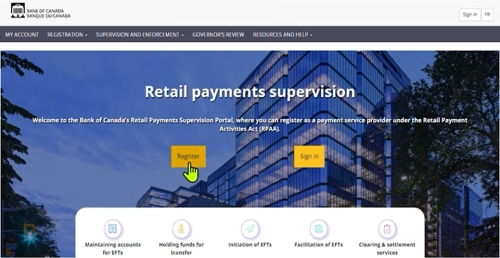
Image: PSP Connect, Retail Payments Supervision (Bank of Canada)
On April 30, 2025, the Bank of Canada (BoC) shared a new update on how it will enforce the Retail Payment Activities Act (RPAA). Payment service providers, known as PSPs, had until November 15, 2024 to register. Those who failed to do so are now being urged to act immediately or face enforcement.
BoC message:
“If you missed this deadline, you must apply immediately and at least 60 days before starting any retail payment activities. Failure to register may result in enforcement action,” the Bank stated in its April 30 message.
The Bank has updated its enforcement process outlining they may contact a PSP that is under investigation. Communication methods may include phone calls, encrypted email, courier delivery, and other secure channels. The approach is inline with the enforcement tools at their disposal published in June 2024, which include monetary penalties and compliance orders.
The BoC is also sending a reminder of how to submit a registration application through PSP Connect, the Bank's secure online portal.
1. Create a PSP Connect account
Here's a handy step by step tutorial and video available on the Bank of Canada's website to help you with the process.
2. Enter the required information and upload all documents
You can save your progress and return later if needed.
3. Submit your completed application and pay the fee
There's a $2500 application fee that must be paid in full by either credit card or debit. Alternative payment arrangements such as direct deposit or wire transfer may be arranged if several card payment attempts fail.
If you are new to the process or need further help, and have missed the workshops/tutorials, the Bank encourages PSPs to use its general inquiries form.
This update signals that the BoC is shifting from education to enforcement, as they are making it clear they are ready to take action against unregistered PSPs. Regulatory oversight of retail payments will only become more structured from here, and payment providers must meet their legal obligations or face financial and operational consequences.
The National Crowdfunding & Fintech Association (NCFA Canada) is a financial innovation ecosystem that provides education, market intelligence, industry stewardship, networking and funding opportunities and services to thousands of community members and works closely with industry, government, partners and affiliates to create a vibrant and innovative fintech and funding industry in Canada. Decentralized and distributed, NCFA is engaged with global stakeholders and helps incubate projects and investment in fintech, alternative finance, crowdfunding, peer-to-peer finance, payments, digital assets and tokens, artificial intelligence, blockchain, cryptocurrency, regtech, and insurtech sectors. Join Canada's Fintech & Funding Community today FREE! Or become a contributing member and get perks. For more information, please visit: www.ncfacanada.org
| | |
|---|---|---|
| | |
ESG | April 30, 2025

Image: Freepik
Retuers reports that Royal Bank of Canada has stepped back from its $500 billion sustainable finance target, which was originally pledged in early 2021.
In its 2024 sustainability report (152 page PDF), RBC wrote that it would no longer publish several climate-related metrics because of the recent changes to Canada’s Competition Act that now require firms to fully support environmental claims with evidence. The Competition Bureau of Canada also published a companion link outlining their perspective on deceptive marketing and views on environmental claims and greenwashing in Canada.
An example of one of the metrics that RBC is no longer reporting is the energy supply ratio, which compares financing of low carbon projects to fossil fuel ones. RBC used to report the metric in past disclosures under shareholder pressure, such as from the New York City Comptroller. However, RBC now says it cannot share it publicly due to the updated laws. It's worth noting that RBC still tracks these metrics internally but it simply stopped reporting them to avoid legal risk.
RBC is part of a larger trend with several major Canadian banks recently exciting the Net Zero Banking Alliance and walking back similar commitments. In addition to the legal risk of 'greenwashing', these decisions are being made following increased scrutiny from regulators, investors, and advocacy groups.
All environmental or climate claims need to be backed by clear evidence, including proof of how the data was calculated (not just the result). Companies must also use internationally recognized standards or methods of calculation like ISO or the Task Force on Climate-Related Financial Disclosures (TCFD). So when a company says it's funding green projects or working towards net zero, it MUST be able to show exactly how with verifiable evidence. The Competition Bureau explains the changes here.
This is surely a turning point in Environmental, Social, and Governance (ESG) and climate reporting in Canada. Institutions must now take climate statements, especially financial ones, more seriously as they have to be accurate, verified, and legally on the right side.
For fintechs and banks that rely on reporting ESG data as either a competitive advantage or primary part of their model, they must strengthen internal tracking and reporting systems if disclosing. Any vague promises about green initiatives is no longer enough, and the cost of getting it wrong is now legal exposure.
The National Crowdfunding & Fintech Association (NCFA Canada) is a financial innovation ecosystem that provides education, market intelligence, industry stewardship, networking and funding opportunities and services to thousands of community members and works closely with industry, government, partners and affiliates to create a vibrant and innovative fintech and funding industry in Canada. Decentralized and distributed, NCFA is engaged with global stakeholders and helps incubate projects and investment in fintech, alternative finance, crowdfunding, peer-to-peer finance, payments, digital assets and tokens, artificial intelligence, blockchain, cryptocurrency, regtech, and insurtech sectors. Join Canada's Fintech & Funding Community today FREE! Or become a contributing member and get perks. For more information, please visit: www.ncfacanada.org
| | |
|---|---|---|
| | |
Innovation Economy | April 29, 2025

Image: Freepik
Mark Carney has been elected as Canada's 24th Prime Minister after leading the Liberal Party to win the 2025 federal election. The Liberals secured 168 seats (just shy of a majority), and are expected to form a minority government. Prime Minister Mark Carney has already spoken with President Trump about the pressing issues of tariffs, trade war and 51st state rhetoric, and the two leaders have agreed to meet in person.
While those issues are of critical importance to Canada's sovereignty, this article looks at Carney's past public comments and Liberals 2025 platform to get a sense for the implications for Canada's fintech sector under his expected leadership.
In 2019, Carney was the Governor of the Bank of England (BoE) and said the following at the Innovate Finance Global Summit:
“A new economy requires a new finance... to serve the digital economy, to support the major transitions underway across the globe and to increase the sector’s resilience”.
The newly elected Prime Minister of Canada has a deep background in finance, global networks, and a steady hand at innovation. He's expected to speed up payments modernization, support the responsible AI development, foster fintech investment, tighten crypto rules, and open more global markets to Canadian companies. The Liberal Party commitments that support innovation include financial technologies and sustainable finance, infrastructure investment, internal trade reform, red tape reduction, and a patent box regime, all told would help strengthen the economy and fintech growth.
When Carney was leading the BoE, he signalled strong support for opening payments infrastructure to non-bank providers, helping to boost innovation and competition. In Canada, the implementation of open banking and payment modernization initiatives (i.e. Real Time Rail System) have sadly faced prolonged delays. Carney is expected to speed up these rollouts to benefit consumers and competition. Open banking will give consumers control over their financial data and allow fintech companies to create new services, while the operating firms must meet high security and operational standards.
As part of its 2025 platform, the Liberal government committed to eliminating federal barriers to interprovincial trade and labour mobility by Canada Day. Reducing costs and aligning standards could benefit fintech companies that must constantly track and adjust to changing and inconsistent provincial compliance requirements, in sectors like payments, insurtech, wealthtech, and others. Streamlining trade and regulatory barriers would help fintechs expand nationally more effectively, reduce legal and operational costs, and also contribute to offering consistent services to customers and businesses from coast to coast.
Carney spoke about how emerging technologies are game-changing finance in a 2018 Mansion House speech “New Economy, New Finance, New Bank”, where he acknowledged AI's growing impact on credit and risk systems.
Under his government, Canada is expected to advance the Artificial Intelligence and Data Act to regulate high impact AI systems including financial firms using AI for credit scoring, fraud detection, or robo advising to ensure responsible AI standards are met for fairness, explainability, and consumer protection.
Immediately after securing Liberal leadership, Carney axed the controversial capital gains tax hike, directly supporting Canada's innovation economy. Under his leadership, Carney could expand access to venture capital, innovation incentives, and encourage national regulatory alignment for startups operating across multiple provinces. The Liberal platform also supports a patent box regime, focused on scaling high growth firms, retaining intellectual property in Canada, and improving commercialization outcomes from public and private R&D. The Liberal 2025 Platform outlines efforts to increase business investment and create a more competitive innovation environment, especially for sectors like fintech and AI.
Although Carney previously showed openness towards regulated forms of crypto innovation, in 2018, he spoke critically of unbacked crypto assets and called Bitcoin “neither a store of value nor a useful means of exchange”. It's expected that he'll tighten oversight of crypto exchanges, stablecoin issuance, and asset custody. Lastly, while Carney hasn't explicitly endorsed a Canadian CBDC, he has called for central banks to explore sovereign digital currencies as tools to support monetary policy and financial stability. During a 2019 speech at the Jackson Hole Economic Symposium, for example, Carney proposed the idea of a "synthetic hegemonic currency" (SHC) as a potential solution to the destabilizing dominance of the U.S. dollar in the global financial system.
Mark Carney is one of the most prominent global figures in sustainable finance. He co-founded the Glasgow Financial Alliance for Net Zero (GFANZ) and served as the UN Special Envoy on Climate Action and Finance. His leadership brings a strong focus on aligning financial systems with climate goals. The 2025 Liberal platform commits to supporting green innovation and transitioning Canada toward a low-carbon economy. This creates opportunities for fintechs in areas like ESG data services, green lending, climate risk modeling, and carbon trading infrastructure.
Carney is expected to support broader digital financial access across Canada. In his 2018 “Future of Money” speech, he emphasized the role of digital identity, financial modernization, and infrastructure in improving inclusion. While he has't directly addressed digital ID for Canada, the Liberal platform’s national digital readiness strategy includes high speed rail and northern connectivity projects that could help bring digital banking and fintech services to underserved and remote communities.
| Opportunities | Challenges |
| Launch of real time payments and open banking | Meeting tougher compliance and risk standards |
| New funding for AI, fintech innovation, and green finance | Higher expectations for responsible AI and cybersecurity |
| Stronger startup investment environment and patent box incentives | Adapting to stricter crypto and stablecoin rules |
| Global trade partnerships and reduced internal trade barriers | Competition from international fintech firms |
| Possible leadership in digital identity and CBDC projects | Regulatory complexity for multi jurisdictional firms |
| Growth in sustainable finance and ESG fintech | Evolving global standards for ESG data and disclosures |
| Growth in digital access through national infrastructure | Uneven fintech access in rural and remote communities |
Mark Carney's credentials offer an elite tier of credibility in global finance, climate leadership, and modernization of financial systems. Together with the Liberal 2025 Platform's strategic commitments to innovation, interprovincial trade liberalization, red tape reduction, and IP commercialization, his leadership is desperately needed to improve Canada's flailing productivity, upgrade its financial ecosystem, build public trust and international competitiveness.
His background also positions Canada to lead in sustainable finance, aligning innovation with global climate goals. For fintech entrepreneurs, investors, and policymakers, the Carney era is underpinned by stable governance and a clear vision, offering a mix of opportunity and responsibility.
The National Crowdfunding & Fintech Association (NCFA Canada) is a financial innovation ecosystem that provides education, market intelligence, industry stewardship, networking and funding opportunities and services to thousands of community members and works closely with industry, government, partners and affiliates to create a vibrant and innovative fintech and funding industry in Canada. Decentralized and distributed, NCFA is engaged with global stakeholders and helps incubate projects and investment in fintech, alternative finance, crowdfunding, peer-to-peer finance, payments, digital assets and tokens, artificial intelligence, blockchain, cryptocurrency, regtech, and insurtech sectors. Join Canada's Fintech & Funding Community today FREE! Or become a contributing member and get perks. For more information, please visit: www.ncfacanada.org
| | |
|---|---|---|
| | |
Capital Markets | April 25, 2025 | Last Updated September 21, 2026

2024 equity crowdfunding investment on FrontFundr by province. Image courtesy of FrontFundr
On April 30, 2026, FrontFundr released its latest Community Capital Report, showing another record year for its Canadian private markets platform. FrontFundr processed $83.2 million across 51 campaigns and 8,064 investments in 2025, with total capital up 23% from the prior year.
The results extend the growth first documented in 2024, when FrontFundr processed $68.3 million across 66 campaigns. Fewer companies raised on the platform in 2025, but more capital and substantially more investments flowed through those campaigns. A closer look at the $83.2 million FrontFundr private market year shows how retail participation and larger community raises contributed to that increase.
Canada's venture market remains selective. According to the CVCA H1 2026 market report, Canadian venture capital reached $2.69 billion across 250 deals in the first half of 2026. Capital increased 17% year over year, but deal count fell 8.8%. Sixteen financings of $50 million or more absorbed 59% of the capital invested.
For founders, that combination matters. Institutional capital remains available, but a significant share is concentrating in larger transactions. Equity crowdfunding gives companies another way to raise capital from customers, supporters and individual investors while building a wider ownership community around the business.
FrontFundr operates as an exempt market dealer and uses several prospectus exemptions. Its full $83.2 million of 2025 platform activity should therefore not be treated as investment crowdfunding conducted solely under National Instrument 45-110.
Activity specifically under the NI 45-110 start-up crowdfunding exemption reached $4.79 million from 4,320 investors in 2025, up from $1.71 million across 1,505 investments in 2024. FrontFundr reported a 93% market share under the exemption.
The 2025 platform results included:
From 2015 through the end of 2025, FrontFundr reported processing more than $340 million across 36,057 investments and more than 285 raises.
The NI 45-110 numbers are particularly important for Canada's early stage capital market. The exemption allows an issuer group to raise up to $1.5 million over a 12 month period. In 2025, several campaigns came close to that ceiling.
Edison Motors raised $1,491,043 from 961 investors under NI 45-110, reaching about 99% of the available limit. Blossom Social raised $1,449,681 from 951 investors under the exemption, or about 97% of the limit, before additional accredited investor capital brought its total FrontFundr raise to approximately $1.93 million.
Gander Social also raised more than $1 million under NI 45-110, with $1,148,066 raised through the exemption as part of a total campaign of approximately $2.01 million.
As more companies develop investor communities capable of reaching the current ceiling, the practical question becomes whether the existing limit continues to fit the financing needs of successful early stage issuers.
Some of the strongest recent campaigns have come from companies that already had customers, followers or communities willing to become investors.
Blossom Social returned to FrontFundr in 2025 after raising $1.34 million from 742 investors in 2024. Its next campaign raised approximately $1.93 million from 1,028 investors in six hours, according to FrontFundr.
Edison Motors became the platform's largest raise of the year at approximately $6.8 million across the exemptions and investment channels available through FrontFundr. Its NI 45-110 component came close to the exemption's annual issuer limit.
Gander Social raised approximately $2.01 million across 2,581 investments, including more than $1.1 million under NI 45-110.
These campaigns show where community capital can be especially effective. Companies with strong customer bases, online audiences or stakeholder networks can convert some of that engagement into ownership capital while reducing their dependence on a single institutional financing source.
The model will not fit every company. Raising from a large number of individual investors requires communications, investor administration and a business that people can understand well enough to make an investment decision. For companies with the right community and capital needs, however, the channel is becoming more established.
FrontFundr's 2025 data shows that investment activity remained concentrated in Canada's largest private capital markets while participation increased across several provinces.
FrontFundr also recorded its first investments from Newfoundland and Labrador and Prince Edward Island late in 2025.
The regional expansion matters because early stage capital is not distributed evenly across Canada. Online investment platforms can give issuers access to investors beyond their immediate city or local angel network while giving individual Canadians another route into private companies.
Equity crowdfunding remains a small part of Canada's overall private capital market. It should not be confused with venture capital, private equity, private credit or the wider exempt market. Its value is that it adds another financing option between personal networks, angel capital and larger institutional rounds.
The distinction between equity crowdfunding and wider online private market investing is also important. FrontFundr's $83.2 million platform total includes activity under several exemptions and investment products, while $4.79 million was specifically raised under NI 45-110. Reporting the two separately gives founders, investors and policy makers a clearer view of how investment crowdfunding itself is developing.
The issue is part of a wider capital formation challenge. Public market pressures and limited IPO activity can keep companies private for longer, while larger venture rounds continue to absorb a substantial share of available institutional capital.
That creates room for financing models that can serve companies before they are ready for a large institutional round. Community capital can play that role alongside angel investment, venture capital and other exempt market financing rather than trying to replace them.
The next test is whether equity crowdfunding can become a more consistent part of Canada's early stage financing system rather than a funding option used mainly when conventional capital is scarce.
The ingredients are improving. More Canadians are participating in private markets, larger issuer communities can mobilize capital quickly, and regulated online platforms now have a decade of operating history behind them.
Growth should still be judged by more than dollars raised. A stronger market requires good companies to raise efficiently, investors to receive enough information to assess risk, platforms to operate sustainably and successful issuers to progress into larger rounds without losing access to the communities that helped fund them.
For investors, private company ownership carries significant risk. Investments can be illiquid for long periods, valuations can be difficult to establish, disclosure is more limited than in public markets and investors can lose some or all of their capital.
For founders, the opportunity is becoming clearer. Companies with credible businesses and engaged communities can combine retail investment with angel, accredited investor and institutional capital rather than treating those sources as separate choices.
Canada does not need equity crowdfunding to replace venture capital. It needs enough credible financing routes that promising companies are not dependent on a single class of investor at every stage of growth.
 The National Crowdfunding & Fintech Association (NCFA Canada) is a financial innovation ecosystem that provides education, market intelligence, industry stewardship, networking and funding opportunities and services to thousands of community members and works closely with industry, government, partners and affiliates to create a vibrant and innovative fintech and funding industry in Canada. Decentralized and distributed, NCFA is engaged with global stakeholders and helps incubate projects and investment in fintech, alternative finance, crowdfunding, peer-to-peer finance, payments, digital assets and tokens, artificial intelligence, blockchain, cryptocurrency, regtech, and insurtech sectors. Join Canada's Fintech & Funding Community today FREE! Or become a contributing member and get perks. For more information, please visit: www.ncfacanada.org
| | |
|---|---|---|
| | |


August 26th, 2025

January 4th, 2024

June 1st, 2021

September 9th, 2020

July 9th, 2018

January 3rd, 2018

September 25th, 2017

June 20th, 2017

May 10th, 2017

December 14th, 2016