





Karsten Wenzlaff, Advisor
August 26th, 2025
Karsten Wenzlaff is a Crowdfunding and Fintech Expert from Germany. He is Secretary-General of Digit[...]


News | Feb 6, 2024

Image: Unsplah/Robert Linder
Conifex Timber Inc., a forestry company that ventured into cryptocurrency mining, faced a setback in its efforts to secure a substantial power supply from BC Hydro for its operations. The B.C. Supreme Court, led by Justice Michael Tammen, upheld the provincial government's decision to temporarily halt new power connections for cryptocurrency miners, a policy introduced in December 2022 to last for 18 months. This decision was deemed "reasonable," reflecting a cautious approach towards the allocation of the province's electrical resources.
Cryptocurrency mining, known for its intensive energy consumption due to the continuous operation of high-powered computers, has been a topic of debate regarding its economic benefits versus environmental impact. BC Hydro's CEO, Christopher O’Riley, highlighted the enormity of the power demand by revealing that the data centers proposed by Conifex would have required 2.5 million megawatt-hours of electricity annually, an amount sufficient to power over 570,000 apartments. This revelation brings to light the significant energy footprint associated with such operations, raising questions about the sustainability of large-scale cryptocurrency mining.
The Energy Minister, Josie Osborne, pointed out that despite the high energy consumption, cryptocurrency mining contributes "very few jobs" to the local economy, suggesting a misalignment with broader economic development goals.
Conifex's response to the court's decision was one of disappointment, with the company expressing its belief in the missed opportunities for the provincial government to enhance energy affordability, foster technological innovation, and achieve more inclusive economic growth.
The issue utility providers worldwide must address is the challenge of balancing the power demand from cryptocurrency mining with the goals of clean energy and electrification, especially as the adoption of electric vehicles and heat pumps increases. The global context of cryptocurrency mining, with moratoriums in places like China, Algeria, and some U.S. states, has led to a surge in demand for power in regions like British Columbia, further complicating the energy landscape.
 The National Crowdfunding & Fintech Association (NCFA Canada) is a financial innovation ecosystem that provides education, market intelligence, industry stewardship, networking and funding opportunities and services to thousands of community members and works closely with industry, government, partners and affiliates to create a vibrant and innovative fintech and funding industry in Canada. Decentralized and distributed, NCFA is engaged with global stakeholders and helps incubate projects and investment in fintech, alternative finance, crowdfunding, peer-to-peer finance, payments, digital assets and tokens, artificial intelligence, blockchain, cryptocurrency, regtech, and insurtech sectors. Join Canada's Fintech & Funding Community today FREE! Or become a contributing member and get perks. For more information, please visit: www.ncfacanada.org
 |  |  |
|---|---|---|
 |  |  |
Climate Inflation | Feb 6, 2024

Image by Freepik
The podcast highlighted a critical warning from economist Paul Conway, Chief Economist at the Reserve Bank of New Zealand, about the emerging challenge of climate inflation.
He stated that climate change is in part responsible for recent inflation and the cost of living crisis - the rising cost of food, spiralling insurance premiums, the escalating cost of construction (as a result of additional demand created in cyclone/flood-damaged areas) pose a threat to economic stability and personal finance.
The insights shared in the podcast underscore the urgency of integrating climate considerations into financial planning and investment strategies, emphasizing the need for the financial sector to adapt to and mitigate the effects of climate change.
The mention of rising home insurance bills due to climate change highlights the broader implications for the insurance industry and financial markets. As risks increase, there could be significant shifts in how risks are assessed and priced, affecting homeowners, businesses, and insurers.
The realization that climate change is affecting people's financial well-being could catalyze political action. Historically, the lack of immediate economic impact has made it challenging to mobilize political will and public support for significant climate policies. However, as the economic consequences become more apparent, there may be increased pressure on governments to take decisive action on climate change, potentially leading to more aggressive environmental policies and investments in sustainable infrastructure.
The discussion suggests a growing awareness among the public and businesses about the tangible effects of climate change on their daily lives and financial health. This awareness could lead to changes in consumer behavior, such as increased demand for sustainable products and services, as well as changes in business practices towards more sustainable operations.
The presence of climate change skeptics and deniers in the discussion, as well as references to "climate scams," indicates ongoing challenges in achieving consensus on climate action. Overcoming misinformation and skepticism remains a significant hurdle for mobilizing collective action on climate change.
Kevin Brady criticizes the reliance on economists for leadership on climate change, arguing that they lack understanding of what is crucial for ecosystem resilience and human survival. This comment is insightful because it suggests a broader, more holistic view of addressing climate change, emphasizing the importance of integrating ecological sustainability into economic decision-making.
Iain Climie discusses the immense benefits of reducing food waste, citing the IMECHE's "Waste Not Want Not" report, which notes that at least 30% of global food production is wasted. This comment is insightful because it implicitly critiques the inefficiency of current food systems and suggests a potential area for impactful change.
Colin Grant argues that the last hope for addressing climate change lies in massive-scale ecosystem regeneration, a solution that is not prioritized by most governments. This comment is insightful because it goes beyond merely reducing emissions and emphasizes the importance of restoring natural habitats and biodiversity as a way to sequester carbon, regulate climate, and support life on Earth.
Nathan Simmonds questions how long it will be until the systems supporting human civilization collapse under their own weight, critiquing the encouragement of over-consumption and pollution by businesses and institutions. This comment is insightful because it highlights the unsustainable nature of current consumption patterns and the blame placed on individuals for systemic issues.
As we live the adverse affects of climate inflation, let's commit to fostering sustainable economic growth through education, innovation, and collaboration. By doing so, we can ensure a resilient financial future that benefits all Canadians and sets a global standard for sustainability in finance.
The National Crowdfunding & Fintech Association (NCFA Canada) is a financial innovation ecosystem that provides education, market intelligence, industry stewardship, networking and funding opportunities and services to thousands of community members and works closely with industry, government, partners and affiliates to create a vibrant and innovative fintech and funding industry in Canada. Decentralized and distributed, NCFA is engaged with global stakeholders and helps incubate projects and investment in fintech, alternative finance, crowdfunding, peer-to-peer finance, payments, digital assets and tokens, artificial intelligence, blockchain, cryptocurrency, regtech, and insurtech sectors. Join Canada's Fintech & Funding Community today FREE! Or become a contributing member and get perks. For more information, please visit: www.ncfacanada.org
| | |
|---|---|---|
| | |
Regeneration | Jan 22, 2024

Image by Freepik
At the 2024 World Economic Forum in Davos, a new narrative in sustainable business emerged, focusing on regeneration rather than mere sustainability.
Business leaders are now recognizing that to thrive in a climate-impacted world, it's not enough to merely reduce harm; instead, there's a need to create a positive impact.
A Pew Research Center survey of 8,842 U.S. adults in late 2023 reveals that 63% believe climate change impacts in the U.S. will worsen in their lifetimes. While most anticipate making minor sacrifices due to climate change, only a smaller portion foresee major lifestyle changes.
A growing number of corporate leaders are witnessing the impact of severe weather conditions on their financial performance. According to a Deloitte survey conducted in 2022, a striking 97% of executives worldwide reported that their businesses have suffered adverse effects from climate change, including significant disruptions in their supply chains.
This new approach goes beyond merely responding to climate change; it involves creating proactive, positive impacts.
Gim Huay Neo, managing director of the World Economic Forum Geneva:
"We have to build new economic models, new businesses and possibly new lifestyles or humanity that are just as good, or even better, than what we have today. This regeneration approach is not just about tweaking existing models but rethinking and reinventing business practices to create a positive impact, moving towards sustainability that benefits both the environment and the economy."
Incorporating the latest sustainability trends into business practices is crucial for companies, both large and small, in 2024.
1. Businesses must embed sustainability into their core strategies, aligning profitability with societal impact through economically viable and socially responsible business models, while staying ahead of regulatory changes for compliance and responsible conduct, including adapting to new sustainability reporting requirements and legal drivers.
2. Collaboration is essential, with companies forming alliances across industries, governments, and civil society to address sustainability challenges, drive innovation, and share best practices, alongside preparing for new regulatory disclosure requirements on their environmental impact and leveraging technology for data collection and analysis.
3. Genuine stakeholder engagement is key, moving beyond simple solutions to impactful collaborations and initiatives, ensuring board diversity translates into real environmental and social impact, prioritizing employee well-being and mental health within corporate culture, and requiring CEOs to balance public positions on social and political issues with stakeholder expectations and potential risks.
Companies, small and big, are advised to incorporate sustainability and regenerative strategies into their business practices and join this transformative movement. By doing so, your company will not only align with the growing global demand for environmental responsibility but also reap the benefits of increased resilience, innovation, and customer loyalty. Embrace these strategies to ensure long-term profitability and a positive impact on both society and the planet. Act now to lead the change towards a sustainable future and set a benchmark in your industry.
The National Crowdfunding & Fintech Association (NCFA Canada) is a financial innovation ecosystem that provides education, market intelligence, industry stewardship, networking and funding opportunities and services to thousands of community members and works closely with industry, government, partners and affiliates to create a vibrant and innovative fintech and funding industry in Canada. Decentralized and distributed, NCFA is engaged with global stakeholders and helps incubate projects and investment in fintech, alternative finance, crowdfunding, peer-to-peer finance, payments, digital assets and tokens, artificial intelligence, blockchain, cryptocurrency, regtech, and insurtech sectors. Join Canada's Fintech & Funding Community today FREE! Or become a contributing member and get perks. For more information, please visit: www.ncfacanada.org
| | |
|---|---|---|
| | |
Report | Jan 18, 2024

Image: CCAF and WEF, 2024 Future of Global Fintech Report
The 2024 Global Fintech Report - Towards Resilience and Inclusive Growth, a collaboration between the World Economic Forum and the Cambridge Centre for Alternative Finance, unveiled at Davos 2024 pivotal insights into the fintech industry's trajectory, marked by resilience, innovation, and transformative growth. This comprehensive analysis, based on a survey of 227 fintech firms, offers a key look into consumer trends, regulatory dynamics, and technological advancements shaping the future of financial technology.
The fintech sector has shown continued growth in the post-COVID era, with an average customer growth rate exceeding 50% across all business models surveyed with insurtech leading the pack at 66% (2021-2022). Custromer growth exceeded 50% across all regions (2021-2022) except SSA (Sub-Saharan Africa). The top 3 sources for acquiring customers was through social media (70%), referrals (68%), and website (65%).
The top challenges faced when trying to scale customer demand to new customer segments were customer education (51%), competition (43%), and compliance and regulation (34%) - see table below. This robust expansion highlights the sector's resilience and the accelerating global shift towards digital financial services.
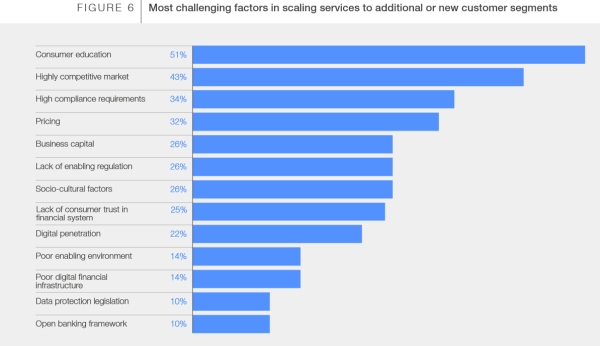
CCAF and WEF 2024 Global fintech report challenges in scaling customer growth
While 63% of fintechs view their regulatory environment as adequate, challenges persist in compliance, licensing, and registration processes. The report emphasizes the necessity of regulatory frameworks that balance innovation encouragement with consumer protection.

CCAF and WEF 2024 Global fintech report perceptions of regulatory environment
Overall, the greatest challenges faced by fintechs were in licensing, registration, and authority coordination. These areas received the most negative ratings, particularly in emerging markets and developing economies (EMDEs), where licensing posed a significant challenge. Additionally, fintechs critical of an 'excessive and overly restrictive' regulatory environment generally gave lower ratings across all regulatory aspects.

CCAF and WEF 2024 Global fintech report ratings of key regulatory aspects
Artificial Intelligence (AI) is earmarked as a game-changer for the fintech industry, with 70% of surveyed firms acknowledging its significance in shaping the industry's next five years. This highlights the crucial role of technology in driving future fintech developments.
Fintechs are increasingly focusing on underserved segments, promoting financial inclusion. The report notes a significant portion of fintechs in emerging markets are dedicated to providing services to these groups, addressing key societal issues like gender disparity and sustainability.

CCAF and WEF 2024 Global fintech report fintechs targeting underserved groups
Traditional banks have historically focused on lending to specific customer segments, mainly those with a formal financial history and living in urban areas. This approach has often excluded low-income individuals, particularly in Emerging Markets and Developing Economies (EMDEs), from accessing essential financial services and products.
Fintechs, leveraging digital technology and mobile phone adoption, have significantly widened the availability and affordability of financial services. They hold the potential to reach the further 1.4 billion unbanked and many more underbanked people globally.
Fintechs are increasingly serving traditionally underserved groups, including women, low-income individuals, and rural or remotely located customers. These segments represent a substantial portion of fintech customer bases globally, averaging 39% for female customers, 40% for low-income, and 27% for rural or remotely-located customers. This approach contributes significantly to the growth of their customer bases.
These underserved segments also contribute notably to fintechs' total transaction values, with 39% from female, 26% from low-income, and 31% from rural or remote customers. This trend is consistent across Advanced Economies (AEs) and EMDEs, with some disparities. For instance, AEs report a higher proportion of female customers, while EMDE fintechs serve more low-income and rural customers.
The United Nations Secretary-General's task force on digital finance has identified fintech companies as key players in accelerating the financing of the Sustainable Development Goals (SDGs). Adopted by the UN in 2015, the SDGs aim to address poverty and other social issues. Fintechs are increasingly incorporating the UN SDGs into their business strategies, becoming agents for catalyzing sustainable finance and fostering a green, inclusive economy.

CCAF and WEF 2024 Global fintech report SDG links, AEs vs EMDEs
The findings of the 2024 Global Fintech Report highlights the sector's resilience and growth potential and also underscores the critical role of consumer demand, regulatory frameworks, and technological innovation in shaping an inclusive and sustainable financial landscape. Fintechs are not just transforming the financial sector; they are playing a crucial role in promoting financial inclusion.
By targeting underserved segments, they are helping bridge the gap left by traditional banking services, offering a more equitable and environmentally sustainable financial landscape. This inclusive approach is essential for building a more financially empowered global population, particularly in regions with significant unbanked and underbanked communities. Fintechs' focus on inclusion is a vital step towards a more inclusive and equitable global financial ecosystem.economy.
The National Crowdfunding & Fintech Association (NCFA Canada) is a financial innovation ecosystem that provides education, market intelligence, industry stewardship, networking and funding opportunities and services to thousands of community members and works closely with industry, government, partners and affiliates to create a vibrant and innovative fintech and funding industry in Canada. Decentralized and distributed, NCFA is engaged with global stakeholders and helps incubate projects and investment in fintech, alternative finance, crowdfunding, peer-to-peer finance, payments, digital assets and tokens, artificial intelligence, blockchain, cryptocurrency, regtech, and insurtech sectors. Join Canada's Fintech & Funding Community today FREE! Or become a contributing member and get perks. For more information, please visit: www.ncfacanada.org
| | |
|---|---|---|
| | |
Sustainable Finance | Jan 12, 2024

Image by rawpixel.com on Freepik
Canada's big five banks - RBC, TD, BMO, CIBC, and Scotiabank - have come under scrutiny for their sustainable finance practices. A climate advocacy group, Investors for Paris Compliance (I4PC), has filed a complaint with securities regulators, raising concerns about potentially misleading claims and the effectiveness of these banks' sustainability efforts.
The Canadian Bankers Association, representing the banks, asserts that Canadian banks adhere to North American market standards for environmental, social, and governance (ESG) disclosure.
They emphasize compliance with applicable rules and regulations and ongoing collaboration with industry and regulators to enhance sustainability reporting standards.
Investors are increasingly vigilant about the authenticity of ESG claims, and financial institutions are under pressure to provide clear, measurable outcomes for their sustainability initiatives. The outcome of this complaint could set a precedent for how sustainable finance is approached and regulated in Canada and potentially influence global practices in the banking sector.
The National Crowdfunding & Fintech Association (NCFA Canada) is a financial innovation ecosystem that provides education, market intelligence, industry stewardship, networking and funding opportunities and services to thousands of community members and works closely with industry, government, partners and affiliates to create a vibrant and innovative fintech and funding industry in Canada. Decentralized and distributed, NCFA is engaged with global stakeholders and helps incubate projects and investment in fintech, alternative finance, crowdfunding, peer-to-peer finance, payments, digital assets and tokens, artificial intelligence, blockchain, cryptocurrency, regtech, and insurtech sectors. Join Canada's Fintech & Funding Community today FREE! Or become a contributing member and get perks. For more information, please visit: www.ncfacanada.org
| | |
|---|---|---|
| | |
Challenge | Jan 12, 2024

Image by jcomp on Freepik
The Financial Consumer Agency of Canada (FCAC) has once again opened the doors to its prestigious "Building Better Financial Futures Challenge" for 2024. This challenge, a beacon of innovation and thought leadership in the financial sector, invites post-secondary students to contribute actionable, evidence-based solutions to financial challenges faced by vulnerable communities. The 2024 edition promises to build on the success of its predecessors, fostering a new wave of ideas and strategies to enhance financial literacy and inclusion across Canada.
The 2024 Building Better Financial Futures Challenge, hosted by the Financial Consumer Agency of Canada (FCAC), invites post-secondary students to engage in research and develop papers focusing on one of three priorities under the theme “Catalyze Action”. These priorities are:
This challenge presents a unique opportunity for students to contribute to the field of financial literacy and consumer protection, with the potential for their work to be recognized and utilized by a broader audience.
The selected papers from last year's challenge showcased a diverse range of ideas, all aimed at improving financial literacy and preparedness among various demographics in Canada.
Last year's winners set a high bar for creativity and practicality. Their contributions not only addressed immediate financial challenges but also laid down pathways for long-term improvements in financial well-being and consumer protection.
In conclusion, the Building Better Financial Futures Challenge is not just about finding winners; it's about nurturing ideas that can shape a more financially inclusive and literate society. As we look forward to the innovative submissions of 2024, NCFA Canada remains dedicated to supporting and celebrating the efforts of these bright minds.
Their contributions are crucial in paving the way towards a financially literate and inclusive Canada, where every individual has the knowledge, skills, and confidence to make responsible financial decisions.
The National Crowdfunding & Fintech Association (NCFA Canada) is a financial innovation ecosystem that provides education, market intelligence, industry stewardship, networking and funding opportunities and services to thousands of community members and works closely with industry, government, partners and affiliates to create a vibrant and innovative fintech and funding industry in Canada. Decentralized and distributed, NCFA is engaged with global stakeholders and helps incubate projects and investment in fintech, alternative finance, crowdfunding, peer-to-peer finance, payments, digital assets and tokens, artificial intelligence, blockchain, cryptocurrency, regtech, and insurtech sectors. Join Canada's Fintech & Funding Community today FREE! Or become a contributing member and get perks. For more information, please visit: www.ncfacanada.org
| | |
|---|---|---|
| | |
Contest | Jan 9, 2024

Image: Climate Safe Lending Network website
The Climate Safe Lending Network has launched the Climate Finance Catalyst Contest to encourage practical ideas that will help banking institutions transition to a net-zero future. This contest is a crucial step in moving from planning to practice in the journey towards a climate-safe world.
This contest is an excellent platform for Canadian fintechs to showcase their innovative solutions in sustainable finance. Participation not only offers the chance to make a significant impact on the global banking sector's transition to net-zero but also provides an opportunity for recognition and collaboration with industry leaders. Canadian fintechs with a vision for a sustainable future should consider this opportunity to contribute their ideas and be part of this transformative initiative.
The contest focuses on three main areas:
For more details or queries, participants can contact the Climate Safe Lending Network team at connect@climatesafelending.org.
The National Crowdfunding & Fintech Association (NCFA Canada) is a financial innovation ecosystem that provides education, market intelligence, industry stewardship, networking and funding opportunities and services to thousands of community members and works closely with industry, government, partners and affiliates to create a vibrant and innovative fintech and funding industry in Canada. Decentralized and distributed, NCFA is engaged with global stakeholders and helps incubate projects and investment in fintech, alternative finance, crowdfunding, peer-to-peer finance, payments, digital assets and tokens, artificial intelligence, blockchain, cryptocurrency, regtech, and insurtech sectors. Join Canada's Fintech & Funding Community today FREE! Or become a contributing member and get perks. For more information, please visit: www.ncfacanada.org
| | |
|---|---|---|
| | |



August 26th, 2025

January 4th, 2024

June 1st, 2021

September 9th, 2020

July 9th, 2018

January 3rd, 2018

September 25th, 2017

June 20th, 2017

May 10th, 2017

December 14th, 2016
