





Karsten Wenzlaff, Advisor
August 26th, 2025
Karsten Wenzlaff is a Crowdfunding and Fintech Expert from Germany. He is Secretary-General of Digit[...]


May 22, 2026 | NCFA Market Activity | Banking And Credit Infrastructure, Payments And Market Infrastructure, Lending Consumer Credit And BNPL, Artificial Intelligence And Data

On May 21, 2026, Wealthsimple unveiled a major expansion of its financial services platform during its live product event, “Wealthsimple Takes Over Your Life”. The announcements included family accounts, business chequing, USD accounts, portfolio backed credit, spend insights, overdraft protection, and a monthly $1M client rewards program. The company said more than 4 million Canadians now use Wealthsimple and hold $150B in assets on the platform.
Wealthsimple isn't a Schedule I bank, but it delivers banking style services through regulated Wealthsimple entities, infrastructure access, and partner financial institutions. Wealthsimple says chequing balances are held in trust with CDIC member institutions, while Wealthsimple Payments Inc. and Wealthsimple Investments Inc. are not CDIC member institutions. Power Corporation disclosed a controlling interest in Wealthsimple through Power Financial, Great-West Lifeco, and IGM. In Q1 2026 results, Power valued its Wealthsimple ownership at $3.8B as of March 31, 2026.
NCFA also covered Wealthsimple’s $750M financing and $10B valuation, which gave Canadian fintech markets one of the rarest and strongest scaleup stories.
The event hit home how far Wealthsimple has moved beyond investing and trading. The company now wants a larger share of daily financial activity across deposits, payments, borrowing, business banking, and household finance.
This builds on earlier product expansion when Wealthsimple added credit and loan tools in 2025, including a cash back credit card and low interest credit line. The latest event pushes that same strategy further into operating accounts, secured borrowing, and household controls.
The business banking launch carried the clearest fintech impact. Wealthsimple introduced business chequing with online setup in less than 20 minutes, virtual cards, automated CRA payments, recurring transfers, interest bearing balances, and higher e transfer limits.
Those features target familiar problems for Canadian SMEs. Many owners still deal with low transfer limits, little or no yield on operating balances, manual tax payments, and weak cash management tools.
The Portfolio Line Of Credit may become one of the company’s most important financial products. Wealthsimple said eligible clients can borrow against portfolios at rates as low as prime minus 0.5%, or about 3.95% at the time of the event.
Clients can borrow up to 35% of portfolio value. A client with $200,000 on the platform could access up to $70,000 in credit, subject to eligibility and risk controls.
The product gives clients a way to fund business expenses, inventory purchases, major purchases, or debt refinancing without selling investments. This type of secured liquidity has historically been more common in private banking and wealth management.
For Wealthsimple, portfolio credit also deepens the customer relationship. The more assets clients keep on the platform, the more useful the credit product becomes.
Wealthsimple introduced three family finance products. Kids and teens accounts give parents card controls, alerts, limits, instant transfers, and parent paid interest. Households lets partners choose what they share, track accounts inside and outside Wealthsimple, and view family finances in one place.
Authorized traders lets a trusted family member make trades on another person’s behalf without password sharing. That addresses a practical issue. Many Canadians already help spouses, parents, or relatives manage investments informally. Wealthsimple is formalizing that process with permission based account access.
Wealthsimple also pointed to deeper access across Canadian payment systems. The company linked that access to cheaper wire transfers, free incoming wires, faster payroll deposits, lower FX costs, instant virtual card issuance, cash deposits through Canada Post, and ATM fee reimbursements.
Wealthsimple gained direct Swift access, becoming the first Canadian fintech to do so. It supports the company’s push into wires, cross border money movement, and lower cost global payments.
The Canada Post cash deposit feature gives clients access to more than 5,000 deposit locations. Wealthsimple said it processed cash deposit transactions in more than 900 communities during the first two months after launch.
Infrastructure access increasingly matters for large fintech platforms. It can improve speed, pricing, product flexibility, and customer experience while reducing dependence on older branch based banking workflows.
Wealthsimple’s Monthly Millionaire program will award $1M each month to one client. Every dollar deposited or saved creates an entry, while direct deposit doubles entries. Move over 'roll up the rim to win'!
The structure encourages clients to move payroll deposits and savings activity onto the platform. For Wealthsimple, that supports higher deposits, stronger engagement, and more primary account usage.
Canadian fintech competition is increasingly focused on who controls the broader financial relationship, not just a single product category. Wealthsimple now spans deposits, payments, investing, borrowing, family finance, business banking, and cross border accounts.
That puts the company into more direct competition with incumbent financial institutions across several revenue areas at once. The company's expansion shows how quickly a Canadian fintech can move when scale, capital, trust, and distribution come together.
 The National Crowdfunding & Fintech Association (NCFA Canada) is a financial innovation ecosystem that provides education, market intelligence, industry stewardship, networking and funding opportunities and services to thousands of community members and works closely with industry, government, partners and affiliates to create a vibrant and innovative fintech and funding industry in Canada. Decentralized and distributed, NCFA is engaged with global stakeholders and helps incubate projects and investment in fintech, alternative finance, crowdfunding, peer-to-peer finance, payments, digital assets and tokens, artificial intelligence, blockchain, cryptocurrency, regtech, and insurtech sectors. Join Canada's Fintech & Funding Community today FREE! Or become a contributing member and get perks. For more information, please visit: www.ncfacanada.org
 |  |  |
|---|---|---|
 |  |  |
Apr 23, 2026 | NCFA Fintech Market Activity | Artificial Intelligence And Data, Capital Markets And Funding

On April 20, 2026, AVAX One announced plans for an initial 10 MW Tier 3 AI and HPC powered land project in Alberta. The site's designed for at least 10 MW of total capacity, including 7 MW of mission critical power, expected to be ready for client deployment in Q1 2027. The project is estimated to cost between $30-35 million.
A 10 MW build is large enough to support a real first deployment for AI and high performance computing workloads. AVAX One also describes the design as scalable in 10 MW increments, which makes this first project a template for future buildout rather than a one-off asset.
Under the planned definitive agreement, BlueFlare Energy Solutions will act as development manager and owner’s representative, handling site identification, engineering, permitting, procurement, and construction. BlueFlare brings the energy and project execution layer. AVAX One brings the public market vehicle and the capital formation angle.
The site will generate its own power instead of relying fully on the grid. It will mainly use natural gas, including gas that would otherwise be wasted, with batteries and backup generators to keep it running without interruption. That approach avoids delays and limits from the main power grid, which is slowing down new AI data center projects.
This is the core strategy. Secure low cost, reliable power first, then contract the powered land to compute customers. The release points to a long term infrastructure agreement with a qualified edge compute client once the site is completed. AVAX One isn’t trying to run massive cloud platforms. It’s focusing on providing something those platforms need most right now: reliable power that’s ready to use for data centers.
Alberta offers a practical advantage with low cost natural gas, brownfield energy assets, and a permitting environment that can support faster deployment than heavily constrained grid markets. That reduces time to market as well as operating cost for AI and High Performance Computing (HPC) infrastructure.
The project also fits the company’s current operating base. Earlier in April, AVAX One reported preliminary Q1 2026 revenue update of about $2.4 million, more than doubling sequentially, while continuing to expand digital asset mining operations. It also acquired 220 Bitmain S21 Pro miners, increasing total hash rate capacity by about 33% from roughly 150 PH/s to over 200 PH/s. That's relevant because mining and AI infrastructure rely on the same core input: power.
Mining can produce near term cash flow from existing energy infrastructure. AI and HPC can support longer duration contracts and higher value workloads once powered land is ready. AVAX One is cleverly bridging one model to finance the next.
Power is becoming the gatekeeper for AI infrastructure. Companies that secure it early can deploy faster and lock in compute customers before capacity tightens.
The National Crowdfunding & Fintech Association (NCFA Canada) is a financial innovation ecosystem that provides education, market intelligence, industry stewardship, networking and funding opportunities and services to thousands of community members and works closely with industry, government, partners and affiliates to create a vibrant and innovative fintech and funding industry in Canada. Decentralized and distributed, NCFA is engaged with global stakeholders and helps incubate projects and investment in fintech, alternative finance, crowdfunding, peer-to-peer finance, payments, digital assets and tokens, artificial intelligence, blockchain, cryptocurrency, regtech, and insurtech sectors. Join Canada's Fintech & Funding Community today FREE! Or become a contributing member and get perks. For more information, please visit: www.ncfacanada.org
| | |
|---|---|---|
| | |
Apr 15, 2026 | NCFA Fintech Market Activity | Wealth Investing And Trading, Financial Inclusion And Access

On April 13, 2026, Common Wealth announced a $12 million Series A financing to expand workplace retirement access in Canada. The Toronto company says the funding will support distribution, advisor partnerships, platform development, and retirement income tools for older Canadians.
The gap is large and measurable. Common Wealth says more than 10 million Canadians working in the private sector do not have access to a workplace retirement plan. It also says the shortfall is most acute among smaller employers, where less than 20% (1 in 5 employers) with 5 to 499 employees offer a workplace retirement plan. 75% of adults aged 55 to 64 have $100,000 or less in savings. The data is pretty clear and points to a broad and growing retirement access problem across the labour market.
Since early 2024, Common Wealth says it has grown its employer base by 3x, now serving more than 1,500 employers across Canada. It says more than 80% of those employers set up a workplace retirement plan for the first time. Over the same period, membership increased 3.5x, assets under administration rose 4x, and its advisor network expanded to more than 400 advisors.
Alex Mazer, Co-founder and CEO, Common Wealth
“We’re opening up the retirement market for small and mid-sized employers and their employees – people who’ve been left behind by a legacy industry built for big employers and wealthy people. And we’re building the platform to help Canadians with one of their biggest financial concerns: turning their savings into income they can count on.”
The financing builds on a $15 million venture debt facility established with Flow Capital in July 2025. The company says it will use the new capital to reach more small and mid-sized employers, deepen advisor distribution, improve member retirement income tools, and invest in its core technology and AI capabilities.
Workplace retirement access in Canada still depends heavily on employer size and legacy plan economics, and as a result long term financial security is still closely tied to where someone works and whether their employer can support a plan.
Common Wealth is not trying to replace large institutional pension plans. It's going after the segment that incumbent providers have served weakly or not at all. That's where the distribution opportunity lies. It means there's also a financial inclusion angle.
Common Wealth is attracting capital by targeting a large, underserved part of the Canadian retirement market.
If more small employers can offer plans and more workers can save through payroll-linked structures, retirement savings becomes less dependent on individual initiative alone.
The National Crowdfunding & Fintech Association (NCFA Canada) is a financial innovation ecosystem that provides education, market intelligence, industry stewardship, networking and funding opportunities and services to thousands of community members and works closely with industry, government, partners and affiliates to create a vibrant and innovative fintech and funding industry in Canada. Decentralized and distributed, NCFA is engaged with global stakeholders and helps incubate projects and investment in fintech, alternative finance, crowdfunding, peer-to-peer finance, payments, digital assets and tokens, artificial intelligence, blockchain, cryptocurrency, regtech, and insurtech sectors. Join Canada's Fintech & Funding Community today FREE! Or become a contributing member and get perks. For more information, please visit: www.ncfacanada.org
| | |
|---|---|---|
| | |
Mar 16, 2026 | NCFA Market Insight | Consumer Duty And Digital Finance

Data Source: UK Financial Conduct Authority Financial Lives Survey
On Mar 13, 2026, the UK Financial Conduct Authority published good practice and areas for improvement on consumer understanding, which is critical under Consumer Duty. It's important because the FCA wants firms to show that customers actually understand products, risks, costs, eligibility, and support at the point of decision. This moves the debate past disclosure.
The FCA has real evidence about consumer weakness. Its 2024, a UK Financial Lives survey found that 12% of adults, about 6.3 million people, had limited understanding of the products they held.
Another 19%, about 10.3 million, had low confidence with everyday numeracy (34% poor or low financial numeracy). Three in 10 said their preferred communication channel had been withdrawn, causing difficulty for most of them.
The FCA also cites research showing that 1 in 7 adults have literacy skills at or below those expected of a 9 to 11 year old.
The study also notes that 22% of adults lacked confidence managing money and 36% had low knowledge about financial matters.
Those numbers explain the policy intent. If firms keep pushing more financial decisions into online self serve journeys, regulators want evidence that speed doesn't come at the expense of understanding.
The FCA says it used a wide evidence base, including supervisory findings, form data, behavioural research, and engagement with industry bodies, charities, and consumer groups.
It also ran a September 2025 survey of 38 firms across insurance, retail banking, payments, consumer finance, and Contract for Difference providers.
The review focused on five areas: (1) management information and testing, (2) innovation and communication design, (3) vulnerability and accessibility, (4) financial promotions, and (5) governance and oversight.
1. One firm used website analytics to find where customers got stuck during a sales process, tested improvements, reduced the number of clicks needed to complete the task, and cut helpline calls.
2. Another smaller firm tested a renewal letter with customers including two with sight impairments, then introduced large print, a 100 word summary, and clearer next steps. Follow up calls and a micro survey then showed better understanding of excesses and cancellations, with fewer complaints about unclear letters.
3. In another example, a firm set an internal target of at least 80% correct recall of key points when testing communications with customers in vulnerable circumstances and repeated drafting until it hit that threshold.
The FCA is not just asking for better UX or a cleaner narrative. It is asking for an integrated control system that links insight, design, testing, vulnerability, promotions, and governance.
The FCA says the publication may help policymakers and other stakeholders improve customer understanding across financial services. That makes it relevant in Canada on two levels.
For fintechs and financial institutions, it offers a practical operating playbook for testing, accessibility, promotions, and governance. For policymakers and regulators, it shows what a more detailed supervisory model looks like when a market evolves from broad conduct guidance to clearer expectations on proof, monitoring, and accountability.
NCFA has already highlighted the demand side of this issue in its analysis of FCA Financial Lives gaps. This new FCA paper adds the supply side. It shows how firms are expected to respond.
The takeaways travel well beyond the UK. Firms should approach it as an operating model. Policymakers should study it as a regulatory benchmark. Consumer Duty is pushing the market from disclosure to proof, and that's raising the standard for digital finance. If the market wants better outcomes, stronger trust, and fewer harmful misunderstandings, it will need more than disclosure rules alone. It will need evidence that customers actually understand what they are being shown and asked to do.
The National Crowdfunding & Fintech Association (NCFA Canada) is a financial innovation ecosystem that provides education, market intelligence, industry stewardship, networking and funding opportunities and services to thousands of community members and works closely with industry, government, partners and affiliates to create a vibrant and innovative fintech and funding industry in Canada. Decentralized and distributed, NCFA is engaged with global stakeholders and helps incubate projects and investment in fintech, alternative finance, crowdfunding, peer-to-peer finance, payments, digital assets and tokens, artificial intelligence, blockchain, cryptocurrency, regtech, and insurtech sectors. Join Canada's Fintech & Funding Community today FREE! Or become a contributing member and get perks. For more information, please visit: www.ncfacanada.org
| | |
|---|---|---|
| | |
Mar 16, 2026 | NCFA Insight | Consumer Fintech And Housing Payments
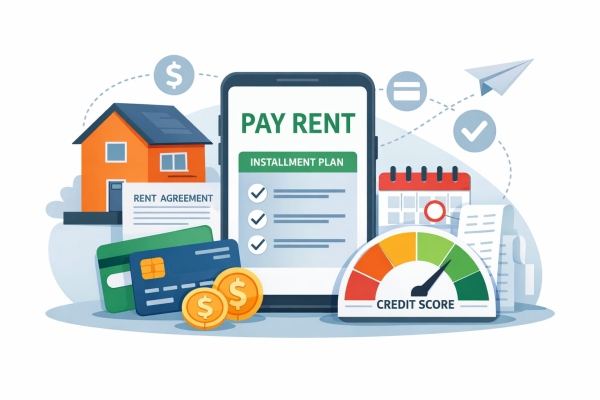
AI generated image: Rent Now Pay Later (RNPL)
On Mar 14 2026, CNN rent BNPL trend coverage in the US highlighted a new area of growth for consumer fintech, Rent Now Pay Later. BNPL providers and payment platforms are starting to move into rent payments, the largest recurring expense for many households.
Canada is already heading down this path. Fintech firms have spent several years pulling rent into the credit system through reporting and credit building services. KOHO rent credit programs allow renters to build credit history through rent payments, while rent credit history tools from Borrowell allow renters to add up to two years of past rent payments to their credit profile.
Now the model goes further.
Instead of only reporting rent payments, fintech platforms are beginning to split, finance, or route rent payments through credit rails. Rent is starting to look less like a fixed housing cost and more like a financial transaction that can generate data, fees, rewards, and short term credit exposure.
The underlying driver is housing affordability. rent burden data from Statistics Canada shows 33.0% of Canadian renter households spent 30% or more of income on shelter costs in 2022, a commonly used affordability threshold. Among private market renters who don't receive rent subsidies, the share rises slightly to 34.0%.
When roughly one third of renters already operate near an affordability limit, even small timing mismatches between income and rent payments can create pressure. Many workers receive pay every two weeks while rent is due monthly. Payment flexibility tools are now working to bridge that gap.
Several Canadian fintech firms are building products around rent payments. Zenbase offers split rent payments while reporting payment history to credit bureaus. Toronto fintech Chexy allows renters to pay rent by card, turning rent into a transaction that can generate rewards and short term credit float.
Borrowell focuses on rent reporting, allowing rent payment history to appear in an Equifax credit file. Products from KOHO, Borrowell, Zenbase, and Chexy differ in structure but share the same direction. They're moving rent deeper into payments infrastructure and credit data systems.
It's an important problem to focus on because rent is one of the largest financial flows in household budgets. Once fintech platforms innovate the payment stream, the implications extend into credit scoring, underwriting, rewards programs, and consumer debt exposure.
The benefits are straightforward. Rent reporting can help renters build credit files that traditional lending products often overlook. Payment flexibility can help align rent payments with pay cycles.
The risk emerges when flexibility substitutes for affordability. The reality is splitting rent into installments doesn't reduce the underlying cost of housing. It only spreads the obligation across time. Service fees, credit card interest, and repeated installment use can gradually turn a convenience feature into ongoing credit reliance.
This fact will likely determine how the category evolves. Products designed for occasional payment timing behave very differently from models that depend on frequent borrowing by financially stressed households.
Canadian regulators already monitor buy now pay later products as a consumer finance issue. The BNPL pilot study from the Financial Consumer Agency of Canada surveyed 1,034 Canadians to better understand how these services are used and whether consumers fully understand repayment terms and penalties.
Rent installment services raise similar questions. When the largest household bill starts moving onto credit rails, repayment discipline, fee transparency, and repeat usage patterns become key areas of concern and focus for both fintech providers and regulators.
Products that help renters manage payment timing or build credit history can deliver real value. But if rent flexibility becomes another channel for consumer borrowing, the category will face the same scrutiny that now surrounds buy now pay later services.
The National Crowdfunding & Fintech Association (NCFA Canada) is a financial innovation ecosystem that provides education, market intelligence, industry stewardship, networking and funding opportunities and services to thousands of community members and works closely with industry, government, partners and affiliates to create a vibrant and innovative fintech and funding industry in Canada. Decentralized and distributed, NCFA is engaged with global stakeholders and helps incubate projects and investment in fintech, alternative finance, crowdfunding, peer-to-peer finance, payments, digital assets and tokens, artificial intelligence, blockchain, cryptocurrency, regtech, and insurtech sectors. Join Canada's Fintech & Funding Community today FREE! Or become a contributing member and get perks. For more information, please visit: www.ncfacanada.org
| | |
|---|---|---|
| | |
February 26, 2026

A national survey in Canada found that teens and their families are planning to spend a significant amount on prom this year.
On average, Canadian households with teenagers expect to spend about $508 on prom during the current prom season. That figure is a decrease from previous years, when the average was around $804, showing that many families are tightening their budgets while still wanting to make the night special.
Prom is widely seen as a major event for high school students. It is often described by experts as one of the biggest social occasions in a teenager’s life, a celebration of finishing school and a rite of passage.
Many parents are willing to help cover the costs, and the survey suggests that about three-quarters of total prom expenses are paid by parents, reflecting how important the event remains for families despite financial pressures.
Although hundreds of dollars are still being spent, the survey highlights a notable drop in expected spending compared with earlier years. The average planned spend of $508 represents roughly $300 less than the previous year’s figure of $804.
This decline suggests that families may be trying to balance making prom memorable with concerns about personal finances and the rising cost of living.
The reduction in spending might reflect careful budgeting by parents and teens. Some families are choosing to focus spending on a few key elements of the prom experience, while trimming costs on others.
For example, parents might prioritise the prom dress or formal outfit at around $200-$300 (Source: Dress2Party) but look for savings on extras such as limousines or professional photos.
Part of the overall prom culture — and one area that can add to the cost — is the trend known as the “promposal.” This has become more popular in recent years, especially among teenagers influenced by social media and American pop culture. A promposal is a creative or elaborate way of asking someone to be your prom date, sometimes involving decorations, gifts, or special outings.
The Canadian survey found that 65 per cent of graduating teens were willing to spend money on their promposal, with an average spend of about $151 on the gesture itself. This shows how even the lead-up to prom can carry significant costs as teens seek memorable and social-media worthy moments.
Despite the focus on costs, many families and students continue to view prom as an important milestone. For teenagers, prom is not just a dance — it is one of the few times in high school when everyone dresses up, takes photos, enjoys a night out with friends and sometimes with a date, and celebrates a key life transition.
Experts say that prom can also be an opportunity for parents to talk with their children about money and budgeting. In fact, the organisation behind the Canadian survey highlighted that prom is a chance for teens to learn about setting limits, planning expenses and understanding how to manage money in a real-world context, which can be useful before they head to college or university.
For many families, the challenge is finding a balance between creating a memorable prom experience and managing practical finances. The reduction in average expected spend suggests that many are becoming more mindful of budgets, particularly where the wider cost of living is a concern. Even as prom remains a cherished event, there is a growing awareness that spending does not necessarily need to be extravagant to be meaningful.
Some parents and teens choose to find creative ways to cut costs — for example, by renting dresses, asking friends to take photos instead of paying for professionals, or sharing transport rather than hiring private vehicles. These approaches can help keep the celebration within reach while still allowing students to enjoy what many describe as one of the most memorable nights of their school years.
Overall, the survey highlights that prom in Canada continues to be an important part of high school life, but one that is evolving with economic pressures. With an average planned spend of $508 and parents covering roughly 75 per cent of costs, families are still investing in the tradition, even as budgets tighten.
Prom remains a celebration of achievement, friendship and transition, and despite changes in how much money is spent, it continues to hold emotional and cultural significance for teenagers and their families across the country.
The National Crowdfunding & Fintech Association (NCFA Canada) is a financial innovation ecosystem that provides education, market intelligence, industry stewardship, networking and funding opportunities and services to thousands of community members and works closely with industry, government, partners and affiliates to create a vibrant and innovative fintech and funding industry in Canada. Decentralized and distributed, NCFA is engaged with global stakeholders and helps incubate projects and investment in fintech, alternative finance, crowdfunding, peer-to-peer finance, payments, digital assets and tokens, artificial intelligence, blockchain, cryptocurrency, regtech, and insurtech sectors. Join Canada's Fintech & Funding Community today FREE! Or become a contributing member and get perks. For more information, please visit: www.ncfacanada.org
| | |
|---|---|---|
| | |
Youth Banking Acquisition | February 13, 2027

Image: Freepik AI
On February 9, 2026, MrBeast and Beast Industries announced the acquisition of Step, who currently serves 7 million users and has high profile listed investors including the likes of Stephen Curry, Charli D’Amelio, Justin Timberlake, Will Smith, and The Chainsmokers.
Step published traction well before the acquisition showing continued growth. On April 27, 2021, Step reached 1.5 million users in less than six months (88% of users joined Step to open their first bank account) and closed $100 million Series C funding. These stats mean youth banking behaves differently from most consumer fintech categories. A teen rarely tries five money apps. Instead they pick one first account and builds habits inside it. That first account moment becomes a habitual wedge.
Jeff Housenbold, CEO of Beast Industries:
"Financial health is fundamental to overall wellbeing, yet too many people lack access to the tools and knowledge they need to build financial security. This acquisition positions us to meet our audiences where they are, with practical, technology-driven solutions that can transform their financial futures for the better."
The purchase connects Step’s youth base with a distribution engine built on repeat attention. With MrBeast having 467 million YouTube subscribers and Step aimed at Gen Z and Gen Alpha users, the logic is simple. A creator brand can teach the same money basics repeatedly, then place the product in front of the same audience without paying for every reminder. Step fits because it already proved teens will open accounts and stick with them long enough to build habit.
MrBeast spoke about financial foundation on x.com:
“Nobody taught me about investing, building credit, or managing money when I was growing up. I want to give millions of young people the financial foundation I never had. I'm so excited to share that we are acquiring the financial services app, @step.
Parents open accounts earlier than many youth product roadmaps assume. The Financial Brand summarized research that said 63% parents opened checking or savings accounts for their children, including 35% before age 6 and 46% ages 6 to 12.
Parents also prefer no fees and no minimums, which is the trust layer in a product built for kids.
A separate parent survey tied account switching risks with youth accounts, reporting a 75.1% switch likelihood when a provider does not offer a family digital wallet.
Student behaviour shows how quickly young segments move away from cash and toward embedded credit products. Save the Student said its 2025 student banking survey collected 701 students and found 27% BNPL use at least some of the time. The same survey said 54% cash use once a month or less.
Investing interest is also moving earlier among teens according to a MarketWatch report who describes an affordability backdrop keeps pushing younger people to look for new paths to financial comfort.
Consumer fintech growth often begins with paid acquisition, so the ad market sets the operating floor. WPP Media forecast $1.08T in global advertising revenue in 2025. In a market that large, repeat reach matters because it lowers how often a brand must pay just to get one more chance to explain the product.
This is the part many fintech teams underestimate. Youth banking needs repetition. Teens and parents need to hear the same rules and see the same controls until trust forms. MrBeast already owns repetition through content. Step already owns the account relationship.
Youth banking wins first account trust and compounds when habits stick. It also punishes fee friction. Canada already has youth focused products that are proving demand. Mydoh positions itself for ages 6 to 17 with a family money app and card. Neo Financial markets a youth offer with no fees and no minimums for teenagers. There's also Spendsafe who recently launched a youth platform for ages 6 and up, backed by Mastercard, with a prepaid card and app controls.
Deal terms stay undisclosed in public coverage, so the outcome will show up in trackable operating numbers on retention, repeat usage, credit building adoption, complaint volume and switching. Building for younger users and their parents? Read more about Gen Z expectations and Gen Z finance at NCFA.
The National Crowdfunding & Fintech Association (NCFA Canada) is a financial innovation ecosystem that provides education, market intelligence, industry stewardship, networking and funding opportunities and services to thousands of community members and works closely with industry, government, partners and affiliates to create a vibrant and innovative fintech and funding industry in Canada. Decentralized and distributed, NCFA is engaged with global stakeholders and helps incubate projects and investment in fintech, alternative finance, crowdfunding, peer-to-peer finance, payments, digital assets and tokens, artificial intelligence, blockchain, cryptocurrency, regtech, and insurtech sectors. Join Canada's Fintech & Funding Community today FREE! Or become a contributing member and get perks. For more information, please visit: www.ncfacanada.org
| | |
|---|---|---|
| | |



August 26th, 2025

January 4th, 2024

June 1st, 2021

September 9th, 2020

July 9th, 2018

January 3rd, 2018

September 25th, 2017

June 20th, 2017

May 10th, 2017

December 14th, 2016
