





Karsten Wenzlaff, Advisor
August 26th, 2025
Karsten Wenzlaff is a Crowdfunding and Fintech Expert from Germany. He is Secretary-General of Digit[...]


September 3, 2026 | NCFA Market Interest | Digital Assets Blockchain And Tokenization, Capital Markets And Market Infrastructure, Wealth Investing And Trading

Kraken parent Payward has reportedly delayed its U.S. IPO again, this time to the second quarter of 2027 at the earliest. The company confidentially filed a draft registration statement in November 2025, then put the listing on hold in March as crypto prices, trading volumes and valuations weakened. Payward hasn't confirmed the new 2027 timing, so it remains a reported window rather than a scheduled IPO date.
The delay comes at an interesting point for the business. Payward reported US$508 million in Q2 adjusted revenue, up 17% year over year. Funded accounts rose 42% to 6.6 million, while assets on the platform were US$40 billion. Adjusted EBITDA was much thinner at US$23 million, and total platform transaction volume fell 18% to US$310 billion as crypto spot trading cooled.
Those numbers give Payward a pretty clear reason to wait. Revenue and customers are growing, but the company is still proving how much earnings it can generate when trading activity softens. Going public now would put that question in front of investors every quarter.
Kraken is still central to Payward, but the parent company now earns money from more than crypto spot trades. Asset based and other revenue accounted for 60% of adjusted revenue in Q2, up from 55% a year earlier. Payward also owns NinjaTrader, has added regulated U.S. derivatives through Bitnomial, and expanded into payments and card issuing through Reap.
Those businesses and revenue lines are important when trading slows. Payward's transaction volume fell 18% year over year, yet adjusted revenue still rose 17%. That doesn't make the company immune to crypto cycles, but it does show that the revenue mix is changing.
The acquisitions have also made Payward more complicated. Investors eventually have to decide whether futures, derivatives, payments, tokenized equities and infrastructure services add up to a stronger financial business or simply a larger collection of products. Staying private gives management more time to answer that with operating results.
Payward's recent transactions have valued its equity at about US$20 billion. The company also says it closed an US$800 million private funding round backed by investors including Citadel Securities, Jane Street, Oppenheimer and Tribe Capital.
The capital gives Payward capital and time, but the valuation also raises expectations for an eventual IPO. Public investors will want to see more than account growth. They will be looking at earnings, cash generation, trading volumes and whether the businesses Payward has bought can produce dependable revenue together.
The current quarter gives them both sides of the argument. A record 6.6 million funded accounts and 17% revenue growth are strong. US$23 million of adjusted EBITDA on US$508 million of adjusted revenue leaves much more room to prove that scale can turn into profit.
Payward's xStocks business is expanding beyond Kraken. xStocks distribution already reaches third party exchanges, wallets and blockchain applications, and Payward now says the products have passed US$40 billion in total volume, including more than US$20 billion settled onchain, across more than 200,000 holders.
The company took another step on September 1 when LSEG and Payward announced plans to explore tokenized UK public equities. Subject to regulatory approval, the London Stock Exchange intends to list xStocks on its planned LSE 24 venue in 2027.
If everything takes, that would put Payward beside a traditional exchange operator at the same time its own IPO waits. It is a good example of how far the company has travelled from being known mainly as a crypto exchange.
The biggest question is earnings. Payward can keep adding accounts and products, but public investors will want to see whether those businesses can produce stronger profits when crypto trading is weak. Q2 showed that revenue can keep growing while transaction volume falls. The next step is showing that more of that revenue reaches the bottom line.
The acquisitions also have to work together. NinjaTrader brings traditional futures clients. Bitnomial adds regulated U.S. derivatives. Reap adds payments and card issuing. xStocks adds tokenized equities. Payward Services sells some of the same technology to banks, fintechs and other platforms. If customers start using several of those products together, the company can earn more from each relationship without depending as heavily on one trading market.
Payward Canada is registered as a restricted dealer, giving Kraken regulated access across Canada. xStocks are still unavailable to Canadian retail clients, so Payward's wider product expansion won't automatically arrive here. Canadian access will depend on what regulators approve and which products the company decides to bring north.
Payward has private capital, growing accounts and several businesses still being integrated. It doesn't have to accept a public valuation today if management believes another year of results can support a better one.
There is risk in waiting too. Crypto markets can weaken further, acquisitions can disappoint and the IPO market may not improve on Payward's schedule. A private US$20 billion valuation is only as strong as the earnings and growth the company can eventually show public investors.
Kraken's IPO delay is therefore more than a calendar change. Payward is using the extra time to prove that it can grow into a larger financial platform, make its acquisitions pay off and earn enough outside crypto spot trading to support the valuation it wants when it finally lists.
Can Payward turn product growth into enough profit to support a US$20 billion public valuation?
 The National Crowdfunding & Fintech Association (NCFA Canada) is a financial innovation ecosystem that provides education, market intelligence, industry stewardship, networking and funding opportunities and services to thousands of community members and works closely with industry, government, partners and affiliates to create a vibrant and innovative fintech and funding industry in Canada. Decentralized and distributed, NCFA is engaged with global stakeholders and helps incubate projects and investment in fintech, alternative finance, crowdfunding, peer-to-peer finance, payments, digital assets and tokens, artificial intelligence, blockchain, cryptocurrency, regtech, and insurtech sectors. Join Canada's Fintech & Funding Community today FREE! Or become a contributing member and get perks. For more information, please visit: www.ncfacanada.org
 |  |  |
|---|---|---|
 |  |  |
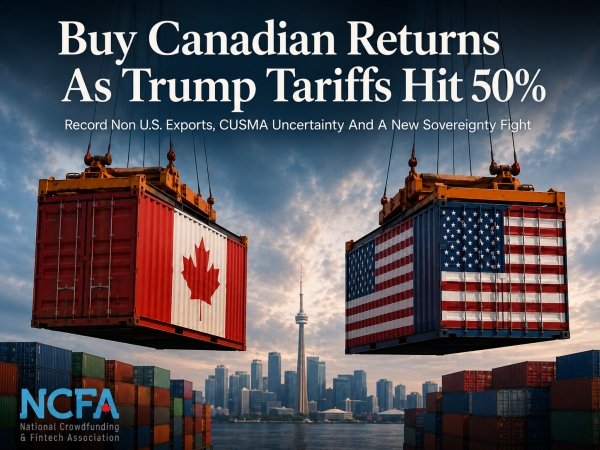
On September 3, 2026, Canada's July trade report put two stories beside each other. Exports to the United States fell 6.6%, while exports to countries outside the U.S. rose 7.4% to a record C$25.6 billion. Canada's merchandise trade surplus with the world narrowed from C$4.2 billion in June to C$769 million. Its surplus with the United States fell from C$10.3 billion to C$5.9 billion.
Those numbers now sit inside a much rougher political relationship. On August 22, the United States imposed a 50% tariff on roughly US$20 billion of Canadian exports, while the Government of Canada values the affected goods at C$27.6 billion. Canada has rejected the terms on offer and announced matching counter tariffs on C$27.6 billion of U.S. imports, scheduled to take effect on September 8.
Canada is still deeply tied to the U.S. economy, but the reaction is no longer confined to government. Buy Canadian sentiment has returned. Companies are reviewing suppliers and customers. Travel choices have changed. More Canadian businesses are looking beyond the U.S. at the same time that Ottawa is asking them to absorb the cost of doing it.
The question running through this story is whether the tariff fight is merely disrupting Canada U.S. trade or helping create commercial relationships that remain different even after the politics cool.
The evolving trade war began with a border argument. Washington said Canada was not doing enough on fentanyl and border security. Ottawa said the scale of the problem did not justify an economy wide tariff and answered with retaliation rather than concession.
Ottawa disputed the premise while tightening the border anyway. Canada argued that the U.S. was imposing an economic penalty far larger than the border problem it cited. At the same time, Ottawa strengthened enforcement, giving the fight an early contradiction that never really disappeared.
North America already has a trade agreement designed to make cross border commerce predictable. The surprise is not that Canada and the U.S. disagree. It is that the disagreement can still produce sweeping tariffs while CUSMA remains in force.
CUSMA then became the shield Canadian companies hoped it would be. A large share of continental trade kept moving under the agreement, offering businesses a degree of protection from the broad tariff threat.
The most politically sensitive sectors did not get the same protection. Steel, aluminum and autos became proof that a trade agreement could survive while the industries most tied to jobs, factories and regional politics still took direct hits.
CUSMA remains in place, but businesses now know that compliance with the agreement does not eliminate every tariff risk. A company can remain inside the North American trade framework and still be exposed to a separate sector fight.
Canada entered the 2026 CUSMA review looking for certainty and left without it. Ottawa wanted companies to know the North American rules would hold for another generation of investment. The review did not deliver that reassurance.
The United States did not give Canada the long runway it wanted. The agreement stayed alive, but companies making plant, supplier and capital decisions measured in years were left with a shorter political horizon.
The agreement remains in force. But the failed long term extension means companies can no longer assume the relationship will simply return to the old operating model after one review.
Then the tariff ceiling moved again. After bilateral talks failed, Washington raised the pressure to levels that made another Canadian response almost unavoidable. The dispute was no longer about whether tariffs would remain. It was about how much economic pain each side was willing to absorb.
Canada chose retaliation over the deal on the table. Ottawa said the U.S. terms would leave Canadian workers and businesses worse off. Canada announced matching counter tariffs on C$27.6 billion of U.S. imports, scheduled to take effect on September 8.
This is where the fight stops looking like a temporary tariff negotiation and starts looking like a choice about economic autonomy. Canada is accepting the risk of another round of costs rather than take terms Ottawa says would leave important industries worse off.
Trump then turned Lake Ontario into part of the dispute. The Lake America order gave Canadians something more visceral than a tariff table to react to. A fight over market access suddenly had a symbol that touched geography, identity and sovereignty.
The symbolism hit a country already primed to push back. The tariff fight had been accompanied by statehood rhetoric and repeated claims that Canada depended too heavily on the United States. The lake renaming made the argument feel less like a dispute over customs schedules and more like a challenge to Canadian identity.
A tariff can feel remote until it affects a price, a contract or a job. Renaming a shared Canadian lake for U.S. federal purposes created a cultural symbol that was easier to understand and harder to separate from the wider sovereignty argument.
Canadian resistance is showing up in everyday choices. Buy Canadian sentiment has strengthened as consumers reconsider groceries, travel, technology, vehicles and other purchases. Businesses are also reviewing where they source products and whether U.S. dependence still looks commercially sensible.
American opinion is much less supportive of the escalation. A Reuters Ipsos poll found 57% of Americans opposed the latest tariffs on Canada and only 20% supported them. The same poll found 63% opposed Lake America and 14% supported it.
Canadian patriotism has many sources, so the tariffs should not be treated as the sole cause. But the observable response to repeated tariff threats, statehood rhetoric and Lake America includes stronger Buy Canadian behaviour, support for retaliation and a more explicit case for economic self reliance.
Some companies are acting on the anger instead of waiting it out. Reuters reported that Chapman's Ice Cream plans to cut U.S. imports by 70% by mid 2027. Other firms are reviewing suppliers, sourcing more at home and looking for customers outside the United States.
Once a supplier is replaced, politics may not put the old relationship back together. New contracts, certifications, logistics routes and internal processes create switching costs. A future agreement could remove a tariff quickly while leaving behind commercial relationships built during the dispute.
This is where a patriotic reaction can become structural economic change. The first purchase may be emotional. The lasting effect depends on whether Canadian and non U.S. alternatives become good enough to keep the customer or supplier relationship after the anger fades.
The July numbers show Canada really is looking elsewhere. Exports outside the United States rose 7.4% to a record C$25.6 billion. Non U.S. destinations accounted for roughly one third of Canadian merchandise exports in July.
America is still too large to replace quickly. Canada's trade surplus with the U.S. fell to C$5.9 billion in July, while Canada ran a C$5.1 billion deficit with countries outside the U.S. More trade elsewhere reduces concentration before it replaces the commercial value of the American market.
The record non U.S. export figure shows diversification was already underway before the August 22 escalation. It does not prove the newest tariffs caused the change. It does show Canada was already finding more business outside the U.S., even while the American market remained too large to replace quickly.
There is also a cost to weakening the North American relationship itself. In a September PBS NewsHour discussion, former U.S. Trade Representative Robert Zoellick argued that the original logic of North American economic integration went well beyond lower tariffs and prices. Combining Canadian, U.S. and Mexican minerals, energy, manufacturing, supply chains and services made all three countries stronger competitors globally. The PBS discussion raises a larger question for both countries: how much competitive strength does North America give up when an integrated economic relationship becomes a zero sum fight?
Every new route creates another bill before it creates resilience. New buyers can require longer shipping, different payment terms, more foreign exchange and more working capital. New suppliers can require deposits, inventory changes and fresh credit checks. The cost arrives before the exporter knows whether the new relationship can match the economics of the old one.
Canada can become less exposed to one market while making individual companies more complicated to finance. Diversification works only if firms have enough liquidity to survive the period between leaving an old relationship and making a new one profitable.
Lenders now have to see tariff risk before the financial statements do. U.S. customer concentration, tariff sensitive inputs, margin exposure and the time needed to replace a buyer can change a borrower's risk within weeks. Historical revenue can therefore look healthy while the economics underneath it are already deteriorating.
Payments, foreign exchange and treasury providers face the opposite problem. More destinations create more currencies, settlement routes, counterparties and cash timing issues. The same diversification that reduces geographic concentration can increase demand for cross border payments, hedging, trade finance, receivables tools and working capital.
Trade policy becomes financial services work once companies start changing customers and suppliers. Credit has to recognize new exposure sooner. Payments have to reach more markets. Treasury teams have to manage more currencies. Working capital has to cover the period before new trade relationships mature.
Markets still assume some of this confrontation eventually fades. Currency forecasts are already looking past the current hostility and pricing a calmer relationship later. Businesses have less freedom to wait for that version of the future.
Businesses cannot wait for that forecast to come true. Carney said on September 1 that the United States must start being serious before talks can resume. At that point no new bilateral negotiations were scheduled. A company choosing a supplier, market or plant location has to make the decision under today's rules.
That is the deeper consequence of the dispute. Governments can reverse tariffs quickly. Companies that have spent months replacing suppliers, winning customers and building payment routes may have less reason to go back. The tariff war could therefore leave a commercial footprint that lasts longer than the tariffs themselves.
Talking Point
Trump's tariff campaign has done more than raise the cost of Canada U.S. trade. It has turned economic dependence into a Canadian political issue, revived Buy Canadian behaviour and pushed companies to look harder for customers and suppliers elsewhere. The unresolved question is whether that response leaves Canada with stronger companies and more durable trade relationships or simply a more expensive way to do business.
The National Crowdfunding & Fintech Association (NCFA Canada) is a financial innovation ecosystem that provides education, market intelligence, industry stewardship, networking and funding opportunities and services to thousands of community members and works closely with industry, government, partners and affiliates to create a vibrant and innovative fintech and funding industry in Canada. Decentralized and distributed, NCFA is engaged with global stakeholders and helps incubate projects and investment in fintech, alternative finance, crowdfunding, peer-to-peer finance, payments, digital assets and tokens, artificial intelligence, blockchain, cryptocurrency, regtech, and insurtech sectors. Join Canada's Fintech & Funding Community today FREE! Or become a contributing member and get perks. For more information, please visit: [www.ncfacanada.org](http://www.ncfacanada.org)
| | |
|---|---|---|
| | |
Sep 3, 2026

A credit card payment at an online casino costs the operator between 2.5% and 5% in processing fees, takes one to three days to settle, and carries a chargeback risk that averages 0.8% to 1.2% of total transaction volume. A USDC transfer on Solana or Base costs less than $0.01, settles in under three minutes, and cannot be reversed once confirmed on chain. For fintech professionals watching how stablecoin infrastructure performs under real production stress, online casinos have quietly become one of the most revealing test environments in payments.
This is not a story about which casino accepts crypto. It is a story about why the payment rails built under pressure from hostile acquirers are now structurally superior to legacy alternatives, and what that means for broader fintech infrastructure.
Online casinos operate under merchant category code 7995, one of the most restricted classifications in card network underwriting. Most tier-one payment processors refuse to onboard iGaming merchants entirely. Those that do charge premiums well above standard interchange rates, often landing between 3% and 5% per transaction.
The structural challenges compound from there. Chargeback rates in iGaming regularly exceed the thresholds set by Visa and Mastercard, triggering remediation programs that can end in merchant termination. Players expect withdrawals within minutes, yet ACH settlement runs on T+1 to T+3 timelines, and SWIFT transfers take three to five business days. The gap between player expectations and banking infrastructure creates friction at every point in the payment lifecycle.
These pressures created a forcing function. Operators that wanted to scale needed payment rails capable of high velocity cross-border flows, instant finality, reduced credit risk, and independence from acquirer gatekeeping. Stablecoin rails, particularly USDC, addressed all four requirements simultaneously.
When a player requests a withdrawal at a stablecoin casino, the transaction never touches an acquiring bank, a card network, or a correspondent banking chain. It travels on chain.
The operator's treasury system holds a liquid float in a hot wallet, sized to cover 24 to 48 hours of rolling withdrawal demand. The player's withdrawal request triggers a signed transaction broadcast to the blockchain. On Base or Solana, confirmation arrives in seconds with cryptographic finality. There is no authorization hold, no batch settlement window, and no reversal mechanism.
Chain selection matters at scale. ERC-20 USDC on Ethereum carries gas fees of $0.50 to $2.00 per transaction depending on network congestion. Solana reduces that below $0.001. Base sits below $0.01. For an operator processing 50,000 withdrawals per month, the choice of chain alone becomes a six-figure annual decision.
According to Circle, USDC has settled more than $70 trillion in cumulative on-chain transactions across institutional, B2B, and consumer use cases. This is production-scale infrastructure running across financial services, payments, and iGaming.
A direct comparison makes the economic case clearer than any narrative.
| Payment Rail | Settlement Time | Operator Fee | Volatility Exposure | Chargeback Risk |
| Credit Card | 1 to 3 days | 2.5% to 5%+ (iGaming premium) | None | High (MCC 7995) |
| Bank Wire (SWIFT) | 3 to 5 business days | $25 to $65 flat + FX spread | FX exposure | Low |
| Bitcoin (BTC) | 10 to 60 minutes | $1 to $30 variable | High | None |
| USDC (Base/Solana) | Under 3 minutes | Below $0.01 per transaction | None | None |
For an operator processing $10 million per month on card rails at a blended 3% iGaming rate, shifting to USDC represents roughly $300,000 in annual fee savings before accounting for chargeback losses.
Bitcoin is not a viable substitute at scale. Price volatility means any operator holding BTC in treasury carries mark-to-market risk on the liability side. A 10% price decline on a $1 million player balance creates an immediate $100,000 accounting gap. USDC, pegged 1:1 to USD and redeemable through Circle Mint, carries no equivalent risk. The liability stack stays USD-denominated throughout.
Platforms already running on these rails demonstrate the production reality. A live USDC casino operating at scale today faces none of the acquirer relationship risk, chargeback remediation exposure, or cross-border correspondent banking friction that card-dependent operators manage as ongoing cost centers.
In Canada, FINTRAC requires operators handling virtual assets, including stablecoins, to register as virtual asset service providers. This registration carries obligations for Travel Rule compliance at the transaction level and ongoing AML monitoring programs.
The regulatory trajectory is converging across jurisdictions. Canada's VASP framework, the EU's MiCA regulation, and emerging US stablecoin legislation all emphasize disclosure, reserve attestation, and Travel Rule compliance. USDC's monthly reserve attestation model, published by an independent accounting firm, already satisfies the transparency requirements taking shape in all three regulatory environments.
Operators building on Circle's infrastructure can inherit compliance controls directly. Circle's Payments Network includes built-in OFAC screening, Travel Rule messaging support, and AML monitoring capabilities. This reduces the compliance engineering burden materially compared to building a custom integration from scratch.
For Canadian fintech professionals, the key milestone to watch is FINTRAC's expected expansion of VASP reporting thresholds to cover stablecoin-specific transaction patterns. Operators and payment processors building on USDC rails now will have a compliance architecture head start when those requirements arrive.
On-chain settlement introduces a transparency layer that legacy payment infrastructure cannot replicate. Every deposit, withdrawal, and balance change is recorded on an immutable public ledger, creating a continuous audit trail without reliance on third-party attestation.
In iGaming, this connects directly to the concept of provable fairness. Understanding what is RTP in slots has traditionally required trust in third-party testing labs that certify return-to-player percentages. On-chain settlement opens the door to cryptographically verifiable RTP calculations, where players and regulators can independently confirm that game outcomes match published odds. This shift from trust-based to verification-based fairness represents a meaningful evolution for both player protection and regulatory oversight.
Programmability adds further capabilities that card rails cannot match. Smart contract-based bonus logic, automated affiliate settlement, and on-chain provable fairness are native to blockchain infrastructure. None require a third-party processor, a settlement delay, or a revenue-share arrangement with a payments intermediary.
The shift away from card rails in iGaming is structural, not cyclical. Card networks retain the unilateral right to remove a merchant category from acquirer eligibility without notice. That existential counterparty risk has no analog in stablecoin settlement, where the protocol itself has no commercial relationship with the merchant.
The cross-border advantage is equally concrete. USDC is natively issued across 37 blockchains and available in over 185 countries. Sending USD from Canada to a licensed offshore operator through a correspondent banking chain costs $30 to $60 per transfer and takes three to five business days. A USDC transfer costs less than a cent and settles in under a minute.
The onboarding friction for USDC is real: players still need a non-custodial wallet or an account on a centralized exchange. That friction is the primary reason card rails coexist in hybrid operator stacks. But for operators targeting experienced crypto users, the economics are unambiguous. And as wallet infrastructure improves, that friction is shrinking quarter by quarter.
A stablecoin casino is an online casino that accepts and settles player balances in USD-pegged stablecoins like USDC or USDT rather than fiat currencies or volatile cryptocurrencies. Operators use stablecoin rails to achieve near-instant withdrawals, eliminate chargeback exposure, and reduce payment processing fees to fractions of a cent per transaction.
On low-fee chains like Base or Solana, on-chain confirmation occurs in seconds with cryptographic finality. This compares to bank wire settlement of three to five business days and card processing of one to three days. The speed is structural, built into the protocol's confirmation mechanics, rather than dependent on processor batch windows or banking hours.
Licensed online gambling operates under provincial regulatory frameworks in Canada. Platforms handling virtual assets, including stablecoins, must comply with FINTRAC's VASP registration requirements, implement Travel Rule compliance, and maintain AML monitoring programs. Players should verify that their chosen platform holds valid licensing and is registered under the applicable VASP framework.
USDC is redeemable 1:1 for USD through Circle Mint at all times. Operator treasuries holding USDC carry no BTC or ETH price risk. The entire liability stack is USD-denominated, which means accounting, regulatory capital calculations, and player balance reconciliation all operate in the same fiat reference currency. This is a fundamental structural difference from Bitcoin or Ethereum reserves, where a price move creates an immediate liability gap.
Both are USD-pegged stablecoins, but they differ on compliance transparency and regulatory alignment. USDC, issued by Circle, publishes monthly reserve attestations from an independent accounting firm and is natively issued on 37 blockchains. USDT, issued by Tether, carries higher consumer adoption but provides fewer issuer-level compliance disclosures. For operators building compliance-forward stacks, USDC's attestation model aligns more directly with the disclosure requirements emerging under MiCA, FINTRAC, and US stablecoin legislation.
Online casinos did not adopt stablecoin rails out of ideological alignment with decentralized finance. They adopted them because card acquirers either refused to underwrite MCC 7995 or charged rates that made the business model unworkable.
The infrastructure built under that pressure is now the same infrastructure payment professionals are deploying for remittances, B2B settlement, and embedded finance. Near-zero fees, instant finality, zero chargeback exposure, and a USD-denominated treasury that requires no foreign exchange management: these properties are not specific to gambling. They represent the core value proposition of stablecoin payment rails in any high-volume, cross-border merchant category. The proving ground is already running at scale.
Circle - USDC Overview: https://www.circle.com/usdc
FINTRAC - Crypto Asset Guidance: https://www.fintrac-canafe.gc.ca/re-ed/crypto-eng
Wild.io USDC Casino: https://wild.io/casino/usdc-casino
Wild.io RTP Guide: https://wild.io/academy/articles/what-is-rtp
The National Crowdfunding & Fintech Association (NCFA Canada) is a financial innovation ecosystem that provides education, market intelligence, industry stewardship, networking and funding opportunities and services to thousands of community members and works closely with industry, government, partners and affiliates to create a vibrant and innovative fintech and funding industry in Canada. Decentralized and distributed, NCFA is engaged with global stakeholders and helps incubate projects and investment in fintech, alternative finance, crowdfunding, peer-to-peer finance, payments, digital assets and tokens, artificial intelligence, blockchain, cryptocurrency, regtech, and insurtech sectors. Join Canada's Fintech & Funding Community today FREE! Or become a contributing member and get perks. For more information, please visit: www.ncfacanada.org
| | |
|---|---|---|
| | |
January 27, 2026 | NCFA Resource | Open Banking And Consumer Driven Finance, Risk Compliance And Regtech, Artificial Intelligence And Data
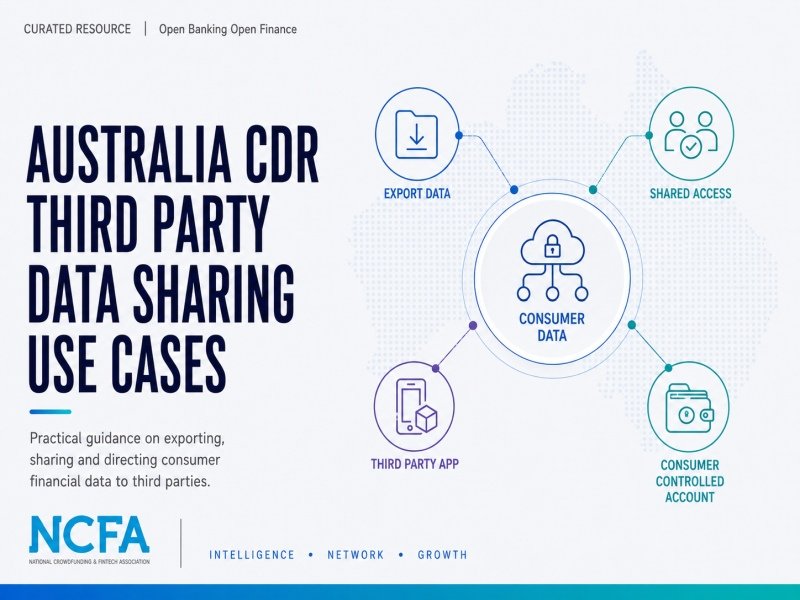
On January 27, 2026, Australia’s Consumer Data Right updated its Third Party Data Sharing Use Cases with practical examples showing how consumers can export financial data, give another person access, send data to another application or direct it into an account they control.
The Australian Competition and Consumer Commission developed the guidance with input from Treasury. It tackles a straightforward product question. After an accredited provider receives a consumer’s financial data, what can the consumer do with it next?
The answer depends on who initiates the sharing, where the information goes and who controls the destination. Those details affect consent, privacy and the provider’s responsibilities.
The guidance organizes third party sharing into four situations:
Who initiates the sharing is the key distinction. The ACCC says these consumer directed scenarios are unlikely to raise compliance concerns when the consumer makes a clear and informed choice. Downloading data, configuring access or instructing the provider to send information helps establish that the consumer chose the disclosure.
If the provider is making the disclosure itself, the permitted use and disclosure rules apply. The provider needs the authority and consent required under Australia’s Consumer Data Right rules.
That difference becomes concrete in product design. Letting someone download transaction history for personal analysis carries different responsibilities from automatically sending customer information to another company. Giving an accountant controlled access inside an SME finance platform is also different from transmitting the data outside that service.
Where the financial data remains inside the accredited provider’s service, the provider continues to carry the relevant Consumer Data Right obligations. These include privacy safeguards covering data security and the destruction or de-identification of information that is no longer required.
When consumers send their data outside that environment, they need to know how the recipient will handle it. The ACCC says providers should explain that other privacy laws may apply and encourage consumers to review the recipient’s data handling policies.
The same framework can support a single disclosure or recurring sharing for a defined period. The provider must hold the collection and use consents required for the service. Consumer Data Right consent generally lasts for up to 12 months, while some business consumer consents can extend for up to seven years.
Fintech product teams can use these examples when building financial data portability into real services. A personal finance app could let customers export transaction data for their own analysis. An SME platform could give an accountant controlled access to business records. A lending or cash flow application could let customers send selected information into another service they already use.
Compliance and legal teams can review the same features by asking a few direct questions. Who initiated the disclosure? Who controls the destination? Does the information stay inside the accredited service? What consent supports the sharing? Which obligations continue once the data leaves?
Banks and other financial institutions can use the examples to anticipate how customers may expect data portability to work. Consumers are unlikely to organize their behaviour around regulatory terminology. They will want financial information to work with budgeting software, accounting systems, lending applications, analytics tools and other services they choose.
Canada will face similar product questions as Consumer Driven Banking reaches implementation. Canada Open Banking And Consumer Driven Banking Rules tracks accreditation, authentication, consent, data sharing, security and liability requirements. Australia’s examples show what product teams have to consider after the first regulated transfer, when a customer wants to reuse the information somewhere else.
Standardized financial data can support credit assessment, fraud detection, cash flow analysis and financial guidance as well. NCFA’s Open Banking Decision Intelligence looks at how firms can turn permissioned financial data into better decisions. Third party sharing gives consumers and businesses more control over which tools can participate in those workflows.
The four examples are specific enough to use in product and compliance discussions. Teams can look at an export button, an accountant access feature, an application-to-application transfer or recurring sharing arrangement and ask exactly who controls the data at each point.
The guidance also shows why interface design and compliance cannot be separated. A button that lets the consumer choose where information goes can create a different regulatory position from a service that sends the same information on its own. Consent, control of the destination and whether the provider continues to hold the data all affect the answer.
That's useful context for Canadian teams working through consent and downstream data use. Canada can define who participates in regulated sharing and how financial institutions transfer data to accredited recipients. Customers will still want to download that information, share it with professionals, use it in another application or authorize access over time.
Australia’s rules do not determine what Canadian firms can do. The two countries have different legislation, privacy requirements, accreditation models and regulatory terminology. The Australian examples are useful because they expose practical questions Canadian product, compliance and policy teams will also have to answer.
The ACCC also makes clear that the article is general guidance. Whether a particular implementation complies with Australia’s Consumer Data Right depends on the circumstances, and providers remain responsible for assessing their legal obligations.
Consumer Data Right (Australian framework, participants and consumer information)
Legal Obligations For Data Recipients (collection, consent, use and disclosure requirements)
CDR Privacy Safeguard Guidelines (privacy requirements for handling consumer financial data)
Canada’s Open Banking Strategy Starts With Trust (consent, fraud, liability and consumer protection in Canada)
The National Crowdfunding & Fintech Association (NCFA Canada) is a financial innovation ecosystem that provides education, market intelligence, industry stewardship, networking and funding opportunities and services to thousands of community members and works closely with industry, government, partners and affiliates to create a vibrant and innovative fintech and funding industry in Canada. Decentralized and distributed, NCFA is engaged with global stakeholders and helps incubate projects and investment in fintech, alternative finance, crowdfunding, peer-to-peer finance, payments, digital assets and tokens, artificial intelligence, blockchain, cryptocurrency, regtech, and insurtech sectors. Join Canada's Fintech & Funding Community today FREE! Or become a contributing member and get perks. For more information, please visit: www.ncfacanada.org
| | |
|---|---|---|
| | |
September 1, 2026 | NCFA Market Activity | Lending Consumer Credit And BNPL, SME Finance And Business Banking, Digital Banking And BaaS

On September 1, 2026, London, Ontario based VersaBank announced the first U.S. Real-Time SRP implementation with ECN Capital. The system can fund eligible point of sale loans within hours. VersaBank says conventional funding can leave lenders waiting five to 30 days or longer while enough receivables accumulate.
ECN isn't a new customer. It implemented VersaBank's original U.S. Structured Receivable Program in 2025, and another ECN subsidiary joined the program in July with at least US$300 million in expected annual fundings. ECN Capital's Chris Johnson said the original SRP helped the company “grow our business faster” while improving profitability. The September implementation adds the newer real time capability, although VersaBank hasn't disclosed how much volume is flowing through it yet.
The scale is already substantial. VersaBank's total Structured Receivable Program portfolio exceeded C$4.4 billion as of January 31, 2026 after growing at a 33% compound annual rate over five years. U.S. SRP credit assets reached US$604.9 million by the end of the bank's second fiscal quarter of 2026, and VersaBank was targeting at least US$1 billion in additional U.S. SRP fundings during fiscal 2026.
What changes with ECN is speed. A funding model VersaBank has used in Canada for more than 15 years, and recently accelerated with Financeit, is now running in the U.S. with an established finance company.
Point of sale lenders need capital to keep making loans. A lender financing home renovations, HVAC systems, equipment or other large purchases may hold new receivables on its own balance sheet or borrow against them through a warehouse facility until the loans can be sold, refinanced or packaged into a securitization. That interval ties up capital and carries a financing cost.
VersaBank's Structured Receivable Program purchases qualifying receivables from finance companies. Real-Time SRP brings that funding closer to the original loan by evaluating and financing eligible individual receivables within hours rather than waiting for a larger pool to accumulate.
The model was first tested through an April Financeit pilot. The pilot finished ahead of schedule, and Financeit became the first partner to use Real-Time SRP at large scale when VersaBank formally launched the program in June. Financeit was approaching C$2 billion in annual loan originations, giving VersaBank a sizeable Canadian lending operation on which to prove the process before taking it into the U.S.
VersaBank describes the system as AI enabled, but its public disclosure supports a more targeted description. The bank says its internal AI technology helps evaluate individual loans underlying SRP receivables. It has not disclosed enough detail to determine exactly how eligibility, credit scoring, fraud checks or other decisions are divided between automation and human oversight.
Financeit completed a C$201 million ABS in June while also using VersaBank's real time funding. Those sources of capital can serve different stages of the same lending business. VersaBank can provide funding closer to origination, while securitization can provide longer term institutional capital after loans have accumulated into a larger pool.
Forward flow provides another option. Propel Holdings secured a US$60 million forward flow from Mesirow managed funds for Freshline loans, allowing institutional capital to purchase eligible production as it is originated. Warehouse lenders, forward flow investors, banks, private credit funds and ABS buyers are all competing to fund the period between a lender making a loan and receiving longer term capital.
VersaBank is trying to compress that period. The economic benefit depends on whether the cost of its funding, integration requirements and credit rules are attractive enough to save lenders money or free enough capital to justify adding another funding relationship.
VersaBank has operated versions of its Structured Receivable Program in Canada for more than 15 years. It entered the U.S. point of sale finance market after acquiring a U.S. bank in 2024, giving VersaBank an OCC chartered national banking platform in Minnesota.
VersaBank is doing more than licensing software to ECN. It's using deposits and its own balance sheet to buy qualifying U.S. receivables through a funding model developed in Canada. That lets the bank grow through lending partners without having to build a large consumer lending operation itself.
ECN is now using the faster version in the U.S. VersaBank already had hundreds of millions of dollars in U.S. SRP assets, and the wider ECN relationship includes at least US$300 million in expected annual fundings. The real time version gets eligible receivables onto VersaBank's balance sheet sooner.
Faster funding can help lenders keep more cash available for new loans, but only if VersaBank's price and credit rules beat the alternatives. Lenders already have warehouse lines, forward flow buyers, banks and securitization markets competing for their business, so speed alone won't win the account.
For VersaBank, more U.S. receivables mean more loans and leases earning interest on the bank's balance sheet without VersaBank having to find the borrowers itself. The economics work only if what the bank earns on those assets stays comfortably above its funding costs and credit losses.
Growth can also concentrate risk. A few large partners, weaker loan quality or rising deposit costs could turn faster asset growth into lower returns. ECN is the first U.S. user of the real time version, so the more telling evidence will be whether other lenders adopt it and whether those portfolios perform well as volumes rise.
Private credit adds another source of competition for finance companies seeking capital. Canadian institutions already have roughly C$500 billion of private credit exposure, much of it outside Canada, while U.S. private credit funds have become major lenders to businesses and specialty finance companies. VersaBank is entering that competition with a regulated bank balance sheet, a deposit base and a funding system designed to work much closer to loan origination.
Can VersaBank turn a Canadian funding model into a scalable U.S. lending business?
The National Crowdfunding & Fintech Association (NCFA Canada) is a financial innovation ecosystem that provides education, market intelligence, industry stewardship, networking and funding opportunities and services to thousands of community members and works closely with industry, government, partners and affiliates to create a vibrant and innovative fintech and funding industry in Canada. Decentralized and distributed, NCFA is engaged with global stakeholders and helps incubate projects and investment in fintech, alternative finance, crowdfunding, peer-to-peer finance, payments, digital assets and tokens, artificial intelligence, blockchain, cryptocurrency, regtech, and insurtech sectors. Join Canada's Fintech & Funding Community today FREE! Or become a contributing member and get perks. For more information, please visit: www.ncfacanada.org
| | |
|---|---|---|
| | |
Sep 2, 2026

Image: Magnific/Rawpixel.com
American retail currency traders navigate one of the most strictly supervised financial environments on earth. A company holding a proper Forex license within the United States offers top-tier security for customer capital and operates under full regulatory transparency. Mandates from the Commodity Futures Trading Commission (CFTC) and National Futures Association (NFA) enforce stringent balance sheet requirements on these platforms. Consequently, only a small, dedicated group of brokerage firms actively accept US residents in 2026.
Federal laws require every retail foreign exchange dealer to maintain at least $20 million in adjusted net capital. This massive financial requirement prevents undercapitalized entities from taking on retail accounts. Additionally, rules designed to safeguard individual deposits impose strict limits on daily trading operations.
Brokers must follow several mandatory execution rules across all trading accounts:
These stringent operating conditions eliminate high-leverage gambles and build a transparent trading environment. Traders who prioritize fund safety often view these regulatory guidelines as a protective buffer rather than a hindrance.
Active traders must research operational histories and compliance records before opening an account. Because foreign unregulated brokers frequently try to attract American traders with promises of extreme leverage, market participants must verify every regulatory claim through official government databases.
On the operational side, financial entities entering this market rely on experienced legal advisors to manage these complex international standards. SBSB Fintech Lawyers brings more than 13 years of experience in fintech, crypto, gambling, and investment consulting. Their team assists international firms with regulatory compliance, structural planning, and licensing solutions across global markets.
Before opening a live account, retail clients should evaluate specific features:
Smart traders check these details carefully before transferring capital. Verification of these factors keeps funds safe from unauthorized offshore entities operating without proper oversight.
Accounts opened within the US regulatory framework offer distinct financial benefits. Tax treatment represents a significant advantage for active market participants. While spot forex trades default to ordinary income rates under Section 988 of the Internal Revenue Code, traders can opt into a more favorable treatment. Under Section 1256, qualifying forex transactions receive a 60/40 tax split. Sixty percent of gains receive long-term capital gains tax rates, while forty percent fall under short-term rates, regardless of position duration.
Traders should consider several practical account management strategies:
Proper record-keeping combined with strategic account management helps market participants keep more of their earnings. American trading regulations impose tight boundaries, yet the enhanced security and favorable tax rules offer tremendous value to serious traders.
The National Crowdfunding & Fintech Association (NCFA Canada) is a financial innovation ecosystem that provides education, market intelligence, industry stewardship, networking and funding opportunities and services to thousands of community members and works closely with industry, government, partners and affiliates to create a vibrant and innovative fintech and funding industry in Canada. Decentralized and distributed, NCFA is engaged with global stakeholders and helps incubate projects and investment in fintech, alternative finance, crowdfunding, peer-to-peer finance, payments, digital assets and tokens, artificial intelligence, blockchain, cryptocurrency, regtech, and insurtech sectors. Join Canada's Fintech & Funding Community today FREE! Or become a contributing member and get perks. For more information, please visit: www.ncfacanada.org
| | |
|---|---|---|
| | |
September 1, 2026 | NCFA Insight | Digital Assets Blockchain And Tokenization, Payments Infrastructure And Money Movement, Cross Border Payments And FX

On September 1, 2026, TD Bank Group and Scotiabank joined a 21 institution stablecoin venture that plans to form a new company in the second half of 2026. The venture is targeting a USD denominated stablecoin launch in the first half of 2027, followed by a euro product, with other G7 currencies possible later.
The group started with 10 banks exploring a shared stablecoin in October 2025. It now includes Bank of America, Citi, Goldman Sachs, Wells Fargo, Santander, Deutsche Bank, UBS and MUFG alongside TD and Scotiabank. Fidelity Investments and WisdomTree put asset managers inside the venture as well, creating potential connections to investment products, tokenized assets and institutional distribution.
The stablecoin isn't live and the group hasn't disclosed the company name or any details. It says the product is intended for wholesale, institutional and retail markets, including cross border payments and digital asset settlement, and is being designed to meet applicable U.S. GENIUS Act and European MiCA requirements.
The banks are entering a US$320 billion stablecoin market as of the end of May 2026. Roughly 98% of stablecoin value is denominated in U.S. If regulated digital dollars become easier for businesses and consumers to hold and use, banks have an economic reason to compete for the deposits, reserves, customer relationships and settlement activity around them.
Bank of America CEO Brian Moynihan put a number on one concern in January. Citing U.S. Treasury studies, he said as much as US$6 trillion, or roughly 30% to 35% of U.S. commercial bank deposits, could migrate into stablecoins under scenarios where stablecoin holders can earn interest. It wasn't a forecast that US$6 trillion will leave banks. It illustrated how digital dollars could compete with deposits if customers can earn more elsewhere.
Deposits help fund lending and other bank balance sheet activity. Stablecoin reserves are generally held in cash, short term government securities and other permitted liquid assets. A large transfer from deposits into independently issued stablecoins could leave banks replacing some lower cost deposits with more expensive funding. Issuing or participating in stablecoins gives banks a way to retain more of the economics if customers start holding money onchain.
Europe is pursuing the same opportunity in euros. Qivalis euro stablecoin expanded to 37 financial institutions across 15 countries in May. Bank backed stablecoin ventures are becoming a competitive model alongside independently issued products such as USDC and USDT.
Banks are developing tokenized deposits at the same time. A tokenized deposit remains a liability of the issuing bank. A reserve backed stablecoin is a separate digital claim supported by designated reserve assets. Those differences affect funding, credit creation, redemption and who controls the customer relationship.
TD is already working across both models.
On August 31, TD completed a Project Agorá payments test using tokenized commercial bank deposits and central bank reserves. TD moved real U.S. dollar funds between two U.S. entities through the Project Agorá platform, with BNY acting as the clearing bank and intermediary.
The test involved 28 central banks and financial institutions, covered 17 transaction scenarios and transferred approximately CHF 800,000 across selected currencies. Project Agorá is examining whether tokenized forms of existing bank money can improve wholesale cross border settlement while keeping commercial bank deposits and central bank money at the centre of the system.
TD also has a direct role in Canadian dollar stablecoins. Stablecorp selected TD in July as primary custodian for the fiat reserves backing QCAD Digital Trust, with the relationship expected to roll out in phases through the third and fourth quarters of 2026.
QCAD is building institutional access from several directions. QCAD bank integration is being developed by Deloitte and Stablecorp for Canadian financial institutions, while VersaBank and QCAD established another Canadian banking relationship earlier this year.
Stablecorp also issued QCAD on Circle's Arc testnet and integrated it with StableFX in May. The QCAD/USDC pair is available in the StableFX sandbox, demonstrating a potential onchain CAD/USD settlement route. Production is expected after Arc's mainnet launch, so this remains development work rather than a live production FX corridor.
Canada now has another domestic model through the CADD stablecoin. Tetra Trust Company, through CAD Digital, launched the 1:1 Canadian dollar backed payment stablecoin in May as Canada's first CAD stablecoin issued by a regulated financial institution.
TD's activity across QCAD custody, tokenized deposits and the new global USD venture explains why banks may want several forms of digital money. Tokenized deposits can serve customers who want bank money on programmable settlement systems. A CAD stablecoin can support Canadian dollar transactions. A USD stablecoin can connect users to international liquidity, digital asset markets and cross border settlement.
The BankChain Alliance offers another approach. Thirty nine U.S. state banking associations are developing shared blockchain capabilities that could support tokenized deposits, stablecoins and automated settlement while giving participating banks a role in ownership and governance.
Banks are now experimenting with shared stablecoins, individual stablecoins, tokenized deposits and common settlement networks at the same time. The commercial winners will depend on where customers hold balances, which products can reach multiple networks and how cheaply money can cross between them.
The U.S. dollar begins with an enormous network advantage. The BIS estimates that about 98% of stablecoin value is already dollar denominated. Annual stablecoin transaction volume reached an estimated US$28 trillion in 2025, although the BIS cautions that the number falls substantially after transfers between wallets controlled by the same party are removed and that ordinary payment use remains modest beside established payment systems.
Other currencies have struggled to build comparable liquidity. Only about 0.2% of global stablecoin circulation is euro denominated, even as European banks invest in Qivalis. CAD begins from a still smaller international base.
Canadian businesses still collect domestic revenue, pay employees, manage treasury balances and settle obligations in Canadian dollars. Sending those transactions through USD stablecoins would introduce foreign exchange exposure and conversion costs where a Canadian dollar product could settle directly in CAD.
Canada has also established a federal regulatory base for the market. Canada's stablecoin regulations now include the Stablecoin Act, Bank of Canada oversight, issuer registration, reserve requirements and redemption obligations, although the Act's substantive requirements are not yet in force.
The Bank of Canada's 2026 Financial System Survey raises a more practical concern. If Canadian businesses rely too heavily on foreign payment systems and foreign controlled stablecoins, more of Canada's payment activity could end up running through systems controlled elsewhere.
TD and Scotiabank can still benefit from joining a global USD stablecoin network. It gives them access to international liquidity, customers and settlement systems. The problem arrives if digital dollars become easy to use while Canadian dollar products remain harder to use for everyday business payments, treasury and settlement.
That risk creates room for Canadian fintechs. Businesses will need ways to convert between CAD and USD, manage liquidity, hold digital assets safely, handle compliance and connect stablecoins to treasury and payment systems without adding unnecessary FX costs.
TD is already working on both sides. It is supporting QCAD reserves, testing tokenized bank money and joining a global USD stablecoin venture. Scotiabank is now part of that international venture too. Canada does not need to match the dollar's global scale, but it does need CAD based digital money that businesses can actually use. Can Canada connect to global digital dollars without making digital CAD an afterthought?
The National Crowdfunding & Fintech Association (NCFA Canada) is a financial innovation ecosystem that provides education, market intelligence, industry stewardship, networking and funding opportunities and services to thousands of community members and works closely with industry, government, partners and affiliates to create a vibrant and innovative fintech and funding industry in Canada. Decentralized and distributed, NCFA is engaged with global stakeholders and helps incubate projects and investment in fintech, alternative finance, crowdfunding, peer-to-peer finance, payments, digital assets and tokens, artificial intelligence, blockchain, cryptocurrency, regtech, and insurtech sectors. Join Canada's Fintech & Funding Community today FREE! Or become a contributing member and get perks. For more information, please visit: www.ncfacanada.org
| | |
|---|---|---|
| | |



August 26th, 2025

January 4th, 2024

June 1st, 2021

September 9th, 2020

July 9th, 2018

January 3rd, 2018

September 25th, 2017

June 20th, 2017

May 10th, 2017

December 14th, 2016
