





Karsten Wenzlaff, Advisor
August 26th, 2025
Karsten Wenzlaff is a Crowdfunding and Fintech Expert from Germany. He is Secretary-General of Digit[...]


Sep 2, 2026

India is increasingly relevant to fintech companies for more than market access. It is also a significant source of technology, product, finance, risk, data, and operational talent that global scaleups can integrate into international teams.
India's wider startup ecosystem had more than 2.23 lakh government-recognised startups by March 31, 2026, while the country's digital financial infrastructure continues to expand rapidly. UPI alone processed more than 24,000 crore transactions during FY26, illustrating the scale at which digital financial services now operate in the country.
For a Canadian or international fintech, however, deciding to recruit in India creates a strategic question:
Should the company establish an Indian entity before building a team, or can it begin hiring first and make the larger corporate investment later?
For many scaleups, these decisions do not need to happen simultaneously.
A phased talent strategy can allow a fintech to test access to Indian talent, build an initial team, understand operating costs, and validate its long-term requirements before committing to a full local entity.
India combines a large technology workforce with an established ecosystem across financial services, digital payments, software development, data, and startup innovation.
This creates hiring opportunities across functions that fintech companies frequently need as they scale, including:
India's digital payments ecosystem also gives fintech professionals exposure to financial products operating at substantial scale. UPI accounted for 85.5% of India's digital payment transaction volume in the second half of 2025, according to RBI data reported by IBEF.
But the business case for building a team should not begin with the question, "How many people can we hire?"
It should begin with:
Which capabilities should the company own internally, and which of those capabilities can be built effectively in India?
That changes hiring from a cost exercise into a talent strategy.
A fintech talent strategy defines which capabilities a company needs, where those capabilities should be located, and how employees will be hired, managed, and integrated into the organisation.
For an India expansion, a useful talent strategy should address five areas:
This is particularly important for fintech companies because many roles interact with sensitive financial data, regulated products, security systems, or customer operations.
Hiring should therefore be considered together with data access, information security, governance, internal controls, and business continuity.
The first India hires should solve clearly defined business problems rather than simply expand headcount.
A practical approach is to prioritise functions where the company already understands the workflows and can manage outcomes remotely.
| Function | Why a Fintech May Build It in India |
| Engineering | Product development, integrations, platform infrastructure |
| Data | Analytics, reporting, data engineering and modelling |
| QA | Product testing, automation and release support |
| Cybersecurity | Security operations and technical monitoring |
| Finance operations | Reporting, reconciliation and operational support |
| Customer operations | User support and service delivery |
| Risk operations | Process-driven risk and verification support |
| Product operations | Coordination between technology, product and commercial teams |
Leadership should also identify whether the function is supporting the global business or conducting activity directly in the Indian market.
That distinction can affect entity, regulatory, tax, and Permanent Establishment considerations later.
Yes, depending on the type of relationship and business activity.
A foreign fintech typically has several potential models available.
Contractors may be appropriate for genuinely independent, project-based work.
For example, a fintech might engage a specialist for:
Contractors should not simply be used as substitutes for employees where the actual working arrangement functions like regular employment.
A fintech can outsource a complete function or defined process to another company.
In this model, the external provider typically manages its own employees and delivers an agreed service or outcome.
That is different from building a dedicated internal team.
Where a fintech wants dedicated employees in India but does not yet have a local employing entity, an Employer of Record India model can provide another option.
The EOR becomes the legal employer in India, while the fintech continues to manage employees' daily responsibilities, goals, projects, and performance.
A fintech can establish its own Indian company and employ staff directly.
This generally provides greater long-term control but also introduces ongoing corporate, accounting, payroll, HR, tax, and administrative responsibilities.
The best structure depends on the company's stage and objectives.
| Factor | Contractor | Outsourcing | EOR | Own Entity |
| Dedicated employee relationship | No | Usually no | Yes | Yes |
| Local entity required | No | No | No for EOR employment | Yes |
| Client controls daily work | Limited by independent relationship | Usually outcome-focused | Yes | Yes |
| Local payroll | Not employee payroll | Provider handles employees | EOR handles | Company handles |
| Initial setup burden | Low | Low | Lower than entity | Highest |
| Suitable for testing India | Yes, for genuine projects | Yes | Yes | Possible but larger commitment |
| Long-term large workforce | Limited | Depends on model | Depends on scale | Strongest fit |
For a fintech building an internal product or operations team, the main comparison is often between EOR employment now and direct employment through an entity later.
Entity establishment is a strategic corporate decision.
Hiring can be an operational decision.
Those decisions may move at different speeds.
Suppose a Canadian fintech has funding to build a six-person engineering and data team in India. It already knows the roles it needs, but management is not yet certain whether India will eventually support 10 employees, 50 employees, or a much larger operation.
Immediately building a company around an uncertain headcount assumption can create unnecessary fixed infrastructure.
A staged approach allows the fintech to answer questions such as:
The business can then make its entity decision using operating evidence rather than projections alone.
Salary is only one component of India workforce costs.
Finance teams should compare the total cost of different structures.
Relevant categories can include:
An EOR may involve a per-employee service fee, while an owned entity introduces more fixed organisational costs.
The economics can therefore change as the team becomes larger.
Companies comparing these structures can also review State of India EOR 2026 when assessing employment costs, entity considerations, compliance responsibilities, and potential tax exposure.

Fintech teams often work within more sensitive operating environments than ordinary remote teams.
The question is not simply whether a developer or analyst can work remotely.
Companies may also need controls around:
Employees may interact with customer data, financial information, transaction records, or internal risk systems.
Access should be based on role requirements.
Devices, authentication, credentials, source code, and internal platforms require appropriate security controls regardless of where employees are located.
Certain finance or payment workflows may require multiple layers of approval rather than giving one employee end-to-end control.
Teams should understand who owns decisions, where approvals are recorded, and how processes are audited.
Hiring someone in India does not itself determine whether the fintech is permitted to offer regulated financial services in India.
Employment structure and financial-services licensing are separate questions.
A company building an India team to support overseas operations should therefore distinguish workforce expansion from market entry.
India's four consolidated Labour Codes came into effect on November 21, 2025, covering wages, industrial relations, social security, and occupational safety and working conditions.
Companies employing workers directly need processes covering relevant employment requirements, including areas such as:
Under an EOR structure, many agreed employer-side administrative responsibilities are handled by the EOR.
However, using an EOR does not remove the fintech's responsibility for how employees access systems, handle information, perform regulated activities, or represent the business.
Potentially, depending on what the employees do.
An EOR or contractor arrangement does not automatically eliminate Permanent Establishment or wider business-connection considerations.
India's Income Tax Department states that business income of a non-resident can be taxable in India where the enterprise has a Permanent Establishment or business connection, subject to applicable tax treaties.
Indian tax rules also identify activities such as habitually concluding contracts or playing a principal role leading to the conclusion of contracts as potentially relevant to business-connection analysis.
A fintech should therefore obtain appropriate tax advice where India-based personnel:
A developer supporting a global product and a senior commercial executive entering contracts on behalf of the foreign company may present very different risk profiles.
An entity can become increasingly attractive as India moves from an experimental talent location to a strategic operating hub.
Common indicators include:
There is no universal employee number at which every fintech should incorporate.
The decision should consider scale, cost, tax, regulation, employment requirements, business activity, and long-term strategy together.
A practical expansion sequence can look like this:
Identify the roles that India can support and the business problem each role solves.
Recruit a small number of clearly defined roles using an appropriate employment structure.
Implement security, communication, management, documentation, payroll, and performance systems.
Compare productivity and total employment costs against the original business case.
Estimate whether the India operation is likely to remain a small global team or grow into a major operating centre.
Once the scale and commercial requirements are clearer, evaluate establishing a local entity.
This approach allows a fintech to treat entity setup as a consequence of proven scale rather than a prerequisite for exploring Indian talent.
For fintech companies that want employees in India before establishing their own entity, Asanify provides an India-focused Employer of Record model.
Asanify operates through its own Indian entity and can act as the legal employer while the client fintech retains control over employees' daily work, responsibilities, and performance.
Its EOR support can include:
This structure can be useful for scaleups testing the Indian talent market or building an initial team while their long-term entity strategy remains under evaluation.
Tax, regulatory, financial-services licensing, PE, data, and other business-specific risks should still be assessed separately.
For fintech scaleups, India expansion should start with the capabilities the business needs, not with entity setup.
Companies can first define the right roles, choose a suitable employment model, and validate costs, compliance, and team performance. This gives leadership a clearer view of how India fits into the wider operating strategy.
As the team grows, the business can then decide whether a larger local infrastructure or entity is justified. A phased approach helps keep early expansion flexible while supporting more informed long-term decisions.
 The National Crowdfunding & Fintech Association (NCFA Canada) is a financial innovation ecosystem that provides education, market intelligence, industry stewardship, networking and funding opportunities and services to thousands of community members and works closely with industry, government, partners and affiliates to create a vibrant and innovative fintech and funding industry in Canada. Decentralized and distributed, NCFA is engaged with global stakeholders and helps incubate projects and investment in fintech, alternative finance, crowdfunding, peer-to-peer finance, payments, digital assets and tokens, artificial intelligence, blockchain, cryptocurrency, regtech, and insurtech sectors. Join Canada's Fintech & Funding Community today FREE! Or become a contributing member and get perks. For more information, please visit: www.ncfacanada.org
 |  |  |
|---|---|---|
 |  |  |
September 1, 2026 | NCFA Market Activity + Insight | Lending Consumer Credit And BNPL, Digital Banking And BaaS, Competition And Market Structure

On September 1, 2026, Solifi acquired Inovatec Systems, a Vancouver company whose cloud software handles digital applications, loan origination and servicing for banks, credit unions, captive finance companies and specialty lenders across North America. Financial terms weren't disclosed. Inovatec brings more than 160 employees and 20 years of lending technology development into a much larger secured finance business.
For Inovatec, the sale provides the scale its founders say customers are demanding. For Solifi, it adds retail automotive, powersports and specialty lending capabilities to a platform already strong in equipment, wholesale, working capital and automotive finance. Canada gets another successful fintech commercialization event, while ownership and future capital decisions now sit with a global company under foreign private equity control.
The transaction arrives in a Canadian market where those outcomes are common. KPMG estimates that nearly half of Canadian acquisition targets across industries are bought by international firms. Canadian companies are active buyers abroad too, completing more than two thirds of their own transactions outside Canada. The question is whether Canada is producing enough companies that can keep scaling into global buyers themselves?
Vladimir and Danijela Kovacevic founded Inovatec in 2006 with two people. The platform now spans its Propel digital application portal, loan origination software and loan and lease servicing. It supports automotive, powersports, equipment and other consumer and commercial lending, with more than 70 third party integrations across its products.
The software reaches several workflows where lenders spend time and money. Applications can flow from consumers or dealers into credit decisioning and funding, while the servicing system handles payments, collections, customer service and asset recovery. Inovatec says lenders using its AI based funding automation have cut time spent manually reviewing documents by as much as 80%. That's a company reported customer result rather than an industry benchmark, but it shows the type of operating efficiency Solifi is buying.
Inovatec has also kept adding capabilities while expanding in the United States. In August, less than a month before the acquisition, it integrated Fortiro technology to detect altered and AI generated lending documents during origination. The company reports annual SOC 1, SOC 2 and SOC 3 audits along with ISO 27001 and ISO 27018 certifications, requirements that help lending software get through the security reviews of banks and other regulated customers.
The founders described the reason for selling in unusually direct terms. Customers want more products, channels and automation, and “meeting those needs requires scale.” Solifi gives Inovatec access to a much larger product portfolio, implementation organization and international customer base.
Solifi has dual headquarters in Minneapolis, United States, and Milton Keynes, United Kingdom, and sells software to banks, captive finance companies and independent lenders around the world. When TA Associates became its majority investor in October 2024, Solifi had more than 650 employees globally. Thoma Bravo, which had backed the company since 2019, kept a meaningful investment.
The ownership change came with an explicit acquisition plan. TA and Solifi said they intended to expand into adjacent finance markets and new countries through strategic acquisitions as well as internal growth.
That plan started producing deals. In September 2025, Solifi acquired DataScan, an Atlanta area company whose wholesale finance and inventory risk software serves more than 45 major banks and captive lenders. DataScan added floorplan lending, digital inventory audits and field inspection capabilities.
While DataScan strengthened the wholesale side of automotive finance. Inovatec adds the consumer application, credit, funding and servicing work that happens on the retail side. Solifi can now sell across more of the financing relationship instead of relying on separate products for each part.
That makes the Vancouver acquisition easier to understand. Solifi isn't simply adding another software company. Its private equity owners are funding a deliberate expansion across secured lending, and Inovatec brings technology and customer relationships that would take years to reproduce organically.
The timing fits Canada's current fintech market. KPMG counted US$996.7 million invested across 47 Canadian fintech deals in the first half of 2026. That was down more than 40% from US$1.7 billion across 82 deals a year earlier, while capital concentrated in companies with established scale, specialized technology and clearer economics.
KPMG partner Dubie Cunningham summarized what is attracting capital as “technology, customers, licences or regulated platforms that can accelerate expansion.” Inovatec fits that description closely. Solifi is buying working lending software, a North American customer base, integrations, regulated industry experience and a team that has spent two decades inside automotive and specialty finance.
Recent Canadian sales highlight various versions of the same commercial pattern. Fiserv bought Toronto based Payfare for C$4 per share, with the final acquisition covering roughly C$193.1 million of outstanding shares. Fiserv wanted Payfare's card program management, white label app and embedded finance capabilities. Payfare's situation included customer concentration and financial pressure before the sale, so it isn't a direct parallel to Inovatec.
Robinhood acquired WonderFi for about C$250 million for a different reason. WonderFi's Bitbuy and Coinsquare platforms brought roughly 300,000 funded customers at closing and regulated Canadian crypto access. Robinhood used the acquisition to enter Canada rather than spending years building that position itself.
European payments company Paynt used its 2025 acquisition of Vancouver based E-xact Transactions to expand in North America. E-xact was processing more than C$3.5 billion annually across 50 million transactions, and Paynt made Vancouver a new operational hub. The transactions differ, but the assets being purchased are software, customers, transaction volume, licences, regulatory experience and local distribution.
Canada isn't simply selling companies while everyone else buys. KPMG's wider M&A data show Canadian firms conduct more than two thirds of their transactions outside the country. The domestic fintech market is also still financing independent growth. Nesto raised C$302 million in its 2026 Series E at a C$1.47 billion valuation, the largest Canadian fintech financing in KPMG's H1 data.
Selling to a larger company can be a good outcome. Founders and investors get paid, employees may get more resources, and Canadian technology can reach customers that would have been costly to win alone. The bigger concern is when Canada keeps building valuable fintechs but too few grow large enough to become global buyers themselves.
Solifi says customers will keep their existing products and support, and that it will continue investing in Inovatec's products. The founders also say clients will keep working with the same team. What Solifi hasn't said is whether Vancouver headcount will grow, where future product decisions will be made, or where new intellectual property will be developed. There is no evidence today of layoffs, office cuts or development work leaving Canada.
Canada's economic return will depend on more than where the shareholder register ends up. Inovatec found the scale it wanted by joining Solifi. Canada's fintech market becomes stronger when more companies can eventually provide that scale themselves.
How many Canadian fintechs can grow from attractive acquisition targets into global acquirers?
The National Crowdfunding & Fintech Association (NCFA Canada) is a financial innovation ecosystem that provides education, market intelligence, industry stewardship, networking and funding opportunities and services to thousands of community members and works closely with industry, government, partners and affiliates to create a vibrant and innovative fintech and funding industry in Canada. Decentralized and distributed, NCFA is engaged with global stakeholders and helps incubate projects and investment in fintech, alternative finance, crowdfunding, peer-to-peer finance, payments, digital assets and tokens, artificial intelligence, blockchain, cryptocurrency, regtech, and insurtech sectors. Join Canada's Fintech & Funding Community today FREE! Or become a contributing member and get perks. For more information, please visit: www.ncfacanada.org
| | |
|---|---|---|
| | |
August 31, 2026 | NCFA Insight | Artificial Intelligence And Data, Competition And Market Structure, Data Privacy And Governance
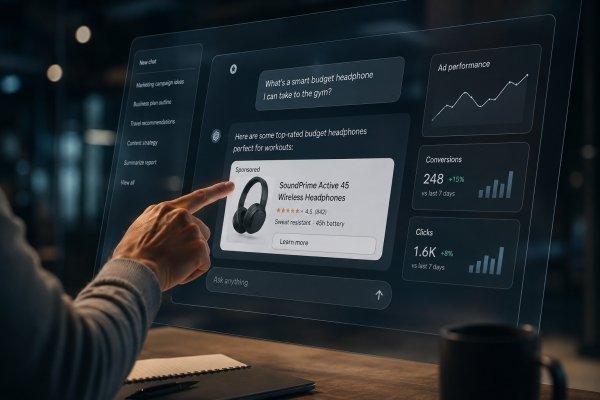
On August 31, 2026, OpenAI said ChatGPT Ads reached a US$1 billion annualized revenue run rate in less than 200 days. Tens of thousands of advertisers are using the platform, OpenAI reports more than one billion weekly active ChatGPT users, and ads are available across more than 40 countries through direct sales, agencies and technology partners.
US$1 billion is a run rate, not revenue already collected. At that pace, ChatGPT Ads would produce roughly US$250 million per quarter. That's small beside the companies OpenAI now competes with for advertising budgets, but getting there in less than seven months gives advertisers, competitors and regulators something tangible to watch.
Notably, on the same day OpenAI announced the milestone, European regulators designated ChatGPT a Very Large Online Search Engine under the Digital Services Act. In the United States, the FTC and 22 states sued Amazon over alleged practices in its advertising auctions. Google is already operating under court ordered search remedies after losing a U.S. monopolization case.
OpenAI is building its advertising business in a market where regulators already know how digital distribution, auction rules, data and default positions can concentrate power.
ChatGPT Ads started as a U.S. test on February 9 for adult Free and Go users. Canada, Australia and New Zealand followed in the spring. OpenAI added self service Ads Manager and cost per click buying in May, expanded into the U.K., Mexico, Brazil, Japan and South Korea in August, and is now adding more markets across Europe, India, the Middle East and North Africa.
The product itself has grown just as quickly. CPC and outcome optimized bidding now account for most campaigns, according to OpenAI. Advertisers can use Pixel and Conversions API measurement, product feeds, geographic targeting and custom audiences, while more than 50 technology and measurement partners connect businesses to the platform.
OpenAI says one ecommerce advertiser produced a 3x return on ad spend over 28 days, while one technology partner reported that more than 80% of traffic generated by ChatGPT ads came from new customers. Those are select examples supplied by OpenAI, so they shouldn't be treated as typical campaign performance. OpenAI also says it doesn't yet have reliable performance benchmarks across industries and campaign types.
Back in February, NCFA asked whether conversational advertising could develop into a new route for product discovery. Six months later, OpenAI has a US$1 billion annualized ad run rate, self service buying, conversion tools and tens of thousands of advertisers. Businesses will pay to advertise inside AI conversations, and enough of them are doing so to create a sizable new revenue stream.
Alec Shao, Newegg performance marketing manager, an advertiser on OpenAI's own ads site explains the attraction directly:
“We want Newegg to be part of the conversation when someone is researching what to buy.”
OpenAI isn't close to Google in advertising revenue. Alphabet reported US$81.63 billion of Google advertising revenue in Q2 2026. Search and other advertising alone generated US$63.27 billion, up from US$54.19 billion a year earlier.
Meta generated US$59.36 billion of Q2 advertising revenue, while Amazon generated US$19.81 billion from advertising services. OpenAI's roughly US$250 million quarterly equivalent makes clear how much ground separates a fast growing new entrant from established digital advertising businesses.
However, ChatGPT offers advertisers something those numbers don't capture. Search advertising usually begins with a query. Social advertising often begins with interests, behaviour and attention. Amazon can catch a shopper close to purchase. A ChatGPT conversation can contain a goal, budget, constraints, preferences and several rounds of comparison before an ad is selected.
OpenAI says its ad system considers the context and intent of the current conversation, the ad and landing page, advertiser supplied context hints and, when personalization is enabled, selected information from a user's wider ChatGPT experience. Advertiser hints describe relevant conversations, topics or keywords, but they aren't exact match search keywords.
The auction is already becoming familiar territory for performance marketers. OpenAI supports CPM and CPC buying and recommends starting CPC bids around US$3 to US$5. It says eligible ads compete through a relevance weighted second price auction.
Whether a detailed conversation produces a better customer than a search keyword hasn't been established. Advertisers now have enough buying and measurement tools to start finding out.
Regulators may reach AI advertising earlier than they reached search and social platforms. Google is already operating under court ordered search remedies, while Amazon now faces allegations over how its ad auctions were priced. OpenAI is entering the same commercial territory with regulators already alert to distribution control, auction transparency, data use and platform power.
ChatGPT Ads is still small beside Google, Meta and Amazon, but it reached a US$1 billion annualized run rate in less than 200 days. Regulators may not need to wait for comparable scale before asking how the market works, especially if distribution, data or auction rules begin limiting competition.
Canadian advertisers can already create and manage ChatGPT Ads through OpenAI's self service Ads Manager, with a minimum daily budget of C$25. Canadian financial firms face an important limit, though. OpenAI currently generally prohibits financial services ads outside the United States, where approved advertisers can be accepted case by case for products such as credit cards, mortgages, brokerages, insurance, loans and payments.
OpenAI treats financial services as a restricted category requiring extra safeguards, including enhanced advertiser verification or manual review, and says advertisers may have to prove they are properly licensed.
Financial software, budgeting tools and educational products may have more room to experiment. For firms that can participate, can ChatGPT produce customers at a better cost and with stronger intent than search, social media, affiliates or other channels?
Will regulators act on AI advertising before market power becomes difficult to unwind?
The National Crowdfunding & Fintech Association (NCFA Canada) is a financial innovation ecosystem that provides education, market intelligence, industry stewardship, networking and funding opportunities and services to thousands of community members and works closely with industry, government, partners and affiliates to create a vibrant and innovative fintech and funding industry in Canada. Decentralized and distributed, NCFA is engaged with global stakeholders and helps incubate projects and investment in fintech, alternative finance, crowdfunding, peer-to-peer finance, payments, digital assets and tokens, artificial intelligence, blockchain, cryptocurrency, regtech, and insurtech sectors. Join Canada's Fintech & Funding Community today FREE! Or become a contributing member and get perks. For more information, please visit: www.ncfacanada.org
| | |
|---|---|---|
| | |
August 31, 2026 | NCFA Market Activity | Digital Assets Blockchain And Tokenization, Wealth Investing And Trading, Competition And Market Structure, Capital Markets And Market Infrastructure
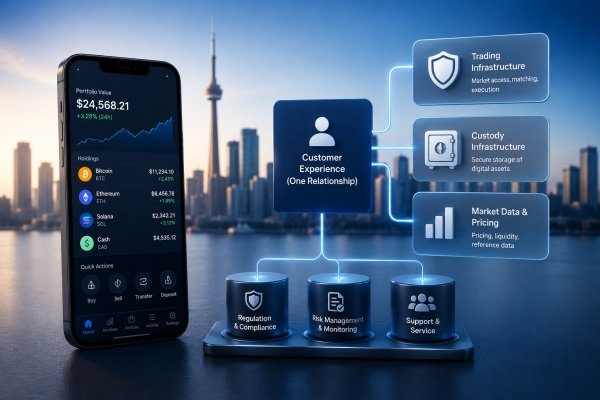
On August 31, 2026, Coinbase announced its Webull Canada partnership, supplying the trading and custody services behind Webull's new Canadian crypto offering. Webull maintains the investor relationship and brokerage experience, while Coinbase handles two core crypto functions. The same partnership already supports Webull in the United States, Brazil and Australia.
Webull Canada Crypto Limited was registered as an Investment Dealer and admitted to CIRO membership effective June 17, 2026. Coinbase Canada, Inc. is registered as a Restricted Dealer across Canada.
Crypto arrives after Webull spent more than two years expanding its Canadian brokerage. It launched here in 2024 with Canadian and U.S. equities and later added registered accounts, options, cash management, desktop trading and longer trading hours. Canadian stocks and ETFs now trade at zero commission, while selected securities are available around the clock five days a week.
When Webull entered Canada, its offering was much narrower. The company has since added enough products that crypto now joins an account already spanning stocks, options, cash, margin, TFSAs and RRSPs.
Using Coinbase lets Webull add crypto without building its own trading and custody systems from scratch. It can use infrastructure already supporting the same partnership elsewhere, reducing the amount of technology and operating capability Webull has to build internally.
Webull still has to persuade Canadians to use the product. The company reports 26 million registered users globally but doesn't disclose its Canadian customer count, leaving a large gap between the breadth of its local product menu and what outsiders can see about actual adoption.
A Canadian investor trading crypto through Webull remains inside Webull's experience, but Coinbase can still earn from the trading and custody taking place underneath it.
Coinbase has been selling more of those capabilities to financial institutions. Its Crypto as a Service business targets banks, brokers, fintechs and payment companies that want to offer digital assets without building everything themselves. Coinbase said in 2025 that more than 200 institutional clients were already using its infrastructure.
Webull gives Coinbase another customer for that business while Coinbase continues competing directly for Canadian crypto users through its own platform. The two companies can pursue the same investor from different positions. Webull wants the account and ongoing customer relationship. Coinbase can benefit whether the investor chooses Coinbase directly or reaches its services through Webull.
Webull is relying on Coinbase for key parts of the service. If trading, custody, pricing or service problems arise, Webull still has to deal with the customer impact.
Webull isn't alone in combining its own customer experience with outside financial infrastructure. Wealthsimple offers stocks, cash and crypto from one relationship, while its regular crypto service uses external custodians including Tetra Trust, Coinbase Custody and BitGo. Its recent in app DEX trading beta uses a different model, creating a self custody wallet for the client and routing trades through a third party DEX aggregator.
Crypto focused firms such as Coinsquare, Newton and Shakepay started from a different approach, building their customer relationships around digital assets before adding more services. Webull started as a brokerage and is bringing crypto into an account already built around conventional investing.
Customers can now see a growing number of competing apps even when some important functions behind those apps come from the same suppliers. If several brokers rely on a small group of firms for custody, execution or liquidity, competition at the customer level can grow faster than the number of companies providing the underlying services.
Building everything internally isn't automatically better and often depends on the lifecycle stage of the firm and target customer base. It can preserve more control and economics, but it also brings technology, security, compliance and operating costs. Buying specialist infrastructure can get a product to market faster, provided the platform is comfortable with the dependency and the economics.
Webull has removed many of the obvious product gaps since entering Canada. Investors can now trade Canadian and U.S. equities, options and crypto, use registered accounts and access longer trading hours. Another product won't automatically pull customers away from Wealthsimple, established brokerages or dedicated crypto platforms.
Existing Webull users may be the easiest audience. They can add crypto beside the rest of their portfolio without opening another trading relationship. Whether that convenience produces meaningful Canadian crypto activity won't be clear until Webull discloses more about adoption or the market provides other evidence.
Coinbase receives another benefit if the model continues to expand. Its Webull relationship now spans four countries, so a successful Canadian launch gives Coinbase another example it can use when selling trading and custody services to other financial firms. It doesn't need its name on the customer's home screen to participate in the transaction.
Webull and Coinbase are building different businesses from the same Canadian launch. One wants to own more of the investor relationship. The other can earn by supplying financial functions to companies that already have one.
As financial apps buy more of what they offer from specialist providers, who keeps more of the long term value: the company with the customer or the company running the service underneath?
The National Crowdfunding & Fintech Association (NCFA Canada) is a financial innovation ecosystem that provides education, market intelligence, industry stewardship, networking and funding opportunities and services to thousands of community members and works closely with industry, government, partners and affiliates to create a vibrant and innovative fintech and funding industry in Canada. Decentralized and distributed, NCFA is engaged with global stakeholders and helps incubate projects and investment in fintech, alternative finance, crowdfunding, peer-to-peer finance, payments, digital assets and tokens, artificial intelligence, blockchain, cryptocurrency, regtech, and insurtech sectors. Join Canada's Fintech & Funding Community today FREE! Or become a contributing member and get perks. For more information, please visit: www.ncfacanada.org
| | |
|---|---|---|
| | |
August 28, 2026 | NCFA Market Activity + Insight | Capital Markets And Market Infrastructure, Risk Compliance And Regtech, Regulation And Policy, Wealthtech Investing And Trading

On August 28, 2026, the Commodity Futures Trading Commission penalized Gabriel Perez for prediction market insider trading after finding that he used confidential presidential speeches to trade event contracts for his own benefit. Perez worked as a White House technical adviser and teleprompter operator, which gave him access to prepared remarks before President Donald Trump delivered them.
Perez generated US$107,539.02 in profits by trading contracts on words and phrases the President would mention. He must return those profits, pay a US$65,000 civil penalty, stop violating the Commodity Exchange Act and stay out of CFTC regulated trading for three years. Perez consented to the settlement without admitting the CFTC's findings or legal conclusions, and the Commission says his cooperation justified a substantial reduction in the civil penalty. The CFTC also thanked KalshiEX for assisting the investigation.
As event contracts attract more volume, products and mainstream distribution, exchanges need to do more than price outcomes and settle trades. They need credible ways to identify when someone may know the answer before everyone else.
A mention market lets traders take a Yes or No position on whether a word, phrase or term will appear during a defined event. Perez opened his Kalshi account on December 8, 2025 and traded markets tied to presidential speeches, including addresses, rallies, policy remarks and the State of the Union.
The CFTC order says Perez generally saw prepared remarks about an hour before the President spoke. He bought Yes contracts when the target word appeared in the speech and No contracts when it did not. On one occasion, he changed his position after watching the President skip part of the prepared text.
Perez traded across 14 presidential mention markets and made money on 39 of 43 contracts. He was not making a better forecast than other traders. He had already seen the prepared remarks and knew whether many of the words being traded were present.
Traditional financial markets already deal with executives, advisers and employees who may hold valuable information before investors receive it. Event contracts can create a much wider group of people with direct knowledge of an outcome. A political speech can involve writers, production staff, government employees and technical crews, while sports, entertainment and corporate events can involve players, coaches, producers, employees, advisers or others close to the result.
That risk was visible before federal enforcement arrived. Kalshi's earlier insider trading cases included a MrBeast editor and a California political candidate, and the exchange said it had opened roughly 200 investigations or probes. Those cases showed that integrity work was already becoming part of running an event market. The Perez action is more consequential because the CFTC is now applying federal commodities law directly to misuse of confidential information in prediction market contracts.
The integrity problem can also extend beyond advance knowledge. Some traders may know an outcome early, others may be able to influence it, and some may hold information through a public duty or private relationship. That makes the source of the information as important as the trade itself.
The CFTC order and what the public record shows is that investigators could connect Perez's account, government role, speech access, trading times and profits. For prediction markets, knowing who is behind an account matters as much as spotting an unusual trade.
Traditional surveillance remains important. Exchanges can look for unusual profits, concentrated positions, repeated success, trading immediately before an event and activity that doesn't fit a customer's normal behaviour. Prediction markets add another requirement because suspicious trading may only make sense once the account is connected to a job, relationship or source of access outside financial markets.
A trader repeatedly winning presidential speech contracts becomes far more interesting if the exchange or regulator also knows that person works on presidential events. The same logic applies to sports personnel trading injury or lineup contracts, employees trading corporate outcomes or production staff trading entertainment events.
Exchanges need to know who is trading, what access they may have to the event and whether their trading pattern fits that access. Reliable customer identity, account history and information about relevant jobs or relationships can help investigators decide whether an unusual trade deserves a closer look. Surveillance teams need tools that can connect trading patterns with occupations, relationships and event access. Case management, alert review and auditable investigation records become more important as the number of contracts and traders grows.
This boosts the commercial case for regulated event contract infrastructure. Market surveillance, identity controls, outcome verification, compliance workflows, investigation tools and regulator reporting are becoming part of what platforms need to operate credible markets, alongside matching, pricing and settlement.
Different contracts also require different surveillance assumptions. An inflation contract settles on a formal public release. A presidential mention contract may depend on a speech seen by staff shortly before delivery. A sports contract can depend on injury or lineup information known to a relatively large group before the public learns it. Exchanges need to understand how each event is produced, who may know the answer early and who can influence the result before they can decide what suspicious trading looks like.
Prediction markets are reaching customers through larger financial platforms, which brings more liquidity but also more accounts and more activity to monitor. Recent CSA and CIRO guidance on prediction markets keeps sports and entertainment event contracts outside Canada's securities dealer channel, while Wealthsimple Investments and Interactive Brokers Canada can offer a narrower set of economic, environmental and financial contracts under CIRO conditions.
The CFTC case also shows that regulators are prepared to use existing commodities rules when confidential information is abused. Exchanges and distributors therefore need to spot suspicious activity early, connect it to useful account information, investigate it and keep records that can support enforcement.
That creates a practical market for surveillance, identity, behavioural analytics and case management tools. Prediction markets have already proved they can attract products, liquidity and mainstream distribution, but can market integrity keep up.
Can prediction markets scale faster than their ability to detect who knows the outcome before everyone else?
The National Crowdfunding & Fintech Association (NCFA Canada) is a financial innovation ecosystem that provides education, market intelligence, industry stewardship, networking and funding opportunities and services to thousands of community members and works closely with industry, government, partners and affiliates to create a vibrant and innovative fintech and funding industry in Canada. Decentralized and distributed, NCFA is engaged with global stakeholders and helps incubate projects and investment in fintech, alternative finance, crowdfunding, peer-to-peer finance, payments, digital assets and tokens, artificial intelligence, blockchain, cryptocurrency, regtech, and insurtech sectors. Join Canada's Fintech & Funding Community today FREE! Or become a contributing member and get perks. For more information, please visit: www.ncfacanada.org
| | |
|---|---|---|
| | |
Aug 31, 2026

Anyone who moves money online eventually thinks about the network they are moving it over. Public Wi-Fi at a co-working space, a hotel connection during a conference, a café network shared with fifty strangers: all of these sit between your device and whatever platform holds your funds. Lets VPN, listed on app stores as "Lets VPN - The VPN that Always Connects" and published under the name LetsGo Network, is one of the tools people reach for in those moments.
It is a Tools-category app with a narrow job. It routes your traffic through a server you pick, encrypts it in transit, and does so without asking who you are.
The pitch from the developers is short. Unlimited data on every monthly plan, no registration and no personal information required, a free download, and a list of servers you choose from yourself rather than being auto-assigned to whatever the app thinks is closest.
That second point matters more than it looks in a fintech context. Most VPN services want an account, which means an email address, sometimes a phone number, and a billing record that ties your identity to your connection history. Lets VPN's stated approach skips the registration step entirely, which shrinks the amount of data any single party holds about you.
The manual server picker deserves a second look too. If you are connecting to a banking portal or an exchange that flags logins from unexpected regions, being able to pick a consistent server yourself avoids the whack-a-mole of geographic fraud alerts.
The obvious audience is the traveller. Founders on the road, contractors billing across borders, anyone checking a payments dashboard from an airport lounge.
Then there is the small business owner running operations from a laptop and a phone with no IT department behind them. A one-person consultancy handling client invoices does not have a corporate VPN concentrator to dial into. A consumer-grade tool that connects reliably and does not require ongoing administration fills that gap reasonably well.
Crypto and web3 users form a third group, often for reasons that have less to do with secrecy than with network hygiene. Wallet interfaces, node dashboards and DeFi front-ends are frequent phishing targets, and reducing exposure on untrusted networks is basic practice.
A caveat before going further: a VPN encrypts transport. It does not authenticate you, it does not protect a compromised device, and it will not save you from approving a malicious transaction. Treat it as one layer, not a security posture.
Financial work happens on big screens. Spreadsheets, treasury dashboards, tax software, three browser tabs of reconciliation. If your VPN only runs on a phone, your protected session and your actual work session are on different devices.
There is also a workflow problem. Toggling a connection on a phone while reading a compliance document on a monitor is friction, and friction is why people skip the security step. Having the connection control in the same place as the work makes it more likely to be used.
Lets VPN is distributed as an Android app, so running it on Windows means running Android on Windows.
An Android emulator creates a virtual Android environment on your PC, and Lets VPN behaves inside it much as it would on a handset. BlueStacks is the usual starting point for people who have never done this before. Users who want something lighter on system resources sometimes prefer LDPlayer instead.
Two things specific to this app are worth getting right.
First, the VPN tunnel inside an emulator generally protects traffic from apps running inside that emulator, not your host Windows browser. If your goal is protecting your everyday desktop browsing, verify what is being routed before you assume you are covered. Some emulator configurations share the host network stack in ways that make this behave differently than you expect.
Second, when the app asks for VPN permission on first launch, that dialog comes from Android's own permission layer, not from the app. Granting it inside the emulator is required for the tunnel to establish at all, and denying it by reflex is the most common reason people report the connection failing on desktop.
That is largely why people look up Lets VPN download for PC instead of just running the phone version: checking two or three servers for latency before committing is a task that takes five minutes on a monitor with a speed test tab open, and considerably longer squinting at a phone screen.
Multitasking is the real difference. Switching servers mid-session on mobile means leaving whatever you were doing; on desktop it is a window you alt-tab to.
For a business, personal VPN tools sit in an awkward spot. They are useful and they are also invisible to whoever is responsible for security oversight.
If your team handles customer financial data, a consumer app installed on individual laptops through an emulator is not an audit-friendly answer. It works for a solo operator or a founder in transit. It does not substitute for a managed solution with logging, device policy and revocation when someone leaves.
Ask yourself which of those two situations you are in before standardising on anything.
Free tiers and paid plans on VPN apps change, and the store description's mention of unlimited data applies to monthly plans specifically, so check current terms rather than assuming.
The more durable caveat is trust. Routing traffic through a VPN moves your visibility from your internet provider to the VPN operator, and a no-registration policy tells you about data collected at signup, not about what happens at the server. That trade is often worth making on hotel Wi-Fi. It is a different calculation for something you leave running all day on a machine that touches client money.
The National Crowdfunding & Fintech Association (NCFA Canada) is a financial innovation ecosystem that provides education, market intelligence, industry stewardship, networking and funding opportunities and services to thousands of community members and works closely with industry, government, partners and affiliates to create a vibrant and innovative fintech and funding industry in Canada. Decentralized and distributed, NCFA is engaged with global stakeholders and helps incubate projects and investment in fintech, alternative finance, crowdfunding, peer-to-peer finance, payments, digital assets and tokens, artificial intelligence, blockchain, cryptocurrency, regtech, and insurtech sectors. Join Canada's Fintech & Funding Community today FREE! Or become a contributing member and get perks. For more information, please visit: www.ncfacanada.org
| | |
|---|---|---|
| | |
Aug 30, 2026

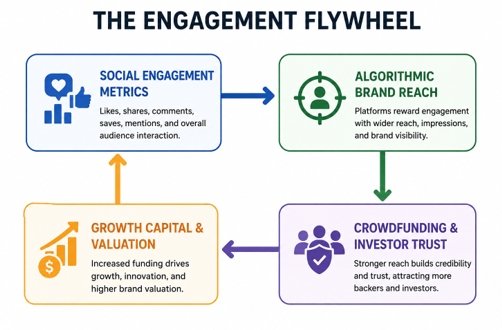
In today's busy market, new founders have to stand out from all the noise. They need to look for new ways to get non-dilutive help and support from ventures. A lot of times, things like repeating income or how much money a company brings in can take a long time to show up. Because of this, people who back these companies now try to find other ways to see if the market wants what the company offers. Many likes, comments, and shares online can be strong signs that people are interested in the brand, even before its first product comes out.
To grow, companies have to use smart ways that grab attention fast. The right platforms and smart marketing help reach more people, make others share, and raise the brand’s name in the market. This can turn someone scrolling on social media into a true fan or bring in the first real support. When you use new tools like Blastup Instagram likes, new businesses can get noticed by backers who can help them take off.
Digital finance asks people to trust what they read and see online. On sites like Kickstarter, Wefunder, or Republic, people do not just look at ideas and promises. They read what others say about the project. They also check if people are talking about it and see how many people are taking part in these talks online.
A high interest means there is less risk in the market for people who may support it.
Social media sites pay more attention to posts that get many likes and shares very fast. When a startup gets many people to talk or react to a post, more people see it. This helps the page reach even more people. A bigger reach lets more users find crowdfunding pages. It brings in extra visitors and can help more people give money.
Social numbers are not only about how things look. They are real tools for marketing. They can help people think about a brand in a good way from the start. This can also help get money faster at the beginning.
| Metric | Core Focus | Direct Impact on Funding |
| Engagement Velocity | Speed of likes, comments, and shares on new posts | Accelerates algorithmic placement and press interest |
| Audience Depth | Frequency of long-form comments and discussions | Signal of high customer retention and brand loyalty |
| Conversion Velocity | Ratio of social followers to email subscribers | Demonstrates commercial intent to institutional VCs |
When founders use clear stories with good ways to get people interested, they make a way to work that old-style outbound marketing cannot match.
To bring together both social proof and getting digital money in a good way, startups should use a clear three-step plan.
Digital finance is changing how people put their money in projects. In this, social proof is one of the main things for crowdfunding to work well. If founders know how to get people’s attention, they can turn talks on social media into real ways to get money that lasts. When you use the right steps to grow Instagram likes and reach more people in the community, your company can build trust and social proof. This can help you pull in investors, go over your crowdfunding goals, and let your business grow with time.
The National Crowdfunding & Fintech Association (NCFA Canada) is a financial innovation ecosystem that provides education, market intelligence, industry stewardship, networking and funding opportunities and services to thousands of community members and works closely with industry, government, partners and affiliates to create a vibrant and innovative fintech and funding industry in Canada. Decentralized and distributed, NCFA is engaged with global stakeholders and helps incubate projects and investment in fintech, alternative finance, crowdfunding, peer-to-peer finance, payments, digital assets and tokens, artificial intelligence, blockchain, cryptocurrency, regtech, and insurtech sectors. Join Canada's Fintech & Funding Community today FREE! Or become a contributing member and get perks. For more information, please visit: www.ncfacanada.org
| | |
|---|---|---|
| | |



August 26th, 2025

January 4th, 2024

June 1st, 2021

September 9th, 2020

July 9th, 2018

January 3rd, 2018

September 25th, 2017

June 20th, 2017

May 10th, 2017

December 14th, 2016
