





Karsten Wenzlaff, Advisor
August 26th, 2025
Karsten Wenzlaff is a Crowdfunding and Fintech Expert from Germany. He is Secretary-General of Digit[...]


Aug 28, 2026

Image: Unsplash/Jakub Żerdzicki
Artificial intelligence is rapidly changing the way individual investors interact with financial markets. Tasks that once required hours of reading reports, comparing charts, or building spreadsheets can now be compressed into a few prompts or clicks.
Modern AI investing tools can summarize market news, screen thousands of securities, identify unusual price movements, compare financial metrics, analyze sentiment, and even help investors test trading ideas.
That convenience is valuable. But it also creates a new problem: when sophisticated analysis appears instantly on a screen, it is easy to confuse speed with reliability.
For investors, the real opportunity is therefore not simply finding the most advanced AI. It is learning where AI adds value, where it can fail, and which decisions should always remain subject to independent due diligence.
The term covers a surprisingly broad range of financial technologies.
Some tools use machine learning to identify patterns in historical market data. Others apply natural language processing to earnings reports, central-bank announcements, news stories, or social-media discussions. Generative AI assistants can explain financial concepts, summarize research, compare investment ideas, or help users create screening criteria.

Image: Pexels/Matheus Bertelli
In practice, retail investors are likely to encounter AI across several areas:
The important distinction is that these tools do not all perform the same job.
An AI assistant that summarizes an earnings call should be evaluated differently from an algorithm that generates trading signals. Likewise, a portfolio risk analyzer presents a very different level of financial consequence from software capable of automatically executing trades.
One of the easiest mistakes is choosing an impressive AI application before deciding what problem actually needs to be solved.
A better approach is to begin with a specific investment task.
| Investment task | How AI may help | What still needs human verification |
|---|---|---|
| Researching a company | Summarize filings, news and earnings calls | Financial statements and original disclosures |
| Finding opportunities | Screen large datasets quickly | Whether the screening logic makes economic sense |
| Monitoring markets | Detect unusual changes or sentiment shifts | Why the change occurred and whether it matters |
| Managing risk | Analyze correlations and portfolio exposure | Personal risk tolerance and liquidity needs |
| Comparing trading platforms | Organize fees, features and trading conditions | Regulation, execution quality and actual costs |
| Generating trade ideas | Identify historical patterns | Whether the pattern remains relevant today |
This simple framework changes the role of AI.
Instead of asking, “What should I invest in?”, an investor might ask, “Which companies in this sector have improving margins, declining debt and positive free cash flow?”
The second question gives AI a defined analytical task rather than handing it an open-ended financial decision.
AI is particularly useful when the bottleneck is information volume.
Imagine following several currencies, commodities, central-bank decisions and economic indicators. Reading every announcement manually can quickly become impractical. An AI system can summarize information and highlight developments that may deserve closer attention.
But summarization is not the same as verification.
A model may misunderstand context, rely on incomplete information, overlook a change that occurred after its underlying dataset was created, or confidently present an incorrect conclusion.
That leads to a useful rule:
AI should reduce the amount of information you need to inspect, not remove the need to inspect important information altogether.
For consequential decisions, investors should return to primary sources whenever possible.
If an AI summary says a company changed its guidance, verify the announcement. If it claims a central bank changed policy, read the official statement. If it identifies an unusual fee or condition at a financial platform, confirm it directly with the provider.

Image: Pexels/Tiger Lily
This distinction becomes especially important in actively traded markets such as forex.
AI can help an investor analyze inflation data, interest-rate expectations, currency correlations, technical indicators or market sentiment. None of those capabilities, however, answer another fundamental question:
Where will the trade actually be executed?
Broker selection involves a different set of variables:
These factors should be researched independently from any AI-generated market signal.
For example, an investor researching the trading infrastructure available in the forex market can use an independent comparison resource such as iamforextrader.com/en/forex-brokers/best/ as one starting point, and then verify relevant regulatory and account information directly with the broker and applicable regulator.
The principle applies beyond forex as well. A good investment idea and a trustworthy platform are two separate questions.
Every financial model has boundaries.
Traditional quantitative models depend on the variables selected by their designers. AI systems may work with much larger datasets, but they still operate within informational limits.
Before trusting an AI-generated conclusion, consider five questions:
The last question is especially important.
The more authority an AI system receives, the higher the standard of oversight should become.
A useful financial tool should help users understand why a result appeared.
Suppose two platforms both generate a “buy” signal.
Tool A explains that the signal resulted from improving earnings expectations, falling valuation multiples and increasing free cash flow.
Tool B simply displays:
AI Confidence Score: 94% — Strong Buy
The second interface may look more sophisticated, but it actually gives the investor less useful information.
An unexplained confidence percentage can create false precision. Without knowing the inputs, methodology, testing conditions or assumptions behind a signal, users cannot properly evaluate its reliability.
This is why explainability matters in financial technology.
Investors do not necessarily need access to every line of code, but they should be able to understand the basic logic behind a recommendation.
AI trading products often attract attention with historical performance.
Backtesting can certainly be useful. It allows investors and developers to see how a strategy would have behaved under previous market conditions.
But historical success can become misleading when a model has effectively been optimized to explain the past.
This is known as overfitting.
A strategy may perform exceptionally well because it has learned patterns that happened to exist in a particular dataset rather than patterns likely to persist in future markets.
When evaluating a data-driven strategy, look beyond headline returns and ask about:
A backtest that ignores realistic trading costs is particularly questionable for strategies that trade frequently.

Image: Pexels/cottonbro studio
AI investing tools can also create privacy and cybersecurity considerations.
Investors should be cautious about entering sensitive information into general-purpose AI systems, particularly:
Before connecting any application directly to an investment account, understand exactly what permissions it receives.
Read-only portfolio access is very different from permission to execute trades or transfer assets.
The principle of least privilege works well here: give a financial application only the access it genuinely needs.
Investors do not need to choose between artificial intelligence and traditional research. The two can complement each other.
A practical workflow might look like this:
Step 1: Use AI for discovery.
Screen markets, identify unusual developments or generate research questions.
Step 2: Ask for reasoning.
Request the factors behind the conclusion rather than accepting a score or recommendation.
Step 3: Verify important facts.
Check financial statements, regulator databases, company announcements and original economic data.
Step 4: Challenge the thesis.
Ask what could make the investment idea wrong.
Step 5: Evaluate execution conditions.
Understand fees, liquidity, spreads, platform risks and regulatory protections.
Step 6: Size the risk independently.
A high-confidence AI prediction should never automatically determine how much capital is placed at risk.
This workflow turns AI into an analytical assistant rather than an autonomous decision-maker.
The evolution of AI investing tools is part of a broader transformation in fintech.
Retail investors increasingly have access to analytical capabilities that were once expensive, technically difficult or available mainly to professional institutions. That democratization of financial technology can improve access to information and make research considerably more efficient.
But better technology does not eliminate uncertainty.
Markets still respond to changing expectations, unexpected events, human behaviour and information that models cannot perfectly anticipate.
The investors who benefit most from AI may therefore not be those who automate the greatest number of decisions. They may be those who learn to divide the investment process intelligently between machines and humans.
Let AI search faster, process more information and challenge assumptions.
Keep verification, risk tolerance and final accountability human.
 The National Crowdfunding & Fintech Association (NCFA Canada) is a financial innovation ecosystem that provides education, market intelligence, industry stewardship, networking and funding opportunities and services to thousands of community members and works closely with industry, government, partners and affiliates to create a vibrant and innovative fintech and funding industry in Canada. Decentralized and distributed, NCFA is engaged with global stakeholders and helps incubate projects and investment in fintech, alternative finance, crowdfunding, peer-to-peer finance, payments, digital assets and tokens, artificial intelligence, blockchain, cryptocurrency, regtech, and insurtech sectors. Join Canada's Fintech & Funding Community today FREE! Or become a contributing member and get perks. For more information, please visit: www.ncfacanada.org
 |  |  |
|---|---|---|
 |  |  |
Aug 22, 2026 | NCFA Fintech Whisperer | Capital Markets Infrastructure And Funding, Cross Border Payments And FX, Payments Infrastructure And Money Movement, Cybersecurity Fraud And Financial Crime, Artificial Intelligence And Data, Lending Consumer Credit And BNPL, Treasury Liquidity And Cash Management, Sustainable Finance ESG And Financial Inclusion, Digital Banking And BaaS, Wealthtech Investing And Trading, Regulation And Policy, Digital Assets Blockchain And Tokenization, Risk Compliance And Regtech

Image: Freepik
This live weekly NCFA intelligence page tracks financial technology developments that significantly affect how fintechs build, sell, raise capital, and operate under scrutiny. Coverage prioritizes Canada and includes global events that directly influence competitive conditions, market access, and execution realities across fintech sectors. This page will be updated throughout the week with market movers in a live format and then each week we'll close the prior week's contents in prep for the upcoming week, and continue on a rolling basis. (Missed prior week's Fintech Whisperer? (December 6-12, 2025, December 13-19, 2025, January 1-9, 2026, January 10-16, 2026, January 17-23, 2026, January 24-30, 2026, January 31-February 6, 2026, February 7-13, 2026, February 14-20, 2026, February 21-27, 2026, February 28-March 6, 2026, March 7-13, 2026, March 14-20, 2026, March 21-27, 2026, March 28-April 3, 2026, April 4-10, 2026, April 11-17, 2026, April 18-24, 2026, April 25-May 1, 2026, May 2-8, 2026, May 9-15, 2026, May 16-22, 2026, May 23-29, 2026, May 30-June 5, 2026, June 6-12, 2026, June 13-19, 2026, June 20-26, 2026, June 27-July 3, 2026, July 4-July 10, 2026, July 11-July 17, 2026, July 18-24, 2026, July 25-July 31 2026, August 1-August 7, 2026, August 8-August 14, 2026, August 15-August 21, 2026).
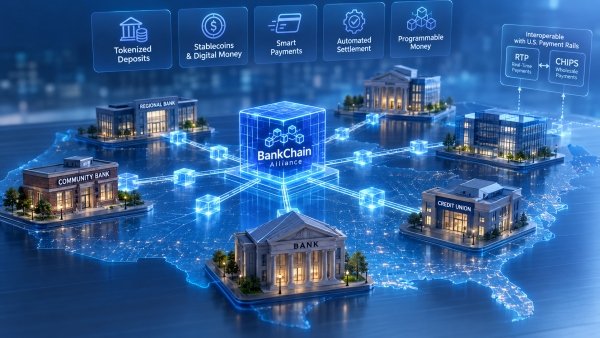
BankChain Alliance adds an association led ownership model to existing bank tokenized deposit networks. Its published plan gives community and regional banks a proposed role in governing shared infrastructure, although the technology provider and participating bank commitments remain unresolved.
RQD combines the financing announcement with disclosed operating volume from its proprietary clearing platform. The expansion plan covers digital-asset custody and tokenization alongside equities and options infrastructure. NCFA’s Alpaca platform analysis examines another provider combining brokerage distribution with regulated clearing and custody.
The pilot tested the digital asset and payment legs within the same institutional transaction. NCFA’s tokenized market infrastructure analysis explains why tokenized securities require a compatible settlement asset. CIMB identifies coupon distribution, secondary transfers and redemption as potential future applications. Commercial production availability has not been announced.
The completed transaction extends Canton's institutional custody and collateral infrastructure into a full repo cycle. Repeat volume, additional counterparties and accepted legal, accounting and capital treatment will determine whether the structure advances beyond a single transaction.
The H1 numbers extend the concentration documented in KPMG's 2025 fintech investment review. Canadian founders now face a market where capital favours scale, regulated access, specialized technology and measurable economics. Infrastructure reform could improve the position of companies that can convert lower data and payment friction into customer adoption.
This is a material follow-on to the June financing behind EDGE's prediction market banking infrastructure. ProphetX provides named distribution and active account funding use for EDGE Connect. Higher limits, dedicated insured accounts and continuous FedNow access give the rail an operating profile that routine partnership announcements lack.
Apex could give Gemini a distribution route through brokerage platforms that already serve tens of millions of investors, while Gemini supplies the regulated venue, execution and clearing. That directly expands the commercial case for event contract distribution infrastructure around brokerage connectivity, compliance and access. The parties still need a definitive agreement, so the LOI establishes the proposed structure rather than a completed rollout.
The March dialogue announcement established the bilateral payments file. The completed August meeting adds an agreement to explore UPI distribution and cross-border payment partnerships, while commercial implementation remains unresolved.
This is a material follow-on to Visa and Nium's earlier stablecoin settlement work. BLOOM adds central bank led governance, multicurrency scope and an explicit interoperability mandate. Together with Nium's recent U.S. card issuance expansion, the pilot gives Nium a larger role across both payment distribution and institutional settlement.
Fasset is putting new capital into the banking, liquidity and settlement connections behind its existing transaction volume. Stablecoins already support settlement across parts of Own Network, placing the company inside the infrastructure opportunity around programmable stablecoin payments rather than relying on token issuance alone. Its 100-plus banking corridors give Fasset a base for competing on routing cost, settlement reach and access across markets where payment infrastructure remains fragmented.
RBC is consolidating ownership of the corporate cash cycle, from payment execution and foreign exchange to liquidity and trade finance. Multinational clients gain a coordinated entry point across Canada and the U.S., raising the integration benchmark for fintechs selling treasury software, cross border payments or working capital tools into the same accounts. The structure continues the transaction banking competition already pushing large banks to invest in digital business payment capabilities.
This is a defined core replacement with a named platform, systems integrator, investment budget and migration sequence. Deutsche Bank says the old and new systems will operate in parallel during the transition to support operational resilience and continuity of service. Testing remains planned for year-end, and no migrated products have yet been reported.
The design gives community banks and credit unions a way to offer AI assistance inside authenticated banking while maintaining institution-level data and transaction controls. iTHINK gives the launch a concrete customer and near-term operating timeline.
The transaction verifies that the connection can process an international card at an approved Syrian merchant. The announcement does not disclose how many merchants are enabled, which issuing markets can participate or when international card acceptance will become widely available.
Banks, payment firms and vendors must revise ISO 20022 delivery schedules without treating the delay as cancellation. Release dependencies, vendor contracts and address-data remediation still need clear ownership while the industry waits for a replacement timeline.
The launch extends USD1's institutional settlement use cases from a planned fund-services pilot to native availability on Canton. Named counterparties and recurring atomic settlement volumes are still needed to prove adoption.
PaidIt combines identity resolution, recipient communication and payment delivery for cases that often depend on manual tracing. CBA’s internal use gives the product operating evidence ahead of its planned institutional client rollout.
August 24 gives prospective RTR participants a live legal framework, while operational access still depends on membership, settlement arrangements, technical integration, fraud controls, testing and certification. The RTR rules and access requirements show why eligibility alone does not put a PSP into production. Firms that can clear the remaining technical and operating requirements will be better positioned to build instant payment, pay by bank, treasury and embedded payment products when the system launches.
Owning Altruist gives Vanguard direct infrastructure across RIA custody and advisor workflows, not only fund distribution. Advisors and competing platforms should watch closing conditions, pricing, product access and whether standalone governance preserves Altruist's independence.
Putting regulated multibank data inside an agent interface connects advisory automation to a structured financial source layer. For wealth firms evaluating governed AI agent workflows, the integration supports portfolio analysis and adviser preparation inside an environment they may already use.
Nasdaq says Q6 data will appear as high-risk alerts inside the existing Verafin investigation workflow, covering check fraud, payment-card fraud and account takeover. The proof-of-concept average demonstrates potential lead time, but it does not establish that every alert will arrive before a fraudulent transaction.
Fraud and compliance teams can now buy agentic case operations within a large identity platform rather than assembling a separate agent layer. Regulated customers still need evidence for each automated decision, clear escalation rules and accountable human owners when an agent closes or changes a case.
The task force turns quantum readiness for fintech into a coordinated financial-sector program. Institutions and vendors should inventory cryptography, rank critical systems and document external dependencies before sector guidance becomes a delivery deadline.
This puts post-quantum preparation into an institutional transaction environment where banks and regulators can test the same cryptographic architecture before migration becomes an operating requirement. That is the implementation work behind financial sector quantum readiness: testing wallet controls, signing standards, governance and cross-border interoperability while existing cryptography still works. A shared reference architecture could also reduce the cost and uncertainty of each institution designing its own migration approach.
India is making technology resilience more measurable while standardizing how cyber incidents enter regulatory reporting. Exchanges, clearing corporations and depositories now face a more structured test of whether critical systems remain reliable and recoverable, while common incident data should make weaknesses easier to compare across institutions and over time.
The task force turns federal quantum policy into a financial sector implementation program. Firms now have a coordinated forum focused on cryptographic inventories, vendor dependencies, digital assets and migration execution. It extends the operating case in quantum readiness analysis: the immediate challenge is finding vulnerable cryptography and planning replacements before migration becomes an operational deadline.
The cohort gives regulators a supervised setting to examine how autonomous financial systems are authorized, monitored and escalated. The useful proof will come from controls that preserve human accountability when an agent completes a task or supervises another agent.
Rowan takes delegated AI access to financial accounts from recommendations into execution. Permission limits, action logs, reversibility and responsibility for losses become core product controls when a conversation can trigger a financial action.
Google is packaging domain methods, licensed data access, workflow execution and governance as one financial AI stack. Banks evaluating the preview will need to examine the quality of its research outputs, permission controls, audit records and integration with existing systems. The same control requirement is already visible in AI agent spending infrastructure, where authorization and observability determine whether automated execution can enter production.
Starling has moved agentic AI inside the authenticated business banking workflow and given it authority to execute a defined financial action, rather than limiting it to analysis or customer support. That brings the consent and liability questions around AI initiated payments into a live bank product: who authorizes the action, what limits apply, how the instruction is recorded and what happens when an automated decision is wrong. For business banking, the commercial opportunity is also concrete. The bank can automate tax, invoicing, fraud checks and cash management inside the account instead of leaving those workflows to separate software providers.
The national improvement does not describe every borrower or every region. Ontario homeowners are carrying persistent mortgage stress while severe non-mortgage delinquency has eased slightly across Canada, giving lenders a more uneven credit picture than the headline rate suggests. That divergence affects underwriting, limit management and collections across consumer lending, including products now becoming more visible in Canadian credit files. Geographic exposure and housing obligations are becoming more important when lenders assess where household credit risk is actually accumulating.
For banks, insurers and investors, the liability perimeter has narrowed. Statutory emissions duties remain, while private climate claims can no longer use this route through tort law. Underwriting, due diligence and climate-risk analysis should reflect the distinction.
Frontier AI preparedness is moving from awareness into evidence of execution. Financial firms need tested escalation authority, recovery plans, dependency mapping and governance that still works when incident timelines compress. The supervisory question is increasingly whether organizations can prove those controls operate under pressure, not whether boards have discussed AI risk.
The mandate changes how payment innovation enters supervisory decision making at the central bank. Stablecoin and payment infrastructure proposals will still have to satisfy financial stability requirements, but innovation becomes an explicit secondary consideration rather than an external policy goal. The practical test is how that mandate affects approvals, infrastructure design and competition as new payment models reach systemic scale.
The notice separates sports and entertainment products from the limited event contracts already available through Canadian investment dealers. NCFA’s event contract infrastructure brief tracks the dealer controls, surveillance, settlement and product-classification requirements connected to permitted contracts.
The final rule directs supervisory attention toward material financial risk and compliance with banking law. It also requires the agencies to tailor unsafe-or-unsound findings and MRA treatment to institution-specific risk factors. The rule does not apply to institutions outside OCC or FDIC supervision.
Payment firms and stablecoin providers will gain a formal innovation consideration within Bank of England supervision, but no automatic approval or lighter standard. Product teams will still need to prove that new payment models protect stability, resilience and users.
The proposed consent judgment gives algorithm design liability a concrete control framework built around age assurance, usage restrictions and parental permissions. Fintech teams offering youth accounts, gamified investing or automated recommendations can compare their controls with these requirements while the court reviews the agreement.
Thailand is working on both sides of institutional crypto access at once: the investment product investors can buy and the custody arrangements funds can use behind it. That puts product approval, offshore asset safeguarding and institutional distribution inside the same regulatory design problem rather than treating crypto ETFs as a listing question alone.
Control of the rails, data, distribution and risk is becoming more valuable. Capital is concentrating around firms that can prove scale and economics, while banks and infrastructure providers invest directly in tokenized settlement, real-time funding, AI and fraud controls. The opportunity remains large, but owning a critical part of how money moves is becoming more valuable than adding another product.
NCFA offers various curated resources to help founders and investors stay current on developments that impact fintech markets. Get the weekly Whisperer and related market intelligence through NCFA's newsletter, view the latest fintech insights, industry research, or launch into emerging financial innovation opportunities.
The National Crowdfunding & Fintech Association (NCFA Canada) is a financial innovation ecosystem that provides education, market intelligence, industry stewardship, networking and funding opportunities and services to thousands of community members and works closely with industry, government, partners and affiliates to create a vibrant and innovative fintech and funding industry in Canada. Decentralized and distributed, NCFA is engaged with global stakeholders and helps incubate projects and investment in fintech, alternative finance, crowdfunding, peer-to-peer finance, payments, digital assets and tokens, artificial intelligence, blockchain, cryptocurrency, regtech, and insurtech sectors. Join Canada's Fintech & Funding Community today FREE! Or become a contributing member and get perks. For more information, please visit: www.ncfacanada.org
| | |
|---|---|---|
| | |
August 26, 2026 | NCFA Insight | Regulation And Policy, Artificial Intelligence And Data, Risk Compliance And Regtech, Competition And Market Structure

On August 26, 2026, U.S. attorneys general announced a settlement with Meta worth up to US$17.1 billion over allegations that Facebook and Instagram were designed to keep children and teens engaged despite risks to their health and well-being. If the court approves the agreement, Meta also has to limit how long minors can use its apps, restrict overnight access and school-hour notifications, strengthen age checks and give families more control over what young users see.
Meta isn't required to admit it did anything wrong under the settlement. It does expect to record an approximately US$10 billion legal expense in Q3 2026. Governments aren't only extracting billions from Meta. They're putting enforceable limits on features that help determine how often young people open Facebook and Instagram, how long they stay and what keeps them scrolling.
Users under 18 will start with a combined two-hour daily limit across Facebook and Instagram. Parents can approve more time, but teens can't simply turn the limit off themselves. Meta also has to block most access from midnight to 6 a.m. by default and mute most notifications during school hours.
The agreement goes deeper. Teens get regular break prompts and more control over personalized feeds, autoplay and visible like counts. Meta also has to strengthen age assurance, identify children under 13, improve parental controls and maintain protections against harmful content and unwanted adult contact.
Recommendations, notifications, autoplay and frictionless consumption help technology companies turn attention into usage, retention and advertising revenue. That's why the settlement is strategically important. A feature can be commercially valuable for years and still become expensive if evidence eventually shows that the same behaviour driving engagement is contributing to harm.
NCFA's Algorithms Go On Trial As AI Scales Across Society unveiled the lawsuits challenging recommendation systems, infinite scroll, autoplay and notifications as deliberate product choices rather than simply arguing about what users post. Those cases have now produced jury findings, large financial awards and operating restrictions. The debate over addictive design is becoming much harder for boards to leave with legal counsel or the product team.
Meta can afford the settlement though. The company earned enough to absorb an approximately US$10 billion quarterly legal charge without changing the financial guidance it gave investors in July. Markets also reacted positively after the settlement was announced, reflecting relief that Meta avoided the potentially larger uncertainty of continuing the federal trial.
That is precisely why boards should study what happened.
Years of complaints, research, lawsuits and internal evidence accumulated around the same basic concern: were Facebook and Instagram using product features to keep children engaged in ways that could harm them? The exposure grew from a difficult policy issue into jury verdicts, court-ordered controls and now one of the largest state settlements ever reached with a single company.
August coverage of the New Mexico Meta ruling showed how quickly the consequences were already expanding. That case combined a US$375 million jury award with a further US$567 million abatement fund and requirements affecting teen usage, notifications, age assurance, adult contact and AI chatbot interactions involving minors.
If management keeps getting signals that a profitable feature may be harming young users and keeps pushing it anyway, the issue eventually belongs with the board. Investors should know when those warnings reach directors, what they’re told and who can decide that the revenue is no longer worth the risk.
Meta also negotiated an unusually strategic feature into the settlement.
Its own disclosure describes an approximately US$18 billion payment structure over ten years. About US$12.7 billion is allocated to participating states regardless of what competitors do. Roughly US$5.3 billion is released only if both TikTok and YouTube adopt specified teen protections and make matching payments.
That gives Meta billions of reasons to bring its competitors along.
Commercially, the logic makes sense given the amount of competition. If Facebook and Instagram restrict teen usage while TikTok and YouTube remain more permissive, users and coveted 'attention' can migrate to competing apps. Meta bears the cost while rivals gain more opportunity to capture the hours, content consumption and advertising inventory Meta gives up.
The terms get tougher if TikTok and YouTube participate. Meta's daily limit falls from two hours across Facebook and Instagram to one hour per app, while its nighttime block expands from midnight to 6 a.m. to 10 p.m. through 7 a.m.
So Meta isn't simply asking competitors to copy its safety policies. It is trying to prevent child-safety rules from becoming a competitive handicap carried mainly by Facebook and Instagram.
TikTok and YouTube haven't agreed to the framework. Until they do, Meta could still end up operating under restrictions its largest rivals don't share.

Concern about how digital products affect children has been building for years. In 2023, NCFA analyzed Canadian research into children's privacy and consent that called for stronger safeguards to be built into digital products from the start. Children don't assess consent, persuasive design or data collection the way adults do, yet personalization and recommendation systems routinely influence what they watch, read and do next.
Meta's settlement gives those concerns a much larger financial consequence. Governments are no longer relying only on warnings or disclosure requirements. They are specifying age checks, usage limits, notification controls, parental oversight and independent monitoring.
Once those requirements appear in a multibillion-dollar agreement, other platforms know what regulators may ask for next. The settlement doesn't create legal precedent, but it gives attorneys general a detailed set of measures they can use in future negotiations and enforcement.
AI companions and conversational assistants can respond personally, remember context and keep conversations going. Research into youth use of AI reported that 72% of teens had tried AI companions and examined evidence of young people using generative AI for emotional and mental health support.
AI can change the type of exposure a child experiences. A recommendation feed influences what a young person sees next. An AI system can respond directly, adapt to the conversation and encourage the user to keep engaging.
For companies serving children or vulnerable users, it's even more important to know what the system is encouraging, where harmful patterns are appearing and who can change the product when the interaction becomes uncomfortable.
The same principle can be seen in fintech where younger customers use digital wallets, investing apps, financial education tools and AI assistants. Meta's settlement rules don't apply to those products. The relevant lesson is that companies need to understand how their own systems influence behaviour before a regulator or court does it for them.
Meta's US$17.1 billion settlement shows how expensive the problem can become when concerns about engagement, harm and product design build for years without a convincing response.
When a company knows a profitable engagement feature may be harming young users, who should have the authority to decide when growth has gone too far?
The National Crowdfunding & Fintech Association (NCFA Canada) is a financial innovation ecosystem that provides education, market intelligence, industry stewardship, networking and funding opportunities and services to thousands of community members and works closely with industry, government, partners and affiliates to create a vibrant and innovative fintech and funding industry in Canada. Decentralized and distributed, NCFA is engaged with global stakeholders and helps incubate projects and investment in fintech, alternative finance, crowdfunding, peer-to-peer finance, payments, digital assets and tokens, artificial intelligence, blockchain, cryptocurrency, regtech, and insurtech sectors. Join Canada's Fintech & Funding Community today FREE! Or become a contributing member and get perks. For more information, please visit: www.ncfacanada.org
| | |
|---|---|---|
| | |
August 26, 2026 | NCFA Market Activity | Payments Infrastructure And Money Movement, Digital Assets Blockchain And Tokenization, Banking And Credit, Competition And Market Structure

On August 25, 2026, 39 U.S. state bankers associations formed BankChain Alliance to build a shared blockchain network for financial institutions. The planned infrastructure would support smart payment tools, tokenized deposits, stablecoins and automated settlement, with participating banks able to take an ownership role. Together, the associations represent thousands of financial institutions serving millions of consumers, businesses and communities.
BankChain is selecting a technology partner and targeting a 2027 launch. It says the network will interoperate with other networks and that banks across the country will be invited to take ownership. The technology platform, ownership terms for individual banks, operating rules and settlement design haven’t been disclosed, so BankChain remains infrastructure under development rather than a live payment rail.
Building tokenized payment infrastructure involves more than choosing a blockchain. Banks need core system integration, compliance controls, security, operating rules and connections to other financial networks. Those costs are easier for a large institution to absorb than for a community or regional bank.
BankChain's model proposes that banks share more of the work and costs while retaining a say in how the network operates. If enough institutions participate, common infrastructure could reduce the amount each bank needs to build independently and give smaller banks another route into tokenized deposits and programmable payments.
The economics are still unknown. BankChain hasn't disclosed participation costs, ownership terms or implementation requirements. A shared network won't solve much for smaller institutions if joining it still requires expensive integrations, duplicated compliance work or several connections to outside payment systems.
BankChain is entering a market where another bank-led model is already taking shape. In June, The Clearing House launched an on-chain money initiative designed to clear and settle tokenized commercial bank deposits between institutions while connecting blockchain activity with its RTP and CHIPS payment networks.
The Clearing House begins with infrastructure that already clears and settles more than $2 trillion in payments each day. BankChain begins with 39 banking associations and plans to build a common network around institutions that may not have the resources to develop proprietary infrastructure.
Interoperability is paramount given that banks will need tokenized money to move between institutions and connect with established payment infrastructure. BankChain says its network will be interoperable, but hasn't explained how those connections will work.
BMO and TD Bank U.S. are among the institutions supporting The Clearing House initiative. Their participation gives Canadian financial institutions a direct view into one model for connecting tokenized commercial bank money with established U.S. payment rails while BankChain develops a different model based on shared ownership.
Individual bank commitments, network architecture and participation economics will determine whether BankChain becomes usable shared infrastructure.
Can shared ownership make tokenized payment infrastructure economical for smaller banks, or will access to established clearing networks and customer distribution remain the bigger competitive advantage?
The National Crowdfunding & Fintech Association (NCFA Canada) is a financial innovation ecosystem that provides education, market intelligence, industry stewardship, networking and funding opportunities and services to thousands of community members and works closely with industry, government, partners and affiliates to create a vibrant and innovative fintech and funding industry in Canada. Decentralized and distributed, NCFA is engaged with global stakeholders and helps incubate projects and investment in fintech, alternative finance, crowdfunding, peer-to-peer finance, payments, digital assets and tokens, artificial intelligence, blockchain, cryptocurrency, regtech, and insurtech sectors. Join Canada's Fintech & Funding Community today FREE! Or become a contributing member and get perks. For more information, please visit: www.ncfacanada.org
| | |
|---|---|---|
| | |
August 26, 2026 | NCFA Market Activity | Capital Markets And Market Infrastructure, Regulation And Policy, Risk Compliance And Regtech

On August 19, 2026, CRSHMARKET promoted a wider vision for its livestream prediction market, where people can put money on events while a stream is still unfolding. Its campaign showed markets around dates, public interactions and creator content, while the live product currently remains concentrated in video games such as Rocket League and Among Us.
The format is built around speed. Users enter dollar amounts on short yes-or-no outcomes and some markets can settle within minutes. When checked on August 26, CRSHMARKET on-chain volume showed about US$7.79 million in cumulative USDC entry volume across current and earlier contracts. DefiLlama says each entry is counted once and treasury seed liquidity is excluded.
What happens if the product expands beyond esports into creator-led livestreams where the person on screen can affect what traders are betting on?
Prediction markets already have to manage insider information. Creator-led markets add another problem because someone close to the content may be able to influence the result itself.
A market on whether a streamer gets someone's phone number, spends more than $100 or completes a stunt can involve people who know more than the audience. The creator, production staff, guests or friends may know what is planned. Some may also be able to change what happens.
There's already a useful precedent. A Kalshi insider trading case resulted in a financial penalty and two year suspension after an internal editor traded on markets connected to MrBeast videos he worked on. Kalshi's surveillance tools and user reports helped identify the activity.
Livestreams compress that problem into a much shorter window. The event is happening now, viewers are trading now and the market may settle before a platform has much time to investigate. Controls therefore need to identify who is close enough to the event to have an unfair advantage before suspicious trading becomes the only warning.
<
| Risk | Why Livestreams Make It Harder | What Platforms Need |
|---|---|---|
| Inside information | Creators, guests or production staff may know what is coming | Restricted accounts and connected party checks |
| Outcome manipulation | People on the stream may be able to change the result | Creator rules and limits on controllable markets |
| Disputed results | Live video can be unclear, interrupted or open to interpretation | Clear settlement rules and independent evidence |
CRSHMARKET has already written some of these concerns into its operating rules. Its published CRSHMARKET Bonus Terms allow identity, age, location, wallet, payment and source-of-funds checks before promotional funds are paid or withdrawn. The terms also identify collusion, automated accounts, location masking and creator manipulation as reasons to cancel promotional value or restrict future eligibility.
Those are promotion rules rather than a complete public rulebook for every market, so they don't establish how all livestream disputes or conflicts will be handled. They do show that CRSHMARKET recognizes creator manipulation and connected-account behaviour as operating risks.
In the U.S., prediction markets can operate within the CFTC regulated derivatives framework, but that protection depends heavily on how the contracts and venue are structured. CRSHMARKET does not appear to be a CFTC registered exchange, so creator led livestream markets could still raise federal derivatives, state gambling and market manipulation questions.
The regulated event contract infrastructure opportunity tracks demand for surveillance, conflict detection, audit trails, settlement tools and dispute handling as prediction markets grow. Creator-led markets make those capabilities more valuable because the event, the people controlling it and the traders can be closely connected.
Some markets may also need to be excluded entirely. For example, when a trader can influence the event they are betting on, an issue already explored in prediction markets on controllable events.
For CRSHMARKET, speed is part of the attraction. It can turn ordinary moments inside a livestream into something viewers can trade almost immediately. The commercial model becomes stronger if creators gain another way to monetize audiences and viewers find the markets entertaining enough to return.
But they'll need to show that people close to an event cannot quietly trade on better information, creators cannot steer outcomes for financial gain and disputed results can be settled consistently. If it can do that, livestream prediction markets could create a new category of interactive financial entertainment. If it can't, the integrity issue may limit the model before the audience does.
If livestream prediction markets expand beyond esports, can platforms build controls fast enough to separate genuine audience participation from markets where creators or insiders can influence the outcome themselves?
The National Crowdfunding & Fintech Association (NCFA Canada) is a financial innovation ecosystem that provides education, market intelligence, industry stewardship, networking and funding opportunities and services to thousands of community members and works closely with industry, government, partners and affiliates to create a vibrant and innovative fintech and funding industry in Canada. Decentralized and distributed, NCFA is engaged with global stakeholders and helps incubate projects and investment in fintech, alternative finance, crowdfunding, peer-to-peer finance, payments, digital assets and tokens, artificial intelligence, blockchain, cryptocurrency, regtech, and insurtech sectors. Join Canada's Fintech & Funding Community today FREE! Or become a contributing member and get perks. For more information, please visit: www.ncfacanada.org
| | |
|---|---|---|
| | |
August 24, 2026 | NCFA Market Activity | Payments And Money Movement, Capital Markets And Market Infrastructure, SME Finance And Business Banking
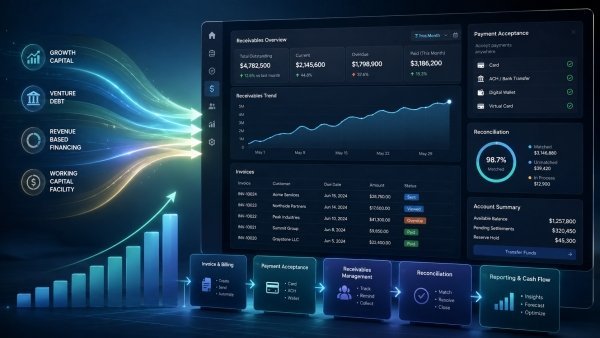
On August 24, 2026, Toronto based Flow Capital announced a US$6 million investment in Aliaswire (see quarterly filing), a Burlington, Massachusetts payments technology company serving vertical SaaS platforms, financial institutions and enterprises. The investment was made August 17 and will provide working capital for growth while refinancing existing debt.
Aliaswire provides billing, receivables and payments technology through DirectBiller for enterprises and financial institutions and DirectEmbed for vertical SaaS platforms. The company says its technology serves more than 7,000 customers and has processed more than one billion transactions and US$100 billion in payment volume.
Its embedded receivables platform lets software companies add billing, invoicing, payment acceptance, account management and reconciliation inside their own products without building the full payments operation themselves.
The financing terms have not been disclosed. Flow's core business is growth venture debt, but the public documents do not identify the Aliaswire instrument, pricing, maturity, security or any equity component. The US$6 million should therefore be treated as an investment unless further terms are released.
Aliaswire is large enough to have more financing choices than an early startup. Equity brings capital without scheduled principal repayments but gives up ownership. Bank debt can be cheaper when a company qualifies. Venture debt can extend runway with less dilution, while other private credit can offer more flexible terms when a financing need falls outside normal bank lending.
Venture debt is one form of private credit. Flow focuses on revenue generating growth companies and typically provides senior secured financing, sometimes with a small warrant component.
This deal sends Canadian growth capital into a U.S. fintech. Canadian institutions already hold roughly C$500 billion in private credit exposure, much of it outside Canada, while non-bank loans account for only about 15% of external funding for Canadian non-financial businesses. Foreign investment is not the problem. The question is whether Canadian fintechs at the same stage can access comparable growth capital at home?
Capital Choice
| Financing | Where It Can Fit | Founder Advantage | Main Tradeoff |
|---|---|---|---|
| Bank debt | Established cash flow, credit history or collateral | Often lower cost when available | High growth companies may not qualify |
| Venture debt | Growth company with traction and a defined next milestone | Can extend runway with limited ownership dilution | Interest and repayment obligations, often with warrants |
| Private credit | Financing needs that do not fit normal bank lending | Terms can be tailored to the company and use of capital | Can cost more and give lenders stronger protections |
| Equity | High growth where cash needs to remain inside the business | No scheduled principal repayment | Founders and existing investors give up ownership |
How Companies Have Used Flow Capital Financing
Flow's portfolio shows how growth debt can serve different jobs. Toronto retirement fintech Common Wealth used a C$15 million senior secured note before raising a C$12 million Series A in March 2026. The debt helped fund product development, customer growth and operating scale before the equity round.
Vancouver based JUDI.AI used several Flow tranches to finance U.S. expansion, including senior sales hiring and new American credit union customers. UK insurtech Wrisk used a C$4.25 million senior secured note to fund growth toward profitability. Revenue rose 142% in the following year, its UK operation later became profitable and the company subsequently raised a £12 million Series B.
UK marketplace lending platform CrowdProperty received a C$5.25 million senior note for marketplace lending growth and technology improvements. Aliaswire adds another use case by combining new working capital with refinancing.
Debt isn't replacing equity in these examples. Common Wealth used it before an equity raise, JUDI.AI used it to enter a new market, Wrisk used it to reach profitability and CrowdProperty used it to expand an established platform. The financing changed with what each company needed to accomplish next.
Aliaswire is raising capital as payments become a bigger part of the vertical SaaS business model. Stripe reported that median payments adoption across its software platforms rose from 27% in 2024 to 40% in 2025, while leading platforms reached 80% or more. Its vertical SaaS payments data also found 11% lower annual churn among platforms offering embedded financial products and 49% faster revenue growth among platforms offering several financial products compared with software only peers.
J.P. Morgan's work on embedded payments points to transaction revenue, stronger customer relationships and proprietary payments data. As AI makes software features easier to reproduce, owning more of the financial workflow can make a platform harder to replace.
Aliaswire is targeting that opportunity through embedded receivables rather than payment acceptance alone. DirectEmbed combines payments with billing, invoicing, self service, account management and payment operations. Aliaswire is also adding AI for receivables automation, including cash flow prediction, DSO optimization, risk analysis and agentic payment workflows.
Aliaswire's embedded receivables model also connects with the Financial Innovation Map, where payments, receivables, SME finance and embedded software are tracked as connected opportunity areas.
If more vertical SaaS companies bring billing, receivables and payments inside their products, Aliaswire can grow with a market it has served for more than two decades while DirectEmbed gives it a newer route into software platforms. Its existing payment volume, customer base and financial institution relationships give it experience that newer embedded finance providers still need to build.
The opportunity is also attracting much larger payment companies and newer infrastructure providers. AI can make software features easier to copy, while deeper control over billing and payments increases fraud, compliance and reliability demands. Aliaswire has to do more than make payments easy to add. It needs to help software companies get customers using them, earn more from them and manage receivables better than competing platforms can.
Aliaswire has already processed more than US$100 billion in payments. Can US$6 million of flexible capital help it turn embedded receivables and AI into a bigger position inside vertical SaaS while larger payment platforms compete for the same customers?
The National Crowdfunding & Fintech Association (NCFA Canada) is a financial innovation ecosystem that provides education, market intelligence, industry stewardship, networking and funding opportunities and services to thousands of community members and works closely with industry, government, partners and affiliates to create a vibrant and innovative fintech and funding industry in Canada. Decentralized and distributed, NCFA is engaged with global stakeholders and helps incubate projects and investment in fintech, alternative finance, crowdfunding, peer-to-peer finance, payments, digital assets and tokens, artificial intelligence, blockchain, cryptocurrency, regtech, and insurtech sectors. Join Canada's Fintech & Funding Community today FREE! Or become a contributing member and get perks. For more information, please visit: www.ncfacanada.org
| | |
|---|---|---|
| | |
August 24, 2026 | NCFA Insight | SME Finance And Business Banking, Cross Border Payments And FX, Competition And Market Structure, Public Sector Policy And Industrial Strategy
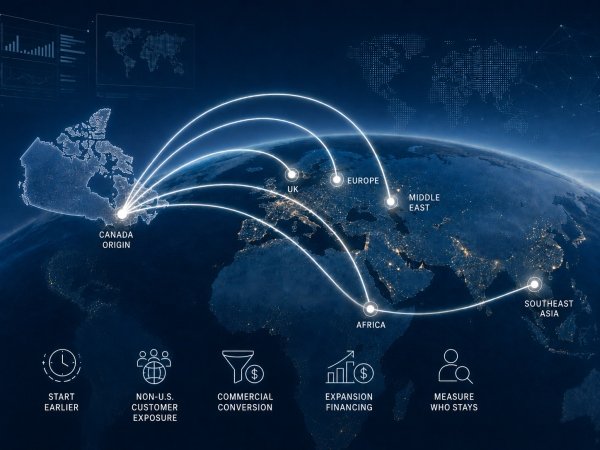
On August 24, 2026, Canada-U.S. trade negotiations had collapsed with new 50% U.S. tariffs on certain Canadian products already in force from August 22. President Donald Trump then threatened to raise new additional 50% tariffs on all Canadian cars, trucks and auto parts beginning January 1, 2027. Canada plans retaliatory tariffs on some U.S. goods beginning September 8.
The breakdown adds fresh urgency to Canada’s push to build more trade outside the U.S. The federal government is already tilting export support in that direction. CanExport SMEs has approximately $31 million available for 2026 and 2027, with about $27.9 million available for non-U.S. market activities and $3.1 million for U.S. projects. The program says the allocation supports Canada’s objective of doubling non-U.S. exports over the next decade.
For fintech, software and other digital firms, the problem is how quickly Canadian companies can turn access to a foreign market into customers and recurring revenue. Europe, the UK, Singapore, Southeast Asia, Latin America, Africa and the Middle East already have local firms and international competitors with licences, integrations, distribution, customer relationships and years of operating experience.
Statistics Canada reported $70.3 billion of digitally delivered commercial services exports in 2023. Large firms increased those exports by 20.1%, while small and medium sized firms recorded a 7.6% decline. Canadian multinationals increased commercial services exports outside the U.S. by 21%, compared with 6.6% growth to the U.S. They also accounted for 75% of the increase in Canadian commercial services exports to non-U.S. markets.
NCFA's earlier digital export comparison shows Singapore ahead of Canada despite operating from a far smaller domestic economy. Singapore ranked 11th globally in the underlying 2023 data at US$153 billion, compared with Canada in 16th place at US$118 billion.
Canada doesn't just need another list of markets to enter. It needs more startups and SMEs able to win non-U.S. customers faster and build businesses that can keep competing once they get there.
Canada already has substantial export infrastructure. The Trade Commissioner Service connects companies with customers, partners and investors. Canadian Technology Accelerators provide business development support, strategic guidance and local introductions. CanExport reduces part of the cost of entering new markets, while Export Development Canada's Trade Impact Program provides financing, working capital, guarantees and credit insurance to companies dealing with trade uncertainty.
The Canadian Technology Accelerator also produces measurable results. A Global Affairs study found participating firms had 27% higher revenue one year after completing the program than otherwise similar companies. The positive differences in revenue, assets and payroll became larger over the following years.
But Global Affairs could not determine how much the firms actually became more international because the available data were insufficient. That leaves the commercial outcome Canada now needs to understand. How many firms supported expansion into London, Singapore or another non-U.S. market are still generating recurring revenue there two, three or five years later?
Canadian fintech history shows why market entry alone is a weak measure. Wealthsimple built a UK business for almost five years and reached about 16,000 customers before selling the operation and concentrating on Canada. Clearco expanded into several overseas markets before transferring its international business to Outfund as ecommerce growth slowed and financing conditions deteriorated.
Neither case proves Canadian fintechs cannot compete abroad. They show how demanding a foreign operation becomes when a company has to fund customer acquisition, staff, compliance, banking relationships, treasury, tax and product adaptation while continuing to compete at home.
VoPay is using another model. The Vancouver founded payments infrastructure company established a global headquarters in Doha in January 2026 while keeping its Canadian operations active. Qatar is being built as a major hub for expansion across the Middle East, Africa and Southeast Asia, with more than 400 planned hires across engineering, technology, security, compliance, data and platform operations. The company didn't abandon Canada, but a meaningful part of its next stage of international capability is being built outside the country.
For Canada, it's not a simple win or loss. VoPay remains rooted in Canada while using Qatar as a launch point into several non-U.S. regions. Using a regional hub can also reduce expansion risk by putting management and operating capability closer to target markets while the Canadian core continues to run. The policy question is where the next layer of technical talent, management, partnerships and enterprise value accumulates as Canadian companies expand internationally.
The U.S. capital pull starts much earlier. NCFA's productive participation analysis examined the Canadian founder drain into the U.S. technology ecosystem. Barn Ventures describes a founder conveyor in which U.S. investors and programs recruit Canadian talent from high school and university through company formation and later scale.
Barn's analysis of the Dominion List found 517 U.S. based companies with a Canadian founder had raised about US$414 billion. It found 73% headquartered in California and 56% in San Francisco. Barn also found the number of listed companies founded each year rose sharply after 2022, while acknowledging that the Dominion List is a curated catalogue rather than a census.
Large U.S. capital markets and Silicon Valley's technology ecosystem will always attract ambitious Canadian founders. Those organizations are doing what successful capital markets do. The Canadian problem becomes more serious when founders also conclude they need to leave to get the capital, customers, infrastructure or operating environment required to build a major company. Canada can then lose value at both ends. Some promising founders build in the U.S. before substantial enterprise value accumulates here.
Also, Canada's main export programs generally engage firms after they have built meaningful operating capacity or market traction. By then, their products, sales models and management experience may already have been shaped largely around Canada and the U.S., while competitors in non-U.S. markets have spent years building customers and local experience. That is why promising firms should encounter non-U.S. customers, regulators and market requirements earlier, before they reach the stage where most formal export support begins.
Financial infrastructure can add to that timing gap. NCFA's financial infrastructure history shows Canadian fintechs developing while Real-Time Rail, wider payments access and regulated consumer driven banking arrived multiple years later than comparable infrastructure in several major fintech markets.
That does not explain Wealthsimple's UK exit, Clearco's retrenchment or any other individual company decision. It also affects what Canadian firms learn at home. Years of working with real time payments, portable financial data, modern APIs and digital onboarding build practical experience that can help when companies expand into other markets.
If Canadian firms gain important financial capabilities later, they also have less time to turn them into competitive advantages before entering non-U.S. markets.
The quickest response to Canada's urgent need to diversify beyond the U.S. is not more export information. Canada already has market intelligence, trade commissioners, financing programs and buyer introductions. The priority is to shorten the time between choosing a non-U.S. market and winning recurring revenue there. Canada can do many things differently to help achieve this.
1. Start earlier. Promising fintech and digital companies should encounter non-U.S. customers, regulators and financial institutions while their products are still developing. This doesn't mean sending every startup overseas. It means finding companies with strong technology and real differentiation early enough that requirements in several jurisdictions can influence what they build.
A company that learns to work across several payment systems, data rules, onboarding requirements and regulatory environments before reaching scale develops a different skill set from one encountering that complexity for the first time after years focused on Canada and the U.S.
2. Push buyer introductions toward commercial conversion. Canada already connects companies with qualified contacts, potential customers and partners. But they need to track and measure how consistently those introductions turn into technical evaluations, paid pilots, contracts and recurring revenue. Trade Commissioners in priority non-U.S. markets are well placed to identify concrete buyer needs and concentrate Canadian firms with relevant products against those opportunities.
That also creates better intelligence. If Canadian fintechs repeatedly lose the same types of opportunities in London, Singapore or São Paulo, Canada can determine whether the problem is product fit, pricing, licensing, procurement, financing or a capability competitors already possess.
3. Finance the period between market entry and recurring revenue. CanExport can provide up to $50,000 toward eligible international business development costs. EDC's Trade Impact Program has up to $5 billion of additional capacity over two years and supports working capital, guarantees, credit insurance and other financing tools. Those tools become more useful when they are organized around the economics of a specific foreign operation. Customer acquisition, regulatory work, FX, payments, local staff and management time can absorb capital before a new market supports itself.
For regulated fintechs, entering another country is like building a second company while the first keeps operating. Management needs to know what the foreign operation costs, what milestones justify further investment and when the economics no longer support continued expansion. That discipline protects the Canadian core while giving a promising foreign business enough runway to prove itself.
4. Measure whether companies win and stay. Canada should track the time from choosing a non-U.S. market to the first paying customer, how many assisted firms develop recurring revenue and how many are still operating there after two, three and five years.
The same scorecard can track local licences, staff and operating entities alongside the value that remains anchored in Canada. That includes Canadian employment, management functions, intellectual property, investment and capital recycled into the next generation of companies.
Those results would expose the bottlenecks quickly. A firm that receives many introductions but cannot win customers has a different problem from one that wins customers but cannot finance its expansion. A company delayed by licensing, payments or compliance needs a different response again.
Canada's non-U.S. diversification push became urgent much faster than companies can build international experience. The fastest response is therefore partly to start earlier.
Then judge success by whether Canadian companies are winning customers outside the U.S., staying in those markets and keeping enough of the resulting value anchored in Canada.
Canada now needs to diversify beyond the U.S. faster than many of its technology companies have historically expanded internationally. Can it help promising fintechs build non-U.S. customers and operating experience early enough to win against established competitors while keeping more of the resulting enterprise value anchored in Canada?
The National Crowdfunding & Fintech Association (NCFA Canada) is a financial innovation ecosystem that provides education, market intelligence, industry stewardship, networking and funding opportunities and services to thousands of community members and works closely with industry, government, partners and affiliates to create a vibrant and innovative fintech and funding industry in Canada. Decentralized and distributed, NCFA is engaged with global stakeholders and helps incubate projects and investment in fintech, alternative finance, crowdfunding, peer-to-peer finance, payments, digital assets and tokens, artificial intelligence, blockchain, cryptocurrency, regtech, and insurtech sectors. Join Canada's Fintech & Funding Community today FREE! Or become a contributing member and get perks. For more information, please visit: www.ncfacanada.org
| | |
|---|---|---|
| | |



August 26th, 2025

January 4th, 2024

June 1st, 2021

September 9th, 2020

July 9th, 2018

January 3rd, 2018

September 25th, 2017

June 20th, 2017

May 10th, 2017

December 14th, 2016
