





Karsten Wenzlaff, Advisor
August 26th, 2025
Karsten Wenzlaff is a Crowdfunding and Fintech Expert from Germany. He is Secretary-General of Digit[...]


Feb 26, 2026 | NCFA Fintech Market Activity | Payments And Market Structure

On February 26 2026, Block reported in its Q4 2025 shareholder letter that it is reducing its workforce from over 10,000 people to just under 6,000, which means more than 4,000 people are leaving or entering consultation as the company resets how it operates around AI.
The timing of the news is strategic given that cuts arrive alongside stronger operating results, not a weak quarter. Block reports Q4 gross profit of $2.87 billion, up 24% year over year, with Cash App gross profit at $1.83 billion, up 33%, and Square gross profit at $993 million, up 7%.
The company also reported $485 million in operating income, $588 million in adjusted operating income, and adjusted diluted EPS of $0.65. Block's XYZ stock popped 25% in after hours trading after the announcement.
Block also raised its 2026 outlook. The company says it now expects $12.20 billion in gross profit for 2026, up 18% year over year, and $3.20 billion in adjusted operating income, up 54%. It says the workforce changes should begin to affect adjusted operating income more meaningfully in Q2, with the full impact of the new cost structure improving profitability in the second half of the year.
So the layoff headline doesn't tell the whole story. The story of a scaling fintech that's using AI to push for higher product velocity and stronger operating leverage at the same time.
Jack Dorsey, CEO Block:
“Intelligence tools have changed what it means to build and run a company. We’re already seeing it internally. A significantly smaller team, using the tools we’re building, can do more and do it better. And intelligence tool capabilities are compounding faster every week.”
Block isn't cutting from a position of visible deterioration or weakness. It's cutting while growth accelerates, guidance rises, and management claims a smaller team can execute faster. That raises a harder question for the market. If a large payments platform can protect growth while resetting headcount this aggressively, investors may start to reward AI led efficiency gains faster than many teams expect.
If stronger fintech earnings now come with smaller teams, does AI start to reset the valuation premium around operating discipline and execution speed?
 The National Crowdfunding & Fintech Association (NCFA Canada) is a financial innovation ecosystem that provides education, market intelligence, industry stewardship, networking and funding opportunities and services to thousands of community members and works closely with industry, government, partners and affiliates to create a vibrant and innovative fintech and funding industry in Canada. Decentralized and distributed, NCFA is engaged with global stakeholders and helps incubate projects and investment in fintech, alternative finance, crowdfunding, peer-to-peer finance, payments, digital assets and tokens, artificial intelligence, blockchain, cryptocurrency, regtech, and insurtech sectors. Join Canada's Fintech & Funding Community today FREE! Or become a contributing member and get perks. For more information, please visit: www.ncfacanada.org
 |  |  |
|---|---|---|
 |  |  |
February 23, 2026 | NCFA Market Activity | Artificial Intelligence And Data

On February 21, 2026, B.C.’s premier says police are pursuing preservation orders for potential evidence held by digital services companies, including social media platforms and AI companies, after media reports tied OpenAI to the case. This isn't a new fintech policy just yet, but it puts evidence readiness into the open. If a partner asks what you can preserve and produce under lawful process, you can’t appear like a 'deer in headlights'. You need a working path.
BC Government, Office of the Premier, Media Relations:
“Reports that allege OpenAI had related intelligence before the shootings in Tumbler Ridge took place are profoundly disturbing for the victims’ families and all British Columbians. We will use all powers of government to ensure that police have the tools they need to investigate every aspect of this horrific tragedy.”
RCMP report said that the active shooter call came in at about 1:20 p.m. on February 10 and the public alert ended at 5:45 p.m. Six victims were found deceased inside the school, two victims were airlifted with serious or life threatening injuries, a third victim died during transport, and about 25 others were assessed for non life threatening injuries. RCMP also reports two additional victims were found deceased at a connected residence.
On February 13, RCMP reports more than 80 interviews took place with students, educators, and first responders, while forensic teams continued processing two scenes and a vehicle connected to the suspect. The investigative update also reported digital evidence work including witness images and videos, CCTV, and body worn camera video, and it says RCMP launched an online portal to collect more evidence, including phone footage captured inside the school.
In a BBC report, OpenAI spokesperson said that they didn't alert authorities about the account because its usage didn't meet its threshold of credible or imminent plan for serious physical harm to others...
"In June 2025, we proactively identified an account associated with this individual [Jesse Van Rootselaar] via our abuse detection and enforcement efforts, which include automated tools and human investigations to identify misuses of our models in furtherance of violent activities."
Evan Solomon, Minister of Artificial Intelligence and Digital Innovation per Globe and Mail reporting:
"Canadians expect online platforms, including OpenAI, to have robust safety protocols and escalation practices in place to protect online safety and ensure law enforcement are warned about potential violence,"
This story turns AI governance into an evidence workflow. If your product runs AI in onboarding, fraud triage, collections, or support, partners need clear answers on what the system records, what it retains, who can access it, and how the team preserves and produces records under lawful process without breaking integrity. A stakeholder may accept model error but they won’t accept uncertainty about records, access, and escalation ownership when scrutiny rises.
Financial technology companies should define escalation triggers in plain language. Name an accountable owner and a backup. Restrict log access. Set retention windows you can defend. Test a short runbook for preservation and production so the team can execute it without debate when the question lands, an be sure to provide suitable ongoing training.
If preservation orders become a more common tool when AI enters an incident, does Canada need a shared baseline for AI logging, retention, and escalation handoffs so every regulated buyer does not rebuild the same checklist from scratch?
Reuters reported that OpenAI reps have been summoned to Ottawa urgently to discuss AI safety.
Update per CTV article: Following the meeting in Ottawa with OpenAI safety leaders, federal officials said they were “deeply disturbed” and ultimately “disappointed” that warning signals tied to the Tumbler Ridge shooter were not escalated to police earlier, with AI Minister Evan Solomon stressing Canadians expect platforms to maintain “robust safety protocols and escalation practices.” OpenAI is cooperating with the RCMP but produced no immediate new safeguards, leaving ministers to seek concrete follow-up proposals.
The National Crowdfunding & Fintech Association (NCFA Canada) is a financial innovation ecosystem that provides education, market intelligence, industry stewardship, networking and funding opportunities and services to thousands of community members and works closely with industry, government, partners and affiliates to create a vibrant and innovative fintech and funding industry in Canada. Decentralized and distributed, NCFA is engaged with global stakeholders and helps incubate projects and investment in fintech, alternative finance, crowdfunding, peer-to-peer finance, payments, digital assets and tokens, artificial intelligence, blockchain, cryptocurrency, regtech, and insurtech sectors. Join Canada's Fintech & Funding Community today FREE! Or become a contributing member and get perks. For more information, please visit: www.ncfacanada.org
| | |
|---|---|---|
| | |
February 20, 2026 | NCFA Market Activity | Policy and Regulation

On February 20 2026, the U.S. Supreme Court tariff ruling found President Trump overstepped authority when invoking emergency powers to impose tariffs, delivering a 6 to 3 decision that impacts trade policy expectations across North America.
The ruling removes one of the most aggressive tariff pathways by confirming that emergency powers cannot serve as a broad trade policy tool. However, other legal authorities remain available, meaning tariff risk does not disappear. Policymakers in Ottawa have already begun reviewing the decision’s implications as cross border supply chains remain exposed to policy shifts.
Canada has already experienced tariff volatility during earlier policy cycles. April 2025 tariff impacts on Canadian businesses highlights how sudden trade actions disrupted pricing, inventory planning, and SME financing decisions. Separate analysis of Canada’s tariff trade tensions and economic spillovers shows how cross border friction affects supply chains and investment confidence even when exemptions exist.
The latest ruling may remove one legal foundation for tariffs, but uncertainty remains as governments retain alternative tools. For Canadian exporters and importers, planning risk continues to dominate strategic decision making.
Recent trade data reflects tariff driven disruption across the Canada United States corridor. Statistics Canada indicators show softening export volumes and declining imports during escalation periods, spotlighting how policy uncertainty can translate into pricing pressure, inventory swings, and capital allocation challenges for businesses operating internationally.
If tariff policy remains unpredictable despite judicial limits, will exporters accelerate adoption of embedded treasury, automated FX, and digital trade finance tools as core resilience infrastructure?
Tariffs apply to goods, yet financial effects surface across payments, FX settlement, and liquidity management. Companies facing trade uncertainty typically increase hedging activity, rely more heavily on short term working capital, and demand faster reconciliation to manage cash exposure.
The Supreme Court decision restores an important legal boundary but doesn't end tariff uncertainty. Political pressure around industrial policy and trade protection remains elevated, suggesting continued volatility in cross border commerce.
For Canada’s fintech ecosystem, the news may strengthens the role of fintech platforms focused on cross border payments, FX automation, trade finance digitization, and SME liquidity tools. Firms that help businesses forecast cash flow, manage currency risk, and access capital faster become operational buffers against geopolitical volatility.
You may also like:
Canada Confronts a Changing World at Davos 2026
Does CUSMA Support Fintech Services Across Borders?
The National Crowdfunding & Fintech Association (NCFA Canada) is a financial innovation ecosystem that provides education, market intelligence, industry stewardship, networking and funding opportunities and services to thousands of community members and works closely with industry, government, partners and affiliates to create a vibrant and innovative fintech and funding industry in Canada. Decentralized and distributed, NCFA is engaged with global stakeholders and helps incubate projects and investment in fintech, alternative finance, crowdfunding, peer-to-peer finance, payments, digital assets and tokens, artificial intelligence, blockchain, cryptocurrency, regtech, and insurtech sectors. Join Canada's Fintech & Funding Community today FREE! Or become a contributing member and get perks. For more information, please visit: www.ncfacanada.org
| | |
|---|---|---|
| | |
Feb 10, 2026 | NCFA Fintech Market Activity | Alternative Finance and Capital Markets
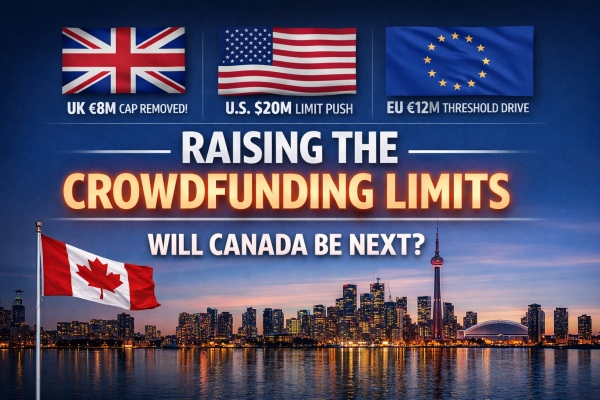
On February 10 2026, UK POP rules go live, removing the old prospectus trigger that made large public raises expensive, slow, and out of reach for many private companies.
For years, UK companies faced a hard line. If a business raised more than €8 million in securities from the public in a year, it had to produce a full prospectus (NB: the UK retained that euro-denominated threshold in its domestic framework post-brexit). Crowdcube says that prospectus costs could cost more than £250,000 and take months, which pushed many companies away from public community rounds even when demand existed.
Under the Public Offer Platform regime, raises above £5 million now run through a regulated POP, and the regime removes the upper fundraising cap for those offers (No more funding caps). Raises under £5 million remain outside the POP requirement, but regulated execution and investor protection expectations still apply.
Platforms now carry more responsibility for diligence, disclosure quality, and investor safeguards. That shifts the burden from a giant issuer document to a supervised platform process that can move faster.
The UK is not alone. In the United States, Crowdfund Capital Advisors submitted a $20M Reg CF petition asking the SEC to raise the Regulation Crowdfunding cap from $5M to $20M. In Europe, the European Digital Finance Association are pushing to increase the ECSP threshold from €5m to €12m.
After years of advocating, Canada finally harmonized nationally its startup-crowdfunding exemption in 2021, but regulators have kept the issuer cap conservative. Under National Instrument 45 110, eligible issuers can raise up to $1.5m in a 12 month period, which a growing company can quickly outgrow and end up soon looking for more funding via heavier paths for larger rounds. If the government wants to prioritize funding scape-ups, they should take another look at increasing equity crowdfunding caps in Canada to be in line with global peers.
This funding cap tension isn't new. In fact NCFA has been advocating for the OSC and CSA to raise issuer funding caps for years. In 2017 for example, NCFA petitioned to raise caps to modernize equity crowdfunding in Ontario. In 2019, $5m cap formed part of NCFA's recommendations to reduce regulatory burden and unlock growth capital. Again in 2020, during national harmonization discussions, NCFA advocated to modernize NI 45 110 including increasing caps to $5 million so the framework could match real funding needs in a digital economy.
Now with the UK FCA removing prospectus triggers and the US and EU push for higher caps, there may be a new policy window for Canada's equity crowdfunding participants to petition yet again. If other jurisdictions support $10m to $20m community rounds under platform oversight, Canada needs to decide whether it wants founders scaling here or structuring growth capital elsewhere.
A higher ceiling, including a path toward $5m and beyond, would better match growth stage reality while keeping platform level investor protection front and centre. The global direction of travel now strengthens the case for a renewed Canadian push grounded in data, experience, and competitiveness.
If regulated platforms can run larger public offers without a prospectus wall in the UK, what should Canada do next, raise the ceiling, create a platform lane for larger rounds, or keep the cap and accept that growth capital routes around Canada?
One practical takeaway stands out. POP style rules treat the platform as the compliance spine, not the issuer. That design can cut cost and time while still demanding clear disclosures, suitability controls, and due diligence at the point of sale. While Canada doesn't necessarily need to copy the UK, it does need a credible path for larger community rounds that doesn't force founders into a prospectus sized bill before they have the scale to absorb it.
The National Crowdfunding & Fintech Association (NCFA Canada) is a financial innovation ecosystem that provides education, market intelligence, industry stewardship, networking and funding opportunities and services to thousands of community members and works closely with industry, government, partners and affiliates to create a vibrant and innovative fintech and funding industry in Canada. Decentralized and distributed, NCFA is engaged with global stakeholders and helps incubate projects and investment in fintech, alternative finance, crowdfunding, peer to peer finance, payments, digital assets and tokens, artificial intelligence, blockchain, cryptocurrency, regtech, and insurtech sectors. Join Canada's Fintech & Funding Community today FREE! Or become a contributing member and get perks. For more information, please visit: www.ncfacanada.org
| | |
|---|---|---|
| | |
February 17 2026 | Equity Crowdfunding and Retail Investors

Image: Freepik/pressfoto
On February 16 2026, multiple UK reports say BrewDog has hired advisers to explore a potential sale after years of losses and slower growth. As a result, about 220,000 Equity for Punks retail shareholders may lose money depending on deal structure and payout priority.
Do you remember the Equity for Punks BrewDog story from years past? It was a story of community empowerment in the early days of the equity crowdfunding movement. NCFA and established partners like Crowdfund Insider tracked that momentum, such as when when BrewDog plans a $50M US equity crowdfunding round. The story today however offers practical lessons about capital structure, liquidity, and investor protection.
BrewDog built one of the most visible equity crowdfunding programs in the world through Equity for Punks. The model gave everyday consumers direct exposure to private company ownership and it proved that brand and community could mobilize serious capital.
In 2017 however, BrewDog took a major private equity investment from TSG Consumer Partners. Reporting in The Guardian describes preferential rights that sit ahead of common shareholders in a sale. That structure now drives the risk for small shareholders in the current sale process, based on how the deal structure affects what retail shareholders receive in a sale. The core point is simple. Structure governs outcomes in private markets.
Phil Halsey (47) invested about £2,500, starting in the second cash call in 2011:
“It’s extremely disappointing that it’s gone this way,” said Halsey. “The last time you could have done some form of cashing out was about a year and a half ago.”
1. Capital stack always decides the payout. Retail investors often focus on brand, traction, and growth narrative. Professional investors focus first on the capital stack. If a preferred investor holds liquidation preferences or other senior rights, that investor receives sale proceeds first. Common shareholders receive what remains. In a strong exit everyone wins. In a weaker exit, common shareholders may receive little or nothing. Investors should read share class terms and understand exactly where they sit before they invest.
2. Liquidity risk shows up at the worst time. Equity crowdfunding expands access, but it rarely guarantees a clean exit path. If investors rely on one big liquidity event, timing risk becomes real. Investors should treat these positions as long duration holdings. Founders and platforms should design credible liquidity pathways where rules allow, because trust grows when investors understand how they can eventually exit.
3. Growth narratives do not replace unit economics. The sale process follows years where BrewDog reported losses. When costs rise and category growth cools, expansion heavier models feel pressure quickly. Investors should challenge founders and operators on the road to profitability, not just the top line story. Founders should align growth with durable margins, because narrative alone doesn't protect valuation.
4. Community builds momentum but it does not hedge downside. Equity for Punks turns customers into owners and it proves that community capital can scale a consumer brand. That impact remains real. Yet community alignment does not override contractual rights in a sale. Retail investors should value perks and participation for what they are, and they should separate those benefits from expected financial return.
BrewDog's case encourages retail investors to have more mature conversations about disclosure, investor education, and deal structure literacy. For Canada, the case reinforces why clear explanations of share classes, payout priority, and realistic liquidity expectations are important for investor protection and long term market credibility.
The National Crowdfunding & Fintech Association (NCFA Canada) is a financial innovation ecosystem that provides education, market intelligence, industry stewardship, networking and funding opportunities and services to thousands of community members and works closely with industry, government, partners and affiliates to create a vibrant and innovative fintech and funding industry in Canada. Decentralized and distributed, NCFA is engaged with global stakeholders and helps incubate projects and investment in fintech, alternative finance, crowdfunding, peer-to-peer finance, payments, digital assets and tokens, artificial intelligence, blockchain, cryptocurrency, regtech, and insurtech sectors. Join Canada's Fintech & Funding Community today FREE! Or become a contributing member and get perks. For more information, please visit: www.ncfacanada.org
| | |
|---|---|---|
| | |
Feb 9, 2026 | NCFA Fintech Market Activity | Ecosystem and Capital

Image: Freepik
On January 26 2026, Y Combinator removed Canada from its standard deal terms, limiting eligibility for startups incorporated domestically. Within days, it reinstated Canada after founder backlash, restoring access under its typical investment framework, which details how incorporation jurisdiction directly affects capital access, governance structure, and long term scaling strategy for Canadian founders.
The initial decision did not involve a specific fintech company or funding round. It was structural. Y Combinator’s standard deal applies to startups incorporated in approved jurisdictions. Removing Canada effectively meant founders would need to incorporate elsewhere, typically in the United States, to participate under YC’s typical structure.
YC is one of the most influential accelerators in the world. Its standard deal, global demo day visibility, and alumni network continue to shape where and how startups incorporate. When a jurisdiction falls off that list, it forces founders to revisit fundamental questions about domicile, governance, and long term capital access.
Canada has long faced tension between building domestic champions and watching startups reincorporate in the U.S. to access deeper venture pools. The temporary exclusion exposed that pressure in real time. Founders openly questioned whether remaining Canadian limited their path to global capital. Investors pushed back on the optics and the implications for ecosystem competitiveness.
The reversal confirms something important. Founder voice still carries weight. When structural barriers appear, the community responds quickly.
This episode also lands in a broader moment of scrutiny around capital flows and jurisdictional friction. As previously covered by NCFA in prediction markets pricing geopolitical risk, capital increasingly reacts to policy shifts, regulatory posture, and national positioning. Incorporation strategy is no longer a back office decision. It sits at the center of competitive positioning, a topic that many legal advisors regularly bring up with their client firms for years, often to the detriment of Canada's startup ecosystem.
YC did not publicly frame the move as a statement about Canadian founders. The accelerator has previously highlighted data showing many international startups choose U.S. incorporation for fundraising efficiency. But the optics of removing an entire G7 country triggered a deeper conversation about structural competitiveness and capital alignment.
For fintech specifically, where your company is registered and domiciled affects licensing pathways, regulatory relationships, and banking partnerships. A Canadian incorporated fintech navigating CIRO, CSA, or RPAA requirements faces a different operating map than one structured under Delaware law. Founders weigh tax efficiency, governance flexibility, investor familiarity, and exit pathways.
Before choosing incorporation jurisdiction, founders should be clear on a few points:
These questions affect investor comfort, term sheet dynamics, and how quickly you can close capital when markets tighten.
The episode also puts a spotlight on Canada’s policy environment. If global accelerators and venture firms default to U.S. incorporation for efficiency, policymakers should ask why. Founders make structural decisions based on predictability, tax treatment, regulatory clarity, and access to institutional capital. If Canada wants more high growth companies to incorporate and remain here, it must reduce friction in securities regulation, modernize capital formation rules, and deepen domestic late stage capital pools. Incorporation decisions follow incentives. Capital flows toward simplicity and scale.
Capital markets still reward certain structures and jurisdictions more predictably than others. That doesn't mean Canadian incorporation is a disadvantage. It does mean founders must approach the decision deliberately, not emotionally.
The larger takeaway is not about one accelerator. It is about ecosystem resilience. When capital gatekeepers adjust terms, even briefly, founders notice. Policymakers should notice too.
If incorporation jurisdiction influences access to global capital networks, how can Canada strengthen incentives so founders choose to build and scale at home without sacrificing investor reach?
This episode resolved quickly. The underlying tension did not.
The National Crowdfunding & Fintech Association (NCFA Canada) is a financial innovation ecosystem that provides education, market intelligence, industry stewardship, networking and funding opportunities and services to thousands of community members and works closely with industry, government, partners and affiliates to create a vibrant and innovative fintech and funding industry in Canada. Decentralized and distributed, NCFA is engaged with global stakeholders and helps incubate projects and investment in fintech, alternative finance, crowdfunding, peer-to-peer finance, payments, digital assets and tokens, artificial intelligence, blockchain, cryptocurrency, regtech, and insurtech sectors. Join Canada's Fintech & Funding Community today FREE! Or become a contributing member and get perks. For more information, please visit: www.ncfacanada.org
| | |
|---|---|---|
| | |
Economy | February 6, 2026

On February 5, 2026, Bank of Canada Governor Tiff Macklem delivered a speech at the Empire Club of Canada called 'Structural Change - Canada at Crossroads' warning that Canada has reached a productivity crossroads, where long standing structural limits now cap growth, wages, and competitiveness. Inflation no longer defines the constraint. Productivity does. For founders, investors, and policymakers, the question is no longer whether innovation exists in Canada, but whether the economic system allows it to scale. Of course, many stakeholders have been eluding to this data-driven fact for a decade, including NCFA.
“Canada’s productivity performance has been weak for a long time, and that limits how fast our economy can grow.”
Macklem identifies productivity as the binding constraint on Canada’s economic outlook. The data is clear. According to OECD GDP per hour worked data, Canada’s labour productivity remains well below the United States and has fallen further behind over the past decade. In 2023, Canada produced roughly 72% of US output per hour worked, a gap that continues to widen.
The Bank of Canada links this shortfall to weak business investment, slow technology adoption, and limited competitive pressure. These factors suppress output growth even as employment rises. As a result, wage growth, firm profitability, and national competitiveness all face structural limits.
NCFA analysis shows that productivity challenges increasingly reflect underinvestment in digital infrastructure, automation, and scalable financial systems rather than a shortage of talent or ideas. For example, see: Breaking Canada’s Productivity Trap For Stronger Growth or Fintech’s Role In Canada’s Productivity Revival or Canada's Productivity Depends on Intangible Tech Adoption, which detail how capital misallocation and limited competition slow modernization across sectors.
For fintech founders, productivity gaps point to unmet demand for tools that reduce friction in payments, lending, compliance, and data driven decision making. Where legacy systems persist, productivity losses accumulate across the economy.
“More competition pushes firms to innovate, invest, and become more productive.”
Macklem ties productivity directly to competitive intensity. Where markets concentrate, firms face less pressure to adopt new technology or improve efficiency. Canada’s financial services sector illustrates this clearly. In fact, the Bank of Canada's Senior Deputy Governor, Carolyn Rogers, called Canada's banking system an Oligopoly. Concentration in lending, payments, and capital markets slows adoption of new models that could lower costs for businesses.
NCFA tracks this dynamic, here are just a couple of examples: How Competition Powers Canada’s Economic Growth and Why SME Loan Competition In Canada Is Under Review.
Small and medium sized businesses feel the impact most. Limited lender choice raises borrowing costs and lengthens approval timelines. For fintech lenders and embedded finance platforms, this reinforces demand for modern credit models that expand access while maintaining risk discipline.
“Investment needs to flow to the firms that can grow and raise productivity.”
Canada’s venture capital structure continues to constrain scale. According to RBCx data, Canadian VC Fundraising Contracts And Concentrates, raising just over $2 billion in 2025. Capital concentrates heavily. The top five funds account for roughly 83% of total capital raised, while emerging managers raise approximately $249 million.
At the same time, total venture investment reached about $4.9 billion across 386 deals through the first nine months of 2025, compared with roughly $8.6 billion across all of 2024. These figures describe two forces in the same system. Fundraising concentrates while deployment becomes more selective.
For founders, capital access becomes a strategic constraint rather than a timing issue. For investors, it narrows the pool of companies able to scale inside Canada.
“Good policy supports competition, investment, and long term growth.”
Macklem acknowledges that productivity doesn't improve in a vacuum. Firms respond to the regulatory environment they operate in. When compliance costs rise faster than firms' capacity, or when rules favour incumbents over new entrants, productivity suffers.
NCFA has consistently shown that regulatory design plays a decisive role in whether innovation scales. When rules increase cost or delay without improving outcomes, firms delay investment and avoid experimentation. Productivity improves when regulation supports entry, proportional compliance, and faster market testing, as outlined in Innovative Approaches to Smarter Regulation and Overcoming Barriers to Growth in Financial Regulation.
Smarter regulation does not weaken safeguards. It reduces duplication, improves clarity, and aligns oversight with actual risk. Jurisdictions that achieve this balance create space for competition and faster technology adoption, lessons explored in Lessons for Canada from Global Leaders in Regulation.
“Efficient financial systems help capital move to its most productive uses.”
Macklem’s remarks extend naturally to payments infrastructure. Canada payments system processes enormous transaction volumes, reaching $12.2 trillion in 2024, yet modernization remains uneven.
Slow settlement and high transaction costs lengthen working capital cycles and increase operational risk, especially for SMEs. The productivity impact of faster payments and modern rails can't be understated as many countries rush to modernize their payment ecosystem and functionality, including Canada who has been working to update it's payment system for years and only now making progress being under the gun.
For fintech builders, payments remain one of the most direct ways to improve productivity across the economy.
“Productivity growth depends on the environment firms operate in.”
Macklem’s framing helps explain why successful Canadian built companies increasingly scale elsewhere. Why A $35M Built In Canada Startup Still Moved To The US, shows how growth stage constraints shape founder decisions even after proving traction at home. When capital pools, market size, and regulatory pathways align more clearly abroad, relocation of entrepreneurs and venture brain drain mirrors operating decisions, not national sentiment.
This trend reinforces the need to address productivity, competition, capital access, and regulation together rather than treating talent retention as a standalone issue. Founders are now at crossroads, and trying to make it work within system constraints.
When capital, regulation, and market access align, firms stay. When they do not, firms move.
Macklem’s speech aligns closely with the productivity, competition, and innovation themes NCFA has tracked and raised for years. Productivity improves when competition deepens, capital flows efficiently, regulation supports entry, and technology adoption accelerates. Fintech sits at the intersection of all four.
Policy tools that support SME expansion, such as export financing and market access programs, can reinforce financial innovation when aligned properly. Programs like CanExport SMEs show how capital support and operational scale can work together rather than in isolation. The challenge now is execution. Productivity gains come from systems that allow new firms to compete, scale, and deploy technology without unnecessary friction.
You may like these additional reads:
The National Crowdfunding & Fintech Association (NCFA Canada) is a financial innovation ecosystem that provides education, market intelligence, industry stewardship, networking and funding opportunities and services to thousands of community members and works closely with industry, government, partners and affiliates to create a vibrant and innovative fintech and funding industry in Canada. Decentralized and distributed, NCFA is engaged with global stakeholders and helps incubate projects and investment in fintech, alternative finance, crowdfunding, peer-to-peer finance, payments, digital assets and tokens, artificial intelligence, blockchain, cryptocurrency, regtech, and insurtech sectors. Join Canada's Fintech & Funding Community today FREE! Or become a contributing member and get perks. For more information, please visit: www.ncfacanada.org
| | |
|---|---|---|
| | |



August 26th, 2025

January 4th, 2024

June 1st, 2021

September 9th, 2020

July 9th, 2018

January 3rd, 2018

September 25th, 2017

June 20th, 2017

May 10th, 2017

December 14th, 2016
