





Karsten Wenzlaff, Advisor
August 26th, 2025
Karsten Wenzlaff is a Crowdfunding and Fintech Expert from Germany. He is Secretary-General of Digit[...]


Mar 4, 2026 | NCFA Fintech Market Insight | AI And Data Governance
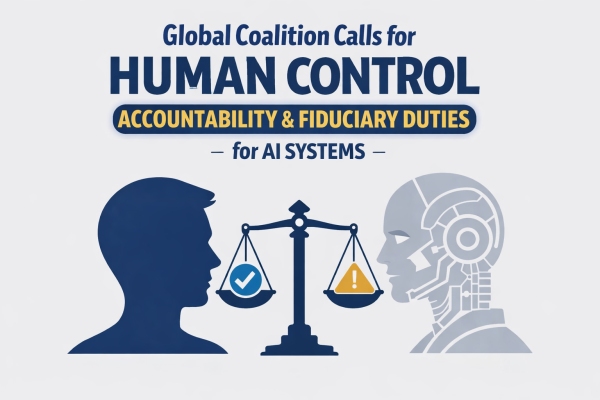
On March 4, 2026, the Pro Human AI Declaration goes public with support from a broad mix of public figures and organizations, including Yoshua Bengio (Professor, Université de Montréal and Turing Award Laureate), Daron Acemoglu (Nobel Prize-winning economist), Sir Richard Branson, and many other individual endorsers, along with groups such as the AFL CIO Tech Institute, American Federation of Teachers, SAG AFTRA, Public Citizen, and Center for Humane Technology. When people from business, labour, civil society, and research line up behind the same message, boards, regulators, and large buyers start to pay attention.
The declaration argues that AI should serve people, not replace them, and that powerful systems should remain under human control. For fintechs and financial institutions, AI already touches onboarding, fraud checks, customer support, compliance, advice, marketing, and risk decisions. As the public debate turns toward accountability and duty, finance is on the front lines of AI's adoption versus it's capabilities.
The declaration opens with a warning about a race to replace people in creative work, care, counselling, companionship, jobs, and decision making. It argues that this approach could push more power into large institutions and their machines while weakening privacy, liberty, democratic governance, and social stability.
It then lays out five core principles:
Keep humans in charge. Avoid concentration of power. Protect the human experience. Preserve human agency and liberty. Hold AI companies responsible and accountable.
The document also argues that AI systems should not be treated as legal persons with their own rights or responsibilities. It calls for protection of children and families from harmful uses of AI. It says people should have meaningful rights, oversight, and recourse when AI affects their lives.
As it relates to financial services, the declaration says AI used in professions such as finance, must meet fiduciary duties including duty of care, conflict disclosure, and informed consent.
Canada already faces its own debate about how to govern and finance artificial intelligence. A recent NCFA analysis on Canada’s AI strategy confronting capital flight and domestic IP retention highlights growing concern that Canadian innovation and economic value could migrate abroad if policy, capital access, and procurement frameworks do not evolve.
The Pro Human AI Declaration adds another dimension to that discussion. It focuses on accountability, human oversight, and responsibility when AI systems influence real world decisions.
It's important because in finance trust decides adoption, and banks, insurers, wealth platforms, lenders, and fintech vendors are already facing harder questions about how they use AI, who stays responsible, how people can challenge a bad outcome, and whether a firm can clearly explain what the system actually does. Pro Human's AI declaration adds more public weight behind those questions.
Take AI driven advice tools for example. If a digital assistant recommends a debt strategy, suggests a product, or influences an investment decision, firms should expect more scrutiny around disclosure, consent, conflicts, and who remains accountable for the outcome. The more the tool acts like an adviser, the harder it becomes to treat it like a simple software feature.
Fraud and risk controls offer another example. Many firms now use machine learning to flag suspicious activity, approve accounts, or block transactions. If a system freezes an account, rejects a customer, or triggers a harmful false positive, firms will face stronger pressure to explain the reason and provide a path to human review. In finance, a wrong decision can have a huge impact in a hurry. It can lock someone out of funds, delay a payment, or damage trust fast.
Customer communication is another live area. Banks and fintechs increasingly use AI chat tools to answer product questions, guide users through forms, or help people make sense of financial options. If those systems are guiding decisions, firms should expect harder questions about disclosure, consent, suitability, and whether the system nudges people in ways they do not fully understand.
Teams building AI for finance should design for human oversight in workflows from the start. They should know where a person can step in, how decisions get reviewed, what data trains the system, how conflicts get surfaced, and who owns the final call. These are no longer side questions. They affect procurement, partnerships, compliance reviews, and customer confidence.
This also creates an opening. Fintechs that can show clear controls, plain language disclosures, reliable audit trails, and real accountability will stand out in a crowded market. In regulated markets, users want to work with tools and systems they can trust when stakes and outcomes are at their highest.
One to watch for fintech and financial service leaders. Companies that keep humans involved, explain their systems clearly, and stay accountable when outcomes matter will be in a stronger position as this debate moves closer to policy, procurement, and market practice. Plus, they may sleep better at night 😉
 The National Crowdfunding & Fintech Association (NCFA Canada) is a financial innovation ecosystem that provides education, market intelligence, industry stewardship, networking and funding opportunities and services to thousands of community members and works closely with industry, government, partners and affiliates to create a vibrant and innovative fintech and funding industry in Canada. Decentralized and distributed, NCFA is engaged with global stakeholders and helps incubate projects and investment in fintech, alternative finance, crowdfunding, peer-to-peer finance, payments, digital assets and tokens, artificial intelligence, blockchain, cryptocurrency, regtech, and insurtech sectors. Join Canada's Fintech & Funding Community today FREE! Or become a contributing member and get perks. For more information, please visit: www.ncfacanada.org
 |  |  |
|---|---|---|
 |  |  |
Mar 5, 2026 | NCFA Fintech Market Insight | Open Banking And Policy And Market Structure

Image: Freepik/Drazen Zigic
On Mar 5 2026, the Bank of Canada made open banking timing comments at an Open Banking Expo highlighting timing and delivery risk. The central bank is still in the requirements stage and it will not commit to a launch date.
“somewhat daunted”
“the information-gathering stage alone will take months.”
In a LinkedIn post, Claire Brownell of The Logic also wrote that Ron Morrow, Executive Director of Payments, Supervision and Oversight, at the bank, “stopped short of confirming” that a 2026 launch is no longer realistic and said the information gathering stage “could take months,” with a clearer timeline only after that work finishes. Canada is still defining how open banking works before it can ship.
Yes, you heard it right. After almost a decade of analyzing, preparing, announcing, and promising the implementation of Consumer-driven Finance (aka Open Banking), the market learns that the bank is still in the information gathering phase.
Requirements work sounds boring, but it sets the rails for everything that follows. It decides which data gets shared, how consent works, how liability lands, how disputes get handled, and what the security bar looks like for every approved participant.
Canada already has a policy target, but the issue is execution speed. Canada's consumer driven banking framework describes open banking as a secure system that lets people and businesses share financial data with approved providers of their choice. Delay keeps Canadians stuck with expensive workarounds for data sharing and money movement like screen scraping.
Firms need clear standards on what data gets shared, how consent works, who is responsible when something goes wrong, and who can join the system. Without that clarity, banks and larger firms delay and smaller firms waste time building for rules that may change.
Delay also changes what gets built. Fintechs keep using screen scraping, password sharing, and one off partnerships because those options work today. That rewards the firms that already control customer access, instead of the firms building safer permission based tools.
Fintechs who have in some cases been waiting years for Open Banking's arrival can continue planning for two tracks. Keep shipping products that work under today’s rails, but design the next version around consumer permissioning, clean audit trails, and repeatable consent. Treat identity, consent, and dispute handling as core product work, not legal add ons. Companies that have these pieces in place will be ready when approval and accreditation rules finally arrive.
The cost of delay is that Canada keeps paying for friction, and Canadian fintechs keep competing with one hand tied behind their back.
If the requirements stage takes months, what needs to change so Canada ships a clear rule set fast enough for fintechs and banks to invest with confidence?
Hopefully this latest timing hiccup will lead to a safer, and more competitive data and payments layer in Canada.
The National Crowdfunding & Fintech Association (NCFA Canada) is a financial innovation ecosystem that provides education, market intelligence, industry stewardship, networking and funding opportunities and services to thousands of community members and works closely with industry, government, partners and affiliates to create a vibrant and innovative fintech and funding industry in Canada. Decentralized and distributed, NCFA is engaged with global stakeholders and helps incubate projects and investment in fintech, alternative finance, crowdfunding, peer-to-peer finance, payments, digital assets and tokens, artificial intelligence, blockchain, cryptocurrency, regtech, and insurtech sectors. Join Canada's Fintech & Funding Community today FREE! Or become a contributing member and get perks. For more information, please visit: www.ncfacanada.org
| | |
|---|---|---|
| | |
Mar 5, 2026 | NCFA Market Insight | AI And The Future Of Work

Image: Labour market impacts of AI: New measure, early evidence (Anthropic Mar 2026)
On March 5 2026, new Anthropic artificial intelligence labour market impact research | download 17 page PDF offers a more grounded way to think about AI and jobs. Most AI labour studies ask what large language models could do in theory. This one asks what workers actually do with AI now. That sounds like a small change, but it matters. Financial institutions, fintechs, and policymakers need to know where real workflow change starts, not just where capability headlines point.
The paper introduces a new measure called observed exposure. It combines occupational task data, Claude usage data, and earlier research on which tasks language models can theoretically handle. The approach tries to separate technical possibility from real use. That makes this study potentially more useful than other broad forecasts about AI replacing jobs. To be clear, at this point the research doesn't claim mass displacement has arrived. It looks instead for early pressure points that may show up before unemployment spikes.
This report matters because it focuses on real work patterns. The authors use the US O*NET task database, Anthropic Economic Index usage data, and earlier task level exposure estimates to build their measure. They also give more weight to automated and work related uses than to lighter forms of assistance. That helps the study track where AI starts to move from drafting help into actual production work.
That said, the research has real limits, and those limits matter. The usage data comes from Claude, not from the full AI economy. A bank using Microsoft, Google, OpenAI, or internal tools may show a different pattern. The measure also tracks task exposure, not direct job loss. And the authors make clear that adoption still lags capability because of legal controls, software requirements, human review, and workflow friction. That caution strengthens the paper rather than weakening it. It keeps the analysis honest.
The most striking findings is the size of the gap between capability and real usage. In STEM (ie. computer and math) occupations, earlier work suggests language models could theoretically touch 94% of tasks. Anthropic’s observed measure puts current Claude coverage in that category at just 33%. In other words, the technology frontier sits much further ahead than the adoption frontier.
That gap matters for fintech and finance because it points to where the real bottleneck sits. The next productivity jump might not come from a bigger, better, faster or smarter model alone. It might come from firms that redesign workflows, tighten controls, connect tools to internal systems, and build trust in output quality. Which operators can close the adoption gap faster than peers.
The report finds that computer programmers rank as the most exposed occupation, with 74.5% coverage. Customer service representatives follow at 70.1%, and data entry keyers come next at 67.1%. Digital, repeatable, text heavy work moves first.
What stands out for NCFA readers is that this isn't just software engineers. Financial analysts are also among the most exposed occupations in the paper’s wider discussion. That should get the attention of banks, insurers, wealth platforms, lenders, and compliance teams. A lot of value in finance comes from summarizing information, checking documents, explaining options, processing forms, and moving data from one system to another. Those are exactly the kinds of tasks that AI enters early.
Workers in the most exposed occupations earn 47% more on average than workers in the unexposed group. People with graduate degrees make up 17.4% of the most exposed group, compared with 4.5% of the unexposed group.
Early pressure is showing up in better paid, more educated, office based roles. In practice, that means AI may alter the work of analysts, developers, researchers, service teams, and operations professionals before it touches many frontline physical jobs. For financial institutions, this points to a management challenge as much as a technology one. Firms need to rethink role design, supervision, training, and quality control inside knowledge work functions.
The research does not find a growing rise in unemployment for workers in the most exposed occupations since late 2022. That is an important result because it pushes back on louder claims that AI already causes wide labour market damage.
But the report does find an early warning sign. For workers aged 22 to 25, job finding rates into highly exposed occupations fall by about 14% compared with 2022 levels. The authors stress that this result is only barely statistically significant and open to other interpretations. So something to watch and track.
This is how labour market change often starts. Not with mass layoffs. Not with an obvious cliff. It starts when firms stop hiring as many junior people because AI now handles part of the routine work those hires once learned on. That's important for banking, fintech, consulting, and other white collar sectors that depend on apprenticeship style career ladders. If entry points narrow, firms may save money in the short run while weakening their future talent pipeline.
Firms should watch three things closely to better anticipate where the real gap may open between leaders and laggards:
For fintech builders, the market needs tools that help institutions safely plug AI into live work. Audit trails, review controls, workflow routing, structured data extraction, policy checking, and role based permissions. Companies that solve those problems help close the distance between AI capability and actual business use and adoption.
Anthropic’s research is quite useful because it shows where real adoption starts, where the biggest gaps remain, and where the cracks may start to appear and proliferate.
The National Crowdfunding & Fintech Association (NCFA Canada) is a financial innovation ecosystem that provides education, market intelligence, industry stewardship, networking and funding opportunities and services to thousands of community members and works closely with industry, government, partners and affiliates to create a vibrant and innovative fintech and funding industry in Canada. Decentralized and distributed, NCFA is engaged with global stakeholders and helps incubate projects and investment in fintech, alternative finance, crowdfunding, peer-to-peer finance, payments, digital assets and tokens, artificial intelligence, blockchain, cryptocurrency, regtech, and insurtech sectors. Join Canada's Fintech & Funding Community today FREE! Or become a contributing member and get perks. For more information, please visit: www.ncfacanada.org
| | |
|---|---|---|
| | |
Mar 4, 2026 | NCFA Fintech Market Insight | Regtech And Identity And Privacy

On Feb 16 2026, an interesting post at The Local Stack conducted a recent LinkedIn identity verification analysis via a real user experience of a larger fintech issue: modern identity checks now collect far more than most people expect, and the privacy tradeoff is becoming harder to ignore as regulated onboarding expands across financial services, platforms, and digital marketplaces.
Persona’s identity verification policy shows the scale of that collection. The policy lists government ID images, selfies, biometric information, NFC chip data, device data, geolocation, usage data, and checks against third party data sources. It also states that uploaded ID images may be used to train or improve the service, and that information may be shared with service providers, data partners, affiliates, and government authorities in some circumstances.
1. Identity verification now reaches well beyond document review. A current verification flow can combine document capture, face matching, biometric analysis, device signals, location data, and external database checks in one session. That means the onboarding event is no longer just a fraud control. It is a multi layer data collection workflow that carries legal, operational, and reputational risk.
2. The trust layer often sits with a specialist vendor, not the brand the user sees. A customer may think they are verifying with LinkedIn, a bank, or a fintech app. In practice, the verification is often run by a third party with its own privacy terms, data sources, subcontractors, retention rules, and model improvement rights. That gap between front end trust and back end processing is where privacy friction starts.
3. Privacy design now affects conversion. When users feel overexposed, abandonment risk rises. Firms that explain what's collected, why it's needed, who processes it, and how long it's kept are more likely to keep trust intact through onboarding. In identity verification, transparency is becoming part of product design.
Map every data field in the verification flow, not just the front end prompts. Disclose which vendor runs the check and what that vendor can do with the data. Remove optional collection that doesn't improve the actual risk decision. Review training, retention, and subcontractor clauses in vendor contracts. Put the plain language explanation before the scan starts, not after the user has already submitted a passport and selfie.
These steps become more important as Canada moves toward broader data portability and consumer directed finance. NCFA has already covered the wider privacy backdrop in North America privacy trends and the policy direction in CSA data portability consultation. Canada’s consumer-driven banking framework and the Consumer-Driven Banking Act push the market toward safer, permissioned data sharing. As that framework matures, identity credentials may become more reusable across providers, which could reduce repeated document collection while increasing pressure for stricter consent controls, narrower data use, and clearer liability when verification vendors sit in the middle.
Identity verification is moving from a hidden compliance step to a visible trust product. More onboarding flows will combine biometrics, device intelligence, and third party data. More enterprise buyers will ask whether vendors can use customer data to improve models. More regulators will look at whether the scope of collection matches the actual risk being assessed. The firms that win will not be the ones that collect the most data. They will be the ones that collect the least data needed to deliver a defensible result.
When identity checks collect more than most users expect, do the firms with the clearest privacy design earn more trust than the firms with the most aggressive control stack?
The National Crowdfunding & Fintech Association (NCFA Canada) is a financial innovation ecosystem that provides education, market intelligence, industry stewardship, networking and funding opportunities and services to thousands of community members and works closely with industry, government, partners and affiliates to create a vibrant and innovative fintech and funding industry in Canada. Decentralized and distributed, NCFA is engaged with global stakeholders and helps incubate projects and investment in fintech, alternative finance, crowdfunding, peer-to-peer finance, payments, digital assets and tokens, artificial intelligence, blockchain, cryptocurrency, regtech, and insurtech sectors. Join Canada's Fintech & Funding Community today FREE! Or become a contributing member and get perks. For more information, please visit: www.ncfacanada.org
| | |
|---|---|---|
| | |
March 2 2026 | Feature | AI Governance And Public Safety
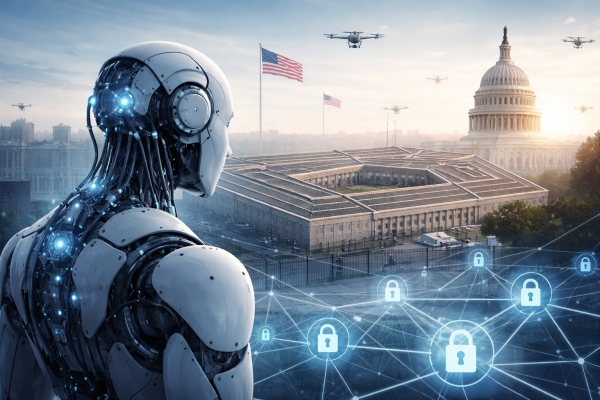
AI Image: Conceptual illustration of AI ethics, defense contracts, and public accountability
On February 26 2026, Anthropic said it wouldn't allow two Pentagon use cases in its contracts: mass domestic surveillance and fully autonomous weapons. Two days later, OpenAI said it reached a Pentagon deal for classified AI deployments and argued its safeguards could still hold inside the agreement. The split exposes the real issue now facing AI vendors, governments, and regulated buyers. That is should ethics limits block deals or be enforced from inside it?
Anthropic wasn't on the outside looking in. It said Claude was extensively deployed across the Department of War and other national security agencies and that the company had already put models into classified U.S. government networks. Anthropic also said two use cases, mass surveillance (including of the public), and fully autonomous weapons, we're never included in its contracts. Those cases are the fault lines in the dispute with Trump's Pentagon and US government.
Anthropic framed the issue as a narrow refusal, not a broad rejection of national security work. Dario Amodei said Anthropic supported “98% or 99%” of Pentagon use cases, but the company would not give up the remaining two limits. In its own words, Anthropic said, “we cannot in good conscience accede to their request.” Reuters reported that stance put a defense contract worth up to $200 million at risk.
The dispute escalated when President Trump directed the government to stop work with Anthropic and ordered a six month phase out of Anthropic technology across government. The Pentagon also moved to treat Anthropic as a supply chain risk. That raised the cost of holding hard limits when the customer is the government.
OpenAI took a different approach. In its own statement titled, 'Our agreement with the department of war', the company said its agreement had “more guardrails than any previous agreement for classified AI deployments, including Anthropic’s.” OpenAI also said, “We were—and remain—unwilling to remove key technical safeguards.” That is the core tension in this story.
Anthropic refused the terms it saw as too open. OpenAI signed and argued that stronger controls inside the agreement could still hold the line.
The details matter. OpenAI said the Department of War may use its system for all lawful purposes, but the same published terms say the system cannot independently direct autonomous weapons where law or policy requires human control, cannot make high stakes automated decisions that require human approval, and cannot be used for unconstrained monitoring of U.S. persons’ private information. OpenAI also said it keeps its safety stack in place, limits deployment to cloud infrastructure, keeps cleared personnel in the loop, and could terminate the contract if the government violates the terms.
The two companies are close on headline principles but not identical in practice. Anthropic draws two hard exclusions and refuses to move them. OpenAI accepts a broader legal framework, then relies on contract language, technical controls, and operational oversight to make similar limits enforceable inside the deal. That is a narrower and more conditional ethics model than refusing the agreement outright.
North of the border, the same trust question is already under pressure. After the Tumbler Ridge school shooting, Ottawa’s focus was whether AI evidence and escalation controls hold when governments ask for proof that safeguards, response rules, and accountability processes actually work under pressure. That's different than the Pentagon story that's testing how AI companies react and accept to full on defense contracts.
For fintechs, banks, and infrastructure providers, the lesson is practical. Buyers in regulated markets now ask more than whether a model performs well. They ask who can audit it, who can override it, what records exist, how long they are kept, and whether a vendor can prove that a stated limit still holds when a regulator, a court, or a government agency pushes hard.
On one hand, Anthropic's founders' moral compass highlights one method by maintaining hard limits even at the risk of losing a major federal contract. On the other hand, OpenAI's deal with the department of war is betting that contract terms, technical safeguards, and human oversight can preserve similar limits inside the agreement. Washington shows how quickly the state can force the issue. Ottawa shows what happens when public safety puts the same claims under direct scrutiny. In the next phase of AI adoption, trust rests less on capability claims and more on what a company can prove when the pressure rises.
The National Crowdfunding & Fintech Association (NCFA Canada) is a financial innovation ecosystem that provides education, market intelligence, industry stewardship, networking and funding opportunities and services to thousands of community members and works closely with industry, government, partners and affiliates to create a vibrant and innovative fintech and funding industry in Canada. Decentralized and distributed, NCFA is engaged with global stakeholders and helps incubate projects and investment in fintech, alternative finance, crowdfunding, peer-to-peer finance, payments, digital assets and tokens, artificial intelligence, blockchain, cryptocurrency, regtech, and insurtech sectors. Join Canada's Fintech & Funding Community today FREE! Or become a contributing member and get perks. For more information, please visit: www.ncfacanada.org
| | |
|---|---|---|
| | |
Feb 27, 2026 | NCFA Fintech Market Activity | Capital Markets And Market Structure

On February 25 2026, prediction market Kalshi disclosed two closed insider trading cases, including one tied to a YouTube editor linked to MrBeast content and one tied to a California political candidate. The same post records 200 investigations in the past year, with more than a dozen active cases.
The CFTC’s enforcement division confirmed the penalties, stating that illegal trading on prediction markets listed on designated contract markets falls within federal derivatives enforcement. Insider trading, misuse of non-public information, and market abuse now sit inside a framework that looks much closer to mainstream market oversight than novelty betting.
1. The MrBeast YouTube editor case carries a $20,397.58 financial penalty and a 2 year suspension from direct or indirect access to Kalshi.
The enforcement post describes trading tied to a popular creator’s videos. Kalshi’s surveillance tools flagged near perfect results in low odds markets, and user reports flagged the same account. The record concludes there was enough evidence to close the matter as an insider trading case and freeze the account.
2. The political candidate case carries a $2,246.36 financial penalty and a 5 year suspension
The second case covers a California political candidate who traded on his own election. The enforcement record treats that conduct as a direct rule breach. Public promotion of those trades made the violation even more visible.
For operators, the takeaway is direct. Once a platform lists contracts tied to events, information control becomes core infrastructure. Monitoring, escalation, account freezes, documented penalties, and regulator coordination all move from compliance overhead to essential operating systems.
For investors, the numbers point to the real test. Volume can scale fast, but conduct failures can damage credibility even faster. The platforms that manage to sustain long term value will be required to run a fair market, enforce their own rules, and stay inside a clear regulatory perimeter. Prediction markets already price geopolitics. The next hurdle is showing they can police information risk with the same seriousness as any other exchange.
When a prediction market issues fines, suspensions, and CFTC backed enforcement over insider trading, does it still trade as a betting product, or does it start operating like exchange infrastructure?
The National Crowdfunding & Fintech Association (NCFA Canada) is a financial innovation ecosystem that provides education, market intelligence, industry stewardship, networking and funding opportunities and services to thousands of community members and works closely with industry, government, partners and affiliates to create a vibrant and innovative fintech and funding industry in Canada. Decentralized and distributed, NCFA is engaged with global stakeholders and helps incubate projects and investment in fintech, alternative finance, crowdfunding, peer-to-peer finance, payments, digital assets and tokens, artificial intelligence, blockchain, cryptocurrency, regtech, and insurtech sectors. Join Canada's Fintech & Funding Community today FREE! Or become a contributing member and get perks. For more information, please visit: www.ncfacanada.org
| | |
|---|---|---|
| | |
Feb 27, 2026 | NCFA Fintech Market Activity | Digital Assets And Market Structure

On February 24 2026, a complaint filed in the Southern District of New York (83 page PDF) by Terraform plan administrator Todd R. Snyder accuses Jane Street and named employees of insider trading, fraud, and market manipulation tied to the May 2022 collapse of the Terra ecosystem.
The filing names Jane Street Group, Jane Street Capital, Bryce Pratt, Robert Granieri, and Michael Huang as defendants. It alleges that Jane Street used confidential information from Terraform insiders, including communications in a group chat identified in the complaint as “Bryce’s Secret”, to gather material non-public information and trade ahead of the UST depeg.
Do Kwon’s guilty plea on fraud charges thrust Terraform in the legal spotlight and forced the scale of the TerraUSD collapse. This lawsuit goes beyond Terraform’s own conduct and asks whether outside trading activity also helped deepen the damage.
The plan administrator was appointed through Terraform’s wind down to pursue recovery claims and maximize value for creditors. The complaint states that the administrator has authority to bring claims on behalf of Terraform, the wind down trust, Luna Foundation Guard, and certain individual victims who assigned claims tied to the collapse. This is a recovery action. The plaintiff is seeking disgorgement and other remedies from parties alleged to have profited from, and contributed to, Terraform’s collapse.
This case now tests whether a major trading firm used information and timing to reduce its own risk while the broader market absorbed the losses.
The complaint alleges that Jane Street sold UST on May 7 2022 after gaining an information edge, then benefited as UST lost its $1 peg within hours and the Terraform ecosystem entered a death spiral. It says those trades allowed Jane Street to unwind hundreds of millions of dollars of potential exposure at a critical point in the collapse.
The filing also points to the scale of emergency support during the crisis. It says Terraform bought more than 250 million UST on May 7, more than 200 million UST on May 8, and more than 1.9 billion UST between May 8 and May 10. It also says Luna Foundation Guard and third parties acting on its behalf used reserves to buy additional UST as the peg failed.
This case puts one of the best known trading firms in global markets into a fresh crypto market integrity fight tied to one of the sector’s biggest failures. If the case moves forward and more evidence enters the public record, scrutiny may increase around how large market makers operate in digital assets, how private information moves between token issuers and trading firms, and how courts apply insider trading and market manipulation theories to crypto markets.
The complaint also underlines the scale of the defendant it targets. It describes Jane Street as responsible for more than 10% of all equity trades in North America and says net trading revenue rose above $24 billion in the first three quarters of 2025. Those figures are allegations in the filing, not court findings, but they help explain why this lawsuit will draw attention well beyond crypto.
For exchanges, brokers, lenders, and digital asset platforms, the immediate issue is control. A case built on alleged private chats, relationship networks, and trade timing puts information barriers, surveillance, and counterparty oversight back at the center of market risk.
If crypto markets face more lawsuits built on insider trading and manipulation claims, does the next major pressure point move from token design to trading conduct?
For investors, the Terra collapse already changed how the market views stablecoins. This lawsuit may force more attention toward trading conduct, information asymmetry, and whether crypto market structure is ready for the same legal standards applied in traditional markets.
The National Crowdfunding & Fintech Association (NCFA Canada) is a financial innovation ecosystem that provides education, market intelligence, industry stewardship, networking and funding opportunities and services to thousands of community members and works closely with industry, government, partners and affiliates to create a vibrant and innovative fintech and funding industry in Canada. Decentralized and distributed, NCFA is engaged with global stakeholders and helps incubate projects and investment in fintech, alternative finance, crowdfunding, peer-to-peer finance, payments, digital assets and tokens, artificial intelligence, blockchain, cryptocurrency, regtech, and insurtech sectors. Join Canada's Fintech & Funding Community today FREE! Or become a contributing member and get perks. For more information, please visit: www.ncfacanada.org
| | |
|---|---|---|
| | |



August 26th, 2025

January 4th, 2024

June 1st, 2021

September 9th, 2020

July 9th, 2018

January 3rd, 2018

September 25th, 2017

June 20th, 2017

May 10th, 2017

December 14th, 2016
