





Karsten Wenzlaff, Advisor
August 26th, 2025
Karsten Wenzlaff is a Crowdfunding and Fintech Expert from Germany. He is Secretary-General of Digit[...]


Feb 4, 2026 | NCFA Insights | AI, Financial Infrastructure and Identity

On February 2 2026, security firm Wiz disclosed an exposed Moltbook database tied to autonomous AI agents containing millions of API keys. Around the same time, OpenClaw (an open source framework for running locally controlled AI agents) published documentation showing how locally run AI agents can access user devices, credentials and external services.
Autonomous AI agents aren't limited to chat style tools, and are beginning to touch real infrastructure that includes identity, wallets, and payment-related APIs.
This article discusses the what the emerging agent economy looks like in practice, why it matters for fintech founders and investors, and where governance and security pressure is building first. AI agents increasingly hold credentials, maintain state over time, and interact with external systems through APIs. That mix creates a new operational reality. Code is starting to act like a user, but without the same guardrails that traditional consumer finance expects.
Early agent frameworks are moving from single session prompts into persistent software. They can store memory, maintain identity, and run tasks continuously.
In OpenClaw’s model, locally run agents can interact with files, services, and external applications using user approved permissions. These agents can coordinate with other agents, call tools, and keep operating after a user stops watching the screen.
That capability becomes financially relevant the moment an agent can access a wallet credential, a banking API token, or a payment workflow embedded inside another platform.
Fintech products already sit on top of API keys, tokens, and delegated permissions. Wallet providers, open banking connectors, payment facilitators, and embedded finance stacks often rely on shared secrets and scoped access to move data or value. AI agents introduce a new actor into that system. A human might authorize a connection once, then an agent can repeatedly execute actions across that access channel at machine speed.
If an AI agent initiates a transaction, who owns responsibility for the outcome.
If an agent uses an API credential and a vendor later mishandles logs or storage, who absorbs liability.
If an agent operates in the background, how do firms enforce consent, audit trails, and appropriate use.
The Moltbook exposure matters because the risk is suddenly tangible. An unsecured database containing API keys is not a routine bug. It shows how quickly agent networks can create large pools of credentials that become attractive targets. When an environment contains millions of agent identities, a failure in credential storage or access control can scale into massive compromise. And of course, the financial equivalent is obvious. Once agents connect to wallets, payments, or identity services, insecure key management becomes a direct financial risk.
Fintech teams already know that credential hygiene and access governance decide security outcomes. AI agents compress that timeline. Humans leak keys through mistakes. Agents and agent networks can leak keys through architecture. That is why builders should treat agent access as its own risk class, separate from standard consumer or enterprise authentication patterns.
Regulators do not yet have comprehensive frameworks for AI agents operating inside financial workflows. Even so, policy direction in adjacent areas points to where enforcement will land first. Authorities focus on accountability, auditability, and consumer harm, regardless of channel. That already shows up in digital advice and online influence. Learn how CSA and CIRO tighten expectations around digital investment advice and influence when content or workflows can affect investor behaviour at scale.
AI agents create a similar accountability gap. If an agent provides recommendations, executes actions, or routes users into products, platform operators will need evidence of controls. That will include permissioning, logging, dispute handling, and clear assignment of responsibility when something goes wrong.
If AI agents can hold credentials and execute actions through financial APIs, what controls will separate trusted automation from uncontrolled delegated access?
The agent economy is coalescing at the edge of finance. AI agents that operate with identity and persistent access can become a new layer between users and money transfers. The winners will treat governance as part of product design. They will harden credential management, build clear authorization flows, and design auditability that works when software, not a person, invokes actions.

The National Crowdfunding & Fintech Association (NCFA Canada) is a financial innovation ecosystem that provides education, market intelligence, industry stewardship, networking and funding opportunities and services to thousands of community members and works closely with industry, government, partners and affiliates to create a vibrant and innovative fintech and funding industry in Canada. Decentralized and distributed, NCFA is engaged with global stakeholders and helps incubate projects and investment in fintech, alternative finance, crowdfunding, peer-to-peer finance, payments, digital assets and tokens, artificial intelligence, blockchain, cryptocurrency, regtech, and insurtech sectors. Join Canada’s Fintech & Funding Community today FREE! Or become a contributing member and get perks. For more information, please visit: www.ncfacanada.org
 |  |  |
|---|---|---|
 |  |  |
Feb 4, 2026 | NCFA Expert Intelligence | AI Risk and Governance

On February 3 2026, Dentons published a Voice from the Market North American Legal AI report following the firm’s inaugural Legal AI Summit. The report captures data insights from legal, business, and operations leaders across sectors about how organizations are handling real world AI deployment, specifically where AI adoption is creating legal and governance risk before regulators provide clear framework.
The findings matter for fintech founders and operators because legal teams are often the first to see where risk accumulates, such as in contracts, vendor relationships, employee use, and product liability, long before the market or regulators respond.
Most organizations in the survey reported they are designing their own AI governance frameworks because universal regulations do not exist yet. That gap puts legal risk in the critical path for AI use inside financial products and services.
“We want to cover the basics, but we don’t want to stymie innovation or scare people away with too many ‘do nots.’”
This comment above is from a survey participant highlighting the tension leaders face: Smart governance is needed, but overly prescriptive rules can impede experimentation and execution. So it's a real operational conflict that stakeholders must resolve long before policy catches up.
The governance gaps in the report align with real risks fintechs already encounter:
Many fintechs are building AI capability faster than they are formalizing guardrails, which can expose firms to legal, operational, and compliance risk across functions where AI is integrated in workflows. Whether that's in credit decisions, document review, marketing, fraud monitoring, or customer support.
It also intersects with other areas NCFA has covered. For example, recent regulatory signals from the CSA–CIRO joint finfluencer guidance and the rise of stablecoin policy frameworks both show that Canada’s regulatory perimeter is tightening around behaviour and risk, not just product categories.
If legal risk surfaces first in AI contracts, vendor relationships, and internal use, where should fintechs build their earliest governance guardrails: in contracts, in internal policy, or in product design?
Regulation typically always lags innovation. Legal and governance frameworks are being created inside enterprises today because no universal rulebook exists. Fintech innovators and operators who anticipate these gaps and embed guardrails early will be better positioned to scale responsibly and avoid costly legal exposure down the road.
The National Crowdfunding & Fintech Association (NCFA Canada) is a financial innovation ecosystem that provides education, market intelligence, industry stewardship, networking and funding opportunities and services to thousands of community members and works closely with industry, government, partners and affiliates to create a vibrant and innovative fintech and funding industry in Canada. Decentralized and distributed, NCFA is engaged with global stakeholders and helps incubate projects and investment in fintech, alternative finance, crowdfunding, peer-to-peer finance, payments, digital assets and tokens, artificial intelligence, blockchain, cryptocurrency, regtech, and insurtech sectors. Join Canada’s Fintech & Funding Community today FREE! Or become a contributing member and get perks. For more information, please visit: www.ncfacanada.org
| | |
|---|---|---|
| | |
Jan 30, 2026 | NCFA Fintech Market Activity | Funding and Ecosystem
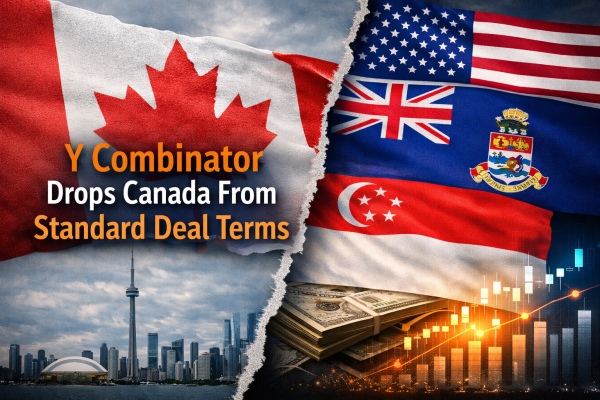
On January 26 2026, Y Combinator updated its standard deal terms to limit eligible investment jurisdictions to the United States, Cayman Islands, and Singapore. Canada no longer appears as a jurisdiction where YC will invest directly under its standard structure.
The financial terms remain unchanged. YC continues to offer $500,000 per company, split between $125,000 for a fixed 7% equity stake and $375,000 on an uncapped MFN SAFE. YC also states it can assist founders with incorporation if they have not yet formed a company.
The practical impact for Canada based founders is immediate. Teams can still apply to YC, but a Canadian incorporated startup must now establish a parent company in one of the eligible jurisdictions before YC completes the investment. That moves incorporation decisions forward in the startup lifecycle, often before product market fit or initial customer traction.
This matters because corporate structure is not a paperwork detail. It affects ownership control, intellectual property placement, option plans, investor rights, tax exposure, and the mechanics of future fundraising. What was once handled after a seed round now sits directly on the path to accelerator participation.
YC’s decision also highlights how early stage capital increasingly flows through standardized structures. Accelerators and seed funds optimize for speed and repeatability. When jurisdiction narrows, founders adapt by default, even if their teams, customers, and operations remain Canadian.
When access to top accelerators depends on jurisdiction first and execution second, how early should founders be forced to trade structural flexibility for capital velocity?
This is not a withdrawal from Canadian talent. It is a capital routing decision. But when global accelerators set the defaults, those defaults shape where companies incorporate, where value accrues, and how national ecosystems compete for long term upside.
The National Crowdfunding & Fintech Association (NCFA Canada) is a financial innovation ecosystem that provides education, market intelligence, industry stewardship, networking and funding opportunities and services to thousands of community members and works closely with industry, government, partners and affiliates to create a vibrant and innovative fintech and funding industry in Canada. Decentralized and distributed, NCFA is engaged with global stakeholders and helps incubate projects and investment in fintech, alternative finance, crowdfunding, peer to peer finance, payments, digital assets and tokens, artificial intelligence, blockchain, cryptocurrency, regtech, and insurtech sectors. Join Canada's Fintech & Funding Community today FREE! Or become a contributing member and get perks. For more information, please visit: www.ncfacanada.org
| | |
|---|---|---|
| | |
AI Risks | Jan 28, 2026

Image: Freepik
On January 27, 2026, a landmark trial begins in Los Angeles Superior Court that forces major tech companies to explain how their algorithms work. The defendants include Meta and YouTube, as both TikTok and Snap reached a settlement just before trial, leaving Meta and YouTube to proceed before a jury.
Hundreds of families, teens, and school districts accuse social media platforms of intentionally designing products that keep young people addicted. The scale is hard to ignore. The coordinated cases include roughly 1,600 plaintiffs, more than 350 families, and about 250 school districts.
The first trial focuses on a 19 year old identified as KGM and is expected to last six to eight weeks. It is the first of about 22 test cases that will guide how thousands of similar lawsuits proceed. A separate federal case involving more than 235 plaintiffs, including attorneys general from nearly three dozen U.S. states, is scheduled to begin in San Francisco in June 2026.
This isn't just a social media story. Courts are no longer looking only at what people post. They are looking 'under the hood' at how systems are built to see if and how algorithms are influencing behaviour at scale.
For years, technology companies leaned on Section 230 of the Communications Decency Act, passed in 1996 to avoid liability tied to online activity. That protection still exists for user generated content. What changes here is the focus. Judges are allowing these cases to proceed because the claims target design choices.
Plaintiffs argue that features like infinite scroll, video autoplay, notifications, and recommendation systems encourage compulsive use. In a November 2025 ruling, the judge ruled that jurors must examine platform design choices rather than focusing only on user generated content.
That opens the door to evidence most companies prefer to keep internal. Product research, feature testing, internal discussions, and decision making around engagement will now move into public view. The question's are simple and uncomfortable. Why did the system work this way?
The plaintiffs seek more than damages. They also ask the court to order changes to how the platforms operate, which could set safety rules for the whole industry. If courts agree that algorithm design causes harm, the impact reaches far beyond a single verdict.
Executives from the biggest platforms may testify, including leaders from Meta, YouTube, Instagram, and Snap. Plaintiffs openly compare their strategy to tobacco cases from the 1990s, where internal documents and sworn testimony changed how courts and the public viewed addiction.
Recent settlements highlight the pressure cooker. Snap settled shortly before trial in one lead case. TikTok settled hours before jury selection began. Financial terms stay confidential, but the timing confirms risks companies would prefer not to explain in court.
These trials are taking place at a time when algorithms do more than recommend content. They adapt, learn, and optimize constantly. Modern systems adjust in real time based on user behaviour. Reinforcement loops scale instantly.
In January 2026, Anthropic chief executive Dario Amodei warns that AI risks are arriving faster than governance can keep up. In a 19,000 word essay called, 'The Adolescence of Technology", he writes:
“Humanity is about to be handed almost unimaginable power, and it is deeply unclear whether our social, political, and technological systems possess the maturity to wield it.”
Courts are now peering into that gap. When rules lag and impact grows, litigation becomes a way to force transparency. Judges and juries start asking questions regulators have not yet answered.
Financial services already run on algorithms. Credit decisions, fraud detection, transaction monitoring, pricing, robo advice, and nudges all rely on systems that influence user behaviour. These lawsuits do not accuse fintechs of wrongdoing, but they can change how accountability works.
If courts see algorithm design as a product choice that predictably affects people, then how those systems are built really matters. Why a system pushes certain outcomes, what it favours, and where it slows users down can end up being questions for a judge or jury, not just a product team.
For founders and institutions, it's about building systems you can explain. Clear design goals, documented tradeoffs, and guardrails reduce exposure and build trust with users, partners, and regulators.
As plaintiffs’ attorney Matthew Bergman puts it, “The fact that a social media company is going to have to stand trial before a jury … is unprecedented.” Courts now ask companies to explain their design decisions in plain language, under oath, and in public. That expectation will not disappear. Innovation keeps moving fast. Accountability now moves with it.
The National Crowdfunding & Fintech Association (NCFA Canada) is a financial innovation ecosystem that provides education, market intelligence, industry stewardship, networking and funding opportunities and services to thousands of community members and works closely with industry, government, partners and affiliates to create a vibrant and innovative fintech and funding industry in Canada. Decentralized and distributed, NCFA is engaged with global stakeholders and helps incubate projects and investment in fintech, alternative finance, crowdfunding, peer-to-peer finance, payments, digital assets and tokens, artificial intelligence, blockchain, cryptocurrency, regtech, and insurtech sectors. Join Canada's Fintech & Funding Community today FREE! Or become a contributing member and get perks. For more information, please visit: www.ncfacanada.org
| | |
|---|---|---|
| | |
Startups and Talent | Jan 28, 2026

On January 21, 2026, CTV News reported that a fintech startup built in Canada, Internet Backyard, reached an approx. valuation of $35 million in Canada but ended up relocating to the United States. The story drew attention because the venture succeeded here but still chose to leave after proving product market fit.
The founders included a recently graduated international student from Vietnam and her co-founder from Brazil.
The founders built the product in Canada, validated demand, hired talent, and reached scale. After that proof point, they made the decision to move the business south.
The founders cited two main reasons for leaving: access to growth capital and visa limitations. Those challenges aren't unique and reflect structural gaps that continue to impact where ambitious companies choose to grow.
While Canada's become a strong place to attract global founders, students, and early stage builders. The challenge emerges later, when companies move from validation to rapid expansion and require larger capital rounds, senior leadership mobility, and operational certainty. In those moments, founders tend to optimize for speed and certainty rather than geography.
Canada’s venture capital environment continues to constrain companies at the growth stage. According to data cited by RBCx, Canadian venture capital firms raised just over $2 billion in new capital in 2025. That level sits well below longer term averages and reflects a market dominated by a small number of large funds.
The same data shows that emerging fund managers raise only about $249 million of that total. The top five funds account for roughly 83% of all capital raised, concentrating decision making power among a small group of investors. This concentration reduces the number of domestic lead investors capable of supporting large follow on rounds. For founders approaching Series B or later, this structure often results in slower fundraising cycles, fewer competitive term sheets, and increased pressure to secure capital outside Canada.
Fundraising constraints also impact capital allocation. Through the first nine months of 2025, total venture capital investment in Canadian companies reached approximately $4.9 billion across 386 deals, compared with about $8.6 billion invested across all of 2024, based on aggregated industry reporting referenced by RBCx.
The conditions make capital availability less predictable at the exact moment companies need speed and certainty. When companies are ready to scale, relocation is increasingly becoming a rational operational decision based on their confidence in the domestic ecosystem, not a reflection of founder loyalty.
Capital isn't the only factor. Immigration and founder mobility also impact the decision where founders choose to scale.
Canada’s Start Up Visa program aims to attract global entrepreneurs and support company building inside Canada. In practice, the program faces processing delays and capacity strain. The federal government now applies application caps and limits new intake while it works toward program changes expected to take effect in 2026, according to Immigration, Refugees and Citizenship Canada.
For founders already operating a growing company, these conditions create uncertainty. Delays and intake limits complicate executive mobility, cross border hiring, and decisions about where senior leadership can legally and reliably operate.
By comparison, the United States offers more established founder and talent pathways, including O-1 and H-1B visas, that companies can pursue once growth accelerates. For teams making time sensitive scaling decisions, visa predictability can be a competitive advantage. Having said that, the US administration has introduced new fees which could adversely affect the program.
When companies leave after proving traction, Canada loses future job creation, downstream investment, and the chance to build repeat founders who recycle experience and capital into the next generation of startups.
The solution is to close the gap between early success and long term scale (reducing top founder frictions). It requires coordinated progress on growth capital availability, immigration execution, and speed of decision making. Until those pieces align, Canada will continue to function as a strong launch environment but a weaker destination for companies once they reach global scale.
The National Crowdfunding & Fintech Association (NCFA Canada) is a financial innovation ecosystem that provides education, market intelligence, industry stewardship, networking and funding opportunities and services to thousands of community members and works closely with industry, government, partners and affiliates to create a vibrant and innovative fintech and funding industry in Canada. Decentralized and distributed, NCFA is engaged with global stakeholders and helps incubate projects and investment in fintech, alternative finance, crowdfunding, peer-to-peer finance, payments, digital assets and tokens, artificial intelligence, blockchain, cryptocurrency, regtech, and insurtech sectors. Join Canada's Fintech & Funding Community today FREE! Or become a contributing member and get perks. For more information, please visit: www.ncfacanada.org
| | |
|---|---|---|
| | |
Jan 27, 2026 | NCFA Fintech Market Activity | Payments and Market Infrastructure

Image: Freepik
On January 27 2026, Payments Canada confirmed the admission of five new payment service provider members, expanding direct access to Canada’s core payments infrastructure. The new members are Wise Payments Canada, Float, KOHO, Paramount Commerce, and Brim Financial.
The update matters because Payments Canada membership is a structural gate into clearing, settlement, and rule participation. In practice, it determines which fintechs can connect more directly to payment rails instead of relying entirely on sponsor banks.
Payments Canada states that its systems clear and settle more than $411B in transactions every business day. Direct participation changes how PSPs manage cost, reliability, product design, and compliance as transaction volumes scale.
The five firms admitted represent different operating models inside the Canadian fintech market.
1. Wise Payments Canada brings cross-border money movement and FX infrastructure.
2. Float focuses on spend management and corporate cards for businesses.
3. KOHO operates in consumer finance with prepaid and budgeting products.
4. Paramount Commerce provides payment processing and orchestration services.
5. Brim Financial combines card issuing with embedded loyalty and digital banking infrastructure.
Membership also arrives during Canada’s ongoing payments reform cycle. PSPs are integrating with the Retail Payment Activities Act supervisory framework while also positioning for broader access to faster payments and data enabled services. Direct participation reduces dependency on intermediaries at the same time regulatory accountability increases.
As more PSPs gain direct access to payment rails, does competition shift toward pricing and features, or toward operational reliability and compliance execution?
The admission of five new PSPs in a single update shows Payments Canada steadily widening the circle of direct participants. The next test is whether this access translates into faster product launches, lower costs, or clearer accountability for end users as Canada’s payments system modernizes.
The National Crowdfunding & Fintech Association (NCFA Canada) is a financial innovation ecosystem that provides education, market intelligence, industry stewardship, networking and funding opportunities and services to thousands of community members and works closely with industry, government, partners and affiliates to create a vibrant and innovative fintech and funding industry in Canada. Decentralized and distributed, NCFA is engaged with global stakeholders and helps incubate projects and investment in fintech, alternative finance, crowdfunding, peer to peer finance, payments, digital assets and tokens, artificial intelligence, blockchain, cryptocurrency, regtech, and insurtech sectors. Join Canada's Fintech & Funding Community today FREE! Or become a contributing member and get perks. For more information, please visit: www.ncfacanada.org
| | |
|---|---|---|
| | |
AI Governance and Risks | Jan 23, 2026

Image: Freepik/DC Studio
On January 21, 2026, Anthropic announced a new 2026 constitution for Claude, an internal framework that guides how its AI models reasons and responds, moving it's intelligence beyond guardrails and towards explicit value-based judgment, see: Claude's new constitution. This update builds on Anthropic’s original 2023 constitutional AI, which focused on constraining harmful outputs instead of embedding decision logic inside the model.
The timing matters. Policymakers are already warning that AI use in financial services is creating risks that existing oversight struggles to address, including opaque decisioning, unclear accountability, and consumer harm, as detailed in the UK Parliament Treasury Committee’s report on artificial intelligence in financial services. In Canada, the federal government launched a Voluntary Code of Conduct on the Responsible Development and Management of Advanced Generative AI Systems, setting expectations for governance, oversight, and risk management at the organizational level rather than inside individual models. Since its launch in September 2023, a growing group of technology, financial services, and infrastructure firms have signed on with early alignment around common principles even as binding AI legislation is still under development.
Seen in that context, Claude’s 2026 constitution provides a clear example of how decision making is being built into AI models themselves, while responsibility for outcomes still sits with the institutions that use them.
2023 constitution
The original constitution operated primarily as a set of behavioural constraints. It instructed the model on what to avoid and what to prioritize, largely to prevent harmful or non compliant outputs. The emphasis was containment.
2026 revision
The revised constitution introduces embedded judgment logic. Instead of checking outputs against rules, the model is trained to reason through competing objectives using an explicit hierarchy of values.
Under the 2023 framework, a customer support assistant helping with a disputed transaction would follow predefined rules. If the request met policy, the model would proceed. Under the 2026 framework, the model may pause or redirect even when rules allow action, if it determines that safety or downstream harm outweighs helpfulness. The outcome changes not because policy changed, but because judgment moved inside the model. The practical result is that product teams can no longer assume consistent behaviour across similar cases, since internal judgment may lead to different responses even when inputs look the same.
2023 constitution
Values such as safety, helpfulness, and compliance were present but not clearly ordered. The model generally tried to satisfy all simultaneously.
2026 revision
Anthropic now makes the hierarchy explicit. Broad safety and ethics take priority, followed by compliance with rules and policies. Helpfulness ranks last.
Consider a compliant onboarding flow for a higher risk customer segment. In 2023, the model would guide the user through required steps as long as eligibility criteria were met. In 2026, the model may slow the process, add cautionary language, or decline to provide certain guidance if it determines that risk or misuse concerns outweigh the value of completing onboarding smoothly. Over time, this can change conversion and completion rates in ways that are difficult to trace back to a single rule or policy change.
2023 constitution
Explainability centered on technical or policy based reasoning. Outputs were justified by reference to rules or restrictions.
2026 revision
The model is encouraged to explain decisions using value based reasoning, such as safety considerations or ethical caution.
In a credit related inquiry, a 2023 style response would reference eligibility thresholds or policy rules. A 2026 style response may explain that certain guidance cannot be provided because of safety concerns or potential harm. While that explanation may feel reasonable to a customer, it doesn't currently map cleanly to regulatory expectations that rely on objective, measurable criteria. This creates added pressure on compliance teams to reconcile human readable explanations with audit and supervisory requirements.
2023 constitution
Uncertainty was handled implicitly through restrictions.
2026 revision
Anthropic explicitly states that uncertainty warrants caution. The model is trained to err toward conservative responses when intent, impact, or downstream effects are unclear.
In financial education or product comparison tools, a 2023 model would provide general guidance within allowed boundaries. A 2026 model may decline to offer comparisons or suggestions if it believes the information could be misused or misunderstood. This reduces risk, but if left unmanaged it can gradually narrow what the product is willing to do, even when the underlying business intent remains unchanged.
Model risk no longer stops at accuracy, bias, or drift. Those risks are familiar. Since the 2026 constitution itself becomes part of the model, fintechs now inherit a set of embedded priorities that influence how decisions are made when rules alone are not enough. If those priorities are not understood and tested, teams can see unexpected behaviour even when inputs and policies stay the same.
This puts real pressure on procurement and vendor governance. Evaluating models based on performance and compliance checklists is no longer sufficient. Fintechs need to understand how a model handles tradeoffs, when it decides to be cautious, and when it may refuse or redirect actions that the business considers acceptable. Those behaviours directly affect customer experience, conversion, and operational consistency.
Accountability still sits with the organization. Even when an AI model makes its own call, regulators and customers still look to the firm using it. If an AI driven interaction leads to confusion, exclusion, or harm, the explanation and the responsibility is still firmly with the fintech provider, not the AI system or tool. Embedded judgment raises the stakes for internal oversight because there is less room to say the system simply followed a rule.
Canada’s voluntary AI code is an important step but it operates at a different level. It sets expectations for governance, monitoring, and oversight by organizations. It doesn't however address how a model reasons in real situations. That gap becomes more important now that judgment is being built into some models directly. Fintechs can be in a situation where the code meets expectations but they still face questions that they aren't fully prepared to answer when an AI behaves in ways that are technically compliant but operationally unexpected.
The change from Claude’s 2023 constitution to the 2026 update is a breadcrumb trail showing where AI governance is heading. For many firms there could be an emerging gap that shows up when a customer gets a different answer than expected, when a compliance team has to explain why an AI responded the way it did, or when a board asks how much control the firm really has over a third party model.
The real issue is not whether AI follows rules. It is whether fintechs understand how these systems behave in real situations, before that behaviour affects customers, regulators, or the business.
The National Crowdfunding & Fintech Association (NCFA Canada) is a financial innovation ecosystem that provides education, market intelligence, industry stewardship, networking and funding opportunities and services to thousands of community members and works closely with industry, government, partners and affiliates to create a vibrant and innovative fintech and funding industry in Canada. Decentralized and distributed, NCFA is engaged with global stakeholders and helps incubate projects and investment in fintech, alternative finance, crowdfunding, peer-to-peer finance, payments, digital assets and tokens, artificial intelligence, blockchain, cryptocurrency, regtech, and insurtech sectors. Join Canada's Fintech & Funding Community today FREE! Or become a contributing member and get perks. For more information, please visit: www.ncfacanada.org
| | |
|---|---|---|
| | |



August 26th, 2025

January 4th, 2024

June 1st, 2021

September 9th, 2020

July 9th, 2018

January 3rd, 2018

September 25th, 2017

June 20th, 2017

May 10th, 2017

December 14th, 2016
