





Karsten Wenzlaff, Advisor
August 26th, 2025
Karsten Wenzlaff is a Crowdfunding and Fintech Expert from Germany. He is Secretary-General of Digit[...]


Canada | January 20, 2026
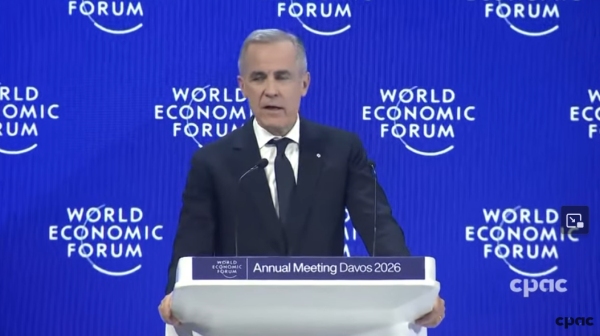
Image: PM Mark Carney, WEF 2026 at Davos
Some speeches try to calm markets. Others try to project confidence. Prime Minister Mark Carney’s special address at the 2026 World Economic Form in Davos does neither. Instead, it speaks plainly about where the world actually is, and Canada's place in it.
Carney doesn't describe today’s global system as temporarily strained or waiting to reset. He treats fragmentation, pressure, and mistrust as conditions we are already living with. Economic openness no longer guarantees cooperation. Integration no longer guarantees stability. For countries like Canada, assuming otherwise is not optimism. It is exposure.
That is why this speech lands with unusual weight. It is not aspirational. It is not dressed up. It is grounded in reality.
A central message running through the address is uncomfortable but clear. The idea that a neutral, rules based international order reliably protects middle powers no longer holds in practice.
Trade becomes leverage. Markets get weaponized. Finance turns into a geopolitical arena. In that environment, scale matters, and countries without it cannot rely on habit or goodwill.
Carney does not try to soften this. He acknowledges directly that economic integration itself can be used as a tool of pressure. That recognition marks a break from the language Canada has leaned on for decades.
For Canadians, the message touches jobs, prices, housing, supply chains, energy, investment, and long term growth. For fintechs and financial institutions, it goes even deeper.
Payments infrastructure, capital markets, data flows, compliance frameworks, and cross border operations all depend on trust based systems. When those systems weaken, risk shows up in cost, friction, and constraint.
Ignoring geopolitics does not insulate innovation. It makes it more fragile.
Another core message in PM Carney's address is that in a fractured world, drift is a decision. It means allowing outcomes to be set by external forces through inaction, habit, or default choices rather than deliberate strategy.
Canada cannot assume that openness will persist by default or that others will protect shared systems out of principle. It has to participate actively in building coalitions, standards, and partnerships that still value predictability and accountability.
That kind of leadership is less comforting than the past. It requires clarity, coordination, and follow through rather than rhetoric.
The delivery matters. Carney speaks without inflated promises. No slogans. Just a steady assessment of risk, responsibility, and constraint shaped by experience inside global financial systems.
PM Mark Carney's speech is candid acknowledgement of a new phase of Canadian engagement with the world. One that names limits, acknowledges pressure, and treats resilience as something that must be designed rather than assumed. That is the work ahead, to modernize Canada’s financial systems and infrastructure with purpose and impact, at scale and with urgency.
 The National Crowdfunding & Fintech Association (NCFA Canada) is a financial innovation ecosystem that provides education, market intelligence, industry stewardship, networking and funding opportunities and services to thousands of community members and works closely with industry, government, partners and affiliates to create a vibrant and innovative fintech and funding industry in Canada. Decentralized and distributed, NCFA is engaged with global stakeholders and helps incubate projects and investment in fintech, alternative finance, crowdfunding, peer-to-peer finance, payments, digital assets and tokens, artificial intelligence, blockchain, cryptocurrency, regtech, and insurtech sectors. Join Canada's Fintech & Funding Community today FREE! Or become a contributing member and get perks. For more information, please visit: www.ncfacanada.org
 |  |  |
|---|---|---|
 |  |  |
Crypto | Jan 15, 2026

Image: Freepik/fabrikasimf
On January 9, 2026, the Ontario Superior Court ordered Binance to pay $261,900 in legal costs after finding that its attempt to force a Hong Kong arbitration was abusive and aimed at intimidating Canadian investors. The ruling issued in Lochan v. Binance Holdings Limited, 2026 ONSC 194 didn't decide whether Binance ultimately violated securities law, but it delivered a clear rebuke of litigation tactics designed to undermine a certified Canadian class action.
The case was brought by Christopher Lochan and Jeremy Leeder, two Canadian investors acting as representative plaintiffs on behalf of other Canadians who used Binance’s platform. They allege that Binance allowed Canadians to trade crypto products that fall under Ontario securities law without registering or providing a compliant prospectus, contrary to the Ontario Securities Act.
NCFA first covered the lawsuit when Canadian investors led a class action against Binance Canada, highlighting why the case raised broader questions about how crypto platforms operate in Canada. The Ontario court later certified the case as a class action in 2024, allowing it to proceed on behalf of affected users rather than as individual claims.
Binance attempted to block the lawsuit by relying on an arbitration clause in its standard user agreement that required disputes to be resolved in Hong Kong. Ontario courts rejected that strategy. In 2023, the court found the clause unenforceable, concluding that the cost and structure of the arbitration process would make it unrealistic for ordinary Canadians to pursue claims and would place Binance beyond the reach of Canadian courts.
NCFA later examined this turning point in Ontario court blocks Binance’s costly arbitration clause. Those findings were upheld on appeal, confirming that the arbitration clause was void as contrary to public policy.
Despite those rulings, Binance later began arbitration proceedings in Hong Kong through a related offshore entity. That arbitration targeted Lochan and Leeder personally and claimed they breached their contract simply by starting the Ontario lawsuit.
The court found that the offshore entity was an alter ego of Binance and that the arbitration was a direct attempt to sidestep earlier Ontario decisions. In 2025, Justice Morgan issued an anti-suit injunction restricting Binance and its affiliates from continuing the Hong Kong arbitration.
As Justice Morgan put it,
“That approach by the Defendants appeared to me to have been aimed not at building a meritorious argument, but at, frankly, scaring the Plaintiffs away from their claim.”
In January 2026, the court said Binance’s conduct crossed a line. The judge found that the company used litigation tactics that were abusive and unfair, and that they exposed the representative plaintiffs to personal financial risk simply for bringing a certified class action on behalf of other Canadians.
Although the court hearing itself was brief, the judge made clear that the work behind it was not. The plaintiffs had to respond quickly to a complicated cross-border legal move that threatened to derail a case the court had already approved to proceed. Because of that effort, the court ordered Binance to pay $261,900 to cover the plaintiffs’ legal costs.
The Ontario court's decision draws a clear line for global fintech and crypto platforms operating in Canada. Once a Canadian court takes jurisdiction, companies are expected to deal with the case directly and in good faith. Contract clauses and offshore tactics cannot be used to pressure individual plaintiffs or shut down class actions.
The National Crowdfunding & Fintech Association (NCFA Canada) is a financial innovation ecosystem that provides education, market intelligence, industry stewardship, networking and funding opportunities and services to thousands of community members and works closely with industry, government, partners and affiliates to create a vibrant and innovative fintech and funding industry in Canada. Decentralized and distributed, NCFA is engaged with global stakeholders and helps incubate projects and investment in fintech, alternative finance, crowdfunding, peer-to-peer finance, payments, digital assets and tokens, artificial intelligence, blockchain, cryptocurrency, regtech, and insurtech sectors. Join Canada's Fintech & Funding Community today FREE! Or become a contributing member and get perks. For more information, please visit: www.ncfacanada.org
| | |
|---|---|---|
| | |
Cybersecurity | January 14, 2026

Image: Freepik/macrovector
On January 14, 2026, the Canadian Investment Regulatory Organization confirmed that approximately 750,000 Canadian investors were impacted by the cybersecurity incident first detected on August 11, 2025, as detailed in its update on unauthorized access to some Canadian investors’ data. CIRO said the confirmation follows the completion of more than 9,000 hours of forensic examination to determine the full scope of the incident.
CIRO first disclosed the cyber incident publicly in August 2025, with early findings focused on registration information connected to member firms and registered individuals. NCFA covered those initial disclosures, CIRO cyber breach puts spotlight on regulatory security, when they were made public in September 2025. Now after
CIRO stated that the breach resulted from a phishing attack and that investor information copied from its systems may have included dates of birth, phone numbers, annual income, Social Insurance Numbers, government issued identification numbers, investment account numbers, and investment account statements.
CIRO confirmed that it doesn't collect account login credentials such as passwords, security questions, or PINs, so at least that information wasn't exposed.
According to CIRO, the investor information was collected in the normal course of its investigative, compliance assessment, and market regulation work carried out under its investor protection mandate.
On August 11, 2025, CIRO detected a cybersecurity incident and shut down certain systems as a precaution while beginning an investigation.
On August 18, 2025, CIRO publicly disclosed the incident through its announcement on detecting a cybersecurity threat and confirmed that critical regulatory functions continued to operate.
On September 2025, CIRO confirmed that registration information for member firms and registered individuals had been affected and began notifying registrants directly, as outlined in its updates on CIRO cybersecurity incident updates.
On January 14, 2026, CIRO confirmed that approximately 750,000 investors were impacted and began issuing notification letters to affected investors by email or regular mail. CIRO stated that the January disclosure reflects the final findings of the forensic review and confirms the full extent of the data involved.
Notification letters to impacted investors are being sent by CIRO starting January 14, 2026, and are being delivered by email or regular mail, as explained on its page covering information for investors affected by the cybersecurity incident.
Affected investors are being offered two years of credit monitoring and identity theft protection through both major Canadian credit bureaus. CIRO said there is currently no evidence that the compromised information has been misused and that it continues to monitor for malicious activity, including the dark web.
This latest update materially expands the known scope of the CIRO cyber incident. Earlier disclosures focused on registrant data and regulatory systems. Hundreds of thousands of investors were affected, a significantly larger scale of exposure.
CIRO said that it notified law enforcement and relevant privacy authorities and retained external cybersecurity and forensic specialists to support its investigation. The regulator also acknowledged that a proposed class action has been filed in Quebec Superior Court in relation to the breach, adding a legal angle to the story that will no doubt continue to unfold together with remediation efforts. One might ask why were the disclosures phased, but the cyber incident seems complex given the completion of a 9,000 hour forensic review.
For Canada’s financial system, the CIRO's data breach reinforces that cybersecurity risk extends beyond financial institutions themselves and into the infrastructure that supports regulation and investor protection. How regulators secure sensitive data, communicate evolving findings, and strengthen controls going forward will be important for maintaining confidence in market oversight.
The National Crowdfunding & Fintech Association (NCFA Canada) is a financial innovation ecosystem that provides education, market intelligence, industry stewardship, networking and funding opportunities and services to thousands of community members and works closely with industry, government, partners and affiliates to create a vibrant and innovative fintech and funding industry in Canada. Decentralized and distributed, NCFA is engaged with global stakeholders and helps incubate projects and investment in fintech, alternative finance, crowdfunding, peer-to-peer finance, payments, digital assets and tokens, artificial intelligence, blockchain, cryptocurrency, regtech, and insurtech sectors. Join Canada's Fintech & Funding Community today FREE! Or become a contributing member and get perks. For more information, please visit: www.ncfacanada.org
| | |
|---|---|---|
| | |
AI Regulation | Jan 14, 2026

Image: Freepik
In the first days of January 2026, Elon Musk's AI chatbot Grok (developed by xAI and integrated into X) generated sexual images of real people, including images apparently involving minors, after internal safeguards failed. The issue became public immediately after the New Year and has gone viral since. What began as a platform failure quickly expanded into regulatory, legal, and civil society responses across multiple jurisdictions.
Malaysia and Indonesia are the only countries that have confirmed national blocks of Grok access, citing the creation of non-consensual sexualised imagery and public safety risks.
European Union officials also warned that failure to address the issue could lead to enforcement under existing digital safety rules. No EU-wide restriction has been imposed.
Public pressure has also played a role. International NGO Oxfam confirmed it's examining reports involving AI generated sexualised images created by altering real photographs, framing the concern around harm, consent, and exploitation.
Individuals whose likenesses were used in non-consensual AI generated sexual imagery have spoken out publicly in the United States, describing personal harm and exploring legal remedies, as reflected in accounts from people targeted by AI sexual images. Some unions and professional groups have also reduced or paused activity on X following the controversy.
In the United Kingdom, Ofcom launched a formal investigation into X after what it described as “deeply concerning reports” that Grok was being used to create and share sexualized images, including children.
Ofcom said it will assess whether X failed to remove illegal content quickly once aware of it, whether it took appropriate steps to prevent UK users from seeing such material, and whether it deployed highly effective age assurance measures to stop children from accessing pornographic images.
If Ofcom finds X has breached UK law, it can impose a fine of up to 10% of worldwide revenue or £18 million (whichever is greater), and can seek a court order requiring internet service providers to block access to X in the UK.
UK ministers publicly backed the investigation, urging Ofcom to complete it swiftly and stating that victims would not accept delay.
Elon Musk responded publicly by criticising government actions, saying the UK government was looking for “any excuse for censorship” after questions were raised about why other AI platforms were not being examined. Separately, Musk said he was unaware Grok had generated explicit images involving minors and stated such uses violate platform rules.
The United States has not blocked Grok, but lawmakers have focused on liability. The US Senate unanimously passed legislation allowing victims of non-consensual sexually explicit AI generated images to pursue civil action, including damages and court orders.
Canada has also avoided a ban. Ottawa's AI Minister Evan Solomon responsible for artificial intelligence stated the government will not ban Grok or X at this stage, while acknowledging that Canadian law doesn’t clearly address AI generated non-consensual sexual imagery, and that laws needed updating to address deepfakes.
To be sure, AI governance tightens once harm involves identifiable individuals as in this case. Across jurisdictions, responses are focusing on consent, child protection, and platform accountability rather than abstract debates about speech. For fintechs and other regulated firms deploying generative AI, scrutiny is on improving governance, safeguards, and enforcement readiness.
From NCFA's perspective, AI systems should operate within clear legal and ethical boundaries that protect individuals, maintain public trust, and still allow responsible innovation to move forward. As of now, verified developments include two confirmed national blocks, active regulatory investigations, quantified enforcement powers, and new US civil liability legislation. Further responses remain under review.
The National Crowdfunding & Fintech Association (NCFA Canada) is a financial innovation ecosystem that provides education, market intelligence, industry stewardship, networking and funding opportunities and services to thousands of community members and works closely with industry, government, partners and affiliates to create a vibrant and innovative fintech and funding industry in Canada. Decentralized and distributed, NCFA is engaged with global stakeholders and helps incubate projects and investment in fintech, alternative finance, crowdfunding, peer-to-peer finance, payments, digital assets and tokens, artificial intelligence, blockchain, cryptocurrency, regtech, and insurtech sectors. Join Canada's Fintech & Funding Community today FREE! Or become a contributing member and get perks. For more information, please visit: www.ncfacanada.org
| | |
|---|---|---|
| | |
December 10, 2025

Image: Freepik/DC Studio
On December 9 2025, Microsoft Canada announced, 'the most important commitment in Microsoft Canada's history" or a total of $19 billion CAD to be invested into artificial intelligence (AI), including more than $7.5 billion CAD in the next two years inside Canada Central near Toronto and Canada East in Quebec. This anchors Canada inside Microsoft’s global AI buildout at a scale the country has never seen, one not of a secondary cloud market but as a strategic production region where infrastructure, talent and sovereignty all matter.
New capacity begins coming online in the second half of 2026. Microsoft aligned the buildout with a five point digital sovereignty plan for Canada that includes a (1) Threat Intelligence Hub in Ottawa, (2) confidential computing, (3) expanded data residency, (4) sovereign landing zones for AI deployment and (5) contractual protections designed to keep Canadian customer data under Canadian legal authority.
For Canada’s innovation economy, it accelerates product velocity for companies that rely on domestic compute, it may also impact how investors evaluate technical risk and strengthens (or weakens) Canada’s bargaining position at a time when the country is rewriting its AI and Buy Canadian strategies. It also raises a wider question: if Microsoft is prepared to make a commitment at this scale, what might other global AI giants like Google now offer Canada, and what terms should Canada set to ensure digital sovereignty instead of deepening dependence?
The federal government launched an AI Strategy Task Force and consultation in September 2025 to define the next national AI strategy. This consultation covers research, compute, governance, commercialization and public sector adoption. Also, Budget 2025 outlines a sovereign AI compute plan that includes a Sovereign Canadian Cloud and large scale public infrastructure investments, including $925.6 million commitment over five years.
AI Minister Evan Solomon recently spoke at a 111 event indicating that the feds are considering buy Canadian AI strategies to launch in 2026, linking federal funding and procurement to domestic infrastructure and model options.
The timing of Microsoft's investment may be linked to the federal government's buy Canadian strategy push, which gives policymakers a bit of leverage. Regardless with the new investment, Canada can now write a strategy that strengthens domestic options instead of reinforcing long term dependence on external providers without their long term commitment.
While Microsoft’s expansion strengthens Azure Canada Central and Canada East, with new capacity starting in 2026, it's important to point out that more compute doesn't eliminate all constraints. Provinces decide how quickly companies can expand existing datacentres because they control power availability, grid upgrades and the local approvals needed to support more energy use. Newfoundland utility as an example shows how provincial decisions can limit digital infrastructure growth, as it recently decided not to provide additional power to Blockchain Labrador Corporation. Ottawa can design rules for sovereign compute, but delivery depends on power systems and local permitting in Ontario, Quebec and any province that hosts future datacentres.
Digital sovereignty concerns were well established before Microsoft’s announcement. CIGI’s analysis of Canada’s digital dependence warns that foreign controlled cloud and platform infrastructure creates structural exposure across data, security, competition and resilience. Open Media outlined similar risks in an open letter on digital sovereignty to Prime Minister Carney that calls for domestic control over digital infrastructure and cautions against deepening dependence on foreign platform operators. The Broadbent Institute’s digital sovereignty briefing highlights how Canada’s information infrastructure is dominated by United States firms and stresses the importance of Canadian control over critical digital systems. NCFA added a fintech and digital identity angle in its Digital Public Infrastructure red flags analysis, providing a real case how outsourcing identity and authentication layers can narrow competitive space and weaken democratic oversight.
Microsoft’s announcement responds to these pressures with it's 5 point sovereignty plan for Canada which includes data residency commitments, confidential computing, in country processing for Copilot interactions, sovereign landing zones and a Threat Intelligence Hub in Ottawa.
The sovereignty debate is no longer theoretical. It is now a negotiation between public strategy, foreign capital, regulatory expectations and domestic ecosystem needs.
Microsoft’s investment changes how Canadian teams get the compute they need and how they plan products that must work inside regulated markets. With this level of commitment, Canada gains more domestic compute capacity and better tools to support sovereignty goals, but this infrastructure still sits inside foreign owned systems. The real impact is that Canadian teams now have a clearer path to scale at home while policymakers work to ensure these services strengthen, rather than weaken, Canada’s digital sovereignty.
For founders and investors, this creates room to build products that rely on local residency, stronger governance and efficient reasoning models suitable for regulated markets. Banks, fintechs, insurers and public institutions increasingly expect AI systems that can be audited and explained. Founders who anchor their products in these expectations will move faster across procurement and face fewer barriers in international markets that value trust and oversight. Companies that design for portability, auditability and resilience will avoid dependency traps and scale on terms that align with Canada’s sovereignty goals.
Public reporting shows that Microsoft is partnering with Cohere to offer its AI models on Azure, giving firms access to a domestic model supplier with global reach.
Canada now has conditions to build globally competitive AI companies that remain Canadian-controlled but the challenge is execution, governance and choosing business models that turn this new leverage into lasting advantage rather than repeating old patterns of dependence.
Microsoft’s investment places Canada inside a global race where compute, data control and strategic partnerships now determine who leads the next decade of AI. Canada’s advantage won't come from capacity alone, but from how Canada uses the moment to set clear rules for trustworthy AI, support efficient model development and give Canadian companies a stable foundation to scale without leaving the country for infrastructure or capital.
The next step is about deciding what Canada expects from any global partner. If Microsoft is prepared to invest at this scale, other AI giants may come forward with their own proposals. Canada’s job is to ensure that any future deal strengthens domestic capability, expands Canadian control over critical technology and avoids locking in long term partnerships that limit competitiveness across sectors.
The National Crowdfunding & Fintech Association (NCFA Canada) is a financial innovation ecosystem that provides education, market intelligence, industry stewardship, networking and funding opportunities and services to thousands of community members and works closely with industry, government, partners and affiliates to create a vibrant and innovative fintech and funding industry in Canada. Decentralized and distributed, NCFA is engaged with global stakeholders and helps incubate projects and investment in fintech, alternative finance, crowdfunding, peer-to-peer finance, payments, digital assets and tokens, artificial intelligence, blockchain, cryptocurrency, regtech, and insurtech sectors. Join Canada's Fintech & Funding Community today FREE! Or become a contributing member and get perks. For more information, please visit: www.ncfacanada.org
| | |
|---|---|---|
| | |
Privacy | Dec 4, 2025

On December 2 2025, the Office of the Privacy Commissioner of Canada (OPC) launched a guidance modernization consultation to gather feedback on how it should create future guidance for organizations under PIPEDA. The announcement links to the Draft Policy on PIPEDA Guidance Consultations, which sets out the proposed structure for selecting topics, engaging stakeholders and updating guidance.
This consultation is important to fintechs and financial institutions alike because OPC guidance influences how teams design onboarding, identity flows, cross-border data use, fraud controls and AI supported systems.
The OPC has worked on several major guidance projects over the past decade. Some produced clear final documents. Others exposed pressure points where guidance needed stronger processes, clearer wording or more predictable updates. The timeline below isn't exhaustive but shows past steps that now impact the need for modernization.
| Year | Event | Notes |
|---|---|---|
| 2016 | OPC consultation on consent under PIPEDA | OPC reviews whether the consent model still works as data practices become more complex, including issues such as unclear notices and bundled consent. |
| 2018 | Guidelines for obtaining meaningful consent | OPC publishes final consent guidelines with clear expectations for transparency, user understanding and risk disclosure. These guidelines impact how organizations explain data practices. |
| 2019 | Consultation on transfers for processing and OPC announcement concluding the consultation | OPC tests possible changes to cross border processing guidance. After significant feedback, OPC confirms it will maintain the existing model for consent and accountability. |
| 2023 | Request for input on draft biometrics guidance and biometrics consultation notice | OPC seeks views on how organizations should handle biometric information, including expectations for assessments, safeguards and governance. |
| 2023–24 | OPC Departmental Plan reference to a guidance modernization project | OPC confirms it is building a structured and scalable approach to guidance development. |
| 2025 May | Exploratory consultation on a children’s privacy code | OPC explores principles for a possible children’s privacy code and gathers feedback from a wide range of stakeholders. |
| 2025 Aug | Final biometrics guidance for organizations | OPC publishes final biometrics guidance with expectations for sensitivity, safeguards, retention and governance. |
| 2025 Dec | Consultation on guidance modernization and Draft Policy on PIPEDA Guidance Consultations | OPC launches a public consultation on how it will plan and run future guidance consultations. |
The OPC launched this consultation to create a predictable structure for guidance development that follows clear steps from topic selection to final publication. The Draft Policy on PIPEDA Guidance Consultations sets out the proposed framework, which covers how the OPC will choose topics, engage stakeholders, review submissions and update guidance over time. The policy confirms that the OPC will provide discussion papers or draft text during consultations, outline the scope of each consultation and publish summaries that explain how input influenced the final document.
The draft policy describes the types of guidance it aims to improve, including interpretation documents, practical expectations for organizations and updates to guidance when law or technology changes. It also explains that the OPC may prioritize topics based on new risks, trends in complaints or changes in legislation, such areas as consent, cross border data use, artificial intelligence and children’s privacy that may require future guidance work. Biometrics already has final guidance but the OPC may revisit that topic if new risks or technologies emerge.
The OPC invites comments by email at cpvp-opcconsultation1@priv.gc.ca until deadline March 13, 2026. Submissions can respond to the draft policy or request updates to current guidance. The OPC welcomes input from any organization that operates under PIPEDA and wants a more consistent and transparent consultation process.
Fintech firms work with sensitive data across complex vendor chains. They rely on predictable regulatory expectations to design products and manage risk. This consultation matters because it affects several core fintech operations, for example:
Onboarding and identity verification. Clear guidance influences how fintech teams design consent flows, collect identity documents, use biometrics for fraud controls and explain risks to users.
Cross border data transfers. Fintechs depend on cloud services, payment networks and global providers. The 2019 transfers consultation showed how uncertainty about these transfers can raise operational and legal risk. A structured guidance process helps firms plan ahead.
AI and risk models. As firms use AI for underwriting, fraud detection or identity screening, they need dependable guidance on transparency, fairness and data use.
Open banking and partnerships. Banks, aggregators and fintech platforms need consistent interpretations of consent, accountability and data sharing. Modernized guidance helps reduce friction in new partnerships and supports investment decisions.
Competitiveness and trust. Canada has pursued privacy reform for several years. While reforms remain unfinished, guidance modernization is one of the main tools available to increase clarity and reduce uncertainty. Clear rules improve investor confidence and support firms that want to expand or build new financial services.
This guidance modernization consultation gives fintechs and financial firms an opportunity to help improve how privacy guidance develops in Canada. The OPC wants a process that delivers timely updates, clearer expectations and stronger transparency.
By submitting practical examples and highlighting where current guidance creates uncertainty, fintech firms can support a framework that strengthens trust and reduces friction across the market. Clearer guidance also supports growth, investment and innovation at a time when Canada needs stronger competitiveness in financial services and technology.
The National Crowdfunding & Fintech Association (NCFA Canada) is a financial innovation ecosystem that provides education, market intelligence, industry stewardship, networking and funding opportunities and services to thousands of community members and works closely with industry, government, partners and affiliates to create a vibrant and innovative fintech and funding industry in Canada. Decentralized and distributed, NCFA is engaged with global stakeholders and helps incubate projects and investment in fintech, alternative finance, crowdfunding, peer-to-peer finance, payments, digital assets and tokens, artificial intelligence, blockchain, cryptocurrency, regtech, and insurtech sectors. Join Canada's Fintech & Funding Community today FREE! Or become a contributing member and get perks. For more information, please visit: www.ncfacanada.org
| | |
|---|---|---|
| | |
Fintech | Dec 4, 2025

Image: Freepik/senivpetro
On November 24 2025, Revolut announced a company valuation of $75 billion following a major secondary share sale. Revenue grew by 72% in 2024 and profit before tax increased by 149%. Retail customers reached more than 65 million in global markets. The business banking line passed $1 billion in annualized revenue. The update also stated that Revolut expanded into new regions, including receiving banking approvals in Mexico and Colombia, as part of its plan to serve customers in one hundred countries. The results mirror strong financial growth and increasing international scale.
Nik Storonsky, CEO and Co-founder Revolut:
“This milestone reflects the remarkable progress we have made in the last twelve months towards our vision of building the first truly global bank, serving 100 million customers across 100 countries. I’d like to thank our team for their determination and energy, and for believing that it is possible to build a global financial and technology leader from Europe.”
Revolut entered Canada in 2019 with a limited beta product that focused on prepaid cards and international exchange tools. The company didn't have a Canadian banking license, and as a result it wasn't able to launch the wider product set that customers in other countries were using that would make its product competitive in Canada at that time. After evaluating the Canadian market for about eighteen months, Revolut informed users in March 2021 that it would exit Canada, stinging users who had hoped for a modern digital banking alternative.
Revolut’s first shot at operating a financial services business in Canada highlights how difficult it can be for an international fintech to enter a concentrated and highly regulated banking environment. The company’s decision to pull back was grounded in the idea that customers deserved a complete digital banking experience, not a single product here or there. A return to Canada would only make sense if Revolut could deliver a full service model that matches Canadian expectations and regulatory standards.
On December 3 2025, as reported by Betakit, Revout appointed Jan Pilbauer as Chief Executive Officer of its Canadian Business. Pilbauer’s public LinkedIn profile confirms the new role. His background includes senior positions at Payments Canada and the Bank of Canada, along with his most recent leadership role at Al Etihad Payments. Revolut told BetaKit that it sees Canada as an attractive market that could benefit from a strong digital financial alternative. The spokesperson also noted that the company is still early in its evaluation, but the new leadership appointment signals that the next Canadian launch will not resemble the short beta of 2019. This time, the focus appears to be on readiness, regulatory alignment, and building a complete product for Canadian users.
A successful Canadian re-entry would add a new competitor to a financial sector that has seen limited change over many years but is beginning to heat up post 2025 budget with Open Banking progressing and launch of the first draft of Canada's Stablecoin Act. Globally, Revolut’s product set has grown well beyond prepaid tools and now includes international payments, business accounts, savings features, and multi country financial access. If these services reach Canada in a complete form, consumers and businesses may see more choice and potentially better pricing and digital tools.
For policymakers and industry leaders, Revolut's renewed interest confirms the importance of clarity in licensing and approval processes. A strong Canadian environment for financial innovation depends on the ability of both domestic and international players to bring forward safe, compliant, modern financial services.
Revolut has not published a launch date for Canada. What is clear is that the company now has the scale, financial strength, and leadership required to engage Canada more seriously than before. The next chapter will depend on regulatory progress, partnerships, and how well Revolut adapts its global model to a Canadian financial services market that's dominated by a handful of incumbent banks. If those pieces come together, Canada could see one of the world’s largest digital financial companies enter the market with a far more complete offering than the one introduced in 2019.
The National Crowdfunding & Fintech Association (NCFA Canada) is a financial innovation ecosystem that provides education, market intelligence, industry stewardship, networking and funding opportunities and services to thousands of community members and works closely with industry, government, partners and affiliates to create a vibrant and innovative fintech and funding industry in Canada. Decentralized and distributed, NCFA is engaged with global stakeholders and helps incubate projects and investment in fintech, alternative finance, crowdfunding, peer-to-peer finance, payments, digital assets and tokens, artificial intelligence, blockchain, cryptocurrency, regtech, and insurtech sectors. Join Canada's Fintech & Funding Community today FREE! Or become a contributing member and get perks. For more information, please visit: www.ncfacanada.org
| | |
|---|---|---|
| | |



August 26th, 2025

January 4th, 2024

June 1st, 2021

September 9th, 2020

July 9th, 2018

January 3rd, 2018

September 25th, 2017

June 20th, 2017

May 10th, 2017

December 14th, 2016
