





Karsten Wenzlaff, Advisor
August 26th, 2025
Karsten Wenzlaff is a Crowdfunding and Fintech Expert from Germany. He is Secretary-General of Digit[...]


Crypto Mining | Dec 1, 2025
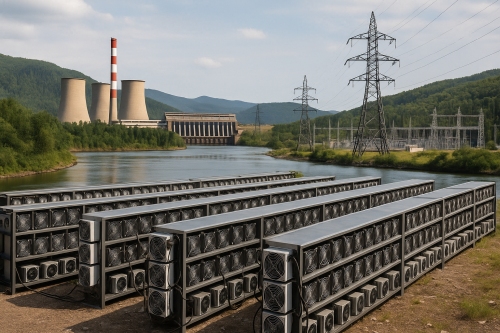
AI generated image
On November 28 2025, the Financial Post reported that the Newfoundland and Labrador Court of Appeal issued a ruling involving Blockchain Labrador Corporation (BLC) that confirmed NL Hydro can limit firm electricity service for new crypto mining operations.
BLC originally applied for 20 megawatts of guaranteed power service for a site in Wabush but NL Hydro declined to commit to that level because it needed to protect capacity for industrial, household and export priorities. Instead, NL Hydro will supply 7.75 megawatts to the company on an interim basis.
The ruling outcome confirms that NL Hydro has set boundaries on clean electricity when new digital workloads (ie. crypto mining, AI processing) add pressure to a constrained system.
Canada was once a notable player in global Bitcoin mining with national activity reaching close to 10% of global hashrate in 2021 but it's participation has since declined. Hashrate Index estimated that Canada held about 4% to 5% of global hashrate in their 2023 Canadian mining review, and then in a recent Q4 2025 global hashrate heatmap update benchmarked the country near 2.9%.
Canada's reduced footprint reflects a sector now concentrated in a few established companies. This smaller group of operators (see below and note, not exhaustive) also gives provinces more room to manage clean electricity across many competing needs.
Several provinces with hydro based systems have taken steps to manage electricity access for mining and other high demand digital activities.
British Columbia's clean electricity announcement enabled restrictions on new mining connections. The province later confirmed a permanent limit in the 2025 energy release, and the Court of Appeal supported provincial authority to set these boundaries in the Conifex ruling summary.
Manitoba adopted a pause on new mining activity when the utility raised concerns about the scale of new load requests. The province issued this direction in the 2022 guidance on electricity connections and extended the pause through 2026 in the 2024 directive on cryptocurrency operations.
New Brunswick took a more restrictive position. The provincial Electricity Act prevents a distribution utility from extending electricity to a new crypto mining business, which appears in the current consolidation of the Act and adopted through Bill 10.
Quebec continues to serve existing projects but limits new load and uses a dedicated rate class for this sector. A review commissioned by Hydro Québec found that mining produces fewer jobs for each megawatt consumed compared to data centres and industrial users, which encouraged ongoing limits.
Alberta remains an outlier, operating a deregulated, competitive market for electricity that allows mining companies and compute operators to negotiate directly for supply, supported by broader generation options.
Global research from the Cambridge Centre for Alternative Finance (CCAF) offers insight into energy use for digital mining. Cambridge estimates that Bitcoin mining draws about one hundred thirty eight terawatt hours of electricity per year, as described in CCAF's update on sustainable energy use and detailed further in a Cambridge digital mining report.
The research shows that more than half of global mining electricity comes from sustainable sources such as hydropower, wind and nuclear.
Low cost clean electricity attracts miners, data centres, industrial electrification and long term export contracts. Provinces build policies that protect available capacity for the users that advance their long term economic priorities.
Crypto mining can contribute value when it aligns with provincial priorities but utilities now apply stronger criteria when making decisions about supplying consistent clean energy.
The ruling involving Blockchain Labrador Corporation is an example of how a province evaluates new digital load against industrial development, household reliability and export duties. Informative for any Canadian fintech leaders following the developments in digital finance, compute infrastructure and national (global) ambitions for clean energy growth.
 The National Crowdfunding & Fintech Association (NCFA Canada) is a financial innovation ecosystem that provides education, market intelligence, industry stewardship, networking and funding opportunities and services to thousands of community members and works closely with industry, government, partners and affiliates to create a vibrant and innovative fintech and funding industry in Canada. Decentralized and distributed, NCFA is engaged with global stakeholders and helps incubate projects and investment in fintech, alternative finance, crowdfunding, peer-to-peer finance, payments, digital assets and tokens, artificial intelligence, blockchain, cryptocurrency, regtech, and insurtech sectors. Join Canada's Fintech & Funding Community today FREE! Or become a contributing member and get perks. For more information, please visit: www.ncfacanada.org
 |  |  |
|---|---|---|
 |  |  |
AI and Mental Health | Nov 27, 2025

AI generated image
Youth's lives are now immersed with AI at every turn. That reality was in sharp focus on November 26, 2025 when OpenAI denied wrongdoing in the death of sixteen year old Adam Raine, who died by suicide earlier this year. The family’s lawsuit alleges that months of increasingly personal conversations with ChatGPT influenced the teen during a period of vulnerability, while OpenAI rejects any link between the system and the tragedy. New reporting shows how those conversations developed over time and why the case is now drawing widespread attention.
Matthew Raine (Adam's father), told United States senators as he described those conversations:
“What began as a homework helper gradually turned itself into a confidant and then a suicide coach,”
This case is one of seven active lawsuits involving generative AI and vulnerable users across North America. NCFA raised similar concerns in earlier reporting on another teen chatbot tragedy. This new case unfolds as AI already significantly impacts how young people study, socialize, seek emotional support and enter the workforce. It raises a broader question about protection that goes beyond content filters or bans.
A national study published in JAMA Network Open reports that 13.1% of adolescents and young adults use generative AI chatbots for mental health advice when they feel sad, angry or nervous. Most describe the advice as helpful. This finding shows how AI now plays a measurable role in emotional coping, based on survey results on youth emotional-support chatbot use.
A recent national survey from Common Sense Media finds that 72% of teens aged thirteen to seventeen have tried AI companions. Many use these tools for advice or personal communications highlighting how quickly AI tools have entered emotional and social spaces once held by peers or family. This comes from new data on widespread teen use of AI companions.
Educators and clinicians also report clear blind spots. A comprehensive review of AI mental health tools notes that chatbots can miss signs linked to psychosis, eating disorders and trauma, while new research has evidence that AI chatbots may reinforce mental-health stigma. NCFA previously reported on early evidence of AI psychosis and trust risks. Together these findings suggest that AI tools may feel supportive while still lacking the judgment needed during moments of real crisis.
Many young people turn to AI tools because other options feel out of reach. AI tools feel private, immediate and nonjudgmental, according to survey findings on why teens choose AI companions (NB: 75% of teens have tried AI companions).
In the United States most adolescents with major depressive episodes don't receive treatment in a given year, according to national data on adolescent depression care gaps.
In Canada, evidence points to similar gaps with thousands of children and youth waiting months for counselling and therapy across the country. In Ontario alone about 28,000 children and youth waited for mental health services in 2020, as captured in this research Kids Can’t Wait report on youth mental-health wait lists. National tracking also finds long waits for community mental health counselling, with delays varying widely by region, based on pan-Canadian data on counselling wait times.
AI now plays a growing role in how young people start their working lives. Recent findings from the Stanford Digital Economy Lab shows that young career workers between 22-25 years old in AI exposed fields saw a 13% drop in employment after late 2022.
Further, according to survey results from the World Economic Forum on the global employer outlook, 40% of companies expect to cut roles where AI can handle routine tasks.
See NCFA’s earlier piece on AI’s hidden costs for junior workers that shows how automation reduces coaching, early learning and long term stability even when it speeds up short term tasks. For Gen Z this means AI can help them work faster while also reducing the number of early roles that once offered training, support and a safe place to learn.
In mental health, AI comforts but still misses red flags.
In everyday digital life, governance and content policies struggle to match the pace of rapid model and features updates.
In early careers, automation reduces entry pathways and increases pressure on young workers to master new tools without adequate support.
These challenges do not create a single fix. They show how youth exposure grows faster than the systems meant to guide and protect them.
Fintech companies and their apps and models are at the center of these changes. Young customers rely on savings apps, credit tools, digital wallets and investment platforms that now embed automated insights and AI guidance. Fintech teams can use design principles that support innovation while adding real protections for young users.
Clear explanations help young customers understand how AI insights form and what limits apply.
Human review in unusual or high stakes interactions prevents automated decisions from pushing users toward unsafe financial choices.
Independent testing of models that guide credit thresholds, advice or spending prompts reveals bias or unrealistic patterns.
These measures strengthen reliability without slowing responsible development and help firms serve younger users with confidence.
As the Raine case continues through the courts. Judges will weigh logs, warnings and design choices. Whatever the outcome, the broader reality is already visible. Youth live in a world where AI companions, homework helpers, work tools and financial apps appear on the same devices. Research shows that these tools offer support while also creating gaps that health, education and employment systems have not yet addressed.
The real question of protection is not whether AI should disappear from youth life. It is how schools, mental health services, employers, regulators and product teams work together so young people can use AI to build stronger futures instead of carrying its risks alone.
The National Crowdfunding & Fintech Association (NCFA Canada) is a financial innovation ecosystem that provides education, market intelligence, industry stewardship, networking and funding opportunities and services to thousands of community members and works closely with industry, government, partners and affiliates to create a vibrant and innovative fintech and funding industry in Canada. Decentralized and distributed, NCFA is engaged with global stakeholders and helps incubate projects and investment in fintech, alternative finance, crowdfunding, peer-to-peer finance, payments, digital assets and tokens, artificial intelligence, blockchain, cryptocurrency, regtech, and insurtech sectors. Join Canada's Fintech & Funding Community today FREE! Or become a contributing member and get perks. For more information, please visit: www.ncfacanada.org
| | |
|---|---|---|
| | |
AI Innovation | Nov 26, 2025

Image: Freepik/DC Studio
On November 24 2025, the United States introduced the Genesis Mission by presidential executive order to create a national plan to use AI to accelerate scientific discovery by turning federal scientific data and national lab supercomputers into one research engine. The Mission instructs the Department of Energy to bring together national lab compute systems, decades of federal datasets, and advanced AI tools into a unified discovery platform.
The United States invests about $940B each year in total R&D across business, academic, and government sectors. Federal agencies perform roughly $74B of that work according to National Science Board data showing total U.S. R&D and federal R&D performance. The Genesis Mission uses this large research base to speed up discovery and strengthen national competitiveness.
Federal leaders say scientific progress has slowed. Research in biotechnology, materials science, clean energy, and other fields takes too much time and requires significant resources. The Genesis Mission will use artificial intelligence to help researchers simulate experiments, test ideas, and find scientific patterns faster.
Federal scientific datasets include information from the Department of Energy open data portal, National Institutes of Health scientific data resources, NASA Earth science and satellite data, NOAA climate and environmental datasets, Environmental Protection Agency public data, and the United States Geological Survey geological data platform. These datasets include physics records, biological data, climate observations, satellite readings, environmental measurements, and outputs from high performance computing systems.
Artificial intelligence can examine large datasets, run simulations, detect scientific relationships, and support experiment design. The White House states that the Mission will “harness Federal scientific datasets, the worlds largest collection of such datasets, developed over decades of Federal investments” to accelerate discovery through new scientific models.
The Mission targets strategic fields such as semiconductors, quantum science, fusion energy, biotechnology, advanced manufacturing, and critical materials. Federal leaders link this work directly to national security and economic strength.
Federal documents describe the Genesis Mission as a national platform that brings government, industry, and academic researchers into one discovery system. The Department of Energy states that the Mission “will mobilize the Department of Energy’s 17 National Laboratories, industry, and academia” to build an AI enabled discovery platform that uses national lab supercomputers and curated federal datasets as described in the Department of Energy announcement of the Genesis Mission.
The executive order also defines the American Science and Security Platform as infrastructure that includes high performance computing, advanced AI models, secure access to federal and synthetic datasets, and tools for AI assisted experimentation. These documents show that the United States intends to create structured pathways for companies and researchers who need access to national compute systems and curated scientific data.
The United States holds a large base of scientific data created through national laboratory work and federal research. These datasets often sit in separate systems. The Genesis Mission brings this information together and connects it to artificial intelligence tools. This gives the United States a clear advantage in fields that rely on data and high performance computing.
Artificial intelligence can help researchers test ideas faster, explore scientific patterns, and move from manual processes to rapid model driven cycles. If the United States reduces discovery times across key scientific fields it can improve innovation strength and create more commercial opportunities.
Canada invests far less in R&D than the United States. The comparison below uses verified public data from the National Science Board, Statistics Canada, the OECD, and Canadian research analysis.
| Measure | United States | Canada | Sources |
| Total R&D spending | $940B in U.S. R&D spending | $55B in Canadian R&D spending 2024 | NSB, Statistics Canada |
| Federal R&D spending | $74B in U.S. federal R&D performance | smaller share inside the total figure | NSB, Statistics Canada |
| R&D intensity | above 3% in many measures | among lowest in G7 according to Canadian reporting on weak R&D intensity | University Affairs, OECD |
| Business R&D | strong private sector | weak according to research on structural gaps in Canadian business R&D | Checkpoint Research |
| Labour productivity | higher output per hour | persistent gap according to OECD reporting on Canada’s productivity | OECD |
This comparison shows the structural difference between the two countries. The United States enters the Genesis Mission with a large research base that artificial intelligence can accelerate. Canada enters with weaker investment and slower productivity growth.
Canada invests less in R&D than the United States and shows lower business led research compared with peer countries. A recent Canadian assessment ranks Canada near the bottom of advanced economies in business enterprise R&D intensity according to research that highlights Canada’s weak private sector R&D investment. Canada also has world class AI research centers such as Vector, Mila, and Amii, and they contribute strong scientific output. However they don't operate a national system that brings together federal datasets, high performance computing, and artificial intelligence for coordinated discovery.
These gaps limit Canada’s ability to compete against countries that build stronger national research infrastructure. If the United States speeds up discovery through a national artificial intelligence platform Canada may rely more on foreign systems and lose ground in advanced materials, biotech, quantum research, and energy.
The Genesis Mission gives the United States a new way to use scientific data, computation, and artificial intelligence to speed up discovery. It supports national security, innovation, and economic strength. For Canada it raises a serious challenge. Canada invests far less in R&D and lacks a unified artificial intelligence research platform. As the United States accelerates discovery Canada must decide how to strengthen the outcomes of its research base and protect its competitiveness in a world where artificial intelligence supports scientific progress.
The National Crowdfunding & Fintech Association (NCFA Canada) is a financial innovation ecosystem that provides education, market intelligence, industry stewardship, networking and funding opportunities and services to thousands of community members and works closely with industry, government, partners and affiliates to create a vibrant and innovative fintech and funding industry in Canada. Decentralized and distributed, NCFA is engaged with global stakeholders and helps incubate projects and investment in fintech, alternative finance, crowdfunding, peer-to-peer finance, payments, digital assets and tokens, artificial intelligence, blockchain, cryptocurrency, regtech, and insurtech sectors. Join Canada's Fintech & Funding Community today FREE! Or become a contributing member and get perks. For more information, please visit: www.ncfacanada.org
| | |
|---|---|---|
| | |
Greeneashing Rules | Nov 24, 2025
On November 18 2025 the federal government introduced proposed changes to Canada’s environmental claim and greenwashing rules through Bill C-15, building on the November 4 2025 federal Budget. These proposals respond to concerns from businesses that the original 2024 framework increased uncertainty and cost. For financial technology firms that use climate related data or sustainability linked claims, these adjustments have important implications.
The original greenwashing provisions came into force through Bill C-59, which received royal assent on June 20 2024. See NCFA's fintech focused overview of the original green claim rules.
When the Competition Bureau released the June 2025 environmental claims guidance, firms received clearer detail on what regulators expected for forward looking climate statements, evidence standards and internal documentation. Even with that guidance, companies found the requirements strict and often unclear, particularly around which international standards qualified.
Bill C-15 proposes to adjust parts of the greenwashing rules that came into force in 2024. The government introduced these changes because many companies, including financial institutions, said the original rules were too unclear and made it difficult to speak openly about their environmental plans.
Bill C-15 responds to those concerns by removing the requirement that business level environmental claims must follow an internationally recognized methodology, which was one of the main sources of confusion. Businesses would still need evidence to support any environmental claim they make but they can focus on internal logic and documented methods.
Bill C-15 also proposes to change how greenwashing complaints are handled. Under the rules introduced in 2024, private parties such as advocacy groups, competitors or individuals can file applications directly with the Competition Tribunal for business environmental claims. This direct access was part of broader competition law reforms and became a significant concern for companies. Bill C-15 would remove that direct pathway and require private parties to bring their concerns to the Competition Bureau instead. The Bureau would then decide whether a case should proceed. The government introduced this change because many firms said the threat of direct Tribunal applications increased uncertainty and could discourage them from sharing legitimate climate related information.
The proposed changes aims to preserve protections against misleading claims while reducing the risk of unnecessary or strategic litigation.
| Consideration | Original 2024 Rules | Updated 2025 Rules (Bill C-15) | What This Means For Fintechs |
| How Environmental Claims Are Justified | Required adequate testing and alignment with an internationally recognized methodology | Requires substantiation but allows firms to use documented internal methods | More flexibility in climate data modelling, ESG scoring and analytics tools |
| Interpretation Burden | High. Firms struggled to interpret which global frameworks counted | Lower. Evidence judged on internal consistency | Clearer expectations reduce risk of misinterpretation |
| Documentation Expectations | Documentation needed to show alignment with international frameworks | Firms must document data sources and assumptions but no external alignment is required | Focus on internal logic and auditability |
| Future Oriented Climate Claims | Long term claims required alignment to global pathways | Claims still require evidence but internal pathways may be used | Forecasts need realistic milestones rather than matching global models |
| Risk of Challenge | Higher due to methodology disputes | Lower for methodology disputes but misleading advertising rules still apply | Risk shifts toward evidence quality |
| Enforcement Pathway | Private parties could bring cases to the Tribunal | Complaints routed through the Competition Bureau | Fewer activist driven cases but oversight continues |
| Practical Impact on Companies | Some firms paused climate commitments due to uncertainty | More predictable expectations support climate initiatives | More predictable environment for climate product development |
| Compliance Costs | Higher due to ambiguity around methodology | Moderate. Costs remain but ambiguity decreases | Less need for external validation. More need for strong internal controls |
| Innovation and Competitiveness | Rigid framework slowed innovation | Flexible system encourages innovation | Fintechs gain room to differentiate through credibility |
| Investor Signal | Uncertainty signalled regulatory volatility | Clear expectations reduce perceived friction | Fintechs become more attractive to investors |
Fintech firms need strong and reliable data infrastructure to support any environmental claims made in their products or services. While the updated rules remove the pressure to match a specific international framework, but they do not lower the expectation for clear evidence. Fintechs must be able to show how their data is collected, how their models work and why their outputs are reasonable.
Internal logic, consistency and transparent documentation matter more than ever because the assessment standard focuses on whether a claim can be substantiated using the firm’s own methods. This means the credibility of a fintech product depends heavily on the quality of its data foundations and (environmental) claims.
Any statement about future emissions, climate pathways or long term environmental outcomes requires realistic modelling and measurable steps.
This risk was highlighted when the Royal Bank of Canada pulled back its sustainable finance commitment after saying it could not confidently measure progress under the current rules.
Fintech tools that produce projections, risk curves or carbon estimates must demonstrate how the assumptions behind those outputs were chosen and how progress will be tracked. Future oriented claims remain high risk unless methods, milestones and supporting records are clear.
The updated framework may reduce the cost that came from interpreting international standards, but meaningful compliance work remains. Fintechs still need controlled data environments, version tracking, testing protocols and maintained audit trails.
Firms that use verification as a core part of product design can position themselves ahead of competitors because customers and investors will expect transparency in climate related data. Strong internal controls also help firms defend claims if they are questioned by regulators or partners.
Removing direct access to the Competition Tribunal lowers the chance of activist driven cases, but environmental claims will continue to be reviewed under misleading advertising rules.
The Competition Bureau remains the main decision maker and it can act where evidence is weak or claims are overstated. For fintechs this means that scrutiny continues but will be more predictable and clearer process. Firms should expect oversight to focus on accuracy and evidence rather than whether a specific global methodology was used.
Fintech teams should review the environmental claims used in products, marketing or investor materials and ensure the evidence behind those claims is complete and easy to explain.
Internal methodologies should be clear so product, compliance and technical teams can show how calculations and scores are produced. Future oriented statements need documented assumptions, milestones and data sources.
Firms should also monitor the progress of Bill C-15 and upcoming Competition Bureau guidance so they can adjust their documentation and product practices as expectations evolve.
Environmental credibility impacts how investors and partners evaluate opportunities in sustainable finance and climate technology ventures. The updated rules aim to keep protections against misleading claims while reducing uncertainty that can slow down innovation. Fintechs that build strong and transparent verification systems can strengthen their competitive position, support customer confidence and contribute to a more trusted and transparent sustainable finance ecosystem in Canada.
The National Crowdfunding & Fintech Association (NCFA Canada) is a financial innovation ecosystem that provides education, market intelligence, industry stewardship, networking and funding opportunities and services to thousands of community members and works closely with industry, government, partners and affiliates to create a vibrant and innovative fintech and funding industry in Canada. Decentralized and distributed, NCFA is engaged with global stakeholders and helps incubate projects and investment in fintech, alternative finance, crowdfunding, peer-to-peer finance, payments, digital assets and tokens, artificial intelligence, blockchain, cryptocurrency, regtech, and insurtech sectors. Join Canada's Fintech & Funding Community today FREE! Or become a contributing member and get perks. For more information, please visit: www.ncfacanada.org
| | |
|---|---|---|
| | |
Bank of Canada | Speech | Nov 20, 2025

Image: OECD via Haver Analytics and Bank of Canada 2023
On November 19 2025, the Bank of Canada (BoC) released a speech, 'Toward a virtuous circle for productivity' delivered by Nicolas Vincent the external Deputy Governor at a recent event of the Association des économistes québécois (ASDEQ) together with CFA Québec.
His talk explains the pattern of Canada's long standing productivity challenges and sets out what needs to change. Canada has lived with the same productivity problem for a generation. Growth has slowed, investment has weakened, and the country has become more exposed to global shocks.
Weak productivity discourages investment, and weak investment keeps productivity low.
Regulatory and competitive conditions are central to improving that pattern.
Training, mobility, and credential recognition must work better to support new technology.
- Status quo isn't acceptable as keeping the current environment in place would lock in today’s slow growth.
Vincent captures the situation clear:
“To put it bluntly, we’re stuck in a vicious circle.”
He notes that productivity grew about 3% in the 1960s and 1970s but fell to roughly 1% between 2000 and 2019. When productivity is weak, wage gains soften and demand becomes fragile. Then companies hesitate to invest in new tools or equipment, and that hesitation feeds right back into weaker productivity.
He highlights 3 things that need to change the trajectory (not a quick fix)
The investment climate is paramount for firms trying to modernize. One of the clearest lines in his speech addresses the barrier businesses often describe:
“Businesses often tell us that Canada’s regulatory framework is too cumbersome, complex and far-reaching.”
A stronger investment climate means faster decisions, clearer expectations, and fewer overlapping rules. That allows companies to move ahead with projects that raise productivity instead of delaying them.
In fintech, it's especially important because licensing decisions, compliance approvals, and inter-provincial regulatory alignment determine how quickly a firm can launch or scale. When these pathways work well, investment grows and innovation accelerates.
The opposite has been visible for a decade (at least). Companies often face unpredictable pathways, uneven timelines, and unclear requirements (think the original equity crowdfunding rules, open banking, payment modernization etc). Those conditions slow product launches, and discourage upgrades. They also weaken the broader economy by delaying the investment (both internal and external) needed to lift productivity.
Vincent says competition pushes companies to improve and become more resilient:
“Canadian businesses that are highly exposed to international competition evolve and improve. This makes them more productive, competitive and resilient.”
Competitive markets encourage businesses to adopt better technology, strengthen processes, and serve customers more effectively. This raises productivity across entire sectors.
When competitive pressure is limited, firms face fewer reasons to upgrade or innovate quickly. That is the opposite of what a modern economy needs. Slower adoption means slower productivity gains, and slower gains leave the economy more exposed to global changes.
Leaving competition conditions unchanged would keep the loop intact and make it more difficult for Canada to close its gap with peer countries.
Vincent points out that productivity depends on people as much as on technology:
“Investing in our talent … means making it easier to recognize professional accreditations across provinces and territories, and the foreign credentials of people who move to Canada.”
Training systems that adapt quickly, credential pathways that work smoothly, and mobility across provinces all help firms adopt new technology with confidence.
Today’s reality is different. Workers often wait months or years to have skills recognized, training programs lag behind new tools, and mobility rules slow the movement of talent. These conditions limit how quickly firms can scale, modernize, or respond to new opportunities.
Keeping this in place would weaken the very foundation needed for stronger productivity.
Vincent’s message is measured but urgent. Canada's productivity problem is caused by multiple things, and no single fix. But the government policies that impact investment, competition, and talent development must work better than they do today. These are public frameworks that governments influence, and businesses must act on them once conditions improve.
The payoff is substantial and what all Canadians should be aiming for. Higher productivity strengthens incomes, supports wage growth without inflation pressure, expands competitiveness, and improves resilience in a world where shocks are becoming more common.
The status quo of slow investment, limited competition, and restricted talent must be changed to improve the the country’s economic strength and provide opportunities for Canadians to build a stronger future.
The National Crowdfunding & Fintech Association (NCFA Canada) is a financial innovation ecosystem that provides education, market intelligence, industry stewardship, networking and funding opportunities and services to thousands of community members and works closely with industry, government, partners and affiliates to create a vibrant and innovative fintech and funding industry in Canada. Decentralized and distributed, NCFA is engaged with global stakeholders and helps incubate projects and investment in fintech, alternative finance, crowdfunding, peer-to-peer finance, payments, digital assets and tokens, artificial intelligence, blockchain, cryptocurrency, regtech, and insurtech sectors. Join Canada's Fintech & Funding Community today FREE! Or become a contributing member and get perks. For more information, please visit: www.ncfacanada.org
| | |
|---|---|---|
| | |
Stablecoin Regulations | Nov 17, 2025

AI generated image
On November 10 2025, the Bank of England released a proposed regulatory regime for sterling denominated systemic stablecoins for consultation. The paper explains how large scale issuers designated as systemic would be required to back customer balances, manage reserves and operate safely within the United Kingdom financial system. These rules apply only when HM Treasury designates an issuer as systemic.
Smaller issuers remain active in the market under the Financial Conduct Authority rules and may transition into the systemic framework if they grow to a scale that could influence the wider financial system.
The consultation is the most detailed update to United Kingdom stablecoin policy since HM Treasury released draft cryptoasset legislation in April 2025, and establishes a clear structure for how systemic digital money could function safely in day to day payments.
The consultation explains how systemic stablecoins must be backed and why this structure matters for safety in everyday payments. Issuers must hold at least 40% of reserves as deposits at the Bank of England. The remaining portion, up to 60%, can be invested in short term United Kingdom government securities. This mix offers strong protection and keeps the reserve simple and transparent.
The Bank of England also outlines a transition period for new issuers. In the early stages, they may place up to 95% of backing assets in government debt before moving toward the long term structure. This step is meant to support early growth while maintaining a high level of safety.
All backing assets must sit in a statutory trust that always matches the value of coins in circulation. This requirement protects customer funds and reduces the risk of shortfalls during periods of stress. It also creates a clear line between the issuer’s own balance sheet and the assets that support the stablecoin.
The proposed regime introduces requirements for how backing assets are held and protected. The consultation sets out the expectation that backing assets sit in a segregated trust structure with protections similar to client asset rules. This mix of central bank deposits and short term government securities is intended to provide strong protection for customer funds while allowing issuers to generate modest returns needed to support operations.
Institutions holding backing assets would also need to meet operational resilience standards and demonstrate they can respond to stress conditions without interruption to customer redemptions.
Systemic stablecoin issuers would operate under prudential requirements similar to other payment system operators. The consultation notes that the Bank of England would supervise major issuers to ensure continuing safety, strong risk controls and effective recovery planning.
The focus is on preventing operational failure in a systemically important payment instrument. The combination of required reserve composition and Bank of England supervision is designed to manage the risks associated with large scale issuance of digital money in everyday payments.
Issuers that reach systemic scale would be supervised in the same framework applied to other major payment firms. The regime outlines how stablecoins can connect to payment rails in the United Kingdom while meeting resilience expectations. The Bank of England highlights the importance of maintaining continuity of payments even during stress events, which is a central consideration in the proposed framework.
The Bank of England is accepting written submissions on the consultation. Responses can be provided directly through the consultation portal hosted by the Bank of England.
The consultation is a major advancement toward integrating large scale stablecoins into the formal financial system. It provides clear expectations for how issuers can operate safely with trusted backing, operational resilience and strong central bank supervision while supporting innovation in payments.
Canada continues to develop its own approach to digital assets and stablecoin oversight. The Retail Payment Activities Act is already in effect and sets expectations for payment service providers. Budget 2025 confirmed that federal authorities are developing a national framework for stablecoins and the Bank of Canada will administer it with publication expected in 2026. As other jurisdictions advance their own frameworks, coordinated and transparent regulation will remain important for financial stability and consumer protection.
The National Crowdfunding & Fintech Association (NCFA Canada) is a financial innovation ecosystem that provides education, market intelligence, industry stewardship, networking and funding opportunities and services to thousands of community members and works closely with industry, government, partners and affiliates to create a vibrant and innovative fintech and funding industry in Canada. Decentralized and distributed, NCFA is engaged with global stakeholders and helps incubate projects and investment in fintech, alternative finance, crowdfunding, peer-to-peer finance, payments, digital assets and tokens, artificial intelligence, blockchain, cryptocurrency, regtech, and insurtech sectors. Join Canada's Fintech & Funding Community today FREE! Or become a contributing member and get perks. For more information, please visit: www.ncfacanada.org
| | |
|---|---|---|
| | |
AI Innovation | Nov 17, 2025

AI generated image
On November 13 2025, OpenAI launched group chats in ChatGPT, a pilot feature that allows multiple users and ChatGPT to share one conversation in pursuit of 'shared intelligence'. The pilot began in Japan, New Zealand, South Korea, and Taiwan across Free, Go, Plus, and Pro plans. The company OpenAI says the feature makes it easy for people to collaborate with each other and with ChatGPT in the same conversation.
Group chats support up to twenty (20) participants with image generation, file sharing, search, and voice input. The system uses GPT 5.1 Auto to select the best model for each prompt. OpenAI confirmed that personal ChatGPT memory is never shared and that group interactions remain separate from private conversations.
Shared intelligence could change how teams capture and process information. According to a 2025 analysis of generative AI productivity and economic potential, integrated AI systems already improve knowledge worker output by 15% to 30% across major sectors. When teams include AI directly in discussion, duplication can drop, consensus can form faster, and complete records of decisions can be created automatically.
For fintechs, this can mean faster product design, simpler compliance, and clearer investor communication.
The change also raises questions about accountability. When AI helps a team reach conclusions, who owns the reasoning and who confirms its accuracy?
The implications extend beyond efficiency. The way AI interacts in a group may influence which ideas get attention. Teams should keep transparency in mind so AI remains a guide and not an unseen decision maker.
Canada explored rules for transparency fairness and accountability in the Artificial Intelligence and Data Act which was part of Bill C-27 but it didn't pass before Parliament prorogued so the framework is not in force. NCFA Canada's article on EU AI transparency rules explains how new European transparency requirements can inform Canadian policy discussions. The rise of multi participant AI spaces like group chats brings these questions forward in practical ways.
OpenAI explains in the announcement that group chats are separate from private conversations and that each person controls who can join see the history or leave at any time. However, the company hasn't stated whether or not combined group chats will be used to improve future models (read: yes, of course it will).
For fintech firms and regulators alike this latest innovation creates a new conversation about privacy and shared decision tools. It could also prompt review by agencies such as the Office of the Superintendent of Financial Institutions and the Canadian Securities Administrators on the expectations for audit consent and oversight in shared AI environments where many people view the same model output at the same time.
Shared intelligence can support teamwork but it also introduces risks. Research shows that digital tools can increase group pressure when an automated system gives the first idea, people may follow it instead of challenging it.
This has been highlighted in a 2024 review on digital collaboration bias (for GenZ) which found that automated cues can influence group judgment. When AI participates in a group, a confident early answer can impact the scope and direction of discussion. In business and policy settings this can lead to faster but sometimes weaker reasoning. In regulated sectors such as financial technology, groupthink sparks questions about traceability and clarity and who owns the final decision.
While OpenAI keeps group chats separate from personal memory, uses invitations, and gives people control over the tools, these steps can't replace good human practice (just yet). Teams should still help themselves by asking for different views, inviting questions, and noting why choices were made when AI is involved. This helps keep decisions strong and makes sure people stay responsible for the final choice.
The arrival of group chats in ChatGPT is an early pilot of shared intelligence where people and AI reason together in a transparent social setting.
As AI moves from a private assistant to a group collaborator, it's time for Canada and global stakeholders to ensure shared intelligence is designed in such a way that it strengthens collective decision-making and trust in both the process and outcome.
The National Crowdfunding & Fintech Association (NCFA Canada) is a financial innovation ecosystem that provides education, market intelligence, industry stewardship, networking and funding opportunities and services to thousands of community members and works closely with industry, government, partners and affiliates to create a vibrant and innovative fintech and funding industry in Canada. Decentralized and distributed, NCFA is engaged with global stakeholders and helps incubate projects and investment in fintech, alternative finance, crowdfunding, peer-to-peer finance, payments, digital assets and tokens, artificial intelligence, blockchain, cryptocurrency, regtech, and insurtech sectors. Join Canada's Fintech & Funding Community today FREE! Or become a contributing member and get perks. For more information, please visit: www.ncfacanada.org
| | |
|---|---|---|
| | |



August 26th, 2025

January 4th, 2024

June 1st, 2021

September 9th, 2020

July 9th, 2018

January 3rd, 2018

September 25th, 2017

June 20th, 2017

May 10th, 2017

December 14th, 2016
