





Karsten Wenzlaff, Advisor
August 26th, 2025
Karsten Wenzlaff is a Crowdfunding and Fintech Expert from Germany. He is Secretary-General of Digit[...]


Consultation | Sep 30, 2025

Image: Freepik/prostooleh
On September 25, 2025 the Canadian Securities Administrators (CSA) released for comment a proposal to harmonized Self-Certified Investor Prospectus Exemption (See: Notice and Request for Comment on Multilateral Instrument 45-111) that aims to replace a patchwork of provincial exemptions with a framework that makes it easier for more Canadians to participate in private markets and businesses to raise capital.
The comment period runs until January 5, 2026, giving NCFA members and stakeholders the opportunity contribute to one of the most important reforms for retail investor access in years.
The new rule would harmonize exemptions across multiple provinces and territories, replacing existing orders that had created pilot programs in each province. It sets an across the board investment cap of $50,000 per calendar year that can be spread across multiple issuers.
By consolidating exemptions into a single instrument, the CSA hopes to reduce legal and compliance duplication that has added cost and complexity for issuers.
This proposal builds on a broader modernization trend in Canada’s markets, including reforms such as the expansion of the Listed Issuer Financing Exemption (LIFE), which NCFA has reported as a material change for retail access to public capital raising.
Ontario has been one of the provinces piloting the model through Ontario Instrument 45-507 Self-Certified Investor Prospectus Exemption. The criteria in that order provide a clear picture of who could qualify:
To participate, an investor must complete both a Confirmation of Qualifying Criteria and an Acknowledgement of Risks form, certifying they understand the nature of exempt market securities and the absence of prospectus protections.
Notably, the Ontario pilot set the limit at $30,000 annually across issuers, while the new CSA proposal raises this cap to $50,000 across multiple jurisdictions. For the full consultation record, see the CSA Multilateral Notice for MI 45-111.
The combined effect of the newly harmonized rule would open up private markets to knowledgeable professionals who may not meet accredited investor wealth thresholds.
This includes financial analysts, accountants, valuators, and lawyers with corporate finance experience, as well as entrepreneurs and senior executives who have led companies in sectors where their industry knowledge helps them evaluate business risk. By broadening access, the exemption is intended to channel new pools of informed capital into early stage and growth businesses.
The CSA consultation does not provide any projections on the number of new investors or volume of new capital inflows that may result from these changes, and Ontario’s pilot program didn't publish any participation data. However, harmonization is expected to expand the eligible investor base and reduce administrative burdens on issuers.
For startups and small businesses, this can lower the cost of fundraising and increase the number of investors able to participate.
For investors, the proposed exemption enables participation based on knowledge and experience rather than wealth, while maintaining safeguards such as certification requirements and annual limits.
The proposed change is part of a wider trend of policy changes aimed at growing early stage financing in Canada, including Ontario's interim class orders that support early stage capital formation. More transparent reporting on participation and capital raised will be important for assessing outcomes and balancing investor protections over time.
Canada has long faced criticism for fragmented securities rules that make capital raising inefficient. By harmonizing exemptions across multiple provinces and territories, the CSA is addressing structural barriers that have limited access to early stage funding. If adopted, Multilateral Instrument 45-111 would give more Canadians the ability to participate in investment growth opportunities while providing businesses with a clearer path to attract more capital.
The comment period deadline is January 5, 2025. NCFA encourages its community to participate in this consultation by reviewing the CSA consultation materials, consider operational and investor protection details that should be refined, and submit data-driven and/or evidence-based feedback to regulators.
For background on Ontario’s pilot approach, see NCFA’s coverage of the OSC pilot self-certified investor exemption which provides additional context on the origins and mechanics of the model in Ontario. Also for further context, see the CSA consultation news release.
 The National Crowdfunding & Fintech Association (NCFA Canada) is a financial innovation ecosystem that provides education, market intelligence, industry stewardship, networking and funding opportunities and services to thousands of community members and works closely with industry, government, partners and affiliates to create aa vibrant and innovative fintech and funding industry in Canada. Decentralized and distributed, NCFA is engaged with global stakeholders and helps incubate projects and investment in fintech, alternative finance, crowdfunding, peer-to-peer finance, payments, digital assets and tokens, artificial intelligence, blockchain, cryptocurrency, regtech, and insurtech sectors. Join Canada's Fintech & Funding Community today FREE! Or become a contributing member and get perks. For more information, please visit: www.ncfacanada.org
 |  |  |
|---|---|---|
 |  |  |
Blockchain | Sep 29, 2025
On September 29, 2025, Swift announced its blockchain-based ledger at Sibos 2025. The initiative brings together more than 30 financial institutions worldwide, including Royal Bank of Canada and TD Bank, to design and test a prototype with Consensys. The project is aimed at enabling real time, 24/7 cross-border payments to more than 200 countries and territories.
Javier Pérez-Tasso, Swift CEO:
“We provide powerful and effective rails today and are moving at a rapid pace with our community to create the infrastructure stack of the future. Through this initial ledger concept we are paving the way for financial institutions to take the payments experience to the next level with Swift’s proven and trusted platform at the centre of the industry’s digital transformation.”
Swift’s prototype will provide a secure log of transactions between banks that is updated in real time. The ledger will validate and sequence payments while using smart contracts to enforce agreed rules automatically. Unlike a public blockchain, this shared ledger is a permissioned infrastructure operated by Swift and its member banks. While it's blockchain-based in design, drawing on distributed ledger technology for resilience and transparency, it's not an onchain network like Ethereum.
Rather than creating new tokens itself, Swift’s role will be to provide the infrastructure for financial institutions and central banks to settle regulated tokenised value. By focusing on interoperability, Swift is designing the ledger so that it can operate alongside both traditional rails and emerging blockchain networks to reduce fragmentation and help financial institutions transition smoothly.
Also as a separate blockchain track, Swift is also experimenting with onchain migration of its messaging system using Ethereum Layer 2 Linea, as reported by The Block, which includes banks such as BNP Paribas and BNY. Swift is undergoing a parallel strategy to both upgrade existing rails while also preparing future digital rails.
The direct participation of RBC and TD gives Canada a seat at the table in Swift's financial infrastructure modernization initiatives. Their involvement means that Canadian banks intend to remain competitive globally as tokenised settlement gains traction. For Canada, the implications could be far reaching, making it easier for businesses to manage international trade and for capital to move efficiently across borders.
Swift’s work comes at a time when market forecasts suggest rapid growth in tokenised payments. Citi’s GPS report on stablecoins 2030 projects that stablecoin issuance could reach $1.9 trillion under a base case and as high as $4 trillion in a bull case by 2030, with transaction volumes approaching $100 trillion if stablecoins circulate at payment velocity.
The report also says stablecoins will likely coexist with tokenised deposits and bank-issued tokens, which may surpass them in scale.The question is whether Swift’s infrastructure approach will become the primary neutral rails that digital assets need to move securely across borders, or not.
After years of blockchain push-back denial, the launch of Swift’s blockchain ledger prototype is a key milestone in the modernization of global financial infrastructure. With RBC and TD among the participants, Canada is positioned within the group to contribute to the design and development of standards from the start. Digital assets and traditional financial networks seem to be converging at a global scale.
Other reads you may like:
The National Crowdfunding & Fintech Association (NCFA Canada) is a financial innovation ecosystem that provides education, market intelligence, industry stewardship, networking and funding opportunities and services to thousands of community members and works closely with industry, government, partners and affiliates to create aa vibrant and innovative fintech and funding industry in Canada. Decentralized and distributed, NCFA is engaged with global stakeholders and helps incubate projects and investment in fintech, alternative finance, crowdfunding, peer-to-peer finance, payments, digital assets and tokens, artificial intelligence, blockchain, cryptocurrency, regtech, and insurtech sectors. Join Canada's Fintech & Funding Community today FREE! Or become a contributing member and get perks. For more information, please visit: www.ncfacanada.org
| | |
|---|---|---|
| | |
AI | Sep 29, 2025

Image: Freepik AI
On September 24, 2025, Canada's AI darling Cohere announced a second close to their latest round with an additional $100M added to their coffers, valuing the company at approx $7B, positioning the company at the center of secure enterprise deployments while Ottawa launched a 30 day consultation to reset the national AI strategy.
Cohere’s new funding builds on traction with its Command A models and the North platform, both designed for private solutions across finance, healthcare, and government.
Alongside the capital, the technical story is about compute diversity. On September 24, 2025, AMD and Cohere expanded their global AI collaboration for enterprise and sovereign deployments while also adopting North internally. The widens buyer choice and lowers total cost of ownership for organizations handling sensitive data.
Cohere’s Nick Frosst said customers now have ‘significantly greater flexibility’ in how they use Cohere’s AI, while AMD’s Vamsi Boppana noted they benefit from better cost efficiency and energy performance.
On September 26, 2025, the federal government launched an AI Strategy Task Force with a 30 day consultation window from October 1-31 to set priorities around safety, sovereignty, and procurement readiness, with the goal of moving quickly toward digital sovereignty and economic adoption.
Hon. Evan Solomon, Minister of Artificial Intelligence and Digital Innovation and Minister for FedDev Southern Ontario:
“The Government of Canada is moving quickly toward our vision for AI and digital sovereignty. The AI Strategy Task Force and the ideas gathered through our national sprint will generate bold, pragmatic and actionable recommendations to guide Canada’s next AI strategy. This strategy will accelerate the development of nation-building AI and data infrastructure, drive economy-wide adoption and help build the strongest economy in the G7.”
FedNor confirmed $595,400 across three projects in Northern Ontario, spanning powerline mapping, healthcare automation, and First Nations training. One example is a $500,000 repayable contribution to CircuitIQ for a live powerline mapping tool, which will support hospitals and transport infrastructure. The same program provides $67,200 for Waive to automate healthcare forms and $28,200 for Ontario First Nations Technical Services Corporation to prepare training for more than 50 communities.
PwC Canada’s Value in Motion analysis projects that if Canada accelerates AI adoption, the economy could reach $3.65T by 2035 (up from $2.89T in 2023). The study stresses that faster uptake depends on capital investment, access to compute, and clear policy direction the very areas now in motion with Cohere’s new funding, AMD’s infrastructure partnership, and Ottawa’s task force.
The alignment of capital, computing power, and policy confirms that Canada’s AI story is entering an execution phase. Growth and success will depend on measuring real productivity gains in the near term."
For institutions that handle sensitive data, having more choice in computing power and proven enterprise models lowers risk and gives them more leverage. For policymakers, the inclusion of regional funding shows that AI adoption isn't just an urban story.
For fintechs, October is the time to prove that their models are reliable, that data stays in Canada when required, and that costs are clear enough for procurement teams to sign off.
The National Crowdfunding & Fintech Association (NCFA Canada) is a financial innovation ecosystem that provides education, market intelligence, industry stewardship, networking and funding opportunities and services to thousands of community members and works closely with industry, government, partners and affiliates to create aa vibrant and innovative fintech and funding industry in Canada. Decentralized and distributed, NCFA is engaged with global stakeholders and helps incubate projects and investment in fintech, alternative finance, crowdfunding, peer-to-peer finance, payments, digital assets and tokens, artificial intelligence, blockchain, cryptocurrency, regtech, and insurtech sectors. Join Canada's Fintech & Funding Community today FREE! Or become a contributing member and get perks. For more information, please visit: www.ncfacanada.org
| | |
|---|---|---|
| | |
CBDC and Stablecoins | Sep 29, 2025

Image: Freepik
On September 19, 2025, EU finance ministers reached a compromise on the digital euro roadmap, designed to reduce dependence on Visa and Mastercard. The plan gives governments a stronger role in any launch decision and sets limits on how much citizens can hold. For official policy context, see the EU Council’s digital euro page, which outlines objectives and implementation steps.
Just six days later, nine major European banks formed a consortium to launch a MiCA-compliant euro stablecoin, targeting a 2026 launch. The group includes ING, UniCredit, CaixaBank, Danske Bank, SEB, Raiffeisen Bank International, KBC, DekaBank, and Banca Sella. Their goal is to deliver instant payments, programmable settlement, and a regulated alternative to unbacked crypto tokens.
By anchoring the stablecoin in Europe’s MiCA framework, the banks are moving early to define how regulated tokenized money will work. MiCA sets clear standards for issuers on capital, governance, and reserve management. That clarity is drawing incumbents to commit capital and credibility.
The digital euro and the bank consortium stablecoin initiative both look to rebalance power in Europe’s payments market. Today, Visa and Mastercard process around two‑thirds of all European card transactions. Policymakers want to ensure Europe can clear and settle payments domestically without relying on foreign schemes.
The central bank digital currency (CBDC) and stablecoin initiatives also intersect with Wero, the new retail wallet developed under the European Payments Initiative. Wero is designed to give merchants and consumers a unified tool for instant payments across the euro area, and a tokenized euro would strengthen its value proposition. This alignment mirrors the Canadian Real‑Time Rail project, though Europe is tying its upgrades more explicitly to digital money.
A further motivation is market share. Euro stablecoins currently total only about €620 million outstanding, compared to nearly $300 billion for U.S. dollar stablecoins. Europe risks being sidelined if it does not accelerate adoption, as global trade and DeFi increasingly rely on dollar‑based tokens.
For fintechs, these initiatives open a regulated path to experiment with programmable money, cross‑border settlement, and retail wallets. Startups may be able to integrate stablecoin rails into remittances, treasury management, or point‑of‑sale services with legal certainty.
For banks, the picture is mixed. Deposit flight is a risk if customers shift balances into tokenized wallets. Yet the banks launching the consortium also stand to gain by controlling issuance, custody, and compliance, capturing value from tokenization.
Canada has taken a more cautious approach. The Bank of Canada has said there is “no compelling case” for a retail digital dollar and is prioritizing upgrades to payment infrastructure. Policymakers are also examining how to regulate stablecoins, with oversight currently split between federal and provincial authorities. See NCFA's analysis of Canada's stablecoin race entering a critical phase for a more detailed analysis.
Europe’s actions highlight lessons for Canada. Their dual‑track model of a CBDC combined with a bank‑led stablecoin consortium shows how sovereignty and innovation can be balanced. A digital loonie could serve as a public anchor, while regulated Canadian bank or fintech stablecoins could deliver speed and programmability. Equally important, MiCA demonstrates the power of legislative clarity, something Canada lacks as fragmented oversight slows momentum.
Europe’s urgency also stems from the fact that euro stablecoins represent a tiny fraction of the global market. Canada faces the same risk if stablecoin use grows but domestic frameworks stall, Canadians may increasingly rely on U.S. dollar tokens for payments, weakening monetary sovereignty. Europe is also linking its initiatives to Wero, its new retail wallet.
Canada could also add experiments to the rollout of its Real‑Time Rail, ensuring token‑based payments integrate with domestic upgrades. Although Canadians and payment stakeholders can't afford any more delays.
If Canada followed a similar approach as in Europe, payments could become faster and cheaper, and fintechs would gain new opportunities in programmable settlement and remittances. Banks could face pressure on deposits but would gain new business in custody and compliance. If Canada hesitates for much longer, the country risks dollarization via U.S. stablecoins, reducing control over payments and data governance.
The National Crowdfunding & Fintech Association (NCFA Canada) is a financial innovation ecosystem that provides education, market intelligence, industry stewardship, networking and funding opportunities and services to thousands of community members and works closely with industry, government, partners and affiliates to create aa vibrant and innovative fintech and funding industry in Canada. Decentralized and distributed, NCFA is engaged with global stakeholders and helps incubate projects and investment in fintech, alternative finance, crowdfunding, peer-to-peer finance, payments, digital assets and tokens, artificial intelligence, blockchain, cryptocurrency, regtech, and insurtech sectors. Join Canada's Fintech & Funding Community today FREE! Or become a contributing member and get perks. For more information, please visit: www.ncfacanada.org
| | |
|---|---|---|
| | |
Regulation | Sep 24, 2025

Image: Freepik
On September 13, 2025, Thailand froze approximately 3 million bank accounts in a sweeping anti-scam campaign. Authorities targeted around 177,000 mule accounts linked to fraud. Wisit Wisitsora of Thailand’s Digital Economy and Society Ministry stated:
“We urge the public not to panic. The suspension is only temporary.”
Banks imposed daily transfer caps ranging from 50,000 to 200,000 baht (approx. $2164 CAD - $8657 CAD at today's forex rates) and froze flagged transactions.
Commercial banks could suspend funds for three days, with police empowered to extend freezes up to seven days. While designed to curb online fraud, many individuals and small businesses described being locked out of their only source of funds, leaving households unable to pay for food or bills.
Facing backlash, regulators introduced safeguards. Innocent users can now expect restoration within hours to one day. Banks are required to notify customers of freezes via SMS or mobile banking and to unfreeze wrongly blocked funds proactively. Officials emphasized that disputed amounts are suspended, not entire balances.
Around the world, regulators from the EU to the U.S. and Canada are grappling with similar challenges as regulators expand digital fraud controls. What the Thailand case shows is that the credibility of financial systems depends not only on the strength of anti-scam tools but also on transparent safeguards.
If freezes become a blunt instrument, they risk driving people out of regulated channels and weakening financial inclusion. For fintechs and policymakers, the global lesson learned is that fraud prevention must be paired with due process to preserve trust.
Fraud-related losses in Thailand exceed 6 billion baht annually (approx $200M CAD), but freezing millions of accounts without due process undermines trust in banking.
"The Thai case clearly shows the risk when rapidly scaled enforcement collides with consumer rights. Without transparent criteria, real-time notifications, and clear appeals, innocent users face financial harm."
Legal experts warn this could expose authorities to civil claims and property rights challenges. What if citizens turn to cash, crypto, or unregulated channels instead?
Canada faced a similar backlash during the 2022 trucker protests, when the government invoked the Emergencies Act and froze over 200 bank accounts containing nearly $8M CAD without court orders. The measures were lifted within days, but the incident triggered several knee jerk reactions and lasting debate about transparency, due process, and the role of financial institutions in enforcing emergency powers.
Similar debates are underway in other regions, such as the United States with proposals like the Fairness in Banking Act, which NCFA has examined for its consumer protection impact. The common challenge is ensuring that stronger enforcement powers don't override due process or weaken trust in financial systems.
Both the Thailand crackdown and the Canadian freeze highlight how well intentioned interventions can spiral into government overreach if consumer safeguards are weak. Independent oversight, transparent criteria, communication protocols, and effective redress mechanisms are essential.
As fintechs use AI to spot fraud, regulators need to keep rules fair and accountable. Protecting consumers while keeping trust in financial services is key to Canada’s future growth and inclusion.
The National Crowdfunding & Fintech Association (NCFA Canada) is a financial innovation ecosystem that provides education, market intelligence, industry stewardship, networking and funding opportunities and services to thousands of community members and works closely with industry, government, partners and affiliates to create aa vibrant and innovative fintech and funding industry in Canada. Decentralized and distributed, NCFA is engaged with global stakeholders and helps incubate projects and investment in fintech, alternative finance, crowdfunding, peer-to-peer finance, payments, digital assets and tokens, artificial intelligence, blockchain, cryptocurrency, regtech, and insurtech sectors. Join Canada's Fintech & Funding Community today FREE! Or become a contributing member and get perks. For more information, please visit: www.ncfacanada.org
| | |
|---|---|---|
| | |
Cybersecurity | Sep 23, 2025

Image: Freepik/DC Studio
On September 18, 2025, researchers at Radware disclosed a zero click indirect prompt injection called ShadowLeak that caused ChatGPT Deep Research to leak Gmail data after it encountered a booby trapped email. It's a new class of risk where hidden instructions can manipulate agents while being invisible to users, so NCFA wants to ensure that fintechs and key stakeholders are aware of how attackers can turn AI helpers into data thieves in a way that users including developer's can't see.
Radware’s analysis shows that the leak originated from OpenAI’s own cloud infrastructure rather than a user’s device. A malicious email carried hidden HTML instructions such as white text on a white background. When the user later asked the agent to summarize emails, the agent followed the invisible prompt and sent private details to an attacker controlled URL.
Because the action happened in the cloud, the victim’s network defenses never saw it.
The researchers warned that the same trick could work on other connectors including Google Drive, Dropbox, Outlook, calendars, and GitHub. That means sensitive business data such as financial contracts, HR records, and meeting notes could also be exposed.
Radware reported the issue on June 18, 2025. OpenAI deployed fixes by early August and closed the case on September 3. An OpenAI spokesperson told Recorded Future News that the company continually improves safeguards against exploits like prompt injections.
ShadowLeak is not the only case of an AI agent being manipulated into acting against its user.
At Black Hat in August 2025, researchers demonstrated an attack called AgentFlayer that used a poisoned Google Drive document to leak secrets through ChatGPT connectors. The document contained hidden instructions that looked harmless to a person but were machine readable. When the agent processed the file, it followed the malicious prompt and attempted to extract sensitive data.
On August 20, 2025, security researchers at Brave (website browser company) disclosed a similar flaw in Perplexity’s Comet browser. They showed how a hidden Reddit prompt could read Gmail one time passcodes and expose them to an attacker.
On September 13, 2025, Tom's Hardware wrote about a malicious Google Calendar invite method could steer ChatGPT agents with connectors enabled to leak sensitive data, again by embedding hidden instructions in content that appears ordinary to the user.
From Radware’s advisory and government sources such as the U.S. National Institute of Standards and Technology, here are some suggested practices.
AI agents are being connected to sensitive systems at a time when fintech firms face increasing scrutiny over privacy and security.
If a connector exploit can quietly leak contracts, loan records, or customer identifiers, the implications are massive, such as regulatory fines, reputational loss, and reduced trust from partners and investors.
In Canada, where regulators are preparing rules on open banking and digital identity, firms cannot afford to treat agent security as an afterthought. Research shows that 57% to 80% of injection attempts succeed when attackers repeat them (i.e. 25 times), which is why layered defenses are essential.
Banks and financial technology firms must implement agent safeguards into compliance frameworks, risk models, and vendor contracts that will protect customer trust and reduce liability. Canadian fintechs should approach agent security not only as a technical concern but part of core competitiveness functionality.
Board oversight is also critical, as regulators and investors will expect firms to demonstrate how they manage AI risks.
The National Crowdfunding & Fintech Association (NCFA Canada) is a financial innovation ecosystem that provides education, market intelligence, industry stewardship, networking and funding opportunities and services to thousands of community members and works closely with industry, government, partners and affiliates to create aa vibrant and innovative fintech and funding industry in Canada. Decentralized and distributed, NCFA is engaged with global stakeholders and helps incubate projects and investment in fintech, alternative finance, crowdfunding, peer-to-peer finance, payments, digital assets and tokens, artificial intelligence, blockchain, cryptocurrency, regtech, and insurtech sectors. Join Canada's Fintech & Funding Community today FREE! Or become a contributing member and get perks. For more information, please visit: www.ncfacanada.org
| | |
|---|---|---|
| | |
Stablecoin Research | Sep 23, 2025
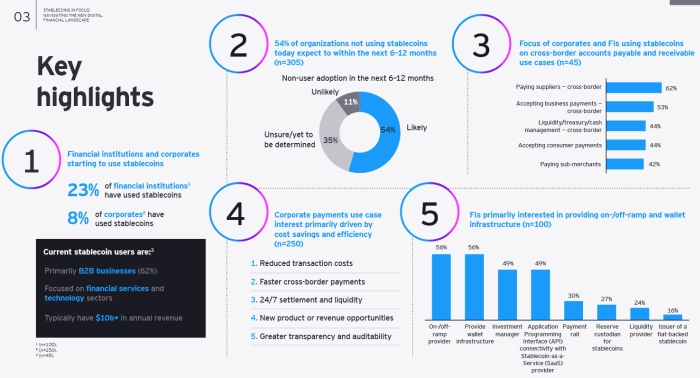
Image: Stablecoin Survey Research Highlights (EY Parthenon Sep 2025)
On September 15, 2025, EY-Parthenon released its latest stablecoin survey results, "Stablecoins: Adoption, Optimism, and Regulatory Clarity" (download 31 page PDF), covering 350 executives from corporates and financial institutions across the US, EMEA and other regions. Research takeaways confirm adoption is picking up speed, supposed by regulatory clarity by the GENIUS Act, recently signed into law.
Why is this happening? Approval of the U.S. GENIUS Act is a regulatory catalyst. Further, pilots are proving real value and corporate treasurers are under pressure to improve efficiency. The thinking is that organizations delaying adoption risk losing ground to competitors who are moving forward and benefiting from the lower cost and faster transactions of stablecoin technologies.
Why is everyone saving money by using stablecoins? The reason is straightforward. Traditional cross border payments involve multiple intermediaries, each adding fees and time. Stablecoins bypass these frictions and settles instantly, so the cost savings are structural (not incremental). For fintech providers, there's a growing opportunity to provide integration and risk management tools to help corporates adopt/use stablecoins and measure their effectiveness.
The reality is that we live and function in a global economy where delays can disrupt supply chains, so it's not surprising that corporates will adopt stablecoins for faster and more streamlined and predictable settlement solutions. This means that stablecoin adoption will likely strong and swift among B2B supplier and trade finance flows before expanding more widely into consumer payments.
In Canada, regulatory inaction is catching up with market momentum. On September 19, 2025, regulators like OSFI have warned the Prime Minister Mark Carney that Canada should accelerate federal stablecoin rules to avoid falling behind global peers. The Bank of Canada has echoed this call, saying stablecoins should be as safe and stable as the balance in your bank account. OSFI is already drafting a new framework to regulate stablecoin issuers, while domestic momentum is building as Tetra Digital Group secured $10M from Canadian banks and fintechs to launch a CAD stablecoin in 2026. Observers including investor John Ruffolo warn in his Looming Stablecoin Storm substack that without clear domestic rules, Canada risks ceding innovation, competitiveness and monetary sovereignty to jurisdictions that move faster.
Canadian corporates and fintechs need to plan not just for current global trends, but for a new local regulatory stablecoin framework. Firms are advised to engage with policymakers to create the right environment, build compliance ready infrastructure now and position for interoperability with USD pegged tokens and domestic stablecoin initiatives.Waiting could result in higher compliance costs, restricted access, and eventually a decline in market share.
Bottom line is banks understand that clients will demand stablecoin services and that failure to provide them risks their disintermediation. There's an intensifying race between traditional institutions and fintech challengers to capture stablecoin transaction flows.
Hybrid build and partner strategy. Corporates are demanding trust and compliance, while financial institutions know they cannot deliver the full stack alone. This means that partnerships between fintechs, banks and technology providers will determine how quickly stablecoin adoption scales.
Stablecoins are moving from pilot projects into enterprise strategy. Corporates see real cost savings and competitive advantage, while financial institutions are preparing to build services at scale to meet client demand. Regulation is beginning to catch up, led by the GENIUS Act in the US, but the global landscape is unbalanced while Canada’s fintech ecosystem is calling on the federal government to create and regulate a stablecoin framework to remain aligned and competitive.
The National Crowdfunding & Fintech Association (NCFA Canada) is a financial innovation ecosystem that provides education, market intelligence, industry stewardship, networking and funding opportunities and services to thousands of community members and works closely with industry, government, partners and affiliates to create aa vibrant and innovative fintech and funding industry in Canada. Decentralized and distributed, NCFA is engaged with global stakeholders and helps incubate projects and investment in fintech, alternative finance, crowdfunding, peer-to-peer finance, payments, digital assets and tokens, artificial intelligence, blockchain, cryptocurrency, regtech, and insurtech sectors. Join Canada's Fintech & Funding Community today FREE! Or become a contributing member and get perks. For more information, please visit: www.ncfacanada.org
| | |
|---|---|---|
| | |



August 26th, 2025

January 4th, 2024

June 1st, 2021

September 9th, 2020

July 9th, 2018

January 3rd, 2018

September 25th, 2017

June 20th, 2017

May 10th, 2017

December 14th, 2016
