




Karsten Wenzlaff, Advisor
August 26th, 2025
Karsten Wenzlaff is a Crowdfunding and Fintech Expert from Germany. He is Secretary-General of Digit[...]


Apr 8, 2026 | NCFA Fintech Market Activity | Embedded Finance Platforms And Partnerships, Payments And Money Movement, Artificial Intelligence And Data

On April 7, 2026, FUTR outlined a proposed digital banking joint venture with EQITrade, with EQIBank Limited and EQITech Limited acting as performing affiliates. It's not a closed transaction or live launch yet. The structure is a binding letter of intent dated April 2 and still depends on definitive agreements, regulatory approvals, technical integration, and TSX Venture Exchange approval.
The proposal is ambitious. The companies are targeting digital banking and payments in more than 100 countries, with a goal of up to 1 million FUTR Verified Active Users over 36 months and a targeted commercial launch in H2 2026. The release also ties future share issuance to funded FUTR accounts, revenue milestones, broader EQIBank integration, and verified user growth. That gives the market a useful clue about what management thinks matters most. Not downloads. Not signups. Funded accounts and actual user activity.
FUTR already has some operating base to build from. The company reported $8.35M in fiscal 2025 revenue, up 13% year over year, with 90% gross margins. FUTR’s July payments update also said FUTR Payments had more than 42,000 users and had processed more than US$3B in value.
The payments footprint has also widened. In December 2025, FUTR Payments expanded data connectivity across about 70% of the U.S. franchised auto dealer market, or roughly 11,000 dealers. In February, it added an exclusive partnership with the New York State Automobile Dealers Association that opened access to about 1,000 more franchised dealerships in New York. That's still a niche payments segment, but it gives FUTR real distribution in one vertical while it tries to expand the product much further.
In January, FUTR appointed Alex McDougall as CEO after bringing him in as President in 2025. FUTR said he had already played a central role in the company’s consumer-first strategy, including the AI Agent App, intelligent payment rails, and data monetization infrastructure. That gives this proposal a bit more continuity than a last-minute strategic pivot.
EQIBank brings the regulated layer underneath. This is EQIBank Limited, a bank licensed and regulated in the Commonwealth of Dominica (note that this is not Canada’s EQ Bank). Its current site says it offers banking, cards, borrowing, custody, escrow, BaaS, and wealth management services to clients in more than 180 countries. That background gives the proposed venture a cleaner division of parties. FUTR brings the app, user layer, and payments capabilities. EQIBank brings the banking, custody, and BaaS rails.
The product ambition goes well beyond a wallet add on. The release says the joint venture would combine the FUTR Agent App, secure data vault, and token rewards engine with EQIBank’s infrastructure to support multi-currency accounts, cards, yield, stablecoins, crypto lending, and digital asset trading, subject to jurisdictional approvals.
The companies put the goal this way: “The vision is to enable a consumer’s FUTR Agent to become an active financial interface” that helps users manage money, documents, rewards, and broader financial life while keeping control of their own data.
While this is a proposal with real building blocks, it's not a finished banking product. No funded account numbers, live transaction volume, or commercial user data for the joint venture exist yet. The main question now is whether FUTR’s agent layer and EQIBank’s regulated stack can turn milestone language into funded accounts, payment activity, and repeat user behaviour.
A banking agent is easy to describe. Getting people to trust it with money is the real test...
 The National Crowdfunding & Fintech Association (NCFA Canada) is a financial innovation ecosystem that provides education, market intelligence, industry stewardship, networking and funding opportunities and services to thousands of community members and works closely with industry, government, partners and affiliates to create a vibrant and innovative fintech and funding industry in Canada. Decentralized and distributed, NCFA is engaged with global stakeholders and helps incubate projects and investment in fintech, alternative finance, crowdfunding, peer-to-peer finance, payments, digital assets and tokens, artificial intelligence, blockchain, cryptocurrency, regtech, and insurtech sectors. Join Canada's Fintech & Funding Community today FREE! Or become a contributing member and get perks. For more information, please visit: www.ncfacanada.org
 |  |  |
|---|---|---|
 |  |  |
Apr 7, 2026 | NCFA Fintech Market Activity | Capital Markets And Market Infrastructure, Digital Assets And Tokenization

On April 6, 2026, Broadridge launched on-chain governance to tokenized equities. The platform now supports proxy voting, corporate actions, and disclosures across traditional and tokenized holdings inside the same workflows institutions already use.
Broadridge is bringing real scale into this launch. The company says its tokenization capabilities already process $8 trillion in tokenized assets per month. It also says its technology platforms process and generate more than 7 billion communications annually and support the daily average trading of more than $15 trillion in tokenized and traditional securities globally.
This is significant because governance is one of the harder parts of tokenized equity infrastructure. Issuing a tokenized share is one step. Running the rights attached to that share is another. Broadridge now gives issuers a single view across registered, beneficial, and tokenized holdings, which makes governance easier to manage across the cap table.
Broadridge already confirmed a real public company use case with Galaxy planning to use the capability for its annual meeting and shareholder vote in May with native tokenized shares on Avalanche.
The company is also extending a tokenized market stack that already has live operating volume. In January 2026, Broadridge’s distributed ledger repo platform processed $365 billion in average daily volume, with total monthly volume of $7.3 trillion, up 508% from January 2025. Broadridge isn't entering tokenization from the sidelines, but rather extending existing market infrastructure into tokenized ownership.
Institutions don't only need tokenized shares. They need voting rights, disclosures, and corporate action controls that work inside familiar systems. That also builds on tokenized money market fund infrastructure from Goldman Sachs and BNY, where the market has already started solving issuance and settlement in a more usable way.
For issuers, custodians, and market operators, it makes tokenized equities easier to use and track inside real workflows. If governance is streamlined institutions have less friction and fewer reasons to hold back.
If tokenized equities can now handle voting and corporate actions inside existing workflows, which part of the traditional equity stack faces pressure next?
The National Crowdfunding & Fintech Association (NCFA Canada) is a financial innovation ecosystem that provides education, market intelligence, industry stewardship, networking and funding opportunities and services to thousands of community members and works closely with industry, government, partners and affiliates to create a vibrant and innovative fintech and funding industry in Canada. Decentralized and distributed, NCFA is engaged with global stakeholders and helps incubate projects and investment in fintech, alternative finance, crowdfunding, peer-to-peer finance, payments, digital assets and tokens, artificial intelligence, blockchain, cryptocurrency, regtech, and insurtech sectors. Join Canada's Fintech & Funding Community today FREE! Or become a contributing member and get perks. For more information, please visit: www.ncfacanada.org
| | |
|---|---|---|
| | |
April 3, 2026 | NCFA Fintech Whisperer Weekly Intelligence | Capital Markets And Market Infrastructure, Payments And Market Infrastructure, Digital Assets Blockchain And Tokenization, Regulation And Policy

Image: Freepik
This live weekly NCFA intelligence page tracks financial technology developments that significantly affect how fintechs build, sell, raise capital, and operate under scrutiny. Coverage prioritizes Canada and includes global events that directly influence competitive conditions, market access, and execution realities across fintech sectors. This page will be updated throughout the week with market movers in a live format and then each week we'll close the prior week's contents in prep for the upcoming week, and continue on a rolling basis. (Missed prior week's Fintech Whisperer? (December 6-12, 2025, December 13-19, 2025, January 1-9, 2026, January 10-16, 2026, January 17-23, 2026, January 24-30, 2026, January 31-February 6, 2026, February 7-13, 2026, February 14-20, 2026, February 21-27, 2026, February 28-March 6, 2026, March 7-13, 2026, March 14-20, 2026, March 21-27, 2026).
The SEC is putting options infrastructure, customer outcomes, and market growth on the table in one public process. That gives exchanges, brokers, market makers, and vendors a clear read on where scrutiny may build next.
The UK is opening a formal industry track to reduce duplication across major wholesale market reporting regimes. That puts reporting design, data standards, and regtech architecture back into play for firms that want lower operational drag in post trade infrastructure.
Lower listing friction can help venture issuers reduce cost and timing pressure, but it does not remove the need for disclosure readiness, investor demand, exchange review, governance, and financing fit. Founders, issuers, dealers, advisors, and investors should track whether public venture market access becomes more usable or whether market conditions remain the bigger constraint.
Europe is locking in how this market runs. Central bank money anchors it. Private players still have room, but they’ll need to fit inside tighter rules and real interoperability. If you’re building for enterprise payments or settlement, this isn’t abstract anymore. You’ll need to design for it now.
Japan is raising the AML/CFT baseline from policy and procedure into board level execution. Banks, brokers, payment firms, and regtech vendors now have a clearer supervisory benchmark for how risk assessment, controls, data, and technology need to work together.
Australia has moved AML reform into implementation with fixed dates and operating deadlines. Banks, remitters, VASPs, and regtech vendors now have a live timetable for travel rule compliance, customer due diligence changes, and system updates.
Canada now has a regulator run tokenization track with dates, intake, and a possible path to live testing. Builders have a direct way to shape how tokenized securities and market infrastructure are handled before rules harden.
Canada is putting financial services back into the trade relationship with China through a formal working channel. That creates a live policy lane for banks, financial institutions, and cross border market access discussions at a time when trade diversification is becoming more urgent.
The fight over prediction markets is now moving through both courts and rulemaking. That gives exchanges, brokers, and market operators a clearer read on where federal authority is likely to be enforced next.
A defined approvals launch date plus explicit capital calibration examples give new entrants and regulated partners a clearer timeline for federal licensing planning and balance sheet capacity conversations.
Claims-driven customer acquisition now faces coordinated scrutiny across conduct, privacy, and marketing rules at the same time. Firms that depend on lead generation, claims funnels, or partner-driven acquisition will need tighter controls across the full chain, not just cleaner front-end marketing.
The competitive edge is moving away from pure speed and toward execution inside the rules. This week’s signals show regulators and market operators getting more specific about how reporting works, how tokenized products may enter the market, how approvals work, and how customer facing conduct gets judged. That creates real openings for fintechs that can align product design with compliance, data architecture, and institutional grade operations earlier. It also raises the cost for firms still treating regulation as something to solve after launch.
NCFA offers various curated resources to help founders and investors stay current on developments that impact fintech markets, subscribe to NCFA weekly newsletter updates, view a rundown of current fintech news and insights, or dive into the latest fintech industry research.
The National Crowdfunding & Fintech Association (NCFA Canada) is a financial innovation ecosystem that provides education, market intelligence, industry stewardship, networking and funding opportunities and services to thousands of community members and works closely with industry, government, partners and affiliates to create a vibrant and innovative fintech and funding industry in Canada. Decentralized and distributed, NCFA is engaged with global stakeholders and helps incubate projects and investment in fintech, alternative finance, crowdfunding, peer-to-peer finance, payments, digital assets and tokens, artificial intelligence, blockchain, cryptocurrency, regtech, and insurtech sectors. Join Canada's Fintech & Funding Community today FREE! Or become a contributing member and get perks. For more information, please visit: www.ncfacanada.org
| | |
|---|---|---|
| | |
Apr 3, 2026 | NCFA Fintech Market Insight | Digital Assets Blockchain And Tokenization
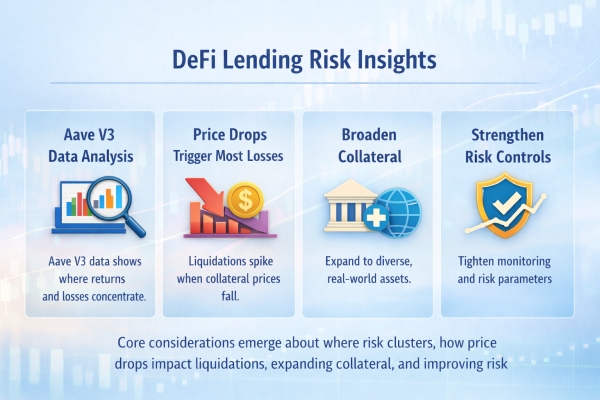
On April 2, 2026, a DeFi lending risk analysis using Aave V3 data from the Bank of Canada analyzes transaction data on Ethereum to find a market that works operationally, but depends on narrow revenue pools, heavy overcollateralization, and fast liquidation when collateral prices fall.
The paper focuses on Aave V3 because it is the largest decentralized lending protocol by total value locked. It cites about $34 billion secured in smart contracts, roughly 25% of all DeFi TVL and about 50% of lending sector TVL. The data analyzed runs from January 27, 2023 to May 6, 2025, which gives the study enough depth to study how the model behaves in live market conditions and not just theory.
The earnings base is much narrower than the deposit base. On Aave V3, WETH, USDT, and USDC generate nearly 83% of total protocol earning in the sample. That doesn't mean the same pattern holds across the entire DeFi lending market, but it does show the largest lending protocol still relies heavily on a small set of assets to produce revenue.
Supply alone does not tell you much. Utilization does. A token can hold a large share of deposits and still contribute very little if borrowing demand stays weak. So careful about judging a lending model by total deposits alone. Look at it by which assets actually generate borrow demand, spread income, and recurring usage.
The comparison with banking makes the constraint clearer. In 2024, Aave V3 posts an estimated 0.64% net interest margin, versus 2.48% for major US banks and 1.69% for major Canadian banks.
Aave V3 also shows a 40.0% loan to deposit ratio, compared with 61.2% for major US banks and 74.2% for major Canadian banks. The model runs with lower overhead, but it also runs with tighter economics and lower capital efficiency.
Repeated borrowing and redepositing of the same collateral accounts for about 20.46% of total borrowed volume and 8.20% of borrowing transactions on Aave V3.
Only about 2% of active users engage in this behaviour, but that small group borrows more often, takes larger positions, uses more flash loans, and runs closer to liquidation.
Risk isn't evenly spread across the user base, but with a relatively small group of sophisticated users who amplify exposure through repeated borrow and redeposit loops. A protocol can look healthy at the aggregate level while vulnerability builds inside a small cluster of accounts.
The largest liquidation wave in the sample reached about $258 million, and the top ten waves account for roughly 80% of total liquidated volume.
WETH, wstETH, WBTC, and weETH account for about 90% of total liquidated value. Collateral diversity on paper is not the same as resilience in practice. When account stress rises, losses still cluster around a small set of core assets.
For all liquidated users, 84.40% of health factor deterioration comes from collateral price declines. For the largest borrowers, that rises to 97.28%. Interest rate changes play only a minor role in the hour before liquidation. So do borrower actions like repaying, withdrawing, borrowing, or supplying more assets.
Immediate risk is mostly market driven. If collateral drops hard enough, the position breaks. Everything else is secondary.
Liquidation fees range from about 5% to 10% of liquidated value. When missed upside from post liquidation price recovery is added, combined borrower losses can reach roughly 10% to 30%.
Automation protects lenders and preserves solvency, but it forces borrowers out at the worst possible time. That raises a harder design question. How do you reduce forced exits before volatility does the damage?
The authors highlight tokenized real world assets as a way to broaden the collateral base and improve stability. They point to decentralized identity frameworks to support better underwriting.
They also raise the question of prudential tools such as leverage limits, capital requirements, or liquidity thresholds.
Concentration risk in DeFi isn't just exposure to a single token. It's dependence on a narrow collateral base, a narrow earnings base, and a narrow set of highly leveraged users. Broader collateral, stronger underwriting signals, and tighter limits can each address a different part of that problem.
Focus on where revenue actually comes from. If earnings depend on a small number of assets, growth is more fragile than it looks.
Track who drives leverage, not just how many users exist. A small group can shape downside risk.
Improve collateral quality, not just collateral variety. Adding assets does not reduce risk if stress still runs through the same core tokens.
Build liquidation buffers into the product. Earlier warnings, better position visibility, and automated risk controls can reduce forced selling.
The strategic takeaway is DeFi lending demand isn't the issue, but rather risk concentration is. The platforms that stand out will spread exposure across better collateral, reduce reliance on highly leveraged users, and design systems that hold up when prices drop. That's how the model can mature from access to durable growth.
The National Crowdfunding & Fintech Association (NCFA Canada) is a financial innovation ecosystem that provides education, market intelligence, industry stewardship, networking and funding opportunities and services to thousands of community members and works closely with industry, government, partners and affiliates to create a vibrant and innovative fintech and funding industry in Canada. Decentralized and distributed, NCFA is engaged with global stakeholders and helps incubate projects and investment in fintech, alternative finance, crowdfunding, peer-to-peer finance, payments, digital assets and tokens, artificial intelligence, blockchain, cryptocurrency, regtech, and insurtech sectors. Join Canada's Fintech & Funding Community today FREE! Or become a contributing member and get perks. For more information, please visit: www.ncfacanada.org
| | |
|---|---|---|
| | |
NCFA Insight | Innovation Policy And Funding

Canada and Singapore show two different ways to support innovation, and both compete to attract fintech, AI, and venture backed companies deciding where to build and grow. Singapore ranks among the strongest fintech hubs globally and remains especially prominent in Asia, which makes it a useful comparison for fintech policy, capital, and scale.
On March 26, 2026, Bill C-15 received Royal Assent, confirming stronger SR&ED support in Canada and adding more structure to the country's financial modernization agenda, including establishing Canada’s digital finance framework. Singapore combines tax relief with capital programs and AI incentives. For fintechs, AI firms, and other innovation led companies, the split affects where investment flows and where growth gets easier.
| Category | Canada | Singapore |
|---|---|---|
| Primary tax support | 35% enhanced SR&ED credit | 40% corporate income tax rebate |
| Core cap | Up to $6M of qualifying expenditures | Up to S$30,000 rebate |
| Additional incentive | Capital expenditures become eligible again | 400% AI deduction up to S$50,000 and S$1,500 minimum cash grant |
| Eligibility expansion | Taxable capital phase out widens to $15M to $75M and eligible Canadian public corporations can qualify | Firms with at least one local employee in 2025 can qualify for grant support |
| Capital programs | No new direct capital pool introduced in this package | New and expanded capital pools in the same policy package. S$1B Startup SG Equity, S$1.5B Anchor Fund, S$1.5B Financial Sector Development Fund |
| Best fit | Engineering heavy firms with high technical build cost | Firms prioritizing expansion, hiring, AI adoption, and capital access |
| What it solves best | Build cost recovery | Commercial growth support |
Canada’s Bill C-15 SR&ED package benefits Canadian builders with heavy engineering, product, infrastructure, and technical development cost that arguably improves improves the case for keeping technical work in Canada. The benefit is strongest for fintech infrastructure, regtech, cybersecurity, AI, and data firms with deep product build requirements.
Tax support helps recover build cost. It doesn’t remove procurement drag, customer acquisition cost, distribution bottlenecks, startup visas or the need for growth capital. Firms can extend build runway. Commercial traction still depends on distribution, procurement, and growth capital.
Singapore’s company level tax benefits are smaller, but the package covers more of what companies need to expand. The package links tax relief to hiring, AI adoption, and capital access. That creates a stronger environment for companies that are past early product build and now need market reach, talent depth, and financing support.
Singapore’s National AI Impact Programme aims to support up to 10,000 enterprises and 100,000 workers over three years.
Canada improves build economics. Singapore provides more support for expansion and growth.
A company building core infrastructure, compliance tools, fraud systems, or AI models may gain real value from stronger SR&ED support in Canada. A company focused on enterprise sales, regional rollout, hiring, or capital access may still find stronger operating support in Singapore, a system built around expansion.
Canada is more attractive now for engineering heavy firms. The harder question is whether companies can also scale here more easily. If not, Canada still risks producing valuable technology that may end up growing elsewhere.
The National Crowdfunding & Fintech Association (NCFA Canada) is a financial innovation ecosystem that provides education, market intelligence, industry stewardship, networking and funding opportunities and services to thousands of community members and works closely with industry, government, partners and affiliates to create a vibrant and innovative fintech and funding industry in Canada. Decentralized and distributed, NCFA is engaged with global stakeholders and helps incubate projects and investment in fintech, alternative finance, crowdfunding, peer-to-peer finance, payments, digital assets and tokens, artificial intelligence, blockchain, cryptocurrency, regtech, and insurtech sectors. Join Canada's Fintech & Funding Community today FREE! Or become a contributing member and get perks. For more information, please visit: www.ncfacanada.org
| | |
|---|---|---|
| | |
Apr 3, 2026 | NCFA Innovation Perspective | Moonshot Thinking

On April 1, 2026, Canada’s Artemis II mission reaches launch as Canadian astronaut Jeremy Hansen boards NASA’s Orion spacecraft, becoming the first Canadian and first non American on a mission beyond Earth orbit to the Moon.
It’s the first crewed Moon mission since 1972, and the 10 day flight around the Moon is designed to carry humans further from Earth than any mission before. For Canada, it’s proof that bold ambition still counts when a country backs talent, engineering, and strategic partnerships over a long stretch of time.
Artemis II isn’t the result of a quick push or a short funding cycle. It reflects decades of work in robotics, advanced systems, and international collaboration. Canada didn't get this seat by accident. It earned it. More founders, investors, institutions, and policymakers should stop and think about that.
Big outcomes rarely appear overnight. By the time the world sees the launch, the hard part has already been building quietly for years. Artemis II carries four astronauts around the Moon and back. Hansen’s place on that crew shows that Canada still plays a meaningful role in one of the most important technology programs now underway. That role is tied to long term Canadian contributions in space robotics, including the Canadarm legacy and Canada’s Canadarm3 commitment to the Lunar Gateway.
Ambition on its own is cheap. Everyone says they want to build big things. What matters is whether people keep going when the payoff is far away, the standards stay high, and the result is still uncertain. Artemis II shows what can happen when the mission stays clear and people stay committed.
This reaches far beyond aerospace. In fintech, financial infrastructure, artificial intelligence, and other serious technology sectors, people often talk about transformation. But real transformation asks for something uncomfortable. It asks for patience from backers, fellow builders and community. It asks for coordination. It asks for institutions that can think beyond the next quarter.
If Canada wants stronger digital identity systems, better financial infrastructure, more globally competitive AI companies, deeper capital markets, and more durable domestic champions, it can’t keep thinking small and expect outsized results. Those goals take time. They take conviction. They take leadership that sticks with the work long enough for the advantage to build.
Artemis II gives Canada a live example of what that looks like when the bet is real, the timeline is long, and the standard doesn’t drop.
Canada has talent. It has real technical depth. It has researchers, engineers, operators, and builders who can compete globally. What it often lacks is the willingness to place bigger bets and stay with them long enough. Artemis II is important for at least one key moonshot innovation reason. It exposes a familiar Canadian habit. We talk like a country with big potential, then act like one that is afraid to commit.
This mission shows that Canada can still contribute at the highest level when it decides to stay in the game. It also shows that credibility is earned over time. You don’t get invited into missions like this because people are being polite. You get there because your contribution is important and your capability is trusted. That should sound familiar to anyone trying to build a serious company in a serious market.
Moonshot thinking does not mean reckless thinking. It means taking on problems that are hard enough to matter and important enough to justify sustained effort. In practical terms, that could mean building financial infrastructure that removes friction across the system, creating AI tools that solve real regulated workflow problems, or designing funding models that help strong Canadian companies scale here instead of leaving early.
At first, that kind of ambition can look expensive, slow, or unrealistic. Later, it often looks obvious. That’s how breakthroughs actually play out. Artemis II is a reminder that countries don't build lasting relevance by backing lots of small bets. t’s built by committing to the work that defines what comes next.
Jeremy Hansen’s flight around the Moon gives Canada a rare public moment people can feel right away. The deeper value sits underneath that moment. This mission shows what long horizon ambition looks like when people actually follow through. It shows younger builders what serious technical achievement looks like. It shows investors and policymakers that long cycle bets can produce real global relevance. And it shows that Canada still has the ability to achieve moonshots when it chooses to commit.
The question now is whether Canada treats Artemis II as a celebration or as a standard. One gives us a proud moment. The other gives us something much more valuable. It gives us permission to think bigger, build longer, and stop pretending that incremental ambition will somehow produce exceptional results.
If this is what Canada can build over decades, what are you building today that is worth the same commitment?
The National Crowdfunding & Fintech Association (NCFA Canada) is a financial innovation ecosystem that provides education, market intelligence, industry stewardship, networking and funding opportunities and services to thousands of community members and works closely with industry, government, partners and affiliates to create a vibrant and innovative fintech and funding industry in Canada. Decentralized and distributed, NCFA is engaged with global stakeholders and helps incubate projects and investment in fintech, alternative finance, crowdfunding, peer-to-peer finance, payments, digital assets and tokens, artificial intelligence, blockchain, cryptocurrency, regtech, and insurtech sectors. Join Canada's Fintech & Funding Community today FREE! Or become a contributing member and get perks. For more information, please visit: www.ncfacanada.org
| | |
|---|---|---|
| | |
Apr 2, 2026 | NCFA Insight | Capital Markets And Market Infrastructure
The market is no longer asking if tokenization works. It is deciding where it works first.
An OMFIF report on tokenization frameworks lays out how this market is forming. Not all tokenization is created equal. It breaks into different legal and operating models, and those models scale at different speeds. That aligns with what NCFA has already highlighted in how tokenized infrastructure is starting to change market operations.
In practice, the limits are already clear. On March 11, 2026, the European Central Bank confirmed Pontes will launch in Q3 2026 to enable central bank money settlement for DLT based transactions. The Eurosystem has also made clear that central bank money remains the anchor for settlement. Without trusted settlement, tokenized assets do not scale.
The OMFIF report separates tokenization into three models.
Most activity today sits in indirect and incomplete models. Fully native on chain markets remain limited. These structures carry different rights the affects ownership, investor protection, and how claims hold up under stress.
The spread across asset classes is now visible in real issuance and product data. As shown below, activity clusters where structure, custody, and settlement align with existing market practice.
Slovenia’s €30m sovereign issue and the World Bank’s €100m digital notes sit alongside tokenized fund products like BlackRock’s BUIDL at about $1.8bn and Franklin Templeton’s Benji fund at about $865m.
Real asset platforms such as RedSwan and Toucan extend this into real estate and carbon markets.
Infrastructure layers like Broadridge’s distributed ledger repo platform process about $385.5bn in daily volume. Adoption follows existing workflows.

Illustrative examples based on OMFIF report data and public disclosures
Most of the activity is around collateral. Assets remain with custodians while ownership records update faster, improving how collateral moves across the system. Market data supports this. RWA.xyz shows tokenized US Treasuries at about $10B and $27.57B in distributed asset value, alongside $299.32B in stablecoins.
Franklin Templeton’s off exchange collateral program shows how this works in practice. Clients use tokenized money market fund shares as collateral while assets remain in regulated custody, which is similar to what NCFA covered in institutional tokenized money market fund adoption. Collateral efficiency and usable capital drive early adoption.
According to the OMFIF report survey, faster isn't always better. Only 16% of bond market participants prefer T+0. Most prefer longer cycles to manage liquidity and funding. The target is settlement on demand, not instant settlement. That's why central banks are focusing on the money leg. Without trusted cash rails, tokenized assets don't scale cleanly.
At the same time, fragmentation still limits how far the model can go. There are 72 blockchains in use across financial services, and assets don't move easily across them without shared standards. Policy adds another constraint. In 2022, the Basel Committee set very high capital requirements for some public blockchain exposures, making them costly for banks to hold.
Even so, infrastructure is advancing. DTCC is preparing tokenization services for DTC-custodied assets, with rollout expected in the second half of 2026. The focus is on collateral mobility, continuous access, and programmable assets within existing systems.
Tokenization already works at scale in market infrastructure. Platforms like Broadridge’s distributed ledger repo solution support high volume repo activity, with reported usage reaching about $385bn in daily volume and roughly $9tn monthly across thousands of trades. It reduces friction in collateral movement and short term liquidity without requiring full market redesign. This is where adoption is already real.
The market is not converging on one model. It is dividing across designs impacted by real constraints. Products that match existing legal structures and improve workflows will adopt first. Others will take longer.
The National Crowdfunding & Fintech Association (NCFA Canada) is a financial innovation ecosystem that provides education, market intelligence, industry stewardship, networking and funding opportunities and services to thousands of community members and works closely with industry, government, partners and affiliates to create a vibrant and innovative fintech and funding industry in Canada. Decentralized and distributed, NCFA is engaged with global stakeholders and helps incubate projects and investment in fintech, alternative finance, crowdfunding, peer-to-peer finance, payments, digital assets and tokens, artificial intelligence, blockchain, cryptocurrency, regtech, and insurtech sectors. Join Canada's Fintech & Funding Community today FREE! Or become a contributing member and get perks. For more information, please visit: www.ncfacanada.org
| | |
|---|---|---|
| | |


August 26th, 2025

January 4th, 2024

June 1st, 2021

September 9th, 2020

July 9th, 2018

January 3rd, 2018

September 25th, 2017

June 20th, 2017

May 10th, 2017

December 14th, 2016