





Karsten Wenzlaff, Advisor
August 26th, 2025
Karsten Wenzlaff is a Crowdfunding and Fintech Expert from Germany. He is Secretary-General of Digit[...]


September 3, 2026 | NCFA Market Interest | Digital Assets Blockchain And Tokenization, Capital Markets And Market Infrastructure, Wealth Investing And Trading

Kraken parent Payward has reportedly delayed its U.S. IPO again, this time to the second quarter of 2027 at the earliest. The company confidentially filed a draft registration statement in November 2025, then put the listing on hold in March as crypto prices, trading volumes and valuations weakened. Payward hasn't confirmed the new 2027 timing, so it remains a reported window rather than a scheduled IPO date.
The delay comes at an interesting point for the business. Payward reported US$508 million in Q2 adjusted revenue, up 17% year over year. Funded accounts rose 42% to 6.6 million, while assets on the platform were US$40 billion. Adjusted EBITDA was much thinner at US$23 million, and total platform transaction volume fell 18% to US$310 billion as crypto spot trading cooled.
Those numbers give Payward a pretty clear reason to wait. Revenue and customers are growing, but the company is still proving how much earnings it can generate when trading activity softens. Going public now would put that question in front of investors every quarter.
Kraken is still central to Payward, but the parent company now earns money from more than crypto spot trades. Asset based and other revenue accounted for 60% of adjusted revenue in Q2, up from 55% a year earlier. Payward also owns NinjaTrader, has added regulated U.S. derivatives through Bitnomial, and expanded into payments and card issuing through Reap.
Those businesses and revenue lines are important when trading slows. Payward's transaction volume fell 18% year over year, yet adjusted revenue still rose 17%. That doesn't make the company immune to crypto cycles, but it does show that the revenue mix is changing.
The acquisitions have also made Payward more complicated. Investors eventually have to decide whether futures, derivatives, payments, tokenized equities and infrastructure services add up to a stronger financial business or simply a larger collection of products. Staying private gives management more time to answer that with operating results.
Payward's recent transactions have valued its equity at about US$20 billion. The company also says it closed an US$800 million private funding round backed by investors including Citadel Securities, Jane Street, Oppenheimer and Tribe Capital.
The capital gives Payward capital and time, but the valuation also raises expectations for an eventual IPO. Public investors will want to see more than account growth. They will be looking at earnings, cash generation, trading volumes and whether the businesses Payward has bought can produce dependable revenue together.
The current quarter gives them both sides of the argument. A record 6.6 million funded accounts and 17% revenue growth are strong. US$23 million of adjusted EBITDA on US$508 million of adjusted revenue leaves much more room to prove that scale can turn into profit.
Payward's xStocks business is expanding beyond Kraken. xStocks distribution already reaches third party exchanges, wallets and blockchain applications, and Payward now says the products have passed US$40 billion in total volume, including more than US$20 billion settled onchain, across more than 200,000 holders.
The company took another step on September 1 when LSEG and Payward announced plans to explore tokenized UK public equities. Subject to regulatory approval, the London Stock Exchange intends to list xStocks on its planned LSE 24 venue in 2027.
If everything takes, that would put Payward beside a traditional exchange operator at the same time its own IPO waits. It is a good example of how far the company has travelled from being known mainly as a crypto exchange.
The biggest question is earnings. Payward can keep adding accounts and products, but public investors will want to see whether those businesses can produce stronger profits when crypto trading is weak. Q2 showed that revenue can keep growing while transaction volume falls. The next step is showing that more of that revenue reaches the bottom line.
The acquisitions also have to work together. NinjaTrader brings traditional futures clients. Bitnomial adds regulated U.S. derivatives. Reap adds payments and card issuing. xStocks adds tokenized equities. Payward Services sells some of the same technology to banks, fintechs and other platforms. If customers start using several of those products together, the company can earn more from each relationship without depending as heavily on one trading market.
Payward Canada is registered as a restricted dealer, giving Kraken regulated access across Canada. xStocks are still unavailable to Canadian retail clients, so Payward's wider product expansion won't automatically arrive here. Canadian access will depend on what regulators approve and which products the company decides to bring north.
Payward has private capital, growing accounts and several businesses still being integrated. It doesn't have to accept a public valuation today if management believes another year of results can support a better one.
There is risk in waiting too. Crypto markets can weaken further, acquisitions can disappoint and the IPO market may not improve on Payward's schedule. A private US$20 billion valuation is only as strong as the earnings and growth the company can eventually show public investors.
Kraken's IPO delay is therefore more than a calendar change. Payward is using the extra time to prove that it can grow into a larger financial platform, make its acquisitions pay off and earn enough outside crypto spot trading to support the valuation it wants when it finally lists.
Can Payward turn product growth into enough profit to support a US$20 billion public valuation?
 The National Crowdfunding & Fintech Association (NCFA Canada) is a financial innovation ecosystem that provides education, market intelligence, industry stewardship, networking and funding opportunities and services to thousands of community members and works closely with industry, government, partners and affiliates to create a vibrant and innovative fintech and funding industry in Canada. Decentralized and distributed, NCFA is engaged with global stakeholders and helps incubate projects and investment in fintech, alternative finance, crowdfunding, peer-to-peer finance, payments, digital assets and tokens, artificial intelligence, blockchain, cryptocurrency, regtech, and insurtech sectors. Join Canada's Fintech & Funding Community today FREE! Or become a contributing member and get perks. For more information, please visit: www.ncfacanada.org
 |  |  |
|---|---|---|
 |  |  |
Sep 3, 2026

A credit card payment at an online casino costs the operator between 2.5% and 5% in processing fees, takes one to three days to settle, and carries a chargeback risk that averages 0.8% to 1.2% of total transaction volume. A USDC transfer on Solana or Base costs less than $0.01, settles in under three minutes, and cannot be reversed once confirmed on chain. For fintech professionals watching how stablecoin infrastructure performs under real production stress, online casinos have quietly become one of the most revealing test environments in payments.
This is not a story about which casino accepts crypto. It is a story about why the payment rails built under pressure from hostile acquirers are now structurally superior to legacy alternatives, and what that means for broader fintech infrastructure.
Online casinos operate under merchant category code 7995, one of the most restricted classifications in card network underwriting. Most tier-one payment processors refuse to onboard iGaming merchants entirely. Those that do charge premiums well above standard interchange rates, often landing between 3% and 5% per transaction.
The structural challenges compound from there. Chargeback rates in iGaming regularly exceed the thresholds set by Visa and Mastercard, triggering remediation programs that can end in merchant termination. Players expect withdrawals within minutes, yet ACH settlement runs on T+1 to T+3 timelines, and SWIFT transfers take three to five business days. The gap between player expectations and banking infrastructure creates friction at every point in the payment lifecycle.
These pressures created a forcing function. Operators that wanted to scale needed payment rails capable of high velocity cross-border flows, instant finality, reduced credit risk, and independence from acquirer gatekeeping. Stablecoin rails, particularly USDC, addressed all four requirements simultaneously.
When a player requests a withdrawal at a stablecoin casino, the transaction never touches an acquiring bank, a card network, or a correspondent banking chain. It travels on chain.
The operator's treasury system holds a liquid float in a hot wallet, sized to cover 24 to 48 hours of rolling withdrawal demand. The player's withdrawal request triggers a signed transaction broadcast to the blockchain. On Base or Solana, confirmation arrives in seconds with cryptographic finality. There is no authorization hold, no batch settlement window, and no reversal mechanism.
Chain selection matters at scale. ERC-20 USDC on Ethereum carries gas fees of $0.50 to $2.00 per transaction depending on network congestion. Solana reduces that below $0.001. Base sits below $0.01. For an operator processing 50,000 withdrawals per month, the choice of chain alone becomes a six-figure annual decision.
According to Circle, USDC has settled more than $70 trillion in cumulative on-chain transactions across institutional, B2B, and consumer use cases. This is production-scale infrastructure running across financial services, payments, and iGaming.
A direct comparison makes the economic case clearer than any narrative.
| Payment Rail | Settlement Time | Operator Fee | Volatility Exposure | Chargeback Risk |
| Credit Card | 1 to 3 days | 2.5% to 5%+ (iGaming premium) | None | High (MCC 7995) |
| Bank Wire (SWIFT) | 3 to 5 business days | $25 to $65 flat + FX spread | FX exposure | Low |
| Bitcoin (BTC) | 10 to 60 minutes | $1 to $30 variable | High | None |
| USDC (Base/Solana) | Under 3 minutes | Below $0.01 per transaction | None | None |
For an operator processing $10 million per month on card rails at a blended 3% iGaming rate, shifting to USDC represents roughly $300,000 in annual fee savings before accounting for chargeback losses.
Bitcoin is not a viable substitute at scale. Price volatility means any operator holding BTC in treasury carries mark-to-market risk on the liability side. A 10% price decline on a $1 million player balance creates an immediate $100,000 accounting gap. USDC, pegged 1:1 to USD and redeemable through Circle Mint, carries no equivalent risk. The liability stack stays USD-denominated throughout.
Platforms already running on these rails demonstrate the production reality. A live USDC casino operating at scale today faces none of the acquirer relationship risk, chargeback remediation exposure, or cross-border correspondent banking friction that card-dependent operators manage as ongoing cost centers.
In Canada, FINTRAC requires operators handling virtual assets, including stablecoins, to register as virtual asset service providers. This registration carries obligations for Travel Rule compliance at the transaction level and ongoing AML monitoring programs.
The regulatory trajectory is converging across jurisdictions. Canada's VASP framework, the EU's MiCA regulation, and emerging US stablecoin legislation all emphasize disclosure, reserve attestation, and Travel Rule compliance. USDC's monthly reserve attestation model, published by an independent accounting firm, already satisfies the transparency requirements taking shape in all three regulatory environments.
Operators building on Circle's infrastructure can inherit compliance controls directly. Circle's Payments Network includes built-in OFAC screening, Travel Rule messaging support, and AML monitoring capabilities. This reduces the compliance engineering burden materially compared to building a custom integration from scratch.
For Canadian fintech professionals, the key milestone to watch is FINTRAC's expected expansion of VASP reporting thresholds to cover stablecoin-specific transaction patterns. Operators and payment processors building on USDC rails now will have a compliance architecture head start when those requirements arrive.
On-chain settlement introduces a transparency layer that legacy payment infrastructure cannot replicate. Every deposit, withdrawal, and balance change is recorded on an immutable public ledger, creating a continuous audit trail without reliance on third-party attestation.
In iGaming, this connects directly to the concept of provable fairness. Understanding what is RTP in slots has traditionally required trust in third-party testing labs that certify return-to-player percentages. On-chain settlement opens the door to cryptographically verifiable RTP calculations, where players and regulators can independently confirm that game outcomes match published odds. This shift from trust-based to verification-based fairness represents a meaningful evolution for both player protection and regulatory oversight.
Programmability adds further capabilities that card rails cannot match. Smart contract-based bonus logic, automated affiliate settlement, and on-chain provable fairness are native to blockchain infrastructure. None require a third-party processor, a settlement delay, or a revenue-share arrangement with a payments intermediary.
The shift away from card rails in iGaming is structural, not cyclical. Card networks retain the unilateral right to remove a merchant category from acquirer eligibility without notice. That existential counterparty risk has no analog in stablecoin settlement, where the protocol itself has no commercial relationship with the merchant.
The cross-border advantage is equally concrete. USDC is natively issued across 37 blockchains and available in over 185 countries. Sending USD from Canada to a licensed offshore operator through a correspondent banking chain costs $30 to $60 per transfer and takes three to five business days. A USDC transfer costs less than a cent and settles in under a minute.
The onboarding friction for USDC is real: players still need a non-custodial wallet or an account on a centralized exchange. That friction is the primary reason card rails coexist in hybrid operator stacks. But for operators targeting experienced crypto users, the economics are unambiguous. And as wallet infrastructure improves, that friction is shrinking quarter by quarter.
A stablecoin casino is an online casino that accepts and settles player balances in USD-pegged stablecoins like USDC or USDT rather than fiat currencies or volatile cryptocurrencies. Operators use stablecoin rails to achieve near-instant withdrawals, eliminate chargeback exposure, and reduce payment processing fees to fractions of a cent per transaction.
On low-fee chains like Base or Solana, on-chain confirmation occurs in seconds with cryptographic finality. This compares to bank wire settlement of three to five business days and card processing of one to three days. The speed is structural, built into the protocol's confirmation mechanics, rather than dependent on processor batch windows or banking hours.
Licensed online gambling operates under provincial regulatory frameworks in Canada. Platforms handling virtual assets, including stablecoins, must comply with FINTRAC's VASP registration requirements, implement Travel Rule compliance, and maintain AML monitoring programs. Players should verify that their chosen platform holds valid licensing and is registered under the applicable VASP framework.
USDC is redeemable 1:1 for USD through Circle Mint at all times. Operator treasuries holding USDC carry no BTC or ETH price risk. The entire liability stack is USD-denominated, which means accounting, regulatory capital calculations, and player balance reconciliation all operate in the same fiat reference currency. This is a fundamental structural difference from Bitcoin or Ethereum reserves, where a price move creates an immediate liability gap.
Both are USD-pegged stablecoins, but they differ on compliance transparency and regulatory alignment. USDC, issued by Circle, publishes monthly reserve attestations from an independent accounting firm and is natively issued on 37 blockchains. USDT, issued by Tether, carries higher consumer adoption but provides fewer issuer-level compliance disclosures. For operators building compliance-forward stacks, USDC's attestation model aligns more directly with the disclosure requirements emerging under MiCA, FINTRAC, and US stablecoin legislation.
Online casinos did not adopt stablecoin rails out of ideological alignment with decentralized finance. They adopted them because card acquirers either refused to underwrite MCC 7995 or charged rates that made the business model unworkable.
The infrastructure built under that pressure is now the same infrastructure payment professionals are deploying for remittances, B2B settlement, and embedded finance. Near-zero fees, instant finality, zero chargeback exposure, and a USD-denominated treasury that requires no foreign exchange management: these properties are not specific to gambling. They represent the core value proposition of stablecoin payment rails in any high-volume, cross-border merchant category. The proving ground is already running at scale.
Circle - USDC Overview: https://www.circle.com/usdc
FINTRAC - Crypto Asset Guidance: https://www.fintrac-canafe.gc.ca/re-ed/crypto-eng
Wild.io USDC Casino: https://wild.io/casino/usdc-casino
Wild.io RTP Guide: https://wild.io/academy/articles/what-is-rtp
The National Crowdfunding & Fintech Association (NCFA Canada) is a financial innovation ecosystem that provides education, market intelligence, industry stewardship, networking and funding opportunities and services to thousands of community members and works closely with industry, government, partners and affiliates to create a vibrant and innovative fintech and funding industry in Canada. Decentralized and distributed, NCFA is engaged with global stakeholders and helps incubate projects and investment in fintech, alternative finance, crowdfunding, peer-to-peer finance, payments, digital assets and tokens, artificial intelligence, blockchain, cryptocurrency, regtech, and insurtech sectors. Join Canada's Fintech & Funding Community today FREE! Or become a contributing member and get perks. For more information, please visit: www.ncfacanada.org
| | |
|---|---|---|
| | |
September 1, 2026 | NCFA Insight | Digital Assets Blockchain And Tokenization, Payments Infrastructure And Money Movement, Cross Border Payments And FX

On September 1, 2026, TD Bank Group and Scotiabank joined a 21 institution stablecoin venture that plans to form a new company in the second half of 2026. The venture is targeting a USD denominated stablecoin launch in the first half of 2027, followed by a euro product, with other G7 currencies possible later.
The group started with 10 banks exploring a shared stablecoin in October 2025. It now includes Bank of America, Citi, Goldman Sachs, Wells Fargo, Santander, Deutsche Bank, UBS and MUFG alongside TD and Scotiabank. Fidelity Investments and WisdomTree put asset managers inside the venture as well, creating potential connections to investment products, tokenized assets and institutional distribution.
The stablecoin isn't live and the group hasn't disclosed the company name or any details. It says the product is intended for wholesale, institutional and retail markets, including cross border payments and digital asset settlement, and is being designed to meet applicable U.S. GENIUS Act and European MiCA requirements.
The banks are entering a US$320 billion stablecoin market as of the end of May 2026. Roughly 98% of stablecoin value is denominated in U.S. If regulated digital dollars become easier for businesses and consumers to hold and use, banks have an economic reason to compete for the deposits, reserves, customer relationships and settlement activity around them.
Bank of America CEO Brian Moynihan put a number on one concern in January. Citing U.S. Treasury studies, he said as much as US$6 trillion, or roughly 30% to 35% of U.S. commercial bank deposits, could migrate into stablecoins under scenarios where stablecoin holders can earn interest. It wasn't a forecast that US$6 trillion will leave banks. It illustrated how digital dollars could compete with deposits if customers can earn more elsewhere.
Deposits help fund lending and other bank balance sheet activity. Stablecoin reserves are generally held in cash, short term government securities and other permitted liquid assets. A large transfer from deposits into independently issued stablecoins could leave banks replacing some lower cost deposits with more expensive funding. Issuing or participating in stablecoins gives banks a way to retain more of the economics if customers start holding money onchain.
Europe is pursuing the same opportunity in euros. Qivalis euro stablecoin expanded to 37 financial institutions across 15 countries in May. Bank backed stablecoin ventures are becoming a competitive model alongside independently issued products such as USDC and USDT.
Banks are developing tokenized deposits at the same time. A tokenized deposit remains a liability of the issuing bank. A reserve backed stablecoin is a separate digital claim supported by designated reserve assets. Those differences affect funding, credit creation, redemption and who controls the customer relationship.
TD is already working across both models.
On August 31, TD completed a Project Agorá payments test using tokenized commercial bank deposits and central bank reserves. TD moved real U.S. dollar funds between two U.S. entities through the Project Agorá platform, with BNY acting as the clearing bank and intermediary.
The test involved 28 central banks and financial institutions, covered 17 transaction scenarios and transferred approximately CHF 800,000 across selected currencies. Project Agorá is examining whether tokenized forms of existing bank money can improve wholesale cross border settlement while keeping commercial bank deposits and central bank money at the centre of the system.
TD also has a direct role in Canadian dollar stablecoins. Stablecorp selected TD in July as primary custodian for the fiat reserves backing QCAD Digital Trust, with the relationship expected to roll out in phases through the third and fourth quarters of 2026.
QCAD is building institutional access from several directions. QCAD bank integration is being developed by Deloitte and Stablecorp for Canadian financial institutions, while VersaBank and QCAD established another Canadian banking relationship earlier this year.
Stablecorp also issued QCAD on Circle's Arc testnet and integrated it with StableFX in May. The QCAD/USDC pair is available in the StableFX sandbox, demonstrating a potential onchain CAD/USD settlement route. Production is expected after Arc's mainnet launch, so this remains development work rather than a live production FX corridor.
Canada now has another domestic model through the CADD stablecoin. Tetra Trust Company, through CAD Digital, launched the 1:1 Canadian dollar backed payment stablecoin in May as Canada's first CAD stablecoin issued by a regulated financial institution.
TD's activity across QCAD custody, tokenized deposits and the new global USD venture explains why banks may want several forms of digital money. Tokenized deposits can serve customers who want bank money on programmable settlement systems. A CAD stablecoin can support Canadian dollar transactions. A USD stablecoin can connect users to international liquidity, digital asset markets and cross border settlement.
The BankChain Alliance offers another approach. Thirty nine U.S. state banking associations are developing shared blockchain capabilities that could support tokenized deposits, stablecoins and automated settlement while giving participating banks a role in ownership and governance.
Banks are now experimenting with shared stablecoins, individual stablecoins, tokenized deposits and common settlement networks at the same time. The commercial winners will depend on where customers hold balances, which products can reach multiple networks and how cheaply money can cross between them.
The U.S. dollar begins with an enormous network advantage. The BIS estimates that about 98% of stablecoin value is already dollar denominated. Annual stablecoin transaction volume reached an estimated US$28 trillion in 2025, although the BIS cautions that the number falls substantially after transfers between wallets controlled by the same party are removed and that ordinary payment use remains modest beside established payment systems.
Other currencies have struggled to build comparable liquidity. Only about 0.2% of global stablecoin circulation is euro denominated, even as European banks invest in Qivalis. CAD begins from a still smaller international base.
Canadian businesses still collect domestic revenue, pay employees, manage treasury balances and settle obligations in Canadian dollars. Sending those transactions through USD stablecoins would introduce foreign exchange exposure and conversion costs where a Canadian dollar product could settle directly in CAD.
Canada has also established a federal regulatory base for the market. Canada's stablecoin regulations now include the Stablecoin Act, Bank of Canada oversight, issuer registration, reserve requirements and redemption obligations, although the Act's substantive requirements are not yet in force.
The Bank of Canada's 2026 Financial System Survey raises a more practical concern. If Canadian businesses rely too heavily on foreign payment systems and foreign controlled stablecoins, more of Canada's payment activity could end up running through systems controlled elsewhere.
TD and Scotiabank can still benefit from joining a global USD stablecoin network. It gives them access to international liquidity, customers and settlement systems. The problem arrives if digital dollars become easy to use while Canadian dollar products remain harder to use for everyday business payments, treasury and settlement.
That risk creates room for Canadian fintechs. Businesses will need ways to convert between CAD and USD, manage liquidity, hold digital assets safely, handle compliance and connect stablecoins to treasury and payment systems without adding unnecessary FX costs.
TD is already working on both sides. It is supporting QCAD reserves, testing tokenized bank money and joining a global USD stablecoin venture. Scotiabank is now part of that international venture too. Canada does not need to match the dollar's global scale, but it does need CAD based digital money that businesses can actually use. Can Canada connect to global digital dollars without making digital CAD an afterthought?
The National Crowdfunding & Fintech Association (NCFA Canada) is a financial innovation ecosystem that provides education, market intelligence, industry stewardship, networking and funding opportunities and services to thousands of community members and works closely with industry, government, partners and affiliates to create a vibrant and innovative fintech and funding industry in Canada. Decentralized and distributed, NCFA is engaged with global stakeholders and helps incubate projects and investment in fintech, alternative finance, crowdfunding, peer-to-peer finance, payments, digital assets and tokens, artificial intelligence, blockchain, cryptocurrency, regtech, and insurtech sectors. Join Canada's Fintech & Funding Community today FREE! Or become a contributing member and get perks. For more information, please visit: www.ncfacanada.org
| | |
|---|---|---|
| | |
August 31, 2026 | NCFA Market Activity | Digital Assets Blockchain And Tokenization, Wealth Investing And Trading, Competition And Market Structure, Capital Markets And Market Infrastructure
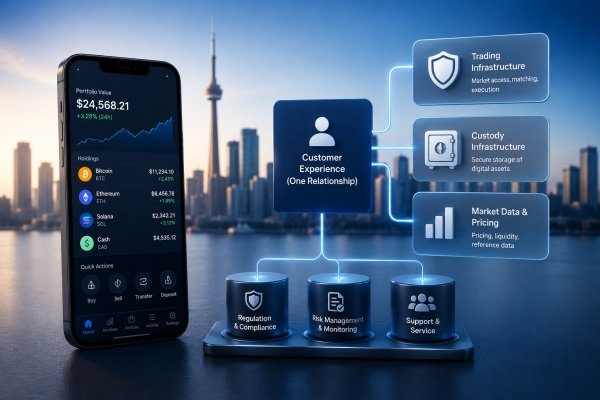
On August 31, 2026, Coinbase announced its Webull Canada partnership, supplying the trading and custody services behind Webull's new Canadian crypto offering. Webull maintains the investor relationship and brokerage experience, while Coinbase handles two core crypto functions. The same partnership already supports Webull in the United States, Brazil and Australia.
Webull Canada Crypto Limited was registered as an Investment Dealer and admitted to CIRO membership effective June 17, 2026. Coinbase Canada, Inc. is registered as a Restricted Dealer across Canada.
Crypto arrives after Webull spent more than two years expanding its Canadian brokerage. It launched here in 2024 with Canadian and U.S. equities and later added registered accounts, options, cash management, desktop trading and longer trading hours. Canadian stocks and ETFs now trade at zero commission, while selected securities are available around the clock five days a week.
When Webull entered Canada, its offering was much narrower. The company has since added enough products that crypto now joins an account already spanning stocks, options, cash, margin, TFSAs and RRSPs.
Using Coinbase lets Webull add crypto without building its own trading and custody systems from scratch. It can use infrastructure already supporting the same partnership elsewhere, reducing the amount of technology and operating capability Webull has to build internally.
Webull still has to persuade Canadians to use the product. The company reports 26 million registered users globally but doesn't disclose its Canadian customer count, leaving a large gap between the breadth of its local product menu and what outsiders can see about actual adoption.
A Canadian investor trading crypto through Webull remains inside Webull's experience, but Coinbase can still earn from the trading and custody taking place underneath it.
Coinbase has been selling more of those capabilities to financial institutions. Its Crypto as a Service business targets banks, brokers, fintechs and payment companies that want to offer digital assets without building everything themselves. Coinbase said in 2025 that more than 200 institutional clients were already using its infrastructure.
Webull gives Coinbase another customer for that business while Coinbase continues competing directly for Canadian crypto users through its own platform. The two companies can pursue the same investor from different positions. Webull wants the account and ongoing customer relationship. Coinbase can benefit whether the investor chooses Coinbase directly or reaches its services through Webull.
Webull is relying on Coinbase for key parts of the service. If trading, custody, pricing or service problems arise, Webull still has to deal with the customer impact.
Webull isn't alone in combining its own customer experience with outside financial infrastructure. Wealthsimple offers stocks, cash and crypto from one relationship, while its regular crypto service uses external custodians including Tetra Trust, Coinbase Custody and BitGo. Its recent in app DEX trading beta uses a different model, creating a self custody wallet for the client and routing trades through a third party DEX aggregator.
Crypto focused firms such as Coinsquare, Newton and Shakepay started from a different approach, building their customer relationships around digital assets before adding more services. Webull started as a brokerage and is bringing crypto into an account already built around conventional investing.
Customers can now see a growing number of competing apps even when some important functions behind those apps come from the same suppliers. If several brokers rely on a small group of firms for custody, execution or liquidity, competition at the customer level can grow faster than the number of companies providing the underlying services.
Building everything internally isn't automatically better and often depends on the lifecycle stage of the firm and target customer base. It can preserve more control and economics, but it also brings technology, security, compliance and operating costs. Buying specialist infrastructure can get a product to market faster, provided the platform is comfortable with the dependency and the economics.
Webull has removed many of the obvious product gaps since entering Canada. Investors can now trade Canadian and U.S. equities, options and crypto, use registered accounts and access longer trading hours. Another product won't automatically pull customers away from Wealthsimple, established brokerages or dedicated crypto platforms.
Existing Webull users may be the easiest audience. They can add crypto beside the rest of their portfolio without opening another trading relationship. Whether that convenience produces meaningful Canadian crypto activity won't be clear until Webull discloses more about adoption or the market provides other evidence.
Coinbase receives another benefit if the model continues to expand. Its Webull relationship now spans four countries, so a successful Canadian launch gives Coinbase another example it can use when selling trading and custody services to other financial firms. It doesn't need its name on the customer's home screen to participate in the transaction.
Webull and Coinbase are building different businesses from the same Canadian launch. One wants to own more of the investor relationship. The other can earn by supplying financial functions to companies that already have one.
As financial apps buy more of what they offer from specialist providers, who keeps more of the long term value: the company with the customer or the company running the service underneath?
The National Crowdfunding & Fintech Association (NCFA Canada) is a financial innovation ecosystem that provides education, market intelligence, industry stewardship, networking and funding opportunities and services to thousands of community members and works closely with industry, government, partners and affiliates to create a vibrant and innovative fintech and funding industry in Canada. Decentralized and distributed, NCFA is engaged with global stakeholders and helps incubate projects and investment in fintech, alternative finance, crowdfunding, peer-to-peer finance, payments, digital assets and tokens, artificial intelligence, blockchain, cryptocurrency, regtech, and insurtech sectors. Join Canada's Fintech & Funding Community today FREE! Or become a contributing member and get perks. For more information, please visit: www.ncfacanada.org
| | |
|---|---|---|
| | |
Aug 22, 2026 | NCFA Fintech Whisperer | Capital Markets Infrastructure And Funding, Cross Border Payments And FX, Payments Infrastructure And Money Movement, Cybersecurity Fraud And Financial Crime, Artificial Intelligence And Data, Lending Consumer Credit And BNPL, Treasury Liquidity And Cash Management, Sustainable Finance ESG And Financial Inclusion, Digital Banking And BaaS, Wealthtech Investing And Trading, Regulation And Policy, Digital Assets Blockchain And Tokenization, Risk Compliance And Regtech

Image: Freepik
This live weekly NCFA intelligence page tracks financial technology developments that significantly affect how fintechs build, sell, raise capital, and operate under scrutiny. Coverage prioritizes Canada and includes global events that directly influence competitive conditions, market access, and execution realities across fintech sectors. This page will be updated throughout the week with market movers in a live format and then each week we'll close the prior week's contents in prep for the upcoming week, and continue on a rolling basis. (Missed prior week's Fintech Whisperer? (December 6-12, 2025, December 13-19, 2025, January 1-9, 2026, January 10-16, 2026, January 17-23, 2026, January 24-30, 2026, January 31-February 6, 2026, February 7-13, 2026, February 14-20, 2026, February 21-27, 2026, February 28-March 6, 2026, March 7-13, 2026, March 14-20, 2026, March 21-27, 2026, March 28-April 3, 2026, April 4-10, 2026, April 11-17, 2026, April 18-24, 2026, April 25-May 1, 2026, May 2-8, 2026, May 9-15, 2026, May 16-22, 2026, May 23-29, 2026, May 30-June 5, 2026, June 6-12, 2026, June 13-19, 2026, June 20-26, 2026, June 27-July 3, 2026, July 4-July 10, 2026, July 11-July 17, 2026, July 18-24, 2026, July 25-July 31 2026, August 1-August 7, 2026, August 8-August 14, 2026, August 15-August 21, 2026).
BankChain Alliance adds an association led ownership model to existing bank tokenized deposit networks. Its published plan gives community and regional banks a proposed role in governing shared infrastructure, although the technology provider and participating bank commitments remain unresolved.
RQD combines the financing announcement with disclosed operating volume from its proprietary clearing platform. The expansion plan covers digital-asset custody and tokenization alongside equities and options infrastructure. NCFA’s Alpaca platform analysis examines another provider combining brokerage distribution with regulated clearing and custody.
The pilot tested the digital asset and payment legs within the same institutional transaction. NCFA’s tokenized market infrastructure analysis explains why tokenized securities require a compatible settlement asset. CIMB identifies coupon distribution, secondary transfers and redemption as potential future applications. Commercial production availability has not been announced.
The completed transaction extends Canton's institutional custody and collateral infrastructure into a full repo cycle. Repeat volume, additional counterparties and accepted legal, accounting and capital treatment will determine whether the structure advances beyond a single transaction.
The H1 numbers extend the concentration documented in KPMG's 2025 fintech investment review. Canadian founders now face a market where capital favours scale, regulated access, specialized technology and measurable economics. Infrastructure reform could improve the position of companies that can convert lower data and payment friction into customer adoption.
This is a material follow-on to the June financing behind EDGE's prediction market banking infrastructure. ProphetX provides named distribution and active account funding use for EDGE Connect. Higher limits, dedicated insured accounts and continuous FedNow access give the rail an operating profile that routine partnership announcements lack.
Apex could give Gemini a distribution route through brokerage platforms that already serve tens of millions of investors, while Gemini supplies the regulated venue, execution and clearing. That directly expands the commercial case for event contract distribution infrastructure around brokerage connectivity, compliance and access. The parties still need a definitive agreement, so the LOI establishes the proposed structure rather than a completed rollout.
The March dialogue announcement established the bilateral payments file. The completed August meeting adds an agreement to explore UPI distribution and cross-border payment partnerships, while commercial implementation remains unresolved.
This is a material follow-on to Visa and Nium's earlier stablecoin settlement work. BLOOM adds central bank led governance, multicurrency scope and an explicit interoperability mandate. Together with Nium's recent U.S. card issuance expansion, the pilot gives Nium a larger role across both payment distribution and institutional settlement.
Fasset is putting new capital into the banking, liquidity and settlement connections behind its existing transaction volume. Stablecoins already support settlement across parts of Own Network, placing the company inside the infrastructure opportunity around programmable stablecoin payments rather than relying on token issuance alone. Its 100-plus banking corridors give Fasset a base for competing on routing cost, settlement reach and access across markets where payment infrastructure remains fragmented.
RBC is consolidating ownership of the corporate cash cycle, from payment execution and foreign exchange to liquidity and trade finance. Multinational clients gain a coordinated entry point across Canada and the U.S., raising the integration benchmark for fintechs selling treasury software, cross border payments or working capital tools into the same accounts. The structure continues the transaction banking competition already pushing large banks to invest in digital business payment capabilities.
This is a defined core replacement with a named platform, systems integrator, investment budget and migration sequence. Deutsche Bank says the old and new systems will operate in parallel during the transition to support operational resilience and continuity of service. Testing remains planned for year-end, and no migrated products have yet been reported.
The design gives community banks and credit unions a way to offer AI assistance inside authenticated banking while maintaining institution-level data and transaction controls. iTHINK gives the launch a concrete customer and near-term operating timeline.
The transaction verifies that the connection can process an international card at an approved Syrian merchant. The announcement does not disclose how many merchants are enabled, which issuing markets can participate or when international card acceptance will become widely available.
Banks, payment firms and vendors must revise ISO 20022 delivery schedules without treating the delay as cancellation. Release dependencies, vendor contracts and address-data remediation still need clear ownership while the industry waits for a replacement timeline.
The launch extends USD1's institutional settlement use cases from a planned fund-services pilot to native availability on Canton. Named counterparties and recurring atomic settlement volumes are still needed to prove adoption.
PaidIt combines identity resolution, recipient communication and payment delivery for cases that often depend on manual tracing. CBA’s internal use gives the product operating evidence ahead of its planned institutional client rollout.
August 24 gives prospective RTR participants a live legal framework, while operational access still depends on membership, settlement arrangements, technical integration, fraud controls, testing and certification. The RTR rules and access requirements show why eligibility alone does not put a PSP into production. Firms that can clear the remaining technical and operating requirements will be better positioned to build instant payment, pay by bank, treasury and embedded payment products when the system launches.
Owning Altruist gives Vanguard direct infrastructure across RIA custody and advisor workflows, not only fund distribution. Advisors and competing platforms should watch closing conditions, pricing, product access and whether standalone governance preserves Altruist's independence.
Putting regulated multibank data inside an agent interface connects advisory automation to a structured financial source layer. For wealth firms evaluating governed AI agent workflows, the integration supports portfolio analysis and adviser preparation inside an environment they may already use.
Nasdaq says Q6 data will appear as high-risk alerts inside the existing Verafin investigation workflow, covering check fraud, payment-card fraud and account takeover. The proof-of-concept average demonstrates potential lead time, but it does not establish that every alert will arrive before a fraudulent transaction.
Fraud and compliance teams can now buy agentic case operations within a large identity platform rather than assembling a separate agent layer. Regulated customers still need evidence for each automated decision, clear escalation rules and accountable human owners when an agent closes or changes a case.
The task force turns quantum readiness for fintech into a coordinated financial-sector program. Institutions and vendors should inventory cryptography, rank critical systems and document external dependencies before sector guidance becomes a delivery deadline.
This puts post-quantum preparation into an institutional transaction environment where banks and regulators can test the same cryptographic architecture before migration becomes an operating requirement. That is the implementation work behind financial sector quantum readiness: testing wallet controls, signing standards, governance and cross-border interoperability while existing cryptography still works. A shared reference architecture could also reduce the cost and uncertainty of each institution designing its own migration approach.
India is making technology resilience more measurable while standardizing how cyber incidents enter regulatory reporting. Exchanges, clearing corporations and depositories now face a more structured test of whether critical systems remain reliable and recoverable, while common incident data should make weaknesses easier to compare across institutions and over time.
The task force turns federal quantum policy into a financial sector implementation program. Firms now have a coordinated forum focused on cryptographic inventories, vendor dependencies, digital assets and migration execution. It extends the operating case in quantum readiness analysis: the immediate challenge is finding vulnerable cryptography and planning replacements before migration becomes an operational deadline.
The cohort gives regulators a supervised setting to examine how autonomous financial systems are authorized, monitored and escalated. The useful proof will come from controls that preserve human accountability when an agent completes a task or supervises another agent.
Rowan takes delegated AI access to financial accounts from recommendations into execution. Permission limits, action logs, reversibility and responsibility for losses become core product controls when a conversation can trigger a financial action.
Google is packaging domain methods, licensed data access, workflow execution and governance as one financial AI stack. Banks evaluating the preview will need to examine the quality of its research outputs, permission controls, audit records and integration with existing systems. The same control requirement is already visible in AI agent spending infrastructure, where authorization and observability determine whether automated execution can enter production.
Starling has moved agentic AI inside the authenticated business banking workflow and given it authority to execute a defined financial action, rather than limiting it to analysis or customer support. That brings the consent and liability questions around AI initiated payments into a live bank product: who authorizes the action, what limits apply, how the instruction is recorded and what happens when an automated decision is wrong. For business banking, the commercial opportunity is also concrete. The bank can automate tax, invoicing, fraud checks and cash management inside the account instead of leaving those workflows to separate software providers.
The national improvement does not describe every borrower or every region. Ontario homeowners are carrying persistent mortgage stress while severe non-mortgage delinquency has eased slightly across Canada, giving lenders a more uneven credit picture than the headline rate suggests. That divergence affects underwriting, limit management and collections across consumer lending, including products now becoming more visible in Canadian credit files. Geographic exposure and housing obligations are becoming more important when lenders assess where household credit risk is actually accumulating.
For banks, insurers and investors, the liability perimeter has narrowed. Statutory emissions duties remain, while private climate claims can no longer use this route through tort law. Underwriting, due diligence and climate-risk analysis should reflect the distinction.
Frontier AI preparedness is moving from awareness into evidence of execution. Financial firms need tested escalation authority, recovery plans, dependency mapping and governance that still works when incident timelines compress. The supervisory question is increasingly whether organizations can prove those controls operate under pressure, not whether boards have discussed AI risk.
The mandate changes how payment innovation enters supervisory decision making at the central bank. Stablecoin and payment infrastructure proposals will still have to satisfy financial stability requirements, but innovation becomes an explicit secondary consideration rather than an external policy goal. The practical test is how that mandate affects approvals, infrastructure design and competition as new payment models reach systemic scale.
The notice separates sports and entertainment products from the limited event contracts already available through Canadian investment dealers. NCFA’s event contract infrastructure brief tracks the dealer controls, surveillance, settlement and product-classification requirements connected to permitted contracts.
The final rule directs supervisory attention toward material financial risk and compliance with banking law. It also requires the agencies to tailor unsafe-or-unsound findings and MRA treatment to institution-specific risk factors. The rule does not apply to institutions outside OCC or FDIC supervision.
Payment firms and stablecoin providers will gain a formal innovation consideration within Bank of England supervision, but no automatic approval or lighter standard. Product teams will still need to prove that new payment models protect stability, resilience and users.
The proposed consent judgment gives algorithm design liability a concrete control framework built around age assurance, usage restrictions and parental permissions. Fintech teams offering youth accounts, gamified investing or automated recommendations can compare their controls with these requirements while the court reviews the agreement.
Thailand is working on both sides of institutional crypto access at once: the investment product investors can buy and the custody arrangements funds can use behind it. That puts product approval, offshore asset safeguarding and institutional distribution inside the same regulatory design problem rather than treating crypto ETFs as a listing question alone.
Control of the rails, data, distribution and risk is becoming more valuable. Capital is concentrating around firms that can prove scale and economics, while banks and infrastructure providers invest directly in tokenized settlement, real-time funding, AI and fraud controls. The opportunity remains large, but owning a critical part of how money moves is becoming more valuable than adding another product.
NCFA offers various curated resources to help founders and investors stay current on developments that impact fintech markets. Get the weekly Whisperer and related market intelligence through NCFA's newsletter, view the latest fintech insights, industry research, or launch into emerging financial innovation opportunities.
The National Crowdfunding & Fintech Association (NCFA Canada) is a financial innovation ecosystem that provides education, market intelligence, industry stewardship, networking and funding opportunities and services to thousands of community members and works closely with industry, government, partners and affiliates to create a vibrant and innovative fintech and funding industry in Canada. Decentralized and distributed, NCFA is engaged with global stakeholders and helps incubate projects and investment in fintech, alternative finance, crowdfunding, peer-to-peer finance, payments, digital assets and tokens, artificial intelligence, blockchain, cryptocurrency, regtech, and insurtech sectors. Join Canada's Fintech & Funding Community today FREE! Or become a contributing member and get perks. For more information, please visit: www.ncfacanada.org
| | |
|---|---|---|
| | |
August 26, 2026 | NCFA Market Activity | Payments Infrastructure And Money Movement, Digital Assets Blockchain And Tokenization, Banking And Credit, Competition And Market Structure

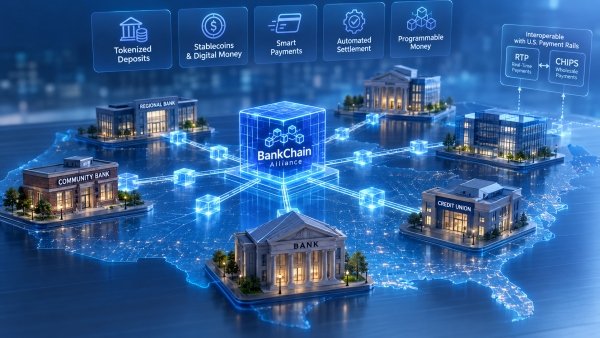
On August 25, 2026, 39 U.S. state bankers associations formed BankChain Alliance to build a shared blockchain network for financial institutions. The planned infrastructure would support smart payment tools, tokenized deposits, stablecoins and automated settlement, with participating banks able to take an ownership role. Together, the associations represent thousands of financial institutions serving millions of consumers, businesses and communities.
BankChain is selecting a technology partner and targeting a 2027 launch. It says the network will interoperate with other networks and that banks across the country will be invited to take ownership. The technology platform, ownership terms for individual banks, operating rules and settlement design haven’t been disclosed, so BankChain remains infrastructure under development rather than a live payment rail.
Building tokenized payment infrastructure involves more than choosing a blockchain. Banks need core system integration, compliance controls, security, operating rules and connections to other financial networks. Those costs are easier for a large institution to absorb than for a community or regional bank.
BankChain's model proposes that banks share more of the work and costs while retaining a say in how the network operates. If enough institutions participate, common infrastructure could reduce the amount each bank needs to build independently and give smaller banks another route into tokenized deposits and programmable payments.
The economics are still unknown. BankChain hasn't disclosed participation costs, ownership terms or implementation requirements. A shared network won't solve much for smaller institutions if joining it still requires expensive integrations, duplicated compliance work or several connections to outside payment systems.
BankChain is entering a market where another bank-led model is already taking shape. In June, The Clearing House launched an on-chain money initiative designed to clear and settle tokenized commercial bank deposits between institutions while connecting blockchain activity with its RTP and CHIPS payment networks.
The Clearing House begins with infrastructure that already clears and settles more than $2 trillion in payments each day. BankChain begins with 39 banking associations and plans to build a common network around institutions that may not have the resources to develop proprietary infrastructure.
Interoperability is paramount given that banks will need tokenized money to move between institutions and connect with established payment infrastructure. BankChain says its network will be interoperable, but hasn't explained how those connections will work.
BMO and TD Bank U.S. are among the institutions supporting The Clearing House initiative. Their participation gives Canadian financial institutions a direct view into one model for connecting tokenized commercial bank money with established U.S. payment rails while BankChain develops a different model based on shared ownership.
Individual bank commitments, network architecture and participation economics will determine whether BankChain becomes usable shared infrastructure.
Can shared ownership make tokenized payment infrastructure economical for smaller banks, or will access to established clearing networks and customer distribution remain the bigger competitive advantage?
The National Crowdfunding & Fintech Association (NCFA Canada) is a financial innovation ecosystem that provides education, market intelligence, industry stewardship, networking and funding opportunities and services to thousands of community members and works closely with industry, government, partners and affiliates to create a vibrant and innovative fintech and funding industry in Canada. Decentralized and distributed, NCFA is engaged with global stakeholders and helps incubate projects and investment in fintech, alternative finance, crowdfunding, peer-to-peer finance, payments, digital assets and tokens, artificial intelligence, blockchain, cryptocurrency, regtech, and insurtech sectors. Join Canada's Fintech & Funding Community today FREE! Or become a contributing member and get perks. For more information, please visit: www.ncfacanada.org
| | |
|---|---|---|
| | |
Aug 15, 2026 | NCFA Fintech Whisperer | Cybersecurity Fraud And Financial Crime, Capital Markets Infrastructure And Funding, Wealthtech Investing And Trading, Digital Assets Blockchain And Tokenization, Cross Border Payments And FX, Regulation And Policy, Insurance And Insurtech, Treasury Liquidity And Cash Management, Artificial Intelligence And Data, SME Finance And Business Banking, Risk Compliance And Regtech
Image: Freepik
This live weekly NCFA intelligence page tracks financial technology developments that significantly affect how fintechs build, sell, raise capital, and operate under scrutiny. Coverage prioritizes Canada and includes global events that directly influence competitive conditions, market access, and execution realities across fintech sectors. This page will be updated throughout the week with market movers in a live format and then each week we'll close the prior week's contents in prep for the upcoming week, and continue on a rolling basis. (Missed prior week's Fintech Whisperer? (December 6-12, 2025, December 13-19, 2025, January 1-9, 2026, January 10-16, 2026, January 17-23, 2026, January 24-30, 2026, January 31-February 6, 2026, February 7-13, 2026, February 14-20, 2026, February 21-27, 2026, February 28-March 6, 2026, March 7-13, 2026, March 14-20, 2026, March 21-27, 2026, March 28-April 3, 2026, April 4-10, 2026, April 11-17, 2026, April 18-24, 2026, April 25-May 1, 2026, May 2-8, 2026, May 9-15, 2026, May 16-22, 2026, May 23-29, 2026, May 30-June 5, 2026, June 6-12, 2026, June 13-19, 2026, June 20-26, 2026, June 27-July 3, 2026, July 4-July 10, 2026, July 11-July 17, 2026, July 18-24, 2026, July 25-July 31 2026, August 1-August 7, 2026, August 8-August 14, 2026).
The numbers show digital assets becoming part of bank formation rather than remaining mainly an activity added to established institutions. More than half of the OCC's recent charter applications include digital asset activity, extending the same infrastructure-ownership question behind Ripple's U.S. bank charter application across a much larger applicant pool. These are applications, not approved banks, but the pipeline shows how many digital asset firms are trying to bring licensing, custody, payments and stablecoin activity inside regulated banking structures.
Singapore is combining tax policy, institutional capital and immigration settings to compete for asset managers and investment talent. The package goes beyond licensing or regulatory simplification by addressing where firms locate teams, where experienced professionals work and whether managers can build enough local scale to anchor investment activity in Singapore. That makes asset-management competitiveness an industrial-policy question as well as a financial-services one.
The report provides unusually concrete evidence on both sides of Canada's securities-policy agenda. Regulators are lowering friction in parts of the capital-raising system while expanding technology-enabled fraud disruption and examining new digital market structures. The C$4 billion raised under the expanded exemption strengthens the question of who gets capital as funding channels multiply because it gives regulators measurable evidence that changing financing limits can alter how Canadian public companies access capital.
As NCFA's review of the RPAA notices explains, a zero-dollar penalty still creates a durable public compliance record. Registration checks now belong in partner onboarding, procurement, investor diligence and market-access planning for payment firms serving Canada.
The SEC is moving from defining how securities law applies to crypto toward creating specific capital-raising pathways for the sector. Its March crypto market structure interpretation established a classification and lifecycle framework; Regulation Crypto Assets would add tailored exemptions that qualifying issuers could use to raise capital within it. If adopted, the rules could materially change how early stage crypto ventures fund development, what they must disclose and how token-based fundraising competes with established private-market exemptions.
The proposal turns the GENIUS Act from legislation into an operating framework for stablecoin issuers and the platforms that distribute their tokens. The definitions of where issuance occurs, which issuers need a licence and when a stablecoin is being offered into the U.S. market will determine how domestic and foreign providers structure access. For exchanges, wallets and payment platforms, compliance will increasingly depend on the regulatory status of the stablecoins they make available, not only on their own licences.
Helcim is using a 22,000 merchant distribution base to extend beyond payment acceptance into more of the financial workflow around small businesses. Vendor payments and business finance could increase revenue per merchant while putting Helcim into closer competition with processors, banks and software platforms that already bundle payments with operating tools. Nearly C$10 billion in expected annual volume gives that expansion enough scale to watch.
Direct participation removes an intermediary from Modulr’s CHAPS settlement process and gives it more control over payment routing and liquidity. The development offers a useful comparison with Canada’s expanding non-bank rail access, where membership and system participation determine how much infrastructure control payment providers can obtain.
The integration gives AlphaPay more Canadian merchant distribution while connecting domestic payment acceptance with Payment Asia's international payment capabilities. The strategic value will depend on whether the combined business can convert that larger merchant footprint into meaningful transaction volume and cross-border activity. The regulatory point also requires precision: Canadian MSBs are registered with FINTRAC, so the company's use of the term "MSB licence" should not be read as a separate banking or payment licence.
Domestic U.S. issuance gives Nium another local component inside a payment network already built for international use. Businesses operating across regions can reduce the number of separate issuing integrations they maintain while combining card programmes with cross-border payouts. That matters most in sectors such as travel and supplier payments, where one transaction can require several payment methods across multiple countries.
New Zealand is still considering the architecture and governance of infrastructure that Canada has placed into approved rules through its Real-Time Rail framework. Payment providers have an early opportunity to address access, fraud responsibilities, interoperability and the role of nonbanks before New Zealand selects its modernization approach.
Offline capability makes hardware compatibility, mobile operator participation and secure deployment part of payment infrastructure design. The consultation gives payment providers and technology companies a direct route into the standards discussion before the pilot begins.
Stripe is reducing the separation between payment acceptance and treasury operations for businesses already using its platform. Revenue can become available for supplier and contractor payments without first being transferred through a separate external banking workflow, while currency conversion stays inside the same system. Treasury for Platforms would extend that model further by letting software platforms distribute account functionality directly to their customers.
Giving an AI agent access to capital requires controls over identity, authority, spending limits, compliance and settlement before the transaction happens. Anchorage is putting those controls inside regulated banking infrastructure, extending the issues already emerging around AI payment consent and liability into institutional treasury and digital asset workflows. Banks, payment firms and fintech platforms now have a clearer benchmark for what controlled agent access to money can look like.
Agent OS puts AI applications closer to financial actions rather than limiting them to analysis or recommendations. The important control boundary is between what an external agent decides and what Binance permits it to execute. That connects directly to the growing AI governance and compliance burden around authorization, audit trails, transaction limits and accountability when agents can act on financial infrastructure.
Financial AI is extending beyond conversational tools into models designed specifically for numerical sequences such as liquidity, transaction flows and other time-dependent financial data. Adoption by global banks gives the model more significance than a research release alone because forecasting accuracy can affect treasury, risk and operating decisions. That also raises the AI compliance burden around model validation, data quality, oversight and evidence when specialist models influence financial decisions.
The useful evidence is adoption inside a real advisory workflow rather than another AI pilot announcement. More than 11,000 client conversations and measurable administrative time savings show where AI governance for Canadian financial advisors is becoming operational: meeting records, follow-up communications and internal information retrieval. As these tools become routine, firms need controls that keep advisor responsibility intact while still capturing the productivity benefit.
Stripe is extending beyond the financial transaction layer into the infrastructure that determines which AI model handles a request and at what cost. That builds on Stripe's expanding infrastructure stack across payments, billing and financial operations. OpenRouter gives Stripe a position in both revenue collection and one of the largest variable costs facing AI companies: model and compute usage.
Giving an AI agent permission to transact creates a different control problem from giving it permission to retrieve information or call software tools. AgentCore places deterministic spending limits and transaction records around an otherwise non-deterministic agent, separating the agent's decision process from the infrastructure that authorizes payment. That control layer is becoming central to whether autonomous financial activity can be deployed at production scale.
Kraken is extending a crypto distribution platform into conventional brokerage while keeping tokenized equities available beside traditional shares. That gives customers two different ownership and market-access structures inside one interface and puts more competitive pressure on brokers that still separate securities, crypto and tokenized products across different accounts.
The proposal addresses how much trading functionality regulators should require when a swap does not have to trade through a prescribed execution method in the first place. Removing the order-book requirement could lower operating complexity for SEFs and give participants more choice in how less standardized or less liquid transactions are executed. The regulatory tradeoff is whether greater flexibility improves market efficiency without weakening transparency or competitive access.
Natural says payment infrastructure at scale requires capital because funds can be advanced before cash settles. The Upper90 facility adds dedicated financing capacity to the software and payment products Natural is building for AI agents. It complements AI agent spending controls emerging elsewhere in the stack, where transaction limits, authorization records and auditability govern automated payments.
Compute is starting to behave like a financial input rather than only a technology expense. Secondary markets are already emerging around scarce AI capacity, with market participants looking for better price discovery, liquidity and ways to manage infrastructure cost risk. Derivatives would take that development further by allowing firms to hedge future compute costs and availability, bringing market structure, manipulation and customer-protection questions directly into AI infrastructure.
The consultation exposes a tension inside post trade regulation: supervisors want better visibility into EU dependence on non-EU clearing infrastructure, but much of the relevant transaction information is already reported elsewhere. ESMA's design work therefore centres on identifying genuine data gaps rather than creating another parallel reporting system. The final technical standards will determine how much additional operational burden clearing firms face for that added visibility.
A regulated leasing route would let AI operators finance compute capacity over time while giving GIFT IFSC a position in the capital layer beneath AI deployment. The proposal addresses the AI infrastructure costs that are becoming a material constraint on production use.
Prediction markets are moving closer to the brokerage infrastructure already used to distribute financial products through fintech apps. That strengthens the innovation opportunity in regulated event contract infrastructure, where distribution, compliance, market integrity and settlement become as important as the contracts themselves. Alpaca's next proof point is whether partners actually embed the product once regulated operations begin.
The significance is regulated market access rather than a full crypto licence. Nigeria is using supervised incubation to bring international digital asset firms inside its regulatory perimeter while retaining control over permitted activities and operating conditions. For Blockchain.com, that creates a formal route into a large African digital finance market without treating sandbox admission as unrestricted authorization.
Adding more operating banks widens the distribution infrastructure behind the e-CNY without proving that customer adoption or transaction volumes have increased. The expansion builds on China's earlier digital yuan bank expansion and shows the operating network continuing to grow through established financial institutions rather than remaining concentrated among the original participants.
RoamQR connects international users to Pix without requiring Brazilian merchants to install new hardware or replace the QR infrastructure they already use. Participating wallets also avoid building separate bilateral integrations for each market. That is the interoperability problem highlighted in the cross border payments benchmark: strong domestic rails create more value when networks can connect them across borders without rebuilding the customer and merchant experience.
The partnership joins several financial layers that are often handled separately: consumer payment settlement, corporate liquidity, foreign exchange, tokenized treasury infrastructure and SME cross-border banking. It also fits Hong Kong's wider push toward tokenized financial infrastructure, where banks are combining regulated balance-sheet access with digital settlement and asset infrastructure rather than treating tokenization as a standalone product experiment.
Cross-border payment platforms can simplify the customer-facing experience, but settlement still depends heavily on regulated banking infrastructure, currency access and correspondent relationships underneath the API. Those dependencies are a central reason faster cross-border payments remain operationally difficult. Deutsche Bank gives TerraPay another institutional layer for moving and settling funds across currencies and jurisdictions, where corridor coverage, liquidity and local network access still determine performance.
Cross border payment competition is increasingly about how much complexity a platform can remove for the business initiating the payment. A single integration into global payout infrastructure can reduce the need to manage separate banking, wallet and local payment connections market by market. Fiserv now gives Thunes a much larger distribution channel into platforms and marketplaces that already manage business payment flows.
The Aug. 17 trigger is the public disclosure of the operating relationship, not the date the partnership became effective. The substance sits underneath Afriex's payment API: sponsor banking, settlement access and regulatory coverage determine how reliably the platform can connect local payment rails with international money movement. For cross-border fintechs, those banking relationships remain core infrastructure even when customers experience the service through a single API.
The acquisition puts insurance capacity, underwriting data and active cyber defence inside the same operating structure. At-Bay already monitors insured risk throughout the policy lifecycle, giving Munich Re a platform that can influence both loss prevention and pricing rather than relying only on claims experience after an incident. That integration could become more important as cyber insurers compete on the quality of the security controls wrapped around coverage.
Boost is putting banking, merchant payments and credit inside one operating interface for small businesses rather than distributing them as separate products. Same-day settlement can feed directly into cash management while transaction history can sit closer to financing decisions. For SMEs, the value depends on whether that integration reduces the time between making a sale, receiving usable funds and obtaining working capital when it is needed.
Canada's move toward faster payments compresses the time available to detect scams before money leaves an account. The survey shows that consumers already put security ahead of speed and convenience, while confidence in fraud protection remains uneven. As Real Time Rail testing and access advance, banks and payment providers will need fraud controls that work across identity, accounts and transaction channels rather than relying mainly on intervention after a suspicious payment has been completed.
The circular connects Faster Payment System deposits directly to trading-account and virtual-asset controls. Efficient funding depends on whether firms can verify ownership, stop suspicious instructions and manage the liability attached to simplified authorization.
The investigation shows why mortgage fraud controls cannot rely only on what one lender can see inside its own book. Repeated brokers, accountants, law firms, documents and funding patterns became more visible when information from multiple banks was analysed together. For lenders, that strengthens the case for shared intelligence and earlier detection before questionable loans are approved and funds become harder to recover.
Hardware wallet security now extends beyond protecting private keys. Order records can identify where crypto holders live and what they purchased, creating targeted phishing, impersonation and physical-security risks even when the wallet itself remains secure. That adds a customer-data layer to the self custody security risks already exposed by device and firmware failures.
APRA’s earlier focus on AI risk governance now extends to shared technology dependencies and stored-value infrastructure. Banks, fintech vendors and wallet providers should expect closer scrutiny of resilience, provider concentration and accountability across outsourced systems.
Like the several past months, this week’s Whisperer shows financial infrastructure becoming more integrated, more programmable and more regulated at the same time. The edge is going to firms that can combine distribution, trusted controls and ownership of the infrastructure underneath payments, AI, digital assets and capital markets without adding friction faster than they add capability.
NCFA offers various curated resources to help founders and investors stay current on developments that impact fintech markets. Get the weekly Whisperer and related market intelligence through NCFA's newsletter, view the latest fintech insights, industry research, or launch into emerging financial innovation opportunities.
The National Crowdfunding & Fintech Association (NCFA Canada) is a financial innovation ecosystem that provides education, market intelligence, industry stewardship, networking and funding opportunities and services to thousands of community members and works closely with industry, government, partners and affiliates to create a vibrant and innovative fintech and funding industry in Canada. Decentralized and distributed, NCFA is engaged with global stakeholders and helps incubate projects and investment in fintech, alternative finance, crowdfunding, peer-to-peer finance, payments, digital assets and tokens, artificial intelligence, blockchain, cryptocurrency, regtech, and insurtech sectors. Join Canada's Fintech & Funding Community today FREE! Or become a contributing member and get perks. For more information, please visit: www.ncfacanada.org
| | |
|---|---|---|
| | |



August 26th, 2025

January 4th, 2024

June 1st, 2021

September 9th, 2020

July 9th, 2018

January 3rd, 2018

September 25th, 2017

June 20th, 2017

May 10th, 2017

December 14th, 2016
