





Karsten Wenzlaff, Advisor
August 26th, 2025
Karsten Wenzlaff is a Crowdfunding and Fintech Expert from Germany. He is Secretary-General of Digit[...]


September 8, 2026 | NCFA Insight | Cross Border Payments And FX, Payments Infrastructure And Money Movement, Digital Assets Blockchain And Tokenization
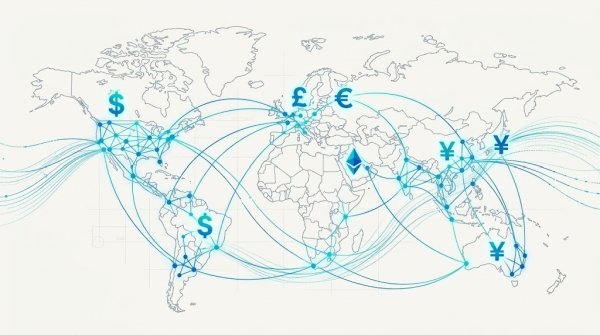
On September 8, 2026, Circle agreed to acquire Tazapay, a Singapore headquartered B2B payments company serving payment providers and financial institutions. Circle says Tazapay brings more than US$25 billion in annualized payment volume, 60+ banking and fintech partners and payout connections across 100+ markets. Approximately 60% of its transaction volume involves stablecoins.
The US$400 million transaction will be paid in Circle Class A shares, subject to specified adjustments. Circle signed the agreement on September 4 and expects it to close in 2027 after required approvals, including approval from the Monetary Authority of Singapore. The acquisition has not closed.
Tazapay was already a Circle Payments Network design partner, and Circle Ventures led an extension of its Series B in March 2026. Circle is now acquiring to own a company that connects stablecoin settlement with local banking, FX and payout access.
Tazapay connects businesses to international collections, local payouts, foreign exchange and stablecoin conversion. Its payments platform supports card payments from 170+ countries, local payment methods in 100+ countries, payouts across 100+ countries and balances in 40+ currencies.
Its operating scale has grown quickly. In August 2025, Tazapay reported more than US$10 billion in annualized volume, 300% annual growth and operational breakeven. Circle reported more than US$25 billion in annualized volume as of July 31, 2026.
Tazapay's Series B reached US$36 million after Circle Ventures led the March extension. So going from payment partner to investor to proposed owner gives Circle more direct control over a business already connecting digital dollars with conventional payment systems.
Stablecoins can settle value across borders, but businesses usually receive and spend local currency. Circle Payments Network reflects that model. Payout partners convert stablecoins to fiat for local delivery, while Circle provides USDC settlement and network routing. Circle's payout network already includes Tazapay and other regional providers.
Circle is also connecting external networks rather than owning every payout route. In May 2026, Nium joined Circle Payments Network with payout infrastructure spanning more than 190 countries and 100 currencies. That partnership gives Circle substantial reach without an acquisition. In Tazapay's case, Circle is paying US$400 million to bring part of that payment capability inside the company.
Circle says roughly 60% of Tazapay transaction volume involves stablecoins. Tazapay describes its stablecoin service as payment and conversion through onramps and offramps, so the figure does not mean 60% of transactions run entirely onchain. Stablecoins may handle settlement while customers still enter or leave through fiat.
Other large payment companies are making similar acquisitions. Stripe completed its purchase of Bridge in 2025, Ripple agreed to acquire Rail for US$200 million, and Mastercard completed its acquisition of BVNK in August 2026. Mastercard explicitly described the deal as connecting digital assets with traditional payment rails. Taken together, a competitive market is forming around the links between stablecoins, banks, FX and local payments.
NCFA's Programmable Stablecoin Payments highlights the same commercial opportunity opening around payment routing, treasury, reconciliation, compliance and bank integration around stablecoin settlement rather than simply issuing another token.
Tazapay has a direct Canadian operating connection. Tazapay Canada Corp. is registered with FINTRAC as a money services business and with the Bank of Canada as a payment service provider under the Retail Payment Activities Act. Tazapay says the Canadian entity handles foreign exchange, fund transfers and virtual currency activity, and provides its stablecoin payment and conversion services. However, Circle has not disclosed a specific role for Tazapay Canada Corp. post acquisition, and therefore should not be treated as automatically giving Circle new Canadian permissions.
The more immediate Canadian relevance is commercial. Tazapay already connects stablecoin settlement with fiat conversion and local payout access. Canadian fintechs serving international businesses face the same need to connect digital money with bank accounts, FX, compliance and usable local payment methods.
Stablecoins can settle globally, but businesses still need banks, currencies and payout systems at either end. As those connections become more valuable, will the leading stablecoin companies keep renting access or increasingly own the rails?
 The National Crowdfunding & Fintech Association (NCFA Canada) is a financial innovation ecosystem that provides education, market intelligence, industry stewardship, networking and funding opportunities and services to thousands of community members and works closely with industry, government, partners and affiliates to create a vibrant and innovative fintech and funding industry in Canada. Decentralized and distributed, NCFA is engaged with global stakeholders and helps incubate projects and investment in fintech, alternative finance, crowdfunding, peer-to-peer finance, payments, digital assets and tokens, artificial intelligence, blockchain, cryptocurrency, regtech, and insurtech sectors. Join Canada's Fintech & Funding Community today FREE! Or become a contributing member and get perks. For more information, please visit: www.ncfacanada.org
 |  |  |
|---|---|---|
 |  |  |
Sep 8, 2026

Futures trading strategies are repeatable plans for entering, managing, and exiting a leveraged contract. The useful strategy is not the one with the most indicators; it is the one whose market condition, trigger, invalidation, position size, and exit process are clear before an order is placed. Leverage can increase exposure without improving the odds of being right, so risk design matters more than a dramatic setup.
This guide is for readers who want a structured way to compare futures approaches before using real capital. It focuses on decision rules, operational checks, and failure modes. It does not issue trade calls, promise returns, prescribe leverage, or give a universal stop-loss or position-size threshold. Futures may not suit every reader, and product rules differ by venue and jurisdiction.
A trading idea becomes a strategy only when it can be tested before and after execution. At minimum, write down the market condition, entry trigger, invalidation level, position size, and exit plan. If one of these is missing, the decision is often an opinion about direction rather than a repeatable method. The same framework underlies a practical guide to futures trading strategies: define the conditions and failure point before considering leverage.
| Strategy component | Question to answer before entry | Why it matters |
| Market condition | Is the market trending, ranging, or unusually volatile? | A setup can fail when the surrounding structure changes |
| Entry trigger | What observable event turns the idea into a trade? | Prevents entries based only on urgency or prediction |
| Invalidation | What price or condition shows the thesis is wrong? | Defines when the original premise no longer applies |
| Position size | How much can be lost if invalidation is reached? | Links exposure to the planned loss rather than available margin |
| Exit plan | How will profit, time, or changing conditions be handled? | Prevents improvisation after the position is open |
The order of operations matters. Start with the condition and invalidation, then calculate size. Choosing a large position first and searching for a stop later reverses the risk decision. A platform may show that a small margin requirement controls a large notional position; the account is exposed to the notional movement, not merely to the margin displayed on screen.
A trend pullback approach waits for a temporary move against an established direction and then looks for evidence that the original structure is resuming. Its central risk is mistaking a reversal for a pullback. Define the structure that must remain intact, such as a sequence of relevant highs and lows or a clearly observed support area. A price moving back toward that area is not enough on its own.
A breakout setup starts with a well-defined range or boundary. Instead of entering on the first move through the level, some traders wait to see whether the old boundary holds after the break. The retest can reduce the need to chase, but it also creates a second failure mode: price may continue without returning, or the apparent breakout may quickly fall back into the range. The rule should say what would count as acceptance, rejection, or no trade.
When price repeatedly turns inside a range, a range approach looks for entries near an edge and exits closer to the middle or opposite boundary. The premise fails when price accepts beyond the range. Range logic should not be applied automatically because a level held once or twice; the more often a boundary is tested, the more important it becomes to define what evidence would show the range is weakening.
Sometimes the strategy is to stay out. Scheduled data, funding settlements, contract expiry, technical outages, or thin liquidity can make fills and stops less predictable. Skipping a trade when the loss cannot be estimated is a valid risk decision, not a missed opportunity. A method that excludes uncertain conditions may produce fewer trades and a clearer review record.
The four families are not mutually exclusive, but mixing them without a written condition can create hindsight. A trader may call a position a breakout when it works and a pullback when it fails. Name the setup before entry so the result can be evaluated against the same rule.
Leverage changes the amount of exposure controlled with a given margin; it does not make a trade more likely to work. Estimated risk for a simplified linear contract can be represented as:
Position size x distance from entry to invalidation + expected fees and slippage
The formula is a planning aid, not a guarantee. Contract specifications, funding, mark-price rules, liquidation mechanics, and execution gaps can change the result. Check the venue's documentation and use assumptions that reflect the instrument rather than treating a generic calculator as precise.
Use a loss limit chosen before the trade and keep it separate from the platform's maximum leverage. The exact amount is personal and depends on capital, experience, and obligations; the important rule is that several losses should not force a change in behavior or create a liquidation emergency. If a wider invalidation distance increases the planned loss, reduce the position size or reject the setup rather than quietly accepting a new risk.
Liquidation is a venue risk-control event, not a planned exit. A position that only fails at liquidation gives normal volatility almost no room and may close at a worse price than expected. A planned invalidation should be meaningfully reached before liquidation becomes relevant, with enough available margin to account for ordinary movement and fees.
Use this process for any proposed position, regardless of whether the idea is trend, breakout, range, or event-driven:
The last step protects against a common mistake: judging a strategy from one win or one loss. A valid process can lose, and a flawed process can win by chance. Evaluation requires a documented set of comparable examples across different conditions.
Market dashboards can help a trader identify where attention and volatility are concentrated. A view of crypto market losers may reveal assets experiencing sharp declines, but a ranking does not explain whether the move reflects news, liquidation, thin liquidity, or a broad market shift. It is a starting point for investigation, not a short signal.
Before using a market ranking in a futures plan, check the instrument, venue, contract type, quote currency, time window, and available liquidity. A spot decline does not map perfectly to a perpetual-futures position, and the most visible loser may have a spread or funding profile that makes the trade unsuitable. Keep the market observation separate from the execution rule.
The same discipline applies to headlines and social commentary. A story can explain why a market moved without telling you where the move is invalidated or whether the contract can be traded at the displayed price. Use external information to update the condition, then return to the written plan and decide whether the setup still qualifies.
The most frequent futures errors are process errors: beginning with leverage, moving a stop farther away, treating margin as total risk, ignoring fees and funding, and trading every visible price move. A strategy should exclude most market noise. If every movement creates a reason to enter, the rule is probably describing emotion rather than a condition.
Jurisdictional protections, margin rules, fees, and product availability vary. Some contracts have funding payments, some have expiry, and some use mark prices that differ from the last traded price. Read the venue's terms and seek professional advice for questions about suitability, tax, or local regulation.
There is no universally best method. Trend, breakout, range, and avoidance approaches suit different conditions and can each fail. A useful strategy is one with defined conditions, invalidation, sizing, costs, and review rules.
Beginners can learn how futures work, but leverage, liquidation, and rapid price changes make the product high risk. Simulation or carefully limited practice can reveal operational mistakes before they become expensive. Learning the contract is not the same as being ready to trade it.
There is no universal answer. Choose exposure only after defining the loss you can accept, the invalidation distance, and the contract rules. The maximum offered by a venue is not a risk recommendation.
No. A strategy can have a high win rate while one large loss erases many small gains. Review the size of wins and losses, costs, drawdowns, execution quality, and performance across different market conditions.
When the market condition is unclear, liquidity is thin, an event can change the price faster than the plan can respond, or the loss cannot be estimated reliably. Waiting preserves the ability to evaluate a clearer setup later.
Futures trading strategies are useful only when they turn a market view into a complete decision: condition, trigger, invalidation, size, costs, and exit. Trend pullbacks, breakouts, ranges, and event avoidance each have a place, but none is permanently superior. Start with the loss you can explain, keep liquidation outside the plan, and review execution rather than celebrating isolated outcomes. In leveraged markets, a strategy is defined as much by the trades it rejects as by the trades it takes.
The National Crowdfunding & Fintech Association (NCFA Canada) is a financial innovation ecosystem that provides education, market intelligence, industry stewardship, networking and funding opportunities and services to thousands of community members and works closely with industry, government, partners and affiliates to create a vibrant and innovative fintech and funding industry in Canada. Decentralized and distributed, NCFA is engaged with global stakeholders and helps incubate projects and investment in fintech, alternative finance, crowdfunding, peer-to-peer finance, payments, digital assets and tokens, artificial intelligence, blockchain, cryptocurrency, regtech, and insurtech sectors. Join Canada's Fintech & Funding Community today FREE! Or become a contributing member and get perks. For more information, please visit: www.ncfacanada.org
| | |
|---|---|---|
| | |
Aug 29, 2026 | NCFA Fintech Whisperer | Digital Assets Blockchain And Tokenization, Competition And Market Structure, Regulation And Policy, Risk Compliance And Regtech, Lending Consumer Credit And BNPL, Cross Border Payments And FX, Digital Banking And BaaS, Capital Markets Infrastructure And Funding, Wealthtech Investing And Trading, Payments Infrastructure And Money Movement

Image: Freepik
This live weekly NCFA intelligence page tracks financial technology developments that significantly affect how fintechs build, sell, raise capital, and operate under scrutiny. Coverage prioritizes Canada and includes global events that directly influence competitive conditions, market access, and execution realities across fintech sectors. This page will be updated throughout the week with market movers in a live format and then each week we'll close the prior week's contents in prep for the upcoming week, and continue on a rolling basis. (Missed prior week's Fintech Whisperer? (December 6-12, 2025, December 13-19, 2025, January 1-9, 2026, January 10-16, 2026, January 17-23, 2026, January 24-30, 2026, January 31-February 6, 2026, February 7-13, 2026, February 14-20, 2026, February 21-27, 2026, February 28-March 6, 2026, March 7-13, 2026, March 14-20, 2026, March 21-27, 2026, March 28-April 3, 2026, April 4-10, 2026, April 11-17, 2026, April 18-24, 2026, April 25-May 1, 2026, May 2-8, 2026, May 9-15, 2026, May 16-22, 2026, May 23-29, 2026, May 30-June 5, 2026, June 6-12, 2026, June 13-19, 2026, June 20-26, 2026, June 27-July 3, 2026, July 4-July 10, 2026, July 11-July 17, 2026, July 18-24, 2026, July 25-July 31 2026, August 1-August 7, 2026, August 8-August 14, 2026, August 15-August 21, 2026, August 22-August 28, 2026).
This is a material step beyond the group's 2025 exploration phase. TD and Scotiabank are now participating in a global bank-led issuance venture while Canada's own stablecoin framework is still moving through implementation. The Canadian question is whether major banks build meaningful CAD-denominated digital-money capacity alongside domestic initiatives or gain scale first through shared global USD infrastructure.
Coinbase supplies the regulated trading and custody stack while Webull keeps the investor interface and brokerage relationship. That reduces the infrastructure brokers need to build themselves and gives specialist providers another route into Canadian retail distribution. It also intensifies Canadian crypto competition over who owns the customer and who supplies the regulated back end.
The useful proof is the cash leg. Tokenized securities have limited value if settlement still depends on separate legacy rails. This transaction puts the asset and payment legs onchain in a live regulated market environment, bringing programmable settlement closer to something institutions can actually use.
LSEG is extending tokenization from private markets and settlement infrastructure toward public equities. The harder test is whether tokenized shares can preserve legal ownership rights, corporate actions, price integrity and regulated settlement while gaining wallet portability and longer trading access. If that model works, public-market infrastructure begins competing directly with blockchain-native distribution without abandoning the protections of an exchange-listed security.
Coinbase is bringing regulated crypto derivatives distribution into Canada without routing the products through Coinbase Canada itself. The important boundary is eligibility as it expands access for sophisticated investors while keeping the offering outside ordinary retail availability. It also gives regulated venues a stronger alternative to offshore derivatives platforms for Canadian capital, hedging and price discovery.
The important development is bank ownership of shared tokenized deposit infrastructure, not the financing round. Cari is moving toward production with banks helping govern, fund and use the network while retaining the customer relationship. Alongside other shared bank blockchain infrastructure, the test is whether common digital money networks can achieve enough participation and interoperability to compete with institution specific systems.
Forty-three state licences give OpenPayd something infrastructure providers can't create through software alone: regulated geographic reach. The company can now connect its payment stack to a much larger U.S. operating footprint while combining fiat and digital asset permissions across the United States, United Kingdom and Europe. The test is how quickly that regulatory coverage converts into client activity and payment volume.
Final approvals put the transactions into execution. National Bank is positioned to absorb Laurentian's retail and SME relationships while Fairstone combines its commercial lending operations with Laurentian's commercial specialization. Customer migration, product continuity and retention now determine how much of the approved transaction value survives the transfer.
Singapore is converting stablecoin policy into the legal requirements issuers will operate under. The consultation advances the status tracked in NCFA's stablecoin regulatory intelligence from a finalized framework awaiting legislation toward implementation. Reserve, redemption, capital and cross-border requirements can now be tested against issuer economics before the rules are finalized.
The case makes privileged information a concrete event contract surveillance problem. Exchanges and brokers need controls that can connect unusual positions with access to confidential information, investigate suspicious activity and enforce trading restrictions. NCFA's regulated event contract infrastructure brief tracks this market integrity gap as distribution expands.
Section 311 can reach beyond a targeted foreign bank because U.S. institutions must also identify transactions routed indirectly through other correspondent relationships. Banks and payment firms therefore need enough counterparty visibility to detect the institution behind a payment chain, not only the correspondent presenting the transaction.
The investigation puts transaction monitoring and global compliance governance under direct supervisory scrutiny at a major cross-border payment provider. The operating test is whether controls identify known laundering typologies across high-risk channels and whether global decisions support local obligations. The eventual findings could provide useful evidence for how regulators assess AML controls across international payment networks.
Australia's AML expansion has reached the point where AUSTRAC is testing whether newly covered firms have entered the regulatory system at all. Service classification, enrollment and working AML controls can no longer remain implementation projects. Regtech providers also gain a much larger addressable compliance market, but buyers will need products matched to obligations regulators are actively checking.
Conditional approval advances Revolut from U.S. fintech distribution toward direct regulated banking capacity. Its U.S. business still relies on a partner bank, while NCFA's Revolut company intelligence had tracked the national bank application as pending. A completed charter would give Revolut more control over deposits, credit and payment connectivity, but the remaining federal approvals and preopening requirements still determine whether that capacity reaches customers in 2027.
OpenReserve is trying to combine conventional banking, tokenized deposits, digital asset custody and stablecoin infrastructure inside one national bank structure. Preliminary approval brings that model closer to regulated operating capacity, but the remaining test is execution: capital, controls, final authorization and separate approval for the planned stablecoin subsidiary still stand between the proposed structure and live customer activity.
TabaPay is trying to internalize regulated banking capacity rather than relying exclusively on sponsor bank relationships. Owning an OCC chartered bank could give the payments fintech more control over settlement, sponsorship, redundancy and difficult client use cases while retaining outside bank partners. The acquisition still requires regulatory approval, making the next test whether supervisors accept that vertical integration and its governance model.
A successful Swedish licence would turn Allica's international expansion from a funding plan into regulated market access. The bank now has to prove that its UK SME model can satisfy a new supervisor and compete in a concentrated, highly digital banking market. Approval would also give Allica a potential base for wider European expansion rather than requiring each new market to begin from the UK.
The US$3 billion target gives scale to the real time receivable funding model introduced in the United States this week. VersaBank is betting that faster access to bank balance sheet funding can take business from conventional securitization and warehouse structures. Fiscal 2027 will test whether partner demand converts into several billion dollars of new assets without weakening credit quality or funding economics.
The licence adds another authorized BNPL provider while reinforcing regulatory permission as a condition of market access in Saudi consumer finance. New entrants have to compete inside that perimeter, putting more weight on underwriting, merchant distribution, pricing and compliance execution once authorization is secured.
QR Ph is extending domestic interoperability into cross-border acceptance without requiring merchants to install another payment system. That reduces one of the practical barriers to international wallet acceptance, especially for smaller merchants. The competitive question is whether national QR networks increasingly become gateways through which global payment aggregators reach local commerce.
Agorá has crossed the real-money test identified in earlier Project Agorá testing. The harder questions now concern legal finality across jurisdictions, liquidity, interoperability and whether a shared multicurrency platform can reduce correspondent-payment friction at institutional scale without weakening central-bank control or commercial-bank money.
Banks are pushing deeper into stablecoins, tokenized deposits and direct control of payment infrastructure, while fintechs are trying to own more of the regulated stack themselves. The fight is increasingly over who controls the account, the customer relationship and the transaction flow.
NCFA offers various curated resources to help founders and investors stay current on developments that impact fintech markets. Get the weekly Whisperer and related market intelligence through NCFA's newsletter, view the latest fintech insights, industry research, or launch into emerging financial innovation opportunities.
The National Crowdfunding & Fintech Association (NCFA Canada) is a financial innovation ecosystem that provides education, market intelligence, industry stewardship, networking and funding opportunities and services to thousands of community members and works closely with industry, government, partners and affiliates to create a vibrant and innovative fintech and funding industry in Canada. Decentralized and distributed, NCFA is engaged with global stakeholders and helps incubate projects and investment in fintech, alternative finance, crowdfunding, peer-to-peer finance, payments, digital assets and tokens, artificial intelligence, blockchain, cryptocurrency, regtech, and insurtech sectors. Join Canada's Fintech & Funding Community today FREE! Or become a contributing member and get perks. For more information, please visit: www.ncfacanada.org
| | |
|---|---|---|
| | |
September 4, 2026 | NCFA Insight | Digital Identity And Trust, Digital Assets Blockchain And Tokenization, Regulation And Policy

On August 10, 2026, ICANN opened a consultation on alternative naming systems that could affect how blockchain based and other naming systems work alongside the global Domain Name System. Comments are open until September 21, 2026 at 23:59 UTC.
ICANN is the nonprofit organization that coordinates the global Domain Name System, including the rules for top level domains such as .com, .org and newer gTLDs. The consultation matters most to domain registries, Web3 naming providers, digital identity firms, wallet and payment companies, cybersecurity specialists and brands that could be affected if the same name appears across multiple naming systems.
ICANN is dealing with a problem that did not exist when the DNS was designed. Alternative naming systems can create names outside the global DNS, while registry operators and potential applicants in the 2026 New gTLD Program are now interested in using some of the same top level strings in both systems. If that happens, users need confidence that the same name is controlled by the same party wherever they encounter it.
ICANN has not approved a general integration model. Its Technical Study Group is testing whether the same gTLD string can operate in both the DNS and an alternative naming system without creating unacceptable security or stability problems. The current consultation asks whether the proposed technical requirements are strong enough.
The report focuses on what ICANN calls string+controller integration. In plain language, if the same name appears in both systems, the same party should control it in both. That relationship also has to remain intact when names are registered, transferred, suspended, expire or change hands.
That becomes especially important when a name is used for identity, wallets, payments or other digital services. A human readable name only helps if users can trust who is behind it. If control changes in one system but not the other, the same looking name could point to different parties.
For fintech and digital asset firms, the risk is less about domain mechanics and more about mistaken identity. A wallet name, payment identifier or digital identity and authorization system can become easier to use, but also easier to misunderstand if two systems recognize the same string without keeping ownership aligned.
Several registry operators and potential 2026 round applicants have already asked ICANN about this kind of integration. Reviewing similar technical questions one application at a time could become expensive and slow, particularly when requests are referred for additional technical review.
The Technical Study Group was created to develop common requirements that future applicants could work from. That would not guarantee approval, but it could make the process more predictable for registries deciding whether to build services that connect conventional domains with alternative naming systems.
The consultation also comes before another policy step. ICANN says proposed registry agreement language related to these services will be published for a separate public consultation. Comments submitted now can still affect the technical work before those contractual terms are finalized.
For domain registries, Web3 naming providers, digital identity firms, cybersecurity specialists, wallet providers and affected brands, the practical questions are already clear.
Should the same party always control both versions of a name? What happens if ownership changes in only one system? And what safeguards are needed so users can tell who they are actually dealing with?
Comments close September 21, 2026 at 23:59 UTC. Affected stakeholders can submit input directly to ICANN before the deadline.
Can the same name work across two systems without creating confusion over who controls it?
The National Crowdfunding & Fintech Association (NCFA Canada) is a financial innovation ecosystem that provides education, market intelligence, industry stewardship, networking and funding opportunities and services to thousands of community members and works closely with industry, government, partners and affiliates to create a vibrant and innovative fintech and funding industry in Canada. Decentralized and distributed, NCFA is engaged with global stakeholders and helps incubate projects and investment in fintech, alternative finance, crowdfunding, peer-to-peer finance, payments, digital assets and tokens, artificial intelligence, blockchain, cryptocurrency, regtech, and insurtech sectors. Join Canada's Fintech & Funding Community today FREE! Or become a contributing member and get perks. For more information, please visit: www.ncfacanada.org
| | |
|---|---|---|
| | |
September 4, 2026 | NCFA Market Activity | Lending Consumer Credit And BNPL, Digital Assets, Embedded Finance

On September 3, 2026, Toronto-based APX Lending launched a five-year crypto-backed line of credit that lets eligible borrowers pledge Bitcoin, Ethereum or both, draw funds, repay them and borrow again. APX says the facility supports borrowing up to 60% loan to value, with annual rates from 10.49% to 11.99% depending on the outstanding balance.
Interest applies only to money actually borrowed, with no charge on unused capacity. APX also says there are no origination, prepayment or liquidation fees. The biggest change from APX's existing fixed-term loans is that borrowers can use the credit line more than once. They can keep approved collateral in place, draw funds when needed, repay them and borrow again.
APX gives the example of C$200,000 of Bitcoin and C$100,000 of Ethereum supporting up to C$180,000 of borrowing at the maximum 60% LTV. Available credit changes with the value of the collateral, so a falling crypto market can reduce borrowing capacity quickly.
The basic idea will be familiar to anyone who has used a securities-backed line or borrowed against property. The difference is the collateral. Bitcoin and Ethereum trade around the clock and can fall sharply in a short period, which makes ongoing collateral management a much bigger part of the borrower experience.
For long-term crypto holders, the attraction is access to cash without selling the underlying asset. That can help with business funding, debt repayment or other liquidity needs, although borrowing costs above 10% mean APX still has to compete with conventional secured credit where borrowers have access to it.
APX begins warnings when a loan reaches 80% LTV. At 90%, collateral is partially sold until the loan returns to 85% LTV. APX introduced the 90/85 liquidation model in August and says there is no liquidation fee.
A borrower can still lose Bitcoin or Ethereum when prices fall. APX's approach changes how much gets sold once the threshold is reached rather than removing liquidation risk altogether.
Custody is part of the product design as well. The OSC decision granting APX exemptive relief says collateral held under the lending arrangement is not rehypothecated (not reused or lent out to other parties). APX says assets are held in segregated BitGo Trust cold-storage wallets. Client accounts are not protected by CDIC or the Canadian Investor Protection Fund.
The revolving line follows APX's July launch of embedded crypto lending with Netcoins. Eligible Netcoins users can access APX loans through the platform while APX supplies the capital, underwriting, collateral management, compliance and servicing.
APX therefore doesn't have to rely entirely on finding borrowers through its own brand. Exchanges and wealth platforms can potentially add crypto-backed credit without building the lending operation themselves. The new revolving facility has not been announced as a Netcoins product, so the partner channel and the new line should be treated separately for now.
Ontario's securities regulator granted APX time-limited exemptive relief for its crypto-backed lending model, with the decision extending to participating jurisdictions through Canada's passport system. The order covers Bitcoin and Ether collateral and sets conditions around custody, disclosure and account suitability. It is tailored to APX and expressly says the decision should not be treated as precedent for other applicants.
APX is entering a market where other Canadian platforms are experimenting with similar products. Shakepay's Bitcoin-backed credit line, launched in August, gives eligible Canadians another way to borrow against digital assets. Cayman-based Ledn also continues to offer Bitcoin-backed Dollar Loans in most Canadian provinces, although Quebec, New Brunswick, Nova Scotia and Saskatchewan are excluded. APX differs by supporting both Bitcoin and Ethereum and by offering a five-year revolving facility rather than Ledn's standard 12-month Bitcoin-backed loan.
One platform can own more of the lending relationship itself; another can plug into a specialist lender such as APX. For exchanges and wealth platforms, embedded credit creates a way to earn more from customers who already hold digital assets without forcing those customers to sell them.
Will crypto holders use Bitcoin-backed credit often enough to make it a mainstream secured lending product?
The National Crowdfunding & Fintech Association (NCFA Canada) is a financial innovation ecosystem that provides education, market intelligence, industry stewardship, networking and funding opportunities and services to thousands of community members and works closely with industry, government, partners and affiliates to create a vibrant and innovative fintech and funding industry in Canada. Decentralized and distributed, NCFA is engaged with global stakeholders and helps incubate projects and investment in fintech, alternative finance, crowdfunding, peer-to-peer finance, payments, digital assets and tokens, artificial intelligence, blockchain, cryptocurrency, regtech, and insurtech sectors. Join Canada's Fintech & Funding Community today FREE! Or become a contributing member and get perks. For more information, please visit: www.ncfacanada.org
| | |
|---|---|---|
| | |
Sep 4, 2026

What is Web3 gaming? It is a broad category of games that use a blockchain for some part of ownership, trading, identity, governance, or the game economy. A player might hold an item in a wallet rather than only in a publisher database. That feature can create new forms of portability and coordination, but it can also add wallets, fees, scams, volatile assets, and irreversible mistakes to an activity many people expect to be simple entertainment.
This guide is for players, researchers, and editors trying to understand what a Web3 label means in practice. It explains what may be on-chain, what remains controlled by the publisher, and how to evaluate the trade-offs before spending time or money. It does not rank games, recommend tokens or collectibles, or provide investment advice.
Web3 gaming is not an all-or-nothing category. A project may put a collection of items on-chain while keeping the game server, combat rules, moderation, and progression system centralized. Another may use a token for governance but keep all gameplay data in a conventional database. The useful question is not whether a game uses a blockchain somewhere; it is which part of the player experience is actually controlled by the player or verified by a public network. For a concise foundation, what is web3 gaming is best answered by mapping those specific functions instead of treating the label as a genre.
| Game element | Common Web2 approach | Possible Web3 approach | Question for a player |
| Items | Recorded in the publisher database | Some items represented by tokens in a wallet | What rights does the token actually grant? |
| Payments | Publisher controls in-game currency | Tokens or NFTs can be transferred externally | What are the fees and exit options? |
| Identity | Login managed by the publisher | Wallet-based identity, sometimes combined with login | What happens if the wallet is lost? |
| Governance | Publisher sets rules and content | Token or community voting covers selected decisions | Which decisions are truly subject to a vote? |
| Continuity | Access depends on the game service | Some assets may remain visible if one interface changes | Does the item still have utility without the original game? |
The word "ownership" also needs precision. Holding an NFT usually means controlling a token record under a contract's rules. It does not automatically grant copyright, a trademark license, access to a server, a guaranteed use in another game, or a right to future development. Those rights may be defined by a license, terms of service, or a separate account system.
An on-chain item can sit outside one account database and be transferred under the token's rules. That may support a secondary market, a player identity, or a collection that is visible across tools. Portability is only useful when another game or service recognizes the asset and knows what its data means. A transferable item with no compatible use is ownership in a narrow technical sense, not automatic utility.
Public transaction records can also make parts of an economy easier to inspect. A reader may be able to observe supply, wallet concentration, transfers, or selected contract rules. This can improve transparency, but it does not make the economy fair by itself. A contract may still be upgradeable, a marketplace may control the interface, and important gameplay data may remain private.
Governance tokens can give players a voice over selected decisions. In practice, voting power may be concentrated among large holders, delegated to a small group, or limited to parameters that do not affect the core experience. Ask what the vote can change, who can propose it, and whether the result is binding. A vote count is not the same as meaningful player control.
Token incentives may create new funding or creator models, but they also change the audience's motivation. A player who wants a game may be competing with participants focused on item resale or token appreciation. That can make prices, participation, and community behavior more volatile than the gameplay itself.
Web3 features add operational steps. A player may need a wallet, a network choice, a transaction fee, an approval, and a marketplace account. Each step creates room for a wrong address, fake link, private-key theft, or an irreversible signature. A custodial onboarding flow can reduce some friction while increasing dependence on the provider. Neither model removes the need to understand what an action authorizes.
Transaction economics can also change the value of an item. Consider a deliberately simple example: a player buys a $20 item, pays a $3 network fee, and later pays a 5% marketplace fee to sell at the same nominal price. The sale returns about $16 before any price change or tax. The arithmetic is not a forecast; it shows why displayed item prices do not equal the amount a player can recover.
Liquidity is another constraint. A marketplace floor is an asking price, not a guaranteed buyer. When interest fades, the highest visible listing may be far above the price at which a sale would actually clear. A token can lose liquidity while the game remains playable, and the reverse can happen as well. Treat marketability as a separate question from entertainment value.
Smart contracts, bridges, marketplaces, and game servers can fail independently. An on-chain item may remain visible in a wallet while the game that gave it meaning shuts down, changes its rules, or removes its server access. A blockchain record can persist while practical utility disappears. This is why "you own the asset" is not a complete explanation of the player outcome.
Use the following sequence to separate a playable product from a token pitch:
This framework keeps the article's central question in view: does the on-chain feature improve the player experience enough to justify its added complexity? A game can be legitimate and still not suit a particular player. The decision should depend on the experience and rights, not on the label alone.
Market context can help explain why a game token is attracting attention, but it cannot measure whether the game is well designed. A token that appears among crypto market gainers may be reacting to a listing, a partnership announcement, thin liquidity, or speculative positioning. The ranking is a prompt to investigate the event and the market structure, not proof that players are adopting the game.
Check the pair, quote currency, time window, volume, and available liquidity before drawing a conclusion. A large percentage move in a shallow market may represent a small amount of capital. Conversely, strong player activity may not immediately appear in a token ranking if the project uses a custodial economy or has no liquid token. Keep game research and market research as related but distinct tasks.
The same distinction applies to community sentiment. A crowded chat can show that a launch is visible, not that the product is sustainable. Look for retention, repeat play, clear updates, and evidence that the economy works for ordinary players. If the only durable demand appears to come from recruiting new buyers, market risk may be replacing game design.
Web3 gaming is best understood as a bundle of design choices rather than a single genre. The same project can offer genuine player ownership in one area while retaining centralized control in another. Rights, fees, wallet security, server access, and token liquidity vary by project and jurisdiction. Read the game's terms, marketplace rules, and wallet prompts before making a consequential decision.
Not always. Some games offer custodial accounts, free starter items, or sponsored transactions. Others require a wallet and network fees. Check the actual onboarding flow instead of assuming the label tells you what is required.
No. You may control the token record while the publisher controls the game, servers, trademarks, and utility. The rights depend on the contract and the project's terms.
Only if the other game chooses to recognize the asset and can interpret its data. On-chain transferability does not create automatic gameplay compatibility.
They can expose a player to market risk, but a token or item is not automatically a sound investment. Prices, liquidity, fees, and utility can change, and the purchase may be better treated as entertainment or speculation.
What is Web3 gaming? It is gaming with selected ownership, payment, identity, governance, or economy functions connected to blockchain systems. The meaningful analysis is not how many tokens a project issues, but what the player can actually control, transfer, use, and recover.
Play the core game, map the control boundaries, calculate the friction, and test what survives when prices stop rising. That approach keeps technology in perspective and leaves room to enjoy a game without mistaking a market narrative for a guarantee.
The National Crowdfunding & Fintech Association (NCFA Canada) is a financial innovation ecosystem that provides education, market intelligence, industry stewardship, networking and funding opportunities and services to thousands of community members and works closely with industry, government, partners and affiliates to create a vibrant and innovative fintech and funding industry in Canada. Decentralized and distributed, NCFA is engaged with global stakeholders and helps incubate projects and investment in fintech, alternative finance, crowdfunding, peer-to-peer finance, payments, digital assets and tokens, artificial intelligence, blockchain, cryptocurrency, regtech, and insurtech sectors. Join Canada's Fintech & Funding Community today FREE! Or become a contributing member and get perks. For more information, please visit: www.ncfacanada.org
| | |
|---|---|---|
| | |
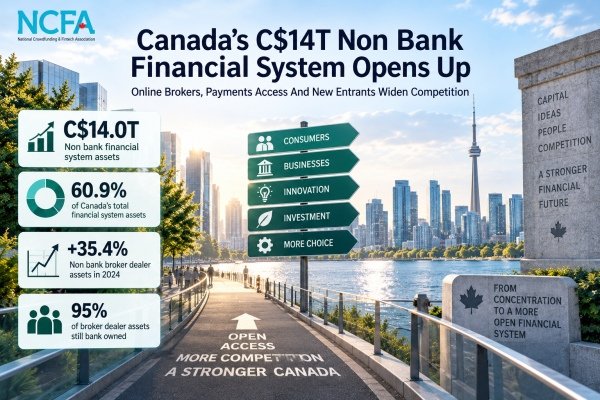
On September 3, 2026, Bank of Canada staff released new non bank finance data showing that Canada’s non bank financial sector held C$14.0 trillion in assets at the end of 2024, equal to 60.9% of the financial system. The Bank's broad definition includes pension funds, insurers, investment funds, financial auxiliaries and other intermediaries. Much of the 2024 increase also came from stronger market valuations.
The headline number is only part of the story. Faster growth is appearing in narrower bank like activities, online brokerage and specialty finance, while commercial banks still retain enormous asset and distribution advantages.
Canada already had a huge financial system outside deposit taking banks. What's changing is how customers reach it, where credit can originate and how many firms can compete for data, payments, investing and banking services.
Canada already had a vast financial system outside banks before fintech took off. Pension funds, insurers and investment funds have held enormous pools of financial assets for decades. The Bank says non bank assets have grown at an average annual rate of 6.9% since 2010.
The C$14 trillion also grew faster in 2024 because markets rose. Other investment funds increased 18.8%, pension assets rose 9.6% and insurance assets rose 9.8%. The Bank attributes much of that growth to stronger valuations.
Fintech arrived inside a financial system that was already enormous. Since then, investing has become easier to distribute online, more credit products have appeared outside traditional bank lending, payment firms have gained access to national infrastructure and financial data is being opened to approved competitors. Customers now have more ways to reach financial products without starting at a bank branch.
Online brokerage is one of the clearest changes in the Bank's data. Non bank broker dealer assets grew 35.4% in 2024, and the Bank says online brokers drove the increase.
Digital investing can win customers quickly because opening an account, moving cash and buying securities no longer requires the same physical distribution network.
The incumbents are nowhere close to disappearing. Non bank firms account for only about 5% of Canada's broker dealer assets. Bank owned broker dealers hold the other 95% of those assets.
The contrast is striking. Challenger activity is changing customer behaviour much faster than it is changing institutional asset share.
A Canadian can now invest through a digital broker, buy an ETF, hold cash inside an investing app and compare financial products without spending much time inside a traditional branch. The banks still own enormous distribution and balance sheet capacity. They no longer own every customer entry point.
Specialty finance has grown quietly beside the banks. Finance companies represent 11.8% of the narrow non bank measure and grew 7.1% in 2024. Statistics Canada includes consumer lending, corporate lending, leasing, mortgage investment corporations and mortgage finance corporations in its non bank credit work.
The official statistics have also expanded over time to capture newer models such as buy now pay later financing.
A mortgage can start outside a bank and still end up inside one. Mortgage finance corporations can originate loans through brokers and then sell them to regulated financial institutions. A borrower may meet a non bank lender first while a bank later funds or owns the mortgage.
Competition and cooperation can exist in the same transaction.
Canadian finance is becoming more distributed without becoming neatly divided into banks on one side and challengers on the other. Origination, funding, servicing, securitization and ownership can happen at different institutions. That makes the system more competitive in places and more interconnected at the same time.
Private credit shows the same Canadian pattern. Non bank loans have supplied about 15% of external funding for Canadian non financial businesses for roughly a decade. Private credit has not rapidly replaced domestic bank lending.
Canadian institutions are still heavily involved. The Bank estimates that private lending by Canadian investors plus Canadian bank lending to private credit funds totalled about C$500 billion around the beginning of 2026, with most of the activity in the United States.
Canadian pensions, insurers and banks know the asset class well. Much of the capital is simply being deployed elsewhere.
That divide is already visible in Canada's C$500 billion private credit exposure. Canadian institutions have substantial capacity to invest in private lending, while Canadian businesses still depend much more heavily on banks and public debt markets.
Payments access is opening to firms that historically could not participate directly. Payments Canada says registered payment service providers can now apply for membership and Real Time Rail participation. Wise, KOHO, Float, Paramount Commerce and Brim were among the first PSP members admitted in 2026.
The Real Time Rail is scheduled to launch in the fourth quarter of 2026 with instant clearing and settlement and support for direct PSP participation.
Financial data is opening too. Canada's consumer driven banking framework makes competition an explicit objective and creates accreditation routes for regulated financial institutions and registered payment firms.
Approved providers will be able to request customer permissioned financial data instead of relying on screen scraping or proprietary bank connections.
The opening of Canada's payments system now extends into consumer driven banking. A challenger with payment access and customer approved data has more room to build a financial relationship without depending on an incumbent for every connection.
In June, OSFI launched a streamlined approvals framework for targeted new entrants. It covers eligible credit unions and firms with technologically innovative or emerging banking models.
OSFI is aiming for a clearer three phase process and a targeted 12 month review after a complete formal application is accepted.
Foreign banks already have a formal route into Canada. OSFI assesses applications for full service and lending branches and recommends eligible applications to the Minister of Finance.
Entry is still tightly supervised. Capital, liquidity, governance, business plans, home country supervision, security and risk management remain part of the approval process.
A firm that qualifies for federal entry can pursue much more than a better financial app. Regulated banking capacity, payment access and customer approved data can put more of the customer relationship inside the challenger itself. The requirements remain demanding, but the route is clearer.
Securities rules are changing at the same time. The Canadian Securities Administrators has expanded the Listed Issuer Financing Exemption, allowed eligible venture issuers to adopt semi annual reporting and introduced other measures intended to reduce financing and disclosure friction.
In July, the CSA said more than 10% of eligible companies had already opted into semi annual reporting and that significant capital had been raised under the expanded exemption.
More financial assets do not automatically create more productivity. A pension portfolio can rise because markets rise. A fund can buy existing securities. Canadian institutions can invest abroad. None of those outcomes guarantees more financing for a Canadian company trying to commercialize technology, buy equipment or scale internationally.
That allocation question runs directly into whether Canada can turn financial access into productive participation.
The C$14 trillion headline makes the productivity problem harder to dismiss. Canada is not short of financial assets. The harder question is whether more of the system can connect viable Canadian businesses with capital on terms that let them invest, grow and compete.
The Bank itself recognizes the upside. Its paper says these non bank firms can foster innovation, increase competition, serve underserved markets and improve financial system efficiency.
The same activities can also carry leverage and transform credit or liquidity in ways that spread stress through funds, dealers and financing markets. More activity outside bank balance sheets can distribute risk while making some connections harder to see.
The Bank's 2026 work on private credit and market based finance reflects that concern without treating every non bank institution as a threat.
As activity spreads across funds, dealers, lenders and platforms, risk travels with it. Credit, liquidity, customer data and operating dependencies become harder to follow when they are shared across more institutions. Regulators have to preserve the benefits of wider competition while keeping those connections visible.
Banks still anchor the system. Their share of total financial system assets barely changed in 2024. They still dominate broker dealer assets, business lending, deposits and many of the funding relationships behind non bank finance.
The starting points are multiplying. Online brokers compete for investors. Specialty lenders compete for borrowers. PSPs can gain direct payment access. Approved providers can compete around financial data. Eligible new entrants can pursue federal regulation through a clearer process.
Canada's banks remain deeply entrenched, but more of the financial activity around them is open to competition. Incumbents keep the scale while challengers gain more ways to reach customers, move money, originate credit, raise capital and, in some cases, become regulated institutions themselves.
Talking Point
Canada already has C$14 trillion of finance outside traditional banks. More firms are now gaining ways to compete for customers, payments, data, credit and regulated entry while the banks remain dominant.
The National Crowdfunding & Fintech Association (NCFA Canada) is a financial innovation ecosystem that provides education, market intelligence, industry stewardship, networking and funding opportunities and services to thousands of community members and works closely with industry, government, partners and affiliates to create a vibrant and innovative fintech and funding industry in Canada. Decentralized and distributed, NCFA is engaged with global stakeholders and helps incubate projects and investment in fintech, alternative finance, crowdfunding, peer-to-peer finance, payments, digital assets and tokens, artificial intelligence, blockchain, cryptocurrency, regtech, and insurtech sectors. Join Canada's Fintech & Funding Community today FREE! Or become a contributing member and get perks. For more information, please visit: www.ncfacanada.org
| | |
|---|---|---|
| | |



August 26th, 2025

January 4th, 2024

June 1st, 2021

September 9th, 2020

July 9th, 2018

January 3rd, 2018

September 25th, 2017

June 20th, 2017

May 10th, 2017

December 14th, 2016
