





Karsten Wenzlaff, Advisor
August 26th, 2025
Karsten Wenzlaff is a Crowdfunding and Fintech Expert from Germany. He is Secretary-General of Digit[...]


Strategic Planning | Nov 28, 2025

Image: Freepik/rawpixel.com
2026 is approaching and fintechs are entering the new year with clear signals on how capital is being deployed, how financial institutions are investing in automation and AI driven capabilities and which policies will shape financial infrastructure. Markets place a higher premium on efficiency, governance and resilience as financial institutions modernize data access and digital settlement. Retail investor participation also expanded as equity crowdfunding set new records in Canada, strengthening another channel of capital formation.
United States tariffs and interest rate expectations continue to influence capital costs and enterprise demand across North America. Singapore FinTech Festival 2025 recently wrapped and outlined what global leaders expect over the next decade. This article provides an overview of how these forces intersect and will impact 2026 conditions, helping fintechs define runway, product plans and investor alignment for the year ahead.
Global investors concentrated capital into fewer fintech companies through 2025. KPMG tracked $44.7B across 2,216 global fintech deals and reported stronger momentum in digital assets and AI powered platforms. The global fintech funding review for 2025 notes uneven performance across payments and infrastructure and continued strength in digital asset investment. AI influence extends across every funding stage and drives the clearest premium in investor behaviour.
Canadian fintechs raised about $1.62B across 60 deals. KPMG data reported by Lexpert shows a steep decline from record 2024 levels as investors became more selective and disciplined. KPMG’s H1 2025 report confirms the trend toward fewer large cheques and more careful deployment.
CVCA reported $2.9B across 254 Canadian VC deals with average cheque sizes near $11.4M. The VC deployment across Canada in H1 2025 reported that early stages represented more than half of deal count but only 10% of dollars. NCFA’s seed review shows AI companies raising about $24M across 12 early stage rounds and fintech attracting about $9M across pre-seed and seed combined in the seed investing trends in H1 2025.
Canadian founders also turned to retail investors through regulated equity crowdfunding channels. FrontFundr, a leading Canadian investment crowdfunding platform, enjoyed a banner year raising CAD $68.3M across 66 campaigns in 2024 with 4,226 individual investments, its strongest year on record. This growth in community capital raising speaks volumes that diversified sources of early stage capital can complement VC allocations during selective cycles. For fintechs, retail participation can help extend runway, validate demand and reduce dependence on a small number of institutional investors.
AI remains the strongest source of valuation strength across the fintech sector. NCFA’s analysis shows that AI fintechs attract a 242 valuation premium compared with non AI peers. This tells fintechs that investors reward automation, accuracy and data advantage even during slower deployment cycles. AI's impact will continue to drive product development strategy, unit economics and growth planning for 2026.
Open banking moves into implementation. Budget 2025 commits to a consumer driven banking framework that designates the Bank of Canada as the supervisor for accredited participants and sets rules for data access, liability, security and technical standards. The consumer driven banking framework in Budget 2025 changes data mobility from one off arrangements to regulated data rails. These data rails also support AI adoption because models require secure access to high quality data. Fintechs that prepare for accredited access and safe data workflows will gain an advantage as institutions deploy AI into risk, compliance and customer operations.
Fintechs should expect accreditation activity, testing and early stage integrations as technical standards move toward production readiness through 2026.
Retail Payment supervision is operational and supports future access to real time settlement. Under the Retail Payment Activities Act, the Bank of Canada supervises payment service providers to ensure operational resilience and safeguarding of client funds. This oversight creates the regulatory foundation required for participation in core payment systems. Payments Canada continues development of the Real Time Rail (expected Q2 2026), while the Bank’s commentary on cashing in on payments innovation explains how regulation strengthens competition and prepares the foundation for modernized settlement. It also sets the operational standards that AI systems must meet for real time fraud detection, liquidity monitoring and compliance automation. Fintechs should plan for higher compliance expectations in 2026 and a clearer pathway into national payment systems once real time settlement becomes available.
Stablecoin regulation advances. Canada released the first draft of its federal stablecoin legislation which sets out rules for high quality reserves, custody, redemption, disclosures and prudential oversight. NCFA’s summary of the first draft of the Stablecoin Act outlines a government framework that brings fiat backed stablecoins into a supervised environment. As tokenized settlement expands, AI will move deeper into treasury, reconciliation, fraud control and settlement routing. Fintechs that design early AI enabled settlement workflows will operate more efficiently under these rules. Fintechs involved in digital money, cross border payments or tokenized settlement should expect stronger regulatory clarity across 2026.
Climate and sustainability disclosure remains paused. CSA halted its mandatory climate disclosure rule in April 2025 and signalled the pause will continue. Although the rule is on hold, enterprise buyers and investors still assess climate and transition risk data during diligence. The CSA climate disclosure update notes that existing materiality rules and OSFI Guideline B-15 still apply through 2026. AI plays a growing role in climate analytics and transition planning, which means fintechs that use AI for risk scoring and scenario work will offer enterprise buyers more actionable intelligence during diligence. Fintechs should assume voluntary disclosure is expected even without a formal mandate.
Competitiveness pressure remains. Bank of Canada leadership warns that slow progress on open data, payment modernization and digital infrastructure affects productivity and innovation. Reuters coverage of the warning on over regulation and competitiveness highlights the need to accelerate foundational reforms. AI impacts that competitiveness gap because institutions deploy AI into fraud detection, lending, treasury and customer workflows. Fintechs that use AI with strong governance will operate more efficiently, support regulated environments and scale faster when data access and payment rails modernize.
For fintechs, these signals point to regulated data access, modern payments and digital assets becoming the highest value infrastructure themes for 2026..
Fintechs operating in the North American economy are being impacted by United States tariffs, rate decisions and political volatility. United States imposed tariffs cut Canada’s projected GDP growth to about 1.4% in 2025 and 1.6% in 2026, according to IMF linked projections. These estimates reflect weaker demand and reduced investment appetite across export dependent sectors. Fintechs should treat tariffs as a structural constraint for 2026, not a short term shock.
Markets now expect the Federal Reserve to cut rates in December. Polymarket shows an 87% chance of a 25 point rate cut, based on more than $183M in trading volume, which reflects strong real time sentiment. Economists still expect only small rate cuts through 2026, with United States growth around 2% and inflation near 2.6%. Fintechs may receive some cost of capital relief but investors will continue to expect efficient spending, strong revenue performance and clear evidence of product viability at today’s cost structure.
Canadian monetary authorities modeled the tariff impact and warned that trade friction could reduce investment by about 12% and lower output by almost 3% over two years. The Bank’s scenario work on tariffs and structural change supports planning for lower investment and slower recovery.
Fintechs should prepare for slower enterprise procurement cycles and more selective purchasing behavior.
Global growth projections dropped to about 2.8% in 2025 as tariffs spread and trade tensions widened. Export Development Canada’s global economic outlook for 2025 and 2026 forecasts Canadian growth around 0.8% in 2025 and 1.1% in 2026. Fintechs should expect slower demand, higher operating costs and more uncertainty across key trading regions.
An MIT study released in 2025 shows that about 12% of United States jobs could be automated using current AI tools today. As AI pressure intensifies it drives enterprise demand for automation, cost control and compliance. It also accelerates talent scarcity and raises expectations for governance and model transparency across financial services.
Global regulatory fragmentation expands. The EU AI Act, United Kingdom digital regulation, Singapore AI governance frameworks and China data sovereignty rules all diverge. If fintechs want to scale internationally in 2026, they must build modular compliance, auditability and data governance into core architecture.
SFF 2025 provided a clear view into the next cycle of fintech infrastructure and the capabilities that institutions expect. The SFF 2025 blueprint for the next decade of finance placed AI, tokenized settlement, quantum readiness and talent at the centre of global financial transformation for the coming years.
AI moved into production across onboarding, monitoring, underwriting and support. Financial institutions showed mature applications that reduce fraud, improve accuracy and accelerate customer workflows. Tokenized finance advanced as central banks and major institutions tested tokenized settlement assets, wholesale CBDCs and regulated stablecoins. These experiments are clear move from demos towards infrastructure design.
Quantum readiness entered strategic planning as banks prepared for post quantum cryptography and assessed their high value data inventory.
Talent emerged as one of the most constrained resources, with strong demand for cybersecurity, data and AI capabilities.
2026 will reward fintechs that integrate AI into their core stack, design products that support tokenized workflows, build quantum safe readiness and hire for digital infrastructure skills that support resilience and scale.
| Canada Policy Shifts That Drive 2026 Strategy | ||
|---|---|---|
| Open Banking Readiness | Canada moves to regulated data rails with accreditation and Bank of Canada oversight. | Build accredited data access readiness now. This creates a major advantage when banks and credit unions adopt regulated data sharing in 2026 and gives fintechs a lead when institutional partners demand safe integration. |
| Payment Supervision Alignment | Retail Payment Activities Act supervision is active and PSPs prepare for Real Time Rail participation. | Raise operational standards to meet supervision requirements. This clears the path for Real Time Rail access when available and strengthens partnership credibility with banks that expect higher resilience from PSPs. |
| Stablecoin Compliance Design | Canada released the first draft of the Stablecoin Act with rules for reserves, custody and redemption. | Design compliance into digital money products now. This avoids costly retrofits when rules finalize and positions fintechs for early participation in tokenized settlement experiments that banks support across 2026. |
| Transition And Climate Disclosure | CSA paused mandatory climate disclosure but investors still expect transition data in diligence. | Maintain credible voluntary disclosure. This reduces diligence friction with investors and large institutions that rank climate and transition data as core risk inputs even without a mandate. |
| Capital Conditions For Canadian Fintechs | ||
| Runway Discipline | Canadian funding normalizes with more selective deployment and fewer large rounds. | Plan 18 to 24 months of runway. This protects valuations and gives Canadian fintechs flexibility during slower deployment cycles and longer diligence timelines. |
| Revenue Quality First | Investors reward revenue durability as rates in the United States and Canada change slowly. | Increase margins, retention and customer lifetime value. This strengthens funding outcomes and signals that the business performs at today cost of capital. |
| Diversified Capital Routes | Equity crowdfunding reached record levels with rising retail participation in Canada. | Use investment crowdfunding to extend runway and validate market demand. This reduces reliance on a small number of venture investors and supports growth during selective funding cycles. |
| AI As The Primary Driver Of Competitiveness | ||
| AI As Core Infrastructure | SFF 2025 showed AI runs onboarding, risk, fraud and support in production. | Automate core work and improve accuracy. This reduces cost, raises product reliability and strengthens enterprise trust when selling into Canadian banks and credit unions. Remember, AI fintechs receive a valuation premium because automation and accuracy improve economics at every growth stage. |
| Model Governance Strength | Institutions expect clear model behaviour and explainability before integration. | Document lineage and monitoring with precision. This increases procurement success and accelerates enterprise adoption when institutions face rising AI governance requirements. |
| AI Driven Efficiency | Canadian enterprises invest in automation as budgets remain tight. | Replace manual workflows with AI to lower operating cost. This strengthens margins during slower growth and improves investor confidence. |
| Tokenized Settlement And Security Readiness | ||
| Tokenized Settlement Readiness | Banks and central banks test tokenized deposits and wholesale CBDCs. | Design workflows that support tokenized settlement. This prepares Canadian fintechs for early pilot participation when infrastructure tests expand in 2026. |
| Quantum Safe Architecture | Institutions begin planning for post quantum encryption. | Inventory sensitive data and adopt cryptographic agility. This protects long term assets and reduces future migration cost for Canadian fintechs selling into regulated environments. |
| Trade, Tariffs And Canadian Procurement Conditions | ||
| Adjusted Sales Cycles | Tariffs reduce Canadian investment and slow enterprise buying. | Extend sales cycle assumptions and build conservative forecasts. This improves cash planning and prevents burn surprises when procurement slows across regulated sectors. |
| Cost And Risk Value Propositions | Global growth slows and Canadian enterprises protect budgets. | Lead with measurable savings and risk reduction. This increases purchase probability in cost constrained environments and improves sales success during slow demand cycles. |
As the close of 2025 nears, fintechs operate in a world where capital rewards evidence first, and where AI driven performance gains receive premium valuation only when they improve accuracy, automation or margins. Fintech policy advancement in Canada moves forward on open banking, payments and stablecoins and these developments create new regulated rails to build on. Tariffs, interest rates and slower global growth increase the need for financial discipline and durable revenue streams. Retail investors also became more active in 2025 as equity crowdfunding set new records, giving Canadian fintechs another way to raise capital when venture funding is more selective. SFF 2025 highlighted the technologies that will shape financial infrastructure for the next decade.
Fintechs that align their strategy with the forces that matter, including AI, regulated data access, modern payments, tokenized settlement and stronger governance, will be better positioned to raise capital, win enterprise partnerships and scale through uncertainty.
 The National Crowdfunding & Fintech Association (NCFA Canada) is a financial innovation ecosystem that provides education, market intelligence, industry stewardship, networking and funding opportunities and services to thousands of community members and works closely with industry, government, partners and affiliates to create a vibrant and innovative fintech and funding industry in Canada. Decentralized and distributed, NCFA is engaged with global stakeholders and helps incubate projects and investment in fintech, alternative finance, crowdfunding, peer-to-peer finance, payments, digital assets and tokens, artificial intelligence, blockchain, cryptocurrency, regtech, and insurtech sectors. Join Canada's Fintech & Funding Community today FREE! Or become a contributing member and get perks. For more information, please visit: www.ncfacanada.org
 |  |  |
|---|---|---|
 |  |  |
AI Innovation | Nov 26, 2025

Image: Freepik/DC Studio
On November 24 2025, the United States introduced the Genesis Mission by presidential executive order to create a national plan to use AI to accelerate scientific discovery by turning federal scientific data and national lab supercomputers into one research engine. The Mission instructs the Department of Energy to bring together national lab compute systems, decades of federal datasets, and advanced AI tools into a unified discovery platform.
The United States invests about $940B each year in total R&D across business, academic, and government sectors. Federal agencies perform roughly $74B of that work according to National Science Board data showing total U.S. R&D and federal R&D performance. The Genesis Mission uses this large research base to speed up discovery and strengthen national competitiveness.
Federal leaders say scientific progress has slowed. Research in biotechnology, materials science, clean energy, and other fields takes too much time and requires significant resources. The Genesis Mission will use artificial intelligence to help researchers simulate experiments, test ideas, and find scientific patterns faster.
Federal scientific datasets include information from the Department of Energy open data portal, National Institutes of Health scientific data resources, NASA Earth science and satellite data, NOAA climate and environmental datasets, Environmental Protection Agency public data, and the United States Geological Survey geological data platform. These datasets include physics records, biological data, climate observations, satellite readings, environmental measurements, and outputs from high performance computing systems.
Artificial intelligence can examine large datasets, run simulations, detect scientific relationships, and support experiment design. The White House states that the Mission will “harness Federal scientific datasets, the worlds largest collection of such datasets, developed over decades of Federal investments” to accelerate discovery through new scientific models.
The Mission targets strategic fields such as semiconductors, quantum science, fusion energy, biotechnology, advanced manufacturing, and critical materials. Federal leaders link this work directly to national security and economic strength.
Federal documents describe the Genesis Mission as a national platform that brings government, industry, and academic researchers into one discovery system. The Department of Energy states that the Mission “will mobilize the Department of Energy’s 17 National Laboratories, industry, and academia” to build an AI enabled discovery platform that uses national lab supercomputers and curated federal datasets as described in the Department of Energy announcement of the Genesis Mission.
The executive order also defines the American Science and Security Platform as infrastructure that includes high performance computing, advanced AI models, secure access to federal and synthetic datasets, and tools for AI assisted experimentation. These documents show that the United States intends to create structured pathways for companies and researchers who need access to national compute systems and curated scientific data.
The United States holds a large base of scientific data created through national laboratory work and federal research. These datasets often sit in separate systems. The Genesis Mission brings this information together and connects it to artificial intelligence tools. This gives the United States a clear advantage in fields that rely on data and high performance computing.
Artificial intelligence can help researchers test ideas faster, explore scientific patterns, and move from manual processes to rapid model driven cycles. If the United States reduces discovery times across key scientific fields it can improve innovation strength and create more commercial opportunities.
Canada invests far less in R&D than the United States. The comparison below uses verified public data from the National Science Board, Statistics Canada, the OECD, and Canadian research analysis.
| Measure | United States | Canada | Sources |
| Total R&D spending | $940B in U.S. R&D spending | $55B in Canadian R&D spending 2024 | NSB, Statistics Canada |
| Federal R&D spending | $74B in U.S. federal R&D performance | smaller share inside the total figure | NSB, Statistics Canada |
| R&D intensity | above 3% in many measures | among lowest in G7 according to Canadian reporting on weak R&D intensity | University Affairs, OECD |
| Business R&D | strong private sector | weak according to research on structural gaps in Canadian business R&D | Checkpoint Research |
| Labour productivity | higher output per hour | persistent gap according to OECD reporting on Canada’s productivity | OECD |
This comparison shows the structural difference between the two countries. The United States enters the Genesis Mission with a large research base that artificial intelligence can accelerate. Canada enters with weaker investment and slower productivity growth.
Canada invests less in R&D than the United States and shows lower business led research compared with peer countries. A recent Canadian assessment ranks Canada near the bottom of advanced economies in business enterprise R&D intensity according to research that highlights Canada’s weak private sector R&D investment. Canada also has world class AI research centers such as Vector, Mila, and Amii, and they contribute strong scientific output. However they don't operate a national system that brings together federal datasets, high performance computing, and artificial intelligence for coordinated discovery.
These gaps limit Canada’s ability to compete against countries that build stronger national research infrastructure. If the United States speeds up discovery through a national artificial intelligence platform Canada may rely more on foreign systems and lose ground in advanced materials, biotech, quantum research, and energy.
The Genesis Mission gives the United States a new way to use scientific data, computation, and artificial intelligence to speed up discovery. It supports national security, innovation, and economic strength. For Canada it raises a serious challenge. Canada invests far less in R&D and lacks a unified artificial intelligence research platform. As the United States accelerates discovery Canada must decide how to strengthen the outcomes of its research base and protect its competitiveness in a world where artificial intelligence supports scientific progress.
The National Crowdfunding & Fintech Association (NCFA Canada) is a financial innovation ecosystem that provides education, market intelligence, industry stewardship, networking and funding opportunities and services to thousands of community members and works closely with industry, government, partners and affiliates to create a vibrant and innovative fintech and funding industry in Canada. Decentralized and distributed, NCFA is engaged with global stakeholders and helps incubate projects and investment in fintech, alternative finance, crowdfunding, peer-to-peer finance, payments, digital assets and tokens, artificial intelligence, blockchain, cryptocurrency, regtech, and insurtech sectors. Join Canada's Fintech & Funding Community today FREE! Or become a contributing member and get perks. For more information, please visit: www.ncfacanada.org
| | |
|---|---|---|
| | |
AI Productivity | Nov 25, 2025

A founder at a Canadian fintech reviewed a routine workflow and noticed something important. The company had recently replaced several older tools with newer AI powered systems, and remarkably the new configuration could complete multi step tasks that used to require manual effort. The system gathered information, applied rules and moved the case forward without constant human prompts. Nothing unexpected happened. The work simply flowed from step to step. In that moment the team recognized that they were no longer working with simple tools. They had introduced capabilities that belonged in the agent category, even if no one had used that word yet.
The realization opened a larger conversation inside the company. That is the new AI systems didn't behave like single purpose tools like before. They behave more like assistants that can move through a workflow once they understand the goal. The team had not changed the work. The technology had changed what the work could look like, and recent research confirmed this realty of how teams are coordinating autonomous systems across full processes.
A tool performs a single action only when prompted. It behaves like a calculator or a search bar. Tasks such as summarizing documents, extracting fields, drafting support replies or classifying transactions remain inside this zone. A person decides each step. The system never chooses what to do next.
An agent behaves differently. It acts. It moves through a journey, maintains context, decides the next step and continues until it reaches a point where it needs help or completes the goal. Take a look at these AI use cases by haptik, such as CASHe credit flow where a conversational system guides a borrower from authentication to instant approval, or how Zuri improves efficiency and customer experience at Global insurance leader Zurich without human involvement. Both examples highlight AI agent behaviour, and not tools.
The practical 'acid test' for fintech teams is simple. Ask who chooses the next step in the workflow. If the human chooses, it remains a tool. If the system decides, it behaves as an agent. This distinction matters because agents require supervision, governance and ownership. They influence outcomes and customer experience. Treating an agent as a tool leads to blind spots.
Evidence from global surveys explains why this distinction matters for performance. The findings on workplace AI usage show that 88% of employees use AI at work but only 5% use it in ways that change their roles. Organizations also lose more than 40% of potential productivity gains (opportunity cost) when talent, workflows and governance do not align with the technology.
When fintech leaders understand the moment when tools become agents, they gain the vision needed to build high performing hybrid teams.
Once a fintech organization recognizes that its systems behave like agents, the nature of work begins to change. People no longer complete tasks in isolation. They supervise agents that perform sequences. The work becomes a blend of human judgement and systems execution. See this research on end-to-end agentic workflows, which analyzes how a few people can guide a large number of agents across full processes. These supervisors focus on results rather than steps. They correct behaviour, interpret outputs and refine the system. The work becomes less about completing tasks and more about guiding outcomes.
Check out this practical example describing an agentic fraud systems showing how agents monitor transactions, test controls and highlight anomalies. Human analysts review these exceptions, approve responses and explain logic to regulators. The agent carries out the first layer of work. Humans perform higher judgement. This structure changes daily routines.
A hybrid team begins the day by reviewing the agent log. They scan escalations, exceptions, unexpected patterns and customer interactions. The team also discusses where the agent needs correction, where it performed well and where rules need refinement. This daily rhythm feels closer to coaching a junior colleague than running a piece of software.
Changing structural workflows and shifting from doing to supervising can have cultural effects. Some feel replaced while others feel empowered. Leadership determines the direction.
When leaders explain that supervising agents is a higher judgement role, employees view it as progression. When leaders fail to explain, they view it as displacement.
Managing hybrid teams requires clarity, structure and shared visibility. A hybrid team succeeds when the agent behaves predictably, the humans supervise confidently and both sides contribute to results.
When no one owns the behaviour of an agent, the system drifts. Fintech leaders need to assign a small group of people to own a journey end to end. Strong supervision with the authority to adjust prompts, thresholds and workflow logic.
Every action taken by an agent must appear in a shared log. Without this, the team can't diagnose issues or maintain trust. The shared log becomes the anchor of the hybrid team.
When a human intervenes, the reason appears in the same log. When an agent acts, the outcome appears there as well. This shared view prevents confusion.
Teams must review the agent’s behaviour frequently. The review cycles in studies of agentic processes show that continuous improvement drives results. In practice, teams meet weekly to adjust rules, refine decision boundaries and align the agent with policy. These refinements keep the system current and adaptive.
Agents cannot handle every scenario. Hybrid teams need clear rules for human intervention. They must know when to stop the agent and how to redirect it. Regulatory environments require this clarity. Fintech companies that operate in regulated sectors must explain why the agent acted and when a human stepped in.
Leaders need to measure the hybrid team as one unit. The work of the humans and the work of the agent form one system. Outcomes such as customer satisfaction, approval speed, fraud reduction and error rates reflect joint performance. When both sides improve together, results accelerate.
Hybrid teams succeed when leaders treat the agent as a teammate with responsibilities and supervision rather than as a simple tool or gadget.
Canadian fintech companies operate inside a competitive global environment. Research from major international surveys positions AI as critical infrastructure for financial systems. Productivity gains increasingly come from the interaction between humans and agents rather than from models alone.
Tools help people work. Agents help the company run. Those that treat AI only as a set of single purpose tools are at risk of falling behind. Fintech leaders who understand this difference, and who build hybrid teams around it, will gain an advantage in scale, efficiency, and risk management. They also build trust with regulators and partners. A company that can explain how its agents behave, why they behave that way and how humans supervise them will become a more reliable and stronger participant.
The National Crowdfunding & Fintech Association (NCFA Canada) is a financial innovation ecosystem that provides education, market intelligence, industry stewardship, networking and funding opportunities and services to thousands of community members and works closely with industry, government, partners and affiliates to create a vibrant and innovative fintech and funding industry in Canada. Decentralized and distributed, NCFA is engaged with global stakeholders and helps incubate projects and investment in fintech, alternative finance, crowdfunding, peer-to-peer finance, payments, digital assets and tokens, artificial intelligence, blockchain, cryptocurrency, regtech, and insurtech sectors. Join Canada's Fintech & Funding Community today FREE! Or become a contributing member and get perks. For more information, please visit: www.ncfacanada.org
| | |
|---|---|---|
| | |
Regulation | Nov 21, 2025

Image: Freepik/jannoon028
On November 19, 2025, the Ontario Securities Commission announced the launch of its Research Grant Competition. This is a pilot initiative that provides up to five (5) grants of $30,000 each to support research on the competitiveness of Ontario capital markets.
The purpose of the competition is to invite proposals from researchers to examine how Ontario capital markets can stay efficient, innovative, and globally competitive as outlined in the Competition Details.
The program is open only to researchers who work at or are enrolled in a Canadian academic institution and who have not been employees or directors of the OSC during the past five years. Applicants must also confirm that they aren't involved in any unresolved regulatory or criminal findings. The OSC will award up to five grants of thirty thousand dollars with submissions due February 27 2026, winners notified April 17 2026, and final papers due August 14 2026.
Grant Vingoe, CEO of the OSC:
“The OSC Research Grant Competition is seeking to tap into Canada’s brightest minds to undertake the challenge of delving into the competitiveness of Ontario’s capital markets. In light of the current global geopolitical and economic challenges, it is increasingly important that we look at ways to help Ontario’s capital markets remain competitive, and we welcome the fresh thinking that the competition will bring, as we look ahead and plan future initiatives.”
The OSC will review proposals based on alignment with its mandate, originality, feasibility, academic support, and public benefit. Successful researchers will have their papers published on the OSC website and may present findings directly to senior leadership.
The competition currently limits eligibility to academic researchers. Wider participation from industry experts, innovators, and market practitioners could provide applied evidence on real operational friction such as registration, compliance, cost, access to capital, and technology adoption.
Numerous experienced practitioners who work on the front line encounter daily competitive pressures and could offer insights that complement academic analysis but unfortunately grant funding appears tied to researchers in academia.
Ensuring Ontario's capital markets remain competitive plays a key role in Canada's economic strength. While the research supported by this OSC initiative could influence future policy decisions related to capital formation, market structure, and investor confidence, if the goal is truly to benefit Ontario's capita markets one wonders why participation is restricted to researchers. The bottom line is that whatever insights are produced, if the OSC is to implement any of the ideas into practice it must be done swiftly, especially insights that help identify (quantify) structural barriers that affect the ability of Canadian firms to grow and compete globally.
The National Crowdfunding & Fintech Association (NCFA Canada) is a financial innovation ecosystem that provides education, market intelligence, industry stewardship, networking and funding opportunities and services to thousands of community members and works closely with industry, government, partners and affiliates to create a vibrant and innovative fintech and funding industry in Canada. Decentralized and distributed, NCFA is engaged with global stakeholders and helps incubate projects and investment in fintech, alternative finance, crowdfunding, peer-to-peer finance, payments, digital assets and tokens, artificial intelligence, blockchain, cryptocurrency, regtech, and insurtech sectors. Join Canada's Fintech & Funding Community today FREE! Or become a contributing member and get perks. For more information, please visit: www.ncfacanada.org
| | |
|---|---|---|
| | |
Bank of Canada | Speech | Nov 20, 2025

Image: OECD via Haver Analytics and Bank of Canada 2023
On November 19 2025, the Bank of Canada (BoC) released a speech, 'Toward a virtuous circle for productivity' delivered by Nicolas Vincent the external Deputy Governor at a recent event of the Association des économistes québécois (ASDEQ) together with CFA Québec.
His talk explains the pattern of Canada's long standing productivity challenges and sets out what needs to change. Canada has lived with the same productivity problem for a generation. Growth has slowed, investment has weakened, and the country has become more exposed to global shocks.
Weak productivity discourages investment, and weak investment keeps productivity low.
Regulatory and competitive conditions are central to improving that pattern.
Training, mobility, and credential recognition must work better to support new technology.
- Status quo isn't acceptable as keeping the current environment in place would lock in today’s slow growth.
Vincent captures the situation clear:
“To put it bluntly, we’re stuck in a vicious circle.”
He notes that productivity grew about 3% in the 1960s and 1970s but fell to roughly 1% between 2000 and 2019. When productivity is weak, wage gains soften and demand becomes fragile. Then companies hesitate to invest in new tools or equipment, and that hesitation feeds right back into weaker productivity.
He highlights 3 things that need to change the trajectory (not a quick fix)
The investment climate is paramount for firms trying to modernize. One of the clearest lines in his speech addresses the barrier businesses often describe:
“Businesses often tell us that Canada’s regulatory framework is too cumbersome, complex and far-reaching.”
A stronger investment climate means faster decisions, clearer expectations, and fewer overlapping rules. That allows companies to move ahead with projects that raise productivity instead of delaying them.
In fintech, it's especially important because licensing decisions, compliance approvals, and inter-provincial regulatory alignment determine how quickly a firm can launch or scale. When these pathways work well, investment grows and innovation accelerates.
The opposite has been visible for a decade (at least). Companies often face unpredictable pathways, uneven timelines, and unclear requirements (think the original equity crowdfunding rules, open banking, payment modernization etc). Those conditions slow product launches, and discourage upgrades. They also weaken the broader economy by delaying the investment (both internal and external) needed to lift productivity.
Vincent says competition pushes companies to improve and become more resilient:
“Canadian businesses that are highly exposed to international competition evolve and improve. This makes them more productive, competitive and resilient.”
Competitive markets encourage businesses to adopt better technology, strengthen processes, and serve customers more effectively. This raises productivity across entire sectors.
When competitive pressure is limited, firms face fewer reasons to upgrade or innovate quickly. That is the opposite of what a modern economy needs. Slower adoption means slower productivity gains, and slower gains leave the economy more exposed to global changes.
Leaving competition conditions unchanged would keep the loop intact and make it more difficult for Canada to close its gap with peer countries.
Vincent points out that productivity depends on people as much as on technology:
“Investing in our talent … means making it easier to recognize professional accreditations across provinces and territories, and the foreign credentials of people who move to Canada.”
Training systems that adapt quickly, credential pathways that work smoothly, and mobility across provinces all help firms adopt new technology with confidence.
Today’s reality is different. Workers often wait months or years to have skills recognized, training programs lag behind new tools, and mobility rules slow the movement of talent. These conditions limit how quickly firms can scale, modernize, or respond to new opportunities.
Keeping this in place would weaken the very foundation needed for stronger productivity.
Vincent’s message is measured but urgent. Canada's productivity problem is caused by multiple things, and no single fix. But the government policies that impact investment, competition, and talent development must work better than they do today. These are public frameworks that governments influence, and businesses must act on them once conditions improve.
The payoff is substantial and what all Canadians should be aiming for. Higher productivity strengthens incomes, supports wage growth without inflation pressure, expands competitiveness, and improves resilience in a world where shocks are becoming more common.
The status quo of slow investment, limited competition, and restricted talent must be changed to improve the the country’s economic strength and provide opportunities for Canadians to build a stronger future.
The National Crowdfunding & Fintech Association (NCFA Canada) is a financial innovation ecosystem that provides education, market intelligence, industry stewardship, networking and funding opportunities and services to thousands of community members and works closely with industry, government, partners and affiliates to create a vibrant and innovative fintech and funding industry in Canada. Decentralized and distributed, NCFA is engaged with global stakeholders and helps incubate projects and investment in fintech, alternative finance, crowdfunding, peer-to-peer finance, payments, digital assets and tokens, artificial intelligence, blockchain, cryptocurrency, regtech, and insurtech sectors. Join Canada's Fintech & Funding Community today FREE! Or become a contributing member and get perks. For more information, please visit: www.ncfacanada.org
| | |
|---|---|---|
| | |
Stablecoins | Nov 19, 2025
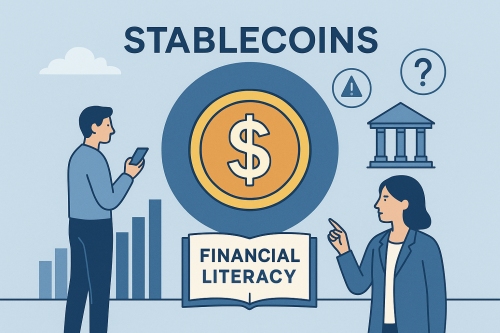
Image generated by AI
On September 11 2025 the Financial Consumer Agency of Canada (FCAF) released national survey findings on how Canadians understand, use and experience stablecoins. The data arrives at a moment when digital money education is becoming essential and also November is Financial Literacy Month. The survey highlights where Canadians feel confident, where they lack clarity and where they face real harm when interacting with stablecoin products.
The findings come from a national sample of 2,410 Canadian adults, including 386 stablecoin owners, surveyed between December 2023 and January 2024. Results reflect a cross-section of Canadians aged 18 and up.
Only 4% of Canadian adults currently hold stablecoins and 5% have held them in the past, while 91% report no ownership at all.
Adoption is higher among adults aged 18 to 34, higher-income households and respondents identifying as Indigenous or Black.
These early patterns show that stablecoin use is limited today, but it is already interacting with diverse communities and younger Canadians who often engage with digital financial tools first. This confirms the need for accessible, plain language education resources that help people understand how stablecoins work and how to evaluate them responsibly.
According to the survey, 21% of Canadians could correctly define a stablecoin.
The average score on a short knowledge test was 18%, even though respondents estimated their score at around 50%. This confidence gap reveals why more stablecoin education is a must.
When people believe they understand a financial tool but lack the basics, they are more likely to overlook risks related to stability, issuer credibility, redemption processes or platform security.
Among Canadians who currently or previously owned stablecoins, 49% reported at least one negative experience.
About 10% said they lost funds due to fraud, hacking or platform failure. Among those affected, reported losses ranged from under CA$10,000 to as high as CA$60,000.
The number of users may still be small, but the concentration of harm is significant. These findings show why stablecoin topics must be included in consumer education, and why fintech firms developing digital money products need strong transparency, redemption clarity and operational safeguards to build and maintain trust.
The survey identifies protection and clarity as key drivers of trust. 41% of respondents support a distinct regulatory framework for stablecoins.
Among current owners, 63% want stablecoins regulated the same way as payment or money-transfer products.
Among people who avoid stablecoins, 44% say missing protections as their main reason.
These results show that Canadians are open to digital forms of money, but they want stablecoin issuers and platforms to offer clear information and credible safeguards before wider participation feels safe.
For NCFA’s community of fintech leaders, innovators, investors and policymakers, this research helps strengthen the case for improving stablecoin literacy for both businesses and consumers who need to get ready for Canada’s evolving digital finance landscape. Strong literacy reduces confusion, builds confidence and supports responsible adoption.
A sampling of NCFA stablecoin coverage and how they fit into Canada’s wider fintech landscape.
The National Crowdfunding & Fintech Association (NCFA Canada) is a financial innovation ecosystem that provides education, market intelligence, industry stewardship, networking and funding opportunities and services to thousands of community members and works closely with industry, government, partners and affiliates to create a vibrant and innovative fintech and funding industry in Canada. Decentralized and distributed, NCFA is engaged with global stakeholders and helps incubate projects and investment in fintech, alternative finance, crowdfunding, peer-to-peer finance, payments, digital assets and tokens, artificial intelligence, blockchain, cryptocurrency, regtech, and insurtech sectors. Join Canada's Fintech & Funding Community today FREE! Or become a contributing member and get perks. For more information, please visit: www.ncfacanada.org
| | |
|---|---|---|
| | |
Bank of Canada Research | Nov 14, 2025
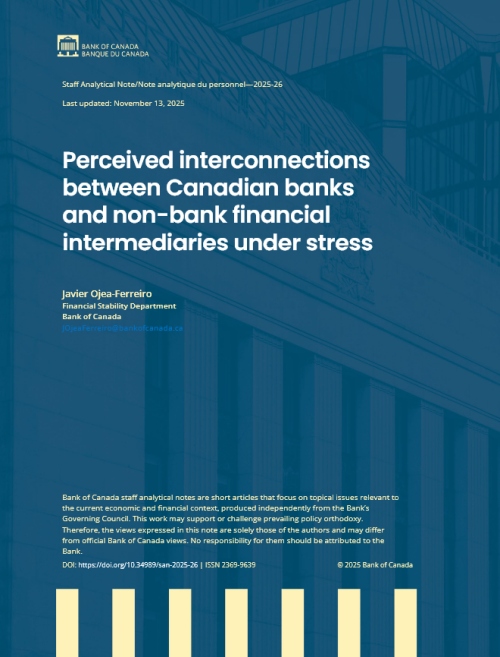
Image: Perceived interconnections between banks and NBFIs (Bank of Canada Staff Report, November 2025)
On November 13 2025, the Bank of Canada Staff published Analytical Note 2025-26 titled, "Perceived interconnections between Canadian banks and non-bank financial intermediaries under stress" (16 page PDF), that examines how stress spreads between banks and non-bank financial intermediaries (NBFIs) such as investment and mortgage funds. While the research found that market-based linkages between banks and non-banks have grown much stronger over the past decade, it offers no specific policy steps.
For Canada’s fintech and regulatory communities, that leaves room to build smarter transparency and data-driven tools that improve resilience while encouraging innovation.
The Bank used a market-based metric called the ratio of tail sensitivities to track how often banks and NBFIs experience stress at the same time. In simple terms, it measures how likely both sectors are to face sharp losses together when markets turn volatile.
Before the pandemic, that overlap was around 60%, meaning stress in one sector often stayed contained. During 2020 (Covid-19), the overlap jumped to almost 90%, showing that both banks and NBFIs were hit by the same shocks at once.
Post Covid-19, it has stayed above 70%. This signals that Canada’s financial system now behaves more like a single network where investor confidence, liquidity, and risk pricing can ripple quickly across different parts of the market.
The analysis relies on market indicators such as price changes and co-movement ratios. These signals show how banks and non-banks react to market stress, but they don't track the underlying funding flows, repo exposure, or off balance sheet commitments that reveal how those stresses move in practice. The Bank acknowledges that data gaps make it hard to see how financial stress truly spreads between institutions.
The research measures perceived connections through statistical patterns rather than verified, real time data linkages. That distinction matters. Without deeper, connected data, it is harder to see where vulnerabilities are forming or how quickly they could spread. Closing that gap doesn't necessarily require new regulation but better tools and shared information that improve resilience while encouraging innovation.
Regulators already monitor funding and liquidity in near real time, but the Bank of Canada notes that current data still do not explain how financial stress moves between different parts of the system. The missing piece is insight into how one market’s strain can quickly affect another’s ability to function.
For example, if liquidity tightens in the mortgage or bond market, investment funds might sell assets to meet investor redemptions. Those sales can push down prices, reducing the value of collateral that banks use for their own lending and funding. Within hours, what starts as a localized funding issue can spread to other sectors that rely on those same assets. Economists have long modelled this type of stress transmission, but those models depend on historical or aggregated data. They show how shocks can travel but not how fast they move in real time.
RegTech innovation could help close this gap. Shared data platforms, digital reporting tools, and secure analytics could give both regulators and market participants a clearer view of where risks are forming. Instead of expediting new rules, the opportunity is better information that allows for faster, better, data-driven action. Fintechs can play a leading role by designing systems that make oversight smarter, not heavier, while strengthening confidence across the financial system.
If Canada wants to maintain stability and support innovation, it needs visibility into where financial pressure builds. The Bank of Canada's findings show that perceived connections already move markets but without deeper real-time data access, those perceptions could harden into real stress events. The opportunity is to turn perception into understanding and make transparency Canada’s real advantage.
The National Crowdfunding & Fintech Association (NCFA Canada) is a financial innovation ecosystem that provides education, market intelligence, industry stewardship, networking and funding opportunities and services to thousands of community members and works closely with industry, government, partners and affiliates to create a vibrant and innovative fintech and funding industry in Canada. Decentralized and distributed, NCFA is engaged with global stakeholders and helps incubate projects and investment in fintech, alternative finance, crowdfunding, peer-to-peer finance, payments, digital assets and tokens, artificial intelligence, blockchain, cryptocurrency, regtech, and insurtech sectors. Join Canada's Fintech & Funding Community today FREE! Or become a contributing member and get perks. For more information, please visit: www.ncfacanada.org
| | |
|---|---|---|
| | |



August 26th, 2025

January 4th, 2024

June 1st, 2021

September 9th, 2020

July 9th, 2018

January 3rd, 2018

September 25th, 2017

June 20th, 2017

May 10th, 2017

December 14th, 2016
