




Karsten Wenzlaff, Advisor
August 26th, 2025
Karsten Wenzlaff is a Crowdfunding and Fintech Expert from Germany. He is Secretary-General of Digit[...]


Fundraising | Jan 22, 2026
Image: RBCx Capital Under Pressure Canadian VC Fundraising Report 2025
In January 2026, RBCx released the Capital Under Pressure report on Canadian VC fundraising in 2025 (42 page PDF), with data analysis that examines how capital flows from investors into Canadian venture funds, and how those fundraising dynamics affect fund sizes, investor concentration, and the amount of capital available for new investments in founders.
The report shows Canadian VC firms raised just over $2.1B in 2025. This level sits well below the long term average of roughly $3.1B and places 2025 among the weakest fundraising years since 2016. A brief rebound in 2024 did not continue, indicating sustained pressure rather than a short term disruption.
Even with lower fundraising totals, 21 new venture funds completed their fundraising process in 2025. In plain terms, these funds finished raising investor commitments and became active for investing. The data shows that while total capital declined sharply, the number of new funds coming to market remained relatively steady with the adjustment occurring through smaller fund sizes rather than fewer funds being formed.
Capital concentration increased materially in 2025. The five largest Canadian venture funds captured 83% of all capital raised during the year, the highest level recorded in the dataset. This reflects investor behaviour in lower liquidity environments, where commitments concentrate around established managers rather than being spread across a broader range of funds.
Emerging managers raised $249M in 2025, the lowest annual total recorded in the report. In contrast, established managers accounted for the majority of new capital raised. The data shows fewer new and early stage funds accessing capital, narrowing the range of investors available to back companies at the earliest stages.
Reliance on federal capital programs has declined but remains significant. Capital linked to VCAP and VCCI accounted for 36% of total Canadian VC fundraising in 2025, down from 53% in 2015. While the share has fallen, government backed capital continues to anchor a meaningful portion of venture fundraising activity.
The composition of available capital shifted materially in 2025. Only 42% of remaining dry powder is available for new investments, with the majority reserved for follow on funding in existing portfolio companies. This is the lowest share of initial investment capital recorded and directly limits the amount of domestic venture capital available for new company formation.
Fund size compression accelerated in 2025. The median Canadian VC fund size declined to $29M, while the top quartile fell to $43M. Both figures represent the lowest levels observed since 2013, confirming that less capital is available per fund even as fund formation continues.
With less venture capital raised overall, higher concentration among a small number of large funds, and only 42% of remaining dry powder available for new investments, fintech founders should expect slower fundraising processes, narrower investor funnels, and higher expectations around proof of traction. In practical terms, this environment favours companies that can demonstrate clear revenue quality, customer retention, regulatory readiness, and capital efficiency earlier than in prior cycles.
In a climate where traditional VC funding is contracting, fintechs benefit from widening their capital strategy beyond venture capital alone. Non-dilutive programs that support technical development and commercialization, such as Eurostars international R&D collaboration programs, can extend runway without ownership dilution when equity capital is scarce. At the same time, alternative finance models, including equity crowdfunding, can provide more aligned and patient capital from users, customers, and sector participants when institutional funds slow initial investments.
These approaches do not replace venture capital, but they can strengthen balance sheets, validate market demand, and reduce dependency on a single capital source at a time when venture capital is increasingly selective.
For fintech founders, the takeaway is not to pause growth plans but to adapt capital strategies to the realities of the market. Stronger evidence, clearer execution, and diversified funding paths matter more than ever. Companies that treat capital raising as a multi channel strategy rather than a single event will be better positioned to navigate this cycle and remain competitive as conditions evolve.
 The National Crowdfunding & Fintech Association (NCFA Canada) is a financial innovation ecosystem that provides education, market intelligence, industry stewardship, networking and funding opportunities and services to thousands of community members and works closely with industry, government, partners and affiliates to create a vibrant and innovative fintech and funding industry in Canada. Decentralized and distributed, NCFA is engaged with global stakeholders and helps incubate projects and investment in fintech, alternative finance, crowdfunding, peer-to-peer finance, payments, digital assets and tokens, artificial intelligence, blockchain, cryptocurrency, regtech, and insurtech sectors. Join Canada's Fintech & Funding Community today FREE! Or become a contributing member and get perks. For more information, please visit: www.ncfacanada.org
 |  |  |
|---|---|---|
 |  |  |
January 21, 2026 | Report Insights
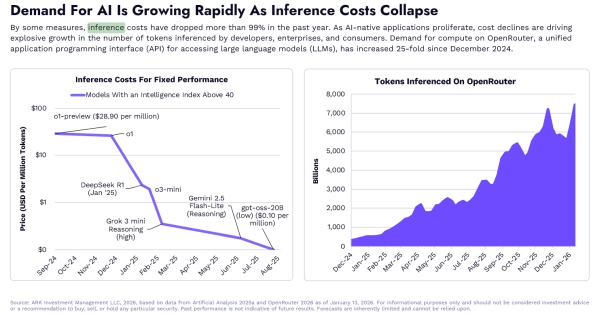
Image: ARK Invest, Big Ideas 2026 report. AI inference cost data reproduced for commentary and analysis.
In January 2026, ARK Invest released its annual research report Big Ideas 2026, building on trends first measured in Big Ideas 2025. The 111 page report spans artificial intelligence, tokenized assets, decentralized finance, Bitcoin, consumer AI platforms, and what ARK describes as the Great Acceleration. Rather than summarizing each theme in isolation, this article focuses on how these technologies accelerate change together inside financial systems.
What felt experimental in 2024 and operationally strained in 2025 now shows up as baseline reality in 2026. AI costs collapse, investment capital concentrates in infrastructure, digital assets move closer to settlement rails, and consumer AI platforms compress decision cycles. These forces do not arrive sequentially. They compound. The result is technically a financial system that no longer needs to pause between decisions.
ARK’s data on collapsing AI inference costs explains why this shift becomes unavoidable. At the same time, investment capital continues to concentrate in infrastructure designed for continuous operation. Together, these forces change how money moves, settles, and gets controlled.
Finance is AI-native by design. It already runs on software, explicit rules, and constant feedback. As AI becomes cheap enough to run continuously, software acts directly inside financial systems instead of waiting for human input.
ARK’s Big Ideas 2026 research shows AI inference costs dropped more than 99% in the past year. That single data point explains why continuous operation becomes economically viable at scale for the first time.
When inference costs fall that far, AI stops being something teams consult occasionally. It becomes something that runs all the time. Human prompts, batch reviews, and periodic decision cycles turn into friction rather than safeguards.
In financial systems, this breaks a long standing boundary. AI no longer stops at scoring, forecasting, or recommendations. It initiates actions. Payment routing adjusts automatically. Exposure limits rebalance in real time. Liquidity thresholds enforce themselves continuously. Software no longer waits for approval at every step.
Founders experience this when systems stay busy all the time instead of spiking occasionally. Investors see it when infrastructure costs stop falling as predictably even while revenue continues to grow. Operating leverage behaves differently because systems no longer rest between decisions.
ARK’s capital analysis shows where investment capital flows as systems scale. In 2025, annual investment in data center systems reached roughly $500B, nearly 2.5 times the long term average from 2012 through 2023. Since the ChatGPT moment, ARK shows growth accelerating from about 5% to 29% annually. The report projects this category of investment could approach $1.4T by the end of the decade.
That level of spending signals where long term value accrues. Capital is not chasing surface automation features. It is concentrating where compute, data availability, uptime, and recovery determine whether systems can operate continuously without failure.
For fintech teams, this breaks a familiar assumption. Products designed for occasional use face redesign pressure. Infrastructure built for constant operation gains structural leverage. Cost structure, resilience, and throughput now shape competitive advantage more than feature differentiation.
Traditional payment systems assume a person initiates the transaction. AI breaks that assumption. Software now initiates payments, manages balances, and settles obligations automatically as conditions change.
This pushes pressure into liquidity management, fraud controls, and settlement logic. Batch review fails quietly when systems never pause. ARK’s analysis of AI driven transaction flows emphasizes sustained throughput and recovery under stress rather than peak performance.
Founders building payment infrastructure encounter this pressure early. Systems designed for bursts now operate under constant load, and cost curves change accordingly. Reliability becomes a competitive feature rather than an operational afterthought.
ARK’s 2026 research frames consumer AI as an operating layer rather than a feature. AI models converge into a consumer operating system, and adoption accelerates faster than earlier digital platforms. As these systems take on purchasing, allocation, and coordination tasks, decision making shifts closer to software execution.
Wallets evolve alongside this change. They function less as interfaces and more as control layers for software driven financial activity. Identity, permissions, and payment logic compress into the same layer.
Investors familiar with earlier platform cycles recognize this pattern. Control consolidates where decisions execute, not where they are merely displayed.
ARK frames tokenized assets as market infrastructure moving trillions of dollars in asset value onto blockchains. Tokenization matters because assets move and settle automatically. DeFi matters because financial rules run on software without manual steps.
ARK’s data shows digital asset application revenue reaches roughly $3.8B in 2025, with around one fifth generated in January alone. The report also notes that about 70 applications generate more than $1M each in monthly recurring revenue. Value capture shifts from base networks toward platforms that control execution, coordination, and user interaction.
For fintech builders, this exposes a structural mismatch. Systems designed for batch reconciliation struggle when assets move continuously.
ARK’s research treats stablecoins as payment and settlement rails, not alternative products. Transaction activity reaches record levels because stablecoins can now move value automatically and clear obligations without waiting for manual steps.
Bitcoin functions as a monetary network with predictable issuance and global settlement. In 2026, its relevance aligns with the same requirement driving stablecoin use. When systems run continuously, money must move at software speed.
This doesn't remove banks, payment firms, or regulators. It changes how settlement works underneath them, reflected in Canada’s Stablecoin Act draft, which outlines how programmable settlement rails are governed.
ARK's analysis points to convergence. Continuous systems expose the limits of oversight built around delayed reporting and human initiated workflows. Design, auditability, and real time visibility matter more because systems no longer pause between decisions.
For policymakers, this changes where effective oversight begins. Rules written for periodic review struggle when financial activity runs continuously. Payments oversight, digital asset policy, and AI governance increasingly overlap because the systems themselves overlap.
Teams that design for transparency and control early reduce downstream risk. Regulators that focus on system behaviour rather than product labels gain clearer visibility and fewer surprises.
Big Ideas 2026 highlights what happens when AI inference costs collapse by more than 99%, investment capital concentrates at unprecedented scale, digital assets mature into settlement rails, and consumer AI platforms compress decision cycles at the same time. Finance changes faster because it already runs on rules, incentives, and software.
AI systems now run continuously. Many teams still model for peak usage instead of sustained operation. The gap appears in compute, monitoring, compliance operations, and incident response long before it shows up in customer metrics.
Infrastructure intensity rises faster than application revenue. ARK’s capital data shows control and throughput capture value before features do. Margins do not scale linearly during infrastructure transitions.
Human initiated workflows. Cost per transaction and average response time lose meaning when systems never pause. Sustained throughput and recovery time under stress become the binding constraints.
Frameworks assume discrete events. Continuous systems blur those boundaries. Risk appears as operational mismatch rather than enforcement action.
The National Crowdfunding & Fintech Association (NCFA Canada) is a financial innovation ecosystem that provides education, market intelligence, industry stewardship, networking and funding opportunities and services to thousands of community members and works closely with industry, government, partners and affiliates to create a vibrant and innovative fintech and funding industry in Canada. Decentralized and distributed, NCFA is engaged with global stakeholders and helps incubate projects and investment in fintech, alternative finance, crowdfunding, peer-to-peer finance, payments, digital assets and tokens, artificial intelligence, blockchain, cryptocurrency, regtech, and insurtech sectors. Join Canada's Fintech & Funding Community today FREE! Or become a contributing member and get perks. For more information, please visit: www.ncfacanada.org
| | |
|---|---|---|
| | |
Davos | Jan 19, 2026

Image: Current Global Risk Landscape (WEF 2026 Global Risks Report)
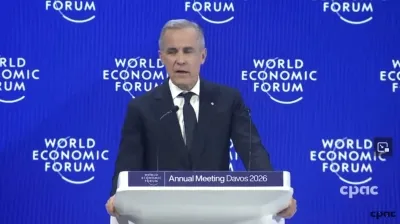
From January 19 to 23, 2026, global leaders are gathering in Davos, Klosters for the World Economic Forum Annual Meeting 2026, one of the few global forums where heads of government, central bankers, investors, and business leaders meet in the same place to discuss economic risk, trade, and long term stability. This year’s theme is "A Spirit of Dialogue", to address growing concerns that cooperation is weakening as global risks are becoming harder to manage.
Ahead of Davos, the World Economic Forum released its Global Risks Report 2026 (102 page PDF) based on its Global Risks Perception Survey of more than 1,300 experts across government, business, academia, and civil society worldwide. Participants were asked to rank the risks most likely to trigger a global crisis in the short term, as well as the most severe risks over longer time horizons.
The report identifies "geoeconomic confrontation" as the top risk most likely to trigger a material global crisis in 2026. 18% of survey respondents ranked it first, moving it ahead of state based armed conflict for the first time. The report defines geoeconomic confrontation as the deliberate use of tariffs, sanctions, export controls, investment screening, subsidies, capital restrictions, and technology controls to advance national interests, rather than as temporary trade friction.
The report frames the current period as an age of competition, where economic tools increasingly replace diplomacy. It also shows that confidence in multilateral systems is weakening.
68% of respondents expecting a more fragmented global order, where countries manage multiple regional relationships instead of relying on a single rules based framework.
Economic risks remain elevated. An economic downturn ranks 6th among global risks for 2026, reflecting concerns tied to trade fragmentation, high debt levels, and asset price vulnerability. The report doesn't predict a specific recession size, but it highlights how shocks can spread faster in a highly interconnected financial system.
The report also quantifies risks tied to trust and technology. Misinformation and disinformation rank 5th, driven by faster and more scalable digital amplification. Cyber insecurity ranks 9th, while adverse outcomes of AI technologies enter the top ten for the first time, reflecting concerns around misuse, governance gaps, and longer term economic and security effects. Importantly, the report shows AI related risks increasing significantly over the ten year horizon, as leaders view AI as a structural risk that compounds other pressures rather than a short term crisis trigger.
Canada doesn't set global rules on its own, but it is deeply affected by how those rules evolve. The Global Risks Report makes clear that mid sized, trade dependent economies face higher exposure when economic pressure becomes a primary policy tool.
Market behaviour already price this sensitivity. Canadian equity markets have shown quick reactions to renewed tariff threats and trade policy signals, reinforcing how closely capital pricing tracks global risk narratives. This volatility isn't driven by domestic structural gaps alone, but by uncertainty in the global trade environment.
In Canada, business leaders are already feeling the pressures Davos is wrestling with. In the Bank of Canada Business Outlook Survey for the fourth quarter of 2025, firms report subdued sentiment and weak recent sales growth, and many point to trade tension and uncertainty as key reasons they stay cautious on hiring and investment. Some exporters also report that they are working harder to sell into markets outside the United States, which fits a broader push toward diversification as global risk rises.
For Canada, the forum offers a place to engage with partners, investors, and institutions that are reassessing risk, diversification, and resilience at the same time. In a world where geoeconomic confrontation leads the risk rankings, visibility and credibility matter.
The risks highlighted in the Global Risks Report translate into practical considerations for Canada’s fintech and innovation ecosystem.
First, trade concentration is a measurable risk.
When tariffs, sanctions, and investment controls rise, companies with narrow market exposure face greater volatility. Diversifying customers, partners, and capital sources becomes a defensive strategy, not just a growth choice.
Second, capital follows predictability. The report links economic downturn risk to policy uncertainty and fragmented governance. Investors respond by adjusting risk premiums, which affects valuations, fundraising timelines, and exit options, particularly for scale ups.
Third, technology risk is contextual, meaning technology itself isn't the main risk. The risk comes from how it is used, governed, and trusted, especially when economic and political tensions are already high. The report doesn't treat AI or digital systems as isolated threats. Instead, it positions them as amplifiers that can worsen misinformation, cyber exposure, and economic disruption if governance and trust break down. For Canadian firms competing globally, credibility around security, governance, and responsible deployment increasingly affects whether they win customers and attract capital.
Trade, finance, and technology are now at the center of geopolitical strategy, with direct consequences for businesses and investors. Canada’s fintech ecosystem should plan for sustained volatility. Growth strategies built on stable trade assumptions face higher risk. Founders and investors who understand these quantified global risks will be better positioned to manage exposure, attract capital, and compete responsibly in a more uncertain global economy.
The National Crowdfunding & Fintech Association (NCFA Canada) is a financial innovation ecosystem that provides education, market intelligence, industry stewardship, networking and funding opportunities and services to thousands of community members and works closely with industry, government, partners and affiliates to create a vibrant and innovative fintech and funding industry in Canada. Decentralized and distributed, NCFA is engaged with global stakeholders and helps incubate projects and investment in fintech, alternative finance, crowdfunding, peer-to-peer finance, payments, digital assets and tokens, artificial intelligence, blockchain, cryptocurrency, regtech, and insurtech sectors. Join Canada's Fintech & Funding Community today FREE! Or become a contributing member and get perks. For more information, please visit: www.ncfacanada.org
| | |
|---|---|---|
| | |
Exporting | Webinar | January 14, 2026

Image: Freepik/Rawpixel.com
Many Canadian companies still operate only in their domestic market or to a narrow set of export markets. That limited exposure becomes a problem when trade rules change, demand softens, or geopolitical risk rises like the current trade environment Canada finds itself in.
On January 28, 2026, Canada's Trade Commissioner Service (TCS) is hosting a webinar for founders and operators called 'Trade diversification: how to select a new market" to better understand the key decisions they must face to determine where to export their business internationally. The session aligns closely with NCFA's community and the hope is that founders will approach choices with more discipline than pure instinct.
Host: Trade Commissioner Service in partnership with the Forum for International Trade Training
Date/Time: January 28, 2026 at 1:00 PM EDT (60 minutes)
Format: Online via Webex
Description: The session introduces a structured approach to evaluating and selecting new international markets based on opportunity, fit, and risk. The webinar also features insights from Chief Trade Commissioner Sara Wilshaw on how Canadian companies can use Trade Commissioner Service support when entering or scaling in foreign markets. The webinar is designed for Canadian companies of all sizes and across all sectors that want to expand internationally, explore new export markets, or strengthen their global growth strategy through diversification. It is relevant for first time exporters as well as firms already active abroad that are reassessing their market mix.
The discussion explains why diversification matters now and how it helps reduce long term business risk.
A certified FITT expert walks through a clear step by step method for choosing the right market.
Canadian exporters share lessons from real expansion efforts including what worked and what they would change.
The session also explains how the Trade Commissioner Service supports companies with market intelligence, local connections, and on the ground insight.
A live Q and A allows participants to ask questions tied directly to their export plans.
Registration closes January 27, 2026. REGISTER HERE before registration closes on Jan 27, 2026. For questions, participants should contact the Trade Commissioner Service directly at tcs-sdc@international.gc.ca.
The National Crowdfunding & Fintech Association (NCFA Canada) is a financial innovation ecosystem that provides education, market intelligence, industry stewardship, networking and funding opportunities and services to thousands of community members and works closely with industry, government, partners and affiliates to create a vibrant and innovative fintech and funding industry in Canada. Decentralized and distributed, NCFA is engaged with global stakeholders and helps incubate projects and investment in fintech, alternative finance, crowdfunding, peer-to-peer finance, payments, digital assets and tokens, artificial intelligence, blockchain, cryptocurrency, regtech, and insurtech sectors. Join Canada's Fintech & Funding Community today FREE! Or become a contributing member and get perks. For more information, please visit: www.ncfacanada.org
| | |
|---|---|---|
| | |
Compliance | December 11, 2025

AI generated image
On December 10 2025 the CSA and CIRO released new findings from their second national review of Client Focused Reforms based on 105 firms. The update arrives in a year marked by a CSA record year of 1,011 investor alerts and outreach that reached more than 4.5 million Canadians.
With the imminent arrival of Canada's commercialization of open banking, and the country's work on faster payments and new digital asset rules, fintechs now face a more demanding compliance environment, and firms must focus on fixing gaps to prepare for what comes next.
Client Focused Reforms arrived in two stages across 2021. Conflicts of interest rules took effect in June 2021 and enhanced rules for know your client, know your product and suitability took effect at the end of 2021.
Regulators did a first sweep in 2022 to confirm whether firms built the foundation. They looked at updated forms, processes and governance. The first sweep focused on whether firms completed the initial implementation work required by the reforms rather than on how well those changes worked in daily practice.
The second sweep tests practical use. Firms have lived with these rules for more than three years. Regulators expected complete records, strong reasoning and evidence of care in client decisions.
Regulators found that some digital onboarding flows move too quickly for the level of detail the rules require.
They saw cases where firms collected risk tolerance but did not collect risk capacity.
They found broad financial ranges that did not support detailed decisions.
They found missing updates when clients changed jobs, retired or faced major life events.
They also saw records that did not show meaningful conversations with clients.
👉 Regulators want firms to gather clear and complete financial information and to treat risk tolerance and risk capacity as separate concepts. They expect client data to guide decisions, not follow them. They expect fintechs to show that a digital experience still produces real understanding.
Fintechs often use a select list of products, model portfolios or automated recommendations. Regulators looked closely at these choices and found cases where product review notes were thin or unclear.
They found approvals without evidence of analysis.
They found firms relying on affiliates even though each firm must complete its own review.
👉 Regulators want product evaluations that show how a firm reviewed the structure, features, risks and costs of a product before deciding to offer it to clients. This work guides what a firm chooses to place on its platform and how it ensures the product suits the clients who may use it. They want clear records that show why a product fits the platform and how the firm reached that decision. They expect firms to understand their products in a practical way and to document that understanding with simple and direct notes.
Suitability is where digital advice models face the most pressure. Regulators found decisions marked as suitable with little or no explanation.
They found missing concentration checks and liquidity checks.
They found limited cost comparison even when firms offered lower cost fund series.
They saw suitability records that did not update after product changes or after changes to the representative responsible for the account.
👉Regulators want suitability work that explains how the firm connected the client’s information to the recommendation. They want firms to consider exposure levels, liquidity needs, cost differences and alternatives. They want reasoning that shows why a recommendation or a model portfolio fits the client.
Fintechs can improve compliance by treating data, product analysis and suitability logic as design elements. Design and process can impact onboarding flows that gather clear information without slowing clients down.
Fintechs strengthen compliance when they update client profiles after major life events and use product files that link directly to real due diligence notes.
Clear concentration and liquidity checks inside the recommendation engine supports more reliable decisions.
Cost comparison helps firms show why a recommendation fits the client.
Investor education tools help clients understand their choices with more confidence.
Thoughtful use of AI can improve accuracy and consistency when firms understand which processes benefit most from automation.
Strong design choices make it easier to show good judgment and better care for clients.
The new CFR review arrives as Canada prepares for major changes in the financial system. Open banking will introduce structured data sharing and clearer expectations for permission and accuracy. Payments modernization will accelerate how money moves, supported by Canada’s payments innovation push toward faster rails. Digital asset rules will mature as Canada moves forward with the first draft of the national stablecoin framework.
These developments point in the same direction. Regulators expect firms to show strong reasoning, accurate information and clear documentation of decisions. Fintechs that build these strengths now will be able to handle the coming changes with confidence instead of surprise.
Good CFR practices support competitiveness and growth. Partners and investors look for firms that manage risk with care and clarity. Clients choose platforms they trust.
The CSA year in review reports 54 permanent bans imposed during the reporting period and 24 enforcement actions tied to crypto assets. This is why strong governance matters at a time when financial infrastructure is evolving.
Fintechs that build accurate data, consistent processes and quality supervision strengthen their position and gain credibility across the market.
The National Crowdfunding & Fintech Association (NCFA Canada) is a financial innovation ecosystem that provides education, market intelligence, industry stewardship, networking and funding opportunities and services to thousands of community members and works closely with industry, government, partners and affiliates to create a vibrant and innovative fintech and funding industry in Canada. Decentralized and distributed, NCFA is engaged with global stakeholders and helps incubate projects and investment in fintech, alternative finance, crowdfunding, peer-to-peer finance, payments, digital assets and tokens, artificial intelligence, blockchain, cryptocurrency, regtech, and insurtech sectors. Join Canada's Fintech & Funding Community today FREE! Or become a contributing member and get perks. For more information, please visit: www.ncfacanada.org
| | |
|---|---|---|
| | |
Economic Research | December 8, 2025

Economic Freedom Provincial Ratings, Fraser Institute 2025
On December 2, the Fraser Institute published the Economic Freedom of North America 2025 (EFNA report) with fresh data on the conditions that impact income, job creation, and business growth across the North American continent. The report measures how much economic freedom people and companies have to make economic choices and what influences long term outcomes. The findings place every Canadian province in the lower half of the ranking except Alberta, which raises an important question for policymakers and industry. That is, how much economic flexibility does Canada need to stay competitive in a market that moves faster each year?
EFNA ranks 93 jurisdictions across North America. Alberta sits at 30th. British Columbia is tied at 47th. All other Canadian provinces fall in the bottom half of the continental list. Canada’s national score peaked at 7.93 in 2015 and now sits at 7.69. The United States records 7.96. These score gaps look small, but EFNA’s outcome data shows why they matter. The index tracks ten year changes in income, jobs, and population, and these outcomes differ significantly across environments.
EFNA groups jurisdictions into quartiles (statistical value that divides a dataset into 4 equal parts) to show how economic conditions impact long-term outcomes.
| Indicator | Most Free Quartile | Least Free Quartile |
| Average income | $66,367 | $3,510 |
| Income growth | 24% | 3% |
| Job growth | 18.3% | 9.4% |
| Population growth | 8.9% | 0.5% |
These numbers highlight a clear pattern across North America. Regions with more economic flexibility tend to show stronger movement in income, jobs, and population over long periods of time.
Canada’s lower ranking results highlight the need to understand what balance of stability and flexibility supports better economic performance. Alberta leads the provinces at an EFNA index score of 6.44, followed by Ontario at 5.67. The remaining provinces sit in a narrow middle band, and Quebec ranks last at 3.10. This tight spread shows that Canada offers stability across the country, but it doesn't produce a high velocity region, so firms cannot rely on domestic momentum the way founders can in faster moving regions.
Another pattern is that income and job growth move at a steady pace. EFNA’s top performers show stronger gains over time. In Canada, steady progress helps households plan, but it also slows the pace at which they change financial behaviours.
Another pattern is EFNA shows the importance of mobility. Meaning, places with more economic flexibility tend to see more movement of people, jobs, and income. This mobility helps drive stronger results over time.
Canada's objective should be to find the level of flexibility that supports stronger economic movement while keeping the trust and protections that underpin Canada’s success. A practical balance for Canada should include regulatory processes that reduce friction, business and tax structures that attract investment, consumer protections that build trust without slowing innovation, labour rules that support adaptation, and clear frameworks that help firms navigate change.
Canada needs to create an environment that supports both stability and speed. The strongest results come from regions that achieve both.
Financial services are intrinsically related to the movement of money, people, firms, and confidence. EFNA outcome data confirms that these forces accelerate in more flexible environments. In Canada, they still move but the pace influences how companies grow. This steady environment affects how/when customers may be willing to try new financial tools and services, and how long new market sectors take to build growth and traction.
For fintechs, it means early fundamentals are more important, especially in the current economic climate. Companies need clearer value, earlier product market fit, stronger unit economics, and a model that can carry the business through longer adoption cycles. Growth comes, but it takes more time to build. Firms that rely only on rapid customer movement might face a harder path.
Government can help shorten this path. Acting as a first customer, reducing administrative friction, speeding approvals, and improving procurement can help credible firms break through sooner. Government can't replace real demand, but it can help companies reach it faster.
EFNA highlights the importance of mobility whether that's economic, labour, or population mobility. Income and jobs move more strongly in flexible environments, and that movement supports scale. Canada’s strength is stability. People stay. Businesses stay. Conditions remain predictable. Stability is valuable, but on its own it doesn't support rapid scaling as well.
Fintechs that want to scale inside Canada need strategies that work in steadier environments. This may include building distribution partnerships earlier, designing products that create immediate and visible value, and targeting segments where switching costs are low. Companies need to shorten the time between awareness, trial, and sustainable use.
Policymakers can support scale by reducing barriers that slow switching, such as streamlining licensing, enabling data portability, modernizing onboarding requirements, and creating space for controlled innovation. These steps do not change stability. They add mobility where it is needed most.
Canada’s provincial scores are pretty close together. Alberta leads the country, but no province reaches the levels seen in EFNA’s top performers. Canada has trust but it needs more flexibility at the edges to create the right conditions for growth.
For fintech companies, this means building trust and flexibility at the same time. Products must meet high expectations on security and reliability while offering customers faster ways to act, decide, and move money. Fintechs that pair strong trust with simple, flexible choices for customers tend to gain momentum in steady environments.
Policymakers play a role by making rules clearer, approvals faster, and compliance pathways more predictable.
Reducing friction does not weaken trust. It helps companies deliver it more effectively. The balance Canada needs is not maximum freedom. It is enough flexibility to let economic movement take shape while protecting the values that matter to Canadians.
The Economic Freedom of North America 2025 report (166 page PDF) is a data-driven look at the kind of environments that tend to generate stronger outcomes. Canada has strong institutions, talent, trust, and resilience. The question is whether the country can create enough flexibility to strengthen Canada's economic competitiveness. The foundation is here, but the next step is structural change.
The National Crowdfunding & Fintech Association (NCFA Canada) is a financial innovation ecosystem that provides education, market intelligence, industry stewardship, networking and funding opportunities and services to thousands of community members and works closely with industry, government, partners and affiliates to create a vibrant and innovative fintech and funding industry in Canada. Decentralized and distributed, NCFA is engaged with global stakeholders and helps incubate projects and investment in fintech, alternative finance, crowdfunding, peer-to-peer finance, payments, digital assets and tokens, artificial intelligence, blockchain, cryptocurrency, regtech, and insurtech sectors. Join Canada's Fintech & Funding Community today FREE! Or become a contributing member and get perks. For more information, please visit: www.ncfacanada.org
| | |
|---|---|---|
| | |
Tokenization | December 3, 2025

Image: Freepik AI
Tokenized infrastructure now appears across everyday financial activity. Shared digital ledgers record ownership directly, and real assets move into programmable formats that speed up settlement, improve transparency and open access to private markets. Growth comes from regulated markets, global banks and high-growth regions that use tokenized systems to remove friction in payments, trading and recordkeeping.
Larry Fink and Rob Goldstein, CEO and COO of BlackRock (world’s largest asset manager) in a December 1, 2025 Economist article describe tokenization as a major upgrade to financial infrastructure:
“Ledgers haven’t been this exciting since the invention of double-entry bookkeeping.”
Some of the largest and most established financial institutions already operate tokenized products in regulated environments. BlackRock issues a tokenized money market fund through BUIDL, which operates on chain and holds short-term U.S. dollar assets under a regulated structure see its 2024 launch announcement. JPMorgan runs ledger-based settlement and tokenized collateral through its Kinexys platform, formerly Onyx. UBS offers tokenized money market funds and structured products under Switzerland’s DLT Act. Franklin Templeton records shareholder ownership on chain and processes fund transactions through a blockchain-integrated fund model.
Swift reinforces this transition with real evidence. In 2023 it demonstrated that its messages can trigger tokenized transfers across public and private blockchains, confirming that banks can keep their existing workflows while settlement moves on chain. Chainlink extended these findings in Sept 2025, outlining a model where tokenized transfers move across ledgers under the same compliance controls institutions already trust.
The United Kingdom now moves beyond sandbox testing and supports full scale tokenization in asset management. In October 2025 the Financial Conduct Authority published a policy update, explaining how tokenisation can cut fund costs and widen access. The FCA also launched a consultation, setting out a roadmap for tokenised fund registers and direct to fund dealing. The FCA frames tokenization as a way to modernize asset management by placing fund units and ownership records on distributed ledgers while keeping regulatory safeguards intact.
Perhaps, the strongest progress now emerges outside the West (think adoption, usage, and real economic integration). The 2025 Chainalysis Global Adoption Index demonstrates this change clearly. Its findings, highlighting leading adoption across Asia and Africa, show that Vietnam, the Philippines, India, Nigeria and Brazil all rank near the top because tokenized value moves faster and more affordably than legacy payment and settlement networks.
Regional hubs are also accelerating. A comparative review identifies Singapore and the UAE as top jurisdictions for tokenized real assets, noting that these markets scale quickly because regulators provide clear rules for tokenized cash, tokenized securities and digital registers. Where legacy constraints are lighter, adoption appears faster because the benefits materialize immediately in cross border flows, settlement and access to private assets.
In many Western financial centers, integration efforts are underway where regulations permit tokenized assets or tokenized cash to operate alongside legacy market plumbing. Liquidity follows the rails that deliver speed, safety and operational clarity.
Tokenization includes multiple assets and falls into three clear categories:
1. Tokenized cash puts digital forms of money on chain. This includes fully backed stablecoins, tokenized deposits and other types of tokenized bank money. Tokenized cash works as a settlement asset on digital ledgers. It supports instant transfers, moves easily across platforms and connects with tokenized securities and tokenized real world assets.
2. Tokenized securities are financial instruments such as bonds, funds, money market assets and equity interests that are issued or recorded on chain. They follow securities law and must meet rules for custody, disclosure and investor protection. Germany, Switzerland, the United Kingdom and the European Union all have frameworks that give these instruments a legally recognized place on digital registers.
3. Tokenized real world assets take off-chain assets and represent their ownership on chain. Examples include private credit, real estate, infrastructure assets, receivables, trade claims, commodities and revenue rights. The asset itself stays off chain, while the legal claim moves on chain, making ownership easier to transfer and manage.
Tokenized cash strengthens settlement. Tokenized securities support modern regulated markets. Tokenized real world assets open access to large pools of private value. Together they form one connected system that links established institutions with modern digital first platforms.
Tokenized markets are expanding because real assets are now moving into these structures. In 2025 the strongest growth appears in United States Treasuries. A detailed review shows that tokenized Treasuries reached about $7.3B in 2025, an increase of more than 250% from 2024. These instruments deliver safe yield in a programmable, globally portable form that fits into digital collateral systems.
Coindesk reported on BlackRock’s USD Institutional Digital Liquidity Fund (BUIDL), driving much of this expansion. Messari later confirmed that BUIDL reached about $1.92B by April 2025, and Yahoo Finance reported that BUIDL passed $2.9B by mid 2025. By late 2025, the Economic Times noted that Binance accepted BUIDL as off exchange collateral.
These cases show tokenized assets working inside regulated markets. They move as collateral, pay interest automatically and settle quickly, and are demonstrating how programmable ownership can support large scale products.
A study by BCG and ADDX estimates that tokenized assets could reach $16T by 2030, while a McKinsey review projects a range of $1T to $4T by the same date. Even the low case would impact global capital formation.
NCFA has tracked similar patterns in its work on digital money, real-time tokenized payments, and competition where tokenized rails extend these forces into the full stack of asset classes.
Tokenization only scales when regulators give it a clear place in existing financial law. Some jurisdictions now recognize digital ledger records as valid securities registers and allow tokenized bonds, funds or equity to operate inside their capital market systems. Others focus on tokenized cash and stable, regulated settlement assets that let digital transactions clear instantly. A few support both sides, combining securities rules with prudential oversight for tokenized money.
The table below reflects these differences. It separates regimes that permit tokenized securities from regimes that regulate tokenized cash, and highlights markets that support both layers. Together these components form the legal base for tokenized assets across cash, securities and real-world assets (RWA).
| Jurisdiction | Framework | What It Allows | Role In Tokenization |
|---|---|---|---|
| European Union | DLT Pilot Regime for tokenized securities MiCA rules governing tokenized cash |
Permission to issue, trade and settle financial instruments on DLT. MiCA governs crypto assets and fully backed stablecoins as tokenized cash. | Combines legal clarity for tokenized securities with rules for tokenized cash so markets can test full stack tokenization. |
| Germany | eWpG electronic securities law for DLT-based securities BaFin regulation for crypto-securities registers and trading infrastructure |
Civil law recognition for securities issued and recorded on electronic or DLT registers; legal foundation for tokenized bonds, fund units and digital securities; regulated register-keeping and custody. | Provides a comprehensive legal and regulatory framework for digital securities in Germany’s capital markets, enabling institutional issuance, trading and custody under DLT infrastructure. |
| Switzerland | Swiss DLT Act enabling ledger-based securities FINMA regulation for DLT trading venues and digital-asset infrastructure |
Legal framework for issuance, transfer and trading of DLT Securities (shares, bonds, structured products); authorized DLT trading venues under financial-market legislation; statutory recognition of ledger-based securities as book entry instruments. | Provides robust, tech neutral statutory clarity for institutional tokenized securities, regulated trading venues and digital asset infrastructure, making Switzerland a leading global hub for blockchain-based capital markets. |
| United Kingdom | Digital Securities Sandbox for tokenized securities FCA 2025 tokenisation policy for funds and asset management FCA CP25/28 roadmap for tokenised fund registers and direct to fund dealing |
Regulated issuance, trading and settlement of tokenized securities, plus a parallel program for tokenized funds, tokenized registers and modern fund dealing models. | Builds tokenization across securities markets and asset management, making the UK one of the first jurisdictions to support fund tokenization at scale. |
| UAE / Abu Dhabi (ADGM) | ADGM DLT Foundations framework ADGM Digital Assets regulation for tokenized securities & virtual assets FSRA amendments 2025 updating digital asset rules 2025 proposal for fiat-referenced token framework |
Legal basis for DLT entities, exchange of digital securities, token issuance, custody and trading under Digital Asset regulation; updated rules for virtual asset firms and a proposed framework for fiat referenced tokens. | Offers one of MENA’s most comprehensive tokenization regimes: supports security-token issuance and custody today, and paves the way for regulated stablecoins or fiat-referenced tokens, enabling full-stack tokenized markets. |
| Hong Kong SAR | Stablecoin Issuance Ordinance for tokenized cash SFC 2023 circulars for tokenised securities and authorised investment products HKMA-Government first tokenised green bond issuance (2023) |
Regulated fiat-backed stablecoins, tokenized securities offerings under SFC rules, tokenized funds and government issued tokenized bonds under HKMA structures. | Combines tokenized cash, tokenized securities and real-world-asset tokenization under a live legal and regulatory regime, including sovereign bond issuance on chain and SFC supervized fund / securities token structures. |
| Singapore | MAS stablecoin framework governing tokenized cash MAS Project Guardian initiative expanding asset tokenization |
Regulation for fully-backed, single currency stablecoins licensed under MAS; plus a regulated pathway for tokenized funds, bonds and other securities under Project Guardian. | Establishes tokenized cash rails and builds institutional frameworks for tokenized securities and real world assets, positioning Singapore as a key hub for digital capital markets in Asia. |
| United States | NYDFS 2022 guidance for U.S. dollar–backed stablecoins SEC 2025 public statement on tokenized securities regulation |
State-supervised stablecoin issuance (fully backed, redeemable USD stablecoins under NYDFS); tokenized securities treated under traditional federal securities law when issued. | Provides a defined path for tokenized cash via regulated stablecoins and maintains that tokenized securities remain subject to full securities compliance, offering partial rails but without a unified national tokenization regime. |
Canada has made early strides toward regulating digital assets but the essential foundations for tokenized markets are still incomplete. The first draft of Canada's Stablecoin Act arrived in November 2025 via PM Carney's Budget 2025 along with Open Banking and payment modernization advancements. The Stablecoin proposal sets reserve, custody and redemption requirements for issuers and would place activity under federal oversight. It is only a draft, but it is the clearest signal that regulated tokenized cash will eventually have a place in the financial system.
Canada is also upgrading its payments infrastructure. NCFA's recent coverage of Canada’s payments innovation work, details progress on the Real-Time Rail, modernized oversight and stronger support for digital payments. The Real-Time Rail is not yet live and is expected after 2026. Until it launches, Canadian markets continue to operate on batch-based systems that limit the speed and precision needed for modern settlement, including tokenized transactions.
Canada still needs to complete several steps before tokenized markets can operate across the financial system. These include finalizing the stablecoin legislation, recognizing digital ledger registers as legally authoritative records for securities and delivering real-time settlement that works across institutions. A secure digital identity standard that functions across ledgers would also help investors and regulated firms meet KYC and AML requirements without slowing transactions.
Canada has the institutions and regulatory credibility to play a meaningful role in tokenized finance. To get there, the country must successfully and expeditiously execute its early policy work into a complete and operational model that supports lawful issuance, settlement and use of digital assets.
Tokenization is here. Real products, regulated structures and live institutional use show how digital ledgers can cut out delays, reduce operating drag and open access to assets that rarely moved with this level of precision. When tokenized cash, tokenized securities and tokenized real-world assets run on the same digital foundation, the market gains faster settlement, clearer ownership and a simpler path for new products to reach investors. Numerous of countries are setting benchmarks with legal clarity, real time payments, and digital ledger recognition. Canada has the institutional strength to be in that group but only if it finishes the work already underway. Those that act early will define how capital moves, how assets are built and who leads the next era of financial markets.
The National Crowdfunding & Fintech Association (NCFA Canada) is a financial innovation ecosystem that provides education, market intelligence, industry stewardship, networking and funding opportunities and services to thousands of community members and works closely with industry, government, partners and affiliates to create a vibrant and innovative fintech and funding industry in Canada. Decentralized and distributed, NCFA is engaged with global stakeholders and helps incubate projects and investment in fintech, alternative finance, crowdfunding, peer-to-peer finance, payments, digital assets and tokens, artificial intelligence, blockchain, cryptocurrency, regtech, and insurtech sectors. Join Canada's Fintech & Funding Community today FREE! Or become a contributing member and get perks. For more information, please visit: www.ncfacanada.org
| | |
|---|---|---|
| | |



August 26th, 2025

January 4th, 2024

June 1st, 2021

September 9th, 2020

July 9th, 2018

January 3rd, 2018

September 25th, 2017

June 20th, 2017

May 10th, 2017

December 14th, 2016
