





Karsten Wenzlaff, Advisor
August 26th, 2025
Karsten Wenzlaff is a Crowdfunding and Fintech Expert from Germany. He is Secretary-General of Digit[...]


Stablecoin Research | Sep 23, 2025
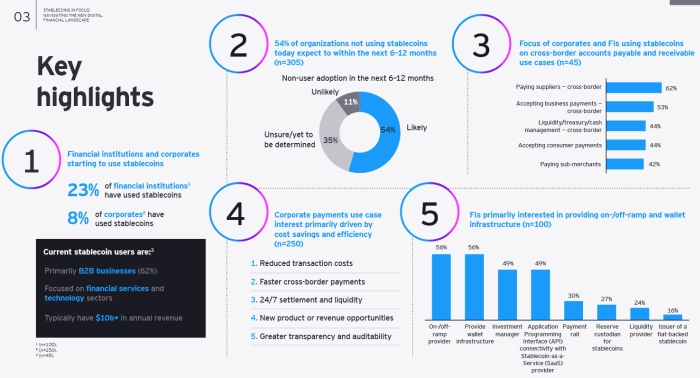
Image: Stablecoin Survey Research Highlights (EY Parthenon Sep 2025)
On September 15, 2025, EY-Parthenon released its latest stablecoin survey results, "Stablecoins: Adoption, Optimism, and Regulatory Clarity" (download 31 page PDF), covering 350 executives from corporates and financial institutions across the US, EMEA and other regions. Research takeaways confirm adoption is picking up speed, supposed by regulatory clarity by the GENIUS Act, recently signed into law.
Why is this happening? Approval of the U.S. GENIUS Act is a regulatory catalyst. Further, pilots are proving real value and corporate treasurers are under pressure to improve efficiency. The thinking is that organizations delaying adoption risk losing ground to competitors who are moving forward and benefiting from the lower cost and faster transactions of stablecoin technologies.
Why is everyone saving money by using stablecoins? The reason is straightforward. Traditional cross border payments involve multiple intermediaries, each adding fees and time. Stablecoins bypass these frictions and settles instantly, so the cost savings are structural (not incremental). For fintech providers, there's a growing opportunity to provide integration and risk management tools to help corporates adopt/use stablecoins and measure their effectiveness.
The reality is that we live and function in a global economy where delays can disrupt supply chains, so it's not surprising that corporates will adopt stablecoins for faster and more streamlined and predictable settlement solutions. This means that stablecoin adoption will likely strong and swift among B2B supplier and trade finance flows before expanding more widely into consumer payments.
In Canada, regulatory inaction is catching up with market momentum. On September 19, 2025, regulators like OSFI have warned the Prime Minister Mark Carney that Canada should accelerate federal stablecoin rules to avoid falling behind global peers. The Bank of Canada has echoed this call, saying stablecoins should be as safe and stable as the balance in your bank account. OSFI is already drafting a new framework to regulate stablecoin issuers, while domestic momentum is building as Tetra Digital Group secured $10M from Canadian banks and fintechs to launch a CAD stablecoin in 2026. Observers including investor John Ruffolo warn in his Looming Stablecoin Storm substack that without clear domestic rules, Canada risks ceding innovation, competitiveness and monetary sovereignty to jurisdictions that move faster.
Canadian corporates and fintechs need to plan not just for current global trends, but for a new local regulatory stablecoin framework. Firms are advised to engage with policymakers to create the right environment, build compliance ready infrastructure now and position for interoperability with USD pegged tokens and domestic stablecoin initiatives.Waiting could result in higher compliance costs, restricted access, and eventually a decline in market share.
Bottom line is banks understand that clients will demand stablecoin services and that failure to provide them risks their disintermediation. There's an intensifying race between traditional institutions and fintech challengers to capture stablecoin transaction flows.
Hybrid build and partner strategy. Corporates are demanding trust and compliance, while financial institutions know they cannot deliver the full stack alone. This means that partnerships between fintechs, banks and technology providers will determine how quickly stablecoin adoption scales.
Stablecoins are moving from pilot projects into enterprise strategy. Corporates see real cost savings and competitive advantage, while financial institutions are preparing to build services at scale to meet client demand. Regulation is beginning to catch up, led by the GENIUS Act in the US, but the global landscape is unbalanced while Canada’s fintech ecosystem is calling on the federal government to create and regulate a stablecoin framework to remain aligned and competitive.
 The National Crowdfunding & Fintech Association (NCFA Canada) is a financial innovation ecosystem that provides education, market intelligence, industry stewardship, networking and funding opportunities and services to thousands of community members and works closely with industry, government, partners and affiliates to create aa vibrant and innovative fintech and funding industry in Canada. Decentralized and distributed, NCFA is engaged with global stakeholders and helps incubate projects and investment in fintech, alternative finance, crowdfunding, peer-to-peer finance, payments, digital assets and tokens, artificial intelligence, blockchain, cryptocurrency, regtech, and insurtech sectors. Join Canada's Fintech & Funding Community today FREE! Or become a contributing member and get perks. For more information, please visit: www.ncfacanada.org
 |  |  |
|---|---|---|
 |  |  |
Report | Sep 19, 2025
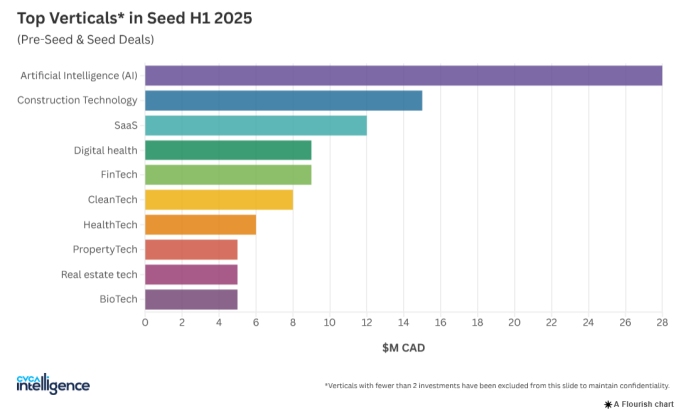
Image: H1 2025 Seed Investing in Canada by Vertical (CVCA Intelligence)
On September 11, 2025, the Canadian Venture Capital and Private Equity Association released its latest report, "The Current State of Seed Investing in Canada", covering tracked investment activity in the first half of 2025. The report recorded $297M invested across 133 seed stage deals in H1 2025.
1. Is seed capital still flowing in Canada, or has the tap run dry?
It's still flowing but selectively. There were 133 rounds worth $297M in H1 2025. The average cheque was $3M, the same as 2024 and down from the $4.09M peak in 2023. But total capital already reached $297M in just six months, equal to all of last year. For entrepreneurs, this means investors are still active but expect clearer proof points before committing. Traction and defensible technology are key.
Ontario pulled in $115.1M across 36 seed deals, nearly 40% of the total. Quebec followed with $66.1M, while Alberta and BC contributed $32.4M and $28.5M. PEI landed a single $6.3M seed round. If you are outside Ontario and Quebec, you may need a lead investor from one of those provinces to close a strong round.
AI is the leader at $24M across 12 seed deals. Construction tech ($15M across 2 deals) and SaaS ($12M across 4 deals) follow. Founders building in other sectors must benchmark carefully. For example, Fintech raised about $9M across pre seed and seed combined, making it harder to get noticed without a compelling angle.
AI again tops the list with $3.9M, followed by digital health at $2.5M. These are modest totals compared to seed, but they set the stage for the next generation of seed deals. Pre seed founders should expect smaller, milestone driven rounds focused on proving product market fit and lining up accelerators, early angels, and alternative finance options like investment crowdfunding.
US investors joined only 27.9% of Canadian seed deals in H1 2025, down from 35.9% in 2023. That is nearly a 30% relative decline. This means Canadian VCs and early stage angels and retail investors are the main gatekeepers at seed. Entrepreneurs should build domestic investor relationships first and then US and global investment pathways.
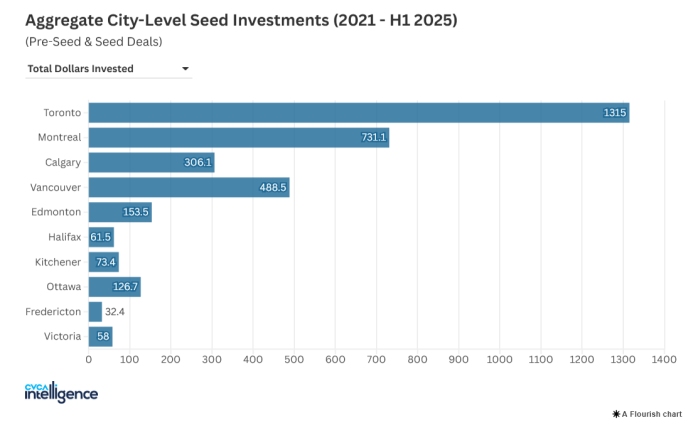
Image: Seed Investments 2021-2025 H1 (CVCA Intelligence)
They have stabilized with the average seed cheque was $3M in H1 2025, unchanged from 2024 but down from $4.09M in 2023. Total deployment hit $297M in H1 2025, already at the full year 2024 level. For investors, that means steady ownership opportunities but faster deal flow.
Ontario ($115.1M across 36 deals) and Quebec ($66.1M across 18 deals) dominate. Alberta ($32.4M) and BC ($28.5M) offer steady but smaller pipelines. For investors, this concentration could means better syndication opportunities in Ontario and Quebec, but higher competition as well.
AI’s $24M across 12 deals makes it the clear leader. SaaS ($12M across 4 deals) provides repeatable playbooks, while construction tech ($15M across 2 deals) indicates appetite for capital intensive bets. Fintech’s about $9M across pre seed and seed shows it remains investable. Portfolios tilted to AI and SaaS, with selective bets in construction and fintech, balance growth with diversification.
Pre seed AI ($3.9M) and digital health ($2.5M) dollars point to pipelines feeding into seed in the next 12 to 18 months. Investors positioning at pre seed should focus on these categories as feeders into later stage strength.
With US participation down to 27.9% from 35.9% last year, a nearly 30% relative decline, Canadian investors are leading more rounds. Other foreign investors ticked up to 10.5%. As a result, early rounds are relying more on domestic syndicates but Series A and B rounds will still require US follow on capital. Investors need to reserve capital and cultivate cross border relationships early.
Seed investment in Canada is concentrating in AI and Ontario while running ahead of last year’s pace. For entrepreneurs, it means tighter pitches and focusing on hubs where money is flowing. For investors, it means disciplined bets on AI and SaaS, while keeping an eye on steady sectors like fintech to diversify portfolios.
The National Crowdfunding & Fintech Association (NCFA Canada) is a financial innovation ecosystem that provides education, market intelligence, industry stewardship, networking and funding opportunities and services to thousands of community members and works closely with industry, government, partners and affiliates to create aa vibrant and innovative fintech and funding industry in Canada. Decentralized and distributed, NCFA is engaged with global stakeholders and helps incubate projects and investment in fintech, alternative finance, crowdfunding, peer-to-peer finance, payments, digital assets and tokens, artificial intelligence, blockchain, cryptocurrency, regtech, and insurtech sectors. Join Canada's Fintech & Funding Community today FREE! Or become a contributing member and get perks. For more information, please visit: www.ncfacanada.org
| | |
|---|---|---|
| | |
AI Research Report | Sep 15, 2025

Image: Banking Use of Agentic AI (Figue 1, MIT Insights Survey 2025)
A recent MIT Technology Review Insights survey of 250 global banking executives found that 70% of banks already use agentic AI, with 16% running live deployments and 52% in pilots. For Canadian financial institutions and fintechs, the race is on with global competitors embedding AI solutions into compliance, fraud prevention, and customer service at scale.
Fraud detection and IT security are setting the pace. More than half of executives report that agentic AI is already highly capable in fraud detection (56%) and security (51%), with efficiency gains and customer experience improvements each cited by 41%. These use cases are significant because fraud losses are rising and regulators are upping their game on cyber resilience.
Practical applications include mortgage underwriting, small business lending, collections, dispute resolution, and know-your-customer KYC compliance. By using agentic agents together with expert human oversight, banks are compressing decision times from weeks to days and freeing time for employees to focus on higher value work.
As HSBC’s Ian Glasner puts it, “Think of agentic AI as like an intern helping you get all of the more simplistic tasks done, but the human is still there to oversee and take the final decision.”

Image: MIT Insights Banking Survey 2025 (Figure 6 Challenges, Agentic AI)
The survey also suggests that adoption challenges are growing, top three barriers include: 1. Governance, risk, and compliance (63%), 2. Shortage of technology skills (58%), and 3. Poor data quality and integration (54%).
To overcome, Canadian banks and fintechs should focus on resolving weak data linkages across silos and the shortage of AI ready talent needed to scale responsibly.
Trust compounds the issue. An EY study found that only 42% of consumers trust financial institutions to manage AI in their best interest, while 30% say they do not trust them at all. That leaves a net trust level of just 12%. In Canada, regulators are focused on consumer protection, and fintechs that build trust into their AI systems could gain an edge.
Leading institutions are building playbooks worth watching. DBS Bank in Singapore applies its PURE framework (Purposeful, unsurprising, respectful, and easy) to explain all customer facing AI systems. If performance metrics breach preset limits, a kill switch halts the system in real time. As DBS’s Nimish Panchmatia warns, “Agentic AI is a continuous journey. If done properly, there’s significant value at the end of it. But you have to persevere.”
HSBC maintains a detailed inventory of AI systems tied to business owners, risk classifications, and model documentation to create a governance baseline across 200,000 employees in more than 50 markets.
For Canadian banks and fintechs, these approaches show the value of aligning governance and technical innovation before scaling widely.
Banks in Asia, Europe, and the U.S. are experimenting with AI at pace, and many are moving from pilots to enterprise adoption. For Canada, efficiency and risk controls are only part of the story. The real differentiator will be who earns the confidence of consumers while scaling responsibly. Agile fintechs can seize this opening. Unlike large banks weighed down by legacy systems and regulatory complexity, fintechs can design AI solutions that are transparent, accountable, and 'trust first' from the start.
The National Crowdfunding & Fintech Association (NCFA Canada) is a financial innovation ecosystem that provides education, market intelligence, industry stewardship, networking and funding opportunities and services to thousands of community members and works closely with industry, government, partners and affiliates to create aa vibrant and innovative fintech and funding industry in Canada. Decentralized and distributed, NCFA is engaged with global stakeholders and helps incubate projects and investment in fintech, alternative finance, crowdfunding, peer-to-peer finance, payments, digital assets and tokens, artificial intelligence, blockchain, cryptocurrency, regtech, and insurtech sectors. Join Canada's Fintech & Funding Community today FREE! Or become a contributing member and get perks. For more information, please visit: www.ncfacanada.org
| | |
|---|---|---|
| | |
Report | Sep 11, 2025

Image: Startups and Scaleups in UK Tech Sectors (Bennett School of Public Policy, Cambridge University)
On September 8 2025, the Bennett Institute for Public Policy (part of Cambridge University) published their latest research called, "Start-ups and scale-ups in UK technology sectors" (37 page PDF).
Fintech stands out as the country’s strongest UK tech sector, attracting the most venture capital investment. While the UK can now go toe to toe with the US in venture funding intensity relative to GDP, the scale of available capital, the reliance on foreign investors, and the dominance of acquisitions as an exit route continue to impact the growth pathways for UK start-ups.
Fintech remains the UK’s top sector for venture funding, showing the strength of financial innovation in London and across the country. Other sectors are growing quickly but fintech continues to set the pace.
The UK start-up ecosystem is attracting more foreign capital, especially from US investors. This fuels growth but raises questions about longer term independence and resilience.
London continues to dominate investment but other regions, particularly those linked to world-class universities are growing their presence.
Acquisitions are still the most common path for UK start-ups to generate investor returns. IPOs are still part of the picture but account for a much smaller share than in the US.
The UK now matches the US in terms of VC intensity relative to GDP, but it still lags far behind in total dollars raised. This gap matters most for later-stage fintech rounds.
London UK and other emerging hubs offer a vibrant, capital rich and globally attractive place to build but its reliance on foreign capital and the dominance of acquisitions as an exit route are challenges. Similar to Canada, the UK must building deeper domestic pools of later stage capital, strengthen listing markets, and support regional ecosystems to encourage more fintech start-ups to scale and stay anchored in the UK economy.
The National Crowdfunding & Fintech Association (NCFA Canada) is a financial innovation ecosystem that provides education, market intelligence, industry stewardship, networking and funding opportunities and services to thousands of community members and works closely with industry, government, partners and affiliates to create aa vibrant and innovative fintech and funding industry in Canada. Decentralized and distributed, NCFA is engaged with global stakeholders and helps incubate projects and investment in fintech, alternative finance, crowdfunding, peer-to-peer finance, payments, digital assets and tokens, artificial intelligence, blockchain, cryptocurrency, regtech, and insurtech sectors. Join Canada's Fintech & Funding Community today FREE! Or become a contributing member and get perks. For more information, please visit: www.ncfacanada.org
| | |
|---|---|---|
| | |
Economy | Sep 2, 2025

Image: Projecting Federal Personnel Expenses (Aug 28, 2025, PBO)
On August 28, 2025, the Office of the Parliamentary Budget Officer published a report titled, 'Projecting Federal Personnel Expenses', projecting that personnel expenses will climb past $76B by 2029/30. While the report does not address productivity directly, rising labour costs combined with low private-sector investment risk deepening Canada’s productivity gap.
Parliamentary Budget Officer (PBO) Yves Giroux projects that total federal personnel spending to increase from $71.1B in 2024/25 to $76.2B by 2029/30. By the end of the period, the average cost per full-time equivalent (FTE) employee will reach $172,000, up from $136,345 in 2023/24. This includes salaries, pensions, overtime, severance, and extended health and disability benefits. Salaries and standard benefits alone account for about $139,000 of the cost per employee.
FTEs are expected to climb to 442,000 by 2029/30, with 87% of the workers with permanent job status (highest since 2015). Personnel costs already represent the largest federal operating expense, creating direct pressure on the government’s commitment to both cap public service employment and deliver a balanced operating budget.
In 2023, Canada’s GDP per hour worked was $74.7 compared with $97.0 in the United States, highlighting the persistent productivity gap. Business R&D spending in Canada is only 1.0% of GDP which is far lower than the 2.6% of GDP invested in the United States. Higher education R&D in Canada accounts for about 0.6% of GDP, but spillover into private sector innovation remains limited.
When media outlets report more job action in Canada is on the horizon, it makes us wonder about the structure of Canada's labour force and it's impact on key metrics like productivity. Canada’s overall unionization rate is 30.4%, far higher than the US (10%) and UK (22%), which is of course highly concentrated in the public sector.
Large strikes, such as the 155,000 worker Public Service Alliance of Canada strike in 2023, spotlight the economic impact of government and quasi-government labour actions. The risk extends beyond the core federal workforce. Many of the most disruptive strikes occur in federally regulated oligopolies such as rail, ports, airlines, telecom, and banking. These sectors are nominally private but face little competition and operate under heavy federal oversight. As a result, labour disputes in these industries have a similar impact to public sector strikes, magnifying service bottlenecks in trade, transportation, and communications. Combined with a large public workforce, the exposure of Canada’s economy to union job action(s) is amplified.
While the PBO report does not attribute rising personnel costs directly to unions, collective bargaining settlements, job actions, and the limited competition in federally regulated industries all add further pressure on expenses and productivity.
Global investors trust Canada's institutions, regulatory framework, and rule of law. These qualities explain why Canada consistently attracts foreign direct investment and maintains one of the world’s top competitiveness rankings despite low productivity.
But stability alone will not carry Canada through the next decade. The global order is shifting toward regions that pair institutional reliability with high productivity and innovation intensity. The United States is pulling ahead with business R&D at 2.6% of GDP and workforce productivity nearly 25% higher than Canada. The European Union is leveraging scale and industrial policy to anchor advanced manufacturing and clean energy. Asian economies are combining strong institutions with aggressive technology investment.
Canada cannot afford to define competitiveness only as political or financial stability. A system that prioritizes protecting incumbents in concentrated industries, expanding public payrolls, and absorbing rising labour costs may sustain trust, but it does not generate growth.
Without a structural shift toward business R&D, more open competition in regulated sectors, and productivity and innovation focused policy, Canada risks being left behind in a global economy where innovation (and not stability alone) determines long term growth and prosperity.
The implications are strong for fintech and financial services. Canada’s federally regulated banking and telecom sectors function as oligopolies, shielding incumbents while limiting space for fintech entrants to scale. High labour costs and frequent disruptions in related regulated industries, such as rail and ports, add to the overall cost base and economic drag.
At the same time, foreign direct investment continues to flow into resource and real estate sectors, while technology and financial innovation receive less priority. Without targeted policy that directs investment into sectors that can significantly boost productivity, Canadian fintechs will remain at a structural disadvantage compared to peers in the US, EU, and Asia.
Canada's competitiveness outlook in the longer term hinges on opening competition in regulated sectors, strengthening private sector R&D, and ensuring that a greater share of FDI flows into innovation rich sectors like financial technology.
The National Crowdfunding & Fintech Association (NCFA Canada) is a financial innovation ecosystem that provides education, market intelligence, industry stewardship, networking and funding opportunities and services to thousands of community members and works closely with industry, government, partners and affiliates to create a vibrant and innovative fintech and funding industry in Canada. Decentralized and distributed, NCFA is engaged with global stakeholders and helps incubate projects and investment in fintech, alternative finance, crowdfunding, peer-to-peer finance, payments, digital assets and tokens, artificial intelligence, blockchain, cryptocurrency, regtech, and insurtech sectors. Join Canada's Fintech & Funding Community today FREE! Or become a contributing member and get perks. For more information, please visit: www.ncfacanada.org
| | |
|---|---|---|
| | |
AI Aug 27, 2025

Image: Freepik AI
For generations, investors have imagined a system that could analyze company filings, market news, and stock prices without bias, synthesize all the information, and generate transparent recommendations. Until now, this dream has remained out of reach. New research by BlackRock, the world's largest asset manager, finds that multi agent artificial intelligence may finally bring this vision closer to reality.
A collection of specialized large language model agents called AlphaAgents who collaborate and debate with each other have proven to outperform benchmarks in certain back tested cases and to provide explainable decision making trails that mirror investment committee discussions.
The system uses three unique agents with focused expertise to deliver a type of collective intelligence into portfolio construction.
Instead of outputting isolated judgments, the agents debate until they reach consensus which produces a stronger investment view aligned with specific risk profiles.
The BlackRock team tested AlphaAgents on 15 technology stocks between February and May 2024. In practical terms, the back test showed that multi agent reasoning can deliver superior returns in balanced mandates and greater stability in conservative ones.
Four portfolios were created. One for each single agent, plus a multi agent consensus portfolio. These were compared against an equally weighted benchmark with the results showing measurable gains and improvements.
With a neutral risk setting, the multi agent portfolio outperformed single agent portfolios and the benchmark on cumulative returns and rolling Sharpe ratios. A case example showed one stock gaining 13.56% in January 2024, far ahead of the 3.85% increase in the S&P 500.
Interestingly, using the risk averse setting, all agent portfolios underperformed the benchmark during a technology rally, but the multi agent portfolio still produced lower volatility and smaller drawdowns, demonstrating its value for downside protection.
The difference between a 13.56% stock return and a 3.85% market return in the same month illustrates why investors have long dreamed of such systems. AlphaAgents not only captured the upside but also flagged risks such as insider selling and negative operating margins.
For managers and advisors, this means decision support that is both measurable and transparent.
AlphaAgent debate logs are like committee notes, creating an audit trail that supports compliance and strengthens client conversations.
For regulators, the full record of data inputs and reasoning provides an unprecedented level of model oversight.
While there are back testing limitations of evaluating a mere four month window across 15 tech stocks, there's real evidence now that multi agent AI systems can produce superior ROI and risk management in risk neutral strategies. If integrated into live portfolios, these systems could in fact significantly alter equity investing.
The National Crowdfunding & Fintech Association (NCFA Canada) is a financial innovation ecosystem that provides education, market intelligence, industry stewardship, networking and funding opportunities and services to thousands of community members and works closely with industry, government, partners and affiliates to create a vibrant and innovative fintech and funding industry in Canada. Decentralized and distributed, NCFA is engaged with global stakeholders and helps incubate projects and investment in fintech, alternative finance, crowdfunding, peer-to-peer finance, payments, digital assets and tokens, artificial intelligence, blockchain, cryptocurrency, regtech, and insurtech sectors. Join Canada's Fintech & Funding Community today FREE! Or become a contributing member and get perks. For more information, please visit: www.ncfacanada.org
| | |
|---|---|---|
| | |
Global Fintech Report | Aug 22, 2025

Image: Pulse of Fintech H1 2025, KPMG
According to the KPMG Pulse of Fintech H1 2025 report (67 page PDF) published in August 2025, global fintech investment in the first half of 2025 fell to $44.7 billion across 2,216 deals, recording the lowest H1 total since early 2020. Investors remain cautious about elevated risks around higher interest rates, capital costs, and geopolitical uncertainty. Q2 2025 was particularly weak, with $18.7 billion across 972 deals.
Investment in digital assets totalled $8.4 billion across 586 deals in H1 2025. Stablecoins attracted attention for payments and remittances in emerging markets, while tokenization platforms and infrastructure also captured capital. Circle's IPO anchored the sector’s strength, raising $1.1 billion with shares jumping 168% on day one.
AI continues to boost fintech investment. Capital flowed into both AI native startups and to incumbents embedding AI in credit scoring, fraud detection, and customer engagement. Investors prioritized business models that combined growth with efficiency and risk control. See NCFAs coverage of AI Fintechs attracting a 242% valuation premium
Regtech attracted $2.1 billion across 190 deals in H1 2025. Adoption of automated KYC, AML, and reporting tools continues to grow as financial institutions look for cost savings and regulatory agility. GenAI in risk and compliance
Insurtech raised $4.8 billion across 141 deals in H1 2025, which is already greater than all of 2024. Wealthtech funding reached $0.9 billion across 14 deals, with AI enabled platforms a recurring theme. Both sectors experienced consolidation as incumbents prefer acquisitions over building new capabilities.
Payments investment slowed to $4.6 billion across 242 deals in H1 2025, as investors grew more selective. But the sector is still foundational with capital being allocated to embedded finance, cross border platforms, and transaction monitoring. For Canada’s policy context see open banking delays and competitiveness and banks exiting merchant acquiring businesses like Moneris.
Cybersecurity specific fintech investment was just $0.1 billion across 26 deals in H1 2025. Despite heightened threat levels, most activity was concentrated at seed and early stages, reflecting investor caution toward scaling security focused fintechs.
Exit momentum is returning. Circle’s successful IPO may open the door for additional digital asset platforms to list in H2 2025, boosting the case for fintech exit activity after years of lack lustre listings.
For Canada, the data shows the window of opportunity for digital assets, AI, and regtech could attract investment with clear policy and infrastructure. The muted state of payments and open banking highlight gaps Canada must address to remain competitive. Clear rules, targeted support, and investment in digital infrastructure are critical to positioning Canadian fintech for growth in the second half of 2025 and beyond. See the crisis Canada and fintech cannot afford to waste
The National Crowdfunding & Fintech Association (NCFA Canada) is a financial innovation ecosystem that provides education, market intelligence, industry stewardship, networking and funding opportunities and services to thousands of community members and works closely with industry, government, partners and affiliates to create a vibrant and innovative fintech and funding industry in Canada. Decentralized and distributed, NCFA is engaged with global stakeholders and helps incubate projects and investment in fintech, alternative finance, crowdfunding, peer-to-peer finance, payments, digital assets and tokens, artificial intelligence, blockchain, cryptocurrency, regtech, and insurtech sectors. Join Canada's Fintech & Funding Community today FREE! Or become a contributing member and get perks. For more information, please visit: www.ncfacanada.org
| | |
|---|---|---|
| | |



August 26th, 2025

January 4th, 2024

June 1st, 2021

September 9th, 2020

July 9th, 2018

January 3rd, 2018

September 25th, 2017

June 20th, 2017

May 10th, 2017

December 14th, 2016
