




Karsten Wenzlaff, Advisor
August 26th, 2025
Karsten Wenzlaff is a Crowdfunding and Fintech Expert from Germany. He is Secretary-General of Digit[...]


Crypto Regulation | July 31, 2025
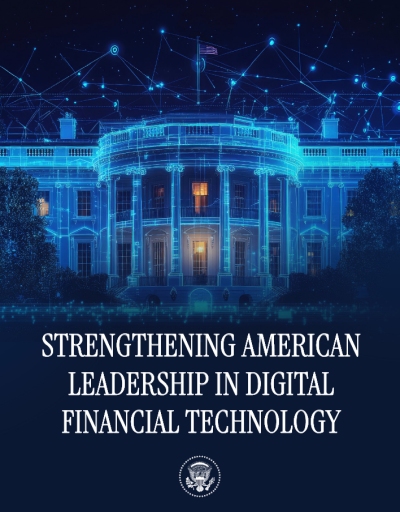
Image: Strengthening American Leadership in Digtal Financial Technology, White House report
On July 30, 2025, the White House released a major 160 page PDF report from the President’s Working Group on Digital Asset Markets called, "Strengthening American Leadership in Digital Financial Technology". The document lays out how the United States plans to build a clear rulebook for crypto and position itself as a leading global hub for blockchain technology, a huge change in direction from a government that previously relied on regulation by enforcement.
The White House report says the US needs a stronger framework for digital asset markets. It calls on Congress to pass the Digital Asset Market Clarity Act to remove gaps in oversight. The plan would give the Commodity Futures Trading Commission authority over trading in digital assets that are not securities, while the Securities and Exchange Commission would focus on those that are securities. The two agencies are asked to provide clear guidance on custody, registration, and record keeping so that new products can launch faster without long delays.
For fintech companies and investors, a more predictable environment is welcomed, and means that developers and platforms would know in advance what licenses they need and how to stay compliant instead of risking enforcement.
A large part of the report focuses on modern banking regulation. It urges federal banking regulators to stop blocking lawful digital asset companies from access to banking, a practice that was known as Operation Choke Point 2.0.
It also suggests a clear process for banks to gain approval for activities such as custody of crypto, tokenization of assets, issuing stablecoins, and using blockchains in financial services. If these changes are implemented, banks will have a clearer path to offer blockchain based products and services, which could expand customer access to digital assets directly through mainstream banks.
The report confirms the importance of stablecoins that are backed by the US dollar. It points to the GENIUS Act, signed into law on July 18, 2025, as the foundation for a federal framework for stablecoins. It also calls for a law to ban central bank digital currencies in the United States, emphasizing that the private sector should lead innovation in payments.
It suggests that the U.S. views private stablecoins as a way to maintain the dollar’s global role. It could lead to faster payments and new payment rails, but it's also a policy preference against government issued digital money.
The Working Group recommends updating anti money laundering rules to reflect how digital assets work. The plan would clarify the reporting obligations for different types of actors, including those in decentralized finance, and protect the right of law abiding citizens to hold their own digital assets. This could make it easier for compliant companies to operate while still giving regulators more effective tools against bad actors.
The report asks the Treasury and IRS to publish clear guidance on how taxes apply to crypto, including on staking, mining, and small day to day transactions. It also calls for Congress to adjust the tax code so that digital assets are treated consistently with other assets such as securities or commodities. Simplified tax rules could lower the cost of compliance and help bring more participants into the market.
If the recommendations are carried out, the US could become a more attractive market for crypto investment and product development. Other countries, including Canada, need to watch closely, as competition for talent and venture funding heats up.
For Canadian fintechs and blockchain companies, this development could open up opportunities for cross border partnerships but also create a more competition.
 The National Crowdfunding & Fintech Association (NCFA Canada) is a financial innovation ecosystem that provides education, market intelligence, industry stewardship, networking and funding opportunities and services to thousands of community members and works closely with industry, government, partners and affiliates to create a vibrant and innovative fintech and funding industry in Canada. Decentralized and distributed, NCFA is engaged with global stakeholders and helps incubate projects and investment in fintech, alternative finance, crowdfunding, peer-to-peer finance, payments, digital assets and tokens, artificial intelligence, blockchain, cryptocurrency, regtech, and insurtech sectors. Join Canada's Fintech & Funding Community today FREE! Or become a contributing member and get perks. For more information, please visit: www.ncfacanada.org
 |  |  |
|---|---|---|
 |  |  |
AI Governance | July 31, 2025

Image: Freepik/rawpixel.com
On July 30, 2025, Google confirmed in a blog post by Kent Walker that it will sign the European Union’s new voluntary code of practice for general purpose AI models. The code supports compliance and is designed to help AI developers comply with the EU’s AI Act, which comes into force on August 2, and aims to set standards for transparency, copyright and safety
Kent Walker, President of Global Affairs and Chief Legal Officer, Google:
"[Google is signing] with the hope that this code, as applied, will promote European citizens’ and businesses’ access to secure, first rate AI tools as they become available”.
Walker also warned that although the code was improved, the AI Act and code could slow Europe’s development and deployment of AI. He cited divergences from EU copyright law, approval delays and requirements that could expose trade secrets that risk hurting AI innovation and Europe’s ability to compete globally.
The European Commission describes the general purpose AI code of practice as covering three areas. The first is transparency, including detailed documentation on how models are built and trained. The second addresses copyright compliance, requiring developers to respect intellectual property and to put in place policies and contact points to handle complaints. The third focuses on safety and security for advanced models that create systemic risks, requiring external audits, risk frameworks and incident reporting.
Signing the code gives a company a presumed conformity with the AI Act, which will apply to new models from August 2, 2025 while some models already in use will have until 2027 to comply.
Google isn't the only global tech company committing to sign the code. Microsoft president Brad Smith has already stated that Microsoft intends to sign. Other companies that have agreed include OpenAI, Anthropic and Mistral AI. Elon Musk’s company xAI has chosen to sign only the safety and security chapter of the code. Meta Platforms has declined to join because of legal uncertainties for developers, as reported by The Verge.
Canada has its own voluntary code of conduct for advanced generative AI which was launched in September 2023. The Canadian code is an interim framework built around six principles of responsible AI: accountability, safety, fairness, transparency, human oversight and robustness. It is designed to guide Canadian companies ahead of the Artificial Intelligence and Data Act as it is still making its way through Parliament. The difference is that Canada’s code is advisory and is aimed predominantly at domestic companies. As of mid 2025, signatories include Canadian companies such as CGI, IBM Canada, TELUS Digital, Mastercard Canada and Cohere.
Major global technology firms like Google, Microsoft, Meta and OpenAI have not signed Canada’s code. By contrast, the EU's AI practice code is tied directly to the legally binding AI Act and offers a presumption of compliance that is attractive to companies serving the European market.
For Canadian fintechs and investors, the contrast between the European and Canadian approaches matters. Europe’s model ties clear rules to market access, while Canada’s model is currently voluntary and focused on domestic adoption.
How these approaches evolve will determine how AI tools are built, funded and deployed across borders. As Canadian firms expand internationally, aligning with these new standards will increasingly become a requirement for competing in markets where AI compliance is a condition for trust and growth.
The National Crowdfunding & Fintech Association (NCFA Canada) is a financial innovation ecosystem that provides education, market intelligence, industry stewardship, networking and funding opportunities and services to thousands of community members and works closely with industry, government, partners and affiliates to create a vibrant and innovative fintech and funding industry in Canada. Decentralized and distributed, NCFA is engaged with global stakeholders and helps incubate projects and investment in fintech, alternative finance, crowdfunding, peer-to-peer finance, payments, digital assets and tokens, artificial intelligence, blockchain, cryptocurrency, regtech, and insurtech sectors. Join Canada's Fintech & Funding Community today FREE! Or become a contributing member and get perks. For more information, please visit: www.ncfacanada.org
| | |
|---|---|---|
| | |
Crypto | July 22, 2025

Image: Youtube Short - Charles Schwab CEO Rick Wurster interview CNBC Television
On July 18, 2025, Charles Schwab CEO Rick Wurster confirmed in an interview with CNBC Television that Schwab will soon let users buy and sell Bitcoin and Ethereum directly in its brokerage accounts, with the trading option to launch within the next 12 months. The change means Schwab clients will be able to hold crypto alongside their stocks, ETFs, and bonds without having to rely on a separate platform.
Schwab already offers clients access to crypto ETFs, and it currently manages more than 20% of the U.S. crypto ETP market. But Wurster says clients have been asking for more, expressing interest to hold actual Bitcoin or Ether at Schwab. This means that Schwab will soon be directly competing with Coinbase and other crypto exchanges.
In an interview with CoinDesk, Wurster said clients say:
"I’ve got 98% of my assets sitting at Schwab. I can’t wait until you have bitcoin or [Ether] because I want them sitting alongside my other assets.”
According to Cointelegraph,crypto interest on Schwab's platform jumped more than 400%, and the new offering is a direct response to what clients are asking for.
The company also plans to launch a Schwab-branded stablecoin at some point in the future, although it hasn’t said how or when that might happen.
This retail launch is separate from Schwab’s earlier involvement in building EDX Markets, a crypto exchange created for institutions and broker-dealers. That platform is still active, but this new offering will be aimed at regular investors using Schwab’s main trading platform.
Schwab’s plan to bring crypto inside the brokerage account highlights a growing difference between the U.S. and Canada. U.S. companies like Schwab, Fidelity, and BlackRock are building full-service crypto options under existing financial rules. But in Canada, crypto trading is still kept separate from brokerage services.
Wealthsimple and a few other Canadian platforms do offer crypto trading, but none of the big Canadian banks or traditional discount brokerages offer integrated crypto and stock/ETF accounts yet. That means Canadian investors still have to open multiple accounts, transfer funds between platforms, and manage different levels of regulation and risk.
Canada was early to approve crypto ETFs, but it has not moved forward on allowing spot crypto trading in mainstream financial accounts. Schwab’s move shows how U.S. rules are creating new opportunities that Canadian investors and fintechs are missing. Unless Canada modernizes its approach, it risks falling further behind in investor access, innovation, and market competitiveness.
Schwab manages over $8 trillion in assets and serves more than 35 million investors. Once the retail services is switched on, Charles Schwab will instantly become one of the largest retail crypto access points in America.
It adds pressure on Canadian regulators and financial firms to review their approach. Canadian fintechs could lose users and assets to U.S. competitors that offer a more complete experience. For investors who want all their assets in one place, Schwab’s upcoming crypto service will make that possible. That could raise expectations on this side of the border too.
For Canada to be competitive, they will need to push for better policy alignment and faster integration of crypto into traditional finance, and ideally offer services that add value beyond what the big U.S. platforms offer.
The National Crowdfunding & Fintech Association (NCFA Canada) is a financial innovation ecosystem that provides education, market intelligence, industry stewardship, networking and funding opportunities and services to thousands of community members and works closely with industry, government, partners and affiliates to create a vibrant and innovative fintech and funding industry in Canada. Decentralized and distributed, NCFA is engaged with global stakeholders and helps incubate projects and investment in fintech, alternative finance, crowdfunding, peer-to-peer finance, payments, digital assets and tokens, artificial intelligence, blockchain, cryptocurrency, regtech, and insurtech sectors. Join Canada's Fintech & Funding Community today FREE! Or become a contributing member and get perks. For more information, please visit: www.ncfacanada.org
| | |
|---|---|---|
| | |
AI Research | July 22, 2025

Image: Freepik AI
According to a recent WORKBank audit, a major new study from Stanford's SALT Lab, 41% of Y Combinator-backed AI agent companies are
to tasks that workers have no desire for automation. These 'no go zones' represent tasks that are technically automatable but socially or emotionally rejected by workers. It's a growing disconnect that highlights a fundamental challenge for the future of work.
Should AI companies and investors automate tasks that people do not want or lead to no progress, no matter how advanced these systems are?
The WORKBank database is based on a comprehensive survey of data collected between January and May 2025 from 1,500 U.S. workers across 104 occupations and 844 occupational tasks. Each task is drawn from the U.S. Department of Labor’s O*NET database and evaluated by worker preferences and AI expert assessments. Responses were collected using an audio interface to reflect practical real world task experience.
This structured format asked workers whether they would want a task fully automated by an AI agent, and how much human collaboration they believe is needed to maintain task quality.
To assess the balance between automation and augmentation, the research team created the Human Agency Scale, a 5 level scale from H1 (no human involvement) to H5 (essential human involvement).
The most preferred response across the workforce was H3, an equal partnership between humans and AI agents. This level was dominant in 47 out of 104 occupations, however for 47.5% of tasks, workers wanted more human involvement than experts believed was technically necessary. It's a gap that could evolve into resistance points in high efficiency AI rollouts.
Despite concerns, 46.1% of tasks received a positive rating for automation. Workers were most supportive of AI when it freed up time for more important work (69.4%), reduced repetitive or tedious tasks (46.6%), or improved quality (46.6%).
On the other hand, resistance appeared from fear of losing trust, jobs, or creativity. Among those expressing concerns, 45% cited lack of trust, 23% named job loss, and 16.3% described the loss of a human touch. Arts, Design, and Media was the sector with the lowest interest in automation where only 17.1% of tasks received a positive score.
Researchers compared the WORKBank tasks with descriptions of companies backed by Y Combinator’s public portfolio. The results show a concentration of capital in areas workers are skeptical about.
41% of companies were mapped to tasks in the Low Priority Zone or Automation Red Light Zone, where worker demand is weak or negative, while many tasks in the Automation Green Light Zone and R&D Opportunity Zone where workers want automation remains underfunded (Read: ripe for AI task automation).
The research also looked at how AI is impacting the demand for certain job skills. Tasks that require higher levels of human agency usually involve interpersonal and decision making abilities rather than data analysis or technical information processing.
Comparing skill rankings based on wage data from the U.S. Bureau of Labor Statistics with human agency requirements revealed a trend away from solo technical execution toward organizational coordination, collaboration, and judgment. This suggests a shift in the kinds of competencies that AI will complement rather than replace.
Canada is investing heavily in AI innovation, fintech development, and reskilling strategies for the future economy. The WORKBank research shows that AI innovation must be aligned with worker needs and social context. If Canadian fintechs and investors focus only on technical feasibility without considering how workers feel about automation, they risk building tools that sit unused, untrusted, or even opposed. AI companies and investors must engage the people whose work is being transformed.
The National Crowdfunding & Fintech Association (NCFA Canada) is a financial innovation ecosystem that provides education, market intelligence, industry stewardship, networking and funding opportunities and services to thousands of community members and works closely with industry, government, partners and affiliates to create a vibrant and innovative fintech and funding industry in Canada. Decentralized and distributed, NCFA is engaged with global stakeholders and helps incubate projects and investment in fintech, alternative finance, crowdfunding, peer-to-peer finance, payments, digital assets and tokens, artificial intelligence, blockchain, cryptocurrency, regtech, and insurtech sectors. Join Canada's Fintech & Funding Community today FREE! Or become a contributing member and get perks. For more information, please visit: www.ncfacanada.org
| | |
|---|---|---|
| | |
Tokenization | July 21, 2025

Image: Freepik
On July 16, 2025, the U.S. Securities and Exchange Commission (SEC) held a private meeting with Ethereum-linked groups including ERC-3643 Association and Chainlink Labs to explore standards for compliant tokenized securities. At the same time, SEC Chair Paul Atkins confirmed that the agency is reviewing an innovation exemption that could allow programmable compliance frameworks to operate with targeted regulatory relief. It's a new development that confirms growing regulatory support for tokenized finance, further raising the bar for Canadian policymakers to respond.
In a major development during Crypto Week, the SEC held a private session with Ethereum-aligned groups, such as the ERC‑3643 Association, Chainlink Labs, the Enterprise Ethereum Alliance, Etherealize, and LF Decentralized Trust to explore the use of public blockchain infrastructure for regulated securities.
The meeting focused on how blockchain systems can follow existing rules for verifying identities, tracking ownership, and controlling who can buy or sell tokenized securities. The groups shared technical solutions that help meet these requirements while still using decentralized public blockchains.
Dennis O’Connell, president of the ERC‑3643 Association said the SEC showed a “noticeable shift in tone” and openness to openly source industry standards.
Two frameworks were at the center of the meeting:
Chainlink Labs in a statement:
“Only Chainlink provides the compliance, privacy, cross-chain, and data infrastructure needed to scale digital asset adoption in a single platform.”
In partnership with the Blockchain Association, Chainlink recently launched Tokenized in America, a national ranking of blockchain leadership across all 50 U.S. states.
The SEC meeting coincided with Crypto Week where rapid legislative developments were taking place in Washington. The GENIUS Act was signed into law, establishing a federal framework for stablecoin regulation, and recognizing the role of tokenized payment infrastructure. It was passed alongside the CLARITY Act, which defines treatment for digital assets, and the Anti-CBDC Surveillance State Act.
SEC Chair Paul Atkins spoke publicly about the Commission’s interest in creating an “innovation exemption” that would allow compliant tokenized securities to be piloted without full adherence to legacy rules, saying:
“If it can be tokenized, it will be tokenized.”
Sergey Nazarov, Chainlink co-founder:
Excited to see our industry reaching new heights and getting global adoption from governments because of the fundamental value that our technology provides.
The GENIUS Act is a huge step forward for stablecoins, forming the basis of on-chain payments for retail users in both… https://t.co/QlgtUgOHlu
— Sergey Nazarov (@SergeyNazarov) July 18, 2025
Canada is already evaluating stablecoins under its existing regulatory framework. The CSA classifies fiat-backed coins like USDC as “Value‑Referenced Crypto Assets” and recently allowed more time for issuers to comply. At the same time, OSFI, Department of Finance and the Bank of Canada are developing new federal rules to license stablecoin issuers to include reserve requirements, redemption, audits, and consumer protection.
However, Canada currently lacks equivalent legal tools for programmable compliance mechanisms like ERC‑3643 or Chainlink ACE. If the SEC approves a standards-based tokenization model, Canadian fintechs will face increasing cross-border friction unless policymakers adapt quickly. NCFA previously highlighted this policy gap in its advocacy post, such as Coinbase Pushes for Tokenized Equities Approval commentary. Canadian regulators cannot fall further behind.
The National Crowdfunding & Fintech Association (NCFA Canada) is a financial innovation ecosystem that provides education, market intelligence, industry stewardship, networking and funding opportunities and services to thousands of community members and works closely with industry, government, partners and affiliates to create a vibrant and innovative fintech and funding industry in Canada. Decentralized and distributed, NCFA is engaged with global stakeholders and helps incubate projects and investment in fintech, alternative finance, crowdfunding, peer-to-peer finance, payments, digital assets and tokens, artificial intelligence, blockchain, cryptocurrency, regtech, and insurtech sectors. Join Canada's Fintech & Funding Community today FREE! Or become a contributing member and get perks. For more information, please visit: www.ncfacanada.org
| | |
|---|---|---|
| | |
Stablecoins | July 18, 2025

Image: Freepik/gstudioimagen
The dominoes are definitely starting to fall. Citigroup and Bank of America have confirmed they are developing or preparing to launch their own stablecoins. In back-to-back Q2 earnings calls this week, executives from both banks outlined their intentions to support stablecoin issuance for use cases like digital payments and tokenized deposits.
As reported by Reuters, Citigroup CEO Jane Fraser said on July 15 that the bank is “looking at the issuance of a Citi stablecoin” and that stablecoins would fit within the bank’s current initiatives in tokenized deposits, custody, and digital cash on/off-ramp services.
Then just a day later, Bank of America CEO Brian Moynihan confirmed that Bank of America is actively preparing to issue a stablecoin of its own. He told analysts the bank “expects to launch” a stablecoin and is in conversations with regulators about what a compliant U.S. dollar-backed version would require. Moynihan also pointed to the advancement of the GENIUS Act in Congress as a key milestone for legal clarity.
Note, JPMorgan Chase already has functional stablecoin infrastructure. JPM Coin, a wholesale payments vehicle used by institutional clients, currently moves over $1 billion in transactions daily. The bank is now expanding into tokenized deposit products for digital settlement use.
Tokenized deposits are regular bank deposits that have been turned into digital tokens. They still belong to the customer and are backed by the bank, but because they run on blockchain technology, they can move money faster and incorporate programmable rules.
Worth noting that while Morgan Stanley has not announced its own stablecoin it confirmed during its latest earnings call that it is “actively discussing” potential use cases. CFO Sharon Yeshaya said the firm is monitoring the regulatory landscape and evaluating client needs.
In a Reuters article May 23, 2025, mentioned that JPMorgan Chase, Bank of America, Citigroup, Wells Fargo, and other large commercial banks (including U.S. Bank via consortium channels) are “exploring whether to team up to issue a joint stablecoin,”, but there have been no commitments or formal statements issued yet.
Traditional banks are positioning themselves to be regulated providers of digital dollars that can be used in fast, transparent, and low-cost transactions across modern financial systems.
Stablecoins issued by large banks could compete or potentially replace legacy payment systems for cross-border transfers, securities settlement, reserve management, and cash liquidity optimization. Eventually they may support consumer payments, although bank executives have stressed that the focus is on B2B use cases first.
Bank of England Governor Andrew Bailey recently warned that privately issued stablecoins could destabilize global financial systems if left unregulated, reinforcing the urgency for banks to operate within robust legal and supervisory frameworks.
Traditional finance (TradFi) is gearing up to compete directly with crypto native infrastructure in the issuance and management of digital cash.
The rapid entry of big banks like Citi and Bank of America into stablecoins confirm what fintech leaders have predicted for years. Programmable money will enter the banking mainstream, depending on regulatory approval and market demand.
The National Crowdfunding & Fintech Association (NCFA Canada) is a financial innovation ecosystem that provides education, market intelligence, industry stewardship, networking and funding opportunities and services to thousands of community members and works closely with industry, government, partners and affiliates to create a vibrant and innovative fintech and funding industry in Canada. Decentralized and distributed, NCFA is engaged with global stakeholders and helps incubate projects and investment in fintech, alternative finance, crowdfunding, peer-to-peer finance, payments, digital assets and tokens, artificial intelligence, blockchain, cryptocurrency, regtech, and insurtech sectors. Join Canada's Fintech & Funding Community today FREE! Or become a contributing member and get perks. For more information, please visit: www.ncfacanada.org
| | |
|---|---|---|
| | |
Tokenization | July 10, 2025

Image: Freepik
On July 9, 2025, U.S. Securities and Exchange Commissioner Hester Peirce (aka Crypto Mom) issued a clear statement about tokenized securities: "Tokenization may facilitate capital formation and enhance investors’ ability to use their assets as collateral" but they are still subject to existing securities laws.
Her comments are directed at companies using blockchain technology to issue or trade digital versions of financial instruments like stocks or bonds. Major U.S. firms such as Franklin Templeton, BlackRock, and Robinhood are already exploring tokenized fund structures and products.
Hester Perice, SEC Commissioner:
“Calling a token representing a security by a different name or moving it to a blockchain does not change its fundamental nature,"
“Tokenizing securities does not render them unrecognizable to our existing rule set. If you issue or trade a tokenized version of a stock or bond, you still must comply with the relevant rules.”
Her statement confirms that registration, disclosure, custody, and investor protection rules apply whether a security is paper-based or tokenized. As more and more firms turn to blockchain to modernize capital markets, the SEC is reminding them that the legal definitions of securities have not changed.
She highlights two categories of tokenized securities and in both cases full compliance is required: (1) those issued directly by a company and (2) those created by a third party based on an existing security.
She also cautioned that third-party tokenization can raise new risks, especially if the offering is misleading or undermines investor protections.
“A third party seeking to tokenize someone else’s security must ensure that such efforts are not misleading, do not violate the securities laws, and do not compromise investor protections.”
Blockchain infrastructure can improve how markets operate. Tokenization allows for faster settlement, greater transparency, and lower administrative costs. It also enables fractional ownership, which can make investing more accessible. Restrictions can be built in and help enforce compliance automatically, some platforms may also offer 24/7 continuous trading access.
In Peirce’s view, innovation and regulation don't have to be in conflict:
“We should consider exemptions, no-action relief, or other tailored regulatory accommodations where the benefits of blockchain technology can be realized without undermining investor protections.”
The SEC’s position does not change Canadian law, but it provides useful direction for NCFA members and fintechs active in U.S. markets. In Canada, tokenized offerings must comply with securities rules. If a financial product is a security under Canadian law then it's subject to regulation.
Canadian fintechs exploring tokenization should expect scrutiny on custody, disclosures, and investor onboarding. Issuers must also ensure that the technology used does not obscure risk or circumvent investor rights. Regulatory engagement is key.
Peirce's statement shows that regulators are open to innovation but only if it maintains transparency and investor safeguards.
The National Crowdfunding & Fintech Association (NCFA Canada) is a financial innovation ecosystem that provides education, market intelligence, industry stewardship, networking and funding opportunities and services to thousands of community members and works closely with industry, government, partners and affiliates to create a vibrant and innovative fintech and funding industry in Canada. Decentralized and distributed, NCFA is engaged with global stakeholders and helps incubate projects and investment in fintech, alternative finance, crowdfunding, peer-to-peer finance, payments, digital assets and tokens, artificial intelligence, blockchain, cryptocurrency, regtech, and insurtech sectors. Join Canada's Fintech & Funding Community today FREE! Or become a contributing member and get perks. For more information, please visit: www.ncfacanada.org
| | |
|---|---|---|
| | |



August 26th, 2025

January 4th, 2024

June 1st, 2021

September 9th, 2020

July 9th, 2018

January 3rd, 2018

September 25th, 2017

June 20th, 2017

May 10th, 2017

December 14th, 2016
