





Karsten Wenzlaff, Advisor
August 26th, 2025
Karsten Wenzlaff is a Crowdfunding and Fintech Expert from Germany. He is Secretary-General of Digit[...]


AI | Feb 12, 2025

Image: Freepik
On February 10, 2025, Elon Musk and his investor group submitted an unsolicited $97.4 billion bid to acquire OpenAI. Sam Altman, CEO of OpenAI quickly rejected the bid which comes comes at a time when OpenAI is transitioning from it's non-profit origins to a for profit structure and currently valued at approx. $260 billion of which Microsoft holds a 49% stake. Musk and Altman have been publicly feuding since Musk who co-founded OpenAI in 2015 but departed in 2018 has been an outspoken critic of OpenAI's pivot towards commercialization. Artificial intelligence (AI) power dynamics in play raises questions about Elon's ambitions and own xAI venture.
OpenAI's board they haven't yet seen the offer but Musk's lawyers said it was delivered on Monday, as reported by Reuters. Regardless, the unsolicited bid gained traction on X in a viral exchange. Lots of long time tension between these two, both whom are playing key roles AI's evolution:
Musk's bid on X:
“I want to buy OpenAI for $97.4B.”
Altman's response on X:
no thank you but we will buy twitter for $9.74 billion if you want
— Sam Altman (@sama) February 10, 2025
Since leaving OpenAI, Musk has been focusing on his own AI ambitions. In 2023 he launched xAI, a direct competitor to OpenAI based on open-source principles. It launched its flagship product, Grok, which was integrated into Musk's X platform but it hasn't reached the scale of OpenAI's ChatGPT.
Musk’s AI efforts are backed by a mix of investors such as Sequoia Capital, Andreessen Horowitz (a16z), BlackRock, Fidelity Management & Research Company, and Valor Equity Partners. Also sovereign wealth funds from Saudi Arabia (Kingdom Holding), Qatar (Qatar Investment Authority), and Oman (Oman Investment Authority) have all invested in xAI.
The Verge reported that Musk's latest consortium for the OpenAI bid includes xAI, Valor Equity Partners, Ari Emanuel, and Joe Lonsdale’s 8VC.
Chalk it up to ego or competition? Musk is unhappy with OpenAI's leadership and the direction to move away from its original non-profit mission bound to safe AI development for humanity, and one towards commercialization. After Musk left OpenAI due to disagreements, in 2019, OpenAI adopted a 'capped' for profit model to attract major investments, which ultimately led to Microsoft's multi-billion dollar funding. Musk's discontent has even led his legal team to file lawsuits against OpenAI, claiming that its partnership with Microsoft prioritizes profit over safety.
Musk has also recently expressed concern that there are AI training data shortages, which could limit future model advancements. In addition to OpenAIs significant growth and traction, they have exclusive access to proprietary datasets through Microsoft and LinkedIn giving it a competitive edge in AI innovation, so acquiring OpenAI is a strategic asset and would also secure longer term data access and strengthen xAI's position.
For OpenAI, the $97.4 billion bid is much lower than the current valuation of $260 billion, and some analysts argue that it could push down the perceived market value, complicating OpenAI's future fundraising efforts.
If xAI is struggling to innovate and compete with the likes of OpenAI and Google's DeepMind, it signals Musk may be looking for new partnerships or acquisitions to boost its strategic offerings.
Musk's other businesses like Tesla who is currently under sales pressure, may be further negatively impacted by Musk's latest actions as markets are being to see him spread too thin with significant corporate drift from the demands from Tesla, SpaceX, X, and the quasi-federal agency, the Department of Government Efficiency.
The battle between Musk and OpenAI is playing out in real time, as tensions grow over AI commercialization, corporate control, and open-source principles. The power plays, decisions, partnerships, and innovations happening today will have lasting implications for the future of artificial intelligence. Stay tuned with eyes wide open.
 The National Crowdfunding & Fintech Association (NCFA Canada) is a financial innovation ecosystem that provides education, market intelligence, industry stewardship, networking and funding opportunities and services to thousands of community members and works closely with industry, government, partners and affiliates to create a vibrant and innovative fintech and funding industry in Canada. Decentralized and distributed, NCFA is engaged with global stakeholders and helps incubate projects and investment in fintech, alternative finance, crowdfunding, peer-to-peer finance, payments, digital assets and tokens, artificial intelligence, blockchain, cryptocurrency, regtech, and insurtech sectors. Join Canada's Fintech & Funding Community today FREE! Or become a contributing member and get perks. For more information, please visit: www.ncfacanada.org
 |  |  |
|---|---|---|
 |  |  |
Bitcoin | Feb 7, 2025

MicroStrategy rebrand as Strategy logo
MicroStrategy (NASDAQ: MSTR) one of the biggest corporate holders of Bitcoin, has officially rebranded as Strategy, reflecting a deeper commitment to Bitcoin and artificial intelligence. Along with the rebrand, the company also launched a new financial product STRK now trading on Nasdaq offering an 8% dividend paying convertible preferred stock. Lastly, (Micro)Strategy who holds over 19,000 bitcoin could now face a huge tax bill on unrealized bitcoin gains due to a recent accounting rule change.
On February 5, 2025, MicroStrategy announced an official rebrand and name change to Strategy (see logo with Bitcoin icon above, orange background) to better represent the company’s evolution beyond software and into a Bitcoin-focused financial strategy. The rebrand also includes a new corporate identity and website for it's AI powered business intelligence Strategy software and a separate URL to acquire Strategy's merchandise. The About Strategy link proudly states on the page, "We are the world's first and largest Bitcoin Treasury Company, and the largest independent, publicly traded business intelligence company."
Michael Saylor, Founder and Executive Chairman, Strategy:
“Strategy is one of the most powerful and positive words in the human language. It also represents a simplification of our company name to its most important, strategic core. Antoine de Saint-Exupery said, ‘Perfection is achieved, not when there is nothing more to add, but when there is nothing left to take away.’ After 35 years, our new brand perfectly represents our pursuit of perfection.”
To fuel its Bitcoin strategy, Strategy launched STRK, an 8% dividend paying convertible preferred stock now trading on Nasdaq. The company raised $563 million from this offering which will likely be used to purchase more Bitcoin.
STRK is designed for investors who want to benefit from Bitcoin’s growth but prefer a steady income instead of dealing with Bitcoin’s price volatility. The stock pays an 8% annual dividend and can later be converted into regular Strategy (MSTR) shares, allowing investors to profit if the stock price goes up.
There are risk however. If too many STRK holders choose to convert their shares into regular stock, it could reduce the value of existing MSTR shares. Having said that, this product still shows that Strategy is using creative financial tools to increase its Bitcoin holdings without selling common stock.
A major Financial Accounting Standards Board (FASB) rule change now requires companies to report Bitcoin and other crypto holdings at fair market value each reporting period. This replaces the old rule which only required companies to record losses (impairments) but did not allow them to record gains unless the crypto was sold. So this means that companies must update the value of their Bitcoin holdings regularly based on market prices by showing gains and losses as the price of Bitcoin fluctuates.
For some companies holding Bitcoin like Tesla, thanks to the new accounting rules, Tesla reported a $600 million profit from its Bitcoin holdings in Q4 2024.
However in Strategy's case, since they hold over 190,000 Bitcoin, are now facing a huge tax bills due to unrealized Bitcoin gains. Following the Corporate Alternative Minimum Tax (CAMT) introduced by the Inflation Reduction Act, large corporations must pay a 15% tax on book profits including unrealized crypto gains.
So while the rule change benefits transparency, it also creates an unexpected tax burden for firms holding large amounts of Bitcoin.
Strategy’s aggressive Bitcoin strategy is attracting strong institutional interest with major investors backing its stock and STRK offering and company. According to Coindesk, the world's largest asset manager, BlackRock, just increased its ownership stake in Strategy to 5% up from its previous 4.09% as of September 30, 2024. Worth noting National Bank Doubling Down on MicroStrategy’s Bitcoin Boom.
The National Crowdfunding & Fintech Association (NCFA Canada) is a financial innovation ecosystem that provides education, market intelligence, industry stewardship, networking and funding opportunities and services to thousands of community members and works closely with industry, government, partners and affiliates to create a vibrant and innovative fintech and funding industry in Canada. Decentralized and distributed, NCFA is engaged with global stakeholders and helps incubate projects and investment in fintech, alternative finance, crowdfunding, peer-to-peer finance, payments, digital assets and tokens, artificial intelligence, blockchain, cryptocurrency, regtech, and insurtech sectors. Join Canada's Fintech & Funding Community today FREE! Or become a contributing member and get perks. For more information, please visit: www.ncfacanada.org
| | |
|---|---|---|
| | |
Economy | Feb 7, 2025

Image: Stephen Poloz (Canada Club Toronto)
On February 5, 2025, the former Governor of the Bank of Canada, Stephen Poloz, delivered a speech at the Canadian Club Toronto about the future of Canada’s economy. He covered a concerns about U.S trade tensions, productivity issues, Canada's weak business investment and the need for policy changes to ensure economic stability. His key message? Canada needs to take bold action NOW before it's too late.
Poloz painted a sobering picture of where Canada's economy stands today. While the economy weathered the COVID-19 crisis pretty well, the economy is in a much weaker position now. What’s wrong?
Poloz said that while these challenges are serious, Canada has an opportunity to strengthen economic resilience through investment, structural reforms, and proactive policy measures. If Canada doesn’t make changes, it risks falling behind in global trade and innovation.
Poloz argued that instead of simply fighting tariffs with more tariffs, Canada should focus on boosting its economy from within, recommending:
One of Poloz’s strongest arguments was that Canada is leaving money on the table by not fixing its internal trade restrictions. He described it as free money that no one is picking up.
Right now, businesses face unnecessary hurdles when trading across provinces, adding extra costs and red tape.
Removing these barriers could boost Canada's economy by 4-7%, which would (completely) offset the losses from U.S. tariffs, yet numerous governments have failed to take any action.
He also made a historical reference to Confederation highlighting that Canada was formed in response to trade challenges with the U.S., so it's lack of internal trade today is very ironic.
Poloz linked trade policy to defence spending saying that the under-investment in defence is one of the biggest irritants for U.S. policymakers, and by increasing military spending, Canada could improve its trade relationship with the United States and potentially avoid severe tariffs.
He said boosting defence is politically sensitive. It would require either tax hikes or budget cuts elsewhere but he argued that a small defence tax (1-2% of GDP) could be a smart trade-off to protect Canada's economic interests and avoid larger losses.
Poloz criticized Canada’s weak business investment over the past decade and urged policymakers to implement tax incentives to encourage companies to modernize and innovate. Canada needs to embrace the Fourth Industrial Revolution by:
He warned that if Canada doesn’t invest in its future now, it will fall even further behind.
With U.S. tariffs looming, a weak economy, slow business investment, and missed opportunities for growth, Canada can’t afford to wait! Canada can strengthen its economy by (1) removing interprovincial trade barriers, (2) investing in AI and digital transformation, and (3) strengthening U.S. relations through defence spending. The country must come together to adapt proactively to global economic challenges by taking bold action to increase productivity, resilience, and long-term growth.
The National Crowdfunding & Fintech Association (NCFA Canada) is a financial innovation ecosystem that provides education, market intelligence, industry stewardship, networking and funding opportunities and services to thousands of community members and works closely with industry, government, partners and affiliates to create a vibrant and innovative fintech and funding industry in Canada. Decentralized and distributed, NCFA is engaged with global stakeholders and helps incubate projects and investment in fintech, alternative finance, crowdfunding, peer-to-peer finance, payments, digital assets and tokens, artificial intelligence, blockchain, cryptocurrency, regtech, and insurtech sectors. Join Canada's Fintech & Funding Community today FREE! Or become a contributing member and get perks. For more information, please visit: www.ncfacanada.org
| | |
|---|---|---|
| | |
Crypto Regulation | Feb 5, 2025

Image: Freepik/wirestock
President Trump's newly appointed 'Crypto Czar', David Sacks, held his inaugural press conference yesterday to outline the administration's vision for Bitcoin and digital assets, signalling a positive shift in U.S. policy. One that provides clear and transparent regulation and policies that will make the U.S. the global leader in digital assets and crypto. Below are the key takeaways from the event.
During the conference Sacks addressed the elephant in the room -- that is the lack of regulatory clarity, by saying he's spoken to countless of crypto entrepreneurs who expressed, "The number one thing founders have told me they need is clarity. They just want to know what the rules are so they can follow them." Sacks announced the formation of a federal digital asset working committee dedicated to developing a regulatory framework that balances oversight with innovation. The working group's mandate includes establishing rules for digital asset issuance and operations with a particular focus on stablecoins.
This approach is most welcomed by anyone in crypto, as the SEC of the prior administration faced criticism for ambiguity and regulating by enforcement, which stifled innovation in the U.S. digital asset ecosystem.
Stablecoins were clearly a focus at the press conference. Senator Bill Hagerty introduced a new bill known as the Guiding and Establishing National Innovation for U.S. Stablecoins (GENIUS) Act that would create two levels of oversight for stablecoin issuers. Large companies holding more than $10 billion in assets would be regulated by federal authorities, while smaller issuers would continue to be supervised at the state level. The bill also requires stablecoin issuers to provide monthly reports on their reserves to ensure that they have suitable backing, enhance transparency and trust, and strengthen the role of the U.S. dollar in digital finance.
Stablecoins play an imperative role in cross-border payments and decentralized finance. By incorporating stablecoins into the regulatory framework, the U.S. plans to position the dollar as a dominant force in the digital economy to ensure capital flows through regulated U.S. channels rather than offshore alternatives.
Previously, U.S. crypto regulation was fragmented across agencies like the SEC and CFTC, causing considerable friction. Now, there's a bipartisan working group with members from the House and Senate's Financial Services, Banking, and Agriculture Committees all working together aiming to create a unified comprehensive legislative approach. Lawmakers including Senator Tim Scott and Representative French Hill emphasized the importance of keeping innovation in the U.S.
Czar Sacks confirmed that the administration is actively evaluating a Strategic Bitcoin Reserve. While details are limited, such a move is akin to the government considering Bitcoin as part of its national reserves, similar to how central banks hold gold today. If implicated, it would legitimize Bitcoin's role as a reserve asset, boost institutional confidence, and increase demand for bitcoin and digital assets broadly. But it's early days and requires further research and political/financial support.
The administration discussed plans for a market structure bill aimed at providing clear regulatory guidelines for digital assets. This proposed legislation will likely be modelled after the Financial Innovation and Technology for the 21st Century Act (FIT21), which previously passed the House with bipartisan support.
Senator Tim Scott, Chairman of the Senate Banking Committee, highlighted the urgency of this initiative and that both the market structure and stablecoin bills are priorities for the administration's first 100 days, and that the stablecoin bill would likely advance first followed by the market structure legislation.
This press conference marks the turning point in crypto regulation in the U.S. towards a pro-innovation, regulation-driven digital asset ecosystem. This shift raises an important question. How will these regulatory developments impact Canadian companies operating in both markets? Canada should not be left behind and consider adopting a structured framework to support and retain innovation in the crypto fintech sector.
The National Crowdfunding & Fintech Association (NCFA Canada) is a financial innovation ecosystem that provides education, market intelligence, industry stewardship, networking and funding opportunities and services to thousands of community members and works closely with industry, government, partners and affiliates to create a vibrant and innovative fintech and funding industry in Canada. Decentralized and distributed, NCFA is engaged with global stakeholders and helps incubate projects and investment in fintech, alternative finance, crowdfunding, peer-to-peer finance, payments, digital assets and tokens, artificial intelligence, blockchain, cryptocurrency, regtech, and insurtech sectors. Join Canada's Fintech & Funding Community today FREE! Or become a contributing member and get perks. For more information, please visit: www.ncfacanada.org
| | |
|---|---|---|
| | |
Launch | Feb 5, 2025

Image from Build Canada's website
As Canada faces a tense period of trade disputes and tariffs from the U.S. and with growing concerns over competitiveness, productivity, investment and innovation, leading Canadian tech entrepreneurs have launched a new initiative called 'Build Canada', a public platform to push forward policy solution ideas to strengthen Canada's economy. Waiting for government is no longer an option. Build Canada aims to provide concrete, actionable policy recommendations to help the the country remain globally competitive and adapt to economic challenges.
Build Canada is a public platform that releases weekly policy proposals that offer actionable ideas and practical solutions that government officials and policymakers can use to address Canada’s most pressing economic challenges such as exporting to new markets, encouraging investment via smarter policies, strengthen innovation but supporting entrepreneurs and nurturing a culture that celebrates ambition and success.
Build Canada is led by experienced entrepreneurs and business leaders who want to help Canada thrive:
And backed by some of Canada’s top tech leaders:
And many more as the initiative grows...
The group has already published four policy proposals called 'memos', each addressing an economic or social issue:
Encourages Canadians to take more pride in their country by recognizing and celebrating achievements in business, technology, and innovation.
The goal is to create a culture where innovation, ambition, and success are celebrated, inspiring more Canadians to build and contribute to the country’s future.
This proposal suggests having one set of national rules for transportation that would be managed by Transport Canada, making it easier for new technology to be approved and used across the country. Now, businesses face different rules in each province and city, which makes it harder to launch innovations like electric vehicles, self-driving cars, and drones. A single, national system would speed up approvals and help Canada become a global leader in transportation technology.
This proposal suggests changing Canada’s immigration system to focus more on bringing in highly skilled workers who can help grow the economy. The goal is to attract the best talent and business leaders to help Canada stay competitive and drive innovation. It recommends:
This proposal suggests fixing Canada’s disconnected health record system to make healthcare more connected, convenient, and better and more efficient for everyone, recommending:
Build Canada is launching alongside another major policy initiative recently announced, The Canadian SHIELD Institute, founded with a $10 million donation from Jim Balsillie, co-founder of the Council of Canadian Innovators, focused on:
As Canada navigates economic uncertainty, shifting trade relationships, and increasing global competition, waiting for government action is no longer enough. Build Canada is just getting started with more entrepreneurs and business leaders joining the initiative. Help strengthen Canada's economy, one policy at a time.
The National Crowdfunding & Fintech Association (NCFA Canada) is a financial innovation ecosystem that provides education, market intelligence, industry stewardship, networking and funding opportunities and services to thousands of community members and works closely with industry, government, partners and affiliates to create a vibrant and innovative fintech and funding industry in Canada. Decentralized and distributed, NCFA is engaged with global stakeholders and helps incubate projects and investment in fintech, alternative finance, crowdfunding, peer-to-peer finance, payments, digital assets and tokens, artificial intelligence, blockchain, cryptocurrency, regtech, and insurtech sectors. Join Canada's Fintech & Funding Community today FREE! Or become a contributing member and get perks. For more information, please visit: www.ncfacanada.org
| | |
|---|---|---|
| | |
Innovation | Feb 4, 2025

Image: Big Ideas 2025 Ark Invest
ARK Invest just dropped their annual Big Ideas 2025 report (148 page PDF) covering the disruptive tech trends that are game-changing industries and global economies. It provides insight into a lot of investment ideas backed with charts and data. Below are the highlights and compelling data points along with their fintech impact.
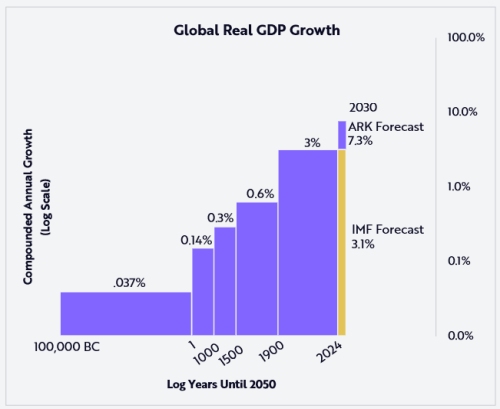
The interconnected fields of AI, robotics, blockchain, energy, and biotech are converging, creating new efficiencies, business models, economic growth, and investment opportunities at an unprecedented pace.
AI agents are changing industries by making decisions automatically, streamlining tasks, and helping people work more efficiently. These smart systems will play a big role in businesses, finance, and healthcare, as well as in everyday life as they improve customer service, digital marketing and provide automated financial advice.
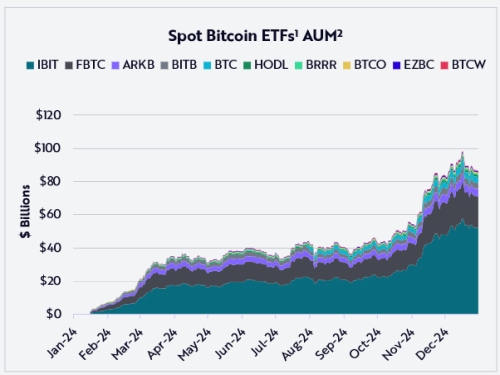
Spot Bitcoin ETF AUM Ark Invest Big Ideas 2025
Bitcoin’s evolution into a mainstream financial asset is being driven by institutional adoption, regulatory clarity, its role as a hedge against inflation, and store of wealth. ETFs and corporate adoption are solidifying its place in global finance. Bitcoin’s adoption will drive new financial products, including tokenized assets, decentralized finance (DeFi) lending, and institutional custody solutions.
Stablecoins are changing the way money moves across borders by making payments faster, cheaper, and more efficient than traditional banks. They connect cryptocurrency with regular money, making digital payments easier, helping more people access financial services, and influencing new rules for digital currencies.
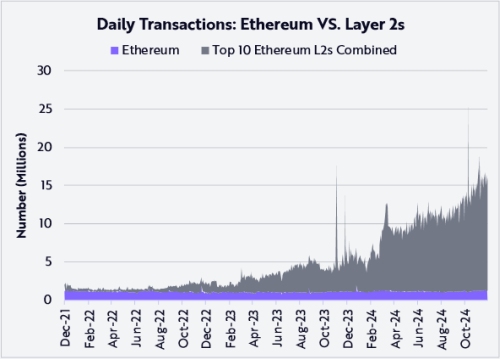
Image: Ethereum vs L2 Daily Transactions (Ark Invest, Big Ideas 2025)
Blockchain scalability will drive growth in DeFi, NFT markets, and enterprise blockchain adoption with solutions such as Layer 2 networks, rollups, and modular architectures are significantly lowering transaction costs and increasing network efficiency. This shift is paving the way for mainstream adoption of decentralized applications.
Autonomous vehicles (robotaxis) will reduce transportation costs, making personal car ownership less necessary, incentivize infrastructure investment and create new financing models for mobility-as-a-service platforms.
AI logistics and smart delivery systems are reducing costs and optimizing supply chain efficiency, creating opportunities in supply chain management solutions and financing of autonomous fleet operations.
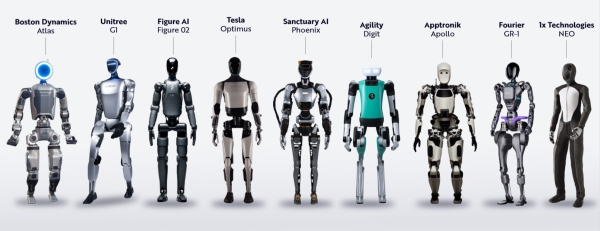
Image: Humanoid Robots Debuting Globally (Ark Invest, Big Ideas 2025)
The rise of AI humanoid robots is changing labour markets and improving manufacturing efficiency. Increased automation will drive investment in robotics startups, manufacturing solutions, and AI workforce solutions.
Breakthroughs in battery technology and renewable energy are reducing dependency on fossil fuels. The shift to decentralized energy creates opportunities in cleantech financing, energy trading, and carbon credit markets.
AI is improving quickly and moving toward Artificial General Intelligence (AGI), which will change how decisions are made, improve risk management, and create new investment opportunities in automation.
The accelerated growth, convergence and adoption of emerging technologies will require new regulatory frameworks, increased infrastructure investments, and a massive shift in market development strategies. Whether it’s the mainstreaming of digital assets or the advancement of artificial intelligence the future is arriving faster than we imagined, and those who adapt will be well positioned for whatever comes next.
The National Crowdfunding & Fintech Association (NCFA Canada) is a financial innovation ecosystem that provides education, market intelligence, industry stewardship, networking and funding opportunities and services to thousands of community members and works closely with industry, government, partners and affiliates to create a vibrant and innovative fintech and funding industry in Canada. Decentralized and distributed, NCFA is engaged with global stakeholders and helps incubate projects and investment in fintech, alternative finance, crowdfunding, peer-to-peer finance, payments, digital assets and tokens, artificial intelligence, blockchain, cryptocurrency, regtech, and insurtech sectors. Join Canada's Fintech & Funding Community today FREE! Or become a contributing member and get perks. For more information, please visit: www.ncfacanada.org
| | |
|---|---|---|
| | |
Tariffs | Feb 3, 2025

Image: Freepik/master1305
The 25% tariffs on Canadian imports into the U.S. (and 10% on energy) have been temporarily paused following a phone call between U.S. President Donald Trump and Canadian Prime Minister Justin Trudeau. The decision comes after Canada agreed to strengthen border security and take further action against fentanyl trafficking, which the U.S. cited as a key justification for the tariffs. The 30-day suspension gives both countries time to negotiate a broader economic and security agreement.
Justin Trudeau, Prime Minister of Canada shared on X:
"I just had a good call with President Trump. Canada is implementing our $1.3 billion border plan — reinforcing the border with new choppers, technology and personnel, enhanced coordination with our American partners, and increased resources to stop the flow of fentanyl. Nearly 10,000 frontline personnel are and will be working on protecting the border.
In addition, Canada is making new commitments to appoint a Fentanyl Czar, we will list cartels as terrorists, ensure 24/7 eyes on the border, launch a Canada- U.S. Joint Strike Force to combat organized crime, fentanyl and money laundering.
I have also signed a new intelligence directive on organized crime and fentanyl and we will be backing it with $200 million. Proposed tariffs will be paused for at least 30 days while we work together."
Following the agreement, Canada is temporarily suspending its planned counter-tariffs on U.S. goods. Ontario Premier Doug Ford confirmed that retaliatory tariffs would not proceed for now, advising that Canada should focus on strengthening trade ties with other partners, including China and the European Union. Ontario was set to remove U.S. alcohol from LCBO shelves Monday night. The province was also going to rip up a $100 million deal with Elon Musk’s Starlink for satellite internet service in Northern Ontario.
With a 30-day deadline, Canada must work quickly to secure a long-term resolution. The next phase of negotiations will likely center on border security measures, trade adjustments, and economic incentives to satisfy U.S. concerns without triggering further trade disruptions. If no agreement is reached within the 30-day period, the tariffs could still take effect, escalating tensions between the two countries. For now, the agreement provides relief for Canadian businesses and consumers, but the outcome remains uncertain as negotiations continue.
We're all consumers. Here are just a few links you may be interested in. Do your research and make the right choice and support/buy Canadian products:
The National Crowdfunding & Fintech Association (NCFA Canada) is a financial innovation ecosystem that provides education, market intelligence, industry stewardship, networking and funding opportunities and services to thousands of community members and works closely with industry, government, partners and affiliates to create a vibrant and innovative fintech and funding industry in Canada. Decentralized and distributed, NCFA is engaged with global stakeholders and helps incubate projects and investment in fintech, alternative finance, crowdfunding, peer-to-peer finance, payments, digital assets and tokens, artificial intelligence, blockchain, cryptocurrency, regtech, and insurtech sectors. Join Canada's Fintech & Funding Community today FREE! Or become a contributing member and get perks. For more information, please visit: www.ncfacanada.org
| | |
|---|---|---|
| | |



August 26th, 2025

January 4th, 2024

June 1st, 2021

September 9th, 2020

July 9th, 2018

January 3rd, 2018

September 25th, 2017

June 20th, 2017

May 10th, 2017

December 14th, 2016
