





Karsten Wenzlaff, Advisor
August 26th, 2025
Karsten Wenzlaff is a Crowdfunding and Fintech Expert from Germany. He is Secretary-General of Digit[...]


Feb 26, 2026 | NCFA Fintech Market Activity | Payments And Market Structure

On February 26 2026, Block reported in its Q4 2025 shareholder letter that it is reducing its workforce from over 10,000 people to just under 6,000, which means more than 4,000 people are leaving or entering consultation as the company resets how it operates around AI.
The timing of the news is strategic given that cuts arrive alongside stronger operating results, not a weak quarter. Block reports Q4 gross profit of $2.87 billion, up 24% year over year, with Cash App gross profit at $1.83 billion, up 33%, and Square gross profit at $993 million, up 7%.
The company also reported $485 million in operating income, $588 million in adjusted operating income, and adjusted diluted EPS of $0.65. Block's XYZ stock popped 25% in after hours trading after the announcement.
Block also raised its 2026 outlook. The company says it now expects $12.20 billion in gross profit for 2026, up 18% year over year, and $3.20 billion in adjusted operating income, up 54%. It says the workforce changes should begin to affect adjusted operating income more meaningfully in Q2, with the full impact of the new cost structure improving profitability in the second half of the year.
So the layoff headline doesn't tell the whole story. The story of a scaling fintech that's using AI to push for higher product velocity and stronger operating leverage at the same time.
Jack Dorsey, CEO Block:
“Intelligence tools have changed what it means to build and run a company. We’re already seeing it internally. A significantly smaller team, using the tools we’re building, can do more and do it better. And intelligence tool capabilities are compounding faster every week.”
Block isn't cutting from a position of visible deterioration or weakness. It's cutting while growth accelerates, guidance rises, and management claims a smaller team can execute faster. That raises a harder question for the market. If a large payments platform can protect growth while resetting headcount this aggressively, investors may start to reward AI led efficiency gains faster than many teams expect.
If stronger fintech earnings now come with smaller teams, does AI start to reset the valuation premium around operating discipline and execution speed?
 The National Crowdfunding & Fintech Association (NCFA Canada) is a financial innovation ecosystem that provides education, market intelligence, industry stewardship, networking and funding opportunities and services to thousands of community members and works closely with industry, government, partners and affiliates to create a vibrant and innovative fintech and funding industry in Canada. Decentralized and distributed, NCFA is engaged with global stakeholders and helps incubate projects and investment in fintech, alternative finance, crowdfunding, peer-to-peer finance, payments, digital assets and tokens, artificial intelligence, blockchain, cryptocurrency, regtech, and insurtech sectors. Join Canada's Fintech & Funding Community today FREE! Or become a contributing member and get perks. For more information, please visit: www.ncfacanada.org
 |  |  |
|---|---|---|
 |  |  |
February 23, 2026 | NCFA Market Activity | Artificial Intelligence And Data

On February 21, 2026, B.C.’s premier says police are pursuing preservation orders for potential evidence held by digital services companies, including social media platforms and AI companies, after media reports tied OpenAI to the case. This isn't a new fintech policy just yet, but it puts evidence readiness into the open. If a partner asks what you can preserve and produce under lawful process, you can’t appear like a 'deer in headlights'. You need a working path.
BC Government, Office of the Premier, Media Relations:
“Reports that allege OpenAI had related intelligence before the shootings in Tumbler Ridge took place are profoundly disturbing for the victims’ families and all British Columbians. We will use all powers of government to ensure that police have the tools they need to investigate every aspect of this horrific tragedy.”
RCMP report said that the active shooter call came in at about 1:20 p.m. on February 10 and the public alert ended at 5:45 p.m. Six victims were found deceased inside the school, two victims were airlifted with serious or life threatening injuries, a third victim died during transport, and about 25 others were assessed for non life threatening injuries. RCMP also reports two additional victims were found deceased at a connected residence.
On February 13, RCMP reports more than 80 interviews took place with students, educators, and first responders, while forensic teams continued processing two scenes and a vehicle connected to the suspect. The investigative update also reported digital evidence work including witness images and videos, CCTV, and body worn camera video, and it says RCMP launched an online portal to collect more evidence, including phone footage captured inside the school.
In a BBC report, OpenAI spokesperson said that they didn't alert authorities about the account because its usage didn't meet its threshold of credible or imminent plan for serious physical harm to others...
"In June 2025, we proactively identified an account associated with this individual [Jesse Van Rootselaar] via our abuse detection and enforcement efforts, which include automated tools and human investigations to identify misuses of our models in furtherance of violent activities."
Evan Solomon, Minister of Artificial Intelligence and Digital Innovation per Globe and Mail reporting:
"Canadians expect online platforms, including OpenAI, to have robust safety protocols and escalation practices in place to protect online safety and ensure law enforcement are warned about potential violence,"
This story turns AI governance into an evidence workflow. If your product runs AI in onboarding, fraud triage, collections, or support, partners need clear answers on what the system records, what it retains, who can access it, and how the team preserves and produces records under lawful process without breaking integrity. A stakeholder may accept model error but they won’t accept uncertainty about records, access, and escalation ownership when scrutiny rises.
Financial technology companies should define escalation triggers in plain language. Name an accountable owner and a backup. Restrict log access. Set retention windows you can defend. Test a short runbook for preservation and production so the team can execute it without debate when the question lands, an be sure to provide suitable ongoing training.
If preservation orders become a more common tool when AI enters an incident, does Canada need a shared baseline for AI logging, retention, and escalation handoffs so every regulated buyer does not rebuild the same checklist from scratch?
Reuters reported that OpenAI reps have been summoned to Ottawa urgently to discuss AI safety.
Update per CTV article: Following the meeting in Ottawa with OpenAI safety leaders, federal officials said they were “deeply disturbed” and ultimately “disappointed” that warning signals tied to the Tumbler Ridge shooter were not escalated to police earlier, with AI Minister Evan Solomon stressing Canadians expect platforms to maintain “robust safety protocols and escalation practices.” OpenAI is cooperating with the RCMP but produced no immediate new safeguards, leaving ministers to seek concrete follow-up proposals.
The National Crowdfunding & Fintech Association (NCFA Canada) is a financial innovation ecosystem that provides education, market intelligence, industry stewardship, networking and funding opportunities and services to thousands of community members and works closely with industry, government, partners and affiliates to create a vibrant and innovative fintech and funding industry in Canada. Decentralized and distributed, NCFA is engaged with global stakeholders and helps incubate projects and investment in fintech, alternative finance, crowdfunding, peer-to-peer finance, payments, digital assets and tokens, artificial intelligence, blockchain, cryptocurrency, regtech, and insurtech sectors. Join Canada's Fintech & Funding Community today FREE! Or become a contributing member and get perks. For more information, please visit: www.ncfacanada.org
| | |
|---|---|---|
| | |
Feb 19, 2026 | NCFA Fintech Market Activity | CIX Summit

Image: Michael Katchen, Co-founder and CEO, Wealthsimple
On February 19 2026, Elevate named Wealthsimple Innovator of the Year for 2026 CIX Summit, who achieved a banner record year that included assets under administration doubling from $50B to more than $100B, 650,000 new clients, and more than 3 million Canadians served.
The release ties the award to three proof points that matter for founders and investors who care about durable scale.
First, it says Wealthsimple raised $750M in equity financing at a $10B post money valuation in October 2025 while maintaining profitability.
Second, it highlighted product expansion that moved beyond a single wedge, including 24/5 trading for US stocks, new trading tools including margin and expanded options strategies, plus a credit card.
Third, it points to distribution outcomes, including capturing 35% of all First Home Savings Accounts opened in Canada and ranking among the top three institutions in the country for net deposits.
Lisa Zarzeczny, CEO, Elevate:
“Wealthsimple exemplifies the bold innovation and execution that the CIX Innovator of the Year award celebrates. Their commitment to using technology to democratize access to sophisticated financial tools is exactly the kind of innovation Canada needs more of. We’re thrilled to honour their achievements and hear from Mike at CIX Summit about how they’re continuing to push boundaries in an industry ripe for disruption.”
This award lands in a moment where Canadian consumers keep moving toward digital first money management, and incumbents keep responding with pricing and product changes like options fee changes and real gold investing, plus competitive positioning where challenger platforms push directly at big bank margins. Those tracks connect cleanly to what CIX rewards here, which is compounding execution across product, distribution, and balance sheet strength.
In addition to Innovator of the Year award, see all 14 CIX 2026 startup award winners across early, emerging, and growth categories.
Mike Katchen is scheduled to accept the award and speak at CIX Summit 2026 on March 25 2026 at the Design Exchange in Toronto, alongside curated startup presentations and investor meetings, according to the release. NCFA is sharing a 20% community partner discount on CIX Summit passes for its community. Use CIXNCFA20 for 20% off. CIX publishes ticket options and event logistics on its official ticket page. Register with NCFA and save.
If a fintech can add hundreds of thousands of clients while it doubles assets, raises late stage capital, and expands into credit, what becomes the real incumbent moat in Canada next, distribution, product depth, or trust?
Awards do not build companies, but they do spotlight operating models that work. Congratulations to Michael Katchen and the entire Wealthsimple team for leading fintech in Canada across a number of fronts. Well deserved!
The National Crowdfunding & Fintech Association (NCFA Canada) is a financial innovation ecosystem that provides education, market intelligence, industry stewardship, networking and funding opportunities and services to thousands of community members and works closely with industry, government, partners and affiliates to create a vibrant and innovative fintech and funding industry in Canada. Decentralized and distributed, NCFA is engaged with global stakeholders and helps incubate projects and investment in fintech, alternative finance, crowdfunding, peer-to-peer finance, payments, digital assets and tokens, artificial intelligence, blockchain, cryptocurrency, regtech, and insurtech sectors. Join Canada's Fintech & Funding Community today FREE! Or become a contributing member and get perks. For more information, please visit: www.ncfacanada.org
| | |
|---|---|---|
| | |
Feb 18, 2026 | NCFA Fintech Market Activity | Tokenization and Digital Assets

Image: Freepik
On February 18 2026, WLFI announced a strategic collaboration with Apex Group covering over $3.5 trillion in serviced assets, with a planned pilot to explore using WLFI’s USD1 stablecoin for tokenized asset subscriptions, distributions, and redemptions.
Apex Group operates in 52 countries and explains the work and partnership as a way to bring regulated stablecoin infrastructure into fund administration workflows, with the stated goal of streamlining settlement and improving operational efficiency for institutional clients.
The collaboration also extends beyond cash movement. Parties will evaluate ways to make WLFI assets, including real estate and infrastructure holdings, available on the London Stock Exchange Group Digital Market Infrastructure platform, subject to applicable regulations and requirements. The Apex Group will also explore making assets tokenized using Apex Digital 3.0 available through WLFI’s planned mobile app, which the release says will support digital asset management and connections to bank accounts and wallets.
Zach Witkoff, Chief Executive Officer and Co Founder, World Liberty Financial:
“Working with Apex Group allows us to demonstrate USD1’s tremendous utility within capital markets infrastructure. This collaboration accelerates our mission to make WLFI assets accessible at the most established financial services platforms globally.”
The release also describes WLFI as inspired by President Donald J. Trump. The link to a political brand raises the stakes for how market participants evaluate governance, oversight, counterparty risk, and reputational exposure, especially when the use case touches institutional fund servicing rather than retail trading. Early WLFI token sales generated significant investor demand and capital commitments, positioning the ecosystem as both a funding vehicle and an emerging digital asset platform.
For tokenized funds, the operational promise is clear. Subscriptions and redemptions create predictable and repetitive money movement. A stablecoin rail can compress settlement timelines, tighten reconciliation loops, and reduce dependency on multi step bank handoffs, if the controls meet the standard that allocators and regulators expect.
If administrators can run clean tokenized fund flows on stablecoin rails, other administrators, custodians, and infrastructure providers will feel pressure to offer equivalent settlement options, or to partner with providers that already can. That competition will centre on who can deliver reliability, auditability, safeguards, and integration speed.
Peter Hughes, Founder and Chief Executive Officer, Apex Group:
“Our clients are increasingly interested in blockchain based solutions that deliver tangible benefits and cost savings. This collaboration with World Liberty Financial lets us examine how USD1 and stablecoin infrastructure can modernize our platform and services, while providing the edge to support our clients as digital asset integration becomes standard practice.”
If stablecoins start handling fund subscriptions and redemptions at scale, do administrators become the main gatekeepers that decide which stablecoin rails earn institutional trust?
The National Crowdfunding & Fintech Association (NCFA Canada) is a financial innovation ecosystem that provides education, market intelligence, industry stewardship, networking and funding opportunities and services to thousands of community members and works closely with industry, government, partners and affiliates to create a vibrant and innovative fintech and funding industry in Canada. Decentralized and distributed, NCFA is engaged with global stakeholders and helps incubate projects and investment in fintech, alternative finance, crowdfunding, peer-to-peer finance, payments, digital assets and tokens, artificial intelligence, blockchain, cryptocurrency, regtech, and insurtech sectors. Join Canada's Fintech & Funding Community today FREE! Or become a contributing member and get perks. For more information, please visit: www.ncfacanada.org
| | |
|---|---|---|
| | |
Feb 10, 2026 | NCFA Fintech Market Activity | Alternative Finance and Capital Markets
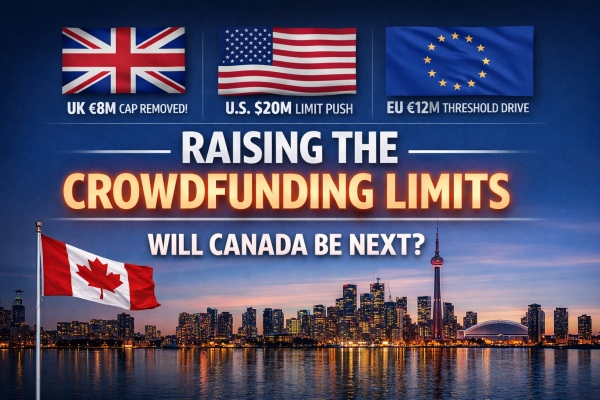
On February 10 2026, UK POP rules go live, removing the old prospectus trigger that made large public raises expensive, slow, and out of reach for many private companies.
For years, UK companies faced a hard line. If a business raised more than €8 million in securities from the public in a year, it had to produce a full prospectus (NB: the UK retained that euro-denominated threshold in its domestic framework post-brexit). Crowdcube says that prospectus costs could cost more than £250,000 and take months, which pushed many companies away from public community rounds even when demand existed.
Under the Public Offer Platform regime, raises above £5 million now run through a regulated POP, and the regime removes the upper fundraising cap for those offers (No more funding caps). Raises under £5 million remain outside the POP requirement, but regulated execution and investor protection expectations still apply.
Platforms now carry more responsibility for diligence, disclosure quality, and investor safeguards. That shifts the burden from a giant issuer document to a supervised platform process that can move faster.
The UK is not alone. In the United States, Crowdfund Capital Advisors submitted a $20M Reg CF petition asking the SEC to raise the Regulation Crowdfunding cap from $5M to $20M. In Europe, the European Digital Finance Association are pushing to increase the ECSP threshold from €5m to €12m.
After years of advocating, Canada finally harmonized nationally its startup-crowdfunding exemption in 2021, but regulators have kept the issuer cap conservative. Under National Instrument 45 110, eligible issuers can raise up to $1.5m in a 12 month period, which a growing company can quickly outgrow and end up soon looking for more funding via heavier paths for larger rounds. If the government wants to prioritize funding scape-ups, they should take another look at increasing equity crowdfunding caps in Canada to be in line with global peers.
This funding cap tension isn't new. In fact NCFA has been advocating for the OSC and CSA to raise issuer funding caps for years. In 2017 for example, NCFA petitioned to raise caps to modernize equity crowdfunding in Ontario. In 2019, $5m cap formed part of NCFA's recommendations to reduce regulatory burden and unlock growth capital. Again in 2020, during national harmonization discussions, NCFA advocated to modernize NI 45 110 including increasing caps to $5 million so the framework could match real funding needs in a digital economy.
Now with the UK FCA removing prospectus triggers and the US and EU push for higher caps, there may be a new policy window for Canada's equity crowdfunding participants to petition yet again. If other jurisdictions support $10m to $20m community rounds under platform oversight, Canada needs to decide whether it wants founders scaling here or structuring growth capital elsewhere.
A higher ceiling, including a path toward $5m and beyond, would better match growth stage reality while keeping platform level investor protection front and centre. The global direction of travel now strengthens the case for a renewed Canadian push grounded in data, experience, and competitiveness.
If regulated platforms can run larger public offers without a prospectus wall in the UK, what should Canada do next, raise the ceiling, create a platform lane for larger rounds, or keep the cap and accept that growth capital routes around Canada?
One practical takeaway stands out. POP style rules treat the platform as the compliance spine, not the issuer. That design can cut cost and time while still demanding clear disclosures, suitability controls, and due diligence at the point of sale. While Canada doesn't necessarily need to copy the UK, it does need a credible path for larger community rounds that doesn't force founders into a prospectus sized bill before they have the scale to absorb it.
The National Crowdfunding & Fintech Association (NCFA Canada) is a financial innovation ecosystem that provides education, market intelligence, industry stewardship, networking and funding opportunities and services to thousands of community members and works closely with industry, government, partners and affiliates to create a vibrant and innovative fintech and funding industry in Canada. Decentralized and distributed, NCFA is engaged with global stakeholders and helps incubate projects and investment in fintech, alternative finance, crowdfunding, peer to peer finance, payments, digital assets and tokens, artificial intelligence, blockchain, cryptocurrency, regtech, and insurtech sectors. Join Canada's Fintech & Funding Community today FREE! Or become a contributing member and get perks. For more information, please visit: www.ncfacanada.org
| | |
|---|---|---|
| | |
Youth Banking Acquisition | February 13, 2027

Image: Freepik AI
On February 9, 2026, MrBeast and Beast Industries announced the acquisition of Step, who currently serves 7 million users and has high profile listed investors including the likes of Stephen Curry, Charli D’Amelio, Justin Timberlake, Will Smith, and The Chainsmokers.
Step published traction well before the acquisition showing continued growth. On April 27, 2021, Step reached 1.5 million users in less than six months (88% of users joined Step to open their first bank account) and closed $100 million Series C funding. These stats mean youth banking behaves differently from most consumer fintech categories. A teen rarely tries five money apps. Instead they pick one first account and builds habits inside it. That first account moment becomes a habitual wedge.
Jeff Housenbold, CEO of Beast Industries:
"Financial health is fundamental to overall wellbeing, yet too many people lack access to the tools and knowledge they need to build financial security. This acquisition positions us to meet our audiences where they are, with practical, technology-driven solutions that can transform their financial futures for the better."
The purchase connects Step’s youth base with a distribution engine built on repeat attention. With MrBeast having 467 million YouTube subscribers and Step aimed at Gen Z and Gen Alpha users, the logic is simple. A creator brand can teach the same money basics repeatedly, then place the product in front of the same audience without paying for every reminder. Step fits because it already proved teens will open accounts and stick with them long enough to build habit.
MrBeast spoke about financial foundation on x.com:
“Nobody taught me about investing, building credit, or managing money when I was growing up. I want to give millions of young people the financial foundation I never had. I'm so excited to share that we are acquiring the financial services app, @step.
Parents open accounts earlier than many youth product roadmaps assume. The Financial Brand summarized research that said 63% parents opened checking or savings accounts for their children, including 35% before age 6 and 46% ages 6 to 12.
Parents also prefer no fees and no minimums, which is the trust layer in a product built for kids.
A separate parent survey tied account switching risks with youth accounts, reporting a 75.1% switch likelihood when a provider does not offer a family digital wallet.
Student behaviour shows how quickly young segments move away from cash and toward embedded credit products. Save the Student said its 2025 student banking survey collected 701 students and found 27% BNPL use at least some of the time. The same survey said 54% cash use once a month or less.
Investing interest is also moving earlier among teens according to a MarketWatch report who describes an affordability backdrop keeps pushing younger people to look for new paths to financial comfort.
Consumer fintech growth often begins with paid acquisition, so the ad market sets the operating floor. WPP Media forecast $1.08T in global advertising revenue in 2025. In a market that large, repeat reach matters because it lowers how often a brand must pay just to get one more chance to explain the product.
This is the part many fintech teams underestimate. Youth banking needs repetition. Teens and parents need to hear the same rules and see the same controls until trust forms. MrBeast already owns repetition through content. Step already owns the account relationship.
Youth banking wins first account trust and compounds when habits stick. It also punishes fee friction. Canada already has youth focused products that are proving demand. Mydoh positions itself for ages 6 to 17 with a family money app and card. Neo Financial markets a youth offer with no fees and no minimums for teenagers. There's also Spendsafe who recently launched a youth platform for ages 6 and up, backed by Mastercard, with a prepaid card and app controls.
Deal terms stay undisclosed in public coverage, so the outcome will show up in trackable operating numbers on retention, repeat usage, credit building adoption, complaint volume and switching. Building for younger users and their parents? Read more about Gen Z expectations and Gen Z finance at NCFA.
The National Crowdfunding & Fintech Association (NCFA Canada) is a financial innovation ecosystem that provides education, market intelligence, industry stewardship, networking and funding opportunities and services to thousands of community members and works closely with industry, government, partners and affiliates to create a vibrant and innovative fintech and funding industry in Canada. Decentralized and distributed, NCFA is engaged with global stakeholders and helps incubate projects and investment in fintech, alternative finance, crowdfunding, peer-to-peer finance, payments, digital assets and tokens, artificial intelligence, blockchain, cryptocurrency, regtech, and insurtech sectors. Join Canada's Fintech & Funding Community today FREE! Or become a contributing member and get perks. For more information, please visit: www.ncfacanada.org
| | |
|---|---|---|
| | |
Feb 12, 2026 | NCFA Fintech Market Activity | Capital Markets and Digital Assets

Image: Freepik/jcstudio
On February 11, 2026, Paul Atkins, Chairman of the U.S. Securities and Exchange Commission, delivered committee testimony to the U.S. House Financial Services Committee.
The testimony puts numbers behind a push to cut the cost of being public. It cites $2.7 billion in annual costs to file annual reports and links that burden to a decline in listed companies. It notes more than 7,800 listed companies shortly after Atkins left the SEC in the mid 1990s, then a roughly 40% drop by the time he returned as Chairman. A footnote lists 4,761 exchange listed companies as of September 30, 2025.
Atkins testimony backs the CLARITY Act and testified that the SEC and CFTC intend to now use joint Project Crypto as a bridge while Congress works through legislation, including considering token taxonomy and exemptions for on chain transactions.
The testimony also targets the cost floor of U.S. market oversight. It orders a comprehensive review of the Consolidated Audit Trail (CAT), a market surveillance system created under Rule 613 that helps regulators track activity across U.S. markets. The review covers governance, funding, scope, security, and retiring duplicative systems.
His testimony put figures on the record. It cited a 2016 estimate of up to about $55 million a year. It also stated the SEC reduced the originally approved 2025 CAT budget, which included about $249 million in annual operating costs, by about $92 million over the course of the year. He also mentioned that amendments to self-regulatory organizations could save an estimate of about $7 million to $9 million annually.
The SEC looks interested in lowering the cost of becoming and staying public, while it reworks how surveillance cost and scope get set in U.S. markets. Fintechs with IPO plans should expect more scrutiny around what truly counts as material disclosure and what becomes removable. Trading, brokerage, and market data firms should expect CAT related requirements and cost allocation to remain under pressure while the review runs.
For Canadian fintechs, this testimony is important for three practical reasons. (1) Many Canadian scaleups raise capital, list, or trade in U.S. markets, so any push to narrow disclosure to material items can change IPO planning and ongoing reporting work. (2) Firms that run U.S. broker dealer, ATS, or market data relationships can expect changing surveillance cost and scope expectations as the Consolidated Audit Trail review progresses. (3) Canadian crypto and tokenized finance firms that serve U.S. customers or counterparties should expect token classification and control evidence to become a harder gate if Project Crypto produces a taxonomy and on chain exemptions.
If token taxonomy becomes the bridge before Congress finishes crypto legislation, what becomes the first trust test for builders, asset classification discipline, market integrity controls, or operational readiness under stress?
The National Crowdfunding & Fintech Association (NCFA Canada) is a financial innovation ecosystem that provides education, market intelligence, industry stewardship, networking and funding opportunities and services to thousands of community members and works closely with industry, government, partners and affiliates to create a vibrant and innovative fintech and funding industry in Canada. Decentralized and distributed, NCFA is engaged with global stakeholders and helps incubate projects and investment in fintech, alternative finance, crowdfunding, peer-to-peer finance, payments, digital assets and tokens, artificial intelligence, blockchain, cryptocurrency, regtech, and insurtech sectors. Join Canada's Fintech & Funding Community today FREE! Or become a contributing member and get perks. For more information, please visit: www.ncfacanada.org
| | |
|---|---|---|
| | |



August 26th, 2025

January 4th, 2024

June 1st, 2021

September 9th, 2020

July 9th, 2018

January 3rd, 2018

September 25th, 2017

June 20th, 2017

May 10th, 2017

December 14th, 2016
