



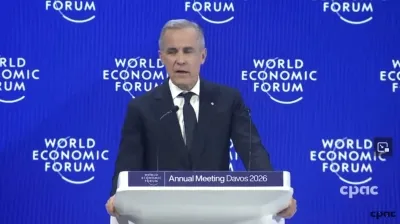

Karsten Wenzlaff, Advisor
August 26th, 2025
Karsten Wenzlaff is a Crowdfunding and Fintech Expert from Germany. He is Secretary-General of Digit[...]


Mar 5, 2026 | NCFA Fintech Market Insight | Open Banking And Policy And Market Structure

Image: Freepik/Drazen Zigic
On Mar 5 2026, the Bank of Canada made open banking timing comments at an Open Banking Expo highlighting timing and delivery risk. The central bank is still in the requirements stage and it will not commit to a launch date.
“somewhat daunted”
“the information-gathering stage alone will take months.”
In a LinkedIn post, Claire Brownell of The Logic also wrote that Ron Morrow, Executive Director of Payments, Supervision and Oversight, at the bank, “stopped short of confirming” that a 2026 launch is no longer realistic and said the information gathering stage “could take months,” with a clearer timeline only after that work finishes. Canada is still defining how open banking works before it can ship.
Yes, you heard it right. After almost a decade of analyzing, preparing, announcing, and promising the implementation of Consumer-driven Finance (aka Open Banking), the market learns that the bank is still in the information gathering phase.
Requirements work sounds boring, but it sets the rails for everything that follows. It decides which data gets shared, how consent works, how liability lands, how disputes get handled, and what the security bar looks like for every approved participant.
Canada already has a policy target, but the issue is execution speed. Canada's consumer driven banking framework describes open banking as a secure system that lets people and businesses share financial data with approved providers of their choice. Delay keeps Canadians stuck with expensive workarounds for data sharing and money movement like screen scraping.
Firms need clear standards on what data gets shared, how consent works, who is responsible when something goes wrong, and who can join the system. Without that clarity, banks and larger firms delay and smaller firms waste time building for rules that may change.
Delay also changes what gets built. Fintechs keep using screen scraping, password sharing, and one off partnerships because those options work today. That rewards the firms that already control customer access, instead of the firms building safer permission based tools.
Fintechs who have in some cases been waiting years for Open Banking's arrival can continue planning for two tracks. Keep shipping products that work under today’s rails, but design the next version around consumer permissioning, clean audit trails, and repeatable consent. Treat identity, consent, and dispute handling as core product work, not legal add ons. Companies that have these pieces in place will be ready when approval and accreditation rules finally arrive.
The cost of delay is that Canada keeps paying for friction, and Canadian fintechs keep competing with one hand tied behind their back.
If the requirements stage takes months, what needs to change so Canada ships a clear rule set fast enough for fintechs and banks to invest with confidence?
Hopefully this latest timing hiccup will lead to a safer, and more competitive data and payments layer in Canada.
 The National Crowdfunding & Fintech Association (NCFA Canada) is a financial innovation ecosystem that provides education, market intelligence, industry stewardship, networking and funding opportunities and services to thousands of community members and works closely with industry, government, partners and affiliates to create a vibrant and innovative fintech and funding industry in Canada. Decentralized and distributed, NCFA is engaged with global stakeholders and helps incubate projects and investment in fintech, alternative finance, crowdfunding, peer-to-peer finance, payments, digital assets and tokens, artificial intelligence, blockchain, cryptocurrency, regtech, and insurtech sectors. Join Canada's Fintech & Funding Community today FREE! Or become a contributing member and get perks. For more information, please visit: www.ncfacanada.org
 |  |  |
|---|---|---|
 |  |  |
Mar 8, 2026 | NCFA Fintech Market Activity | Digital Banking And Data Governance

On Mar 7 2026, The Guardian posted that UK challenger bank Monzo is dealing with backlash from Monzo’s Year in review spending recap, a trust issue created by automated personalization. A customer escalated a complaint to the UK Financial Ombudsman Service after the AI recap used mocking language about food spending. The simple truth is banks can use AI to summarize spending, but it should avoid a tone that feels like judgement.
Two examples of the AI lines personalization that didn't sit well with customers after letting AI analyze their spending habits:
“Mainly, you fast fooded.”
“You like your banquets beige and boxed up.”
The customer described the wording as humiliating. The story also makes clear why tone can hurt even when the data is accurate. Spend patterns can reflect disability, illness, caregiving, job loss, stress, or crisis routines. A system that only sees categories and merchants can't understand the exact context. When it adds snark, it fills that context with judgement.
Monzo’s response was mixed. They didn't accept the complaint, but they still admitted the tone was wrong for that customer and apologized, and offered £20 as a goodwill payment. That mix reduces immediate heat, but it does not fix the underlying product risk.
“I recognise that in your case, the automated and standardised language we used was inappropriate and caused genuine upset.”
The primary lesson here is that personal spending data is too sensitive for automated copy that sounds like judgement.
Opt out doesn't fix a bad default. Banks and fintechs need controls that block mockery, shame, and moral scoring in any automated spending narrative. Teams also need to test outputs against vulnerable scenarios and worst case interpretations, not just average reactions.
Complaint handling needs a fast way to learn from these mistakes and force product improvements. A goodwill payment helps one customer, but it does not change the system. Banks and fintechs need escalation that can remove harmful language templates quickly, suppress outputs for affected customers, and pause the feature when tone crosses the line.
Automated spending recaps will continue to grow because customers want clarity and progress tracking. Banks and fintechs should keep recaps factual, let customers choose tone, and treat trust as a product requirement. When a bank speaks about a customer’s money, it needs to speak with care.
When a bank turns transaction history into a narrative, what standard should govern tone, testing for vulnerable scenarios, and escalation when a customer reports harm?
The National Crowdfunding & Fintech Association (NCFA Canada) is a financial innovation ecosystem that provides education, market intelligence, industry stewardship, networking and funding opportunities and services to thousands of community members and works closely with industry, government, partners and affiliates to create a vibrant and innovative fintech and funding industry in Canada. Decentralized and distributed, NCFA is engaged with global stakeholders and helps incubate projects and investment in fintech, alternative finance, crowdfunding, peer-to-peer finance, payments, digital assets and tokens, artificial intelligence, blockchain, cryptocurrency, regtech, and insurtech sectors. Join Canada's Fintech & Funding Community today FREE! Or become a contributing member and get perks. For more information, please visit: www.ncfacanada.org
| | |
|---|---|---|
| | |
March 5, 2026 | NCFA Feature | Capital Markets And Policy And Regulation
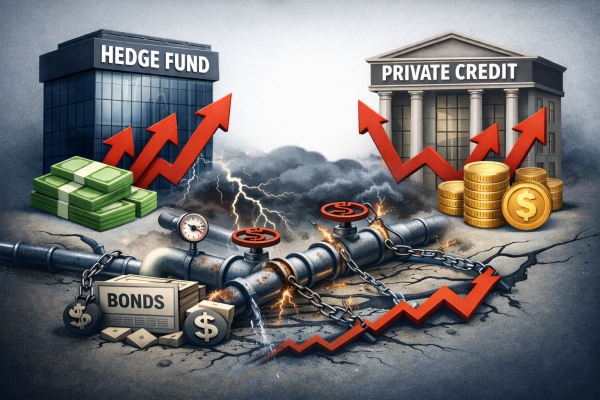
On March 4 2026, Bank of Canada Governor Tiff Macklem discussed how non bank finance can amplify stress in debt markets during remarks at the Global Risk Institute in Toronto. He pointed at two pressure points that matter for Canada right now:
Macklem puts a clear number on hedge fund demand in Canada:
"In Canada, they purchase up to 50% of Government of Canada bonds sold at auction and account for a big portion of secondary market trading.”
Hedge funds aren't just active in Canada. Similar patterns show up across many major economies. Hedge funds now hold a significant share of government debt outside central banks and large institutions. When government bond markets become unstable, the effects spread quickly. Mortgage rates, business loans, and corporate borrowing costs all move with government bond yields, so shifts in that market ripple through the entire economy.
The Bank highlights the repo market because repo borrowing funds many leveraged bond trades. A repo (repurchase agreement), works like a very short term loan. An investor borrows cash and posts government bonds as collateral, then agrees to buy those bonds back a day or a few days later.
Macklem says many hedge fund bond positions rely on this type of borrowing and are often highly leveraged. The structure makes markets sensitive to sudden changes in funding conditions.
He explains that “globally, about half have an overnight maturity. And haircuts are low zero or negative more than 80% of the time.” If lenders raise collateral requirements or reduce lending, investors may need to sell bonds quickly to reduce leverage.
When several large investors unwind positions at the same time, liquidity can vanish and prices can fall sharply. Macklem points to past episodes where this dynamic played out, including the global dash for cash at the start of the pandemic, the United Kingdom gilt crisis in 2022, and stress in the United States Treasury market in 2023.
Macklem also focuses on private credit because transparency is more difficult than in public markets:
“The opacity of private credit means investors may not have enough information about the quality of loans held in their funds.”
If defaults rise and investors rush for exits, he warns that the strain can spill into public credit markets. Canada connects to this risk because Canadian institutions invest in private credit globally, and funding links can pull stress back into the regulated system through liquidity needs and cross border channels.
The Bank of Canada is also changing how it plans to conduct its repo transactions. In a market notice, the Bank says it will join the Canadian Collateral Management Service tri party platform for its domestic repo operations by early 2027. CCMS is a market utility launched by TMX Group and Clearstream that helps participants move collateral, manage substitutions, and automate settlement for repo trades.
The Bank also says it intends to clear its repo operations through the Canadian Derivatives Clearing Corporation once TMX completes upgrades to expand central clearing services. CDCC acts as a central counterparty that guarantees settlement if one side of a trade fails.
The goal is to support stronger collateral management, reduce counterparty risk, and encourage broader use of modern repo infrastructure in Canada.
More lending and market activity now happens via non-bank firms who often use short term funding that can tighten quickly, not just traditional banks. When that happens, pressure in debt markets can build fast. Canadian institutions need better visibility into funding conditions, leverage, and collateral movement across markets. Fintech companies that help banks monitor liquidity, collateral, and repo exposures in near real time can fill an important gap.
At the same time, stronger market infrastructure matters for Canada’s competitiveness. Investors and dealers gravitate to markets that settle trades smoothly and manage collateral efficiently, especially during periods of stress.
The National Crowdfunding & Fintech Association (NCFA Canada) is a financial innovation ecosystem that provides education, market intelligence, industry stewardship, networking and funding opportunities and services to thousands of community members and works closely with industry, government, partners and affiliates to create a vibrant and innovative fintech and funding industry in Canada. Decentralized and distributed, NCFA is engaged with global stakeholders and helps incubate projects and investment in fintech, alternative finance, crowdfunding, peer-to-peer finance, payments, digital assets and tokens, artificial intelligence, blockchain, cryptocurrency, regtech, and insurtech sectors. Join Canada's Fintech & Funding Community today FREE! Or become a contributing member and get perks. For more information, please visit: www.ncfacanada.org
| | |
|---|---|---|
| | |
March 5, 2026 | NCFA Advocacy | Data Governance

Sent by email:
Dear Minister
Power of Data
We (the undersigned – data driven tech and policy experts) very much support the letter of 4 Feb 2026 to you from CCPA – https://www.policyalternatives.ca/news-research/open-letter-to-the-honourable-melanie-joly-minister-responsible-for-statistics-canada/.
We add to that letter the following points:
1. At a time when we need more data, not less, to support evidence-based decision making and community engagement in Canada, the staffing and other cuts already started at StatsCan are misguided. Even if the cuts will “have a ‘low’ or ‘limited’ impact on existing service levels” (a position which is contestable), we echo concerns about the long-term impact on data collection, statistical reliability, and public trust in government institutions.
We ask StatsCan to outline how core programs, release schedules, and quality standards will be maintained. How do we reconcile the cuts with the Digital Research Infrastructure Strategy - https://ised-isde.canada.ca/site/ised/en/programs-and-initiatives/digital-research-infrastructure? Clarifying how “modernization” will offset reductions would strengthen confidence in the transition.
2. Our need for data is magnified by the attacks on data collection in the US, keeping in mind that in the past we have relied on much of that data. The attacks show how quickly statistical capacity can erode and how difficult it is to rebuild.
3. StatsCan plays an important coordinating role in maintaining statistical standards. Although StatsCan is not necessarily the body that should be collecting all the data we need in Canada, we suggest that StatsCan should be the body to oversee an inventory of what Canada does collect (or should be collecting) and to consult on and publish best practices for collection and governance. However, the cuts will clearly constrain an expanded governance role for StatsCan for the foreseeable future.
To provide some examples of data that is sorely needed:
(a) commercialization from Canadian universities, along the lines of the UKRI spinout registry (https://www.ukri.org/news/world-leading-register-of-uk-university-spin-outs-published); *
(b) data on emerging tech commercialization for defence (https://www.nato-pa.int/document/2024-dual-use-technologies-report-baldwin-051-esc and https://www.cigionline.org/publications/intellectual-property-is-economic-and-national-security/); and
(c) data on the outcomes of research spending.
4. Under the World Bank’s Statistical Performance Indicators, Canada’s statistical system ranks highly – https://www.worldbank.org/en/programs/statistical-performance-indicators. While we do not doubt that reform of StatsCan is needed in an increasingly tech-driven economy, wholesale cuts are not the way to do it. Expertise will be lost, collaborative connections across organizations will be lost, mistakes will be made, there will be loss of morale, and direct costs of “redundancy” will be high, when strong statistical capacity is even more essential to support productivity and competitiveness.
5. The timing could not be worse. We are facing enormous challenges, and Canada’s need for reliable data is increasing as the economy evolves. To provide but one example, Canada is increasing defence spending under a new defence industrial strategy and engaging in “nation-building” projects. As noted in the Institute for Research in Public Policy report (https://irpp.org/research-studies/how-industrial-policy-can-strengthen-canada/), these projects must be “accompanied by rigorous evaluation and good governance practices” which can only be effective when Canadian institutions, including StatsCan, collect high quality data and use it to connect action to outcomes.
6. Rebuild or shred? (‘The Doom Loop’ and the future of the global order – https://www.youtube.com/watch?v=6ULm87aidxM). This is a moment for careful planning to ensure institutional capacity is preserved and to plan for rebuilding, not shredding.
Respectfully
Signed
Kyle Briggs - https://www.linkedin.com/in/kyle-briggs/
David Durand – https://www.linkedin.com/in/daviddurandavocat/
Craig Asano, CEO National Crowdfunding & Fintech Assn of Canada - https://ncfacanada.org/
Robin Ford, Robin Ford Consulting - https://www.linkedin.com/in/robinericaford/
Peter Morand, Past President of the Natural Sciences and Engineering Research Council of Canada (NSERC)
Patrick Leblond, CN-Paul M. Tellier Chair on Business and Public Policy, University of Ottawa
José Carlos Marques, Associate Professor, Telfer School of Management, University of Ottawa
* While Canada invests billions in research, we translate very little of the value created into long-term economic and social benefit for Canadians. StatsCan recently attempted to survey Canadian universities on their commercialization activities but was unsuccessful. StatsCan removed the report from the website following complaints that the data was incomplete.
In contrast, the UK recently created a “spin-out register” of all startups commercializing IP created during publicly funded research (https://www.ukri.org/blog/university-spin-out-register-a-step-change-in-insights-for-all/). This register is already providing valuable insights that are helping UK policy makers make better funding decisions.
Canada’s world-class research institutions could contribute far more to Canada’s economy and economic security (https://www.cigionline.org/publications/intellectual-property-is-economic-and-national-security/), but without high-quality data, we struggle to identify and fix the problems.
The National Crowdfunding & Fintech Association (NCFA Canada) is a financial innovation ecosystem that provides education, market intelligence, industry stewardship, networking and funding opportunities and services to thousands of community members and works closely with industry, government, partners and affiliates to create a vibrant and innovative fintech and funding industry in Canada. Decentralized and distributed, NCFA is engaged with global stakeholders and helps incubate projects and investment in fintech, alternative finance, crowdfunding, peer-to-peer finance, payments, digital assets and tokens, artificial intelligence, blockchain, cryptocurrency, regtech, and insurtech sectors. Join Canada's Fintech & Funding Community today FREE! Or become a contributing member and get perks. For more information, please visit: www.ncfacanada.org
| | |
|---|---|---|
| | |
Mar 5, 2026 | NCFA Fintech Market Insight | Digital Assets And Policy And Regulation

On January 29 2026, at the joint SEC CFTC event in Washington titled CFTC SEC Harmonization U.S. Financial Leadership in the Crypto Era.
CFTC Chair Michael S. Selig’s remarks laid out a detailed US policy direction for crypto market structure. The speech goes past broad support for innovation and points to specific rule work on tokenized collateral, perpetual derivatives, software safe harbours, retail leveraged crypto trading, and event contracts.
SEC Chair Paul S. Atkins’ remarks support the same direction from the SEC side, which is part Project Crypto.
“Fragmented regulation in an integrated market is not a safeguard for investors so much as a source of confusion among them.”
That line from Atkins defines the problem. Unclear boundaries change how firms structure products, where they launch, and how much they spend on compliance before they can scale.
“Project Crypto recognizes that crypto markets span across our agencies’ respective regulatory boundaries.”
Selig starts from the point that crypto products don't fit neatly into older lines between agencies. Clearer lines are needed to cut the cost of operating in uncertainty.
“I have directed CFTC staff to develop rules to enable the responsible deployment of additional forms of eligible tokenized collateral.”
Eligible collateral is what a trading venue accepts to back positions. It decides how much margin traders need, how fast funds move, and how safely trades settle. If the CFTC allows more tokenized assets to count as eligible collateral, more crypto trading can happen inside regulated U.S. markets, but custody and collateral movement will need tighter controls and clearer proof that assets are protected and available when they are needed.
“The CFTC will use the tools at its disposal to onshore perpetual and other novel derivative products so that they can flourish across both centralized and decentralized markets, subject to appropriate safeguards.”
Perpetuals are a popular kind of crypto futures that many platforms offer outside the U.S. If U.S. rules start allowing them in a regulated way, more trading, market making, and new product builds can move onshore. That would also make it harder for offshore exchanges to keep growing just because the U.S. has no clear legal path today.
“The CFTC will explore ways in which the agency can encourage innovation in software development and support builders as they work toward product market fit, including by assessing whether an innovation exemption may be appropriate in certain circumstances.”
This targets a hard issue in crypto regulation. Wallets, interfaces, and on chain software do not fit cleanly into rules built around centralized intermediaries. If the CFTC creates clearer room for software development and early stage testing, legal uncertainty will be reduced for teams building core infrastructure.
“As part of this harmonization effort, we will examine whether substituted compliance can achieve equivalent or better regulatory outcomes at lower costs for market participants.”
This is about cost, duplication, and speed. Overlapping requirements can turn compliance into a barrier to entry. Substituted compliance can cut repeated work where two regimes are trying to solve the same control problem.
“Within the bounds of the law and where appropriate, market participants should be able to offer multiple products through a single platform without navigating an inefficient patchwork of registrations and overlapping regulatory regimes.”
This points to a model where firms can run more of their product stack under one platform instead of splitting activity across separate legal and operational silos. That can improve operating leverage for exchanges, brokers, and infrastructure firms that want to offer more than one regulated product. Also see broader SEC direction in Atkins crypto rules testimony.
“I have directed CFTC staff to begin drafting rules clarifying when leveraged, margined, or financed retail commodity transactions in crypto may be offered off-exchange under an ‘actual delivery’ exception.”
Retail users can already get leveraged crypto in some places, but U.S. rules have left big gaps in what is clearly allowed. If the CFTC writes clearer rules, firms will know which leverage products they can offer, which ones are off limits, and what steps they must follow to stay compliant.
“I have directed CFTC staff to explore the creation of a new category of DCM registration that is tailored specifically to retail leveraged, margined, or financed crypto asset trading.”
This suggests the CFTC may create a new kind of regulated exchange category built specifically for retail leveraged crypto trading. If it does, firms will be able to design products and go to market using a clearer venue rulebook, and exchanges will compete on who can offer the best compliant access and distribution.
“First, I have directed CFTC staff to withdraw the 2024 event contracts rule proposal that would prohibit political and sports-related event contracts and the 2025 staff advisory.”
This removes a major source of uncertainty around prediction markets.
“Second, looking ahead, and in the spirit of markets that trade on expectations, I have directed CFTC staff to move forward with drafting an event contracts rulemaking.”
Withdrawing the old proposal reduces near term uncertainty, but new event contract regulations would spell out which event-based contracts are allowed, what monitoring and controls platforms must run, and how firms can build prediction style products without guessing where the line is.
These speech commitments point to a practical attempt to aggregate more products, more liquidity, and more infrastructure into regulated US channels. Tokenized collateral, perpetuals, retail leveraged crypto, and event contracts are all in the spotlight with real market share potential. Companies that can meet the bar for custody, risk controls, disclosures, and auditable operations can begin building onshore products more confidentially than they could before.
The CFTC and SEC discussion focuses on market structure, but tokenized collateral and onshore crypto venues still rely on a settlement instrument that can hold up under supervision. That is why the stablecoin perimeter matters.
On February 25, 2026, the OCC issued a notice of proposed rulemaking (See: OCC stablecoin NPRM) to implement the GENIUS Act (Guiding and Establishing National Innovation for U.S. Stablecoins Act) for payment stablecoin issuance and related activities under OCC jurisdiction, including national banks and their subsidiaries, federal savings associations and their subsidiaries, federal branches and their subsidiaries, and foreign payment stablecoin issuers, along with entities approved as federal qualified payment stablecoin issuers and certain state qualified issuers. The OCC points to a new 12 CFR 15 that covers reserve assets, redemption, risk management, audits and supervision, custody, applications and registrations, examination of foreign issuers, and a capital and operational backstop.
While the OCC moves ahead with rulemaking under the GENIUS Act, the legislative framework for crypto market structure is still contested in Washington. A Reuters report from March 5, 2026 on the crypto bill impasse in Congress describes renewed disagreement over stablecoin related customer rewards and whether they could draw deposits away from banks. The dispute shows that even as regulators move ahead with rules for trading infrastructure, tokenized collateral, and stablecoin issuance, Congress is still debating how far crypto firms should be allowed to compete with the traditional deposit system.
If the CFTC and SEC push tokenized collateral, perpetuals, and event contracts into regulated channels while the OCC pushes stablecoin issuance into a bank style rulebook, does the next U.S. advantage move to firms that can run both market structure and the cash leg under supervision?
The National Crowdfunding & Fintech Association (NCFA Canada) is a financial innovation ecosystem that provides education, market intelligence, industry stewardship, networking and funding opportunities and services to thousands of community members and works closely with industry, government, partners and affiliates to create a vibrant and innovative fintech and funding industry in Canada. Decentralized and distributed, NCFA is engaged with global stakeholders and helps incubate projects and investment in fintech, alternative finance, crowdfunding, peer-to-peer finance, payments, digital assets and tokens, artificial intelligence, blockchain, cryptocurrency, regtech, and insurtech sectors. Join Canada's Fintech & Funding Community today FREE! Or become a contributing member and get perks. For more information, please visit: www.ncfacanada.org
| | |
|---|---|---|
| | |
Mar 3, 2026 | NCFA Fintech Market Activity | Payments And Market Infrastructure

On March 3 2026, Hanna Zaidi, VP Payments Strategy and COO of Wealthsimple announced on LinkedIn that Wealthsimple just became the first Canadian fintech to earn direct access to Swift, and the second non-bank fintech globally to gain direct access. The Globe and Mail reported that Wealthsimple will be offering cheaper international money transfers than larger Canadian competitors and a spring launch for the new service.
From reviewing WS's website, Wealthsimple wire fees lists CA$15 for outgoing CAD wires (US$15 for outgoing USD wires), while inbound wires will have no fee on Wealthsimple’s side. There's also a per transfer limit of up to CA$1,500,000 or US$1,500,000.
Swift membership rules explain why direct access is hard to secure. Applicants must qualify under Swift’s user categories and Swift's onboarding requires mandatory security controls and a security attestation before a new member can go live. Meaning WS earned a direct network membership milestone, not a reseller arrangement.
Swift's network scale connects 11,500+ institutions across 220+ countries and territories, handles 53 million+ FIN messages each day on average, and routes 75% of payments to destination banks within 10 minutes.
The table below highlights the price gap Wealthsimple is attacking, compared with TD fees and RBC fees for incoming/outgoing wire transfers which are more expensive. Wealthsimple enters the wire market below the published outgoing wire fees at both banks and below the published incoming wire fees in both schedules.
| Comparison | Wealthsimple | TD | RBC |
|---|---|---|---|
| Outgoing international wire | CA$15 CAD wire / US$15 USD wire | $50 | Starting at $45 |
| Incoming wire | $0 (WS's side) | $15 | Starting at $17 over $50 |
| Published transfer limit | Up to CA$1.5M / US$1.5M | Not stated in cited fee schedule | Not stated in cited fee page |
| SWIFT Access | Direct member access as a fintech | Direct bank member access | Direct bank member access |
The strategic value goes beyond a wire product though. In addition to direct Swift access, Wealthsimple has also earned direct participation in Payments Canada, Interac, and the Bank of Canada’s coming real time rail. That gives one non-bank platform direct reach across more of the domestic and global payment stack that sets pricing, speed, and settlement.
For Canada, from a competitive perspective, when a fintech now has direct entry into the same global messaging network used for bank wires and is attaching a lower listed fee to that access, consumers benefit. That puts direct pressure on wire pricing and strengthens Wealthsimple’s position in cross-border money movement services.
When a non-bank fintech gets direct Swift access and lists lower wire fees than major banks, does the competitive edge move to firms that control the rail instead of firms that only package the service?
The National Crowdfunding & Fintech Association (NCFA Canada) is a financial innovation ecosystem that provides education, market intelligence, industry stewardship, networking and funding opportunities and services to thousands of community members and works closely with industry, government, partners and affiliates to create a vibrant and innovative fintech and funding industry in Canada. Decentralized and distributed, NCFA is engaged with global stakeholders and helps incubate projects and investment in fintech, alternative finance, crowdfunding, peer-to-peer finance, payments, digital assets and tokens, artificial intelligence, blockchain, cryptocurrency, regtech, and insurtech sectors. Join Canada's Fintech & Funding Community today FREE! Or become a contributing member and get perks. For more information, please visit: www.ncfacanada.org
| | |
|---|---|---|
| | |
March 2 2026 | Feature | AI Governance And Public Safety

AI Image: Conceptual illustration of AI ethics, defense contracts, and public accountability
On February 26 2026, Anthropic said it wouldn't allow two Pentagon use cases in its contracts: mass domestic surveillance and fully autonomous weapons. Two days later, OpenAI said it reached a Pentagon deal for classified AI deployments and argued its safeguards could still hold inside the agreement. The split exposes the real issue now facing AI vendors, governments, and regulated buyers. That is should ethics limits block deals or be enforced from inside it?
Anthropic wasn't on the outside looking in. It said Claude was extensively deployed across the Department of War and other national security agencies and that the company had already put models into classified U.S. government networks. Anthropic also said two use cases, mass surveillance (including of the public), and fully autonomous weapons, we're never included in its contracts. Those cases are the fault lines in the dispute with Trump's Pentagon and US government.
Anthropic framed the issue as a narrow refusal, not a broad rejection of national security work. Dario Amodei said Anthropic supported “98% or 99%” of Pentagon use cases, but the company would not give up the remaining two limits. In its own words, Anthropic said, “we cannot in good conscience accede to their request.” Reuters reported that stance put a defense contract worth up to $200 million at risk.
The dispute escalated when President Trump directed the government to stop work with Anthropic and ordered a six month phase out of Anthropic technology across government. The Pentagon also moved to treat Anthropic as a supply chain risk. That raised the cost of holding hard limits when the customer is the government.
OpenAI took a different approach. In its own statement titled, 'Our agreement with the department of war', the company said its agreement had “more guardrails than any previous agreement for classified AI deployments, including Anthropic’s.” OpenAI also said, “We were—and remain—unwilling to remove key technical safeguards.” That is the core tension in this story.
Anthropic refused the terms it saw as too open. OpenAI signed and argued that stronger controls inside the agreement could still hold the line.
The details matter. OpenAI said the Department of War may use its system for all lawful purposes, but the same published terms say the system cannot independently direct autonomous weapons where law or policy requires human control, cannot make high stakes automated decisions that require human approval, and cannot be used for unconstrained monitoring of U.S. persons’ private information. OpenAI also said it keeps its safety stack in place, limits deployment to cloud infrastructure, keeps cleared personnel in the loop, and could terminate the contract if the government violates the terms.
The two companies are close on headline principles but not identical in practice. Anthropic draws two hard exclusions and refuses to move them. OpenAI accepts a broader legal framework, then relies on contract language, technical controls, and operational oversight to make similar limits enforceable inside the deal. That is a narrower and more conditional ethics model than refusing the agreement outright.
North of the border, the same trust question is already under pressure. After the Tumbler Ridge school shooting, Ottawa’s focus was whether AI evidence and escalation controls hold when governments ask for proof that safeguards, response rules, and accountability processes actually work under pressure. That's different than the Pentagon story that's testing how AI companies react and accept to full on defense contracts.
For fintechs, banks, and infrastructure providers, the lesson is practical. Buyers in regulated markets now ask more than whether a model performs well. They ask who can audit it, who can override it, what records exist, how long they are kept, and whether a vendor can prove that a stated limit still holds when a regulator, a court, or a government agency pushes hard.
On one hand, Anthropic's founders' moral compass highlights one method by maintaining hard limits even at the risk of losing a major federal contract. On the other hand, OpenAI's deal with the department of war is betting that contract terms, technical safeguards, and human oversight can preserve similar limits inside the agreement. Washington shows how quickly the state can force the issue. Ottawa shows what happens when public safety puts the same claims under direct scrutiny. In the next phase of AI adoption, trust rests less on capability claims and more on what a company can prove when the pressure rises.
The National Crowdfunding & Fintech Association (NCFA Canada) is a financial innovation ecosystem that provides education, market intelligence, industry stewardship, networking and funding opportunities and services to thousands of community members and works closely with industry, government, partners and affiliates to create a vibrant and innovative fintech and funding industry in Canada. Decentralized and distributed, NCFA is engaged with global stakeholders and helps incubate projects and investment in fintech, alternative finance, crowdfunding, peer-to-peer finance, payments, digital assets and tokens, artificial intelligence, blockchain, cryptocurrency, regtech, and insurtech sectors. Join Canada's Fintech & Funding Community today FREE! Or become a contributing member and get perks. For more information, please visit: www.ncfacanada.org
| | |
|---|---|---|
| | |



August 26th, 2025

January 4th, 2024

June 1st, 2021

September 9th, 2020

July 9th, 2018

January 3rd, 2018

September 25th, 2017

June 20th, 2017

May 10th, 2017

December 14th, 2016
