





Karsten Wenzlaff, Advisor
August 26th, 2025
Karsten Wenzlaff is a Crowdfunding and Fintech Expert from Germany. He is Secretary-General of Digit[...]


Apr 13, 2026 | NCFA Insight | Digital Assets Blockchain And Tokenization, Risk Compliance And Regtech

A public dispute and investor backlash at World Liberty Financial (WLFI) is exposing two issues in token markets: who controls the asset, and what happens when a project uses its own token as collateral.
The control question surfaced first. Justin Sun alleged hidden wallet freeze controls in WLFI's token design. World Liberty rejected the allegation and threatened legal action, which doesn't settle the technical question, but it does expose the governance problem. If investors are unclear about who can intervene and control the asset, confidence weakens quickly.
Justin Sun, investor in World Liberty Financial:
“a trap masquerading as a door”
I am calling on World Liberty Financial @worldlibertyfi to publicly disclose who controls the single guardian EOA and the 3/5 multisig that govern the WLFI smart contract.
Every investor has the right to know who holds the power to freeze their assets.
Here is what on-chain… https://t.co/dxYKDp5Zbi— H.E. Justin Sun 👨🚀 🌞 (@justinsuntron) April 13, 2026
The collateral issue is easier to understand and harder to dismiss. $75 million borrowed against WLFI means the project used its own token to support leverage. If the token falls, the collateral weakens. That creates a self reinforcing risk where price declines can lead to more pressure on the asset. If the position needs support, pressure can build on price, liquidity, and trust at the same time.
The current backlash doesn't come out of nowhere. Earlier in the project’s lifecycle, WLFI’s initial token sale reached only 4% of its $300 million target, raising about $12 million on day one. The token was structured as a non transferable governance asset, which limited liquidity and reduced speculative demand. Those early signs pointed to questions around investor incentives and value capture that are now resurfacing in a different form.
This is where token design and investor protection collide. Admin controls, freeze powers, or blacklist functions are not unusual on their own. In some cases, they support compliance and fraud controls. The problem starts when those powers are not clearly understood by holders, or when decentralization language creates expectations the structure doesn't meet. At one point, the asset can look less like open infrastructure and more like a centrally managed financial product.
The borrowing structure adds another layer. Projects can use leverage to support operations or liquidity, but using the native token itself as collateral blurs the line between treasury management and price support. Investors then have to evaluate not only market risk, but also insider control, disclosure quality, and whether the structure holds up when markets turn the other way.
A key lesson here is that token markets still move faster than disclosure standards. That gap is manageable in a strong market, but it can quickly break when investors start asking who controls the asset, who benefits from the structure, and who carries the downside when confidence breaks.
Investor revolts in token markets rarely stop at price. When a project uses its own token as collateral and holders are unsure who can intervene in the asset, trust can disappear quickly.
 The National Crowdfunding & Fintech Association (NCFA Canada) is a financial innovation ecosystem that provides education, market intelligence, industry stewardship, networking and funding opportunities and services to thousands of community members and works closely with industry, government, partners and affiliates to create a vibrant and innovative fintech and funding industry in Canada. Decentralized and distributed, NCFA is engaged with global stakeholders and helps incubate projects and investment in fintech, alternative finance, crowdfunding, peer-to-peer finance, payments, digital assets and tokens, artificial intelligence, blockchain, cryptocurrency, regtech, and insurtech sectors. Join Canada's Fintech & Funding Community today FREE! Or become a contributing member and get perks. For more information, please visit: www.ncfacanada.org
 |  |  |
|---|---|---|
 |  |  |
Mar 24, 2026 | NCFA Feature | AI Finance And Data Governance
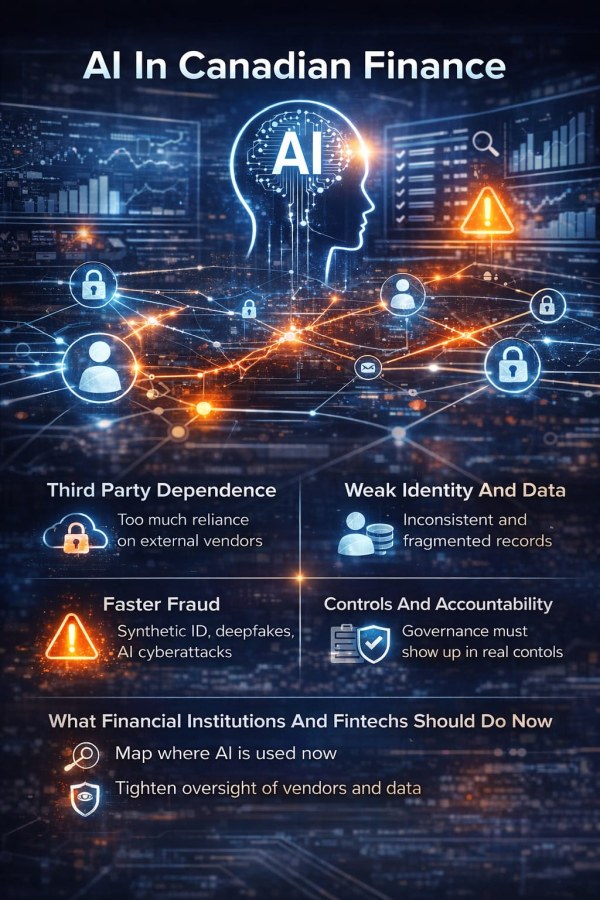
On Mar 23 2026, OSFI and the Global Risk Institute published the FIFAI II final report based on four workshops held between May and November 2025. More than 170 participants took part across banks, insurers, asset managers, fintechs, vendors, regulators, academics, and consumer voices.
The report confirms that AI adoption is here, citing 72% AI use at work in financial services and 75% organizational support for AI. While AI is already in use. The real issue is what still limits its use in regulated decisions and customer outcomes.
The series covered four areas that affect operational, prudential, consumer, and system-wide risk at the same time. Full report and framework: FIFAI II final report and AGILE framework PDF
One of the clearest takeaways is that AI will not spread across finance at the same speed. The first gains will come in internal functions such as fraud detection, surveillance, reporting, cyber defence, and operations. Those areas already have strong data, measurable outputs, and clearer accountability.
Customer-facing decisions are different. Underwriting, advice, product recommendations, and self-serve tools carry more pressure around explainability, fairness, consent, and complaints handling.
AI powered Canadian finance will likely grow faster in control functions than in customer-facing decisions.
The report treats third party AI as more than a procurement issue. It highlights growing dependence on external providers for models, infrastructure, and data, along with limited visibility into how those systems work and who sits behind them.
It's important because a failure, outage, or change in access at one provider can affect more than one function at the same time. Fraud controls, underwriting tools, customer service, and risk monitoring can all be exposed together. The financial stability workshop adds to that concern by linking third party dependency to concentration and system level risk.
Banks, insurers, and fintechs will need stronger oversight of models and providers, better audit access, tested fallback plans, and clearer visibility into the wider supply chain behind key AI services.
AI is improving both offence and defence. The final report points to synthetic identity, deepfakes, voice spoofing, AI assisted cyberattacks, fraud as a service, and disinformation. It notes a sharp rise in deepfake attacks and growing concern about voice verification as AI voice cloning improves.
This reality changes the operating environment. Static controls lose value faster when attack tools get cheaper, stronger, and easier to use. Manual review and occasional rule updates will not be enough. Firms will need faster detection, stronger identity controls, better information sharing, and systems that can adjust while attacks are happening.
Data problems come up across the whole series, but the larger issue is bigger than data quality alone. Weak identity and fragmented data still limit how far AI can go in regulated finance. The report points to inconsistent data, incomplete records, fragmented platforms, offshore storage concerns, and weak data lineage as barriers to both efficiency and safety.
The report doesn't mince words on identity. Canada still doesn't have a widely adopted secure digital identity layer. That leaves onboarding, authentication, consumer channels, remote work, and agent based systems more exposed than they should be. If identity and data remains weak, AI will keep working best in narrower internal use cases and face more limits in customer facing execution.
The final report introduces the AGILE framework as part of its overall findings, which stands for Awareness, Guardrails, Innovation, Learning, and Ecosystem Resiliency. The framework calls for stronger governance and oversight, stronger data and risk controls, continued investment in technology and talent, and deeper public private collaboration.
AI oversight cannot remain just at the strategy level. If AI is used in lending, fraud, underwriting, complaints, or customer recommendations, governance has to show up in controls, evidence, escalation, and accountability. In regulated finance, that's what turns AI use from experimentation into something firms can defend and scale.
The workshop series points to a practical sequence:
First, identify where AI already impacts decisions and controls.
Second, separate the use cases that can scale now from the ones that still need stronger explainability and customer safeguards.
Third, tighten vendor oversight before dependency grows further.
Fourth, invest more in identity, data lineage (origin and how it's used and updated), and real time fraud controls.
Fifth, show boards stronger evidence instead of high level claims and broad assurance language.
The report also carries a warning worth taking seriously. Firms that move too slowly can fall behind on productivity, resilience, and customer expectations while still facing external AI enabled threats. One participant line stands out: “The biggest risk is not doing enough.”
Canada’s national AI strategy work has focused heavily on trust, safety, and responsible adoption. That is necessary, but this workshop series adds something more useful for operators. It shows where AI use slows once it enters regulated finance: concentrated provider risk, weak identity, fragmented data, explainability pressure, fraud risk, and unclear accountability.
There's a call to action policy lesson here too. Canada doesn't just need AI ambition and adoption. It needs stronger execution layers around Digital ID, data governance, third party oversight, and information sharing if it wants regulated financial AI to scale beyond contained pilots.
The OSFI and GRI workshop series is useful because it takes a holistic approach to identifying and adapting to AI risks in finance. AI is already inside financial systems. The advantage now goes to firms that can prove control, trust, and accountability in live decisions.
The National Crowdfunding & Fintech Association (NCFA Canada) is a financial innovation ecosystem that provides education, market intelligence, industry stewardship, networking and funding opportunities and services to thousands of community members and works closely with industry, government, partners and affiliates to create a vibrant and innovative fintech and funding industry in Canada. Decentralized and distributed, NCFA is engaged with global stakeholders and helps incubate projects and investment in fintech, alternative finance, crowdfunding, peer-to-peer finance, payments, digital assets and tokens, artificial intelligence, blockchain, cryptocurrency, regtech, and insurtech sectors. Join Canada's Fintech & Funding Community today FREE! Or become a contributing member and get perks. For more information, please visit: www.ncfacanada.org
| | |
|---|---|---|
| | |
Mar 23, 2026 | NCFA Insight | Capital Markets And Regulation

On Mar 22, 2026, a jury verdict found that Elon Musk's public tweets during the 2022 Twitter takeover fight misled investors. The jury didn't find an intentional fraud scheme, but the plaintiff's lawyers said damages total about $2.6B. The verdict puts more weight behind a growing problem that fintech founders, platforms, and financial brands already face every day. A high profile post can move money before anyone inside the firm has time to slow it down.
The verdict doesn't mean Musk is on the hook for writing a $2.6B cheque (just yet). The jury found liability on specific statements, and the estimated damages reflects the plaintiffs’ claim based on investor losses during the period in question. The final amount still depends on post trial motions and potential appeals. That process can take time and could change the outcome.
The reality is finance no longer only runs through filings, earnings calls, and official statements. It's found it's way to X posts, podcasts, YouTube clips, founder interviews, affiliate campaigns, and finfluencer content. Markets now react to all of it. Investors don't stop to verify if a message came from investor relations, legal, or a even a founder’s phone. They see a statement, they price it in, and capital follows.
The same pressure is already building in Canada. NCFA has been tracking how regulators are tightening expectations around online financial promotion, including new guidance on digital investing content and supervision and increasing enforcement around undisclosed promotion. The direction is consistent. Online influence is now being monitored and part of the regulatory perimeter.
Why? Investor behaviour has already changed. Research cited in Canadian retail investor trends on social media shows that 53% of investors use social platforms for investment information, rising to 82% among those aged 18 to 24. It also shows that 35% have acted on that content.
That means there's no question that online content affects markets. The issue now is control. Who reviews what gets said, and how quickly the firm can step in before a post starts affecting investors.
Many fintech firms still treat public communication as a branding issue first and a control issue second. A founder post about a funding round, a growth number, a partnership, a token plan, or a future launch can change expectations long before the business is ready to support the claim. In public markets that creates obvious exposure. In private markets it can still distort trust, fundraising, customer decisions, and partner behaviour.
Top firms will respond to these realities by tightening how they handle high impact communication. They'll get sharper, not quiet. They will know which claims need evidence, which messages need review, and which topics should never go out in casual language. And they'll stop pretending that online distribution isn't a compliance item just because it feels informal or fast.
A jury has now linked informal public statements to investor harm in a way that carries financial consequences. That raises the standard for how founders, executives, and financial brands handle any communication that can influence investor decisions.
The National Crowdfunding & Fintech Association (NCFA Canada) is a financial innovation ecosystem that provides education, market intelligence, industry stewardship, networking and funding opportunities and services to thousands of community members and works closely with industry, government, partners and affiliates to create a vibrant and innovative fintech and funding industry in Canada. Decentralized and distributed, NCFA is engaged with global stakeholders and helps incubate projects and investment in fintech, alternative finance, crowdfunding, peer-to-peer finance, payments, digital assets and tokens, artificial intelligence, blockchain, cryptocurrency, regtech, and insurtech sectors. Join Canada's Fintech & Funding Community today FREE! Or become a contributing member and get perks. For more information, please visit: www.ncfacanada.org
| | |
|---|---|---|
| | |
Mar 19, 2026 | NCFA Feature | AI Finance Policy

On Jan 27 2026, the UK Financial Conduct Authority launched the Mills Review into the long term impact of AI on retail financial services to examine how AI could reshape consumers, firms, markets, and regulation through to 2030. NCFA flagged the review earlier in NCFA Weekly Fintech Intelligence Jan 24-30, 2026.
On Mar 4 2026, Innovate Finance submitted its response to the Mills Review, setting out where the UK fintech industry believes deployment will stall unless policy and infrastructure move faster. The paper cites Bank of England and FCA data showing 75% of firms now use AI, up from 58% in 2022. The issue is no longer whether AI adoption will happen. It is what still blocks firms from using AI inside live financial workflows at scale.
AI is clearly evolving from chatbot assistance to execution at scale. The submission describes AI agentic systems that can act on behalf of users. One example is an AI bot that handles everything from comparing mortgage deals to submitting the application and coordinating with conveyancers under user permission.
The value is no longer only in the model itself (ie. speed, quality, cost, expertise), but rather the full operational chain from customer permission to data access to execution to payment. That's why industry is focused on a stacked layer of tech solutions from Open Finance and Digital ID to payment access and rulebook friction to ensure AI can fully complete financial tasks.
The same logic applies to industry concerns over gatekeepers. As AI agents begin to initiate and route transactions, control moves to the layer that connects the agent to the payment method and the financial product. If that layer becomes concentrated, a small number of providers can influence access, routing, and competition.
The response uses real commercial examples and market data, highlighting that AI in finance is already underwriting, trading, core banking, and compliance.
The next phase isn't whether or not firms can build AI tools. It is whether regulation and infrastructure will allow them to use those tools in broader customer and transaction flows.
The stronger points made is that AI in finance won't scale on model quality alone. It will however scale on the stack around the model. That means smart data, Open Finance, Digital ID, fraud data sharing, wallet infrastructure, and payment access. Without those layers, AI stays stuck in narrow support roles. With them, it can move into lending, advice, payments, and automated execution.
That is why the response is more useful than another generic values and ethics based AI policy statement. It identifies where deployment slows, where control could become concentrated, and what has to move together if the UK wants AI to scale significantly inside financial services.
Canada is also building its next AI strategy. The federal government launched an AI Strategy Task Force in September 2025 as part of a 30 day national sprint, and later said it heard from more than 11,000 Canadians and 28 task force members. The Canadian process is broad. It is focused on national AI leadership, trust, safety, adoption, and public interest.
That broad approach is already raising execution questions. NCFA covered this earlier in its analysis of Canada’s AI strategy and capital flight risk, which argued that deployment, investment, and commercialization need clearer direction.
The UK industry response to the Mills Review is more targeted. It focuses on what is blocking AI deployment inside financial services today. Open Finance, Digital ID, payment access, wallets, third party model assurance, and rulebook friction sit at the center of that response.
Canada is still discussing the national direction of AI while UK fintech industry is already laying out what has to change for AI to work inside live financial workflows. The lesson for Canada is straightforward. AI policy cannot move on its own. Open Finance, Digital ID, wallet policy, payments modernization, and data access frameworks need to move with it or adoption in regulated finance will stay limited.
There is also a market structure lesson. If agent led payments grow, whoever controls the interface between the agent, the wallet, and the payment rail can control distribution. Policymakers who want competition and innovation to hold need to keep that layer open.
The industry response to the Mills Review is not just a call for clearer AI rules. It argues that the next barrier sits outside the model. Data access, identity, payments, and regulatory clarity now decide whether AI in finance stays at the support layer or moves into execution. The firms and jurisdictions that solve those bottlenecks will have the advantage.
The National Crowdfunding & Fintech Association (NCFA Canada) is a financial innovation ecosystem that provides education, market intelligence, industry stewardship, networking and funding opportunities and services to thousands of community members and works closely with industry, government, partners and affiliates to create a vibrant and innovative fintech and funding industry in Canada. Decentralized and distributed, NCFA is engaged with global stakeholders and helps incubate projects and investment in fintech, alternative finance, crowdfunding, peer-to-peer finance, payments, digital assets and tokens, artificial intelligence, blockchain, cryptocurrency, regtech, and insurtech sectors. Join Canada's Fintech & Funding Community today FREE! Or become a contributing member and get perks. For more information, please visit: www.ncfacanada.org
| | |
|---|---|---|
| | |
March 11 2026 | NCFA Feature | AI And Commerce

On March 5 2026, a report that OpenAI is scaling back end-to-end ChatGPT shopping plans could be a turning point in the widely watched Agentic Commerce sector. OpenAI had already pushed into retail online buying with ChatGPT shopping research and product recommendation tools designed to help users evaluate items inside a conversation. It could be that OpenAI is stepping back from running the full transaction, including instant checkout, to focus on where the real leverage is in digital commerce.
The early lesson from AI shopping is straightforward. The platform that captures the buying decision before checkout holds more power than the platform that processes the final payment. When an AI assistant receives and interprets the request, compares options, and produces the shortlist, it influences which merchants receive traffic and which products buyers even see.
The opportunity exists because conversational AI already operates at massive scale. OpenAI reports 900 million weekly ChatGPT users, giving the company a distribution graph that rivals the largest consumer internet platforms. Its online help also confirms that ChatGPT product recommendation results can present product images, descriptions, and links to merchant purchase pages.
A user no longer needs to open multiple product pages to compare items. The assistant interprets the request, analyzes specifications and reviews, and produces a shortlist instantly. Once a shortlist is compiled, the system that produced it holds influence over where the buyer goes next.
Marketplaces are responding quickly because they recognize the same risk. Amazon continues embedding AI deeper into its commerce stack to keep discovery inside the platform. NCFA coverage of Amazon Launches Always On Agentic AI for Sellers shows how the company now deploys AI tools that assist merchants with pricing decisions, product listings, and marketplace optimization.
Amazon is also testing new ways to extend its reach beyond its own catalog. In a recent update, the company says Shop Direct and Buy for Me purchasing options allows customers either to buy through an external merchant store or allow Amazon to complete eligible purchases on the buyer’s behalf.
Both approaches keep Amazon positioned at the gateway of the transaction. It's important because marketplaces still hold advantages in logistics, reviews, merchant density, and trusted payment infrastructure.
Google and Shopify are advancing a different strategy that focuses on open access to merchant data. Google recently introduced agentic commerce protocols designed to connect retailers directly to AI assistants.
Google's Shopping Graph now contains 50 billion product listings updated roughly 2 billion times each hour. That dataset gives AI systems real time access to pricing and inventory information across the web.
Shopify brings merchant scale to the same conversation. The company reports $1.4 trillion in cumulative commerce volume processed through its platform. By exposing merchant catalog data to AI systems, Shopify positions its merchants to reach customers through multiple conversational interfaces rather than relying exclusively on one marketplace.
If these open commerce approaches gain traction, merchants gain more flexibility. If closed platforms dominate discovery, a small number of technology companies could gain stronger influence over product ranking and customer access.
Payments companies also recognize the stakes. When AI assistants guide purchase decisions, the payment options integrated into those flows become strategically important. NCFA coverage of PayPal and OpenAI Partner On ChatGPT Instant Checkout shows how payment providers are already moving closer to conversational commerce infrastructure.
If AI assistants direct the user from recommendation to purchase, the wallet displayed first, the financing option offered in context, and the payment provider integrated into the conversation all influence where transaction revenue flows.
For fintech firms, integrate early into AI driven buying journeys or remain dependent on traditional checkout pages.
Commercial ad pressure typically follows intent. When a platform captures product discovery, merchants eventually compete for visibility. OpenAI Tests Ads Inside ChatGPT Free Tiers shows early experimentation with commercial placement inside conversational AI experiences.
Search engines generate billions in revenue from sponsored product listings. Marketplaces generate similar revenue through promoted items and advertising placements. AI assistants that guide buying decisions may eventually support similar models.
Whether that monetization happens through sponsored results, affiliate partnerships, or merchant integrations is still unclear, but the incentive structure is already visible.
OpenAI's reported pullback from full in-chat checkout doesn't weaken the case for AI driven commerce. It clarifies though where the first competitive advantage may emerge. Platforms that capture the buying conversation can route traffic toward marketplaces, merchants, and payment providers without owning the full transaction.
The infrastructure and scale is in place which explains why competition is intensifying. Hundreds of millions of users now ask AI systems for advice before making decisions. Retail databases contain tens of billions of products. Merchant platforms process trillions in commerce. Talking Point: The next evolution of digital commerce will depend less on checkout pages and more on which system people trust when they ask what to buy.
The National Crowdfunding & Fintech Association (NCFA Canada) is a financial innovation ecosystem that provides education, market intelligence, industry stewardship, networking and funding opportunities and services to thousands of community members and works closely with industry, government, partners and affiliates to create a vibrant and innovative fintech and funding industry in Canada. Decentralized and distributed, NCFA is engaged with global stakeholders and helps incubate projects and investment in fintech, alternative finance, crowdfunding, peer-to-peer finance, payments, digital assets and tokens, artificial intelligence, blockchain, cryptocurrency, regtech, and insurtech sectors. Join Canada's Fintech & Funding Community today FREE! Or become a contributing member and get perks. For more information, please visit: www.ncfacanada.org
| | |
|---|---|---|
| | |
March 9, 2027

Image: Freepik/ArthurHidden
Susanne Klatten is the heiress to the BMW car company and the richest woman in Germany. In 2026, Bloomberg estimated her fortune at $31.3 billion.
She is one of the ten richest women in the world. Klattens owns 19.2% of BMW shares and heads the company's supervisory board. However, she is not only the owner of the family fortune, but also actively participates in the development of the business, which earns billions annually.
Her path is not the story of a businesswoman who built a huge fortune from scratch, but an example of how the responsibility and dedication of an heiress helps the business of several generations of a family to develop and grow.
Susanne Klatten was born in 1962 in Bad Homburg, Germany. Her father is German billionaire and industrialist Herbert Krupp, who saved the German car company BMW from bankruptcy in the 1960s and made it profitable again.
The Quandt family began building their wealth at the end of the 19th century. At that time, the head of the family, Emil, created a thriving textile company. His son, Günther, took over the company before World War I and, having made his fortune supplying uniforms to the German army, began engaging in mergers and acquisitions. He acquired the battery manufacturer Varta, as well as shares in BMW and Daimler-Benz.
Here you can take a break from business and work and play your favourite games - Reddogcasino.com
In building capital, as in any business, the main thing is to get started. If you don't want to start your own business, you can earn money by buying a share in someone else's. We help new Finama clients take their first step in investing with us — and immediately start making a profit. Invest with a guaranteed daily premium of 36.6% per annum on your assets.
The Quandt family has two golden rules: the family business must constantly expand, and control over it must always remain in the hands of family members. From childhood, Klatt was raised and educated with the idea that one day she would have to manage the family assets.
After earning a degree in business finance, the young Klatt honed her skills at the Young&Rubicam advertising agency in Frankfurt, where she interned from 1981 to 1983. She then continued her education, studying marketing and management at Buckingham University and earning an MBA from the IMD business school in Lausanne, Switzerland.
After her studies, Klattten worked at Dresdner Bank, the Munich branch of the consulting firm McKinsey, and Bankhaus Reuschel & Co.
In 1982, Klatt's father, Herbert Quandt, died, leaving his daughter 12.5% of BMW shares and 50.1% of shares in the chemical and pharmaceutical company Altana AG.
Under Klatt's leadership, Altana AG reached a new level and demonstrated significant growth. It entered the list of the 30 largest pharmaceutical companies in Germany. Experts praised Clatten's contribution and called her strategy for developing Altana AG effective.
In 2006, Altana AG sold its pharmaceutical business to Nycomed for €4.5 billion. This amount was paid to shareholders as dividends, and the company continued to specialise in the production of speciality chemical products.
In 2009, Klatt became the sole owner of Altana AG by buying out the remaining shares. She became deputy chair of the board with an annual turnover of just over $2.5 billion.
In 1987, Klatt began working at BMW and, after ten years with the company, joined the BMW Supervisory Board in 1997 alongside her younger brother Stefan Quandt. She played a decisive role in implementing an appropriate risk management system at BMW and was responsible for regular reporting to the Supervisory Board and representing BMW's external interests.
The National Crowdfunding & Fintech Association (NCFA Canada) is a financial innovation ecosystem that provides education, market intelligence, industry stewardship, networking and funding opportunities and services to thousands of community members and works closely with industry, government, partners and affiliates to create a vibrant and innovative fintech and funding industry in Canada. Decentralized and distributed, NCFA is engaged with global stakeholders and helps incubate projects and investment in fintech, alternative finance, crowdfunding, peer-to-peer finance, payments, digital assets and tokens, artificial intelligence, blockchain, cryptocurrency, regtech, and insurtech sectors. Join Canada's Fintech & Funding Community today FREE! Or become a contributing member and get perks. For more information, please visit: www.ncfacanada.org
| | |
|---|---|---|
| | |
Mar 4, 2026 | NCFA Fintech Market Insight | AI And Data Governance
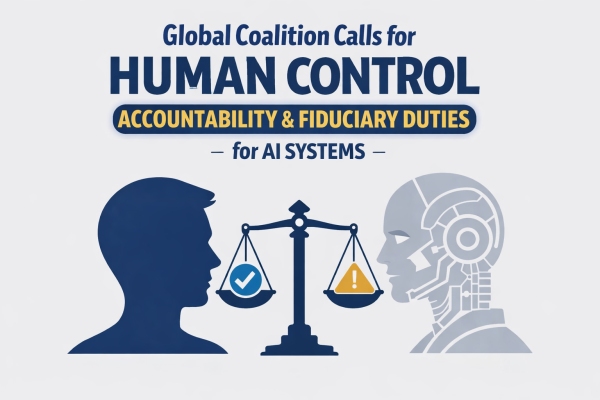
On March 4, 2026, the Pro Human AI Declaration goes public with support from a broad mix of public figures and organizations, including Yoshua Bengio (Professor, Université de Montréal and Turing Award Laureate), Daron Acemoglu (Nobel Prize-winning economist), Sir Richard Branson, and many other individual endorsers, along with groups such as the AFL CIO Tech Institute, American Federation of Teachers, SAG AFTRA, Public Citizen, and Center for Humane Technology. When people from business, labour, civil society, and research line up behind the same message, boards, regulators, and large buyers start to pay attention.
The declaration argues that AI should serve people, not replace them, and that powerful systems should remain under human control. For fintechs and financial institutions, AI already touches onboarding, fraud checks, customer support, compliance, advice, marketing, and risk decisions. As the public debate turns toward accountability and duty, finance is on the front lines of AI's adoption versus it's capabilities.
The declaration opens with a warning about a race to replace people in creative work, care, counselling, companionship, jobs, and decision making. It argues that this approach could push more power into large institutions and their machines while weakening privacy, liberty, democratic governance, and social stability.
It then lays out five core principles:
Keep humans in charge. Avoid concentration of power. Protect the human experience. Preserve human agency and liberty. Hold AI companies responsible and accountable.
The document also argues that AI systems should not be treated as legal persons with their own rights or responsibilities. It calls for protection of children and families from harmful uses of AI. It says people should have meaningful rights, oversight, and recourse when AI affects their lives.
As it relates to financial services, the declaration says AI used in professions such as finance, must meet fiduciary duties including duty of care, conflict disclosure, and informed consent.
Canada already faces its own debate about how to govern and finance artificial intelligence. A recent NCFA analysis on Canada’s AI strategy confronting capital flight and domestic IP retention highlights growing concern that Canadian innovation and economic value could migrate abroad if policy, capital access, and procurement frameworks do not evolve.
The Pro Human AI Declaration adds another dimension to that discussion. It focuses on accountability, human oversight, and responsibility when AI systems influence real world decisions.
It's important because in finance trust decides adoption, and banks, insurers, wealth platforms, lenders, and fintech vendors are already facing harder questions about how they use AI, who stays responsible, how people can challenge a bad outcome, and whether a firm can clearly explain what the system actually does. Pro Human's AI declaration adds more public weight behind those questions.
Take AI driven advice tools for example. If a digital assistant recommends a debt strategy, suggests a product, or influences an investment decision, firms should expect more scrutiny around disclosure, consent, conflicts, and who remains accountable for the outcome. The more the tool acts like an adviser, the harder it becomes to treat it like a simple software feature.
Fraud and risk controls offer another example. Many firms now use machine learning to flag suspicious activity, approve accounts, or block transactions. If a system freezes an account, rejects a customer, or triggers a harmful false positive, firms will face stronger pressure to explain the reason and provide a path to human review. In finance, a wrong decision can have a huge impact in a hurry. It can lock someone out of funds, delay a payment, or damage trust fast.
Customer communication is another live area. Banks and fintechs increasingly use AI chat tools to answer product questions, guide users through forms, or help people make sense of financial options. If those systems are guiding decisions, firms should expect harder questions about disclosure, consent, suitability, and whether the system nudges people in ways they do not fully understand.
Teams building AI for finance should design for human oversight in workflows from the start. They should know where a person can step in, how decisions get reviewed, what data trains the system, how conflicts get surfaced, and who owns the final call. These are no longer side questions. They affect procurement, partnerships, compliance reviews, and customer confidence.
This also creates an opening. Fintechs that can show clear controls, plain language disclosures, reliable audit trails, and real accountability will stand out in a crowded market. In regulated markets, users want to work with tools and systems they can trust when stakes and outcomes are at their highest.
One to watch for fintech and financial service leaders. Companies that keep humans involved, explain their systems clearly, and stay accountable when outcomes matter will be in a stronger position as this debate moves closer to policy, procurement, and market practice. Plus, they may sleep better at night 😉
The National Crowdfunding & Fintech Association (NCFA Canada) is a financial innovation ecosystem that provides education, market intelligence, industry stewardship, networking and funding opportunities and services to thousands of community members and works closely with industry, government, partners and affiliates to create a vibrant and innovative fintech and funding industry in Canada. Decentralized and distributed, NCFA is engaged with global stakeholders and helps incubate projects and investment in fintech, alternative finance, crowdfunding, peer-to-peer finance, payments, digital assets and tokens, artificial intelligence, blockchain, cryptocurrency, regtech, and insurtech sectors. Join Canada's Fintech & Funding Community today FREE! Or become a contributing member and get perks. For more information, please visit: www.ncfacanada.org
| | |
|---|---|---|
| | |



August 26th, 2025

January 4th, 2024

June 1st, 2021

September 9th, 2020

July 9th, 2018

January 3rd, 2018

September 25th, 2017

June 20th, 2017

May 10th, 2017

December 14th, 2016
