





Karsten Wenzlaff, Advisor
August 26th, 2025
Karsten Wenzlaff is a Crowdfunding and Fintech Expert from Germany. He is Secretary-General of Digit[...]


AI Policy Consultation | February 11, 2026
On February 5, 2026, Innovation Science and Economic Development Canada (ISED) released the official Engagements on Canada’s Next AI Strategy Summary of Inputs. The report summarizes a 30 day consultation that ran from October 1 to 31, 2025 and confirms that 11,300 participants submitted 64,600 responses across 26 policy questions about Canada’s next AI strategy.
The consultation addressed the full AI policy landscape, including research and talent, adoption across industry and government, education and skills, infrastructure resilience, national security, environmental sustainability, Indigenous data sovereignty and inclusion. The process ran under The Honourable Evan Solomon, Minister of Artificial Intelligence and Digital Innovation, supported by a National AI Strategy Task Force composed of startup operators, investors, researchers and civil society leaders.
This article focuses on what matters most for fintech founders and investors, where the strongest inputs from the consultation relate to capital formation, procurement design, intellectual property retention and domestic scaling incentives.
The consultation drew wide participation. 83% submitted as individuals. 17% responded on behalf of organizations, and reflected national engagement across technology, finance, academia, professional services and public institutions.
52% identified as interested Canadians. 19% came from business. 13% represented academia or research. The rest included government, associations and other sectors.
Ontario accounted for 39% of responses. British Columbia 20.6%. Alberta 7.8%. Québec 7.6%.
Across submissions, one theme stood out. Canada produces AI research. It struggles to anchor AI companies at scale.
Respondents called for sovereign capital vehicles, modernization of SR&ED and IRAP, and stronger intellectual property retention frameworks. Intellectual property retention refers to keeping ownership of core technology, patents and data assets inside Canada rather than transferring them through early acquisition or foreign incorporation. Stakeholders expressed a preference for patient domestic capital tied to retention conditions, not simply additional grants. That implies potential co-investment models, domestic head office commitments and scaling tools designed to prevent early exits or foreign acquisition.
Canada ranks among global leaders in AI research output. Yet growth stage capital is still significantly thinner than in the United States. In 2025, Canadian VC firms raised just over $2.1B, with fundraising concentrating as the five largest Canadian venture funds captured 83% of all capital raised while emerging managers raised $249M. That level of concentration narrows the number of scaled domestic capital sources available to support long runway AI and fintech growth.
When companies reach scale, many incorporate abroad or raise major rounds outside Canadian markets. Capital migration reduces ownership, long term tax capacity and domestic control over strategic assets. This consultation reflects recognition that Canada’s scaling architecture requires structural reform.
For fintech founders following new AI minister prioritizes growth over rules, this reinforces the need for commercialization outcomes and ownership durability rather than additional regulatory layering.
Respondents pushed for standardized procurement playbooks and real pathways from pilot to deployment. Suggestions were for coordinated procurement models that create anchor customers at scale.
Predictable domestic revenue reduces investor risk perception and strengthens valuations. It also strengthens Canadian firms’ credibility when competing internationally. Procurement design therefore influences capital formation and competitive positioning.
This matters most in regulated sectors. When government adoption aligns with frameworks such as the CIRO digital asset custody framework, compliance becomes a strategic advantage rather than a cost centre. Procurement validation can reinforce regulatory credibility and accelerate scaling.
Participants identified gaps in domestic compute capacity and reliance on foreign cloud providers. Calls for Canadian controlled infrastructure go beyond just hardware investment. They imply potential changes to data residency expectations, cloud dependency exposure and compliance thresholds.
Sovereign compute investment could open infrastructure financing opportunities while raising entry costs for firms dependent on foreign controlled platforms. Infrastructure choices influence market structure.
Submissions supported proportionate, risk tiered regulatory frameworks, independent audits and clearer liability standards. Respondents generally favoured governance models where obligations scale with actual risk exposure rather than one size fits all rules.
Regulatory preference was for clarity, predictability and alignment between risk level and compliance burden. High impact AI applications would face stronger safeguards, while lower risk use cases would not carry unnecessary constraints.
If thresholds are calibrated carefully and compliance pathways are clear, early stage firms gain certainty and investors price regulatory exposure more confidently. If risk categories are broad or implementation complex, governance costs rise and time to market slows.
The strategic issue is how regulatory architecture affects scaling speed, capital formation and Canada’s cost competitiveness relative to larger markets. Governance design influences who scales, who consolidates and who exits.
The consultation closed on October 31, 2025. The Engagement on Canada's Next AI Strategy summary report states that the inputs will inform drafting of Canada’s 2026 AI strategy, which the federal government plans to release later this year.
The report doesn't however specify any fiscal commitments or program design details. Those decisions will appear, if at all, in the final strategy document and subsequent budget measures.
From a market perspective, founders and investors should watch for concrete triggers for a sovereign capital vehicle with defined funding, commercialization linked SR&ED reform, procurement commitments beyond pilot programs, budget allocations for domestic compute infrastructure, and enforceable intellectual property safeguards.
If those elements appear with timelines and capital attached, they strengthen Canada's domestic scaling environment. If not, capital migration and entrepreneur drain will likely persist. The final strategy with design and implementation choices will be known this year.
 The National Crowdfunding & Fintech Association (NCFA Canada) is a financial innovation ecosystem that provides education, market intelligence, industry stewardship, networking and funding opportunities and services to thousands of community members and works closely with industry, government, partners and affiliates to create a vibrant and innovative fintech and funding industry in Canada. Decentralized and distributed, NCFA is engaged with global stakeholders and helps incubate projects and investment in fintech, alternative finance, crowdfunding, peer-to-peer finance, payments, digital assets and tokens, artificial intelligence, blockchain, cryptocurrency, regtech, and insurtech sectors. Join Canada's Fintech & Funding Community today FREE! Or become a contributing member and get perks. For more information, please visit: www.ncfacanada.org
 |  |  |
|---|---|---|
 |  |  |
Economy | February 6, 2026

On February 5, 2026, Bank of Canada Governor Tiff Macklem delivered a speech at the Empire Club of Canada called 'Structural Change - Canada at Crossroads' warning that Canada has reached a productivity crossroads, where long standing structural limits now cap growth, wages, and competitiveness. Inflation no longer defines the constraint. Productivity does. For founders, investors, and policymakers, the question is no longer whether innovation exists in Canada, but whether the economic system allows it to scale. Of course, many stakeholders have been eluding to this data-driven fact for a decade, including NCFA.
“Canada’s productivity performance has been weak for a long time, and that limits how fast our economy can grow.”
Macklem identifies productivity as the binding constraint on Canada’s economic outlook. The data is clear. According to OECD GDP per hour worked data, Canada’s labour productivity remains well below the United States and has fallen further behind over the past decade. In 2023, Canada produced roughly 72% of US output per hour worked, a gap that continues to widen.
The Bank of Canada links this shortfall to weak business investment, slow technology adoption, and limited competitive pressure. These factors suppress output growth even as employment rises. As a result, wage growth, firm profitability, and national competitiveness all face structural limits.
NCFA analysis shows that productivity challenges increasingly reflect underinvestment in digital infrastructure, automation, and scalable financial systems rather than a shortage of talent or ideas. For example, see: Breaking Canada’s Productivity Trap For Stronger Growth or Fintech’s Role In Canada’s Productivity Revival or Canada's Productivity Depends on Intangible Tech Adoption, which detail how capital misallocation and limited competition slow modernization across sectors.
For fintech founders, productivity gaps point to unmet demand for tools that reduce friction in payments, lending, compliance, and data driven decision making. Where legacy systems persist, productivity losses accumulate across the economy.
“More competition pushes firms to innovate, invest, and become more productive.”
Macklem ties productivity directly to competitive intensity. Where markets concentrate, firms face less pressure to adopt new technology or improve efficiency. Canada’s financial services sector illustrates this clearly. In fact, the Bank of Canada's Senior Deputy Governor, Carolyn Rogers, called Canada's banking system an Oligopoly. Concentration in lending, payments, and capital markets slows adoption of new models that could lower costs for businesses.
NCFA tracks this dynamic, here are just a couple of examples: How Competition Powers Canada’s Economic Growth and Why SME Loan Competition In Canada Is Under Review.
Small and medium sized businesses feel the impact most. Limited lender choice raises borrowing costs and lengthens approval timelines. For fintech lenders and embedded finance platforms, this reinforces demand for modern credit models that expand access while maintaining risk discipline.
“Investment needs to flow to the firms that can grow and raise productivity.”
Canada’s venture capital structure continues to constrain scale. According to RBCx data, Canadian VC Fundraising Contracts And Concentrates, raising just over $2 billion in 2025. Capital concentrates heavily. The top five funds account for roughly 83% of total capital raised, while emerging managers raise approximately $249 million.
At the same time, total venture investment reached about $4.9 billion across 386 deals through the first nine months of 2025, compared with roughly $8.6 billion across all of 2024. These figures describe two forces in the same system. Fundraising concentrates while deployment becomes more selective.
For founders, capital access becomes a strategic constraint rather than a timing issue. For investors, it narrows the pool of companies able to scale inside Canada.
“Good policy supports competition, investment, and long term growth.”
Macklem acknowledges that productivity doesn't improve in a vacuum. Firms respond to the regulatory environment they operate in. When compliance costs rise faster than firms' capacity, or when rules favour incumbents over new entrants, productivity suffers.
NCFA has consistently shown that regulatory design plays a decisive role in whether innovation scales. When rules increase cost or delay without improving outcomes, firms delay investment and avoid experimentation. Productivity improves when regulation supports entry, proportional compliance, and faster market testing, as outlined in Innovative Approaches to Smarter Regulation and Overcoming Barriers to Growth in Financial Regulation.
Smarter regulation does not weaken safeguards. It reduces duplication, improves clarity, and aligns oversight with actual risk. Jurisdictions that achieve this balance create space for competition and faster technology adoption, lessons explored in Lessons for Canada from Global Leaders in Regulation.
“Efficient financial systems help capital move to its most productive uses.”
Macklem’s remarks extend naturally to payments infrastructure. Canada payments system processes enormous transaction volumes, reaching $12.2 trillion in 2024, yet modernization remains uneven.
Slow settlement and high transaction costs lengthen working capital cycles and increase operational risk, especially for SMEs. The productivity impact of faster payments and modern rails can't be understated as many countries rush to modernize their payment ecosystem and functionality, including Canada who has been working to update it's payment system for years and only now making progress being under the gun.
For fintech builders, payments remain one of the most direct ways to improve productivity across the economy.
“Productivity growth depends on the environment firms operate in.”
Macklem’s framing helps explain why successful Canadian built companies increasingly scale elsewhere. Why A $35M Built In Canada Startup Still Moved To The US, shows how growth stage constraints shape founder decisions even after proving traction at home. When capital pools, market size, and regulatory pathways align more clearly abroad, relocation of entrepreneurs and venture brain drain mirrors operating decisions, not national sentiment.
This trend reinforces the need to address productivity, competition, capital access, and regulation together rather than treating talent retention as a standalone issue. Founders are now at crossroads, and trying to make it work within system constraints.
When capital, regulation, and market access align, firms stay. When they do not, firms move.
Macklem’s speech aligns closely with the productivity, competition, and innovation themes NCFA has tracked and raised for years. Productivity improves when competition deepens, capital flows efficiently, regulation supports entry, and technology adoption accelerates. Fintech sits at the intersection of all four.
Policy tools that support SME expansion, such as export financing and market access programs, can reinforce financial innovation when aligned properly. Programs like CanExport SMEs show how capital support and operational scale can work together rather than in isolation. The challenge now is execution. Productivity gains come from systems that allow new firms to compete, scale, and deploy technology without unnecessary friction.
You may like these additional reads:
The National Crowdfunding & Fintech Association (NCFA Canada) is a financial innovation ecosystem that provides education, market intelligence, industry stewardship, networking and funding opportunities and services to thousands of community members and works closely with industry, government, partners and affiliates to create a vibrant and innovative fintech and funding industry in Canada. Decentralized and distributed, NCFA is engaged with global stakeholders and helps incubate projects and investment in fintech, alternative finance, crowdfunding, peer-to-peer finance, payments, digital assets and tokens, artificial intelligence, blockchain, cryptocurrency, regtech, and insurtech sectors. Join Canada's Fintech & Funding Community today FREE! Or become a contributing member and get perks. For more information, please visit: www.ncfacanada.org
| | |
|---|---|---|
| | |
Feb 4, 2026 | NCFA Expert Intelligence | AI Risk and Governance

On February 3 2026, Dentons published a Voice from the Market North American Legal AI report following the firm’s inaugural Legal AI Summit. The report captures data insights from legal, business, and operations leaders across sectors about how organizations are handling real world AI deployment, specifically where AI adoption is creating legal and governance risk before regulators provide clear framework.
The findings matter for fintech founders and operators because legal teams are often the first to see where risk accumulates, such as in contracts, vendor relationships, employee use, and product liability, long before the market or regulators respond.
Most organizations in the survey reported they are designing their own AI governance frameworks because universal regulations do not exist yet. That gap puts legal risk in the critical path for AI use inside financial products and services.
“We want to cover the basics, but we don’t want to stymie innovation or scare people away with too many ‘do nots.’”
This comment above is from a survey participant highlighting the tension leaders face: Smart governance is needed, but overly prescriptive rules can impede experimentation and execution. So it's a real operational conflict that stakeholders must resolve long before policy catches up.
The governance gaps in the report align with real risks fintechs already encounter:
Many fintechs are building AI capability faster than they are formalizing guardrails, which can expose firms to legal, operational, and compliance risk across functions where AI is integrated in workflows. Whether that's in credit decisions, document review, marketing, fraud monitoring, or customer support.
It also intersects with other areas NCFA has covered. For example, recent regulatory signals from the CSA–CIRO joint finfluencer guidance and the rise of stablecoin policy frameworks both show that Canada’s regulatory perimeter is tightening around behaviour and risk, not just product categories.
If legal risk surfaces first in AI contracts, vendor relationships, and internal use, where should fintechs build their earliest governance guardrails: in contracts, in internal policy, or in product design?
Regulation typically always lags innovation. Legal and governance frameworks are being created inside enterprises today because no universal rulebook exists. Fintech innovators and operators who anticipate these gaps and embed guardrails early will be better positioned to scale responsibly and avoid costly legal exposure down the road.
The National Crowdfunding & Fintech Association (NCFA Canada) is a financial innovation ecosystem that provides education, market intelligence, industry stewardship, networking and funding opportunities and services to thousands of community members and works closely with industry, government, partners and affiliates to create a vibrant and innovative fintech and funding industry in Canada. Decentralized and distributed, NCFA is engaged with global stakeholders and helps incubate projects and investment in fintech, alternative finance, crowdfunding, peer-to-peer finance, payments, digital assets and tokens, artificial intelligence, blockchain, cryptocurrency, regtech, and insurtech sectors. Join Canada’s Fintech & Funding Community today FREE! Or become a contributing member and get perks. For more information, please visit: www.ncfacanada.org
| | |
|---|---|---|
| | |
January 21, 2026 | Report Insights
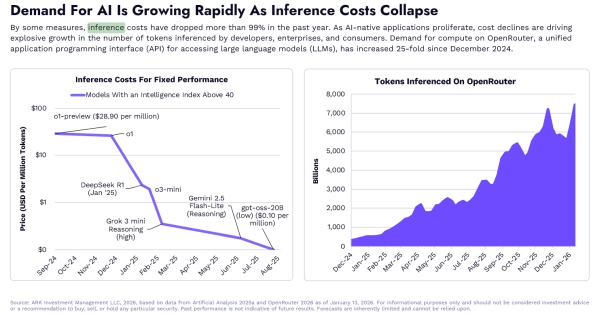
Image: ARK Invest, Big Ideas 2026 report. AI inference cost data reproduced for commentary and analysis.
In January 2026, ARK Invest released its annual research report Big Ideas 2026, building on trends first measured in Big Ideas 2025. The 111 page report spans artificial intelligence, tokenized assets, decentralized finance, Bitcoin, consumer AI platforms, and what ARK describes as the Great Acceleration. Rather than summarizing each theme in isolation, this article focuses on how these technologies accelerate change together inside financial systems.
What felt experimental in 2024 and operationally strained in 2025 now shows up as baseline reality in 2026. AI costs collapse, investment capital concentrates in infrastructure, digital assets move closer to settlement rails, and consumer AI platforms compress decision cycles. These forces do not arrive sequentially. They compound. The result is technically a financial system that no longer needs to pause between decisions.
ARK’s data on collapsing AI inference costs explains why this shift becomes unavoidable. At the same time, investment capital continues to concentrate in infrastructure designed for continuous operation. Together, these forces change how money moves, settles, and gets controlled.
Finance is AI-native by design. It already runs on software, explicit rules, and constant feedback. As AI becomes cheap enough to run continuously, software acts directly inside financial systems instead of waiting for human input.
ARK’s Big Ideas 2026 research shows AI inference costs dropped more than 99% in the past year. That single data point explains why continuous operation becomes economically viable at scale for the first time.
When inference costs fall that far, AI stops being something teams consult occasionally. It becomes something that runs all the time. Human prompts, batch reviews, and periodic decision cycles turn into friction rather than safeguards.
In financial systems, this breaks a long standing boundary. AI no longer stops at scoring, forecasting, or recommendations. It initiates actions. Payment routing adjusts automatically. Exposure limits rebalance in real time. Liquidity thresholds enforce themselves continuously. Software no longer waits for approval at every step.
Founders experience this when systems stay busy all the time instead of spiking occasionally. Investors see it when infrastructure costs stop falling as predictably even while revenue continues to grow. Operating leverage behaves differently because systems no longer rest between decisions.
ARK’s capital analysis shows where investment capital flows as systems scale. In 2025, annual investment in data center systems reached roughly $500B, nearly 2.5 times the long term average from 2012 through 2023. Since the ChatGPT moment, ARK shows growth accelerating from about 5% to 29% annually. The report projects this category of investment could approach $1.4T by the end of the decade.
That level of spending signals where long term value accrues. Capital is not chasing surface automation features. It is concentrating where compute, data availability, uptime, and recovery determine whether systems can operate continuously without failure.
For fintech teams, this breaks a familiar assumption. Products designed for occasional use face redesign pressure. Infrastructure built for constant operation gains structural leverage. Cost structure, resilience, and throughput now shape competitive advantage more than feature differentiation.
Traditional payment systems assume a person initiates the transaction. AI breaks that assumption. Software now initiates payments, manages balances, and settles obligations automatically as conditions change.
This pushes pressure into liquidity management, fraud controls, and settlement logic. Batch review fails quietly when systems never pause. ARK’s analysis of AI driven transaction flows emphasizes sustained throughput and recovery under stress rather than peak performance.
Founders building payment infrastructure encounter this pressure early. Systems designed for bursts now operate under constant load, and cost curves change accordingly. Reliability becomes a competitive feature rather than an operational afterthought.
ARK’s 2026 research frames consumer AI as an operating layer rather than a feature. AI models converge into a consumer operating system, and adoption accelerates faster than earlier digital platforms. As these systems take on purchasing, allocation, and coordination tasks, decision making shifts closer to software execution.
Wallets evolve alongside this change. They function less as interfaces and more as control layers for software driven financial activity. Identity, permissions, and payment logic compress into the same layer.
Investors familiar with earlier platform cycles recognize this pattern. Control consolidates where decisions execute, not where they are merely displayed.
ARK frames tokenized assets as market infrastructure moving trillions of dollars in asset value onto blockchains. Tokenization matters because assets move and settle automatically. DeFi matters because financial rules run on software without manual steps.
ARK’s data shows digital asset application revenue reaches roughly $3.8B in 2025, with around one fifth generated in January alone. The report also notes that about 70 applications generate more than $1M each in monthly recurring revenue. Value capture shifts from base networks toward platforms that control execution, coordination, and user interaction.
For fintech builders, this exposes a structural mismatch. Systems designed for batch reconciliation struggle when assets move continuously.
ARK’s research treats stablecoins as payment and settlement rails, not alternative products. Transaction activity reaches record levels because stablecoins can now move value automatically and clear obligations without waiting for manual steps.
Bitcoin functions as a monetary network with predictable issuance and global settlement. In 2026, its relevance aligns with the same requirement driving stablecoin use. When systems run continuously, money must move at software speed.
This doesn't remove banks, payment firms, or regulators. It changes how settlement works underneath them, reflected in Canada’s Stablecoin Act draft, which outlines how programmable settlement rails are governed.
ARK's analysis points to convergence. Continuous systems expose the limits of oversight built around delayed reporting and human initiated workflows. Design, auditability, and real time visibility matter more because systems no longer pause between decisions.
For policymakers, this changes where effective oversight begins. Rules written for periodic review struggle when financial activity runs continuously. Payments oversight, digital asset policy, and AI governance increasingly overlap because the systems themselves overlap.
Teams that design for transparency and control early reduce downstream risk. Regulators that focus on system behaviour rather than product labels gain clearer visibility and fewer surprises.
Big Ideas 2026 highlights what happens when AI inference costs collapse by more than 99%, investment capital concentrates at unprecedented scale, digital assets mature into settlement rails, and consumer AI platforms compress decision cycles at the same time. Finance changes faster because it already runs on rules, incentives, and software.
AI systems now run continuously. Many teams still model for peak usage instead of sustained operation. The gap appears in compute, monitoring, compliance operations, and incident response long before it shows up in customer metrics.
Infrastructure intensity rises faster than application revenue. ARK’s capital data shows control and throughput capture value before features do. Margins do not scale linearly during infrastructure transitions.
Human initiated workflows. Cost per transaction and average response time lose meaning when systems never pause. Sustained throughput and recovery time under stress become the binding constraints.
Frameworks assume discrete events. Continuous systems blur those boundaries. Risk appears as operational mismatch rather than enforcement action.
The National Crowdfunding & Fintech Association (NCFA Canada) is a financial innovation ecosystem that provides education, market intelligence, industry stewardship, networking and funding opportunities and services to thousands of community members and works closely with industry, government, partners and affiliates to create a vibrant and innovative fintech and funding industry in Canada. Decentralized and distributed, NCFA is engaged with global stakeholders and helps incubate projects and investment in fintech, alternative finance, crowdfunding, peer-to-peer finance, payments, digital assets and tokens, artificial intelligence, blockchain, cryptocurrency, regtech, and insurtech sectors. Join Canada's Fintech & Funding Community today FREE! Or become a contributing member and get perks. For more information, please visit: www.ncfacanada.org
| | |
|---|---|---|
| | |
Canada | January 20, 2026

Image: PM Mark Carney, WEF 2026 at Davos
Some speeches try to calm markets. Others try to project confidence. Prime Minister Mark Carney’s special address at the 2026 World Economic Form in Davos does neither. Instead, it speaks plainly about where the world actually is, and Canada's place in it.
Carney doesn't describe today’s global system as temporarily strained or waiting to reset. He treats fragmentation, pressure, and mistrust as conditions we are already living with. Economic openness no longer guarantees cooperation. Integration no longer guarantees stability. For countries like Canada, assuming otherwise is not optimism. It is exposure.
That is why this speech lands with unusual weight. It is not aspirational. It is not dressed up. It is grounded in reality.
A central message running through the address is uncomfortable but clear. The idea that a neutral, rules based international order reliably protects middle powers no longer holds in practice.
Trade becomes leverage. Markets get weaponized. Finance turns into a geopolitical arena. In that environment, scale matters, and countries without it cannot rely on habit or goodwill.
Carney does not try to soften this. He acknowledges directly that economic integration itself can be used as a tool of pressure. That recognition marks a break from the language Canada has leaned on for decades.
For Canadians, the message touches jobs, prices, housing, supply chains, energy, investment, and long term growth. For fintechs and financial institutions, it goes even deeper.
Payments infrastructure, capital markets, data flows, compliance frameworks, and cross border operations all depend on trust based systems. When those systems weaken, risk shows up in cost, friction, and constraint.
Ignoring geopolitics does not insulate innovation. It makes it more fragile.
Another core message in PM Carney's address is that in a fractured world, drift is a decision. It means allowing outcomes to be set by external forces through inaction, habit, or default choices rather than deliberate strategy.
Canada cannot assume that openness will persist by default or that others will protect shared systems out of principle. It has to participate actively in building coalitions, standards, and partnerships that still value predictability and accountability.
That kind of leadership is less comforting than the past. It requires clarity, coordination, and follow through rather than rhetoric.
The delivery matters. Carney speaks without inflated promises. No slogans. Just a steady assessment of risk, responsibility, and constraint shaped by experience inside global financial systems.
PM Mark Carney's speech is candid acknowledgement of a new phase of Canadian engagement with the world. One that names limits, acknowledges pressure, and treats resilience as something that must be designed rather than assumed. That is the work ahead, to modernize Canada’s financial systems and infrastructure with purpose and impact, at scale and with urgency.
The National Crowdfunding & Fintech Association (NCFA Canada) is a financial innovation ecosystem that provides education, market intelligence, industry stewardship, networking and funding opportunities and services to thousands of community members and works closely with industry, government, partners and affiliates to create a vibrant and innovative fintech and funding industry in Canada. Decentralized and distributed, NCFA is engaged with global stakeholders and helps incubate projects and investment in fintech, alternative finance, crowdfunding, peer-to-peer finance, payments, digital assets and tokens, artificial intelligence, blockchain, cryptocurrency, regtech, and insurtech sectors. Join Canada's Fintech & Funding Community today FREE! Or become a contributing member and get perks. For more information, please visit: www.ncfacanada.org
| | |
|---|---|---|
| | |
RPAA | January 20, 2026

Image: Freepik
On September 8 2025, the Bank of Canada published a letter to PSPs on a trust tax issue, that said safeguarding end-user funds in “trust” accounts, a requirement under the Retail Payment Activities Act (RPAA), could create unintended tax obligations under the Income Tax Act. The impact threatened to burden PSPs with additional tax filings and compliance complexity for simply holding user funds.
For fintech founders, investors and advisors building or backing PSPs, safeguarding end-user funds is a core requirement of the RPAA. If standard trust arrangements triggered full trust tax treatment, PSPs could end up doing extra tax filings simply to meet payments rules. That would force teams to spend time and money on tax compliance instead of building products, serving customers, or growing the business.
On December 23 2025, the Bank of Canada issued an update that confirmed the Department of Finance proposed changes to the Income Tax Act so that RPAA safeguarding trust arrangements would not be treated as formal trusts for tax purposes. Instead, qualifying arrangements would be treated as deemed loans from end users to PSPs, removing the risk that PSPs would face extra trust tax filings requirements.
The change is intended to apply retroactively to September 8 2025, subject to legislative approval.
The lesson here is that staying engaged with regulators, raising issues early, and participating in public comment or industry groups can help outcomes that materially affect operations and capital efficiency.
The National Crowdfunding & Fintech Association (NCFA Canada) is a financial innovation ecosystem that provides education, market intelligence, industry stewardship, networking and funding opportunities and services to thousands of community members and works closely with industry, government, partners and affiliates to create a vibrant and innovative fintech and funding industry in Canada. Decentralized and distributed, NCFA is engaged with global stakeholders and helps incubate projects and investment in fintech, alternative finance, crowdfunding, peer-to-peer finance, payments, digital assets and tokens, artificial intelligence, blockchain, cryptocurrency, regtech, and insurtech sectors. Join Canada's Fintech & Funding Community today FREE! Or become a contributing member and get perks. For more information, please visit: www.ncfacanada.org
| | |
|---|---|---|
| | |
Bank of Canada | Speech | December 17, 2025

Image: Freepik/rawpixel.com
On December 16, 2025, Bank of Canada Governor Tiff Macklem delivered a year end speech at the Chamber of Commerce of Metropolitan Montreal called, “Good money and your central bank.” This time instead of focusing on rates or short term market conditions, Macklem spoke about something more foundational. Trust. As money becomes faster, more digital, and more complex, the Bank of Canada is expanding its role to make sure every form of money Canadians use remains safe, convertible, and stable in value.
“At its core, the role of the Bank of Canada is to maintain trust in our monetary system.”
Macklem is clear about where everything starts. Money only works when people trust it to behave the same way tomorrow as it does today. He defines good money as money that trades at par, moves reliably, and holds its purchasing power.
For founders and investors, it explains how the Bank evaluates new ideas. Innovation that makes money easier to use while keeping it predictable fits inside this system. Innovation that introduces uncertainty around access, value, or redemption runs into resistance. Trust is the gate that determines which ideas scale and which ones stall.
“Cash has undeniable benefits. It’s simple, widely accepted, inexpensive to use and reliable.”
Macklem talks about cash because it sets the standard. It works during outages, power failures, and cyber incidents. It does not depend on networks or intermediaries behaving perfectly.
By committing to new bank notes and upgraded security features, the Bank is reinforcing a simple idea. Money must keep working when systems fail. For builders, this is a reminder that how a system behaves under stress matters. For investors, it highlights why resilience is still the core cash test, even as products move further into the digital realm.
“This year, the Bank began overseeing retail payments.”
This changes who sets the rules for payments. Payment service providers now operate inside the same trust framework as banks and other core financial infrastructure. Digital wallets, point of sale platforms, and cross border payment services are no longer treated as peripheral technology layers.
The scale and growth of payments makes the change unavoidable. Canadian payments reached $12.2 trillion in 2024, with digital methods representing the majority of how Canadians move money day to day. Payments are not a niche function. They are the system.
Nearly 1,500 payment service providers must now register under the Retail Payment Activities Act. This aligns with NCFA’s analysis in Canada’s payments innovation push gains speed, which explains how broader access to payment rails comes with higher expectations around safeguarding funds and managing operational risk.
Real Time Rail sits at the center of this change. Instant settlement creates opportunity, but it also removes buffers. When money moves faster, mistakes and failures propagate faster too. That is why oversight and discipline rise alongside speed.
“It is important for Canada to have its own regulatory framework for stablecoins.”
Macklem treats stablecoins as money that must earn trust before it earns scale. Any stablecoin used in Canada must trade at par, be backed by high quality liquid assets, and provide clear redemption terms. It's not about blocking innovation but about making sure innovation behaves like money.
This approach builds on Canadian dollar stablecoin testing with institutional partners, where testing is actively taking place in live environments. All sounds exciting but adoption remains limited. Stablecoin insights from FCAC’s 2025 national survey show that only a small share of Canadians currently hold or use stablecoins. The Bank is clearly designing rules before use expands, not after problems emerge (plus they are playing catch-up on a number of files that have spanned years of industry advocacy).
Open banking follows the same logic. Today, millions of Canadians still share banking credentials through insecure screen scraping. That creates real exposure to fraud and misuse. The consumer-driven open banking framework aims to replace this with secure, permission based data sharing.
Consumer understanding remains uneven. An FCAC survey on Canadian consumer perspectives on open banking shows many Canadians are unclear about how their financial data is accessed and protected. NCFA’s open banking commercialization roadmap for Canada outlines how trust, education, and competition need to advance together for the model to work.
Stablecoins and open banking are treated the same as payment modernization. Innovation is welcome, but only when it strengthens confidence instead than testing it.
“Structural shifts… make global economies increasingly vulnerable to shocks and uncertainty.”
Macklem is describing a reality founders and investors already recognize. Trade relationships change quickly. Technology fails in unexpected ways. Geopolitical risk shows up in supply chains, costs, and access overnight.
In this environment, faster payments and digital money create upside, but they also raise the cost of failure. Systems need to work under pressure, not just in steady conditions. That's why the Bank keeps returning to trust and why it continues to treat inflation control as foundational.
“Good money in all its forms is only as good as its purchasing power.”
Macklem closes with a reminder that no amount of innovation matters if money loses value. Payments, data sharing, and digital instruments all sit downstream from price stability. The Bank remains committed to the 2% inflation target and will review its framework in 2026 to make sure it still works in a more volatile environment. For reference, the Bank of Canada held interest rates steady at 2.25% last Wednesday with no timeline for increases.
For consumers, builders and investors alike, Canada's inflation rate sets the outer boundary. Per Macklem's speech, innovation is scaled inside stability, not outside of it.
What emerges from Macklem’s speech is a Bank of Canada that is now impacting the conditions under which change can scale. By pulling payments, digital money, and data access into a single trust framework, the Bank is defining how money must behave before innovation reaches mass adoption. For Canada’s fintech ecosystem, the most durable opportunities will belong to those who build inside that reality rather than trying to outrun it.
The National Crowdfunding & Fintech Association (NCFA Canada) is a financial innovation ecosystem that provides education, market intelligence, industry stewardship, networking and funding opportunities and services to thousands of community members and works closely with industry, government, partners and affiliates to create a vibrant and innovative fintech and funding industry in Canada. Decentralized and distributed, NCFA is engaged with global stakeholders and helps incubate projects and investment in fintech, alternative finance, crowdfunding, peer-to-peer finance, payments, digital assets and tokens, artificial intelligence, blockchain, cryptocurrency, regtech, and insurtech sectors. Join Canada's Fintech & Funding Community today FREE! Or become a contributing member and get perks. For more information, please visit: www.ncfacanada.org
| | |
|---|---|---|
| | |



August 26th, 2025

January 4th, 2024

June 1st, 2021

September 9th, 2020

July 9th, 2018

January 3rd, 2018

September 25th, 2017

June 20th, 2017

May 10th, 2017

December 14th, 2016
