





Karsten Wenzlaff, Advisor
August 26th, 2025
Karsten Wenzlaff is a Crowdfunding and Fintech Expert from Germany. He is Secretary-General of Digit[...]


Funding | December 8, 2025

Image: Freepik/rawpixel.com
On December 8 2025, Canadian payment fraud fintech Tuhk announced a US$6 million seed round led by FINTOP (US), with particiation from Lloyds Banking Group (UK), and Capital One Ventures (US), to transform fragmented information into a shared intelligence network that improves approval rates, reduces disputes, and strengthens real time decisioning for financial institutions and merchants.
Tuhk is planning an imminent launch in the United Kingdom, the United States, and Canada and is offering an early access program while it refines its product ahead of the broader rollout, which you can confirm on the Tuhk early access page.
Andre Edelbrock, Tuhk Co-Founder and CEO:
"This funding round represents an important milestone for Tuhk, and we are grateful for the support from partners like Lloyds Banking Group, Capital One Ventures, and FINTOP. With these resources, we look forward to expanding the platform's reach and delivering practical, scalable solutions that strengthen the global payments ecosystem."
Cybersecurity Ventures projects global cybercrime losses at US$10.5 trillion in 2025. This projection appears in the cybercrime cost estimate report. The figure includes financial loss from fraud, digital attacks, and misuse across global markets.
The scale of the projected loss shows the size of the problem that payment systems, banks, merchants, and financial platforms must work collaboratively to address in real-time, rather than isolated tools.
The release says Tuhk’s founding team includes veterans of Ethoca and NuData Security, two Canadian companies that helped define collaboration based fraud intelligence before Mastercard acquired NuData Security in 2017 and then acquired Ethoca in 2019.
Tuhk builds on this experience as it prepares for a full commercial launch in early 2026. The company named Andre Edelbrock as CEO and appointed Stewart McIntosh as Chief Revenue Officer to lead global commercial strategy.
Tuhk's US$6 million funding will go a long way as the company prepares to show financial institutions and merchants that by working together in sharing real-time shared fraud intelligence, improves approval accuracy, reduces misuse, and strengthens fraud outcomes for institutions that manage rising digital payment volumes.
Lloyds Banking Group framed the direction clearly saying that “collaboration is the only way we combat the increasing global threat of fraud and stop it from happening in the first place.”
 The National Crowdfunding & Fintech Association (NCFA Canada) is a financial innovation ecosystem that provides education, market intelligence, industry stewardship, networking and funding opportunities and services to thousands of community members and works closely with industry, government, partners and affiliates to create a vibrant and innovative fintech and funding industry in Canada. Decentralized and distributed, NCFA is engaged with global stakeholders and helps incubate projects and investment in fintech, alternative finance, crowdfunding, peer-to-peer finance, payments, digital assets and tokens, artificial intelligence, blockchain, cryptocurrency, regtech, and insurtech sectors. Join Canada's Fintech & Funding Community today FREE! Or become a contributing member and get perks. For more information, please visit: www.ncfacanada.org
 |  |  |
|---|---|---|
 |  |  |
Strategic Planning | Nov 28, 2025

Image: Freepik/rawpixel.com
2026 is approaching and fintechs are entering the new year with clear signals on how capital is being deployed, how financial institutions are investing in automation and AI driven capabilities and which policies will shape financial infrastructure. Markets place a higher premium on efficiency, governance and resilience as financial institutions modernize data access and digital settlement. Retail investor participation also expanded as equity crowdfunding set new records in Canada, strengthening another channel of capital formation.
United States tariffs and interest rate expectations continue to influence capital costs and enterprise demand across North America. Singapore FinTech Festival 2025 recently wrapped and outlined what global leaders expect over the next decade. This article provides an overview of how these forces intersect and will impact 2026 conditions, helping fintechs define runway, product plans and investor alignment for the year ahead.
Global investors concentrated capital into fewer fintech companies through 2025. KPMG tracked $44.7B across 2,216 global fintech deals and reported stronger momentum in digital assets and AI powered platforms. The global fintech funding review for 2025 notes uneven performance across payments and infrastructure and continued strength in digital asset investment. AI influence extends across every funding stage and drives the clearest premium in investor behaviour.
Canadian fintechs raised about $1.62B across 60 deals. KPMG data reported by Lexpert shows a steep decline from record 2024 levels as investors became more selective and disciplined. KPMG’s H1 2025 report confirms the trend toward fewer large cheques and more careful deployment.
CVCA reported $2.9B across 254 Canadian VC deals with average cheque sizes near $11.4M. The VC deployment across Canada in H1 2025 reported that early stages represented more than half of deal count but only 10% of dollars. NCFA’s seed review shows AI companies raising about $24M across 12 early stage rounds and fintech attracting about $9M across pre-seed and seed combined in the seed investing trends in H1 2025.
Canadian founders also turned to retail investors through regulated equity crowdfunding channels. FrontFundr, a leading Canadian investment crowdfunding platform, enjoyed a banner year raising CAD $68.3M across 66 campaigns in 2024 with 4,226 individual investments, its strongest year on record. This growth in community capital raising speaks volumes that diversified sources of early stage capital can complement VC allocations during selective cycles. For fintechs, retail participation can help extend runway, validate demand and reduce dependence on a small number of institutional investors.
AI remains the strongest source of valuation strength across the fintech sector. NCFA’s analysis shows that AI fintechs attract a 242 valuation premium compared with non AI peers. This tells fintechs that investors reward automation, accuracy and data advantage even during slower deployment cycles. AI's impact will continue to drive product development strategy, unit economics and growth planning for 2026.
Open banking moves into implementation. Budget 2025 commits to a consumer driven banking framework that designates the Bank of Canada as the supervisor for accredited participants and sets rules for data access, liability, security and technical standards. The consumer driven banking framework in Budget 2025 changes data mobility from one off arrangements to regulated data rails. These data rails also support AI adoption because models require secure access to high quality data. Fintechs that prepare for accredited access and safe data workflows will gain an advantage as institutions deploy AI into risk, compliance and customer operations.
Fintechs should expect accreditation activity, testing and early stage integrations as technical standards move toward production readiness through 2026.
Retail Payment supervision is operational and supports future access to real time settlement. Under the Retail Payment Activities Act, the Bank of Canada supervises payment service providers to ensure operational resilience and safeguarding of client funds. This oversight creates the regulatory foundation required for participation in core payment systems. Payments Canada continues development of the Real Time Rail (expected Q2 2026), while the Bank’s commentary on cashing in on payments innovation explains how regulation strengthens competition and prepares the foundation for modernized settlement. It also sets the operational standards that AI systems must meet for real time fraud detection, liquidity monitoring and compliance automation. Fintechs should plan for higher compliance expectations in 2026 and a clearer pathway into national payment systems once real time settlement becomes available.
Stablecoin regulation advances. Canada released the first draft of its federal stablecoin legislation which sets out rules for high quality reserves, custody, redemption, disclosures and prudential oversight. NCFA’s summary of the first draft of the Stablecoin Act outlines a government framework that brings fiat backed stablecoins into a supervised environment. As tokenized settlement expands, AI will move deeper into treasury, reconciliation, fraud control and settlement routing. Fintechs that design early AI enabled settlement workflows will operate more efficiently under these rules. Fintechs involved in digital money, cross border payments or tokenized settlement should expect stronger regulatory clarity across 2026.
Climate and sustainability disclosure remains paused. CSA halted its mandatory climate disclosure rule in April 2025 and signalled the pause will continue. Although the rule is on hold, enterprise buyers and investors still assess climate and transition risk data during diligence. The CSA climate disclosure update notes that existing materiality rules and OSFI Guideline B-15 still apply through 2026. AI plays a growing role in climate analytics and transition planning, which means fintechs that use AI for risk scoring and scenario work will offer enterprise buyers more actionable intelligence during diligence. Fintechs should assume voluntary disclosure is expected even without a formal mandate.
Competitiveness pressure remains. Bank of Canada leadership warns that slow progress on open data, payment modernization and digital infrastructure affects productivity and innovation. Reuters coverage of the warning on over regulation and competitiveness highlights the need to accelerate foundational reforms. AI impacts that competitiveness gap because institutions deploy AI into fraud detection, lending, treasury and customer workflows. Fintechs that use AI with strong governance will operate more efficiently, support regulated environments and scale faster when data access and payment rails modernize.
For fintechs, these signals point to regulated data access, modern payments and digital assets becoming the highest value infrastructure themes for 2026..
Fintechs operating in the North American economy are being impacted by United States tariffs, rate decisions and political volatility. United States imposed tariffs cut Canada’s projected GDP growth to about 1.4% in 2025 and 1.6% in 2026, according to IMF linked projections. These estimates reflect weaker demand and reduced investment appetite across export dependent sectors. Fintechs should treat tariffs as a structural constraint for 2026, not a short term shock.
Markets now expect the Federal Reserve to cut rates in December. Polymarket shows an 87% chance of a 25 point rate cut, based on more than $183M in trading volume, which reflects strong real time sentiment. Economists still expect only small rate cuts through 2026, with United States growth around 2% and inflation near 2.6%. Fintechs may receive some cost of capital relief but investors will continue to expect efficient spending, strong revenue performance and clear evidence of product viability at today’s cost structure.
Canadian monetary authorities modeled the tariff impact and warned that trade friction could reduce investment by about 12% and lower output by almost 3% over two years. The Bank’s scenario work on tariffs and structural change supports planning for lower investment and slower recovery.
Fintechs should prepare for slower enterprise procurement cycles and more selective purchasing behavior.
Global growth projections dropped to about 2.8% in 2025 as tariffs spread and trade tensions widened. Export Development Canada’s global economic outlook for 2025 and 2026 forecasts Canadian growth around 0.8% in 2025 and 1.1% in 2026. Fintechs should expect slower demand, higher operating costs and more uncertainty across key trading regions.
An MIT study released in 2025 shows that about 12% of United States jobs could be automated using current AI tools today. As AI pressure intensifies it drives enterprise demand for automation, cost control and compliance. It also accelerates talent scarcity and raises expectations for governance and model transparency across financial services.
Global regulatory fragmentation expands. The EU AI Act, United Kingdom digital regulation, Singapore AI governance frameworks and China data sovereignty rules all diverge. If fintechs want to scale internationally in 2026, they must build modular compliance, auditability and data governance into core architecture.
SFF 2025 provided a clear view into the next cycle of fintech infrastructure and the capabilities that institutions expect. The SFF 2025 blueprint for the next decade of finance placed AI, tokenized settlement, quantum readiness and talent at the centre of global financial transformation for the coming years.
AI moved into production across onboarding, monitoring, underwriting and support. Financial institutions showed mature applications that reduce fraud, improve accuracy and accelerate customer workflows. Tokenized finance advanced as central banks and major institutions tested tokenized settlement assets, wholesale CBDCs and regulated stablecoins. These experiments are clear move from demos towards infrastructure design.
Quantum readiness entered strategic planning as banks prepared for post quantum cryptography and assessed their high value data inventory.
Talent emerged as one of the most constrained resources, with strong demand for cybersecurity, data and AI capabilities.
2026 will reward fintechs that integrate AI into their core stack, design products that support tokenized workflows, build quantum safe readiness and hire for digital infrastructure skills that support resilience and scale.
| Canada Policy Shifts That Drive 2026 Strategy | ||
|---|---|---|
| Open Banking Readiness | Canada moves to regulated data rails with accreditation and Bank of Canada oversight. | Build accredited data access readiness now. This creates a major advantage when banks and credit unions adopt regulated data sharing in 2026 and gives fintechs a lead when institutional partners demand safe integration. |
| Payment Supervision Alignment | Retail Payment Activities Act supervision is active and PSPs prepare for Real Time Rail participation. | Raise operational standards to meet supervision requirements. This clears the path for Real Time Rail access when available and strengthens partnership credibility with banks that expect higher resilience from PSPs. |
| Stablecoin Compliance Design | Canada released the first draft of the Stablecoin Act with rules for reserves, custody and redemption. | Design compliance into digital money products now. This avoids costly retrofits when rules finalize and positions fintechs for early participation in tokenized settlement experiments that banks support across 2026. |
| Transition And Climate Disclosure | CSA paused mandatory climate disclosure but investors still expect transition data in diligence. | Maintain credible voluntary disclosure. This reduces diligence friction with investors and large institutions that rank climate and transition data as core risk inputs even without a mandate. |
| Capital Conditions For Canadian Fintechs | ||
| Runway Discipline | Canadian funding normalizes with more selective deployment and fewer large rounds. | Plan 18 to 24 months of runway. This protects valuations and gives Canadian fintechs flexibility during slower deployment cycles and longer diligence timelines. |
| Revenue Quality First | Investors reward revenue durability as rates in the United States and Canada change slowly. | Increase margins, retention and customer lifetime value. This strengthens funding outcomes and signals that the business performs at today cost of capital. |
| Diversified Capital Routes | Equity crowdfunding reached record levels with rising retail participation in Canada. | Use investment crowdfunding to extend runway and validate market demand. This reduces reliance on a small number of venture investors and supports growth during selective funding cycles. |
| AI As The Primary Driver Of Competitiveness | ||
| AI As Core Infrastructure | SFF 2025 showed AI runs onboarding, risk, fraud and support in production. | Automate core work and improve accuracy. This reduces cost, raises product reliability and strengthens enterprise trust when selling into Canadian banks and credit unions. Remember, AI fintechs receive a valuation premium because automation and accuracy improve economics at every growth stage. |
| Model Governance Strength | Institutions expect clear model behaviour and explainability before integration. | Document lineage and monitoring with precision. This increases procurement success and accelerates enterprise adoption when institutions face rising AI governance requirements. |
| AI Driven Efficiency | Canadian enterprises invest in automation as budgets remain tight. | Replace manual workflows with AI to lower operating cost. This strengthens margins during slower growth and improves investor confidence. |
| Tokenized Settlement And Security Readiness | ||
| Tokenized Settlement Readiness | Banks and central banks test tokenized deposits and wholesale CBDCs. | Design workflows that support tokenized settlement. This prepares Canadian fintechs for early pilot participation when infrastructure tests expand in 2026. |
| Quantum Safe Architecture | Institutions begin planning for post quantum encryption. | Inventory sensitive data and adopt cryptographic agility. This protects long term assets and reduces future migration cost for Canadian fintechs selling into regulated environments. |
| Trade, Tariffs And Canadian Procurement Conditions | ||
| Adjusted Sales Cycles | Tariffs reduce Canadian investment and slow enterprise buying. | Extend sales cycle assumptions and build conservative forecasts. This improves cash planning and prevents burn surprises when procurement slows across regulated sectors. |
| Cost And Risk Value Propositions | Global growth slows and Canadian enterprises protect budgets. | Lead with measurable savings and risk reduction. This increases purchase probability in cost constrained environments and improves sales success during slow demand cycles. |
As the close of 2025 nears, fintechs operate in a world where capital rewards evidence first, and where AI driven performance gains receive premium valuation only when they improve accuracy, automation or margins. Fintech policy advancement in Canada moves forward on open banking, payments and stablecoins and these developments create new regulated rails to build on. Tariffs, interest rates and slower global growth increase the need for financial discipline and durable revenue streams. Retail investors also became more active in 2025 as equity crowdfunding set new records, giving Canadian fintechs another way to raise capital when venture funding is more selective. SFF 2025 highlighted the technologies that will shape financial infrastructure for the next decade.
Fintechs that align their strategy with the forces that matter, including AI, regulated data access, modern payments, tokenized settlement and stronger governance, will be better positioned to raise capital, win enterprise partnerships and scale through uncertainty.
The National Crowdfunding & Fintech Association (NCFA Canada) is a financial innovation ecosystem that provides education, market intelligence, industry stewardship, networking and funding opportunities and services to thousands of community members and works closely with industry, government, partners and affiliates to create a vibrant and innovative fintech and funding industry in Canada. Decentralized and distributed, NCFA is engaged with global stakeholders and helps incubate projects and investment in fintech, alternative finance, crowdfunding, peer-to-peer finance, payments, digital assets and tokens, artificial intelligence, blockchain, cryptocurrency, regtech, and insurtech sectors. Join Canada's Fintech & Funding Community today FREE! Or become a contributing member and get perks. For more information, please visit: www.ncfacanada.org
| | |
|---|---|---|
| | |
AI and Mental Health | Nov 27, 2025

AI generated image
Youth's lives are now immersed with AI at every turn. That reality was in sharp focus on November 26, 2025 when OpenAI denied wrongdoing in the death of sixteen year old Adam Raine, who died by suicide earlier this year. The family’s lawsuit alleges that months of increasingly personal conversations with ChatGPT influenced the teen during a period of vulnerability, while OpenAI rejects any link between the system and the tragedy. New reporting shows how those conversations developed over time and why the case is now drawing widespread attention.
Matthew Raine (Adam's father), told United States senators as he described those conversations:
“What began as a homework helper gradually turned itself into a confidant and then a suicide coach,”
This case is one of seven active lawsuits involving generative AI and vulnerable users across North America. NCFA raised similar concerns in earlier reporting on another teen chatbot tragedy. This new case unfolds as AI already significantly impacts how young people study, socialize, seek emotional support and enter the workforce. It raises a broader question about protection that goes beyond content filters or bans.
A national study published in JAMA Network Open reports that 13.1% of adolescents and young adults use generative AI chatbots for mental health advice when they feel sad, angry or nervous. Most describe the advice as helpful. This finding shows how AI now plays a measurable role in emotional coping, based on survey results on youth emotional-support chatbot use.
A recent national survey from Common Sense Media finds that 72% of teens aged thirteen to seventeen have tried AI companions. Many use these tools for advice or personal communications highlighting how quickly AI tools have entered emotional and social spaces once held by peers or family. This comes from new data on widespread teen use of AI companions.
Educators and clinicians also report clear blind spots. A comprehensive review of AI mental health tools notes that chatbots can miss signs linked to psychosis, eating disorders and trauma, while new research has evidence that AI chatbots may reinforce mental-health stigma. NCFA previously reported on early evidence of AI psychosis and trust risks. Together these findings suggest that AI tools may feel supportive while still lacking the judgment needed during moments of real crisis.
Many young people turn to AI tools because other options feel out of reach. AI tools feel private, immediate and nonjudgmental, according to survey findings on why teens choose AI companions (NB: 75% of teens have tried AI companions).
In the United States most adolescents with major depressive episodes don't receive treatment in a given year, according to national data on adolescent depression care gaps.
In Canada, evidence points to similar gaps with thousands of children and youth waiting months for counselling and therapy across the country. In Ontario alone about 28,000 children and youth waited for mental health services in 2020, as captured in this research Kids Can’t Wait report on youth mental-health wait lists. National tracking also finds long waits for community mental health counselling, with delays varying widely by region, based on pan-Canadian data on counselling wait times.
AI now plays a growing role in how young people start their working lives. Recent findings from the Stanford Digital Economy Lab shows that young career workers between 22-25 years old in AI exposed fields saw a 13% drop in employment after late 2022.
Further, according to survey results from the World Economic Forum on the global employer outlook, 40% of companies expect to cut roles where AI can handle routine tasks.
See NCFA’s earlier piece on AI’s hidden costs for junior workers that shows how automation reduces coaching, early learning and long term stability even when it speeds up short term tasks. For Gen Z this means AI can help them work faster while also reducing the number of early roles that once offered training, support and a safe place to learn.
In mental health, AI comforts but still misses red flags.
In everyday digital life, governance and content policies struggle to match the pace of rapid model and features updates.
In early careers, automation reduces entry pathways and increases pressure on young workers to master new tools without adequate support.
These challenges do not create a single fix. They show how youth exposure grows faster than the systems meant to guide and protect them.
Fintech companies and their apps and models are at the center of these changes. Young customers rely on savings apps, credit tools, digital wallets and investment platforms that now embed automated insights and AI guidance. Fintech teams can use design principles that support innovation while adding real protections for young users.
Clear explanations help young customers understand how AI insights form and what limits apply.
Human review in unusual or high stakes interactions prevents automated decisions from pushing users toward unsafe financial choices.
Independent testing of models that guide credit thresholds, advice or spending prompts reveals bias or unrealistic patterns.
These measures strengthen reliability without slowing responsible development and help firms serve younger users with confidence.
As the Raine case continues through the courts. Judges will weigh logs, warnings and design choices. Whatever the outcome, the broader reality is already visible. Youth live in a world where AI companions, homework helpers, work tools and financial apps appear on the same devices. Research shows that these tools offer support while also creating gaps that health, education and employment systems have not yet addressed.
The real question of protection is not whether AI should disappear from youth life. It is how schools, mental health services, employers, regulators and product teams work together so young people can use AI to build stronger futures instead of carrying its risks alone.
The National Crowdfunding & Fintech Association (NCFA Canada) is a financial innovation ecosystem that provides education, market intelligence, industry stewardship, networking and funding opportunities and services to thousands of community members and works closely with industry, government, partners and affiliates to create a vibrant and innovative fintech and funding industry in Canada. Decentralized and distributed, NCFA is engaged with global stakeholders and helps incubate projects and investment in fintech, alternative finance, crowdfunding, peer-to-peer finance, payments, digital assets and tokens, artificial intelligence, blockchain, cryptocurrency, regtech, and insurtech sectors. Join Canada's Fintech & Funding Community today FREE! Or become a contributing member and get perks. For more information, please visit: www.ncfacanada.org
| | |
|---|---|---|
| | |
Nov 27, 2025

Image: Freepik/creativeart
In today’s uncertain and volatile global economy, businesses need to be resilient in order to succeed. Many businesses have been struggling to steady the ship since the pandemic due to a range of factors, including lockdowns, lower consumer confidence, increasing costs, cybercrime, tariffs, supply chain issues, and more. Therefore, businesses must be resilient in order to weather the storm and achieve success despite the external factors. So, how can a company build financial resilience during an age of uncertainty? It might feel like an uphill battle, but there are a few smart strategies to build financial resilience that can help you succeed and benefit from peace of mind.
First, businesses must be aware of the risks that their company faces. Risk assessments can help companies determine the general and specific risks they face, allowing them to develop strategies to mitigate these risks. For SMEs, this is vital for resilience against various threats but also for building trust with investors, partners, and clients. Threats are constantly evolving, so it is wise to conduct regular risk assessments to identify vulnerabilities and reduce your exposure. This can prevent issues from arising in the first place, allowing you to take a proactive stance.
One of the most effective ways to build financial resilience is to build an emergency buffer. This is a contingency fund that you can turn to if you face an unexpected expense or if business slows down for one reason or another. It is generally recommended to have 3-6 months’ worth of expenses in the fund and keep it in an easy-access, high-interest account. This can prevent you from having to take on debt in an emergency and can provide peace of mind.
Liquidity is certainly important in uncertain times, but you should never underestimate the importance of insurance. Insurance can provide financial stability and business continuity when an unexpected situation arises, so you want to make sure that you are fully protected against general and industry-specific threats. You will also want to find a reliable insurance provider, such as Aviva. Trusted companies like this can provide insurance policies tailored to the needs of your business, allowing for comprehensive protection and reassurance.
Finally, it is important to be adaptable. To achieve long-term success, businesses need to be ahead of the curve and willing to change. This means embracing digital transformation and new technologies, investing in staff training, conducting regular market research, and taking advantage of new opportunities that present themselves. While these uncertain times can certainly create challenges, they can also create new opportunities. This is why the businesses that are light on their feet are the ones that enjoy long-term success.
It can be challenging for businesses to thrive during these uncertain times, which is why building financial resilience is key. By focusing on the above areas, businesses will be able to protect themselves against the various modern threats that every company faces and industry-specific challenges. Hopefully, this will enable you to weather the storm, adapt, and achieve long-term success.
The National Crowdfunding & Fintech Association (NCFA Canada) is a financial innovation ecosystem that provides education, market intelligence, industry stewardship, networking and funding opportunities and services to thousands of community members and works closely with industry, government, partners and affiliates to create a vibrant and innovative fintech and funding industry in Canada. Decentralized and distributed, NCFA is engaged with global stakeholders and helps incubate projects and investment in fintech, alternative finance, crowdfunding, peer-to-peer finance, payments, digital assets and tokens, artificial intelligence, blockchain, cryptocurrency, regtech, and insurtech sectors. Join Canada's Fintech & Funding Community today FREE! Or become a contributing member and get perks. For more information, please visit: www.ncfacanada.org
| | |
|---|---|---|
| | |
Nov 17, 2025

Image: Pixabay/PIX1861
Forex trading can be profitable, but it is also an avenue for scammers. Not all brokers can be trusted, and falling for one can cost you money fast. Knowing warning signs before you trust anyone with your money can save you from these losses. Here is a look at the most common red flags and how to spot them before it is too late.
The main reason to try forex trading is its potential for higher profit margins from short-term trading opportunities. However, these promising high returns come with equal risks that no legitimate broker can remove. The first warning sign of a scam broker is unrealistic promises like “never lose money” and “earn 10% on each trade.” Some dealers may also show you doctored screenshots or fake account statements to convince you that their system is profitable.
These promises are meant to convince inexperienced beginners looking for quick money. You can avoid them by choosing dealers who explain risks clearly and do not give unreasonable promises. These dealers will provide historical data, trading tools, and education. They will also prioritize risk management and walk you through the journey without promising quick wins. Remember, if the numbers are too good to be true, always analyze them before risking your money.
One of the most important things to check before opening an account with a forex agent is their registration and adherence to regulatory bodies. A reliable middleperson should be legally registered with a verifiable address or trading platform. They should also be licensed by recognized bodies like the Financial Conduct Authority or the Canadian Investment Regulatory Organization. Any dealer who cannot prove their registration and licensing is a major red flag.
Check reviews to see what other people say about the dealer. Avoid anyone who does not give honest details about their services. Moreover, check their website to see if they offer customer support or additional resources. For stress-free trading, you can work with brokers that use Tradelocker, as they are regulated with proper licensing. They also offer client fund protection to ensure your deposits are not at risk, even if the broker experiences financial issues.
A scam broker will always push you to act quickly. They may call, email, or message you repeatedly, urging you to deposit funds immediately. Some dealers may also offer bonuses or exclusive deals that require immediate action. This kind of pressure is designed to instill fear or missing out (FOMO) and exploit you with urgency tactics. Avoid any broker who uses aggressive sales tactics or promises last-chance deals from the outset.
A legitimate broker gives you time to make decisions and provide the necessary information before you invest. They will also operate transparently and respect your decision if you choose to withdraw your funds. Moreover, be aware of brokers who offer mastery courses or expensive mentorship programs that cost you thousands of dollars. These programs are a secret to get your money with generic content that can be found for free.
Fake brokers lack verifiable licenses and use pushy and unrealistic promises to get your money. You can protect yourself by asking for registration and being wary of guaranteed profits and high-pressure brokers. Seeking guidance from investment advisors is also important to understand the risks involved in forex trading.
The National Crowdfunding & Fintech Association (NCFA Canada) is a financial innovation ecosystem that provides education, market intelligence, industry stewardship, networking and funding opportunities and services to thousands of community members and works closely with industry, government, partners and affiliates to create a vibrant and innovative fintech and funding industry in Canada. Decentralized and distributed, NCFA is engaged with global stakeholders and helps incubate projects and investment in fintech, alternative finance, crowdfunding, peer-to-peer finance, payments, digital assets and tokens, artificial intelligence, blockchain, cryptocurrency, regtech, and insurtech sectors. Join Canada's Fintech & Funding Community today FREE! Or become a contributing member and get perks. For more information, please visit: www.ncfacanada.org
| | |
|---|---|---|
| | |
Bank of Canada Research | Nov 14, 2025
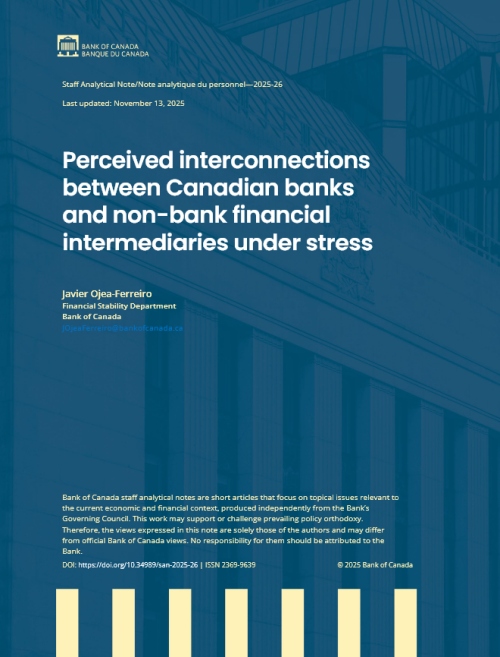
Image: Perceived interconnections between banks and NBFIs (Bank of Canada Staff Report, November 2025)
On November 13 2025, the Bank of Canada Staff published Analytical Note 2025-26 titled, "Perceived interconnections between Canadian banks and non-bank financial intermediaries under stress" (16 page PDF), that examines how stress spreads between banks and non-bank financial intermediaries (NBFIs) such as investment and mortgage funds. While the research found that market-based linkages between banks and non-banks have grown much stronger over the past decade, it offers no specific policy steps.
For Canada’s fintech and regulatory communities, that leaves room to build smarter transparency and data-driven tools that improve resilience while encouraging innovation.
The Bank used a market-based metric called the ratio of tail sensitivities to track how often banks and NBFIs experience stress at the same time. In simple terms, it measures how likely both sectors are to face sharp losses together when markets turn volatile.
Before the pandemic, that overlap was around 60%, meaning stress in one sector often stayed contained. During 2020 (Covid-19), the overlap jumped to almost 90%, showing that both banks and NBFIs were hit by the same shocks at once.
Post Covid-19, it has stayed above 70%. This signals that Canada’s financial system now behaves more like a single network where investor confidence, liquidity, and risk pricing can ripple quickly across different parts of the market.
The analysis relies on market indicators such as price changes and co-movement ratios. These signals show how banks and non-banks react to market stress, but they don't track the underlying funding flows, repo exposure, or off balance sheet commitments that reveal how those stresses move in practice. The Bank acknowledges that data gaps make it hard to see how financial stress truly spreads between institutions.
The research measures perceived connections through statistical patterns rather than verified, real time data linkages. That distinction matters. Without deeper, connected data, it is harder to see where vulnerabilities are forming or how quickly they could spread. Closing that gap doesn't necessarily require new regulation but better tools and shared information that improve resilience while encouraging innovation.
Regulators already monitor funding and liquidity in near real time, but the Bank of Canada notes that current data still do not explain how financial stress moves between different parts of the system. The missing piece is insight into how one market’s strain can quickly affect another’s ability to function.
For example, if liquidity tightens in the mortgage or bond market, investment funds might sell assets to meet investor redemptions. Those sales can push down prices, reducing the value of collateral that banks use for their own lending and funding. Within hours, what starts as a localized funding issue can spread to other sectors that rely on those same assets. Economists have long modelled this type of stress transmission, but those models depend on historical or aggregated data. They show how shocks can travel but not how fast they move in real time.
RegTech innovation could help close this gap. Shared data platforms, digital reporting tools, and secure analytics could give both regulators and market participants a clearer view of where risks are forming. Instead of expediting new rules, the opportunity is better information that allows for faster, better, data-driven action. Fintechs can play a leading role by designing systems that make oversight smarter, not heavier, while strengthening confidence across the financial system.
If Canada wants to maintain stability and support innovation, it needs visibility into where financial pressure builds. The Bank of Canada's findings show that perceived connections already move markets but without deeper real-time data access, those perceptions could harden into real stress events. The opportunity is to turn perception into understanding and make transparency Canada’s real advantage.
The National Crowdfunding & Fintech Association (NCFA Canada) is a financial innovation ecosystem that provides education, market intelligence, industry stewardship, networking and funding opportunities and services to thousands of community members and works closely with industry, government, partners and affiliates to create a vibrant and innovative fintech and funding industry in Canada. Decentralized and distributed, NCFA is engaged with global stakeholders and helps incubate projects and investment in fintech, alternative finance, crowdfunding, peer-to-peer finance, payments, digital assets and tokens, artificial intelligence, blockchain, cryptocurrency, regtech, and insurtech sectors. Join Canada's Fintech & Funding Community today FREE! Or become a contributing member and get perks. For more information, please visit: www.ncfacanada.org
| | |
|---|---|---|
| | |
AI | Nov 13, 2025

In October 2025, the Center for Security and Emerging Technology (CSET) released a report called, "The Mechanisms of AI Harm", that breaks down how artificial intelligence can cause harm through predictable pathways. The study found that most failures stem not from malicious use but from system design, biased data, and weak oversight.
CSET warns that as AI systems spread through banking, healthcare, and infrastructure, the harm becomes self-reinforcing. Each model learns from the last, compounding flaws over time. The problem is not bad actors but feedback loops that quietly scale risk. Governance is lagging behind by years, while the pace of model deployment grows monthly.
In Detroit, a police facial recognition system wrongly identified Robert Williams, leading to a false arrest that eroded public trust in the technology meant to improve safety.
An MIT article found that error rates for darker-skinned women reached 34% compared with less than 1 % for lighter-skinned men. These disparities reveal structural bias baked into training data and feedback systems.
Across Europe, the EU AI Act now treats such failures as foreseeable harms requiring traceability and documentation.
In the United States, federal regulators have begun enforcement actions against companies using opaque algorithmic decisions.
Canada’s proposed Artificial Intelligence and Data Act (AIDA) remains under parliamentary review and was impacted by prorogation in January 2025, leaving gaps between good intentions and enforceability, read the death of AIDA. Policymakers now are debating how AI accountability should evolve.
Many Canadian financial institutions already use machine learning to underwrite credit, detect fraud, and screen clients. Yet few publicly document how models are tested for bias or explainability. The Office of the Superintendent of Financial Institutions (OSFI) Guideline E-23 on Model Risk Management (2027) outlines how financial institutions should govern advanced analytics and AI models, including validation, bias testing, and accountability expectations, but without enforcement the framework still relies on internal discretion.
Regulators acknowledge the need for governance but lack consistent mechanisms to test, benchmark, or verify models across industries. The result is a patchwork system where AI tools can operate with little external visibility. Each institution assumes its safeguards are sufficient, even though no one has a full view of the risk landscape.
CSET’s model shows harm accumulates when oversight is fragmented. A 2024 OSFI-FCAC Risk Report on AI Uses and Risks at Federally Regulated Financial Institutions found that many financial institutions rely on third-party AI systems without full audit access or validation rights, which means models can change without regulators or even clients knowing. These dependencies create silent risk channels within the financial ecosystem.
And in Europe, a Europol “Facing reality? Law enforcement and the challenge of deepfakes” report cautions that deep-fake technology is proliferating rapidly and posing new risks for fraud, misinformation, and market manipulation. Each failure feeds the next, so it creates a feedback loop of risk spreading across jurisdictions and markets.
Regulators and financial institutions have a limited window to close the governance gap before public trust erodes. The real challenge is not whether to slow innovation, but how to steer it responsibly. CSET’s findings suggest that effective AI governance must protect stakeholders while allowing systems to improve and scale safely. Overregulation can push innovation into unregulated spaces, but weak oversight leaves markets exposed to preventable harm.
CSET’s framework shows that AI harm grows from feedback loops where technical design, human behaviour, and oversight interact. Preventing harm means building governance that evolves at the same pace as the systems it regulates. The question is not whether AI will cause harm, but whether leaders will move fast enough to limit it. Accountability cannot be automated. It must be led.
The National Crowdfunding & Fintech Association (NCFA Canada) is a financial innovation ecosystem that provides education, market intelligence, industry stewardship, networking and funding opportunities and services to thousands of community members and works closely with industry, government, partners and affiliates to create a vibrant and innovative fintech and funding industry in Canada. Decentralized and distributed, NCFA is engaged with global stakeholders and helps incubate projects and investment in fintech, alternative finance, crowdfunding, peer-to-peer finance, payments, digital assets and tokens, artificial intelligence, blockchain, cryptocurrency, regtech, and insurtech sectors. Join Canada's Fintech & Funding Community today FREE! Or become a contributing member and get perks. For more information, please visit: www.ncfacanada.org
| | |
|---|---|---|
| | |



August 26th, 2025

January 4th, 2024

June 1st, 2021

September 9th, 2020

July 9th, 2018

January 3rd, 2018

September 25th, 2017

June 20th, 2017

May 10th, 2017

December 14th, 2016
