




Karsten Wenzlaff, Advisor
August 26th, 2025
Karsten Wenzlaff is a Crowdfunding and Fintech Expert from Germany. He is Secretary-General of Digit[...]


Retail Banking | May 1, 2025
Retail digital banking platforms are evolving into the foundation of modern financial services driven by consumers appetite for AI driven platforms that make it easier to manage money, get personalized advice, and accessible services anytime on any device.
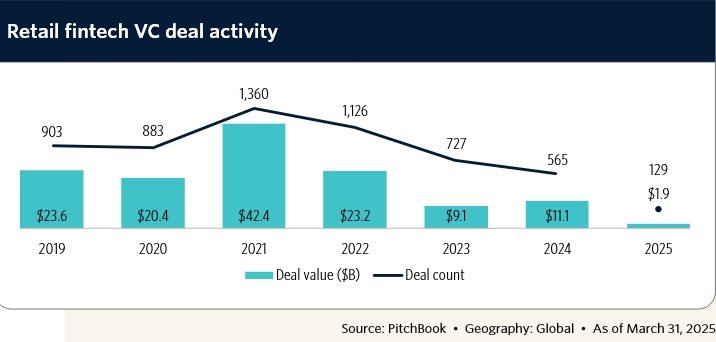
According to PitchBook Retail Fintech VC Trends, global retail fintech funding volumes reached $1.9 billion in Q1 2025, representing a 37.8% drop from Q4 2024 despite rising interest in platform-first strategies and growing AI adoption.
Although venture growth deals were the exception with median deal sizes jumping 67% to $47 million, making up 53.7% of total VC value. Klarna’s $12 billion valuation and Addi’s $170 million growth round stand out. IPO prospects for Klarna and eToro postponed listings due to market volatility ala Trump-effect.
Early stage retail fintech including median pre-seed and seed valuations fell by 50% and declined in size and count.
CCG Catalyst’s May 1 2025 snapshot of retail digital banking platforms features fintech companies are gaining traction because they stack cloud-native scale, AI tools, and modular architecture:
| U.S. Platform | Why Investors Are Interested |
| Backbase | Microservices, API-first architecture, and enterprise flexibility |
| Narmi | Open API stack and fast onboarding (under 3 minutes) |
| Lumin Digital | AI-native with strong mobile UX, cloud-native since day one |
| SoFi/Cyberbank | End-to-end infrastructure with embedded finance support |
| Temenos Infinity | Low-code platform enabling rapid interface development |
Canada’s fintech ecosystem has several growing players with potential to evolve into full service modular banking platforms or infrastructure providers:
| Canadian Company | Comparable U.S. Platform | Strategic Direction |
| Wealthsimple | SoFi | Expanding beyond investing into cash accounts, cards, and tax tools |
| Koho | Narmi | Prepaid card and banking-like functionality with open APIs |
| Neo Financial | Lumin Digital | Mobile-first, rewards-driven model with merchant integration |
| EQ Bank | Backbase | Hybrid of legacy and digital bank offering API access and high-interest accounts |
| Tandem or Brim | Apiture or Temenos | Fintechs with credit and loyalty platforms, potential to grow through partnerships |
Canadian fintech is still limited by federal regulatory complexities but opportunities are increasing as consumers move away from branch-based banking, the need for increased competition amidst Trump's economic pressures, and newly elected Prime Minister Mark Carney vowing to protect Canada.
According to the Canadian Bankers Association's 2024 report, 70% of Canadians used a mobile banking app in the last year (on average 7.4 times per month), up from 65% in 2021.
VC interest in Canadian fintech remained strong in 2024, despite a global slowdown. Fintechs with platform enabling capabilities such as embedded finance, banking-as-a-service, and open API designs continue to attract interest. Plus, the rise of U.S. plug-and-play models is a playbook for homegrown infrastructure players to serve Tier 2 banks, credit unions, and niche verticals like gig economy banking.
Digital banking platforms at the forefront are meeting customer expectations and improving operational efficiency with a few key technologies:
Digital retail banking platforms are using AI, APIs, and modular designs to deliver flexible, intelligent, and ready to scale solutions. Canadian fintechs that embrace open architecture and build for partnerships can lead not just here in Canada, but globally.
 The National Crowdfunding & Fintech Association (NCFA Canada) is a financial innovation ecosystem that provides education, market intelligence, industry stewardship, networking and funding opportunities and services to thousands of community members and works closely with industry, government, partners and affiliates to create a vibrant and innovative fintech and funding industry in Canada. Decentralized and distributed, NCFA is engaged with global stakeholders and helps incubate projects and investment in fintech, alternative finance, crowdfunding, peer-to-peer finance, payments, digital assets and tokens, artificial intelligence, blockchain, cryptocurrency, regtech, and insurtech sectors. Join Canada's Fintech & Funding Community today FREE! Or become a contributing member and get perks. For more information, please visit: www.ncfacanada.org
 |  |  |
|---|---|---|
 |  |  |
Innovation Economy | April 29, 2025

Image: Freepik
Mark Carney has been elected as Canada's 24th Prime Minister after leading the Liberal Party to win the 2025 federal election. The Liberals secured 168 seats (just shy of a majority), and are expected to form a minority government. Prime Minister Mark Carney has already spoken with President Trump about the pressing issues of tariffs, trade war and 51st state rhetoric, and the two leaders have agreed to meet in person.
While those issues are of critical importance to Canada's sovereignty, this article looks at Carney's past public comments and Liberals 2025 platform to get a sense for the implications for Canada's fintech sector under his expected leadership.
In 2019, Carney was the Governor of the Bank of England (BoE) and said the following at the Innovate Finance Global Summit:
“A new economy requires a new finance... to serve the digital economy, to support the major transitions underway across the globe and to increase the sector’s resilience”.
The newly elected Prime Minister of Canada has a deep background in finance, global networks, and a steady hand at innovation. He's expected to speed up payments modernization, support the responsible AI development, foster fintech investment, tighten crypto rules, and open more global markets to Canadian companies. The Liberal Party commitments that support innovation include financial technologies and sustainable finance, infrastructure investment, internal trade reform, red tape reduction, and a patent box regime, all told would help strengthen the economy and fintech growth.
When Carney was leading the BoE, he signalled strong support for opening payments infrastructure to non-bank providers, helping to boost innovation and competition. In Canada, the implementation of open banking and payment modernization initiatives (i.e. Real Time Rail System) have sadly faced prolonged delays. Carney is expected to speed up these rollouts to benefit consumers and competition. Open banking will give consumers control over their financial data and allow fintech companies to create new services, while the operating firms must meet high security and operational standards.
As part of its 2025 platform, the Liberal government committed to eliminating federal barriers to interprovincial trade and labour mobility by Canada Day. Reducing costs and aligning standards could benefit fintech companies that must constantly track and adjust to changing and inconsistent provincial compliance requirements, in sectors like payments, insurtech, wealthtech, and others. Streamlining trade and regulatory barriers would help fintechs expand nationally more effectively, reduce legal and operational costs, and also contribute to offering consistent services to customers and businesses from coast to coast.
Carney spoke about how emerging technologies are game-changing finance in a 2018 Mansion House speech “New Economy, New Finance, New Bank”, where he acknowledged AI's growing impact on credit and risk systems.
Under his government, Canada is expected to advance the Artificial Intelligence and Data Act to regulate high impact AI systems including financial firms using AI for credit scoring, fraud detection, or robo advising to ensure responsible AI standards are met for fairness, explainability, and consumer protection.
Immediately after securing Liberal leadership, Carney axed the controversial capital gains tax hike, directly supporting Canada's innovation economy. Under his leadership, Carney could expand access to venture capital, innovation incentives, and encourage national regulatory alignment for startups operating across multiple provinces. The Liberal platform also supports a patent box regime, focused on scaling high growth firms, retaining intellectual property in Canada, and improving commercialization outcomes from public and private R&D. The Liberal 2025 Platform outlines efforts to increase business investment and create a more competitive innovation environment, especially for sectors like fintech and AI.
Although Carney previously showed openness towards regulated forms of crypto innovation, in 2018, he spoke critically of unbacked crypto assets and called Bitcoin “neither a store of value nor a useful means of exchange”. It's expected that he'll tighten oversight of crypto exchanges, stablecoin issuance, and asset custody. Lastly, while Carney hasn't explicitly endorsed a Canadian CBDC, he has called for central banks to explore sovereign digital currencies as tools to support monetary policy and financial stability. During a 2019 speech at the Jackson Hole Economic Symposium, for example, Carney proposed the idea of a "synthetic hegemonic currency" (SHC) as a potential solution to the destabilizing dominance of the U.S. dollar in the global financial system.
Mark Carney is one of the most prominent global figures in sustainable finance. He co-founded the Glasgow Financial Alliance for Net Zero (GFANZ) and served as the UN Special Envoy on Climate Action and Finance. His leadership brings a strong focus on aligning financial systems with climate goals. The 2025 Liberal platform commits to supporting green innovation and transitioning Canada toward a low-carbon economy. This creates opportunities for fintechs in areas like ESG data services, green lending, climate risk modeling, and carbon trading infrastructure.
Carney is expected to support broader digital financial access across Canada. In his 2018 “Future of Money” speech, he emphasized the role of digital identity, financial modernization, and infrastructure in improving inclusion. While he has't directly addressed digital ID for Canada, the Liberal platform’s national digital readiness strategy includes high speed rail and northern connectivity projects that could help bring digital banking and fintech services to underserved and remote communities.
| Opportunities | Challenges |
| Launch of real time payments and open banking | Meeting tougher compliance and risk standards |
| New funding for AI, fintech innovation, and green finance | Higher expectations for responsible AI and cybersecurity |
| Stronger startup investment environment and patent box incentives | Adapting to stricter crypto and stablecoin rules |
| Global trade partnerships and reduced internal trade barriers | Competition from international fintech firms |
| Possible leadership in digital identity and CBDC projects | Regulatory complexity for multi jurisdictional firms |
| Growth in sustainable finance and ESG fintech | Evolving global standards for ESG data and disclosures |
| Growth in digital access through national infrastructure | Uneven fintech access in rural and remote communities |
Mark Carney's credentials offer an elite tier of credibility in global finance, climate leadership, and modernization of financial systems. Together with the Liberal 2025 Platform's strategic commitments to innovation, interprovincial trade liberalization, red tape reduction, and IP commercialization, his leadership is desperately needed to improve Canada's flailing productivity, upgrade its financial ecosystem, build public trust and international competitiveness.
His background also positions Canada to lead in sustainable finance, aligning innovation with global climate goals. For fintech entrepreneurs, investors, and policymakers, the Carney era is underpinned by stable governance and a clear vision, offering a mix of opportunity and responsibility.
The National Crowdfunding & Fintech Association (NCFA Canada) is a financial innovation ecosystem that provides education, market intelligence, industry stewardship, networking and funding opportunities and services to thousands of community members and works closely with industry, government, partners and affiliates to create a vibrant and innovative fintech and funding industry in Canada. Decentralized and distributed, NCFA is engaged with global stakeholders and helps incubate projects and investment in fintech, alternative finance, crowdfunding, peer-to-peer finance, payments, digital assets and tokens, artificial intelligence, blockchain, cryptocurrency, regtech, and insurtech sectors. Join Canada's Fintech & Funding Community today FREE! Or become a contributing member and get perks. For more information, please visit: www.ncfacanada.org
| | |
|---|---|---|
| | |
April 25, 2025

Image: Freepik/lyashenko
Most people choose to manage their finances by maintaining accounts across different banks. They often do so to take advantage of specialized offerings, such as higher interest rates for savings, better rewards for spending, or tailored features for specific financial goals like emergency funds, investments, or travel expenses. It’s also overall better for financial security to have multiple accounts, as this reduces the risk of someone losing access to all their funds in case of technical issues, fraud, or unexpected account freezes in an institution.
Of course, it’s no walk in the park to determine where you should open your next bank account, given the sheer number of options on the market. However, there are plenty of reasons to turn your attention toward digital banks in particular. Unlike traditional banks with physical branches, digital banks operate entirely online and are purpose-built for the highly tech-driven world of today. They utilize technology to offer fast, convenient, and innovative financial solutions without the hassle of in-person visits or cumbersome processes.
All of the above mentioned qualities are making digital banking an increasingly popular choice among modern consumers around the world. According to data from the American Bankers Association, for instance, up to 71% of consumers in the country now prefer digital banking. In the Philippines, digital banks have seen growth by leaps and bounds, collectively accumulating more than PHP 80 billion worth of deposits by June 2024.
If at this point you’re still unsure about letting yourself get caught up in this rising tide, then read on; this article will outline why a digital bank might be the perfect choice for you.
If you’re looking to grow your savings faster, digital banks might give you just the incentive you need. With fewer operational expenses, they can afford to give higher interest rates on savings accounts compared to traditional banks. These competitive rates can make a significant difference over time and help you maximize the returns on your deposits without requiring any extra effort on your part.
If you’re looking for the best digital bank account Philippines’s consumers go to for a rewarding saving experience, then you’ll definitely want to bank with Maya. All Maya savings accounts start with a competitive interest rate of 3.5% p.a.—and from there, you can boost it as high as 15% p.a. by paying bills and buying load through the Maya app, as well as making purchases using your Maya Card, QR, or via online checkout. There are also other savings products like Personal Goals and Time Deposit Plus, both of which have higher interest rates compared to their counterparts from other providers. It’s without a doubt the bank account that can make your savings work the hardest.
High banking fees like monthly maintenance fees and withdrawal charges can chip away at your money over time. Though the one-time cost of these fees is often not that high, the sheer quantity of fees you often have to pay at a traditional bank can make the amount snowball quickly. Digital banks, in contrast, are designed to eliminate many of these expenses. Since they operate without physical branches, they save on overhead costs and pass those savings directly to their customers. This means you can enjoy low or even no fees on services like account maintenance, fund transfers, and ATM withdrawals, which allows you to keep more of your hard-earned money.
Picture this: it’s late at night, and you suddenly need to transfer funds, check your account balance, or pay a bill. Traditional banks with fixed hours might leave you stranded until morning, but digital banks will never lock you out. Their platforms are accessible round-the-clock through your smartphone or computer—a convenience their traditional counterpart just can’t match. Whether you’re traveling across time zones or just need banking services during unconventional hours, digital banks keep you connected to your money at all times.
Navigating the world of finance doesn’t have to be complicated and digital banks excel at making their platforms intuitive and easy to use, even for those who aren’t tech-savvy. Features like clean interfaces, real-time notifications, and built-in budgeting tools transform digital financial management into a seamless experience. These thoughtful designs help you stay in control of your money without the frustration that often accompanies the experience of using traditional banking apps.
Fear of online threats like identity theft and scams is one of the biggest roadblocks preventing consumers from embracing digital finance. For this reason, digital banks will always prioritize the safety of your finances and personal information. The latest cybersecurity technologies—such as biometric authentication, two-factor verification, and encryption—form the backbone of their security systems. In addition, you can set up real-time alerts to keep you informed of every transaction, so you can act swiftly in case of suspicious activity.
Gone are the days of lengthy paperwork and multiple trips to a bank branch just to open an account. Digital banks streamline the process by letting you sign up entirely online, often in just a few minutes. With straightforward instructions and minimal documentary requirements, you can start managing your money without delay.
Why settle for standard banking when you can access tools that help you save, invest, and spend more effectively? Digital banks often lead the way in offering innovative features, like the ability to create multiple accounts for different savings goals or integrated investment options. These unique offerings cater to the evolving needs of modern customers and elevate the user experience far beyond the basics of banking.
Digital banks represent the future of personal finance, surpassing traditional banks in terms of accessibility, affordability, and innovation. As the financial landscape continues to evolve, choosing a digital bank could be the step that modernizes how you manage your money. Explore your options and see how a digital bank might fit seamlessly into your financial life.
The National Crowdfunding & Fintech Association (NCFA Canada) is a financial innovation ecosystem that provides education, market intelligence, industry stewardship, networking and funding opportunities and services to thousands of community members and works closely with industry, government, partners and affiliates to create a vibrant and innovative fintech and funding industry in Canada. Decentralized and distributed, NCFA is engaged with global stakeholders and helps incubate projects and investment in fintech, alternative finance, crowdfunding, peer-to-peer finance, payments, digital assets and tokens, artificial intelligence, blockchain, cryptocurrency, regtech, and insurtech sectors. Join Canada's Fintech & Funding Community today FREE! Or become a contributing member and get perks. For more information, please visit: www.ncfacanada.org
| | |
|---|---|---|
| | |
Banking License | April 7, 2025

Image: Freepik/rawpixel.com
After almost a six year wait, Banco Santander has secured a Schedule II banking license in Canada, an achievement that could ramp up digital competition in banking. Santander first applied for a Canadian banking license back in July 2019. After a long multi-year regulatory process, Santander received letters patent from Canada’s Minister of Finance in June 2024, a required step to establish a new bank under federal law. Last weekend in the official government gazette newsletter, stated that the Office of the Superintendent of Financial Institutions (OSFI) issued an order for Santander to 'commence and carry on business early last month - meaning its clear to operate.
Santander is the largest bank in Spain (and one of the largest in Europe), and the new license will allow it to offer full retail banking services, such as deposit taking, lending, credit cards, and wealth management products and services. This approval places Santander alongside other foreign banks operating as Schedule II subsidiaries in Canada , such as Citibank Canada, ICICI Bank Canada, Amex Bank of Canada, and others. It also raises fresh questions about the future of competition, digital transformation, and fintech collaboration in Canada’s tightly held banking industry.
Although the Canadian banking license is new, Santander has been operating in Canada for more than a decade by acquiring Carfinco Financial Group, a company focused on automobile financing. So Santander already has a foothold in the Canadian market but now with a retail banking license, they can now expand offerings.
Santander bank is already a major player in Europe and Latin America, and it operates in the U.S. and Mexico through a mix of consumer lending, auto finance, and digital-first retail banking. From Banco Santander's 2024 Annual Report, here's what sets them apart:
Its Canadian strategy definitely won't be going toe to toe against incumbent banks like RBC, Scotia or BMO by opening up hundreds of physical branches. Santander is more likely to curate niche offerings in personal finance and use its robust digital infrastructure to scale quickly and efficiently.
According to The Logic, Santander’s license is one of just 11 new federal banking licenses granted in Canada over the past 10 years. So, yes this license is pretty big news to competition aficionados.
Recently on March 4 2025, President Trump complained on his Truth Social platform that "Canada doesn’t allow American banks to do business in Canada, but their banks flood the American market. Oh, that seems fair to me, doesn’t it?” However this is not really accurate given that there are at least a dozen of U.S. Financial Institutions currently operating in Canada including 3 who also have a schedule II license the same as Santander.
So, U.S. banks can operate here in Canada but they face regulatory and market challenges, since foreign banks must either collaborate with a Canadian partner, setup a Canadian subsidiary, or get government approval to do business here. There are also foreign ownership restrictions preventing them from acquiring Canadian banks and their licenses outright. Canadian consumers may also prefer working with one of the big six Canadian banks or the inherent trust of walking into a physical branch.
The door to a banking license isn't locked for qualified foreign banks but they'll need to meet rigorous standards of risk management and governance. Santander's success in receiving a Canadian banking license may open the pathway for more foreign digital-first banks interested in entering Canadian markets.
Santander is bringing more than just capital and niche retail services to Canada. They have a fully developed digital platform and a strong history of working with financial technologies. They even have their own fintech division that operates PagoNxt, their global payment service offering with tools for merchants and embedded finance features that can be integrated into both banking and non-bank platforms.
Santander also owns Openbank, which has grown into Europe’s largest digital only bank by deposits.
As of May 2022, Santander had moved over 80% of their global it infrastructure to the cloud, which means they are a cloud-native system that can launch products quickly, iterate, and experiment with tools that traditional banks would likely take years to develop (without similar infrastructure).
For fintechs working on API based banking, automated lending and other similar innovative and novel products and services, Santander could be more than a competitor but a potential partner who can bring capital, research, and tech enablement all in one place, and ready to go.
Is Santander's license approval tied in some way to Canada's imminent open banking rollout (expected in 2026) or the need to diversify and strengthen Canada's economy?
While the timing is certainly interesting, and there may be some nuanced reasons into the approval of Santander's license, we'll refrain from any speculation and just reiterate that when consumer-driven finance finally arrives in Canada, it will help newer brands like Santander to connect with more customers, offer new products/services, and deepen financial relationships, all powered by artificial intelligence and cloud-native systems.
As Investment Executive noted, Canada's largest banks have long benefited from their exclusive access to consumer data. Open banking could begin to shift that balance. And let's be clear, that shift will take time but open banking may certainly allow for more experimentation, more competition, and more chances for fintech firms and digital banks like Santander to connect with customers in new ways.
For NCFA's community, Santander’s arrival is a sign that the ecosystem is evolving. Canada’s financial future is bound to become more digital, more connected, and hopefully more competitive than ever. For fintech firms building in lending, onboarding, or data innovation, now is the time to explore how players like Santander could support growth through partnership.
The National Crowdfunding & Fintech Association (NCFA Canada) is a financial innovation ecosystem that provides education, market intelligence, industry stewardship, networking and funding opportunities and services to thousands of community members and works closely with industry, government, partners and affiliates to create a vibrant and innovative fintech and funding industry in Canada. Decentralized and distributed, NCFA is engaged with global stakeholders and helps incubate projects and investment in fintech, alternative finance, crowdfunding, peer-to-peer finance, payments, digital assets and tokens, artificial intelligence, blockchain, cryptocurrency, regtech, and insurtech sectors. Join Canada's Fintech & Funding Community today FREE! Or become a contributing member and get perks. For more information, please visit: www.ncfacanada.org
| | |
|---|---|---|
| | |
AI Innovation | April 4, 2025

Image: Unsplash/Solen Feyissa
On April 3 2025, Amazon quietly rolled out a new artificial intelligence (AI) feature called 'Buy for Me'. That is if a user finds an item that they want on another retailer's site, Amazon's agentic AI on its app will complete the purchase on the user's behalf, handling all the details such as checkout, payment, and even delivery tracking.
Buy for Me is currently available on both iOS and Android for a limited number of U.S. customers. Amazon plans to test with a limited number of brand stores and products and then intends to roll the offering out to more customers and incorporate more third party brand stores and products based on iterative feedback.
This isn't just about shopping convenience. It's Amazon extending it's AI concierge systems beyond its own moat and walls and into the open web. It acts as a secure authorized buying agent for users and goes beyond giving suggestions and 'gets things done'. This is where things can get interesting for financial services.
Imagine an AI concierge that doesn’t just show you your bank balances, but it can move money between your accounts, negotiate better rates, or automatically file your taxes when it’s time on your behalf.
You wouldn't have to log into five different apps to manage investments, savings, loans, and bills because you could simply as your AI assistant 'Finance for Me'.
“Can you move $500 from savings into my RRSP and check if there’s a better mortgage rate than I’m getting now?”
And it would.
Smart financial AI is proactive and not meant to be a dashboard with traffic lighting that shows you how much you spent at restaurants last month. It would be designed to be your go to problem solver on all things finance, securely and in real-time able to iterate and execute tasks across different fintech companies and institutions on your behalf.
'Finance for Me' could remove the complexities and taboo that's often associated with dealing and managing money. Here's just a few examples of how such an agentic AI assistant could help you:
Yes, all of the above could happen in the near future with full consent, transparent and clear logs, and security safeguards.
Open Banking standards would enable connections to be made securely. Regulators and lawmakers would need to create a responsible agentic AI framework and all transactions would have to be compliant and in regulatory alignment...but it's technically possible or getting closer to that reality (on a ridiculous curve of innovation and disruption).
Canada's financial ecosystem is full of great tools but they remain siloed, reactive (not predictive/proactive), and are often out of reach to those without deeper pockets, knowledge, and time. A 'Finance for Me' AI dedicated to optimizing finance on your behalf would be a game-changer and truly democratize financial capabilities. Amazon's 'Buy for Me' innovation is just at the beginning of the 'let me delegate that to my AI assistant curve. Fintechs, banks, and regulators should be eyes wide open.
The National Crowdfunding & Fintech Association (NCFA Canada) is a financial innovation ecosystem that provides education, market intelligence, industry stewardship, networking and funding opportunities and services to thousands of community members and works closely with industry, government, partners and affiliates to create a vibrant and innovative fintech and funding industry in Canada. Decentralized and distributed, NCFA is engaged with global stakeholders and helps incubate projects and investment in fintech, alternative finance, crowdfunding, peer-to-peer finance, payments, digital assets and tokens, artificial intelligence, blockchain, cryptocurrency, regtech, and insurtech sectors. Join Canada's Fintech & Funding Community today FREE! Or become a contributing member and get perks. For more information, please visit: www.ncfacanada.org
| | |
|---|---|---|
| | |
Fintech in Canada | March 31, 2025

Image: Freepik
In early Q2 2019, Ontario's largest credit union, Meridian Credit Union launched a digital only bank called motusbank, now after 6 years in operation, motusbank is shutting down. In a joint announcement, Meridian and Coast Capital Savings confirmed they will take over motusbank’s accounts and assets by early 2026, pending regulatory approval. This marks the end of motusbank's short run as a national online bank. It was meant to be Meridian's vehicle for expanding across Canada but it struggled to reach sufficient scale to remain viable long term.
According to the announcement, despite having national ambitions, motusbank only reached 16,000 members by 2025. It highlights that competing in Canada's banking markets without branches or significant branding, or a strong digital acquisition strategy, is a grind.
The pandemic also hurt smaller banks, but the stiff competition from bigger players like EQ Bank, Tangerine, and Simplii who have more brand recognition, marketing might and deeper pockets was a headwind.
Additionally, there was a leadership change in January 2022 when Jan-Ann Gilfoy was appointed President and CEO of both Meridian and motusbank. motusbank was pushed by Meridan's previous CEO, and now new leadership is emphasizing local growth, cooperative values, and is aiming to deepen relationships with existing members (customers).
Jay-Ann Gilfoy, CEO of Meridian and motusbank:
“We’ve made the decision to sharpen our focus on the growth and success of Meridian.”
👉 Loans originated in Ontario like mortgages and HELOCs will transfer to Meridian starting May 2025. Deposit accounts and loans outside of Ontario will be transferred to Coast Capital Savings.
For customers, this news is obviously an inconvenience but their funds remain insured and most customers don't need to do anything for now, as the transition will happen automatically.
For industry however, news of motusbank's closure shows that without deep pockets, unique value proposition, a strong digital marketing acquisition strategy, and strong brand, being 'digital only with low fees' may not be enough. Compare and contrast the approach to Robinhood's wealthtech push and lifestyle finance offering.
This is a quiet exit from the digital banking space, but it says a lot. According to Reddit users commenting on motusbank shutting down, many saw this coming and pointed to the outdated app, slower innovation and lack of aggressive growth.
One user said, “Motusbank has been pretty much on life support through the pandemic.”
Others said they’ll likely switch banks unless Coast Capital can impress them. Some are locked in for now, like one poster with a GIC maturing in 2027.
Neo, challenger, and digital-first banks should sit up and take notice, given that motusbank was one of Canada's few fully digital banks not owned by one of the incumbent banks. The message is pretty clear, convenience and low fees must be paired with innovation, strong growth strategy, size/trust and scale.
Given the dominance of Canada's banks and the governments hesitance to open up more competition in the banking sector, it's harder and harder to go it alone and customers will suffer with limited choice for innovative alternatives and high fees. The Crisis Canada and Fintech Can’t Afford to Waste
The National Crowdfunding & Fintech Association (NCFA Canada) is a financial innovation ecosystem that provides education, market intelligence, industry stewardship, networking and funding opportunities and services to thousands of community members and works closely with industry, government, partners and affiliates to create a vibrant and innovative fintech and funding industry in Canada. Decentralized and distributed, NCFA is engaged with global stakeholders and helps incubate projects and investment in fintech, alternative finance, crowdfunding, peer-to-peer finance, payments, digital assets and tokens, artificial intelligence, blockchain, cryptocurrency, regtech, and insurtech sectors. Join Canada's Fintech & Funding Community today FREE! Or become a contributing member and get perks. For more information, please visit: www.ncfacanada.org
| | |
|---|---|---|
| | |
Bank of Canada Staff Report | March 27, 2025

Image: Canadians' access to cash in 2023 (Bank of Canada, Staff Research)
On March 21, 2025 the Bank of Canada's staff published a cash-related study called 'Canadians Access to Cash in 2023' (16 page PDF) that confirms what most folks especially fintechs and financial institutions (FI) know. That is banks and credit unions are quietly closing branch locations across Canada, particularly in rural and remote areas.
The report compares a snapshot taken in Q4 of 2019 and compared it with Q4 in 2023, four years later, and found that 561 branches were shut down, along with more than 900 bank-owned ATMs (automatic teller machines). Now even though the banks and credit unions are closing hundreds of ATMs, private companies or white-label ATMs, fintechs, and innovative alternatives have moved in to fill the gap to provide access to cash for people who rely on them.
“The infrastructure for accessing cash may look stable on the surface, but the underlying delivery models have changed significantly.”
| Type | 2019 Q4 | 2023 Q4 | Change |
| Bank branches | 5,921 | 5,699 | –222 |
| Credit union branches | 2,984 | 2,645 | –339 |
| FI-owned ABMs | 21,538 | 20,604 | –934 |
| White-label ABMs | 38,863 | 39,660 | +797 |
The table above is sourced from the BoC's staff research report and shows that white-label ATMs, typically not located in retail stores and not affiliated with any financial institution, now make up approx two-thirds of all automatic teller machines in Canada. While they offer convenience, they often come with higher fees and lack the services or security that bank owned ATMs provide.
In many rural or remote communities where branches and ATMs have been removed, residents now have to travel further to access basic financial services. Credit unions which often serve smaller populations, have reduce the number of branches at a steeper percentage drop than major banks.
While a growing number of Canadians are transitioning to online banking, those that still rely on cash such as seniors, some small businesses, and those with limited internet access, are faced with rising challenges to access basic banking services.
Some innovative partnerships and initiatives are expanding access through digital and community-based models.
Earlier this month, Canadian fintech Koho and Canada Post formed a partnerships and launched postal banking services via the My Money Account, a digital spending and savings account managed through the KOHO app. So citizens living in rural or remote areas that live near a post office will be able to load cash, access funds, and manage their money at their local post office and users can deposit cash at over 6,000 Canada Post locations. The service is expected to rollout nationally this year 2025 and is specifically targeting rural, remote and indigenous communities.
While we've never stepped in one, reports online show that Desjardins has launched mobile banking branches, which are fully equipped vehicles that travel to underserved regions of Quebec. These mobile branch units offer in-person banking services, including deposits, withdrawals, bill payments, and consultations. The approach is proving effective in areas where internet access is limited and/or digital adoption is low.
Digital banking platforms like EQ Bank, Koho, and Wealthsimple Cash are also helping Canadians open accounts, pay bills, and send e-transfers, all remotely. Most of these services offer secure ID verification tools that don't require a branch visit, so they are an ideal fit for communities lacking traditional brick-and-mortar infrastructure.
Digital banks have become a reliable alternative for delivering a growing suite of financial services at lower rates than traditional banks providers.
As the number of physical banking locations and ATMs decline in rural communities, the alternative solutions will be used more and more. From white label ATMs to postal banking services and mobile branch units, are now part of the financial infrastructure of rural Canada.
The National Crowdfunding & Fintech Association (NCFA Canada) is a financial innovation ecosystem that provides education, market intelligence, industry stewardship, networking and funding opportunities and services to thousands of community members and works closely with industry, government, partners and affiliates to create a vibrant and innovative fintech and funding industry in Canada. Decentralized and distributed, NCFA is engaged with global stakeholders and helps incubate projects and investment in fintech, alternative finance, crowdfunding, peer-to-peer finance, payments, digital assets and tokens, artificial intelligence, blockchain, cryptocurrency, regtech, and insurtech sectors. Join Canada's Fintech & Funding Community today FREE! Or become a contributing member and get perks. For more information, please visit: www.ncfacanada.org
| | |
|---|---|---|
| | |



August 26th, 2025

January 4th, 2024

June 1st, 2021

September 9th, 2020

July 9th, 2018

January 3rd, 2018

September 25th, 2017

June 20th, 2017

May 10th, 2017

December 14th, 2016
