




Karsten Wenzlaff, Advisor
August 26th, 2025
Karsten Wenzlaff is a Crowdfunding and Fintech Expert from Germany. He is Secretary-General of Digit[...]


Fintech | June 18, 2025

Image courtesy of Trump Mobile website
On June 18, 2025, Fortune reported that Trump Mobile is entering the U.S. wireless market with a $47.45 per month prepaid plan and a smartphone built by Chinese device maker Unihertz. Beyond the political optics, the announcement is interesting from a fintech perspective since Trump Mobile plans to use a telecom backbone to bundle lifestyle services in a way that mirrors embedded finance strategies seen in a variety of global fintech ecosystems.
The T1 smartphone is priced at $499 with a $100 down payment, and is scheduled to ship in late summer 2025. Trump Mobile is powered by Patriot Mobile, an MVNO that leases infrastructure from existing carriers. The business model relies on branding and licensing rather than owning physical networks. This setup closely resembles the way fintechs white label financial infrastructure through APIs and software platforms.
Eric Trump, EVP Trump Organization on Trump Media:
“I'm incredibly excited to step into this new digital space, hard-working Americans deserve a wireless service that's affordable, reflects their values, and delivers reliable quality they can count on. We're especially proud to offer free long-distance calling to our military members and their families — because those serving overseas should always be able to stay connected to the people they love back home. ”
The flagship product is the “47 Plan” offered at $47.45 per month. According to Trump Mobile’s website, it includes unlimited talk, text, and data, plus international calling. The bundled services also include 24/7 telehealth access and roadside assistance, which are traditionally sold separately or through insurance providers. Packaging them into a single mobile bill is a similar approach of fintech super apps.
The T1 phone has midrange specs: a 6.8-inch AMOLED 120 Hz screen, 12 GB RAM, 256 GB storage, a 50 MP triple camera setup, Android 15, a 5,000 mAh battery with 20 W fast charging, USB-C, a headphone jack, and biometric unlocking. The phone is manufactured by Unihertz in China, despite political framing that implied U.S. manufacturing. It unveils global hardware supplier realities that fintechs face when bringing physical devices to market.
According to The Wall Street Journal, the Trump family licenses its name to Patriot Mobile, which operates the network. This approach is similar to how fintech startups offer debit cards, wallets, and investment tools without becoming licensed financial institutions. The infrastructure is external, but the customer relationship is owned by the brand.
There is also a digital asset component. Reuters reported that Trump Media is applying for a cryptocurrency ETF made up of 75% Bitcoin and 25% Ethereum. Even though the potential crypto ETF isn't directly tied to the phone plan just yet, it highlights the Trump brand's ambition to combine lifestyle, media, and financial products.
Ironic as you get that earlier in 2025, the Trump administration slapped a raft of reciprocal tariffs, including a baseline 20% tariff on Chinese-made consumer electronics. According to Al Jazeera, the administration later exempted certain chips and phones but it's unknown which specific products currently qualify. If the T1 is subject to tariffs, the cost could be absorbed by Unihertz, passed to Patriot Mobile, or used to justify higher retail pricing.
Trump Mobile offers a live case study in how embedded services can be sold through telecom. For Canadian fintechs, it opens a conversation about how telcos and startups might partner to deliver subscription-based insurance, health care, or financial tools to underserved communities. Packaging multiple services into a mobile plan can improve customer stickiness, adding to predictable revenue, as also seen in bundled offerings by Koho, Neo, and other Canadian fintechs.
There should be policy concerns however, with potential conflicts of interest involving Trump's family ties to regulatory agencies. Also combining telco infrastructure with consumer finance triggers questions around cross-sector regulation, as regulators will need to consider the risks of a converging telco-fintech model as it grows.
For NCFA members, this launch offers insight into how bundled, cross-platform models can scale quickly with the right partnerships. As Canada expands open banking and explores new models of service delivery in underserved markets, this example shows how telecom-fintech convergence could work, assuming regulators allow it.
 The National Crowdfunding & Fintech Association (NCFA Canada) is a financial innovation ecosystem that provides education, market intelligence, industry stewardship, networking and funding opportunities and services to thousands of community members and works closely with industry, government, partners and affiliates to create a vibrant and innovative fintech and funding industry in Canada. Decentralized and distributed, NCFA is engaged with global stakeholders and helps incubate projects and investment in fintech, alternative finance, crowdfunding, peer-to-peer finance, payments, digital assets and tokens, artificial intelligence, blockchain, cryptocurrency, regtech, and insurtech sectors. Join Canada's Fintech & Funding Community today FREE! Or become a contributing member and get perks. For more information, please visit: www.ncfacanada.org
 |  |  |
|---|---|---|
 |  |  |
Open Banking | June 17, 2025

Today at Toronto's Open Banking Expo, the Canadian federal government says they will introduce the long delayed open banking legislation 'at the earliest opportunity'. The Financial Consumer Agency of Canada (FCAC) responsible for implementing and regulating Open Banking in Canada confirmed that Ottawa remains committed to building the infrastructure for consumer-driven banking, despite momentum stalling after a Spring without a federal budget or any kind of legislative update.
Open banking allows Canadians to securely share their financial data with apps and services outside their traditional banks. Instead of screen scraping which is a risky process where users give third parties their login credentials for use on their behalf, open banking would give users a more control over what data is shared, with whom, and for how long.
In December 2024, Canada announced that open banking would be delayed until 2026. Now, according to the Department of Finance, the remaining parts of Canada's Open Banking Framework will be introduced as soon as possible (not a specific date or deadline). This includes the process for accrediting service providers, establishing common rules for data access, and creating a public registry.
The FCAC is preparing the groundwork by developing a public registry of accredited fintech firms and collaborating with Finance Canada to finalize operating rules, but let's be honest here. Without the final legislation, the FCAC is limited in what it can do.
While Prime Minister Mark Carney and the Liberals returned with a minority government, open banking unfortunately wasn't included in the party's platform, and given the delays following the Spring 2025 election and absence of a Spring budget, more delays were expected despite advocates remaining optimistic given the change in Canada's leadership and need to improve productivity and economic strength.
The National Crowdfunding & Fintech Association of Canada (NCFA) believes that consumer-driven finance is a key milestone for driving innovation, competition, and financial inclusion in financial services. NCFA's Executive Director/CEO, Craig Asano said:
“Consumer-driven banking is not just a policy item, it’s critical infrastructure for unlocking productivity and creating an ecosystem that works better for consumers and fintech innovators. Canada cannot afford another year of delay.”
While some fintechs and financial institutions have gone ahead and prepared for open banking the best they can ahead of final legislation, others are waiting for clarity from the Canadian government before moving forward, especially considering there have been many years of delay.
Open Banking could transform Canada's financial sector, making it easier for consumers to access improved products and services. It would also improve competition by enabling qualifying fintech firms to connect directly to consumer data in a secure and regulated way.
However, simply saying that Open Banking will be implemented 'as soon as possible' without committing to a specific date, Canada continues to fall behind other jurisdictions of its peers.
The National Crowdfunding & Fintech Association (NCFA Canada) is a financial innovation ecosystem that provides education, market intelligence, industry stewardship, networking and funding opportunities and services to thousands of community members and works closely with industry, government, partners and affiliates to create a vibrant and innovative fintech and funding industry in Canada. Decentralized and distributed, NCFA is engaged with global stakeholders and helps incubate projects and investment in fintech, alternative finance, crowdfunding, peer-to-peer finance, payments, digital assets and tokens, artificial intelligence, blockchain, cryptocurrency, regtech, and insurtech sectors. Join Canada's Fintech & Funding Community today FREE! Or become a contributing member and get perks. For more information, please visit: www.ncfacanada.org
| | |
|---|---|---|
| | |
Fintech Product Launch | June 12, 2025
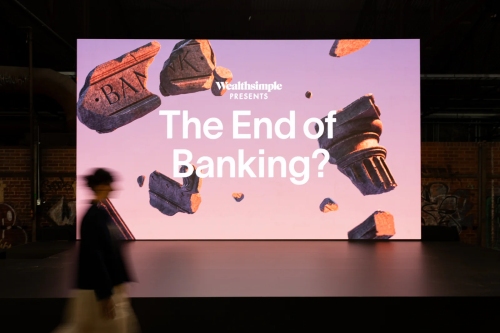
Image: Wealthsimple Presents: The End of Banking (WS Newsroom)
On June 11, 2025, Wealthsimple hosted their first 'Wealthsimple Presents: The End of Banking?" public event in Toronto where they announced the launch of two new financial products that will compete head-on with Canada's largest banks and financial institutions. (1) No fee 2% cashback credit card; and (2) Instant access low rate line of credit starting as low as 4.45%.
These offerings are for anyone who is currently paying banks and credit card companies higher interest rates and fees for the same services, and everything is online and available without having to visit a physical branch. This is healthy competition that will only benefit consumers, and the Canadian government and regulators should take notice.
The company also highlighted a series of upgrades to its hybrid chequing/spending account and teased new cash delivery pilots that could soon offer same day cash drop-offs to users' doorsteps.
Michael Katchen, Co-founder and CEO of Wealthsimple:
“Canadians don’t need another bank. They need something better. We’re removing friction, fees, and outdated experiences.”
The new Wealthsimple credit card is the most requested product in the company’s history. It offers:
Sam Newman-Bremang, Senior Product Director at Wealthsimple:
“This isn’t just another credit card, it’s the one Canadians have been asking for. As the most requested product in our history, it’s clear people want a smarter and more rewarding way to use credit. So that’s what we built: a card that puts humans first, with unlimited cashback, no foreign transaction fees, and no hidden charges.”
Wealthsimple will also roll out a line of credit product by the end of 2025 with rates starting at 4.45%, depending on collateral and client profile. The current Bank of Canada prime rate is 4.95% source, which means Wealthsimple’s offering could undercut many traditional unsecured personal loan products, such as unsecured credit card APRs (20-24%+) or home equity LOC rates (typically 5.5-5.7%).
Unlike typical credit lines, Wealthsimple clients will be able to use their investment or chequing balances at Wealthsimple as collateral, enabling lower risk and faster approval.
Plus, because Wealthsimple is not a federally regulated bank, it partners with 10 Canadian banks to hold deposits and qualify customers for up to $1 million in CDIC protection, which is much more than the standard $100,000 protection one would get by banking at a single institution.
Wealthsimple now offers a type of chequing account that pays 2.75% interest, 1% cashback on debit purchases, no monthly fees, and no ATM or FX fees. Over one million clients or approx 33% of Wealthsimple’s user base has already adopted the spending account.
The company estimates that in 2024, its users saved more than $100 million in fees they would have paid to traditional banks source.
Recent additions include:
Wealthsimple’s growth strategy is grounded in public dissatisfaction with incumbent financial institutions. In a 2025 Angus Reid survey commissioned by Wealthsimple:
Despite this, the Big Six banks still dominate with over 90% of banking assets under management in Canada. But no doubt that Wealthsimple is on a growth pathway that will chip away at the bank's dominant share by competing with seamless design, lower fees, higher yielding accounts and integrated financial tools built for mobile first customers.
Canada's fintech sector continues to face significant barriers to scale, including regulatory delays around open banking and digital ID. Despite that, leading scale-up fintechs like Wealthsimple are demonstrating how digital platforms can expand their value propositions without becoming a formal bank or acquiring a banking license.
Its model has scaled without a banking licence by partnering with regulated banks and embedding services within a single mobile platform. Wealthsimple now has over 3 million clients and manages over $70 billion in assets, up from $18 billion in 2021. If/when opening banking arrives in Canada, platforms that blend investments, borrowing, payments on a single interface will be game-changing for Canada's financial economy.
The National Crowdfunding & Fintech Association (NCFA Canada) is a financial innovation ecosystem that provides education, market intelligence, industry stewardship, networking and funding opportunities and services to thousands of community members and works closely with industry, government, partners and affiliates to create a vibrant and innovative fintech and funding industry in Canada. Decentralized and distributed, NCFA is engaged with global stakeholders and helps incubate projects and investment in fintech, alternative finance, crowdfunding, peer-to-peer finance, payments, digital assets and tokens, artificial intelligence, blockchain, cryptocurrency, regtech, and insurtech sectors. Join Canada's Fintech & Funding Community today FREE! Or become a contributing member and get perks. For more information, please visit: www.ncfacanada.org
| | |
|---|---|---|
| | |
Fintech Financing | May 22, 2025
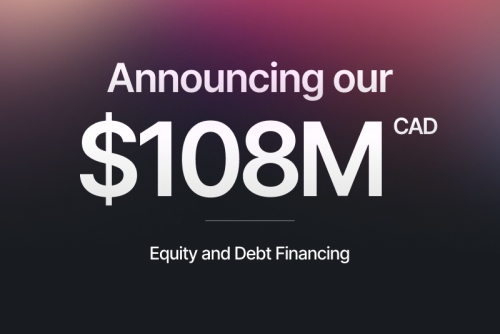
Image: Keep Announces 108M funding
On May 20, 2025, Toronto-based fintech Keep revealed that it raised C$108 million in new funding to reinvent small business finance in Canada. The funding round includes C$33 million in equity financing led by Tribe Capital, plus C$71 million credit facility from Treville Capital, and C$4 million in venture debt from Silicon Valley Bank.
Founded by Oliver Takach and Helson Taveras, Keep is specifically designed for Canadian small and medium sized businesses (SMEs or SMBs) and provides an integrated financial suite of tools, such as automated expense management, a rewards-based business credit card, multi-currency accounts, and flexible global bill payments.
Oliver Takach, CEO Keep said in a CEO letter:
Keep was born from that frustration. I went into the branch. Twice. I signed personal guarantees. I paid fees no one could explain. And in the end, they still wouldn’t give me a business credit card.”
Canada’s small business sector is the backbone of the economy, contributing more than 40% of GDP and accounts for over 98 percent of all employer businesses. Keep estimates that the small business banking market in Canada is worth $500B, which is dominated by legacy institutions who continue to rely on paper-based underwriting, limited tools and integrations, and haven't adapted products to align with modern workflows or regulatory requirements.
Yet, many entrepreneurs remain locked out of fast, reliable credit and banking tools, which is what Keep's platform is designed to solve. Since launching in 2022, Keep has on-boarded over 3,000 SMBs across a range of industries, and has surpassed C$20 million in annualized revenue. The company also reports a 300% net dollar retention rate, reflecting strong adoption and satisfaction.
Glen Napier, CEO of James G Armour & Co.:
"With Keep, we've cut our financial admin time by 80%. The integration of their products was seamless and helped us double our revenue in just six months. What used to take weeks with traditional banks now happens instantly."
Keep operates in a competitive domestic market that includes startups like Float, Loop, and Venn, aiming to differentiate itself by providing an all-in-one model that integrates core financial tools rather than offering individual product solutions.
Investor confidence seems to agree with the strategy. The latest found has attracted both returning and new backers including Rebel Fund, Liquid2 Ventures, Cambrian, and Assurant Ventures, as well as individual investors from Stripe, Coinbase, Robinhood, Plaid, and Chime.
Takach said, "By 2027, we aim to serve 100,000 small businesses across Canada and help them save over a quarter billion dollars in fees annually.”
Backed by global investors, the Canadian fintech industry keeps getting stronger. Keep's emergence from stealth to grow founder-led financial infrastructure to support how entrepreneurs actually operate will help close gaps left by traditional banks. Domestic competition is heating up.
The National Crowdfunding & Fintech Association (NCFA Canada) is a financial innovation ecosystem that provides education, market intelligence, industry stewardship, networking and funding opportunities and services to thousands of community members and works closely with industry, government, partners and affiliates to create a vibrant and innovative fintech and funding industry in Canada. Decentralized and distributed, NCFA is engaged with global stakeholders and helps incubate projects and investment in fintech, alternative finance, crowdfunding, peer-to-peer finance, payments, digital assets and tokens, artificial intelligence, blockchain, cryptocurrency, regtech, and insurtech sectors. Join Canada's Fintech & Funding Community today FREE! Or become a contributing member and get perks. For more information, please visit: www.ncfacanada.org
| | |
|---|---|---|
| | |
Open Finance Policy Development | May 22, 2025

Image: Freepik/rawpixel.com
On May 15, 2025, the Cambridge Centre for Alternative Finance (CCAF) hosted a webinar, “Open Finance in Practice: Implementation, Liability & Monetisation” with experts from Thailand, Rwanda, India, the UK, and Asia-Pacific who shared what's working and what's not, based on their practical experience. Open finance is progressing globally but real world experience shows that it is not just about technology or APIs, and successful implementation depends on clear rules, trusted governance, and strong infrastructure. These insights are especially relevant now as Canada prepares to implement its own open banking system in 2026.
Sanjay Janeja, Open Banking Lead, CCAF:
“Our data shows that regulation-led models support faster implementation and broader data sharing.”
CCAF’s Global Regulatory Innovation Dashboard (GRID) shows that countries with clear regulatory mandates, like Brazil and Australia, have progressed faster than those relying on voluntary participation. India in contrast, moved slowly at first without regulatory mandates. Canada risks similar delays unless its upcoming rules are clear, enforceable, and consistent.
Denise Dias, Regulatory and Supervisory Consultant:
“Governance is the soul of open finance.”
Governance critically defines who sets the rules, allows the accreditation of participants, and resolves disputes. Rwanda is building shared oversight between its financial and telecom regulators. Countries that define this early see smoother adoption. Canada's future governance structure needs to include clear roles for regulators, industry, and consumer protection agencies.
Rafael Mazer, Director, Fair Finance Consulting:
“Consumers should not have to wait for firms to assign blame before they are made whole.”
As more parties exchange financial data, legal clarity is paramount. The UK mandates reimbursement even before liability is settled. Oman and UAE require indemnity insurance for open finance participants. Canada needs to define who is liable, under what conditions, and how disputes will be resolved before open banking go live.
Rafael Mazer:
“This is where the claws come out.”
Camilla Bullock, CEO, Emerging Payments Association Asia:
“You cannot grow the pie if the small players cannot afford a slice.”
Thailand uses free access for consumers and capped pricing for commercial use. Brazil allows a set number of free requests per user. These models keep access open for small fintechs. Canada should consider following suit to avoid anti-competitive pricing that could exclude new entrants.
Pamela Umutesi, Lead for Open Finance, National Bank of Rwanda:
“Let your local context guide how you implement.”
Thailand focused on non financial data first because the infrastructure was already in place. Rwanda’s model prioritizes mobile money. Canada of course is considering its own requirements, including provincial data laws, legacy banking systems, and regional financial access gaps. Bottom line is that a one-size-fits-all model that works abroad will not necessarily work elsewhere.
The table below primarily covers open banking implementations, with some jurisdictions extending toward open finance (Brazil, India, Thailand).
This is an important distinction because open banking generally refers to access to 'bank account data' which is often mandated for regulated institutions. While Open Finance expands beyond banking data to include insurance, investments, pensions, government data, mobile money, and more.
| Country | Pricing Model | Regulatory Status | Governance Approach |
| Brazil | Free access below threshold | Mandated and implemented | Central bank |
| Thailand | Free for consumers; capped for firms | Mandated and being implemented | Bank of Thailand and industry consortium |
| India | Commercial pricing; no fixed rules | Voluntary, evolving | NGO-led (Sahamati); gaining government support |
| Rwanda | Pilot phase; not-for-profit approach | Mandated, not yet implemented | Multi-agency regulator framework |
| UK | Free for regulated APIs | Mandated and implemented (OB only) | Regulators (CMA, then OBIE, now JROC) |
| Australia | Free basic; optional premium | Mandated and implemented | Treasury under Consumer Data Right law |
| EU (PSD2) | Mostly free under PSD2 | Mandated and implemented (OB only) | Regulator; preparing Financial Data Access (FiDA) |
| Singapore | Voluntary pricing; no mandate | Voluntary | MAS; market-driven with government-backed standards |
| Hong Kong | Commercial rates allowed | Voluntary with phased guidance | HKMA; implementation by industry associations |
| Canada | TBD (under consultation) | Mandated, not yet implemented | Department of Finance; FCAC |
Canada has committed to implementing open banking but full rollout isn't expected until 2026. In June 2024, the Department of Finance enacted the Consumer-Driven Banking Act, the legal framework for open banking, and appointed the Financial Consumer Agency of Canada (FCAC) as the authority responsible for implementing, overseeing, and enforcing the framework. Final rules on liability, pricing, and participation are still under development.
Countries that wait too long or rely only on voluntary models are playing catch-up. NCFA supports an open finance framework in Canada that protects consumers, enables competition, and accelerates innovation. Canada should learn from the world's most successful open finance systems, which are defined by clear regulation, fair pricing, and shared governance. As the CCAF’s global tracker and research show, clear rules work. Delay does not.
The National Crowdfunding & Fintech Association (NCFA Canada) is a financial innovation ecosystem that provides education, market intelligence, industry stewardship, networking and funding opportunities and services to thousands of community members and works closely with industry, government, partners and affiliates to create a vibrant and innovative fintech and funding industry in Canada. Decentralized and distributed, NCFA is engaged with global stakeholders and helps incubate projects and investment in fintech, alternative finance, crowdfunding, peer-to-peer finance, payments, digital assets and tokens, artificial intelligence, blockchain, cryptocurrency, regtech, and insurtech sectors. Join Canada's Fintech & Funding Community today FREE! Or become a contributing member and get perks. For more information, please visit: www.ncfacanada.org
| | |
|---|---|---|
| | |
Digital Banking | May 9, 2025
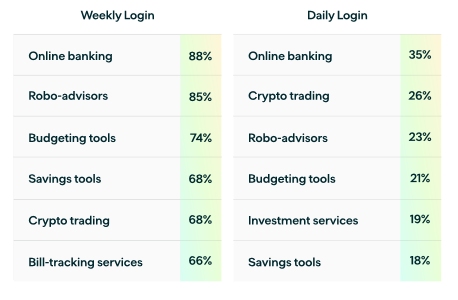
Image: Frequency of Use (Plaid x YouGov Money Talks survey report)
Between August 20-26th 2024, Plaid commissioned a national survey through the YouGov platform to understand how U.S. consumers bank, pay, and invest. The survey reveals insights of consumer preferences in digital finance, including trust in financial providers, app usage, payment methods, credit attitudes, and investment habits, based on weighted responses from 2,077 adults. Fintechs, digital finance platforms, and financial institutions need to stay up to date with the latest retail digital banking trends if they want to compete for consumer loyalty. Read 'Money Talks' (28 page PDF) report explaining these trends. Below we break-down key insights for NCFA's readers. Not yet subscribed? Sign-up for NCFA's weekly newsletter here.
Consumers continue to trust traditional banking institutions more than 100% digital platforms:
Trust and security go hand and hand, and overall, trust comes from perceived care and protection:
Consumers also shared who they rely on for financial well-being. The takeaway is that fintechs and advisory services must do more to be seen as helpful and caring, a useful partner in people’s financial lives.
Online banking is the most widely used financial tool: 99% percent of consumers are familiar with it, and 74% use it weekly.
Other commonly used tools include savings apps (68% weekly or daily), budgeting tools (85%), and peer-to-peer payment apps like Venmo or Zelle (used weekly by 50% of users). Roboadvisors are accessed more than once per week by (80%) of their users but only 1% of all consumers report using them regularly.
When asked what improvements they want most in financial apps:
60% of respondents said it is important to link their bank account with the financial apps they use.
Takeaway: Apps that are integrated, responsive, and secure are the most likely to be used often. Fintechs and banks that overcomplicate services or create friction in setup risk being overlooked, even if their offerings are advanced.
25% currently invest in cryptocurrency. Another 21% say they plan to invest in crypto or NFTs in the next year. These responder levels of engagement are equal to the 25% of people who say they will invest in stocks or trading platforms during the same period.
Crypto investors are not limiting their exposure:
Only 11% of respondents have used AI tools to support their investing decisions -> interestingly, this already exceeds the share of people using roboadvisors, suggesting that AI powered investment tools are gaining traction faster than traditional automated advice products.
Takeaway: Fintechs offering secure, easy to understand crypto access or AI investment tools can appeal to a growing investor base. Banks that avoid crypto are at risk of losing relevance with younger and self-directed investors.
Debit cards are now more commonly used than credit by younger adults. According to EY data cited in the report, 69% of Gen Z use debit cards daily or weekly. Many say they avoid credit cards because they do not want debt or do not qualify.
Buy now pay later (BNPL) services have grown 40% in usage since 2021.
Takeaway: Only 30% of respondents believe their credit score accurately reflects their financial health. 55% said they have been denied a loan due to a low score. These figures support growing interest in alternative data, such as cash flow and account history, for lending decisions.
Older adults are especially cautious. People aged 66 to 70 are 55% more likely to mistrust digital banks than those aged 22 to 25. Younger adults are more flexible. Among respondents aged 18 to 24, 36% said they would switch banks for a better digital payment experience.
Despite these trends, most people are not actively looking to change banks:
Consumers use different payment methods based on transaction size and age group:
To fund digital wallets:
Takeaway: Fintechs that want to increase adoption of pay by bank options must improve the experience. According to the report, 49% of users say they are likely to use pay by bank if the account linking process is easy.
Consumers want financial services that are clear, secure, and helpful, with trust remaining the most important factor in deciding whether to try a new app, share data, or switch banks. Traditional banks still hold an advantage in trust and reach but must modernize quickly. Fintechs have room to grow if they lead with transparency and value. Financial institutions that support financial goals and offer simple, connected experiences will stay relevant in 2025 (and beyond). Learn more about how consumers in the U.S. use, feel, bank, transact and acquire in 'Money Talks'.
The National Crowdfunding & Fintech Association (NCFA Canada) is a financial innovation ecosystem that provides education, market intelligence, industry stewardship, networking and funding opportunities and services to thousands of community members and works closely with industry, government, partners and affiliates to create a vibrant and innovative fintech and funding industry in Canada. Decentralized and distributed, NCFA is engaged with global stakeholders and helps incubate projects and investment in fintech, alternative finance, crowdfunding, peer-to-peer finance, payments, digital assets and tokens, artificial intelligence, blockchain, cryptocurrency, regtech, and insurtech sectors. Join Canada's Fintech & Funding Community today FREE! Or become a contributing member and get perks. For more information, please visit: www.ncfacanada.org
| | |
|---|---|---|
| | |
Fintech Services | May 6, 2025

Image: Freepik
Two of Europe's leading digital banks, Revolut and N26 are now expanding into the telcom sector for continued growth. First it was Revolut on April 30, 2025 who announced they are launching mobile phone plan offerings in the UK and Germany, directly challenging traditional telecommunications network providers. Offering unlimited calls, texts, domestic, and 20GB of EU and US roaming, all managed inside its app without the need for a contract, all for £12.50 per month (introductory offer; UK waitlist; GER waitlist)
Just days later, Bloomberg reported that German neobank N26 also planned to launch a mobile phone service in Germany in May. These are not side pet projects but new product launches that provide key insight into how digital banks plan to fuel growth. It's easy to envision how digital finance platforms that offer banking, payments, and other services like phone plans or even internet can be rolled into a single platform and customer experience. The question for Canada is not whether consumers want more product choice and better pricing, it's whether the country (read: political will) are ready for it or not?
Revolut first dipped its toes into mobile connectivity by launching its eSIM product last year which has already become its most popular non-banking feature, with millions of data plans being activated in more than 100 countries. And now, backed by user demand and network partnerships, Revolut is launching a full mobile service. And now, N26 is doing the same. Both digital banks are offering a simple, affordable (flat rate) plans through national mobile networks and bundling everything into their apps.
In 2018, the CBC reported that Canadian mobile phone bills were among the highest globally. Even the Canadian Radio-television and Telecommunications Commission (CRTC) regulator has acknowledged concerns about the affordability of telecommunications services in Canada. It's not a new discovery, they've been saying the same thing for years. The Competition Bureau of Canada published a report confirming that Canadians want more competition in the financial sector, especially younger generation who are mobile first and ready for apps that simplify their bills, reduce fees, and improve control.
While the majority of Canadians still rely on a handful of banks and telcoms, Canada's market is still closed to this model. The top five-six banks in Canada control over 90% of all bankable assets, and the top three telcoms serve the majority of mobile customers. Mobile virtual network operator access is limited. Same thing goes for banks. Banking licensing process is long (approx 5 years) and expensive. While these conditions may protect incumbents, it makes it almost impossible for platforms like Revolut or N26 to launch integrated financial or mobile services in Canada.
Now that Mark Carney has been elected as Canada's new prime minister, there's increasing pressure to improve competition to drive affordability and fix Canada's weak and declining productivity. The convergence of banking and telecommunications checks all boxes. Canada just needs to expedite the modernization of it's digital infrastructure to support long term and sustainable growth from a more competitive sector.
Canada's policies must enable innovation for Canada to build a more robust economy and attract investment. The benefits of expanding competition and bundling the fintech-telcom sectors are many including consumer affordability and choice.
Revolut and N26 are showing that mobile and financial services can be bundled into seamless digital service platforms that offer users more control and lower fees. Canadian consumers want this to happen but past-governments have lacked the political will to act. However, with a new prime minister and economic mandate, there's hope and a window of opportunity that Canada may see increased focus on competition and productivity.
The National Crowdfunding & Fintech Association (NCFA Canada) is a financial innovation ecosystem that provides education, market intelligence, industry stewardship, networking and funding opportunities and services to thousands of community members and works closely with industry, government, partners and affiliates to create a vibrant and innovative fintech and funding industry in Canada. Decentralized and distributed, NCFA is engaged with global stakeholders and helps incubate projects and investment in fintech, alternative finance, crowdfunding, peer-to-peer finance, payments, digital assets and tokens, artificial intelligence, blockchain, cryptocurrency, regtech, and insurtech sectors. Join Canada's Fintech & Funding Community today FREE! Or become a contributing member and get perks. For more information, please visit: www.ncfacanada.org
| | |
|---|---|---|
| | |



August 26th, 2025

January 4th, 2024

June 1st, 2021

September 9th, 2020

July 9th, 2018

January 3rd, 2018

September 25th, 2017

June 20th, 2017

May 10th, 2017

December 14th, 2016
