





Karsten Wenzlaff, Advisor
August 26th, 2025
Karsten Wenzlaff is a Crowdfunding and Fintech Expert from Germany. He is Secretary-General of Digit[...]


Global Standards | Aug 4, 2025

Image: Freepik
Canada chooses how it measures its economy but if it wants to be part of the global system, it needs to follow the updated rules. The System of National Accounts (SNA) is a global reporting framework developed and published jointly by the UN, IMF, OECD, World Bank, and European Commission to measure and compare economies across borders, including GDP, investment, and national wealth. Canada has followed it for decades, along with almost every other economy in the world, so we can expect change is coming.
Now, for the first time since 2008, the SNA has been updated. It gives countries the option to include intangible assets like AI systems, datasets, software, cloud infrastructure, and crypto in their official economic reporting. SNA 2025 is the new data reporting standard.
Statistics Canada currently uses SNA 2008 to compile GDP, capital formation, trade, and household income. Finance Canada and the Bank of Canada rely on that data to make major policy decisions. Because Canada aligns with the international system, it will be expected to transition to SNA 2025, and include a new measured view including intangibles, which NCFA has reported and advocated for the inclusion of intangibles for years. See this great report dating back 6 years ago now in 2019 called, " A New North Star: Canadian Competitiveness in an Intangibles Economy".
The new SNA 2025 includes formal categories for AI tools, machine learning models, digital platforms, tokenized assets, and data used in production. These can now be classified as fixed capital and included in investment statistics.
The framework also includes crypto assets such as Bitcoin in national wealth reporting. While countries are not required to adopt every element immediately, SNA 2025 sets the boundaries for what is allowed. If Canada continues using the SNA—and it will—these options are now on the table.
SNA 2025 does not show that digital or intangible assets are driving growth nor does not include statistics. What it does is give countries the structure to count what was previously invisible. Until now, if a Canadian fintech trained a large AI model, built infrastructure for a payments network, or developed a data engine for fraud detection, none of that was guaranteed to show up in national accounts. It was often treated as a cost, not an investment.
That matters because what gets counted drives policy.
When Statistics Canada does not report digital capital formation, Finance Canada cannot target it. When platform services are excluded from output figures, regulators and funders underestimate their value.
SNA 2025 also introduces new tools to reflect sustainability. It promotes the use of Net Domestic Product (NDP), which subtracts both depreciation and natural resource depletion from GDP. This is critical for a country like Canada, where growth often comes from extractive sectors. Using NDP can help the government better understand how much of that growth is truly lasting.
The new framework also supports clearer tracking of ESG finance, public sector innovation, and economic activity by multinationals that operate across borders. It aligns with global changes in how governments view risk, resilience, and value creation.
This is a global accounting and reporting change with deep consequences. SNA 2025, the updated global standard now recognizes intangibles, and so will the data that influences budgets, tax design, economic forecasts, and investment strategy. Canada is already committed to using the SNA, so the only question is how fully and how quickly we adopt the 2025 version.
NCFA urges Statistics Canada and federal decision makers to prioritize early implementation of the most relevant components of SNA 2025. These include digital capital assets, crypto asset recognition, and intangible production by fintech and AI firms.
 The National Crowdfunding & Fintech Association (NCFA Canada) is a financial innovation ecosystem that provides education, market intelligence, industry stewardship, networking and funding opportunities and services to thousands of community members and works closely with industry, government, partners and affiliates to create a vibrant and innovative fintech and funding industry in Canada. Decentralized and distributed, NCFA is engaged with global stakeholders and helps incubate projects and investment in fintech, alternative finance, crowdfunding, peer-to-peer finance, payments, digital assets and tokens, artificial intelligence, blockchain, cryptocurrency, regtech, and insurtech sectors. Join Canada's Fintech & Funding Community today FREE! Or become a contributing member and get perks. For more information, please visit: www.ncfacanada.org
 |  |  |
|---|---|---|
 |  |  |
Fintech Report | July 30, 2025

Image: BCG QED Report Scaled Winners, Emerging Disruptors (Cover)
The latest analysis from BCG and QED Partners in a report titled, "Fintech's Next Chapter: Scaled Winners and Emerging Disruptors" (38 page PDF), shows that fintech companies currently capture just 3% of global banking and insurance revenues, leaving substantial room to grow.
The study frames this stage around two groups. The scaled winners are fewer than 100 companies generating more than $500 million in annual revenue. They account for most of the sector’s revenues and are now focused on profitability, compliance and expansion into adjacent services.
The emerging disruptors are thousands of smaller companies between $50 to $500 million in revenue. They are fast moving, often AI native, and are working in underserved markets and niches. Some of these emerging disruptors are well on their way to becoming the next generation of scaled winners.
In 2024, global fintech revenues increased 21% compared with 13% the previous year. Segments such as deposits grew 23%, trading and investment 21% and insurance 40%. This growth is happening while valuations and funding have recovered. In the first quarter of 2025, equity funding was 34% higher than a year earlier and valuations improved by 10%.
Earnings margins improved by 4% points to reach 16% in 2024. 69% of public fintechs are profitable, up from less than half the year before, and 35% now meet the rule of 40. Valuations are being driven by these fundamentals. Forward revenue growth and profitability explain half of the variation in valuations. Size and research and development spending explain another 39%.
Fintechs generate 3% of banking and insurance revenues. Penetration is as high as 14% in payments but under 1% in insurance, leaving a large gap for future growth. Payments still make up 55% of scaled fintech revenues (see image below), followed by challenger banks at 15%, crypto trading at 7% and buy now pay later at 4%.

Image: Distribution of Scaling fintechs 2024 BCG report 'Scaled Winners, Emerging Disruptors'
New AI models can act as autonomous agents that execute payments, preapprove loans, rebalance portfolios and anticipate risk exposures. Fintechs that are AI native receive 49% of all equity funding even though their seed rounds are smaller. Over the past three years, $32 billion has gone to B2B fintechs and $30 billion to financial infrastructure providers, with most of this capital flowing to AI powered models.
Large institutions are piloting tokenized bonds and funds. Tokenizing assets can remove up to $20 billion in intermediary costs every year, shorten settlement times and broaden access. Progress depends on clear regulatory frameworks and infrastructure ready for institutional standards.
After years of rapid expansion, challenger banks are focusing on core markets. 92 of them are now profitable and 24 generate more than $500 million in revenue. Geographic distribution of scaled fintech revenue remains uneven with 52% from the United States, 10% each from Asia Pacific excluding China and from Latin America, and 1% from the Middle East and Africa.
Fintech originated loans total $500 billion while private credit funds manage $1.7 trillion. There is a $280 billion gap in capital deployment, and partnerships between private credit funds and fintech lenders are set to grow quickly. Strong funding conditions in early 2025 support this trend.
B2B payments, treasury and workflow automation are still underdeveloped. Deposit related revenues grew 23% in 2024, ahead of the 21% industry growth rate. Insurtech fintechs grew by 40% over the same period, driven by distribution and brokerage models. These segments are becoming the growth engines for disruptors.
There are still 150 private fintechs founded before 2016 that have each raised more than $500 million and have not yet gone public, showing that investors are still ready to back scale-up stories.
The report highlights fintechs need to choose whether they are on a path to becoming a scaled winner or emerging disruptor. Canadian fintechs and NCFA members should prioritize sustainable growth in home markets before pursuing global expansion.
AI native products will be the key differentiator. Companies that engage early with regulators on AI and digital asset rules will be better positioned as these markets evolve. Partnerships with private credit funds can provide growth in lending. B2B automation and modernization of financial infrastructure are major opportunities.
The National Crowdfunding & Fintech Association (NCFA Canada) is a financial innovation ecosystem that provides education, market intelligence, industry stewardship, networking and funding opportunities and services to thousands of community members and works closely with industry, government, partners and affiliates to create a vibrant and innovative fintech and funding industry in Canada. Decentralized and distributed, NCFA is engaged with global stakeholders and helps incubate projects and investment in fintech, alternative finance, crowdfunding, peer-to-peer finance, payments, digital assets and tokens, artificial intelligence, blockchain, cryptocurrency, regtech, and insurtech sectors. Join Canada's Fintech & Funding Community today FREE! Or become a contributing member and get perks. For more information, please visit: www.ncfacanada.org
| | |
|---|---|---|
| | |
Open Banking | July 15, 2025

Image: Freepik
On July 11, 2025, Reuters reported that JPMorgan Chase is planning to charge fintechs for access to customer data (subscription required) through its APIs, starting in September. The aggressive announcement by by a major U.S. bank to charge and control data access generated immediate pushback from fintech platforms and open banking advocates, as highlighted on Payments Drive.
Steve Boms, executive director of the Financial Data and Technology Association North America:
“It’s hard to look at this decision by Chase as anything other than a cynical attempt to take advantage of regulatory uncertainty and an about-face by the CFPB. I think they’re banking on the court throwing the rule out.”
Penny Lee, Chief Executive of the Financial Technology Association:
Americans deserve the “freedom” to control their financial data. Charging for financial data access undermines that freedom and threatens to jeopardize millions of Americans’ access to the financial services of their choice. This action is designed to crush competition, hold back American innovation, and lock consumers into bank-only products.”
Open banking is designed to put consumers in control of their own financial data. But JPMorgan has another idea; charging fintechs to access customer data when open banking rules are not not clearly regulated, and in doing so, incumbent banks can continue to control terms that limit competition.
In Canada, this issue is highly relevant for it's proposed Consumer-Directed Finance or open banking framework to be implemented and overseen by the Financial Consumer Affairs Authority (FCAC) in 2026. While Canada’s upcoming framework mandates data sharing and prohibits fees for baseline access by accredited firms, it has not yet been implemented in law. Until then, banks could continue using private agreements that include fees or restrictive terms.
Without legislation or regulatory direction, banks are free to protect their dominant positions by pricing out smaller fintechs or forcing bilateral contracts.
This strengthens the importance of Canada finalizing its open banking rules with clear and enforceable standards that prevent data paywalls.
Fintech competitiveness and market access are at risk. If fees for data access take hold more broadly, it could shift the balance of fintech innovation away from consumer-focused tools towards banking ecosystems, which would limit diversity and competition.
In the UK, the Competition and Markets Authority mandates that large banks provide access to current account data at no cost through standardized APIs, under the Open Banking Implementation Entity. This has led to a dynamic fintech ecosystem where consumers can safely and easily share data across apps and services.
In Australia, the Consumer Data Right (CDR) goes even further than just banking to include energy and telecommunications. Under CDR rules, banks must provide access to customer data free of charge, with fees allowed only for optional or value-added services.
In contrast, both the U.S. and Canada have not yet fully implemented open banking frameworks. In the U.S., the Consumer Financial Protection Bureau (CFPB) proposed Section 1033 to support consumer data rights, but no binding national law exists. And to make matters worse, under the Trump-appointed CFPB, they effectively killed off the open banking rule as proposed, adopting the banks’ legal argument that the rule was beyond its authority and should be invalidated by the court. So without any protective data sharing framework, banks in the U.S. can act unilaterally in their favour..
If large incumbent banks like JPMorgan are allowed to set fees or gatekeep data access, consumer choice suffers and fintech innovation slows. As NCFA has advocated for years, Canadian regulators and policymakers must move urgently to finalize a national open banking framework that guarantees:
If we don't act now, the same risks and fragmentation now emerging in U.S. markets will further stifle productivity, innovation, and competition in Canada.
The National Crowdfunding & Fintech Association (NCFA Canada) is a financial innovation ecosystem that provides education, market intelligence, industry stewardship, networking and funding opportunities and services to thousands of community members and works closely with industry, government, partners and affiliates to create a vibrant and innovative fintech and funding industry in Canada. Decentralized and distributed, NCFA is engaged with global stakeholders and helps incubate projects and investment in fintech, alternative finance, crowdfunding, peer-to-peer finance, payments, digital assets and tokens, artificial intelligence, blockchain, cryptocurrency, regtech, and insurtech sectors. Join Canada's Fintech & Funding Community today FREE! Or become a contributing member and get perks. For more information, please visit: www.ncfacanada.org
| | |
|---|---|---|
| | |
Digital Finance Public Infrastructure Report | July 9, 2025

Image: Freepik/Rawpixel.com
The Cambridge Centre for Alternative Finance (CCAF) just published a new report, "Digital Public Infrastructure (DPI) and Digital Financial Services" (69 page PDF) showing that 113 countries have adopted at least one DPI building block. Over half have adopted all three: digital identity, real-time payments, and consent-based data sharing. DPI is not just a policy trend. Countries with strong DPI systems result in much better financial inclusion outcomes. Canada, however, is still working on its foundational pieces.
According to the World Bank Group, DPI refers to digital systems like ID, payments, and data exchange platforms that support public and private services. These systems work best when they are (1) Interoperable, (2) Open for innovation, and (3) Designed for public benefit.
According to the CCAF report, there are three core components of Digital Public Infrastructure:
These systems help reduce fraud, speed up services, and lower costs for businesses and consumers. Most importantly, they help more people access the financial system.
The CCAF report shows clear adoption patterns with 113 jurisdictions having implemented at least one core DPI component, and 56 jurisdictions having adopted all three components. That includes countries with advanced economies and strong financial sectors, so they are relevant comparators for Canada such as:
Other high-income countries, such as the United Kingdom and United States, are making progress but fall short of full DPI readiness due to gaps in national digital identity or regulated data sharing.
| Country | Digital Identity | Real-Time Payments | Consent-Based Data Sharing | Full DPI (All 3)? |
| Canada | ❌ No national ID | ❌ No live system | ❌ Proposed Consumer Driven Banking Act | ❌ |
| Australia | ✅ MyGov/MyID | ✅ NPP live | ✅ Consumer Data Right (CDR) | ✅ |
| Singapore | ✅ Singpass | ✅ PayNow | ✅ MAS APEX + open finance | ✅ |
| Estonia | ✅ e-ID/X-Road | ✅ SEPA Instant | ✅ Full integration | ✅ |
| Switzerland | ✅ e-ID live | ✅ SIC | ✅ I14Y platform | ✅ |
| UK | ❌ No national ID | ✅ FPS | ✅ Open Banking | ❌ |
| US | ❌ No national ID | ✅ FedNow | ❌ Market-driven only | ❌ |
CCAF cross referenced data from the World Bank’s Global Findex to compare outcomes across countries. It grouped countries by how many DPI components they had in place.
| Indicator | Countries with 1 DPI component | Countries with 3 components |
| Own a debit or credit card | 25% | 77% |
| Use digital payments | 45% | 83% |
| Borrow from formal institutions | 15% | 38% |
| Receive government transfers | 14% | 28% |
| Say lack of ID prevents account access | 19% | 7% |
| Find it very difficult to raise emergency funds | 34% | 19% |
The data-driven and outcome message is clear. More DPI means better access to financial tools and stronger financial resilience.
According to the CCAF’s global DPI landscape, Canada is in the exploratory or early development stage across all three DPI pillars. Each area has seen policy activity, but none are fully operational, which NCFA agrees.
“Planning status indicates that foundational DPI systems are under discussion or development but are not yet implemented at scale in a way that enables key financial use cases.”
DPI is more than just government infrastructure. The report highlights that public-private partnerships are key to scaling systems that reduce onboarding costs, improve access to credit, and allow fintechs to innovate securely. Countries with strong DPI frameworks offer:
It’s time for Canada to take action and build. No more delays. We cannot expect to maintain our quality of life or Canada’s global economic position without bold steps forward. Digital public infrastructure is no longer optional. It's foundational and without DPI, Canada’s fintech sector remains limited in how it can compete, scale, or serve excluded groups.
Moving from strategy to execution is the only way to close the gap. Without it, the country risks falling further behind. It is a public good that lifts access, speeds services, and builds trust. Countries that move fast, collaborate across regulators, industry, and communities are seeing real results. Canada has the policy tools, the tech capacity, and the industry support to do the same. But time is running out to catch up.
The National Crowdfunding & Fintech Association (NCFA Canada) is a financial innovation ecosystem that provides education, market intelligence, industry stewardship, networking and funding opportunities and services to thousands of community members and works closely with industry, government, partners and affiliates to create a vibrant and innovative fintech and funding industry in Canada. Decentralized and distributed, NCFA is engaged with global stakeholders and helps incubate projects and investment in fintech, alternative finance, crowdfunding, peer-to-peer finance, payments, digital assets and tokens, artificial intelligence, blockchain, cryptocurrency, regtech, and insurtech sectors. Join Canada's Fintech & Funding Community today FREE! Or become a contributing member and get perks. For more information, please visit: www.ncfacanada.org
| | |
|---|---|---|
| | |
M&A | July 7, 2025

Imgae: Freepik
The acquisition of WealthONE Bank of Canada by Globalive and its Canadian investment partners has officially closed, following federal government approval on June 18, 2025. Establishing a precedent, it's the first time a non-bank, fintech-aligned private investor group has successfully taken control of a Schedule I chartered bank in Canada.
The deal follows a two-year national security review under the Investment Canada Act, which required WealthONE’s former owners to divest due to foreign influence concerns. WealthONE had previously faced scrutiny over ties to China-based investors, prompting a 2023 directive from Ottawa to restructure ownership.
Globallive led by Anthony Lacavera (telcom and fintech entrepreneur) now owns 65% of WealthONE’s equity. The remaining 35% is held by a group of Canadian investors whose names have not been disclosed publicly. According to Bloomberg, the full acquisition was valued at approximately $58 million CAD, and covers all issued and outstanding shares of WealthONE and includes a commitment by the buyers to inject new capital to support the bank’s next phase of growth.
The transaction was reviewed by multiple federal departments and found to meet requirements for Canadian control, transparency, and risk mitigation. Worth noting that the Competition Bureau previously cleared the acquisition in advance of the final approval.
WealthONE will continue to operate independently under its current federal Schedule I charter. Its current CEO, Paul Leonard, will remain in place and work with Globalive to expand products and reach more customers in underserved market segments.
WealthONE was founded in 2016 and currently manages approximately $516 million CAD in assets. The bank focuses on customers often excluded from traditional financial institutions, including newcomers, immigrants, self-employed professionals, and small business owners.
In the months leading up to the acquisition, WealthONE introduced a cloud-based digital onboarding platform that supports accounts such as TFSAs, GICs, and high-interest savings.
According to AINVEST, Globalive intends to scale WealthONE’s operations to reach between $750 -$800 million CAD in assets by streamlining operations, modern digital services, and lean risk-adjusted lending models.
Globalive's acquisition of WealthONE demonstrates how new non-bank players can enter Canada’s banking system. Instead of applying for a new banking license, fintechs and private investors now have a verified path of entering the market via acquisition of existing chartered institutions. The WealthONE deal sets precedent that private capital can take control of federally regulated banks (as long as there aren't any national security concerns).
For fintech founders, challenger banks, and digital lenders, it creates an opportunity to scale into deposit-taking and lending under an existing charter, without having to go through the arduous process of applying for a new banking license which will likely take a minimum of 5 years, just ask Santander.
The National Crowdfunding & Fintech Association (NCFA Canada) is a financial innovation ecosystem that provides education, market intelligence, industry stewardship, networking and funding opportunities and services to thousands of community members and works closely with industry, government, partners and affiliates to create a vibrant and innovative fintech and funding industry in Canada. Decentralized and distributed, NCFA is engaged with global stakeholders and helps incubate projects and investment in fintech, alternative finance, crowdfunding, peer-to-peer finance, payments, digital assets and tokens, artificial intelligence, blockchain, cryptocurrency, regtech, and insurtech sectors. Join Canada's Fintech & Funding Community today FREE! Or become a contributing member and get perks. For more information, please visit: www.ncfacanada.org
| | |
|---|---|---|
| | |
Crypto Banking | July 7, 2025
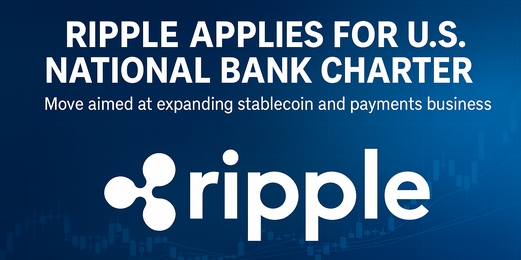
Ripple has officially applied for a national bank charter from the US Office of the Comptroller of the Currency (OCC). The company is also seeking a Federal Reserve master account to support direct access to US payment rails.
CEO Brad Garlinghouse confirmed the news on X:
True to our long-standing compliance roots, @Ripple is applying for a national bank charter from the OCC. If approved, we would have both state (via NYDFS) and federal oversight, a new (and unique!) benchmark for trust in the stablecoin market.
Earlier in the week via… https://t.co/IdiR7x3eWZ
— Brad Garlinghouse (@bgarlinghouse) July 2, 2025
If approved, Ripple would bypass correspondent banks by settling payments directly with the Fed and holding dollar reserves without intermediaries. This is designed to support Ripple’s push to offer a compliant, enterprise-grade stablecoin and accelerate global payments. These objectives align with new federal rules proposed under the GENIUS Act, which sets clear reserve and disclosure standards for stablecoin issuers.
Ripple’s approach mirrors that of Anchorage Digital and Circle, which operate under national trust bank charters regulated by the OCC. Ripple may use its regulated subsidiary, Standard Custody & Trust, to separate digital asset exposure from its core balance sheet. This structure could help the firm meet Basel III capital requirements by keeping volatile assets like XRP off its banking books.
Following the announcement, XRP surged above $2.28 as trading volume spiked. Analysts said the rally was driven by rising confidence that Ripple’s regulatory strategy will boost its long-term institutional credibility.
If Ripple is granted the charter and Fed account, it will become one of the few crypto-native firms operating fully within the traditional banking system. It's a significant and growing trend among major fintechs like Circle, Wise, and others seeking deeper integration with regulated payment rails. For Canadian fintechs and regulators, Ripple’s move could accelerate the need to clarify stablecoin policy, custody standards, and access to domestic settlement infrastructure. Regulatory certainty is a competitive advantage today and quickly becoming the norm.
The National Crowdfunding & Fintech Association (NCFA Canada) is a financial innovation ecosystem that provides education, market intelligence, industry stewardship, networking and funding opportunities and services to thousands of community members and works closely with industry, government, partners and affiliates to create a vibrant and innovative fintech and funding industry in Canada. Decentralized and distributed, NCFA is engaged with global stakeholders and helps incubate projects and investment in fintech, alternative finance, crowdfunding, peer-to-peer finance, payments, digital assets and tokens, artificial intelligence, blockchain, cryptocurrency, regtech, and insurtech sectors. Join Canada's Fintech & Funding Community today FREE! Or become a contributing member and get perks. For more information, please visit: www.ncfacanada.org
| | |
|---|---|---|
| | |
Banking | June 25, 2025

The National Crowdfunding & Fintech Association of Canada (NCFA) is deeply saddened by the sudden passing of Andrew Moor, President and CEO of Equitable Bank, (EQB) over the weekend of June 21–22, 2025 per the Financial post. Moor was a bold and thoughtful leader who believed in making Canada’s financial system more innovative, digital, and inclusive.
As CEO since 2009, Moor led Equitable Bank’s transformation into a technology-forward institution known for its direct-to-consumer offerings and fintech partnerships. EQ Bank, the digital arm of Equitable, became one of Canada’s most trusted alternatives to traditional banking under his leadership. His forward-looking vision earned admiration across the financial sector, including from those of us at NCFA.
Moor supported open banking frameworks, digital infrastructure reform, and meaningful collaborations between regulated banks and emerging fintechs. He served on the board of the Canadian Bankers Association and consistently advocated for innovation that benefits Canadian consumers.
His leadership helped create new paths for collaboration between incumbents and innovators, something that NCFA has long supported.
Andrew Moor’s contributions advanced financial innovation in Canada. His sudden passing is a loss to all who care about the future of finance, technology, and inclusion. NCFA extends heartfelt condolences to his family, colleagues, and the entire team at EQB.
The National Crowdfunding & Fintech Association (NCFA Canada) is a financial innovation ecosystem that provides education, market intelligence, industry stewardship, networking and funding opportunities and services to thousands of community members and works closely with industry, government, partners and affiliates to create a vibrant and innovative fintech and funding industry in Canada. Decentralized and distributed, NCFA is engaged with global stakeholders and helps incubate projects and investment in fintech, alternative finance, crowdfunding, peer-to-peer finance, payments, digital assets and tokens, artificial intelligence, blockchain, cryptocurrency, regtech, and insurtech sectors. Join Canada's Fintech & Funding Community today FREE! Or become a contributing member and get perks. For more information, please visit: www.ncfacanada.org
| | |
|---|---|---|
| | |



August 26th, 2025

January 4th, 2024

June 1st, 2021

September 9th, 2020

July 9th, 2018

January 3rd, 2018

September 25th, 2017

June 20th, 2017

May 10th, 2017

December 14th, 2016
