





Karsten Wenzlaff, Advisor
August 26th, 2025
Karsten Wenzlaff is a Crowdfunding and Fintech Expert from Germany. He is Secretary-General of Digit[...]


May 15, 2026 | NCFA Insight | Artificial Intelligence And Data

On May 1, 2026, the Academy of Motion Picture Arts and Sciences announced Oscars rules requiring human performed acting and human authored screenplays. The Academy didn’t ban AI tools, but rather protected human creativity at a time when synthetic performers, AI music, and digital personas are iterating live in mainstream culture. The questions are who gets credit, who gives consent, who gets paid, and who takes responsibility when AI is the engine inside the creative process.
In March 2026, AI generated performer Tilly Norwood gave the Oscars restriction a real world stress test by launching a music video called “Take The Lead”. While a human team is behind the creation, the video clearly features a synthetic artist as the visible performer. People designed the character, shaped the concept, guided prompts, edited outputs, and built the persona around the performance.
The production apparently started with a notice stating it was made by “18 real humans” including production designers, costume designers, prompters, editors, and an actor.
Futurism reported that Suno generated the song and Particle6 used performance capture from Eline van der Velden’s acting performance. That means the audio came from an AI music tool, while a real person performed the movements, expressions, or acting choices that helped animate the synthetic Tilly Norwood character on screen.
As synthetic personalities improve, creative credit gets harder to assign. The audience sees the AI performer first while the human labour is more difficult to see. Was the performer the AI character, the actor behind the capture, the director, the prompt team, the studio, the model provider, or the person who shaped the concept?
Futurism called the video “one of the dingiest and depressing things we’ve ever seen.” Viewers also pushed back on the unusual visuals, processed vocals, and pro AI message cutting through the hype.
Bottom line is AI can make more content, faster, but it can’t make audiences care by default.
Creative markets still reward taste, originality, trust, and a sense that real people stand behind the work. As synthetic content spreads, proof of origin, consent, and accountability will likely become part of the product.
Financial services already depends on verified identity, trusted records, permissions, approvals, and auditability. AI raises the stakes because automated agents and AI generated advice and support can blur the line between human and software activity.
A customer may not know whether they’re reading human advice, AI assisted advice, or fully automated output. A compliance team may need to prove who approved a model generated communication. A marketplace may need to verify whether a creator, advisor, vendor, or agent is real. A lender, insurer, or investment platform may need a reliable record of how an AI system influenced a decision.
The Academy’s new rules don’t reject AI. They protect human recognition inside AI assisted creation. Tilly Norwood shows why the boundary won’t stay clean. The battle line is who gets credit, who gets paid, who gives consent, and who is responsible when synthetic work enters the market.
 The National Crowdfunding & Fintech Association (NCFA Canada) is a financial innovation ecosystem that provides education, market intelligence, industry stewardship, networking and funding opportunities and services to thousands of community members and works closely with industry, government, partners and affiliates to create a vibrant and innovative fintech and funding industry in Canada. Decentralized and distributed, NCFA is engaged with global stakeholders and helps incubate projects and investment in fintech, alternative finance, crowdfunding, peer-to-peer finance, payments, digital assets and tokens, artificial intelligence, blockchain, cryptocurrency, regtech, and insurtech sectors. Join Canada's Fintech & Funding Community today FREE! Or become a contributing member and get perks. For more information, please visit: www.ncfacanada.org
 |  |  |
|---|---|---|
 |  |  |
May 14, 2026 | NCFA Fintech Market Activity | Artificial Intelligence And Data, Capital Markets And Funding

On May 13, 2026, Goldman Sachs Alternatives closed its acquisition of QScale, a Québec based developer and operator of AI ready data centre campuses for an undisclosed transaction value. QScale’s founders and management are reinvesting alongside Goldman Sachs Alternatives and will continue to lead the business. The company will also keep its headquarters in Québec.
This is private capital buying into Canadian compute capacity at the same time AI demand is putting pressure on power, land, cooling, and Canadian based infrastructure. For Canada, AI productivity needs more than models and talent. It needs domestic compute that Canadian companies can actually use.
QScale designs, builds, and operates data centre campuses for high performance computing and AI workloads. Its flagship Q01 campus in Lévis uses Québec’s low carbon, hydro dominated grid and natural cold climate cooling. QScale says that combination supports strong power efficiency and a lower environmental footprint than conventional facilities. The company is also developing additional campuses across Canada to meet customer demand.
Leonard Seevers, Partner, Goldman Sachs Alternatives:
“AI is rapidly redefining the infrastructure requirements to deliver compute to consumers and enterprises at scale. We believe QScale is building to the highest standard to meet these complex needs, and we are excited to partner with Martin and the QScale team to accelerate their build-out and support Canada's emergence as a global hub for sustainable AI compute.”
AI compute is expensive to build. Data centres need grid access, cooling, land, power contracts, engineering, customer commitments, and long term capital. Small software style funding rounds don't solve that problem.
Goldman Sachs Alternatives gives QScale access to a deeper capital base and global infrastructure network. Goldman Sachs has about $3.7 trillion in assets under supervision globally as of March 31, 2026. Infrastructure at Goldman Sachs Alternatives has invested about $22 billion in infrastructure assets since 2006. It invests across digital infrastructure, energy transition, transportation and logistics, and circular economy.
AI compute is now closer to energy, real estate, and national competitiveness than a normal technology product. Private markets are likely to finance more compute projects like this because the capital needs are large, the buildout is physical, and the customer demand is tied to AI adoption across industries.
Québec brings clean power, cold climate advantages, and a growing data centre base. Goldman Sachs Alternatives brings private capital and infrastructure operating experience. Together, those pieces can help Canada compete for AI workloads that might otherwise land in larger U.S. or global hubs.
Worth noting that hyperscale customers may absorb much of the capacity. The release doesn't say how much compute will be available to Canadian startups, scaleups, fintechs, or public sector AI projects. If Canada hosts the infrastructure but local companies cannot access affordable capacity, then the project may only capture construction and energy demand while missing more of the AI product value.
This connects directly to Canada’s productivity and competitiveness challenge. AI can reduce manual work and improve decision support, but only if companies can access the infrastructure behind serious deployment and can turn AI into measurable operating gains.
Martin Bouchard, Founder and Chief Executive Officer, QScale:
“From day one, QScale was built around a simple thesis: the world will need vastly more compute, and it will need it to be clean, dense, and resilient. Partnering with Goldman Sachs Alternatives gives us the capital base and the global network to scale faster, build bigger, and serve the most demanding hyperscale and AI customers in the world.”
Who gets priority access to Canadian compute capacity once global capital owns more of the infrastructure? The real test is whether Canadian firms can use that infrastructure to build products, own IP, and scale from here.
The National Crowdfunding & Fintech Association (NCFA Canada) is a financial innovation ecosystem that provides education, market intelligence, industry stewardship, networking and funding opportunities and services to thousands of community members and works closely with industry, government, partners and affiliates to create a vibrant and innovative fintech and funding industry in Canada. Decentralized and distributed, NCFA is engaged with global stakeholders and helps incubate projects and investment in fintech, alternative finance, crowdfunding, peer-to-peer finance, payments, digital assets and tokens, artificial intelligence, blockchain, cryptocurrency, regtech, and insurtech sectors. Join Canada's Fintech & Funding Community today FREE! Or become a contributing member and get perks. For more information, please visit: www.ncfacanada.org
| | |
|---|---|---|
| | |
May 13, 2026 | NCFA Resource | Risk Compliance And Regtech, Digital Identity Privacy KYC AML ATF
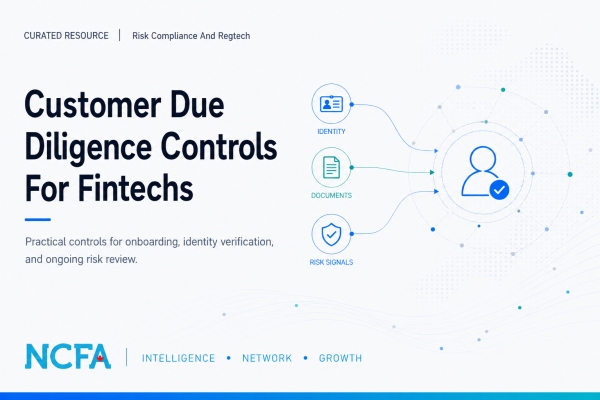
On April 8, 2026, the UK FCA published customer due diligence (CDD) findings from a multi firm review. The review covers practical weaknesses that matter to fintech teams, including thin policies, unclear review cycles, weak evidence records, poor senior approval steps, and audit gaps.
This is a UK resource, but the operating lessons travel well. Canadian fintechs still need local legal and compliance advice, including FINTRAC obligations where applicable. The FCA shows where customer checks break down when firms grow, add automation, rely on vendors, or treat onboarding as a sales funnel instead of a risk control.
The FCA review gives compliance and product teams a useful checklist for testing how customer due diligence works inside the business. It doesn't just ask whether a policy exists. It looks at whether staff know what to collect, when to escalate, how to record decisions, and how often files need review.
Stronger firms clearly separate standard CDD from enhanced due diligence (EDD) for higher risk customers. They define when senior approval is needed. They document EDD steps, keep review cycles clear, and test whether onboarding files support the risk decision made at the time.
The weaker examples are just as useful. The FCA points to firms that could not show what extra checks were completed for high risk customers, did not record key information about the purpose of a business relationship, lacked clear review schedules, or used the same people to onboard customers and review their own work.
For fintechs, fast onboarding can become a liability when the business cannot prove why a customer passed, why a file received extra review, or who approved a higher risk relationship. Policies are no longer enough, as teams need evidence.
This resource is useful for fintech founders, compliance leads, money laundering reporting officers (MLROs), onboarding teams, product managers, payments companies, lending platforms, crypto firms, crowdfunding portals, regtech providers, and financial institutions reviewing digital account opening.
It is especially relevant for firms that use automated onboarding, AI assisted reviews, third party identity vendors, risk scoring tools, or outsourced compliance support. Those tools can improve speed, but companies still needs clear accountability, review rules, exception handling, and audit trails.
The strength of this resource is its practical format. It shows good and poor practice side by side. That makes it easier for a fintech team to compare the report against its own onboarding journey, file review process, vendor controls, and board reporting.
The review also makes a simple point that many growing firms miss. Regulators want to see how decisions happen in real life. A clean policy document doesn't help much if customer files are thin, staff guidance is vague, or senior approval only exists in theory.
The limit is geography. The FCA findings reflect UK regulation and UK supervisory expectations. Canadian firms shouldn't treat this as Canadian legal guidance. They should use it as a practical benchmark, then test their own controls against Canadian requirements, sector rules, and legal advice.
FCA Customer Due Diligence Findings (primary FCA resource with good and poor practice examples)
FCA Risk Assessment Controls Findings (companion FCA review on customer and business risk assessments)
FCA 2025 To 2030 Strategy (broader strategy context for financial crime supervision)
The National Crowdfunding & Fintech Association (NCFA Canada) is a financial innovation ecosystem that provides education, market intelligence, industry stewardship, networking and funding opportunities and services to thousands of community members and works closely with industry, government, partners and affiliates to create a vibrant and innovative fintech and funding industry in Canada. Decentralized and distributed, NCFA is engaged with global stakeholders and helps incubate projects and investment in fintech, alternative finance, crowdfunding, peer-to-peer finance, payments, digital assets and tokens, artificial intelligence, blockchain, cryptocurrency, regtech, and insurtech sectors. Join Canada's Fintech & Funding Community today FREE! Or become a contributing member and get perks. For more information, please visit: www.ncfacanada.org
| | |
|---|---|---|
| | |
May 13, 2026 | NCFA Insight | Artificial Intelligence And Data, Capital Markets And Funding, Risk Compliance And Regtech

On May 13, 2026, Bank of Canada External Deputy Governor Michelle Alexopoulos delivered a speech on AI and productivity at the Ottawa Economics Association and Canadian Association for Business Economics Spring Policy Conference. Her message was direct. AI can help Canada grow faster, but only if firms turn adoption into workflow gains, owned IP, stronger investment, and real operating results.
Michelle Alexopoulos, External Deputy Governor, Bank of Canada:
“To put it simply, the Bank of Canada cares about AI because of its potential to significantly affect productivity, economic growth, employment and inflation.”
Adoption numbers show progress, but also a gap:
Statistics Canada gives the upside a useful range. AI could raise Canada’s annual labour productivity growth by 0.4 to 1.1 percentage points over the next decade. Its April 2026 analysis also found that Canadian firms that adopted AI were 16.8% more productive than firms that did not. Those numbers are encouraging but they aren't automatic.
The first wave of AI in many companies has been useful but shallow. Staff use tools to draft, summarize, search, analyze, and code faster. That saves some time but it doesn't always change the business or lead to large productivity increases. The harder work (and benefits) starts when AI enters high value workflows such as onboarding, fraud review, lending files, advisor support, treasury, payments, and compliance testing.
That's where fintechs and financial institutions should focus.
Better AI execution should show up in operating numbers. Faster approvals. Lower error rates. Stronger fraud detection. Lower cost per file. Cleaner compliance evidence. If a firm cannot measure the workflow gain, it has not found the productivity gain.
The Bank is also using AI in its own work. AI helps forecast inflation and economic activity, track sentiment, analyze household and business data, review earnings call transcripts, and monitor financial stability. AI is already entering regulated analysis, but the Bank is clear that AI doesn't make monetary policy decisions. It use AI to sharpen judgment, not replace accountability.
That same control point now runs through governed AI workflows in finance. The value isn't just a quicker answer, but a workflow that leaves evidence, keeps humans responsible, and gives risk teams something they can inspect.
The compute point is hard to ignore. Top U.S. technology firms like Alphabet, Microsoft, Meta, Amazon and Oracle spent roughly US$200 billion on AI investment in 2024. That figure doubled to about US$400 billion in 2025. The Bank also noted that AI data centres are expanding so quickly that power generation is struggling to keep up. Compute is no longer a back office technology cost. It's now industrial, economic and national security infrastructure.
Canada has started to respond. The federal AI Compute Access Fund helps Canadian SMEs access compute for AI projects, with project compute costs ranging from $100,000 to $5 million. That funding helps some companies get beyond small pilots, but it doesn't solve the whole problem. If Canadian companies cannot sustainably access enough affordable compute, the country risks training talent here while building value somewhere else.
For fintech operators, compute affects competitiveness. AI in fraud, risk, underwriting, compliance, markets, and customer support needs secure data pipelines, model testing, and monitoring. Firms that cannot fund compute and controls will stay stuck in trials. While companies that can fund and execute both have a better chance of turning AI into operating advantage.
The Bank’s labour message is more balanced than the public debate. There is no evidence yet that AI is replacing workers on a large scale. About 90% of Canadian businesses that adopted AI reported no staffing effect. Roughly 4% reported job creation, while about 6% reported employment decreases linked to AI use.
The reality is reported job data can lag, and i t doesn't mean the AI labour risk narrative fake. The Bank noted weak hiring in AI exposed roles such as entry level coding and customer service. It also flagged younger workers as a group to watch. This connects directly to recent evidence on AI spending and workforce redesign and AI’s hidden workforce costs. The question is how companies are redesigning workflows in the age of AI. Will they break training channels, judgment, supervision, and customer trust?
The time savings are real. The Bank cited Indeed research showing that 57% of Canadians who use AI at work save one to two hours a day, while 22% save three to five hours. The value depends on what happens next.
If workers use the time for better service, stronger analysis, and tighter controls, then productivity can improve. If companies only cut junior roles, then they might lose the next generation of trained operators.
Execution takes money. AI firms and AI adopting fintechs need a lot of investment to compete and the middle stage is expensive. Canada has strong research and strong founders, but too many companies hit a capital wall before they become global platforms.
Budget 2025 recognized part of the gap. It proposed $750 million to support Canadian firms facing early growth stage funding gaps, with details expected in 2026. It also proposed $1 billion for BDC to launch the Venture and Growth Capital Catalyst Initiative. This is good but allocation matters. Capital needs to reach firms when compute, enterprise sales, compliance, and global distribution become expensive.
Beyond just announcements, Canada needs a fuller capital stack with more domestic lead investors, growth equity, private credit, venture debt, angel capital, compliant investment crowdfunding, strategic corporate capital, and better public market routes for quality scaleups. Capital should help productivity companies scale from Canada, not push them to sell early or move the value elsewhere. CVCA reported $56.5B in Canadian private equity investment across 483 transactions in the first nine months of 2025, the strongest nine month period on record. More of that capital needs to back productivity firms that can scale from Canada and keep IP, customers, and senior talent here.
Fintech investment is concentrating into fewer larger deals, which makes scale-up capital more important. Otherwise, Canadian companies may build and test the prototype in Canada but scale the value somewhere else. That’s the leakage problem. That is where fintech’s role in Canada’s productivity revival becomes practical. Better access to capital, faster technology adoption, and stronger business investment need to show up in firm level execution.
The OECD’s 2025 Canada survey lays out the structural problem clearly. Canada’s productivity performance has lagged peers, and limited investment in intellectual property and digital technologies has held back growth. That is the bridge between AI use and AI value.
In a recent Financial Post op ed on Canada’s IP gap, Louis Carbonneau argues that Canadian founders often build strong technology but lack the literacy, capital discipline, and enforcement capacity needed to own and extract value from it. He points to weak IP diligence in venture funding, limited IP education, thin enforcement culture, and policy support that often helps companies file a first patent without helping them turn it into a defensible business asset.
If Canadian companies use imported AI tools but don't own proprietary workflows, data layers, patents, models, or distribution channels, the productivity gap can widen and value continue to leak away. IP strategy shouldn't be a legal afterthought. It needs to be part of the productivity and growth plan.
Budget 2025 proposed new IP support, including $84.4 million over four years to extend Elevate IP, $22.5 million over three years to renew support for the Innovation Asset Collective’s Patent Collective, and $75 million over three years to extend the National Research Council’s IP Assist Program. That support can help, but only if it's tied to business strategy, and follow through after the first filing.
The IP Canada Report 2025 shows an eye popping statistic. In 2024, nearly 86,500 patents, trademarks, and industrial designs were filed in Canada by non residents. In 2023, Canadian residents filed about 44,500 IP rights abroad. Although Canada participates in global IP markets, participation is not the same as owning the most valuable parts of AI enabled productivity.
Canada needs to treat AI execution like an economic buildout and not another software trend. Adoption is still early. Compute is expensive. Jobs are changing. Capital is thin at the scale up stage. IP decides who keeps the value.
That's how AI adoption improves becomes Canadian productivity and competitiveness. Not through more pilots. Not through more research reports. Through financed, governed, IP protected companies, skilled workers, and community capacity that can turn AI into practical gains.
Can Canada turn AI adoption into owned productivity gains, or will the biggest value flow to foreign platforms that provide the tools, compute, capital, and distribution?
The National Crowdfunding & Fintech Association (NCFA Canada) is a financial innovation ecosystem that provides education, market intelligence, industry stewardship, networking and funding opportunities and services to thousands of community members and works closely with industry, government, partners and affiliates to create a vibrant and innovative fintech and funding industry in Canada. Decentralized and distributed, NCFA is engaged with global stakeholders and helps incubate projects and investment in fintech, alternative finance, crowdfunding, peer-to-peer finance, payments, digital assets and tokens, artificial intelligence, blockchain, cryptocurrency, regtech, and insurtech sectors. Join Canada's Fintech & Funding Community today FREE! Or become a contributing member and get perks. For more information, please visit: www.ncfacanada.org
| | |
|---|---|---|
| | |
May 13, 2026 | NCFA Fintech Market Activity | Artificial Intelligence And Data, Risk Compliance And Regtech

On May 6, 2026, Montreal based Jetty raised over $2 million in pre seed funding to build infrastructure for reliable agentic AI applications. AQC Capital and Hidden Layers Capital led the round. Mila Ventures, Akinox, and strategic angel investors with AI systems experience at Google and Meta AI also joined. While the round is early, the production problem is already very real.
Jetty is targeting the gap between AI agents that work in demos and agents that can handle enterprise workflows. Jetty's platform gives agents structured runbooks, isolated execution environments and evaluation loops. The agent gets a defined job, runs in a controlled space, checks the result, and improves with human oversight. It's operating infrastructure for AI work that has to be repeatable, observable, and safe enough to review.
Jonathan Lebensold, Founder and CEO, Jetty
“Most AI systems today are still fragile - they work in isolation but break under real-world complexity,”
Gartner predicts that over 40% of agentic AI projects will be cancelled by the end of 2027 because of rising costs, unclear business value, or weak risk controls. McKinsey’s 2025 global AI survey found that 23% of respondents are scaling agentic AI in at least one business function. Another 39% are experimenting.
These numbers explain Jetty's opening. Enterprises want to implement agentic AI, but they need proof before they let agents touch real workflows. Buyers need agents they can test, limit, monitor, correct, and review. This type of rigorous testing isn't optional in finance, insurance, health, and public services to name a few.
Doina Precup, Professor at McGill University and CIFAR AI Chair:
“As AI systems become more autonomous, ensuring they behave reliably in complex environments becomes a central challenge.”
Financial institutions will only use and trust AI agents when the workflow transparently shows what happened, who approved it, and how mistakes get corrected.
Controls matter in onboarding, fraud review, compliance checks, and underwriting. They also matter in customer support, reporting, and internal operations. If an agent makes a mistake, teams need to see the inputs, how the tool used the inputs, the outputs, approvals, and any corrective actions.
The near term opportunity isn't just replacing staff with free running agents. It's reducing manual drag in workflows where humans still own the decision. That lines up with governed AI workflows in finance, where the value comes from evidence, reviewability, and accountability.
Canada has deep AI research talent, but productivity gains depend on companies that turn research into owned enterprise infrastructure. Reliable agent systems could become part of that. If Canadian firms build tools for evaluation, audit trails, controlled execution, and human review, they can own more of the AI workflow stack instead of only using tools built elsewhere.
This is still an early stage round, but the production problem is real. Jetty hasn't disclosed revenue, customer metrics, deployment volume, or reliability benchmarks. The company says it will use the funding to accelerate product development, expand engineering, and support enterprise customer deployments. That is the right use of proceeds, but the market will need proof that Jetty can make agents reliable in regulated workflows, not just promising in pilots.
The National Crowdfunding & Fintech Association (NCFA Canada) is a financial innovation ecosystem that provides education, market intelligence, industry stewardship, networking and funding opportunities and services to thousands of community members and works closely with industry, government, partners and affiliates to create a vibrant and innovative fintech and funding industry in Canada. Decentralized and distributed, NCFA is engaged with global stakeholders and helps incubate projects and investment in fintech, alternative finance, crowdfunding, peer-to-peer finance, payments, digital assets and tokens, artificial intelligence, blockchain, cryptocurrency, regtech, and insurtech sectors. Join Canada's Fintech & Funding Community today FREE! Or become a contributing member and get perks. For more information, please visit: www.ncfacanada.org
| | |
|---|---|---|
| | |
May 12, 2026 | NCFA Feature | Digital Banking And Credit Union Infrastructure

On May 12 2026, Intellect Design Arena announced that 37 Canadian financial institutions participating in the National Digital Banking Working Group (NDBWG) selected its eMACH.ai Digital Engagement Platform as part of a broader digital banking modernization effort.
This is more than a software contract. It's one of the clearest examples of smaller Canadian financial institutions coordinating technology execution to manage platform risk, modernization costs, and rising digital banking expectations.
Back in October 2024, Canadian credit union infrastructure provider Central 1 announced plans to wind down digital banking over a three to four year transition period. That created immediate pressure for many Canadian credit unions that relied on Central 1’s Forge and MemberDirect platforms.
In March 2025, Central 1 and Intellect finalized an operating partnership that transferred operation of Forge, MemberDirect, public website, and mobile app products to Intellect, along with digital banking engineering and service personnel.
The latest announcement now evolves beyond transition support into long term modernization.
The National Digital Banking Working Group formed after the Central 1 announcement to help participating institutions coordinate vendor evaluation, migration planning, procurement, implementation support, and governance.
According to NDBWG's website, the initiative was designed to help financial institutions navigate a system wide platform transition together instead of individually carrying the cost, risk, and operational complexity of replacing digital banking infrastructure. It's a coordinated modernization program.
NDBWG’s public member page lists 59 participating institutions across British Columbia, Alberta, Saskatchewan, Manitoba, and Ontario. The specific 37 institutions that formally signed with Intellect is likely a subset. Intellect states the participating institutions represent more than $11.7B CAD in combined assets and serve over 262,000 members.
Greg Sol, Board Chair, Credit Unions Future Committee:
“Building on the NDBWG’s rigorous process from vendor evaluation to a fully negotiated agreement, we’re confident that Intellect is the right long-term partner for Canada’s financial institutions.”
Canada’s banking competition debate often focuses on large banks and fintech challengers. Less attention goes to the infrastructure pressure facing smaller regional and community based financial institutions.
Members compare their credit union app with all other digital services they use daily. They expect simple onboarding, quick support, fewer branch visits, and secure ways to handle routine requests. Behind that experience, smaller institutions also face heavier compliance work, sharper fraud risk, and technology costs that keep climbing. For many smaller institutions, maintaining those capabilities independently becomes harder every year.
NDBWG’s model attempts to create digital scale without forcing consolidation. Participating institutions keep their local brands, governance, and member relationships while coordinating around infrastructure, migration planning, and platform execution.
The stronger advantage of a shared approach isn't the software itself, but rather the emerging operating model around it.
Canada already has one of the most concentrated banking systems in the world. If smaller institutions cannot modernize efficiently, the competitive gap widens further. Shared infrastructure and coordinated execution may become one of the few realistic ways for regional financial institutions to stay competitive without dramatically increasing operating costs.
Canada continues preparing for consumer driven banking, stronger fraud controls, and real time payments modernization. Those changes place additional pressure on legacy systems and fragmented operating models.
Steve Kingan, CEO, Frontline Credit Union:
“The NDBWG process gave our credit union the expertise and collective strength to navigate this transition in a way we couldn’t have managed alone.”
For fintech companies, this may also create opportunity. Smaller institutions need practical tools that reduce daily friction, protect members, and improve service without adding complexity. That creates room for focused partners in fraud prevention, digital identity, payments, workflow automation, AI assisted service, and embedded financial services tailored for smaller institutions.
It also explains why more vendors are building Canada ready digital banking platforms for credit unions rather than treating them as small versions of large banks.
Canada’s smaller financial institutions are starting to treat digital infrastructure as a shared strategic capability instead of a fully independent function.
NDBWG represents one of the clearest Canadian examples so far of institutions coordinating modernization to support local financial competition while reducing migration risk and operational cost. If implementation succeeds, it could become a practical model for how smaller financial institutions modernize in other parts of Canada.
Can smaller Canadian financial institutions can build enough shared digital scale to remain competitive while preserving regional and community based banking choice?
The National Crowdfunding & Fintech Association (NCFA Canada) is a financial innovation ecosystem that provides education, market intelligence, industry stewardship, networking and funding opportunities and services to thousands of community members and works closely with industry, government, partners and affiliates to create a vibrant and innovative fintech and funding industry in Canada. Decentralized and distributed, NCFA is engaged with global stakeholders and helps incubate projects and investment in fintech, alternative finance, crowdfunding, peer-to-peer finance, payments, digital assets and tokens, artificial intelligence, blockchain, cryptocurrency, regtech, and insurtech sectors. Join Canada's Fintech & Funding Community today FREE! Or become a contributing member and get perks. For more information, please visit: www.ncfacanada.org
| | |
|---|---|---|
| | |
May 11, 2026 | NCFA Fintech Market Activity | Artificial Intelligence And Data, Digital Assets Blockchain And Tokenization, Wealth Capital Markets And Investing

On May 11, 2026, MoonPay acquired Dawn Labs and launched Dawn CLI, an AI native trading tool that lets users describe a trading strategy in plain English, generate code, and test the strategy before a user can approve execution.
Dawn CLI targets a time consuming pain point. Building a trading strategy takes research, testing, and judgment. Most users don’t have all of those skills. Dawn CLI pulls more of that work into one flow based on a user's described strategy. The tool helps surface market data and trading context, writes code, stress tests the strategy, and executes trades as directed by the user.
Dawn CLI is different from a charting app, a trading bot, or a chatbot that explains markets. Based on MoonPay’s description, Dawn CLI keeps execution 'as directed by the user' (to avoid implying autonomous trading). AI can help translate intent into action, but trading products still need plain risk warnings, permission controls, auditable records, and limits on what the system can and can't do.
Ivan Soto Wright, CEO and Founder, MoonPay:
“The team at Dawn Labs have made the most complex parts of active trading accessible to anyone with an idea,”
The question is whether users understand what the strategy does, where it can fail, how it behaves under stress, and when execution should stop. A backtest can look clean and still break in live markets.
This is where AI trading gets serious for fintech operators. A bad trade loses money. Companies that use AI in trading need stronger controls around suitability, leverage, market volatility, testing quality, and user consent. They also need logs that show what the user asked, what the tool generated, what changed, and what was executed.
MoonPay's scale adds distribution to the model with 30 million customers across 180 countries, including 500 enterprise customers across crypto and fintech. The acquisition of Dawn means MoonPay is expanding from on ramps into AI enabled financial activity. Access is no longer enough. Platforms want to own more of what users do after they enter digital markets.
Neeraj Prasad, Founder of Dawn Labs and Chief Engineer of MoonPay Labs:
“We built Dawn to address the fragmentation traders face across research, strategy development and execution,”
The impact could be meaningful if this model spreads. More users may test trading ideas without coding skills. Platforms may deepen engagement after onboarding. Active traders may begin to expect AI to handle research and execution prep. But the downside grows too.
The wider crypto business model is also changing. On ramps and wallets are simply no longer enough to compete on. The next area of activity, including trading, payments, stablecoin spending, agent workflows, and embedded market access. More activity can create deeper customer relationships, but it also puts platforms closer to regulated decisions.
When AI can turn a trading idea into code, testing, and execution, who owns the controls that keep user intent, risk, and accountability clear?
The National Crowdfunding & Fintech Association (NCFA Canada) is a financial innovation ecosystem that provides education, market intelligence, industry stewardship, networking and funding opportunities and services to thousands of community members and works closely with industry, government, partners and affiliates to create a vibrant and innovative fintech and funding industry in Canada. Decentralized and distributed, NCFA is engaged with global stakeholders and helps incubate projects and investment in fintech, alternative finance, crowdfunding, peer-to-peer finance, payments, digital assets and tokens, artificial intelligence, blockchain, cryptocurrency, regtech, and insurtech sectors. Join Canada's Fintech & Funding Community today FREE! Or become a contributing member and get perks. For more information, please visit: www.ncfacanada.org
| | |
|---|---|---|
| | |



August 26th, 2025

January 4th, 2024

June 1st, 2021

September 9th, 2020

July 9th, 2018

January 3rd, 2018

September 25th, 2017

June 20th, 2017

May 10th, 2017

December 14th, 2016
