





Karsten Wenzlaff, Advisor
August 26th, 2025
Karsten Wenzlaff is a Crowdfunding and Fintech Expert from Germany. He is Secretary-General of Digit[...]


May 11, 2026 | NCFA Fintech Market Activity | Artificial Intelligence And Data, Digital Assets Blockchain And Tokenization, Payments And Money Movement

On May 11, 2026, Circle launched Circle Agent Stack, a set of tools that lets developers and AI agents hold assets, find services, and transact with USDC across supported blockchains and payment protocols. The first stack has five parts:
Nanopayments is a useful detail. Circle says the new protocol supports gas free USDC transfers as small as $0.000001. That opens the door to small payments between software systems, such as API calls, data access, compute, and agent services. Traditional payment systems aren't built for that kind of volume or precision.
Agent Wallets give AI agents policy controlled wallets to hold, send, and manage funds inside predefined guardrails. Meanwhile, Agent Marketplace gives humans and AI agents a place to browse, assess, and connect with agentic services. Circle isn't only asking whether agents can make decisions. It's asking whether they can move money with limits, permissions, and a record of activity.
Jeremy Allaire, Co Founder, Chairman and CEO, Circle:
“Financial infrastructure has historically been built for people, with manual onboarding, approvals, and payment flows that were never designed for software acting on its own,”
That's the operator gap. Human payment workflows still rely on dashboards, approvals, fraud checks, and service hours. Agent workflows need different rails. Wallets that can hold value, rules that limit spending, payment systems that work at software speed, and audit trails that show what happened.
Circle's scale is ready to test this stack for the agentic era. In Q1 2026, Circle reported $77.0 billion (up 28% yoy) of USDC in circulation at quarter end. It also reported $21.5 trillion (up 263%) of USDC on chain transaction volume in the quarter. Agent commerce needs liquid digital money, developer tools, and enough reach to make machine payments useful.
Nikhil Chandhok, Chief Product and Technology Officer, Circle:
“USDC is uniquely well-suited for the agentic economy because it is internet-native, programmable, and always available,”
Banks, PSPs, fintechs, marketplaces, and compliance teams should start asking how autonomous software will pay for services without exposing users to open ended risk. Who sets the spending limit? Who approves the wallet? Who reviews failed transactions? Who owns the fraud loss? Who explains an agent’s payment history to a customer, auditor, or regulator?
For Canadian stablecoin builders, Circle raises the competitive infrastructure. A dollar token sitting in a wallet isn't enough. The future is programmable payment infrastructure with controls, identity, settlement, and developer access. Key considerations for Canada, as it works to complete it's stablecoin policy and domestic digital money experiments.
Global platforms are already building for software driven transaction volume. If autonomous agents begin buying compute, data, services, and financial access, payment infrastructure will need to price, route, monitor, and govern transactions that are too small and too frequent for legacy rails.
The launch of Circle's infrastructure isn't immediate proof that agent commerce has reached scale. Developers still need to build useful services. Enterprises still need to approve agent spending. Compliance teams need monitoring rules that work when transactions happen in small amounts, high volume, and real time.
A nanopayment can be tiny and still create a unique risk surface. Millions of agent actions can turn small payments into material exposure fast. That makes wallet rules, customer consent, fraud controls, dispute handling, and auditability all central to the product (and not handled in the back end).
Stablecoins are already supporting trading, treasury, settlement and global payments. Now agent commerce adds a new use case that is software paying software. If that grows, payment infrastructure will need to work at machine speed without losing human accountability.
Circle’s launch is worth watching as it converges three live themes at once. Stablecoins, AI agents, and programmable payments.
If AI agents become financial participants, which firms will control the wallet, rules, settlement, and audit trail behind software driven payments?
 The National Crowdfunding & Fintech Association (NCFA Canada) is a financial innovation ecosystem that provides education, market intelligence, industry stewardship, networking and funding opportunities and services to thousands of community members and works closely with industry, government, partners and affiliates to create a vibrant and innovative fintech and funding industry in Canada. Decentralized and distributed, NCFA is engaged with global stakeholders and helps incubate projects and investment in fintech, alternative finance, crowdfunding, peer-to-peer finance, payments, digital assets and tokens, artificial intelligence, blockchain, cryptocurrency, regtech, and insurtech sectors. Join Canada's Fintech & Funding Community today FREE! Or become a contributing member and get perks. For more information, please visit: www.ncfacanada.org
 |  |  |
|---|---|---|
 |  |  |
May 8, 2026 | NCFA Fintech Whisperer Weekly Intelligence | Regulation And Policy, Payments And Market Infrastructure, Digital Assets Blockchain And Tokenization, Artificial Intelligence And Data, Cybersecurity Fraud And Financial Crime

Image: Freepik
This live weekly NCFA intelligence page tracks financial technology developments that significantly affect how fintechs build, sell, raise capital, and operate under scrutiny. Coverage prioritizes Canada and includes global events that directly influence competitive conditions, market access, and execution realities across fintech sectors. This page will be updated throughout the week with market movers in a live format and then each week we'll close the prior week's contents in prep for the upcoming week, and continue on a rolling basis. (Missed prior week's Fintech Whisperer? (December 6-12, 2025, December 13-19, 2025, January 1-9, 2026, January 10-16, 2026, January 17-23, 2026, January 24-30, 2026, January 31-February 6, 2026, February 7-13, 2026, February 14-20, 2026, February 21-27, 2026, February 28-March 6, 2026, March 7-13, 2026, March 14-20, 2026, March 21-27, 2026, March 28-April 3, 2026, April 4-10, 2026, April 11-17, 2026, April 18-24, 2026, April 25-May 1, 2026).
Reduced margin rules shape leverage, dealer inventory financing, and how quickly exposure can build when markets heat up. Keeping crypto funds out of reduced margin leaves higher friction on leveraged crypto fund exposure even as crypto and tokenized market infrastructure moves closer to mainstream rails.
Canada’s stablecoin framework is moving from legislation into implementation timing. Issuers, custodians, exchanges, payment firms, and banks should plan for a 2027 rulebook while watching how reserve assets, redemption rights, supervision, and payment use cases get defined. See Canada’s First FI Issued CAD Stablecoin Launches and Stablecoins Split Into Issuance And Service Layers
Claims management is moving into a tougher conduct and perimeter review. Firms using lead generation, social ads, outsourced claims workflows, or high volume complaint models need clean consent, fair pricing, clear authority, and evidence that customers understand what they are signing.
Climate disclosure is moving from delayed implementation toward formal rollback. Public companies, reporting platforms, auditors, and ESG data providers should watch the proposal text, because the next decision point is whether climate risk disclosure becomes narrower, materiality driven, or removed from SEC rule requirements.
May 6, 2026, Canada and South Korea
Stablecoin adoption won’t only depend on reserves, licences, and payment use cases. It will also depend on how issuers protect minting, burning, settlement authority, custody permissions, and administrative controls as quantum risk becomes an infrastructure planning issue.
Regional banks are looking for third party digital asset infrastructure instead of building it from scratch. For Canadian credit unions, regional banks, and bank technology providers, stablecoins and tokenized deposits are becoming a bank distribution question, not just a crypto platform product.
Tokenized securities are moving into issuer services and transfer agency. The next control point is not only trading. It is who manages shareholder records, corporate actions, voting, dividends, custody links, and settlement between public companies and investors.
This is an early bank participation signal, not a final product launch. European banks are expanding a shared euro stablecoin effort before formal updates expected later in the year. For fintechs and payment firms, the read through is practical: euro stablecoin access may develop through regulated bank networks, not only crypto native providers.
Tokenized securities are moving into DTC’s production roadmap. That changes the question from whether tokenized assets can exist to whether brokers, custodians, issuers, and trading venues can plug tokenized ownership into existing post trade infrastructure without weakening rights, controls, or settlement discipline.
MiCA is turning stablecoin issuance into regulated service infrastructure. Circle now has a clearer European pathway for custody and transfer services tied to USDC and EURC, which raises the bar for stablecoin issuers competing on compliance, distribution, and institutional access.
Canada’s real time payments window is now coming into view. Banks, PSPs, fintechs, fraud vendors, and treasury teams need to prepare for testing, phased onboarding, ISO 20022 data, instant settlement, and new fraud controls before launch.
Canada’s payment access model keeps opening beyond incumbent financial institutions. Fintechs, PSPs, banks, and payment infrastructure providers should track which firms gain a formal seat inside payment system governance because direct participation can affect product design, compliance readiness, and competitive timing around modernized payment rails.
Stablecoin settlement is moving into Canadian payment operations, not just crypto trading. Wealthsimple now has a live route to test USDC settlement with Visa Canada, while banks, PSPs, wallets, and regulators watch how on chain settlement fits inside existing card network obligations.
Stablecoin card infrastructure is moving closer to mainstream payment networks. Canadian fintechs, issuers, and payment providers should pay attention to who controls issuance, settlement, compliance, and customer access when tokenized money connects to everyday card spending.
Banks, insurers, fintechs, regtech vendors, and AI providers operating in Europe need clearer compliance planning around governance, documentation, model oversight, and content labeling requirements. The updated timeline gives firms more preparation time while confirming the EU still intends to enforce formal AI accountability rules across regulated industries.
Private credit is evolving from private market growth story to global stability watchlist. Banks, insurers, fund managers, platforms, and risk vendors should expect more scrutiny on exposure mapping, borrower quality, valuations, leverage, liquidity terms, and private ratings.
The proposal would change the disclosure rhythm for U.S. public companies. Issuers may gain lower reporting costs and more planning room, while investors, analysts, and data providers face less frequent mandated information and a bigger premium on interim signals, voluntary updates, and market surveillance.
The findings give Canadian banks, fintechs and infrastructure operators a useful test for shared identity and cloud dependencies. Strong current availability does not resolve the risk created when authentication, payments and outsourced technology depend on a limited number of providers without proven alternatives for prolonged disruptions.
It seems like we say this every week but the competitive gap between fintechs is starting to widen. While there's still opportunities it's less about product design and more about infrastructure access, regulatory positioning, distribution control, and operational execution. Fintechs aren't just launching apps faster, but are embedding themselves deeper into payment rails, compliance systems, tokenized market infrastructure, AI governed workflows, and regulated distribution channels. Canada still has room to compete, but the advantage is increasingly going to operators that can execute inside regulated systems at scale while keeping costs, trust, and customer experience under control.
NCFA offers various curated resources to help founders and investors stay current on developments that impact fintech markets, subscribe to NCFA weekly newsletter updates, view a rundown of current fintech news and insights, or dive into the latest fintech industry research.
The National Crowdfunding & Fintech Association (NCFA Canada) is a financial innovation ecosystem that provides education, market intelligence, industry stewardship, networking and funding opportunities and services to thousands of community members and works closely with industry, government, partners and affiliates to create a vibrant and innovative fintech and funding industry in Canada. Decentralized and distributed, NCFA is engaged with global stakeholders and helps incubate projects and investment in fintech, alternative finance, crowdfunding, peer-to-peer finance, payments, digital assets and tokens, artificial intelligence, blockchain, cryptocurrency, regtech, and insurtech sectors. Join Canada's Fintech & Funding Community today FREE! Or become a contributing member and get perks. For more information, please visit: www.ncfacanada.org
| | |
|---|---|---|
| | |
May 8, 2026 | NCFA Insight | Regulation And Policy, Cybersecurity And Fraud, Artificial Intelligence And Data

On May 7, 2026, Apple and Meta warned that Canada’s Bill C-22 could weaken encryption, pushing a long running lawful access debate back into the spotlight. The bill reaches far beyond Silicon Valley politics. It touches the same infrastructure that supports digital banking, fintech apps, cloud platforms, AI systems, wallets, fraud detection, secure communications, and identity verification.
What started as a policing and national security issue increasingly looks like a broader fight over cybersecurity, digital trust, and how governments regulate access to modern technology systems.
Bill C-22 creates a lawful access framework for electronic service providers operating in Canada.
Part 1 updates investigative powers related to subscriber information and transmission data.
Part 2 creates the Supporting Authorized Access to Information Act, which would require certain providers to maintain operational and technical capabilities that allow them to comply with lawful access requests under existing Criminal Code or CSIS Act authorities.
The scope is broad. The bill applies to electronic service providers involved in creating, storing, processing, transmitting, receiving, or making information available electronically. That definition reaches beyond telecom networks and traditional internet providers. Depending on regulations and ministerial orders, the framework could affect cloud providers, messaging platforms, device ecosystems, AI infrastructure, payment systems, digital identity platforms, and fintech companies handling sensitive customer information.
The government argues that Canada’s investigative framework no longer matches modern communications technology. Public Safety Canada says current lawful access rules still reflect a 1995 voice telephony environment, even though investigations now involve encrypted messaging systems, cloud services, internet platforms, and cross border digital infrastructure.
The FBI, RCMP, and other law enforcement agencies have long referred to encrypted communications and inaccessible digital evidence as the “going dark” problem.
Investigators increasingly struggle to access information tied to organized crime, online fraud, ransomware, terrorism, child exploitation, and financial crime because modern services collect less accessible data or use strong encryption that even the provider cannot access directly.
The Canadian Association of Chiefs of Police publicly supported the legislation and argued that police need updated tools to investigate serious crimes in digital environments. Justice Canada also says the bill would allow judges to authorize requests for subscriber information or transmission data from foreign telecommunications or social media providers where there are reasonable grounds to suspect an offence and the information would help the investigation.
The fraud backdrop strengthens the government’s case politically. Competition Bureau Canada reported CAFC data showing Canadians lost more than $704 million to fraud in 2025, while only 5% to 10% of fraud gets reported. Reported losses since 2022 have surpassed $2.4 billion.
Critics argue the proposed solution risks weakening the same security architecture modern digital systems depend on. Reuters reported that Apple warned the bill could allow Canada to “force companies to break encryption by inserting backdoors.”
Meta argued the legislation could force providers to weaken encryption protections or undermine zero knowledge systems designed so providers themselves cannot access customer data.
Public Safety Canada disputes that interpretation. Government officials say the legislation would not require providers to create a “systemic vulnerability” in encryption systems, which is now at the center of the debate.
The problem is technical as much as legal. Security engineers often argue that once a system preserves exceptional access for any party, it creates a potential weak point that can eventually attract criminals and and insider abuse.
For fintechs and financial institutions, it's the same strong encryption that protects account credentials, wallet keys, transaction approvals, secure communications, and increasingly AI workflows that may soon handle sensitive financial tasks autonomously.
The UK offers an important lesson for Canada. Earlier this year, Apple removed Advanced Data Protection for new UK users after government pressure around encrypted cloud access. Apple later stated that UK users would no longer have access to the feature and said, “we have never built a backdoor or master key.”
The UK outcome shows how a lawful access demand can expand into a wider cybersecurity and trade problem. Instead of settling the issue, Apple’s feature rollback intensified scrutiny from privacy advocates, security experts, and U.S. officials concerned about government access to encrypted cloud data.
Canada could face the same kind of fallout if Bill C-22 leaves companies unclear about what they may be forced to build, disclose, weaken, or keep secret under future access orders.
Timing isn't great. Canada is already dealing with pressure around digital sovereignty, platform regulation, AI governance, and trade relations with the United States.
In June 2025, Canada rescinded its Digital Services Tax to restart trade negotiations with the U.S. The CUSMA review is an active pressure point for companies operating across borders through cloud infrastructure, data systems, and digital financial services.
Europe is moving differently. The European Commission imposed the first Digital Markets Act penalties in April 2025, including €500 million against Apple and €200 million against Meta. Meanwhile, the Trump administration has taken a more defensive posture toward American technology firms facing foreign digital regulation, including ordering U.S. diplomats to push back against foreign data sovereignty rules.
That leaves Canada to balance a convergence of pressure around public safety expectations, cybersecurity concerns, platform dependence, trade risk, and digital sovereignty ambitions.
Large platforms will likely absorb the first round of scrutiny. The second order effects may matter more for fintech operators and infrastructure providers.
Fintechs, digital identity companies, crypto wallet providers, cloud based banking platforms, AI finance systems, payment processors, fraud vendors, and regulated financial institutions could all face pressure around compliance architecture, data retention, encryption design, and cross jurisdiction operational requirements.
The cost may not appear immediately through direct enforcement. It may emerge through audits, vendor obligations, insurance requirements, infrastructure redesign, compliance overhead, or changes to how secure systems get built and marketed in Canada.
Encryption is key to financial infrastructure. Customer trust, cybersecurity resilience, fraud prevention, and digital competitiveness now all depend heavily on whether secure systems remain genuinely secure.
Does Canada need to choose between ineffective investigations and weakened encryption for everyone?
A better version of the bill would be more precise. It should clearly say which companies can receive access orders, protect end to end encryption and zero knowledge systems, require independent technical review before any order is approved, and give companies a real way to challenge orders that put security at risk.
The core dispute is not whether courts can authorize lawful investigations. It is whether governments should be able to force companies to preserve technical access inside systems designed specifically to remove that access. That is the fight at the centre of the global encryption debate.
Encryption is foundational infrastructure for finance, AI, communications, identity, and cloud systems. Canada’s challenge is no longer simply how to access digital evidence. It's how to modernize investigations without creating weaker systems that undermine cybersecurity, trust, and long term digital competitiveness.
The National Crowdfunding & Fintech Association (NCFA Canada) is a financial innovation ecosystem that provides education, market intelligence, industry stewardship, networking and funding opportunities and services to thousands of community members and works closely with industry, government, partners and affiliates to create a vibrant and innovative fintech and funding industry in Canada. Decentralized and distributed, NCFA is engaged with global stakeholders and helps incubate projects and investment in fintech, alternative finance, crowdfunding, peer-to-peer finance, payments, digital assets and tokens, artificial intelligence, blockchain, cryptocurrency, regtech, and insurtech sectors. Join Canada's Fintech & Funding Community today FREE! Or become a contributing member and get perks. For more information, please visit: www.ncfacanada.org
| | |
|---|---|---|
| | |
May 6, 2026 | NCFA Feature | Artificial Intelligence And Data
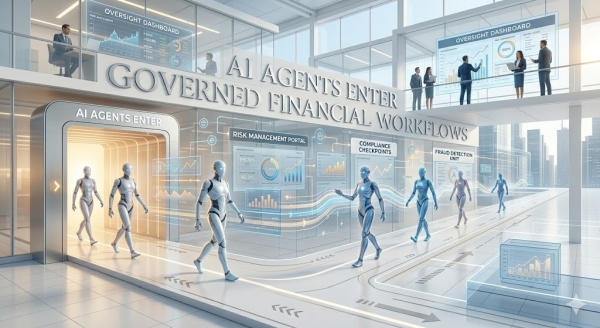
On May 5, 2026, Anthropic introduced finance agent templates for work that financial teams already manage every day. The list covers five agent templates and five workflow control templates all ready to go. This isn't just another AI product update and points to import changes to how financial services will operate in the near future. It also confirms that AI once again is leaving the loose prompt box and entering into controlled workflow systems.
These systems keep work inside permissioned data rules, use approved tools, review evidence, and provide risk teams a record that they can inspect and follow-up on. Regulated financial fintechs and financial institutions need these controlled AI agents inside defined workflows along with human review before output reaches a client file, compliance record, valuation, trade document, or board package.
The first wave of generative AI in finance looked like a personal productivity tool. Staff used chat assistants to summarize documents, draft emails, explain code, build first cut memos, and prepare research notes. That helped save some workers a lot of time, but it kept AI at the edge of the operating model. Now there's a return on intelligence in finance applications.
Anthropic’s new finance agents look capable of handling work on a more serious level. Each template combines task instructions, governed data connectors, and subagents for specific jobs such as peer company review, checking valuation methods, or reviewing source material. Teams can also adapt the agents to their own modelling conventions, risk policies, approval flows, and data access rules.
A governed agent can follow a checklist, call a tool, update a model, prepare a file, and hand the work to a reviewer. It can also create a record inside Claude Console. An audit section that doesn't auto correct the output by itself but makes the work easier to inspect. Model access is becoming common. Controlled execution is harder to obtain.
For operators, the useful question is where can an agent reduce manual drag without taking final judgment away from people. The measurable benefit should come from workflow metrics, not AI hype. Anthropic’s primary source gives one hard implementation claim. Teams can put Claude on finance work in days rather than months.
1. Pitch Builder A human banker builds a pitchbook by gathering company data, picking peers, checking comparables, drafting a story, and turning numbers into slides. An agent can run that process as a controlled sequence. It can pull approved data, prepare peer company comparisons, draft pages, and carry figures into a deck. The banker still decides which story is credible. The agent cuts the assembly work and leaves a clearer trail of sources and assumptions.
2. Meeting Preparer A human relationship manager often prepares by searching email, notes, filings, news, and prior client material. That process depends on memory and time. An agent can assemble a brief from connected sources, organize recent events, flag open issues, and keep the context ready for the meeting. The constraint is conduct risk. Firms need approved sources, stale data warnings, and a clear line between internal preparation and client ready advice.
3. Earnings Reviewer A human analyst reads filings, transcripts, guidance changes, and prior models to find what changed. An agent can do the first pass faster. It can compare current results with previous periods, update a draft model, flag changed language, and highlight items tied to an investment thesis. The analyst still decides what's important.
4. Model Builder A human analyst builds and updates models by entering figures, linking sheets, checking formulas, and adjusting assumptions. An agent can pull data from filings and feeds, create a first draft model, update assumptions, and help test formula consistency. That can save time, but it also raises the control bar. Firms need version control, formula review, source tagging, and named ownership before model output supports pricing, credit, valuation, or investment decisions.
5. Market Researcher A human researcher scans news, filings, broker research, sector reports, and internal notes to decide which facts matter. An agent can monitor connected sources, group findings by issuer or sector, and surface items for credit, risk, or investment review. The value is less search time and a better first cut of the evidence people need to judge.
6. Valuation Reviewer A human reviewer checks valuation work by testing inputs, peers, methods, policy thresholds, and judgment calls. An agent can run a structured first pass against approved comparisons, methodology rules, and company standards. It can flag gaps or inconsistencies before a reviewer signs off. That helps private markets, credit teams, fund administrators, and auditors, but the firm still has to control the inputs. In valuation, speed without discipline can multiply risk.
7. General Ledger Reconciler A human finance team reconciles accounts by matching records, finding breaks, explaining differences, and routing exceptions. An agent can compare account records, identify mismatches, prepare exception notes, and support net asset value calculations against books of record. The practical gain is cleaner exception handling. Reviewers still need the break list, explanations, approvals, and audit trail.
8. Month End Closer A human close team runs checklists, prepares entries, confirms balances, and packages reports under deadline pressure. An agent can run the checklist, prepare draft journal entries, assemble support, and produce close reports for review. That helps speed and consistency. Finance leaders still need approval evidence, segregation of duties, and a clean record of changes before final sign off.
9. Statement Auditor A human reviewer checks financial statements for consistency, completeness, formula issues, disclosure gaps, and unexplained changes. An agent can run those checks across statements and supporting files, then package exceptions before external review. The value is earlier detection and better reports. Audit judgment stays with people.
10. KYC Screener A human compliance analyst gathers documents, checks entity details, reviews risk flags, and escalates unclear cases. An agent can assemble entity files, compare source documents, identify missing information, and prepare escalation packages for compliance review. The strategic value is a cleaner file, fewer manual searches, better evidence capture, and faster escalation when risk is unclear.
On Apr 30, 2026, APRA called for a step change in AI risk management and governance across banks, insurers, and superannuation trustees. APRA warned that AI use is growing faster than governance, risk management, assurance, and operational resilience practices.
It also raised concerns about concentration risk, weak contingency planning, fragmented assurance, and reduced transparency when AI features come embedded within larger software platforms.
The FCA is testing similar issues in live environments. On Apr 21, 2026, the FCA named firms in its second AI Live Testing cohort, with use cases that include agentic payments, anti money laundering detection, credit score insights, KYC, and investment support. Testing runs through the end of 2026, with an evaluation report expected in Q1 2027.
Buyers won't only ask if the tool works. They'll ask what evidence proves it works, where humans review it, how errors surface, how permissions operate, and how the firm can stop the workflow when risk changes.
Financial institutions should treat finance agents as workflow infrastructure:
For banks, controlled scale should start where process discipline already exists. Good candidates include KYC reviews, credit memo preparation, internal research, model checking, finance close support, and audit readiness. These workflows already have owners, policies, and reviewer structures. That makes them better candidates than open ended client advice or autonomous transaction decisions.
For wealth firms, the strongest use cases sit in client preparation, research support, portfolio review notes, and compliance ready documentation. The danger is blurred accountability. A meeting brief can become advice in practice if staff reuse it without review. Wealth firms need templates, source labels, approval gates, and retention rules that fit suitability, disclosure, and conduct obligations.
For capital markets platforms and private market operators, agents can improve diligence speed. They can search data rooms, compare issuer materials, prepare investor questions, review disclosure consistency, and draft internal summaries. The platform must show where each fact came from and keep investment judgment with people.
For regtech vendors, the opening is clear. Build around review evidence, role based permissions, source traceability, escalation records, model monitoring, and shutoff controls. Don’t sell a generic AI layer. Sell the control fabric that lets financial firms use agents without losing accountability.
For investors, the better diligence question is where AI enters the workflow, what data it can touch, who reviews its output, and what record proves the process worked. AI adoption without operational evidence isn't a moat. It's a future remediation cost.
Small and mid sized financial institutions face a practical capacity gap. Many do not have deep AI engineering, data governance, risk, and integration teams. Anthropic’s May 4 announcement of a new enterprise AI services company with Blackstone, Hellman & Friedman, and Goldman Sachs speaks to that constraint. Anthropic said companies from community banks to mid sized manufacturers and regional health systems can benefit from AI, but lack the in house resources to build and run frontier deployments.
AI agents in finance don't need more use cases. Startups shouldn't copy bank scale infrastructure too early, and banks shouldn't treat agentic AI like another desktop tool. The right balance is to start with narrow workflows, measure the time saved, add controls as risk rises, and stop before governance costs outrun the value.
But once an agent touches regulated records, client decisions, and audit files, cheap experimentation ends. The real cost isn't only the model. It's all the other infrastructure from data access, permissions, monitoring, review gates, and vendor oversight that make work usable in finance.
The National Crowdfunding & Fintech Association (NCFA Canada) is a financial innovation ecosystem that provides education, market intelligence, industry stewardship, networking and funding opportunities and services to thousands of community members and works closely with industry, government, partners and affiliates to create a vibrant and innovative fintech and funding industry in Canada. Decentralized and distributed, NCFA is engaged with global stakeholders and helps incubate projects and investment in fintech, alternative finance, crowdfunding, peer-to-peer finance, payments, digital assets and tokens, artificial intelligence, blockchain, cryptocurrency, regtech, and insurtech sectors. Join Canada's Fintech & Funding Community today FREE! Or become a contributing member and get perks. For more information, please visit: www.ncfacanada.org
| | |
|---|---|---|
| | |
May 5, 2026 | NCFA Fintech Market Activity | Digital Assets Blockchain And Tokenization, Capital Markets And Funding

On May 5, 2026, a16z crypto announced Crypto Fund 5, a $2.2 billion fund for startups building crypto infrastructure and products. a16z isn’t waiting for another hype cycle. It's putting capital behind the parts of crypto that already look useful, including stablecoins, tokenized assets, on chain lending, payments, and AI agents.
The stablecoin thesis carries the most weight currently. Trading activity still rises and falls with crypto markets, but stablecoins keep gaining use in saving, cross border transfers, and payments. That’s the fintech read. Stablecoins aren't just trading tools. They're becoming payment, treasury, and settlement infrastructure.
Fund 5 also points to a capital markets build. Perpetual futures, prediction markets, on chain lending, stablecoin credit markets, and tokenized real world assets push crypto closer to financial workflows that run continuously and settle faster than legacy systems. The opportunity is infrastructure that reduces friction where money, collateral, data, and ownership move.
The Canadian market is perking up too, with a practical example in Canada’s first financial institution issued CAD stablecoin, while bank technology providers are building toward bank issued digital money. The next test is volume growth. Stablecoins and tokenized cash only matter if they improve settlement, treasury, lending, compliance, and payment workflows for real customers (while at the same time servicing robot customers too? Here's Google says to build for agents And humans).
And then there's AI that makes the fund more of everything all at once. a16z links crypto networks to software agents that can decide, act, and transact on behalf of users. Agent driven commerce needs payment rails, permissions, identity, auditability, digital property rights, and settlement that works without banking hours. Crypto infrastructure may become one way machines pay for compute, data, services, and financial access.
Where's the risk? A large fund can finance infrastructure, but customers still need simple products, trusted custody, clear rules, strong compliance, and measurable cost savings. The market has already punished crypto projects that don’t turn tech novelty into customer value. Fund 5 allocation will need to ensure builders can turn crypto infrastructure into everyday financial products that work better than the old rails.
If global venture capital is backing crypto infrastructure for payments, tokenization, and AI agents at scale, can Canada turn regulated digital asset rails into products that win real settlement, treasury, and financial services volume?
The National Crowdfunding & Fintech Association (NCFA Canada) is a financial innovation ecosystem that provides education, market intelligence, industry stewardship, networking and funding opportunities and services to thousands of community members and works closely with industry, government, partners and affiliates to create a vibrant and innovative fintech and funding industry in Canada. Decentralized and distributed, NCFA is engaged with global stakeholders and helps incubate projects and investment in fintech, alternative finance, crowdfunding, peer-to-peer finance, payments, digital assets and tokens, artificial intelligence, blockchain, cryptocurrency, regtech, and insurtech sectors. Join Canada's Fintech & Funding Community today FREE! Or become a contributing member and get perks. For more information, please visit: www.ncfacanada.org
| | |
|---|---|---|
| | |
May 5, 2026 | NCFA Insight | Artificial Intelligence And Data, Digital Assets Blockchain And Tokenization

Image: Magnific
On May 5, 2026, Coinbase filed a Form 8-K restructuring plan to cut about 700 employees or 14% of its global workforce as of May 1, 2026. The company expects most of the work cuts to finish in the second quarter of 2026 and estimates $50 - $60 million in restructuring expenses, such as severance and termination benefits. This isn't just another volatile crypto layoff, but rather a public market test of how the integration of AI tech is altering cost, team design, and operating workflow and design.
Coinbase linked the restructuring plan to current market conditions and the need to optimize operations for the AI era. With AI now disrupting the cost base, fintech boardrooms are facing harder questions around how much work can run through smaller teams, better tooling, and tighter controls?
Brian Armstrong, CEO and Co-Founder, Coinbase:
“Over the past year, I've watched engineers use AI to ship in days what used to take a team weeks. Non-technical teams are now shipping production code and many of our workflows are being automated.”
For fintech leaders, artificial intelligence is a capital allocation decision. AI spending and workforce redesign is surfacing new trade-offs about spending the next dollar on creating more output, people, platforms, or compute?
That question is currently running through every repeatable workflow in finance. Customer support. Compliance triage. Fraud review. Internal reporting. Software development. Onboarding. Risk monitoring. AI can compress parts of that work, but financial firms don’t get to optimize for speed alone. They also need audit trails, data controls, customer protection, and clear human accountability.
Clean operators can use AI to remove friction. Messy operators may spend more just to make automation safe enough to use.
AI raises the benchmark because investors can now ask whether a crypto infrastructure firm needs the same headcount to support the same activity.
It's pressure that's proliferating through all fintechs, not just crypto, but payment firms, wealth platforms, regtech and insurtech vendors, market infrastructure providers, and more.
Can they serve more customers, process more exceptions, ship better software, and meet compliance obligations without scaling headcount at the same rate?
There's inherent danger in treating AI as a simple cost cutter. It is not because automation creates new work around oversight, security, data quality, model review, escalation, and governance. In financial services, a faster workflow that weakens trust is not progress. It is future liability.
Investors want stronger unit economics. Customers expect faster service. Regulators expect better controls.
Companies should be rebuilding work before harder choices arrive. Canadian firms should know which workflows still depend on manual review, which controls can be automated safely, and which teams can support growth without adding people at the same pace as revenue.
This is also a productivity issue. Canada’s fintech competitiveness will depend on whether firms can turn AI into better service, lower operating cost, stronger fraud controls, faster onboarding, and cleaner compliance. Companies that can solve this earlier will have more room to invest when capital tightens.
AI changes the economics of work, but it also changes decision making. If software helps write code, approve support responses, flag suspicious activity, draft compliance notes, or review onboarding files, management must know where human review remains mandatory. That is where AI agents in finance become more than a software story. They force firms to decide which tasks should run through automation, which decisions still need human judgment, and how every exception gets reviewed.
AI can improve speed, but weak controls can create opaque decision chains. Smaller teams can be stronger teams when work is clear, measurable, and governed. They can also become fragile when automation hides weak process design.
If AI is now establishing operating cost benchmarks for crypto exchanges and fintech platforms, can Canadian financial innovators redesign work fast enough to compete without weakening trust, compliance, or customer protection?
For Canada, the opportunity is practical. Build cleaner workflows. Improve data quality. Keep accountability visible. Use AI where it strengthens the work, not where it hides weak process.
The National Crowdfunding & Fintech Association (NCFA Canada) is a financial innovation ecosystem that provides education, market intelligence, industry stewardship, networking and funding opportunities and services to thousands of community members and works closely with industry, government, partners and affiliates to create a vibrant and innovative fintech and funding industry in Canada. Decentralized and distributed, NCFA is engaged with global stakeholders and helps incubate projects and investment in fintech, alternative finance, crowdfunding, peer-to-peer finance, payments, digital assets and tokens, artificial intelligence, blockchain, cryptocurrency, regtech, and insurtech sectors. Join Canada's Fintech & Funding Community today FREE! Or become a contributing member and get perks. For more information, please visit: www.ncfacanada.org
| | |
|---|---|---|
| | |
May 1, 2026 | NCFA Fintech Whisperer Weekly Intelligence | Digital Assets Blockchain And Tokenization, Payments And Market Infrastructure, Regulation And Policy, Capital Markets And Market Infrastructure
Image: Freepik
This live weekly NCFA intelligence page tracks financial technology developments that significantly affect how fintechs build, sell, raise capital, and operate under scrutiny. Coverage prioritizes Canada and includes global events that directly influence competitive conditions, market access, and execution realities across fintech sectors. This page will be updated throughout the week with market movers in a live format and then each week we'll close the prior week's contents in prep for the upcoming week, and continue on a rolling basis. (Missed prior week's Fintech Whisperer? (December 6-12, 2025, December 13-19, 2025, January 1-9, 2026, January 10-16, 2026, January 17-23, 2026, January 24-30, 2026, January 31-February 6, 2026, February 7-13, 2026, February 14-20, 2026, February 21-27, 2026, February 28-March 6, 2026, March 7-13, 2026, March 14-20, 2026, March 21-27, 2026, March 28-April 3, 2026, April 4-10, 2026, April 11-17, 2026, April 18-24, 2026).
Open banking is moving from policy design into standards governance. The next control point is who sets the technical, data, consent, and implementation standards that banks, fintechs, and payment firms will have to build against.
AI governance is now part of prudential supervision. Banks, insurers, super funds, and vendors need evidence that AI systems can be explained, challenged, monitored, and shut down without breaking critical operations.
Canada is moving financial crime policy closer to the access points where fraud enters the system. Crypto ATMs, MSBs, account funding, and platform coordination now sit inside the same risk conversation. For fintech operators, the message is practical: faster finance needs stronger onboarding, monitoring, reporting, and partner controls. Weak compliance is becoming a market access problem, not just a regulatory issue.
CSA is removing unnecessary personal data from registration filings before the formal rule amendment is complete. Registrants, dealers, advisers, and compliance vendors should update onboarding, change notice, and filing workflows to reduce data collection and privacy risk.
ESG ratings regulation is moving from consultation into reporting design. Data providers, asset managers, platforms, and compliance teams should watch what information the FCA tests now, because today’s pilot data fields can become tomorrow’s supervisory evidence.
Europe’s digital euro case is now less about payment choice and more about infrastructure control. Banks, wallets, processors, and fintechs should watch how legal tender status, offline payments, privacy, and private sector distribution are built into the final framework.
Mercury’s conditional approval shows how fintech infrastructure is moving closer to regulated bank ownership. The test now is execution: capital planning, compliance controls, risk governance, deposit insurance approval, payments operations, and regulator confidence.
Brazil is drawing a clear line inside regulated cross border payment infrastructure. eFX providers get broader investment related use cases, but crypto and stablecoins stay outside the supervised settlement flow between providers and foreign counterparties.
Stablecoin settlement is moving deeper into card network infrastructure. Visa’s multi chain expansion gives issuers and acquirers more settlement options while keeping a global payment network as the common operating layer.
AI commerce is moving beyond card rails into wallets, super apps, banking interfaces, and wearable devices. Payment providers now need agent controls, authentication, settlement, and audit trails built directly into mobile workflows.
Canada is creating a new public capital vehicle that blends nation building, private co investment, and retail participation. For fintechs, dealers, platforms, and wealth firms, the key watch item is the retail product design: distribution, disclosure, capital protection, eligibility, liquidity, and how ordinary Canadians gain access to strategic national investments.
The FCA is trying to reduce friction in UK listings. Issuers, banks, advisers, and research teams should watch this closely because research timing affects IPO execution, investor education, and how competitive London looks beside other listing venues.
The stablecoin yield fight is moving from a hard stop to a narrower fight over rewards design. Stablecoin issuers, exchanges, wallets, and banks should watch whether Congress draws the line around deposit like yield, activity based rewards, and who gets to define the difference.
Tokenized equities are being routed into existing U.S. market structure rather than a parallel venue. That makes the DTC pilot more important: the operating question is no longer whether tokenized securities can trade, but how clearing, settlement, custody, controls, and shareholder rights fit inside the national market system.
Bank led tokenized deposits are moving from experiments toward shared network infrastructure. The signal is not only the technology transfer. It is the bank roster, production launch timing, and push to keep always on settlement inside the regulated deposit perimeter.
Korea is moving bank led stablecoin infrastructure toward cross border distribution and wallet access. Stablecoin providers, banks, and payment firms should watch whether KRW backed settlement becomes a regulated bridge between domestic bank money and global digital commerce.
Simon Walls, Executive Director of Markets, Financial Conduct Authority
“Tokenisation has the potential to play an important role in asset management, and its adoption will be driven by firms and investors. We have focused on delivering what the market has asked for: a clear, practical framework that provides confidence in how fund tokenisation can operate within our rules, both now and into the future.”
Institutional Bitcoin adoption is expanding through public equity as well as direct digital asset holdings. Pension funds, asset managers, banks and capital markets participants should watch whether listed Bitcoin treasury companies become a common route for regulated institutions seeking digital asset exposure within existing investment mandates.
Tokenized equities are moving into the transfer agent layer. That matters because shareholder records, voting, dividends, and issuer controls are the plumbing that separates real tokenized securities from synthetic exposure or offshore wrappers.
Bank issued digital money is moving closer to core banking infrastructure. Lyriq gives banks a way to run tokenized deposit style money flows with controls, auditability, settlement finality, and core integration built in from the start.
Tokenized Treasury funds are moving from passive yield products into active collateral infrastructure. Exchanges, custodians, asset managers, and institutional trading desks now have a working model for combining yield, margin, custody, and counterparty risk controls in one operating stack.
This week is about ownership of core financial infrastructure. Canada introduced a sovereign wealth fund. Fintechs pursued bank charters. Global banks, exchanges, transfer agents, payment networks, and core processors advanced tokenized deposits, fund tokenization, tokenized shares, stablecoin settlement, and AI agent payments. These initiatives are about control: who owns the account, who controls settlement, who keeps custody, who sets the rules, and who earns the economics when financial assets and payments become programmable.
NCFA offers various curated resources to help founders and investors stay current on developments that impact fintech markets, subscribe to NCFA weekly newsletter updates, view a rundown of current fintech news and insights, or dive into the latest fintech industry research.
The National Crowdfunding & Fintech Association (NCFA Canada) is a financial innovation ecosystem that provides education, market intelligence, industry stewardship, networking and funding opportunities and services to thousands of community members and works closely with industry, government, partners and affiliates to create a vibrant and innovative fintech and funding industry in Canada. Decentralized and distributed, NCFA is engaged with global stakeholders and helps incubate projects and investment in fintech, alternative finance, crowdfunding, peer-to-peer finance, payments, digital assets and tokens, artificial intelligence, blockchain, cryptocurrency, regtech, and insurtech sectors. Join Canada's Fintech & Funding Community today FREE! Or become a contributing member and get perks. For more information, please visit: www.ncfacanada.org
| | |
|---|---|---|
| | |



August 26th, 2025

January 4th, 2024

June 1st, 2021

September 9th, 2020

July 9th, 2018

January 3rd, 2018

September 25th, 2017

June 20th, 2017

May 10th, 2017

December 14th, 2016
