





Karsten Wenzlaff, Advisor
August 26th, 2025
Karsten Wenzlaff is a Crowdfunding and Fintech Expert from Germany. He is Secretary-General of Digit[...]


May 1, 2026 | NCFA Fintech Market Activity | Risk Compliance And Regtech, Artificial Intelligence And Data

On May 1, 2026, Datavault AI and CyberCatch announce a binding letter of intent for Datavault AI to acquire 100% of CyberCatch in an all stock transaction structured as a court approved plan of arrangement under the Business Corporations Act (British Columbia).
The proposed deal values CyberCatch at about CAD $136.8 million (CAD $5.11 per share). CyberCatch shareholders would hold about 7.52% of the combined company, with Datavault AI shareholders holding about 92.48% on a non fully diluted basis.
CyberCatch CYBE is listed on the TSX Venture Exchange and OTCQB US Venture Market, focuses on continuous compliance and AI driven cyber risk testing. Its platform uses generative AI to assess whether controls are in place, then uses agentic AI to simulate attack scenarios and produce a Cyber Breach Score. The model is built around continuous validation rather than periodic audit cycles.
Timing aligns with rising demand for continuous security assurance. The release cites Gartner estimates that global information security spending will reach $240 billion in 2026, while AI driven security could grow to $160 billion by 2029 (up from $49 billion 2025). IBM’s 2025 Cost of a Data Breach report places the average U.S. breach at $10.22 million and the global average at $4.44 million.
Regulatory pressure is picking up. The U.S. Department of Defense started rolling out its CMMC program on Nov 10, 2025, and stricter certification requirements are expected to expand in 2026 across about 220,000 contractors and suppliers. CyberCatch aligns its platform with widely used standards such as CMMC 2.0, NIST, ISO 27001, HIPAA, and PCI.
There’s also a growing focus on future security risks. As computing power increases, current encryption methods may become easier to break. CyberCatch is working on quantum resistant encryption, and signs like Google’s 2029 timeline for upgrading its systems show that companies are starting to prepare now.
Nathaniel T. Bradley, CEO, Datavault AI:
“Cybersecurity is no longer a separate stack from data and AI - it is the precondition for both. CyberCatch's continuous compliance platform is expected to provide another strategic advantage by adding to DataValue®, DataScore®, and the IDE® a real-time risk and compliance signal at every node of our quantum-secured edge fleet, from federal contractors to enterprise data customers.”
For Datavault AI, the transaction adds a compliance layer to its broader data, edge computing, and tokenization infrastructure. The company positions CyberCatch as a way to deliver real time assurance across regulated environments, including fintech, healthcare, energy, and defence.
CyberCatch brings a Canadian public market cybersecurity and regtech platform into a U.S. AI infrastructure strategy.
The transaction is subject to a definitive agreement, due diligence, board approvals, CyberCatch shareholder approval, British Columbia court approval, Nasdaq approval, TSX Venture Exchange approval, and other customary closing conditions. The parties have agreed to a 45 day exclusivity period.
Will continuous, AI driven compliance become a required layer for regulated industries, or will firms continue relying on periodic audits that do not reflect real time risk?
 The National Crowdfunding & Fintech Association (NCFA Canada) is a financial innovation ecosystem that provides education, market intelligence, industry stewardship, networking and funding opportunities and services to thousands of community members and works closely with industry, government, partners and affiliates to create a vibrant and innovative fintech and funding industry in Canada. Decentralized and distributed, NCFA is engaged with global stakeholders and helps incubate projects and investment in fintech, alternative finance, crowdfunding, peer-to-peer finance, payments, digital assets and tokens, artificial intelligence, blockchain, cryptocurrency, regtech, and insurtech sectors. Join Canada's Fintech & Funding Community today FREE! Or become a contributing member and get perks. For more information, please visit: www.ncfacanada.org
 |  |  |
|---|---|---|
 |  |  |
Apr 29, 2026 | NCFA Resource | Artificial Intelligence And Data, Risk Compliance And Regtech
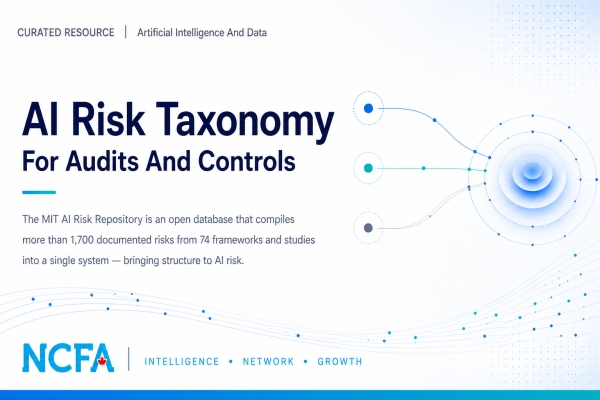
The MIT AI Risk Repository is an open database created by researchers at MIT to bring structure to AI risk. It compiles more than 1,700 documented risks from 74 existing frameworks and studies into a single system. The aim is practical. AI risk guidance exists, but it is scattered and inconsistent across sources. This repository organizes it into a shared taxonomy, with links that show how risks connect and compound across systems.
In practice, this gives teams a consistent way to map risk across AI systems.
Teams already running AI in production will get the most from this. If you’re operating models in lending, fraud, onboarding, or customer support, it gives you a structured way to think about risk across systems. Larger fintechs and financial institutions dealing with audit and regulatory pressure will find it useful quickly. Early stage teams without deployed models will likely find it heavy and not immediately relevant.
The strength here is structure. It turns fragmented AI risk concepts into something teams can actually use, and the causal links add depth that most frameworks miss. At the same time, it does not rank risks by likelihood or impact, and it does not translate directly into controls or regulatory compliance. Some classifications reflect interpretation across sources, and emerging risks may not be fully captured. Teams still need to apply judgment and build their own control layer on top.
Repository Homepage (AI risk overview and navigation)
Full Risk Database (AI risk dataset for audits)
Causal Taxonomy (AI risk relationships mapping)
Domain Taxonomy (AI risk classification framework)
Research Paper (AI risk methodology and design)
The National Crowdfunding & Fintech Association (NCFA Canada) is a financial innovation ecosystem that provides education, market intelligence, industry stewardship, networking and funding opportunities and services to thousands of community members and works closely with industry, government, partners and affiliates to create a vibrant and innovative fintech and funding industry in Canada. Decentralized and distributed, NCFA is engaged with global stakeholders and helps incubate projects and investment in fintech, alternative finance, crowdfunding, peer-to-peer finance, payments, digital assets and tokens, artificial intelligence, blockchain, cryptocurrency, regtech, and insurtech sectors. Join Canada's Fintech & Funding Community today FREE! Or become a contributing member and get perks. For more information, please visit: www.ncfacanada.org
| | |
|---|---|---|
| | |
Apr 29, 2026 | NCFA Fintech Market Activity | Lending Consumer Credit And BNPL, Capital Markets And Funding
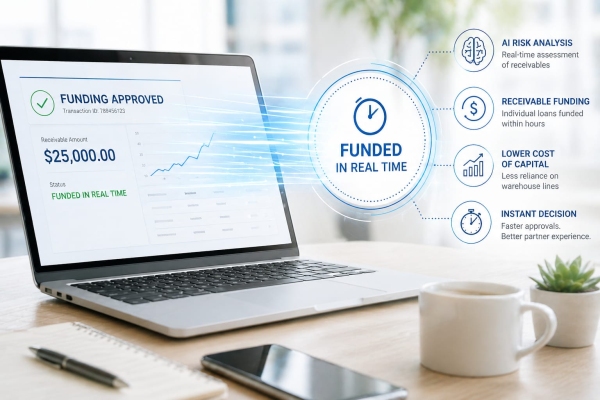
On Apr 29, 2026, VersaBank and FinanceIt Canada announce breakthrough in Real Time Structured Receivable Program pilot, an AI enabled funding model for point of sale finance receivables.
The change is in timing. Many point of sale lenders originate loans and then hold those receivables for 5 to 30+ days before financing them. VersaBank aims to fund individual receivables within hours. That shortens the gap between origination and funding and reduces the need for warehouse lines.
The program already operates at scale. VersaBank’s Structured Receivable Program portfolio exceeded CAD $4.4 billion as of Jan 31, 2026 and has grown at a 33% compound annual rate over the past five years. In the U.S., it completed more than US $310 million in fundings in its first year, above a US $290 million target.
The pilot with FinanceIt focuses on funding at or near the point of sale. FinanceIt originates consumer loans across home improvement, retail, and other merchant channels. If funding happens closer to origination, partners can reduce how long loans sit on balance sheet and lower the cost of carrying receivables.
This approach also changes how lending platforms access capital. Many point of sale and BNPL providers rely on warehouse facilities and forward flow agreements before selling loans into securitization or institutional channels. Shortening the time between origination and funding improves capital turnover and reduces reliance on those structures.
It's AI's decision support layer that's supporting faster decisions. VersaBank positions the program as using AI to assess and structure receivables in real time, allowing funding decisions without batch processing or manual review cycles.
David Taylor, President and CEO, VersaBank:
“This represents a breakthrough innovation in point-of-sale financing.”
It's the combination of faster decisioning and immediate access to capital. Funding can move closer to continuous, loan level decisions rather than batch processing. That allows capital to be deployed when a loan is approved instead of after it sits waiting in a pool. Over time, this leads to more precise pricing and better use of balance sheet capacity.
What happens when capital is deployed at the moment a loan is approved instead of days later, and which lenders are set up to operate at that speed?
Funding speed is becoming a core driver of economics in point of sale lending. When capital is deployed at origination, lenders can reduce costs and improve returns without taking on more credit risk.
The National Crowdfunding & Fintech Association (NCFA Canada) is a financial innovation ecosystem that provides education, market intelligence, industry stewardship, networking and funding opportunities and services to thousands of community members and works closely with industry, government, partners and affiliates to create a vibrant and innovative fintech and funding industry in Canada. Decentralized and distributed, NCFA is engaged with global stakeholders and helps incubate projects and investment in fintech, alternative finance, crowdfunding, peer-to-peer finance, payments, digital assets and tokens, artificial intelligence, blockchain, cryptocurrency, regtech, and insurtech sectors. Join Canada's Fintech & Funding Community today FREE! Or become a contributing member and get perks. For more information, please visit: www.ncfacanada.org
| | |
|---|---|---|
| | |
Apr 28, 2026 | NCFA Insight | Artificial Intelligence And Data, Banking And Credit Infrastructure

On Apr 27, 2026, Customers Bank announced a multiyear collaboration with OpenAI to deploy AI across commercial banking operations. The bank has nearly $26 billion in assets and already has 75% of team members using OpenAI powered tools. Customers Bank even used an AI voice clone on its last earnings call. The bigger change is how the bank is deploying AI agents across lending, onboarding, and payments.
On its Q1 call, Customers reported more than 500 internal agents and custom GPTs, over 28,000 hours saved through AI enabled workflows, and productivity gains equal to almost 15 full time employees. Q1 results also show $69.7 million in net income available to common shareholders, total deposits up $813.9 million from Q4, and total loans up $609.0 million from Q4.
Sam Sidhu, President and CEO, Customers Bancorp
“We expect a fundamental re-engineering of how Customers Bank operates. We have spent the last year building the operational and governance infrastructure to deploy AI at scale. This strategic collaboration with OpenAI gives us the frontier models, engineering expertise, and ability to co-create a roadmap toward becoming an AI-native bank."
Customers Bank wants AI inside its operating model, with OpenAI engineers working directly with the bank to automate commercial lending, deposit onboarding, and payments. The bank’s cubiX platform already processes about $2 trillion in annual payments volume, giving the collaboration a live operating base, not a pilot or lab only environment.
During Q1 2026 earnings call, Sidhu disclosed that his prepared remarks had been delivered by an AI clone, not read by him. While it was sure to be a memorable call at that point, it's important if AI can represent management's voice in a public market setting, boards need rules for disclosure, script approval, recordkeeping, and accountability before the next experiment becomes normalized.
AI banking use cases aren't just theatre. Customers Bank wants to reduce its commercial loan closing from 30-45 days to about 7 days. It also wants complex commercial account opening to fall from more than a day to under 20 minutes. They are targeting the slowest, most expensive parts of commercial banking.
This is where smaller banks and fintechs should pay attention. AI in banking won’t be won by buying a model and asking staff to use it. The value comes from redesigning workflows around agents, then keeping humans on approvals, exceptions, and risk judgement. That requires clean data, mapped processes, audit trails, escalation rules, and ownership of each AI output.
There's a regulatory approach too. Investor relations, lending decisions, onboarding, and payments all require accountable systems. If an agent drafts, routes, ranks, or speaks, the bank's still on the hook for the result. The lesson is not “let AI run the bank.” It's use AI to remove friction, but keep governance strong enough to prove who approved what and why.
Can Customers Bank turn AI from a productivity tool into an AI enabled engine powering lending, deposits, and payments?
The National Crowdfunding & Fintech Association (NCFA Canada) is a financial innovation ecosystem that provides education, market intelligence, industry stewardship, networking and funding opportunities and services to thousands of community members and works closely with industry, government, partners and affiliates to create a vibrant and innovative fintech and funding industry in Canada. Decentralized and distributed, NCFA is engaged with global stakeholders and helps incubate projects and investment in fintech, alternative finance, crowdfunding, peer-to-peer finance, payments, digital assets and tokens, artificial intelligence, blockchain, cryptocurrency, regtech, and insurtech sectors. Join Canada's Fintech & Funding Community today FREE! Or become a contributing member and get perks. For more information, please visit: www.ncfacanada.org
| | |
|---|---|---|
| | |
Apr 28, 2026 | NCFA Insight | Risk Compliance And Regtech

Image: Freepik
On Apr 26, 2026, the CBC reported that Premier Wab Kinew announced at a weekend fundraiser that Manitoba plans to restrict youth access to social media and AI chatbots.
At the time of publishing, an official government release, bill or consultation paper wasn't available so treat this as early insight rather than a confirmed regulatory event (just yet). The stronger proof is already visible in global policy patterns, so it's only a matter of time.
Australia’s social media minimum age rules took effect on Dec 10, 2025, and eSafety reported that platforms had removed access to 4.7 million under 16 accounts across Australia by mid December 2025.
In Europe, the European Commission has published minor protection guidelines under the Digital Services Act, and the European Parliament has backed a minimum age of 16 for access to social media, video sharing platforms, and AI companions.
Given the trajectory and potential risks of AI, the debate isn't just about doom scrolling any more. It's fuelling a compliance market for age assurance, safer design, and AI access controls.
Australian government's rules put responsibility on age restricted platforms to take reasonable steps, not on parents to police every account. So age restrictions and assurance are now an infrastructure issue. A checkbox, self declared birth date, or parental reminder won't satisfy regulators when millions of accounts need to be assessed, restricted, or removed.
Children can get pulled into endless feeds, autoplay videos, harmful recommendations, bullying, sexual exploitation, self harm content, eating disorder content, and late night scrolling that cuts into sleep. That's why social media is getting the attention from lawmakers first. The bigger question for fintech and digital identity comes next. Once governments make platforms check age, the same requirement can spread to other digital services used by minors.
The EU hasn't implemented a social media ban on age just yet, but it's building the infrastructure that could support stricter controls. On July 14, 2025, the European Commission released an age verification app prototype under the Digital Services Act. The Commission says the app would let users prove they are over 18 when accessing restricted adult content while keeping control of other personal information, including their exact age and identity.
The Commission’s age verification page says the solution was technically ready for implementation as of Apr 15, 2026. The blueprint also gives platforms a practical build plan. It covers the technical specs, system design, data connections, and open source code needed to support age checks. Age assurance now has to protect children without creating a new privacy problem. Platforms need a trusted age signal. Users should not have to share a full identity file just to prove they meet an age limit.
The clearest policy clue comes from Europe’s treatment of AI companions. On Nov 26, 2025, the European Parliament voted 483 in favour, 92 against, and 86 abstentions on a non legislative report calling for a minimum age of 16 for social media, video sharing platforms, and AI companions, unless parents authorize access for users aged 13 to 16.
The same Parliament release cites research that 97% of young people go online every day, 78% of 13 to 17 year olds check their devices at least hourly, and one in four minors show problematic or dysfunctional smartphone use. It also cites 2025 Eurobarometer impact of digitalisation findings that more than 90% of Europeans see online child protection as urgent, including 93% for social media’s negative impact on mental health, 92% for cyberbullying, and 92% for restricting access to age inappropriate content.
Those numbers explain why AI gets pulled into the same debate. Doom scrolling rules target addictive design and harmful content discovery. AI companion rules target interaction, dependency, personalized responses, manipulation, and adult like conversations with minors. NCFA has already examined youth AI protection risks, including lawsuits involving generative AI and vulnerable users. Regulators are starting to connect age, vulnerability, consent, product design, and AI behaviour into one compliance problem.
The public debate may start with under 16 social media bans. The business reality runs deeper. Governments want digital services to know when a user is a child, adjust the experience, and prove that controls work. Age assurance is becoming part of digital trust infrastructure. AI makes the stakes higher because the product doesn't just offer access to content anymore. It talks back, adapts, remembers, and can build dependence. That's why kid risk now part of the compliance stack. Once age becomes a regulated access condition, the same logic can reach payments, gaming, lending, investing, AI assistants, marketplaces, app stores, and identity wallets.
The National Crowdfunding & Fintech Association (NCFA Canada) is a financial innovation ecosystem that provides education, market intelligence, industry stewardship, networking and funding opportunities and services to thousands of community members and works closely with industry, government, partners and affiliates to create a vibrant and innovative fintech and funding industry in Canada. Decentralized and distributed, NCFA is engaged with global stakeholders and helps incubate projects and investment in fintech, alternative finance, crowdfunding, peer-to-peer finance, payments, digital assets and tokens, artificial intelligence, blockchain, cryptocurrency, regtech, and insurtech sectors. Join Canada's Fintech & Funding Community today FREE! Or become a contributing member and get perks. For more information, please visit: www.ncfacanada.org
| | |
|---|---|---|
| | |
Apr 28, 2026 | NCFA Insight | AI, Fintech And Productivity

AI Image: Jobs vs Compute
AI layoffs are becoming a capital allocation story. In April 2026, large firms across technology, retail, media, and financial services kept cutting roles while at the same time spending more on AI, automation, cloud infrastructure, and operating efficiency.
That doesn’t mean all layoffs are as a result of AI, but boards are asking a harder question now as they divert capital from labour to compute: where does the next dollar produce more output, people, platforms, or compute?
The numbers are getting harder to ignore. Big Tech AI spending could reach about $600 billion in 2026. Meta plans to cut about 10% of its workforce while guiding to $115 billion to $135 billion in capital spending driven largely by AI infrastructure. Microsoft is offering a voluntary employee buyout as it manages rising AI and cloud costs. Snap is cutting about 16% of full time staff. Nike is cutting about 1,400 jobs, with technology roles taking most of the impact.
The decision has been made in the boardroom. AI investment is competing with payroll, product teams, operations, and layers of management. Every job and role now has to show where it adds judgment, customer trust, regulatory knowledge, risk control, or revenue that automation can’t easily replace.
A fintech that can process more volume and scale without adding the same number of people has a better margin story. A fintech cost structure that needs a new team every time revenue grows will be under pressure fast.
AI usage and early labour strain is already appearing before every company announces formal cuts. Entry level roles in AI exposed fields are tightening first. That’s where the next generation of operators and compliance talent usually starts.
A recent Armstrong Economics commentary on AI costs raises a useful counterpoint: AI can reduce headcount pressure, but it doesn't remove cost. For example, the cost of compute, vendor fees, data cleanup, cybersecurity, audit trails, , human review and workflow redesign are all part of real ROI calculations. For fintechs and financial institutions, the acid test is whether the full process costs less, runs faster, and keeps risk under control.
That makes unit economics more important than AI headlines. If those metrics improve, AI is creating operating leverage. If they don't, the company may end up moving cost from payroll to infrastructure in the end.
Nike may be a clearer signal for Canada than Meta. Canada has fewer Meta sized AI infrastructure bets, but it has many established firms that added apps, data projects, digital teams, and customer platforms during the low rate years. Some of that work created real value. Some became expensive to maintain, hard to scale, or too slow to justify.
As a result, many companies are replacing older internal builds with leaner AI enabled stacks, vendor platforms, and automation tools that reduce operating cost. That’s the opening for fintech infrastructure. Companies still need modern payments, identity, credit, fraud controls, compliance tools, treasury, and customer finance.
They just don't want every capability built and staffed internally. Easier said than done but the option is goals and motivations are to buy proven tools, connect them faster, and reduce cost without adding another large costly operating layer. It’s removing friction from financial workflows. Faster onboarding. Cleaner risk checks. Less manual reconciliation. Better fraud detection. More useful cash flow data. Compliance that costs less to run.
The economics are are already visible. AI agents and return on intelligence in finance shows that 77% of financial institutions report positive ROI from AI, while nearly half plan to allocate more than half of their AI budgets to agent driven systems.
Productivity gains are now the baseline expectation, not the upside case. That changes how financial services teams are built and what gets funded.
There are limits, though. If companies eliminate too many junior roles, they risk weakening the talent pipeline. Financial services can’t automate accountability (can they?). Someone still needs to understand the customer, the regulation, and the risk.
Founders and investors should monitor operating metrics to understand where leverage is. Revenue per employee. Gross margin. Onboarding cost. Support cost. Compliance cost per customer. Fraud loss rates. A fintech that grows without adding headcount at the same pace stands out. One that talks about AI without showing better unit economics doesn’t.
Canada is earlier in this cycle, but the friction is starting to show. Statistics Canada reports that about 6% of AI adopting businesses say they've reduced employment due to AI, which suggests the adjustment is underway but not yet widespread. Firms are not always announcing large AI driven layoffs (publicly), but they are slowing hiring, tightening teams, and pushing more output through automation.
That pressure is also showing up in large Canadian incumbents, even when AI isn't named as the cause. Rogers is offering voluntary departure packages to about half of its workforce as it looks to reduce costs.
Canada also won’t follow the US pattern exactly. The country has fewer hyper-scaleup companies and less direct exposure to massive domestic AI infrastructure spending. Canadian companies are more likely to buy AI capability through partners than build it internally. That creates a different risk. The US may adjust faster. Canada may carry this margin and efficiency friction longer.
It's important because productivity remains a concern. Statistics Canada reports that business labour productivity declined in late 2025.
The labour story is not about pure job cuts but whose rebuilding their operating model and productivity structure. If large US firms trade headcount for compute, Canadian firms need to trade manual work and fragmented systems for better infrastructure.
The National Crowdfunding & Fintech Association (NCFA Canada) is a financial innovation ecosystem that provides education, market intelligence, industry stewardship, networking and funding opportunities and services to thousands of community members and works closely with industry, government, partners and affiliates to create a vibrant and innovative fintech and funding industry in Canada. Decentralized and distributed, NCFA is engaged with global stakeholders and helps incubate projects and investment in fintech, alternative finance, crowdfunding, peer-to-peer finance, payments, digital assets and tokens, artificial intelligence, blockchain, cryptocurrency, regtech, and insurtech sectors. Join Canada's Fintech & Funding Community today FREE! Or become a contributing member and get perks. For more information, please visit: www.ncfacanada.org
| | |
|---|---|---|
| | |
Apr 27, 2026 | NCFA Fintech Insight | Cybersecurity And AI Risk

On April 21, 2026, Mozilla's Firefox team said early access to Anthropic’s Claude Mythos Preview helped identify 271 vulnerabilities in Firefox 150, after an earlier Anthropic collaboration with Opus 4.6 helped fix 22 security sensitive bugs in Firefox 148. It's a real world test Warning that AI has started to compress months of expert vulnerability research into a much shorter discovery cycle.
The deeper issue for financial services isn’t whether AI can find bugs. Mozilla’s post makes that answer fairly clear. The harder question is whether banks, fintechs, payment providers, cloud vendors, and critical infrastructure operators can test, rank, schedule, and deploy fixes fast enough once the bug volume rises?
Security teams have always fought an unfair game. That is attackers only need one weakness while defenders have to protect the full surface. Mozilla’s Bobby Holley wrote that elite security researchers find bugs that fuzzers miss by reasoning through source code, and that computers “were completely incapable of doing this a few months ago, and now they excel at it.” He also wrote that Mythos Preview was “every bit as capable” as the best security researchers Mozilla has studied.
Limited human cyber security expertise no longer limits discovery in the same way. Once AI can reason through large codebases, the volume of known vulnerabilities rises quickly. Mozilla for example jumped from 22 bugs in Firefox 148 to 271 vulnerabilities in Firefox 150. Detection capacity jumps faster than operational capacity.
For fintechs, that means security teams may see more vendor alerts, more emergency updates, more dependency risk, and more pressure to patch without breaking customer facing systems. More discovery helps defenders, but only when organizations can practically execute on the risk.
The Financial Times reported that companies with Mythos access want stronger joint defense across government and business, especially for hospitals, banks, utilities, and other critical infrastructure. It also reported that Microsoft, Fifth Third’s technology provider, has rolled out almost 150 software updates since Mythos’s release. Patching can affect numerous areas, such as customer access, payments, fraud controls, and vendor dependencies.
Financial infrastructure like core banking systems, payment gateways, and fraud engines operate on tight turnaround schedules and a bad patch or gap can interrupt service, leaving a known weakness open. And the tradeoff becomes harder when AI expands the queue of fixes beyond human capacity.
A 2026 analysis summarized on the Harvard Law School Forum on Corporate Governance found that Russell 3000 companies hit by significant cyber incidents underperformed the broader market by about 5% on average over three years. The study reviewed 176 unique cyber events from 2022 through 2024, and found that finance, banking, and health care accounted for more than half of reported incidents. That means board failures, patch delays, poor vendor oversight can damage shareholder value for years.
The old comfort of quarterly patch cycles won’t hold up well in a world where AI can surface hundreds of issues at once.
Reuters reported on April 21 that unauthorized users accessed Mythos through what Anthropic described as a third party vendor environment. Anthropic said it was investigating the report and had no evidence that the access affected Anthropic systems.
If a tool can find bugs as well as top security experts, then that tool becomes a prime target. Anyone who gets access to it could shortcut months of work and go straight to weak points. That means security is no longer just about protecting your systems. It also includes controlling who can use these AI security tools, how they’re accessed, and what they can see across your vendors and environments.
Warnings from Palo Alto Networks point to where this could go. These tools may allow attackers to link multiple weaknesses together and automate attacks. That’s why the unauthorized access issue matters even without confirmed misuse. The real risk is that the capability itself could leak.
Canadian fintechs don’t run everything themselves. They depend on cloud providers, banks, payment networks, identity services, and other vendors. That means they don’t control when fixes happen, but they still carry the risk if something goes wrong.
That puts pressure on knowing how vendors handle security. Fintech teams need to understand how quickly partners fix serious issues, how they report problems, and whether important updates get priority. Even smaller firms can push for clearer answers before relying on a vendor for critical services.
Regulators should pay attention too. AI can help find problems faster, but only if companies can act on that information in a coordinated way. If not, bigger firms with early access move ahead, while smaller ones fall behind. In Canada, where many fintechs depend on a few key providers, that gap could widen quickly.
Mozilla believes there’s a limit to how many bugs exist, and that defenders may finally be able to find them all. That could happen over time. Right now, though, things will feel messy. More bugs will show up. Fix lists will get longer. Vendors will have to decide what to fix first. Leaders will have to choose between keeping systems running and fixing issues right away. For banks and fintechs, the edge will go to those who can move faster, work closely with partners, and handle frequent updates without disrupting customers, payments, or data.
The National Crowdfunding & Fintech Association (NCFA Canada) is a financial innovation ecosystem that provides education, market intelligence, industry stewardship, networking and funding opportunities and services to thousands of community members and works closely with industry, government, partners and affiliates to create a vibrant and innovative fintech and funding industry in Canada. Decentralized and distributed, NCFA is engaged with global stakeholders and helps incubate projects and investment in fintech, alternative finance, crowdfunding, peer-to-peer finance, payments, digital assets and tokens, artificial intelligence, blockchain, cryptocurrency, regtech, and insurtech sectors. Join Canada's Fintech & Funding Community today FREE! Or become a contributing member and get perks. For more information, please visit: www.ncfacanada.org
| | |
|---|---|---|
| | |



August 26th, 2025

January 4th, 2024

June 1st, 2021

September 9th, 2020

July 9th, 2018

January 3rd, 2018

September 25th, 2017

June 20th, 2017

May 10th, 2017

December 14th, 2016
