





Karsten Wenzlaff, Advisor
August 26th, 2025
Karsten Wenzlaff is a Crowdfunding and Fintech Expert from Germany. He is Secretary-General of Digit[...]


July 31, 2026 | NCFA Market Activity | Capital Markets And Market Infrastructure, Competition And Market Structure, Wealth Investing And Trading

On July 30, 2026, U.S.-based Intercontinental Exchange (ICE), the owner of the New York Stock Exchange, agreed to acquire MarketAxess for US$167 a share in cash, valuing the electronic bond-trading company at about US$5.7 billion. The ICE MarketAxess agreement carries a 33% premium to MarketAxess's previous closing price. Both boards approved the transaction, with closing targeted for the first half of 2027 subject to regulatory approvals.
ICE plans to finance the purchase with new bonds, a term loan and commercial paper. Management forecasts the acquisition to add to adjusted earnings per share in the first full year after closing.
The strategic value is inside the bond trade itself. ICE already sells fixed-income prices, reference data, indices and execution services. MarketAxess brings a network used by about 2,100 institutional investors and dealers, alongside automated execution, all-to-all liquidity and post-trade tools. The acquisition would let one owner serve more of the workflow from price discovery through execution and compliance.
MarketAxess built its position by making institutional bond trading more electronic. Its Open Trading model allows asset managers and dealers to trade with a wider pool of counterparties instead of relying only on a traditional dealer request for quote. The platform also supports portfolio trades, large block orders, automated execution, pricing analytics and regulatory reporting.
The business is large enough to matter and specialized enough to fill a gap for ICE. MarketAxess's 2025 annual report says its clients operate across about 90 countries. Open Trading handled 37% of eligible credit volume on the platform that year, while 86.8% of company revenue came from trading commissions. MarketAxess reported US$846.3 million of 2025 revenue, followed by US$233.4 million in the first quarter of 2026.
In August 2024, the companies agreed to connect their liquidity networks. That work linked ICE TMC with MarketAxess Open Trading across municipal and corporate bonds, extending institutional liquidity toward wealth-management order flow. Ownership would bring the economics, product decisions and customer data from that relationship inside ICE.
The timing also provides some background. MarketAxess entered the deal after losing ground in electronic corporate bond trading. A June 2026 Bank of America assessment estimated that its share had fallen from 57% to 33% over five years as Tradeweb and Trumid gained business. ICE is paying a substantial one-day premium, but it is buying after a longer period of competitive pressure.
The transactions are not identical, but the ownership logic has appeared elsewhere. Kraken's NinjaTrader acquisition combined a large distribution platform with specialist futures execution and regulated market access. ICE is pursuing that model in institutional bonds, where data and workflow tools can be sold alongside execution.
The above group keeps the combined company from owning institutional bond trading outright. The question is whether ICE can use its data, connectivity and customer reach to make MarketAxess more useful than it was as a standalone platform. If more clients price, route, execute and review trades inside the same system, the commercial advantage comes from repeat workflow use rather than a single transaction fee.
The buyer and target already overlap in fixed-income execution, and ICE supplies data used before and after a trade. Regulators will decide whether those businesses remain sufficiently competitive when held together. The review may look at market access, data licensing, fee bundles, interoperability and whether rival venues can obtain the information and connectivity their clients need.
For clients, a unified workflow can reduce system switching, duplicated data and manual reconciliation. However, it can also deepen dependence on one vendor. Asset managers and dealers will watch whether ICE preserves open connections, improves execution quality and keeps pricing competitive across data and trading services.
Canadian institutions are part of the commercial audience even though this is a U.S. transaction. Pension funds, asset managers, banks and dealers in Canada trade global corporate and government debt through international data and execution networks. The deal materials do not disclose MarketAxess's Canadian client count, so the immediate Canadian question is vendor choice rather than a local ownership change.
Canada has already tested one part of a more connected fixed-income workflow. BMO's Canadian bond pilot mirrored a C$250 million deposit-note transaction with Ontario Teachers' on blockchain while the official issuance remained with CDS. That experiment focused on issuance records and payment information rather than electronic bond execution, but it shows why Canadian institutions care about how trading, data and post-trade systems connect.
ICE has been extending its reach across regulated and digital markets, including its OKX investment and futures plan. MarketAxess adds a proven institutional network in traditional fixed income.
When one company supplies the prices, trading network and post-trade tools, does the integrated workflow lower costs for bond investors or make it harder to use a competing venue?
Continue into the fixed-income, digital-market and platform-consolidation developments most closely connected to the transaction.
ICE agreed to pay US$167 in cash for each MarketAxess share. The transaction values MarketAxess at about US$5.7 billion and represents a 33% premium to its closing share price immediately before the announcement.
MarketAxess operates electronic trading platforms for corporate bonds, government bonds, municipal securities, emerging-market debt and other fixed-income products. It also provides pricing data, automated execution and post-trade services to institutional investors and broker-dealers.
MarketAxess would add a large institutional execution network to ICE's fixed-income data, indices, trading venues and post-trade tools. ICE could serve more of each bond trade inside one group and distribute those services across its existing customer base.
Its main electronic fixed-income competitors include Tradeweb, Bloomberg and Trumid, alongside ICE's existing bond venues, broker-dealer systems and other specialist trading networks.
The companies are targeting the first half of 2027. Completion remains subject to regulatory approvals and the other closing conditions in the transaction agreement.
Canadian pension funds, asset managers, banks and dealers trade global bonds and buy international pricing and execution services. A combined ICE and MarketAxess could affect their vendor choice, workflow integration, data access and trading costs even though the transaction does not transfer a Canadian company.
Transaction terms and company figures are based on public disclosures and reporting available on July 31, 2026. The acquisition remains subject to approvals and closing conditions. This content is provided for informational purposes only and does not constitute investment, financial or legal advice.
 The National Crowdfunding & Fintech Association (NCFA Canada) is a financial innovation ecosystem that provides education, market intelligence, industry stewardship, networking and funding opportunities and services to thousands of community members and works closely with industry, government, partners and affiliates to create a vibrant and innovative fintech and funding industry in Canada. Decentralized and distributed, NCFA is engaged with global stakeholders and helps incubate projects and investment in fintech, alternative finance, crowdfunding, peer-to-peer finance, payments, digital assets and tokens, artificial intelligence, blockchain, cryptocurrency, regtech, and insurtech sectors. Join Canada's Fintech & Funding Community today FREE! Or become a contributing member and get perks. For more information, please visit: www.ncfacanada.org
 |  |  |
|---|---|---|
 |  |  |
July 28, 2026 | NCFA Market Activity | Open Banking Open Finance And Data Sharing, Payments And Money Movement, Competition And Market Structure

On July 28, 2026, Credit Connect reported that UK open banking passed one billion cumulative payments and 100 billion cumulative API calls across the CMA9 banks. Both totals cover more than eight years of activity.
The report directly quotes Open Banking Limited CEO Henk Van Hulle. A matching announcement wasn't available in Open Banking Limited's newsroom when this article was prepared, so the cumulative totals are attributed to Credit Connect.
Open Banking Limited's June performance data also shows what the system's baseline is for a single month. It recorded 2.8055 billion successful API calls, a 99.50% success rate and an average response time of 349 milliseconds. Credit Connect reported that API use rose 4.4% from May and response time improved by 50 milliseconds.
June also produced 40.16 million successful open banking payment initiations. Single domestic payments declined 1.2%, while Variable Recurring Payments increased 6.7%.
The cumulative milestone gets attention, but the monthly numbers say more about the current market. Banks are processing billions of API requests while third party providers initiate more than 40 million payments a month. Open banking now supports regular payment activity alongside account information services.
The figures describe different parts of the system. An API call is a request between an authorized provider and a bank. A payment is a successful payment initiation. Open Banking Limited also reports more than 19 million active user connections, but those connections aren't deduplicated individuals. The same customer may be counted through more than one provider or brand.
Payment use has been building quickly. The FCA's 2025 open banking progress report recorded 53% year over year growth in open banking payments. Variable Recurring Payments accounted for 16% of open banking transactions at that point.
The UK now has a functioning base for account to account payments. Banks supply the required APIs, fintechs build payment services and merchants decide whether the cost and customer experience compare favourably with cards and Direct Debit.
Variable Recurring Payments are relatively new to the UK market. UK open banking update tracked approximately 3.7 million VRP transactions in March 2025, along with more than 240 regulated third party providers. It also cited a UK Finance estimate that recurring payments could save merchants approximately £1.5 billion a year.
The July numbers show continued use while the industry develops commercial VRP beyond transfers between a customer's own accounts. Customers can authorize businesses to initiate repeat payments within agreed limits without approving every transaction separately.
On June 2, 2026, the FCA supported the launch of the UK Payments Initiative, an industry operated scheme for commercial Variable Recurring Payments. The FCA expects other commercial schemes to compete with it.
The initiative has substantial industry backing. In 2025, 31 participating firms, including banks, fintechs and payment providers, agreed to fund the initial operator. Proposed uses cover utilities, rail, government agencies, charities and regulated financial services.
The remaining question is how the economics are divided. Banks incur costs to provide premium APIs, while payment providers need pricing low enough to compete for merchants. In January 2026, the FCA and Payment Systems Regulator said they wouldn't prioritize a competition investigation into the proposed centralized access fee model at that stage.
The one billion payment total gives the industry a larger customer base on which to build. It doesn't determine who captures the revenue. Banks may charge for premium access, payment firms may win merchant distribution and software platforms may package recurring payments into billing, treasury and account management products.
The original open banking system was built around a market competition order applied to nine large banks. Commercial schemes now bring more providers, products, pricing agreements and customer relationships into the system.
The FCA expects a new Future Entity to set common API standards, monitor performance, oversee certification and support commercial schemes. Its role will influence whether payment providers receive consistent access across participating banks.
The UK payments playbook connects commercial VRP delivery with retail payment rules, Faster Payments improvements and the future regulatory structure for open banking.
Reliability is already measurable. June's weighted API availability reached 99.80%, while successful calls reached 99.50%. Those averages are interesting, although a customer experiences the individual bank connection used for a particular service or payment.
Fraud still remains part of the operating model. Open Banking Limited's fraud monitor found that roughly one in 6,000 open banking payments was fraudulent in 2025, compared with one in 2,500 across the wider payments industry. Authorized push payment fraud accounted for more than two thirds of reported open banking fraud cases.
The direct Canadian relevance is the connection between data access and payments. Canada is developing consumer driven banking, payment system participation and future write access through separate rules and institutions. The UK experience shows where those files eventually meet through commercial pricing, recurring payment permissions, technical standards, liability and scheme governance.
As commercial VRP expands, who should control access pricing and liability when banks, fintechs and merchants all depend on the same connection?
The National Crowdfunding & Fintech Association (NCFA Canada) is a financial innovation ecosystem that provides education, market intelligence, industry stewardship, networking and funding opportunities and services to thousands of community members and works closely with industry, government, partners and affiliates to create a vibrant and innovative fintech and funding industry in Canada. Decentralized and distributed, NCFA is engaged with global stakeholders and helps incubate projects and investment in fintech, alternative finance, crowdfunding, peer-to-peer finance, payments, digital assets and tokens, artificial intelligence, blockchain, cryptocurrency, regtech, and insurtech sectors. Join Canada's Fintech & Funding Community today FREE! Or become a contributing member and get perks. For more information, please visit: www.ncfacanada.org
| | |
|---|---|---|
| | |
July 30, 2026

Image: Pexels/khezez
Fintech is no longer the "new kid" on the financial services block.
Fintech / Alt-Finance is a behemoth industry that attracts billions of dollars of investment annually. And a significant portion of this growth takes place at the trade show floor. Major fintech / alt-finance brands are exhibiting like never before to:
Did you know… Trade shows are now the single most valuable marketing channel for fintech.
The fintech ecosystem is booming. $44.7 billion was invested in fintech globally across 2,216 deals in H1 2025. That's billions of dollars looking for a home. Most of those deals begin with an in-person conversation at a key event.
Trade shows offer fintech brands something ads and cold emails never will: … Face-to-face conversations with actual decision makers.
Take Money 20/20 in Vegas as an example. In October 2025, during the four day event, over 11,000 attendees from 85 countries gathered together to network, learn and "create the future". From banking executives to cryptocurrency founders to policy makers, they were all in the same room.
It's no surprise, then, that events are where fintech companies invest most of their marketing budget. It's also no surprise that selecting the perfect booth builders Las Vegas company has become such an important part of doing it right. When your target demographic is walking past 500 other booths in one hallway, your booth design is what makes them stop.
Here's why trade shows work so well for fintech:
Pretty simple, right?
Financial technology isn't like other industries. And the most forward-thinking fintech brands know that "safe" won't fly for a corporate booth anymore.
Reason being: FinTech offerings are often digital, intangible and cannot be described in a single sentence. Therefore the booth has to carry most of the brand messaging burden. It must illustrate what the technology can do rather than tell them.
The best fintech booths in 2026 are packed with:
And why does this matter? Because fintech events bring senior buyers. 1 out of every 3 attendees at Money 20/20 are C-Suite Executives. You're not pitching to interns. You're pitching to CEOs, CTOs and heads of product who control budgets.
It means every square foot of your booth has to earn its keep. If a Chief Product Officer passes by and does not "get" your product in 3 seconds they will move on.
FinTech Trade show designs used to be "pretty". Now they are "functional". Create an experience.
Alt finance refers to alternative finance. It is currently the fastest growing segment of the fintech industry. Alt finance consists of:
You're seeing these companies BIG at trade shows this year. Alt finance brands have a trust issue. Consumers are still uncertain if they should entrust their money with a non-bank. Meeting the team face-to-face solves that problem overnight.
Alt-finance brands are also using trade shows to:
Think about how buy now pay later brands have exploded in the last few years. 3-4 years ago most retailers had never heard of BNPL. Now they seem to be everywhere. And where did most of those retail partnerships come from? Trade shows.
Payments growth is another reason alt finance is exploding. $2.4 trillion in Global payments revenue was generated in 2023 alone. This number will grow to $3.1 trillion by 2028. That's trillion with a T. Alt-finance brands are battling it out to get their slice of the pie.
Here's something a lot of fintech founders don't realise…
Your booth is their first experience with your product. Before they download your app or signup for a demo, they're going to see your booth. If your booth looks cheap, boring or confusing, they will assume your product does too.
That's why booth design has become so important. You want your fintech booth to feel:
Doing all three of those things correctly is difficult. That's where a professional booth builder comes in handy. They understand how to represent your fintech brand with an attractive booth that will draw attention for all the right reasons.
The best booth builders will help you with:
Don't leave your design decisions to the week of the show. Booths that wow are crafted weeks, sometimes months in advance.
The return on that investment is huge. One survey found that 73% of financial services firms plan to increase spending on digital marketing in 2025. Event marketing is getting a big piece of that pie because the ROI is so great.
It's safe to say that FinTech and alt-finance companies are dominating trade shows now more than ever. In fact, this trend is only going to continue growing. Billions of dollars are poured into fintech each year, and the fight for anyone's attention is getting more and more competitive. Finding ways to stand out on an overcrowded show floor has become tablestakes. Literally the difference between:
To quickly recap:
Only the fintech brands taking tradeshows seriously as a bona fide marketing channel are gaining ground. The rest are just showing face.
The National Crowdfunding & Fintech Association (NCFA Canada) is a financial innovation ecosystem that provides education, market intelligence, industry stewardship, networking and funding opportunities and services to thousands of community members and works closely with industry, government, partners and affiliates to create a vibrant and innovative fintech and funding industry in Canada. Decentralized and distributed, NCFA is engaged with global stakeholders and helps incubate projects and investment in fintech, alternative finance, crowdfunding, peer-to-peer finance, payments, digital assets and tokens, artificial intelligence, blockchain, cryptocurrency, regtech, and insurtech sectors. Join Canada's Fintech & Funding Community today FREE! Or become a contributing member and get perks. For more information, please visit: www.ncfacanada.org
| | |
|---|---|---|
| | |
July 29, 2026 | NCFA Market Activity | Digital Assets Blockchain And Tokenization, Capital Markets And Market Infrastructure, Artificial Intelligence And Data

On July 27, 2026, Circle acquired part of IBM's blockchain patent portfolio. The deal covers more than 680 patent families and nearly 1,000 issued patents worldwide across blockchain technology, banking, financial services, insurance, enterprise infrastructure, supply chain verification and secure cloud operations. Circle says the purchase makes it the largest U.S. holder of blockchain patents. The price wasn't disclosed.
That's a substantial collection. A patent family usually groups related applications filed in different countries around the same or similar invention. Nearly 1,000 issued patents therefore doesn't mean Circle bought nearly 1,000 separate technologies.
Circle says the portfolio supports USDC, Circle Payments Network, its Arc blockchain and financial tools built for AI agents and agentic finance. Circle and IBM also plan to explore other commercial work together. What hasn't been disclosed is just as important. Circle hasn't said how many patents were issued in the United States, how long they have before they expire, whether IBM kept any licensing or usage rights, or how Circle plans to use the portfolio.
A patent gives its owner the right to stop others from making, using or selling the claimed invention in the jurisdiction where it was granted. The commercial value depends on the claims, their remaining life, where they apply and whether they cover technology that companies actually need.
There are several ways Circle can use the patents. They can use them defensively if another company challenges its products, license selected rights to partners, include them in a commercial agreement or enforce them where it believes a competitor is infringing. Circle joined the LOT Network in 2023 to reduce its exposure to patents acquired by patent assertion firms, which suggests its earlier IP strategy was primarily defensive. The IBM purchase gives Circle more choices, but the company hasn't said which one it intends to use.
The portfolio also arrives as Circle is taking on more of the financial stack. USDC remains the core business. At March 31, 2026, Circle reported US$77 billion of USDC in circulation, 28% of the fiat-backed stablecoin market and US$694 million in quarterly revenue and reserve income. Reserve income still supplied 94% of that total. The company is growing other revenue, but it remains highly exposed to USDC circulation, interest rates and the distribution payments required to support its network.
Circle has been adding products around the stablecoin rather than relying on issuance alone. Circle Payments Network connects financial institutions for cross-border settlement. Arc gives the company its own blockchain environment for payments, foreign exchange and capital markets applications. Its developer tools cover wallets, contracts and transfers between blockchains.
Circle has been adding products around the stablecoin rather than relying on issuance alone. Circle Payments Network connects financial institutions for cross-border settlement. Arc gives the company its own blockchain environment for payments, foreign exchange and capital markets applications. Its developer tools cover wallets, contracts and transfers between blockchains. In July, Circle received final OCC approval to establish a U.S. national trust bank, adding federally supervised custody and the possibility of managing the USDC reserve later.
NCFA has followed that expansion through Circle's public listing, its push to make stablecoins usable through banks and its infrastructure for AI agent payments. The IBM portfolio can support those products where the patent claims match what Circle is building. It may also give enterprise partners more confidence that Circle has rights around important parts of its technology.
For Canada, the immediate connection is USDC. Circle committed to meet Canadian value-referenced crypto asset requirements in 2024, allowing registered crypto platforms that comply with the rules to continue offering it. Circle's Canadian undertaking explains that operating position. Canadian banks, payment firms and fintechs considering stablecoin infrastructure will care less about the size of the patent portfolio than whether it produces reliable products, clearer commercial rights and integrations they can use.
Circle could use the relevant patents to build products faster, lower legal risk in partner deals and protect technology that customers are already adopting. Licensing could add another source of fee income, while joint work with IBM could help Circle reach enterprise buyers that are difficult to win through crypto channels alone.
There are limits however. A large portfolio costs money to review, maintain and defend. Some patents may cover older systems, narrow claims or countries that don't matter to Circle's current sales. Enforcement can be expensive and may create friction with developers or partners. Most importantly, Circle hasn't connected the portfolio to a new product, customer contract, licensing programme or revenue target.
Founders should read this as an IP and distribution decision, not a product launch. Investors have clearer numbers to watch. Those include growth in Circle's non-reserve revenue, adoption of Circle Payments Network and Arc, new IBM commercial agreements, licensing income and any legal action tied to the acquired patents. Until those appear, the portfolio expands Circle's options. It doesn't tell us which options will pay.
Talking Point Will Circle use the IBM patents to build faster, win enterprise partners or keep competitors away?
Jeremy Allaire and Sean Neville founded Circle in 2013. Its first product made it easier for consumers to buy, hold and send bitcoin, then added dollar, pound and euro balances for social payments.
Circle Internet FinancialFounded by Jeremy Allaire and Sean Neville
LaunchConsumer bitcoin and money transfer service
US$136MFunding announced through the 2016 strategic round
US, UK And EuropeDollar, pound and euro payment accounts
ConsumersPeople buying bitcoin and sending money
Simple AccessReduced the friction of buying and using bitcoin
Circle began by hiding much of bitcoin's complexity from consumers. The company later applied the same idea to businesses that wanted blockchain settlement without building every part themselves.
Four useful ways to place Circle's patent portfolio inside the stablecoin market it is building around.
Patent counts do not establish product quality, commercial value or future revenue. Undisclosed transaction terms and possible patent uses are identified as such. Information may change after the stated update date. This content is provided for informational purposes only and does not constitute investment, financial or legal advice.
The National Crowdfunding & Fintech Association (NCFA Canada) is a financial innovation ecosystem that provides education, market intelligence, industry stewardship, networking and funding opportunities and services to thousands of community members and works closely with industry, government, partners and affiliates to create a vibrant and innovative fintech and funding industry in Canada. Decentralized and distributed, NCFA is engaged with global stakeholders and helps incubate projects and investment in fintech, alternative finance, crowdfunding, peer-to-peer finance, payments, digital assets and tokens, artificial intelligence, blockchain, cryptocurrency, regtech, and insurtech sectors. Join Canada's Fintech & Funding Community today FREE! Or become a contributing member and get perks. For more information, please visit: www.ncfacanada.org
| | |
|---|---|---|
| | |

We're opening up more and more APIs to partners, fintech services, and client applications. The only question is whether we're confident these same APIs aren't opening up new paths for attackers.
Just a few years ago, a bank mostly dealt with its own systems. A customer would log into the app, check their balance, make a transfer. The whole journey stayed inside the perimeter of a single organization.
Today, one customer might simultaneously use a mobile banking app, a budgeting service, an accounting platform, a payment provider, and an AI assistant that analyzes their spending. All of these services exchange data through APIs - interfaces that let different systems talk to each other according to a set of established rules.
Open Banking isn't just a regulatory requirement or a new integration channel - it's a shift in the trust model itself. A bank used to be responsible for security within its own infrastructure. Now it hands off part of its data to dozens of external services, and those services, in turn, rely on the bank. The more participants in the ecosystem, the more points there are where trust is either reaffirmed or cracked, every single day.
Attackers are less and less interested in finding a weak spot inside any one bank. Today, hackers target the interaction between systems itself. The longer the chain - bank, fintech, payment hub, partner app - the more places there are for something to go wrong.
Common examples include:
An API can perform flawlessly on the functional side - fast, stable, no errors in the logs - and still carry a critical vulnerability. Functional correctness and cybersecurity don't always go together.
Banks and fintech companies generally don't neglect API security. They go through certifications, run automated scans, do code reviews and QA. But none of these tools answer the one question that matters most: can this specific API's logic be bypassed in a way its developer never anticipated? Scanning catches known vulnerability patterns; code review and QA confirm the code does what it was built to do. Neither one thinks like an attacker who isn't hunting for a bug in the code, but for a logical gap in how the API interacts with other systems.
That's why most attacks on financial APIs today aren't about technical mistakes - they're about logic: the sequence of actions, the boundaries of authority, the trust placed in data coming from the client. It's also why modern Cybersecurity Solutions for Fintech increasingly go beyond formal compliance with standards, testing real-world abuse scenarios at the points where multiple systems meet.
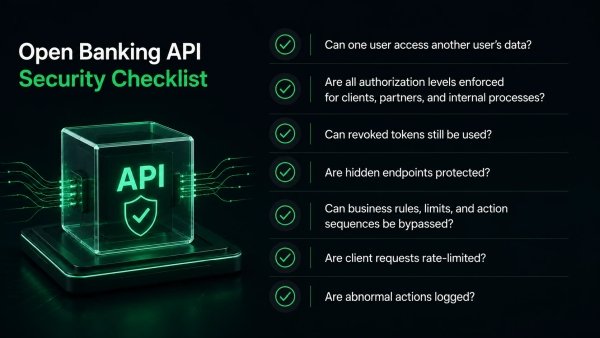
Here's a short checklist for reviewing every external API in your ecosystem:
If you don't have a confident answer to any of these, that's reason enough to look closer.
It's worth telling apart three things that often get lumped together. Vulnerability scanning looks for known vulnerabilities by signature, catching familiar vulnerability classes, common misconfigurations, and known dangerous patterns. Automated testing checks whether the code performs its intended functions correctly. Separate from both is API Penetration Testing (https://datami.ee/services/pentest/api-penetration-testing/) - manual testing in which a specialist plays the role of a real attacker: combining requests, tweaking parameters, hunting for unusual sequences of actions that a scanner, in most cases, won't flag as anomalous, because each individual request looks legitimate on its own.
It's also best if this kind of testing is handled by an external team. In-house specialists tend to know their own API inside and out - and that's precisely what makes it hard for them to spot an unconventional abuse scenario, since day-to-day work with a system's logic doesn't train you to look at it through the eyes of someone deliberately trying to break it. External specialists bring experience from other architectures and payment integrations, so they're more likely to catch the gaps a team had written off as unimportant.
A bank can offer the most convenient digital service and the best partner API on the market. But if even one partner or customer stops trusting the security of the data exchange, the benefits of Open Banking vanish almost instantly. Trust here isn't a bonus feature - it's the baseline condition, and without it the whole structure loses its meaning.
That's why investing in API protection in the financial sector isn't just about regulatory compliance - it's about sustaining trust across the whole ecosystem: between bank and fintech, fintech and customer, and customer and every new service they let into their data.
The National Crowdfunding & Fintech Association (NCFA Canada) is a financial innovation ecosystem that provides education, market intelligence, industry stewardship, networking and funding opportunities and services to thousands of community members and works closely with industry, government, partners and affiliates to create a vibrant and innovative fintech and funding industry in Canada. Decentralized and distributed, NCFA is engaged with global stakeholders and helps incubate projects and investment in fintech, alternative finance, crowdfunding, peer-to-peer finance, payments, digital assets and tokens, artificial intelligence, blockchain, cryptocurrency, regtech, and insurtech sectors. Join Canada's Fintech & Funding Community today FREE! Or become a contributing member and get perks. For more information, please visit: www.ncfacanada.org
| | |
|---|---|---|
| | |
July 27, 2026 | NCFA Insight | Digital Assets Blockchain And Tokenization, Competition And Market Structure, Risk Compliance And Regtech

On July 26, 2026, BitMart began winding down its trading platform. Three days earlier, BitMEX announced its closure after eleven years. AscendEX had already stopped operating on July 1.
Three exchange closures announced or underway inside one month deserve more than a roundup. They raise a harder question around the 2026 bear market. Is it breaking the centralized exchange model, or exposing platforms that had already lost the trading activity, regulatory access or financial capacity needed to keep going?
The public record doesn't support one cause for all three.
The bear market is real, and it strikes at the first line of exchange economics. Trading fees rise and fall with activity. CoinGecko found that spot volume across the ten largest centralized exchanges fell 39.1% in the first quarter of 2026. Its second quarter report recorded a further 27.9% decline to US$1.95 trillion. Perpetual futures held up better, although volume still fell 10% from the prior quarter.
The numbers explain the pressure. They don't explain which exchange closes. The declines among leading spot venues ranged from 5% to 56% in the second quarter, while Binance increased its share to 38.7%. A weak market can therefore strengthen the largest venue at the same time it makes a smaller one uneconomic.
BitMEX is the clearest example. It created the perpetual swap product that became central to crypto trading, yet product invention didn't preserve its liquidity. Kaiko data reported by Reuters put BitMEX below 0.01% market share with roughly US$400,000 in daily volume when the closure was announced. Meanwhile, the ten largest centralized perpetual exchanges still processed US$12.7 trillion in the second quarter. The market BitMEX helped create remained huge, while its position inside it had collapsed.
Liquidity has its own impact. Traders prefer deeper order books, tighter spreads and reliable execution. Market makers follow trading activity, then their capital improves execution and attracts more traders. Once that cycle runs in reverse, adding another token, staking programme or interface may not repair the core business.
Regulation is decisive when it controls market access. Under the MiCA transition rule, a crypto asset service provider that wasn't authorized by the applicable deadline had to stop serving the market until it received authorization. That deadline arrived on July 1, the same day AscendEX ceased operations.
Authorization also carries an operating load. MiCA requires prudential safeguards, governance, internal controls, business continuity planning and security documentation. ESMA's current custody review reaches into key storage, transaction controls, incident response and service provider dependencies. The cost continues after authorization because firms need people, systems and capital while trading revenue can fall quickly.
Regulation is therefore a filter and one part of the explanation. It directly affected AscendEX. Neither BitMEX nor BitMart identified licensing as the cause of its closure. Tighter rules can force a decision or raise the cost of staying open, while weak economics determine how much room a platform has to absorb that cost. NCFA's comparison of MiCA and UK rules shows why regulation can favour companies with stronger governance and compliance infrastructure.
Onchain exchanges are also taking a larger piece of derivatives trading. CoinGecko's perpetuals data shows that the top decentralized venues averaged US$611.6 billion in monthly volume during the first four months of 2026, up from US$531.7 billion in 2025. Their share of open interest reached 13.5% by the end of April, compared with 3.6% at the start of 2025.
Still, centralized exchanges held 86.5% of open interest. Onchain competition is meaningful, especially for active derivatives traders, but it hasn't replaced the centralized model. It has given traders another place to go just as a falling market makes every lost account more expensive.
The closing notices reveal almost as much through their differences as their similarities.
Customers need clear answers about whether their assets are held separately, whether reserves cover liabilities, how open positions will be priced, how quickly withdrawals will be processed and which legal entity is responsible for returning their money.
For founders, exchange businesses needs deep liquidity, active traders who keep coming back, trusted custody and permission to operate in every market it serves. New products and jurisdictions can bring in more revenue, but they also add capital, compliance, security and support costs. Those costs don't disappear when trading activity goes somewhere else.
Investors should watch market share, order book depth, active trader retention, withdrawal performance, reserve and liability reporting, market maker concentration and the status of key licences. Historical user totals can hide a much weaker current business. BitMEX's decline from an industry pioneer to less than 0.01% market share shows just how far activity can fall before an established name finally exits.
Canada uses a different regulatory framework, but the same operating questions apply. Canadian platform rules cover registration, custody and delivery requirements, while Kraken's registration shows the conditions attached to serving Canadian customers. Registration can strengthen oversight and make the rules clearer. It can't remove market, custody or company risk.
So the answer goes beyond “bear market plus regulatory pressure.” Lower prices and weaker trading cut fee revenue. Licensing determines where an exchange can legally operate. Liquidity keeps concentrating around fewer large venues, while onchain platforms compete for active traders. Custody, compliance and security remain expensive throughout. If an exchange loses trading activity, market access or customer confidence, it can run out of room even when the global crypto market remains very large.
When trading volume falls, which exchange numbers tell you whether a platform is temporarily quieter or losing the liquidity, trust and regulatory access it needs to remain viable?
The National Crowdfunding & Fintech Association (NCFA Canada) is a financial innovation ecosystem that provides education, market intelligence, industry stewardship, networking and funding opportunities and services to thousands of community members and works closely with industry, government, partners and affiliates to create a vibrant and innovative fintech and funding industry in Canada. Decentralized and distributed, NCFA is engaged with global stakeholders and helps incubate projects and investment in fintech, alternative finance, crowdfunding, peer-to-peer finance, payments, digital assets and tokens, artificial intelligence, blockchain, cryptocurrency, regtech, and insurtech sectors. Join Canada's Fintech & Funding Community today FREE! Or become a contributing member and get perks. For more information, please visit: www.ncfacanada.org
| | |
|---|---|---|
| | |
July 27, 2026 | NCFA Market Activity | Capital Markets And Market Infrastructure, Wealth Investing And Trading, Banking And Credit

On July 27, 2026, Ontario Teachers’ and M&G agreed to establish a European CLO joint venture. Ontario Teachers’ Pension Plan has agreed to provide up to €200 million for equity investments in future M&G Margay collateralized loan obligation issuances. It will also participate in the long term economics of M&G’s European CLO business.
The second part makes this more interesting than a pension fund buying CLO securities for its portfolio. Ontario Teachers’ is tying capital to future M&G issuances and participating in the long term economics of the platform those transactions can grow. The release doesn’t disclose an ownership stake in M&G itself, the economic formula, governance rights, return targets or the term of the joint venture.
Capital will be deployed transaction by transaction under an agreed investment framework. That gives Ontario Teachers’ room to assess each issuance instead of transferring the entire commitment at closing. For M&G, it provides an aligned source of equity capital that can help the Margay programme issue more CLOs when market conditions and available loans support them.
A CLO buys a diversified pool of corporate loans and finances that pool by issuing layers of debt and equity. M&G says Margay invests in European broadly syndicated loans. Those are loans arranged for larger corporate borrowers and distributed across several institutional lenders.
Cash collected from the loans pays the senior CLO tranches first. The equity tranche sits at the bottom and receives what remains after interest, expenses and required payments have been made. The European Central Bank’s CLO analysis explains the tradeoff clearly where equity has the highest potential return, but it's paid last and absorbs losses first when loans default.
Ontario Teachers’ is therefore accepting more than ordinary bond risk. Returns can benefit when loan income exceeds the cost of the CLO’s debt and credit losses remain contained. They can fall when defaults rise, recoveries disappoint, financing becomes expensive or structural tests redirect cash away from equity investors.
The pension plan says European CLO equity complements and diversifies its existing programme. Europe also gives it a different pool of borrowers, managers and issuance periods. What hasn’t been disclosed is the expected return, how much of the €200 million may be used in each Margay transaction or exactly how the platform economics will be divided.
M&G launched Margay in 2023 and reports €1.6 billion currently in issue. The programme sits inside a €10 billion loan platform, a €27 billion structured and private credit business and M&G’s €93 billion Private Markets business. M&G’s Life business has also invested more than £1 billion in structured credit strategies over time.
Equity capital is essential because every new CLO needs investors willing to take the most junior position. A dependable partner can make future issuance easier to plan, although every transaction still depends on loan availability, funding costs and investor demand for the more senior tranches.
The market is active enough however to support that ambition. European CLO issuance reached €15.9 billion in the first quarter of 2026, up from €14 billion in the previous quarter. CLOs led all placed European securitisation categories during the period.
Other managers are securing similar pools of committed equity:
Sagard | HalseyPoint launched a US$250 million target CLO equity fund for future issuances after Sagard acquired a 40% interest in the manager. Sagard, affiliates, insurers and other institutional investors had committed US$92.5 million at launch.
Oak Hill Advisors closed a US$1.1 billion CLO equity fund in September 2025 with commitments from pension funds, sovereign wealth funds and other institutions. OHA said the capital could support about US$10 billion of CLO deployment.
Columbia Threadneedle entered a multiyear agreement with a Jefferies led investor consortium to supply equity for several CLOs. The structure gave the manager repeat issuance capital rather than funding for only one transaction.
These deals are structured differently, but the managers face the same challenge in that they need investors willing to fund the riskiest part of each new CLO. A strong credit team and a supply of suitable loans aren’t enough without that equity capital. Ontario Teachers is also going a step further. Along with investing in future CLO equity, it will participate in the long term economics of M&G’s European CLO business.
If Margay issues regularly and its loan pools perform, Ontario Teachers’ could earn from both its equity positions and its negotiated participation in the platform. M&G gains a long term institutional partner without receiving the full commitment before suitable transactions are ready.
A slower issuance market may leave part of the commitment unused. Competition for loans can make assets more expensive and reduce the difference between loan income and CLO funding costs. Higher defaults or weaker recoveries reach the equity tranche first. The public announcement also leaves outsiders unable to compare the value of the platform participation with the risk Ontario Teachers’ is taking.
This transaction is aligned with a larger expansion in non bank credit, but the categories need care. Margay’s disclosed collateral consists of broadly syndicated loans, while private credit normally refers to loans negotiated privately between non bank lenders and borrowers. They can share institutional investors and leveraged corporate borrowers without being the same market.
The Bank of Canada recently issued a warning about non bank debt risk. The Bank says Canadian pension fund and insurer exposures to global private credit appear manageable, while limited transparency and growing connections across financial structures still warrant monitoring. The Ontario Teachers’ transaction isn’t evidence of distress. It does show why the ownership, funding and risk links around credit managers are becoming more important to understand.
The commercial trend is already visible across private market platforms. Large investors want more than passive fund exposure, while managers want dependable capital that can support repeat origination or issuance. The open question is whether the added platform economics compensate investors for taking concentrated, junior risk over several market cycles.
Will more pension funds negotiate access to both CLO equity and CLO platform economics, or will first loss risk and tighter returns keep most institutions in individual securities and diversified funds?
The National Crowdfunding & Fintech Association (NCFA Canada) is a financial innovation ecosystem that provides education, market intelligence, industry stewardship, networking and funding opportunities and services to thousands of community members and works closely with industry, government, partners and affiliates to create a vibrant and innovative fintech and funding industry in Canada. Decentralized and distributed, NCFA is engaged with global stakeholders and helps incubate projects and investment in fintech, alternative finance, crowdfunding, peer-to-peer finance, payments, digital assets and tokens, artificial intelligence, blockchain, cryptocurrency, regtech, and insurtech sectors. Join Canada's Fintech & Funding Community today FREE! Or become a contributing member and get perks. For more information, please visit: www.ncfacanada.org
| | |
|---|---|---|
| | |



August 26th, 2025

January 4th, 2024

June 1st, 2021

September 9th, 2020

July 9th, 2018

January 3rd, 2018

September 25th, 2017

June 20th, 2017

May 10th, 2017

December 14th, 2016
