





Karsten Wenzlaff, Advisor
August 26th, 2025
Karsten Wenzlaff is a Crowdfunding and Fintech Expert from Germany. He is Secretary-General of Digit[...]


AI Jobs | Sep 5, 2025

Image: Freepik/Rawpixel.com
On September 4, 2025, Fidji Simo, CEO of Applications at OpenAI announced in a post called, "'Expanding economic opportunity with AI", that it is building an employment platform for AI jobs, designed to connect workers with companies more effectively than traditional hiring tools. It will use AI to match qualified candidates to employers, putting OpenAI in direct competition with Microsoft’s LinkedIn who are the dominant player in online professional networking.
To build trust between workers and employers, OpenAI is expanding its Academy to offer AI fluency certifications. These certifications will range from basic workplace AI use to advanced skills such as prompt engineering.
Training will take place within ChatGPT’s Study mode, which acts like an interactive tutor by asking questions, giving hints, and offering feedback. This training approach is designed to move beyond traditional 'click through' training methods towards real skill-building.
OpenAI’s Academy has already attracted more than two million users and has committed to certifying 10 million Americans by 2030. Launch partners include Walmart, John Deere, Boston Consulting Group, Accenture, Indeed, and several regional organizations such as the Bay Area Council and the Delaware governor’s office.
John Furner, U.S. CEO Walmart explained the company’s involvement:
“By bringing AI training directly to our associates, we’re putting the most powerful technology of our time in their hands—giving them the skills to rewrite the playbook and shape the future of retail.”
The combination of certification and hiring makes OpenAI’s model different from LinkedIn. Employers can recruit with more confidence, knowing that candidates have been assessed for AI fluency. For workers, certifications can translate into higher earning power; a recent Lightcast analysis shows that job postings requiring AI skills offer 28% higher salaries, about $18,000 more annually, compared to those that don’t.
The initiative also fits into wide scale efforts in the U.S. to expand AI literacy. OpenAI is working with the White House Task Force on Artificial Intelligence Education, part of a policy push to prepare workers for the AI economy.
The initiative also aligns with recent U.S. policy. In April 2025, the White House established the Task Force on Artificial Intelligence Education through an executive order, and also see Melania Trump's briefing on September 4 for more context.
OpenAI’s strategy combines upskilling and hiring into one ecosystem, changing how companies can screen and recruit talent. For Canada, the development raises important questions. Will Canadian workers have access to comparable certification programs? Should governments and fintechs create partnerships to ensure the workforce remains competitive? With the U.S. moving quickly to integrate AI literacy at scale, Canada will need to act decisively to avoid falling behind.
 The National Crowdfunding & Fintech Association (NCFA Canada) is a financial innovation ecosystem that provides education, market intelligence, industry stewardship, networking and funding opportunities and services to thousands of community members and works closely with industry, government, partners and affiliates to create a vibrant and innovative fintech and funding industry in Canada. Decentralized and distributed, NCFA is engaged with global stakeholders and helps incubate projects and investment in fintech, alternative finance, crowdfunding, peer-to-peer finance, payments, digital assets and tokens, artificial intelligence, blockchain, cryptocurrency, regtech, and insurtech sectors. Join Canada's Fintech & Funding Community today FREE! Or become a contributing member and get perks. For more information, please visit: www.ncfacanada.org
 |  |  |
|---|---|---|
 |  |  |
Competition | Sep 4, 2025

The most consequential U.S. antitrust case in decades ended without a breakup. On September 2, 2025, Judge Amit Mehta ruled that Google had illegally monopolized search and search advertising markets but rejected the Justice Department’s request to spin off Chrome and Android.
Instead, the $2 trillion company was hit with six years of penalties that ban exclusive defaults, limit contract duration, and require targeted data access for rivals. As CBS news reports, Mehta emphasized the need to “gaze into a crystal ball and look to the future,” saying that conduct, not structure, was the appropriate focus this time.
Evidence showed Google spent more than $26.3 billion in 2021 to lock in default placement on devices and browsers, giving it nearly 90% market share in search. The Justice Department’s remedies announcement emphasized that the following penalties were designed to create a fairer pathway for new entrants into the market.
Judge Mehta penalized this practice by prohibiting contracts that grant exclusivity for Google Search, Chrome, Assistant, or Gemini. Also, revenue share agreements are capped at one year to prevent long term lock-in. These penalties are aimed at restricting contractual strategies that cemented Google’s dominance while still allowing manufacturers and carriers to include Google in non-exclusive deals alongside competitors.
He explained that courts must approach remedies with humility, given the fast pace of AI development, but that limits are necessary to prevent Google from transferring its search dominance into the AI sector. The Reuters summary of the decision confirmed that generative AI competition was central to the court’s reasoning.
The judgment also punishes Google for hoarding data and limiting rivals’ ability to scale. Google must now provide qualified competitors with defined portions of its search index and aggregated user data.
In addition, Google is required to offer both search syndication and search-text-ad syndication, making it possible for smaller firms to build comprehensive services and monetize queries.
Alphabet shares jumped more than 7% in the days following the decision, adding over $200 billion in market value. Apple’s stock also climbed because its profitable arrangement to feature Google as Safari’s default search engine remains intact, though it is no longer exclusive. Analysts described the outcome as pragmatic, combining enforcement with continuity.
As reported by the Guardian, expert reactions show the divide between those who see the penalties as meaningful versus those who view them as insufficient. Antitrust advocates questioned whether limited data access and one year contract caps will significantly weaken Google’s entrenched position.
Attorney General Pamela Bondi praised the decision as an important milestone in protecting consumers.
The September ruling is not the end of Google’s legal troubles. The company faces another remedies trial in Virginia later this year, after a judge found it held an illegal monopoly in ad tech. Perhaps that's one of the motivations behind Google investing $9 billion in cloud and data infrastructure in Virgina.
Additional antitrust cases are in progress against Amazon, Apple, and Nvidia. As analysis of the legal calendar shows, penalties imposed across these cases could redefine how the largest technology companies operate in both the United States and abroad.
Canada’s Competition Bureau is pressing its own case against Google’s advertising technology practices before the Competition Tribunal. Recent changes to the Competition Act expanded private access to the Tribunal and introduced financial remedies, giving publishers, advertisers, and fintech firms stronger tools to pursue claims. The U.S. penalties provide a roadmap for Canadian regulators which may follow as they judge their own enforcement strategies.
Google avoids a disruptive breakup but its ability to rely on exclusivity and hoarded data has been penalized. These changes might gradually lower barriers to entry for startups and create new chances to compete in advertising and AI services.
One of the key lessons for Canada here is that markets dominated by only one or a few players directly impacts the countries competitive balance.
The National Crowdfunding & Fintech Association (NCFA Canada) is a financial innovation ecosystem that provides education, market intelligence, industry stewardship, networking and funding opportunities and services to thousands of community members and works closely with industry, government, partners and affiliates to create a vibrant and innovative fintech and funding industry in Canada. Decentralized and distributed, NCFA is engaged with global stakeholders and helps incubate projects and investment in fintech, alternative finance, crowdfunding, peer-to-peer finance, payments, digital assets and tokens, artificial intelligence, blockchain, cryptocurrency, regtech, and insurtech sectors. Join Canada's Fintech & Funding Community today FREE! Or become a contributing member and get perks. For more information, please visit: www.ncfacanada.org
| | |
|---|---|---|
| | |
Crypto Regulation | Sep 3, 2025

Image: Freepik/DC Studio
On September 2, 2025, Staff from the SEC’s Division of Trading and Markets and the CFTC’s Divisions of Market Oversight and Clearing and Risk issued a joint statement announcing that under existing law registered U.S. exchanges are not prohibited from listing and trading certain spot crypto asset products. The move is tied to the SEC’s Project Crypto and the CFTC’s Crypto Sprint, and follows recommendations from the President’s Working Group on Digital Asset Markets to strengthen U.S. leadership in blockchain innovation and finance.
The statement makes clear that regulated venues such as national securities exchanges, designated contract markets, and foreign boards of trade can facilitate spot crypto trading without new legislation. In doing so, the agencies say they want to provide market participants with more choice and keep blockchain innovation within U.S. borders.
Staff emphasized that this is a nonbinding staff view, and not a rule or regulation, but invited firms to bring filings and proposals for prompt review. The joint effort is aimed at balancing innovation with investor and customer protection.
For market participants, the agencies highlighted several expectations:
According to analysis from Shearman and Sterling, the coordinated message is an important step toward clarity and a more constructive approach by regulators, potentially opening the way for spot digital assets to be listed on traditional U.S. exchanges like NYSE and Nasdaq.
Industry commentary highlight that over 92 crypto ETF applications are already before the SEC, including more than a dozen targeting XRP and other assets, and many of these could benefit directly from the new staff position.
For Canada, this development matters. If major U.S. exchanges begin offering spot crypto products under a coordinated regulatory approach, it will put further pressure on Canadian markets and regulators to keep pace. Canadian fintechs and exchanges would face heightened competition if retail and institutional investors move liquidity south. Without similar clarity, Canadian platforms risk falling behind in attracting capital, innovation, and building global relevance.
The SEC and CFTC’s joint staff statement isn't a new binding law but it sends a clear message that there's room for regulated spot crypto markets in the United States. For entrepreneurs, investors, and regulators in Canada, buckle up because competition in crypto and digital finance markets could anchor the next several years to come.
The National Crowdfunding & Fintech Association (NCFA Canada) is a financial innovation ecosystem that provides education, market intelligence, industry stewardship, networking and funding opportunities and services to thousands of community members and works closely with industry, government, partners and affiliates to create a vibrant and innovative fintech and funding industry in Canada. Decentralized and distributed, NCFA is engaged with global stakeholders and helps incubate projects and investment in fintech, alternative finance, crowdfunding, peer-to-peer finance, payments, digital assets and tokens, artificial intelligence, blockchain, cryptocurrency, regtech, and insurtech sectors. Join Canada's Fintech & Funding Community today FREE! Or become a contributing member and get perks. For more information, please visit: www.ncfacanada.org
| | |
|---|---|---|
| | |
Competition | Aug 28, 2025

On October 8, 2025, the Rotman School of Management will host an in person debate on one of the most contested questions in Canada’s economy: Are Canada’s so called oligopolies standing in the way of a dynamic Canadian economy?
This debate is at the heart of whether concentrated industries in banking, telecom, airlines, and grocery are reducing competition and consumer choice or whether a few large firms are needed to sustain investment in a relatively small market.
Host: Rotman School of Management
Rotman Debate: Are Canada's So-Called "Oligopolies" Holding Us Back?
Date: October 8, 2025
Time/venue: 6:00 PM to 8:00 PM at Desautels Hall
Agenda: Live in-person debate followed by a networking reception
Anthony Durocher, Deputy Commissioner of the Competition Bureau, and Robin Shaban, economist and founder of the Canadian Anti Monopoly Project. They bring a competition policy and inclusive growth lens, pressing the case that concentration stifles productivity and affordability.
They will likely emphasize how concentrated markets in banking, telecom, grocery, and airlines restrict consumer choice, keep prices high, and hurt innovation. Both have deep expertise in competition policy, which will resonate with Canadians worried about affordability, productivity, rising costs, and declining foreign direct investment.
Erin O’Toole, former Leader of the Conservative Party and now President of ADIT North America, and Dany Assaf, co chair of Torys LLP’s competition and foreign investment practice. Their case focuses on the role of scale in driving resilience, capital inflows, and global competitiveness.
Expect them to argue that scale is necessary in Canada’s small market to attract global investment, maintain resilience, and provide stability. O’Toole brings political credibility and public speaking skills, while Assaf brings legal and transactional expertise from landmark competition cases.
The debate will be moderated by Anne Gaviola, senior broadcast journalist at Global News, who has more than 15 years covering Canada’s business and financial sectors.
For the NCFA Canada, this debate could not be more timely. The structure and size of Canada’s markets and levels of competition directly affects opportunities for new entrants in fintech and alternative finance. Concentrated industries can create barriers to entry. With productivity and affordability now central to Canada’s policy agenda, the insights from this debate will be directly relevant for startups, investors, and regulators. This is a ticketed event. Register now to secure your spot.
The National Crowdfunding & Fintech Association (NCFA Canada) is a financial innovation ecosystem that provides education, market intelligence, industry stewardship, networking and funding opportunities and services to thousands of community members and works closely with industry, government, partners and affiliates to create a vibrant and innovative fintech and funding industry in Canada. Decentralized and distributed, NCFA is engaged with global stakeholders and helps incubate projects and investment in fintech, alternative finance, crowdfunding, peer-to-peer finance, payments, digital assets and tokens, artificial intelligence, blockchain, cryptocurrency, regtech, and insurtech sectors. Join Canada's Fintech & Funding Community today FREE! Or become a contributing member and get perks. For more information, please visit: www.ncfacanada.org
| | |
|---|---|---|
| | |
Crypto | Aug 28, 2025

On Aug 26, 2025, the Trump Media & Technology Group, Crypto.com and Yorkville Acquisition Corp (SPAC). announced the launch of Trump Media Group CRO Strategy Inc., a new treasury firm designed to acquire, hold and actively manage large reserves of the Cronos token (CRO).
Devin Nunes, CEO of Trump Media, said:
“We continue to be bullish on cryptocurrency, and we are excited to be partnering with a leading global cryptocurrency platform and namesake of its industry in Crypto.com and one of the most sophisticated investor groups in Yorkville for this strategic initiative.”
The company will go public on Nasdaq under the ticker MCGA. The venture combines 6.3 billion CRO tokens valued at $1 billion (approx 19% of supply)+ $200 million in cash + $220 million in warrants + $5 billion equity line of credit from a Yorkville affiliate YA II PN. In total,$6.42 billion in committed resources.
Trump Media will also buy $105 million worth of cronos for its balance sheet, and Crypto.com has agreed to invest $50 million into Trump Media stock.
All told, the deal will be the first and largest publicly traded CRO treasury company and what is being described as the largest deal ever when compared to the total size of the token’s market. The business combination is being reinforced by a mandatory 1 year lock-up and 3 year release schedule on founding shares. See Form 8-K filing.
Kris Marszalek, CEO of Crypto.com, said:
“The sheer size and structure of this project will encompass more than the entire current market capitalization of CRO … this, combined with share lock-ups by each party and the treasury’s validator strategy, make it a unique and compelling offering compared to all other digital asset treasuries.”
Markets reacted immediately. Cronos spiked nearly 30% in the hours after the news (currently trading at $0.3205 on CoinGecko), while Trump Media’s stock rose 5% to $18.11. Yorkville shares fell 2.4% on the day of the announcement. This is another massive deal for crypto and boost for corporate crypto treasury strategies.
One of the most distinctive aspects of the venture is its validator strategy. Trump Media Group CRO Strategy will establish and operate a validator node on the Cronos network, delegating CRO under management to that node. This allows the company to directly participate in the security and governance of the blockchain while generating native staking rewards that will be reinvested to grow CRO holdings and offset operational expenses.
AP reported that “the Trump family is expanding its crypto empire,” adding to a series of projects that include a proposed bitcoin ETF and a $2 billion bitcoin reserve. With the White House progressing friendly crypto policies, this venture shows how closely aligned political influence and corporate strategy can be, which raises conflict of interest and transparency questions, as Trump’s family business benefits directly from a favourable regulatory climate.
The United States is moving fast with token-backed treasury vehicles and SPAC-financed listings, while Canada’s regulatory approach has been slower and more cautious. In Canada, a deal structured as a SPAC merger with a crypto corporate treasury at its core would likely not pass regulatory muster today.
That's a competitive gap. If American firms can put tokens on their balance sheets, raise capital through SPAC mergers, and connect those tokens to consumer platforms, they can innovate at a scale in a way that Canadian firms cannot match.
The question for Canada is whether to stay on the sidelines or to create the right framework for safe experimentation. That could mean regulatory sandboxes for token-based treasuries, pilot programs to test new structures, or clearer rules that give firms confidence to innovate. Without these kinds of steps, Canada risks falling further behind (skilled jobs, innovation and global capital flows) as U.S. firms set the pace in crypto finance.
The Trump Media and Crypto.com deal is an experiment to see if a token like cronos can play the same role in corporate reserves that bitcoin has for MicroStrategy. Investors jumped in quickly, but the approach still comes with the risks of big price swings and political baggage.
The National Crowdfunding & Fintech Association (NCFA Canada) is a financial innovation ecosystem that provides education, market intelligence, industry stewardship, networking and funding opportunities and services to thousands of community members and works closely with industry, government, partners and affiliates to create a vibrant and innovative fintech and funding industry in Canada. Decentralized and distributed, NCFA is engaged with global stakeholders and helps incubate projects and investment in fintech, alternative finance, crowdfunding, peer-to-peer finance, payments, digital assets and tokens, artificial intelligence, blockchain, cryptocurrency, regtech, and insurtech sectors. Join Canada's Fintech & Funding Community today FREE! Or become a contributing member and get perks. For more information, please visit: www.ncfacanada.org
| | |
|---|---|---|
| | |
Semi Conductor Chips | Aug 25, 2025

Image: Freepik/xb100
On August 22, 2025, Intel announced a historic investment deal with the U.S. government. Washington will convert $8.9 billion of grants from the CHIPS and Science Act and funds awarded under the Secure Enclave program into an equity stake. That adds up to $11.1 billion when combined with earlier support. The U.S. will own almost 10% of Intel through the purchase of 433 million shares at $20.47 each with a five year option to buy more if Intel’s foundry control slips. Intel’s stock rose 5% after the news showing market confidence. The U.S. deal fuses industrial policy, national security, and capital markets.
If Intel executes with strength this deal could become a model for other strategic industries where similar partnerships could emerge, such as in cloud computing, artificial intelligence, and cybersecurity. The U.S. is treating advanced technology as a matter of national security and economic resilience, not just market growth.
But the risks are serious given that preferential government equity can tilt markets. Even without board seats, U.S. national security priorities are likely to influence Intel’s decision-making. Analysis from the WSJ (subscription) spotlights concerns that allies could see this move as protectionist while competitors like China are doubling down on their own state programs. For Intel, receiving public investment capital does not eliminate technical and competitive challenges.
Canada shouldn't miss this message. Our economy depends on digital infrastructure, fintech, and artificial intelligence, yet we are slipping in the basics. Labour productivity fell 1.8% in 2023, the worst among OECD countries according to OECD data. Business R&D intensity has stalled even as total spending reached $53.1 billion in 2023. The Toronto Stock Exchange has seen a collapse in new listings, with the number of operating companies falling 42.5% since 2008. In the first half of 2024 there were only 12 IPOs raising $12.9 million, the weakest in decades.
Retail investors have limited options in Canada with current crowdfunding rules cap issuers at $1.5 million per year and individuals at $2,500 per deal per CSA's NI 45-110, while American policy leaders are advocating to increase U.S. crowdfunding caps from $5M to $10M USD. Meanwhile, open banking is still not live with the government targeting early 2026 for rollout. Canada needs to recognize that leading economies are treating technology as sovereign infrastructure. But our record with national large scale projects from broadband and digital ID to defense procurement is often delayed, underfunded, or misaligned with the original vision.
Canada must respond from a position of strength while recognizing its constraints.
Capital formation is a constant constraint. IPO markets remain weak and the pool of listed operating companies continues to shrink. Without deeper domestic pathways, Canadian innovators will keep looking south. Retail access must expand. Current equity crowdfunding limits are too modest for capital intensive sectors like AI infrastructure, semiconductor packaging, and cybersecurity. Modernize equity crowdfunding and exemption rules to turn Canadians into shareholders in their own innovation economy, not passive taxpayers.
Competition must be unlocked. Canada’s banking market remains highly concentrated, and the continued delay of open banking weakens fintech growth compared to peers already live. Accelerating the rollout with clear liability rules and payments initiation is essential.
Semiconductors require realism. Canada is not building leading edge fabs, but we already host a North American advanced packaging hub at IBM Bromont. Ottawa and Quebec backed upgrades in 2024 and further support is expected. Packaging is becoming a chokepoint as chiplet designs spread across AI systems. Doubling down on this strength could anchor Canada in the supply chains funded by U.S. CHIPS investments.
Intellectual property must be treated as a strategic asset. Canada has a long history of world leading research that too often turns into patents and companies controlled abroad. In AI, for example, Canadian researchers pioneered deep learning yet most of the firms capturing that value are headquartered elsewhere. A national IP strategy that ties public research funding to commercialization in Canada, strengthens IP retention rules, and helps scale ups build patent portfolios would keep more value at home.
Public funds should be linked directly to domestic value creation. The Intel deal shows how governments can require alignment with national goals in exchange for capital. Canada can do the same, not by choosing a single corporate champion but by tying support to measurable outcomes like higher R&D intensity, Canadian patent filings, and stronger Canadian controlled firms.
Talent and immigration must become a growth engine, not just a safety valve. Canada’s immigration system is a global advantage but skilled newcomers too often become employees of foreign firms rather than founders of Canadian ones. Scaling visa programs tied to entrepreneurship and improving access to early stage capital for immigrant founded companies would unlock more homegrown innovation.
The Intel deal shows the world is changing fast. Countries are treating technology as a national asset. Canada must act too, but in our own way. We can rebuild competitiveness not through giant one off bets but by modernizing capital markets, opening doors for retail investors, and backing the companies that will define our digital future. It is a call to seize our strengths and trust Canadians to invest in them. If we act now, Canada can remain a competitive, innovative, and inclusive player in the global economy.
The National Crowdfunding & Fintech Association (NCFA Canada) is a financial innovation ecosystem that provides education, market intelligence, industry stewardship, networking and funding opportunities and services to thousands of community members and works closely with industry, government, partners and affiliates to create a vibrant and innovative fintech and funding industry in Canada. Decentralized and distributed, NCFA is engaged with global stakeholders and helps incubate projects and investment in fintech, alternative finance, crowdfunding, peer-to-peer finance, payments, digital assets and tokens, artificial intelligence, blockchain, cryptocurrency, regtech, and insurtech sectors. Join Canada's Fintech & Funding Community today FREE! Or become a contributing member and get perks. For more information, please visit: www.ncfacanada.org
| | |
|---|---|---|
| | |
Economy and Policy | Aug 25, 2025
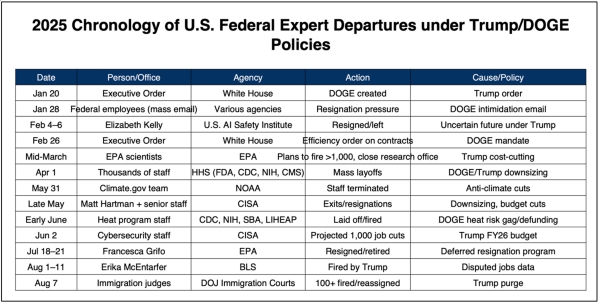
Nearly three decades ago, Carl Sagan warned in The Demon-Haunted World (1996) that when technological power is concentrated in a few hands and public institutions lose expertise, societies risk “sliding, almost without noticing, back into superstition and darkness.”
On Aug 22, 2025, Andrea Bonime-Blanc in a LinkedIn post discusses how recent U.S. federal budget cuts and policy changes are accelerating a “brain drain” of scientific and economic expertise. This article looks at the business impacts and implications for fintech of the significant human capital and policy changes taking place in the U.S. and how Canada and other collaborative countries should be responding.
The departure of experts at the Bureau of Labor Statistics (BLS) erodes confidence in U.S. economic indicators that businesses and markets rely on.
- President Trump fired BLS Commissioner Erika McEntarfer on August 1, 2025 after controversy over jobs report revisions
- The July 2025 jobs report showed 73,000 jobs gained and revisions down of 86,000 in May and 64,000 in June
- In July 2025 only 58% of employers answered the U.S. government’s payroll survey, which normally tracks over 120,000 workplaces. With so few responses, the jobs numbers are less reliable and more likely to be revised
Takeaway: 👉 For fintech lenders and investment platforms that depend on U.S. labor and wage data, model uncertainty and risk costs may increase.
Cuts to cybersecurity agencies increase systemic risk for payments and banking networks, and weaken the ability to build secure AI systems.
In 2025, the main federal agency that protects critical infrastructure including finance, energy, and healthcare, the U.S. Cybersecurity and Infrastructure Security Agency (CISA), had about $3 billion in funding and just over 3,600 staff. These resources cover everything from monitoring threats to helping banks and utilities recover from cyberattacks. Lawmakers are now weighing a $135 million cut to CISA’s 2026 budget or equal to about 4.5% of its funding. On paper it may sound small, but it reduces the agency’s ability to share intelligence, build new defenses, and support partners in both the public and private sectors.
Takeaway: 👉 Reduced federal cyber capacity raises exposure for cross-border fintech systems.
Environmental and climate science cuts reduce access to datasets critical for insurers, lenders, and ESG related products.
- EPA workforce cut from 16,155 in January 2025 to 12,448 , a 23% reduction with closure of its scientific research division
- NOAA terminated staff for its Climate.gov portal on May 31, 2025, halting new content
- NOAA seeks a 17% workforce cut after firing hundreds of probationary employees in early 2025
Takeaway: 👉 For fintech ESG products, fewer trusted U.S. datasets could degrade climate related financial models. Canada can step in with trusted open-data collaborations.
Graduate students and researchers face reduced U.S. funding, pushing talent abroad.
- PBS reports that at least 17 immigration judges were fired across 10 states in July 2025, adding delays to skilled worker case processing
Takeaway: 👉 Processing delays affect STEM talent inflows. Canada could capture this talent to strengthen fintech innovation by accelerating recruitment by offering scholarships, innovation hub partnerships, and fast-track visas.
Federal compliance and AI governance structures are weakening, raising trust issues.
- Elizabeth Kelly the inaugural director of the U.S. AI Safety Institute departed in February 2025 leaving a leadership vacuum
Takeaway: 👉 With U.S. leadership unsettled, Canada and the EU can shape AI assurance frameworks for fintech. Canadian regtech firms are well positioned to step up and help lead.
Canada needs to open up the country as a trusted hub for financial data integrity, cyber resilience and AI governance by focusing on the following practical steps:
- Map out data sources and diversify away from over reliance on U.S. federal inputs
- Invest in AI enabled cybersecurity and fraud detection systems
- Explore alternative and open-source data partnerships to fill data gaps (NGOs, universities, private market collaborations)
- Support STEM students and researchers displaced by U.S. funding cuts
- Build compliance and governance tools that embed transparency into fintech systems
The U.S. brain drain is visible in staff firings, layoffs, budget cuts and agency closures and contractions. Carl Sagan’s caution from 1996 reminds us that losing expertise erodes both science and democracy. By investing in data integrity, global standards, and fintech innovation, Canada can transform today’s U.S. retreat into a foundation for stronger, competitive growth. This is a chance for Canada to step up and lead.
The National Crowdfunding & Fintech Association (NCFA Canada) is a financial innovation ecosystem that provides education, market intelligence, industry stewardship, networking and funding opportunities and services to thousands of community members and works closely with industry, government, partners and affiliates to create a vibrant and innovative fintech and funding industry in Canada. Decentralized and distributed, NCFA is engaged with global stakeholders and helps incubate projects and investment in fintech, alternative finance, crowdfunding, peer-to-peer finance, payments, digital assets and tokens, artificial intelligence, blockchain, cryptocurrency, regtech, and insurtech sectors. Join Canada's Fintech & Funding Community today FREE! Or become a contributing member and get perks. For more information, please visit: www.ncfacanada.org
| | |
|---|---|---|
| | |



August 26th, 2025

January 4th, 2024

June 1st, 2021

September 9th, 2020

July 9th, 2018

January 3rd, 2018

September 25th, 2017

June 20th, 2017

May 10th, 2017

December 14th, 2016
