




Karsten Wenzlaff, Advisor
August 26th, 2025
Karsten Wenzlaff is a Crowdfunding and Fintech Expert from Germany. He is Secretary-General of Digit[...]


Mar 25, 2026 | NCFA Insight | Regulation And Policy, Capital Markets And Market Infrastructure
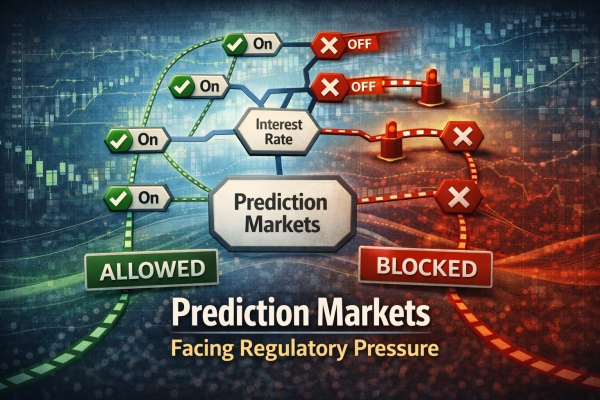
Sports volume built the business. Now rules, surveillance, and product limits will decide who lasts. On March 23, 2026, a bipartisan Senate bill moved to ban sports and casino style contracts on CFTC registered prediction market venues. The Senate release said a March Madness winner contract had already passed $100M in trading volume and that Super Bowl prediction market volume topped $1B in 2026.
Those numbers explain why prediction markets are now under direct pressure from lawmakers. Prediction markets are no longer fringe. They now sit in a fight over who regulates them, which contracts stay allowed, and whether the business still works under tighter rules.
Sports helped prediction markets reach a wide audience fast, but that same growth put them in direct competition with state regulated sportsbooks and tribal gaming interests. The Prediction Market Senate bill to ban sports contracts is aimed straight at that overlap. It would prohibit any CFTC registered entity from listing contracts that closely resemble a sports bet or a casino style game. If it advances, sports contracts would be the first part of the business to take a hit. That in itself wouldn't kill prediction markets, but it would force a reset around contracts that look more like economic, financial, or commercial forecasting and less like entertainment wagering.
Sports contracts brought scale, attention, and league partnerships. NCFA looked at that earlier when the NHL partnered with Kalshi and Polymarket. Sports now look like the part of the business most likely to trigger a stronger federal and state response.
Polymarket and Kalshi tightened their controls on the same day. On March 23, Polymarket tightened its market integrity rules across both its DeFi venue and its CFTC regulated US exchange. The updated rules ban trading on stolen confidential information, illegal tips, and outcomes a trader can influence.
Kalshi added candidate and athlete trading bans covering political candidates, athletes, referees, coaches, and team staff, and introduced a whistleblower feature to tighten insider risk controls.
These aren't minor changes. They prove Kalshi and Polymarket understand that insider risk is now a live issue. Prediction markets want to be treated as financial infrastructure, but financial infrastructure has to show it can police insiders, document rules, and respond fast when abuse appears. NCFA covered that tension earlier when prediction markets started pricing geopolitical events.
Canada is taking a narrower approach. The Globe and Mail reported today that Wealthsimple cleared a regulatory hurdle to offer forecast contracts in Canada, but only for economic indicators, financial markets, and climate trends. Sports and election contracts are out. Wealthsimple is the second firm to receive this approval in Canada, after Interactive Brokers Canada.
Interactive Brokers Canada has positioned contracts around government, economic, finance, and climate events, not sports books in a different wrapper. The product is already live in Canada on that basis.
Wealthsimple now brings local retail distribution, stronger brand reach, and a better chance of testing whether forecast contracts can find a market here without leaning on the sports volume that pushed the US fight into the open.
Can a prediction market still grow once sports contracts face a ban, insider screening gets tighter, and compliance costs rise? Some firms may adapt by leaning into macro, rates, inflation, climate, earnings, and other information markets. Others may find that the most profitable contracts were also the ones most likely to trigger a crackdown.
The CFTC is also reviewing the rules. On March 12 2026, the CFTC opened an Advance Notice of Proposed Rulemaking on prediction markets and asked for public comment on which event contracts may be contrary to the public interest, how current rules apply, and what changes may be needed. That means this fight is not limited to one Senate bill or one week of headlines. The federal rule in the U.S. is now under review.
For Canadian dealers, fintechs, and market operators, there is room to build forecast products here, but the lane is narrower than in the US.
Prediction markets already proved they can attract users and volume. The next test is whether prediction markets can still grow once product limits tighten, regulators draw a harder line around what is allowed, and compliance demands rise.
 The National Crowdfunding & Fintech Association (NCFA Canada) is a financial innovation ecosystem that provides education, market intelligence, industry stewardship, networking and funding opportunities and services to thousands of community members and works closely with industry, government, partners and affiliates to create a vibrant and innovative fintech and funding industry in Canada. Decentralized and distributed, NCFA is engaged with global stakeholders and helps incubate projects and investment in fintech, alternative finance, crowdfunding, peer-to-peer finance, payments, digital assets and tokens, artificial intelligence, blockchain, cryptocurrency, regtech, and insurtech sectors. Join Canada's Fintech & Funding Community today FREE! Or become a contributing member and get perks. For more information, please visit: www.ncfacanada.org
 |  |  |
|---|---|---|
 |  |  |
March 24, 2026
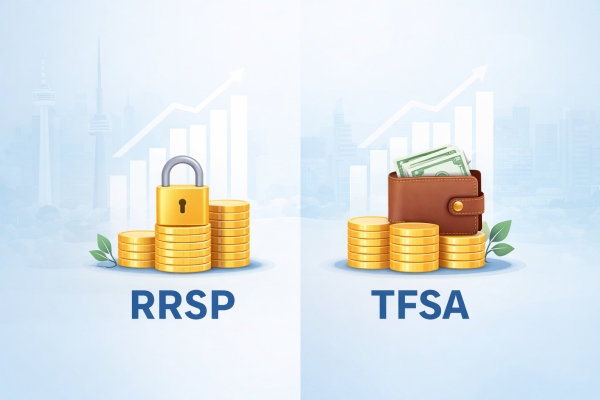
If you're a high-earning Canadian trying to build wealth, you've likely been told to "max out your RRSP" or "use your TFSA first." The advice often sounds definitive - but rarely accounts for your actual situation. Both accounts offer powerful tax advantages, yet they work in fundamentally different ways. Choosing between them isn't just a tax question; it's a behavioral and strategic one that depends on your income trajectory, spending patterns, and psychological relationship with money.
Understanding how RRSPs and TFSAs actually function - and how your brain responds to each - can help you make smarter decisions that stick.
The Registered Retirement Savings Plan (RRSP) is a tax-deferred account. Contributions reduce your taxable income in the year you make them, and your investments grow tax-free inside the account. You pay tax only when you withdraw, ideally in retirement when your income - and tax rate - are lower. For 2024, the contribution limit is 18% of your previous year's earned income, up to $31,560. [1]
The Tax-Free Savings Account (TFSA) works differently. You contribute with after-tax dollars - no immediate deduction - but all growth and withdrawals are completely tax-free, forever. The 2024 contribution limit is $7,000, with cumulative room of $95,000 if you've been eligible since the TFSA launched in 2009. [2]
Both accounts shelter investment gains from annual taxation, which is their shared superpower. The difference lies in when you pay tax and how withdrawals affect your future finances.
The classic rule of thumb: if your tax rate is higher now than it will be in retirement, the RRSP wins. If your rate will be the same or higher later, the TFSA is better. [3]
For high earning $150,000+ in provinces like Ontario, the combined federal-provincial marginal rate can exceed 43%. [4] An RRSP contribution at that rate delivers an immediate, substantial tax refund. If you withdraw in retirement at a 30% rate, you've effectively earned a permanent tax arbitrage.
But here's where it gets nuanced. RRSP withdrawals count as income, which can trigger clawbacks of Old Age Security (OAS) benefits and affect other income-tested programs. The OAS recovery tax kicks in once your income exceeds approximately $90,000, reducing benefits by 15 cents for every dollar over the threshold. [5]
TFSA withdrawals, by contrast, are invisible to the tax system. They don't affect OAS, GIS, or any means-tested benefit. For retirees who want flexibility and predictability, this can be worth more than the upfront RRSP deduction. [6]
Tax optimization assumes you'll actually invest the RRSP refund - not spend it. Research on windfall spending shows that unexpected money, including tax refunds, is often treated as "found money" and spent rather than saved. [7]
If you contribute $10,000 to your RRSP and receive a $4,000 refund, the math only works if that $4,000 goes back into investments. If it funds a vacation or lifestyle upgrade, you've diluted the RRSP's advantage significantly.
There's also the mental accounting problem. Behavioral research shows that people treat money differently depending on which "mental account" it sits in. [8] RRSP funds feel locked away (and largely are, due to withholding taxes on early withdrawal), which can be protective. TFSA funds feel more accessible, which can lead to premature withdrawals for non-emergencies.
Research from the Financial Consumer Agency of Canada found that many TFSA holders use their accounts primarily for short-term savings rather than long-term investing - missing the compounding benefits the account was designed for. [9]
Rather than treating this as an either/or question, most HENRYs benefit from using both accounts strategically. Here's a simplified decision framework:
Prioritize RRSP when: your marginal tax rate is high (above 40%), you're confident your retirement rate will be lower, and you have the discipline to reinvest the refund. Also consider RRSP contributions if you're planning to use the Home Buyers' Plan (HBP), which allows first-time buyers to withdraw up to $60,000 tax-free for a home purchase. [10]
Prioritize TFSA when: you're in a lower tax bracket now but expect higher earnings later, you want flexibility for mid-life goals (since withdrawals don't trigger tax or penalties), or you're already maximizing RRSP contributions and have additional savings capacity.
Use both when: you can afford to maximize contributions to each. The combined annual room (RRSP + TFSA + the newer FHSA for first-time home buyers) can exceed $40,000 - a powerful wealth-building engine if used consistently. [11]
Contributing to RRSP in a low-income year. If you're between jobs or earning less than usual, the deduction is worth less. Consider contributing to your TFSA instead and saving RRSP room for higher-earning years.
Ignoring employer matching. If your employer offers RRSP matching, that's an immediate 50–100% return on your contribution. Always capture the full match before directing money elsewhere.
Using TFSA as a savings account. Parking TFSA funds in a low-interest savings account wastes the tax shelter. Long-term data shows that diversified equity portfolios dramatically outperform cash over decades - and the TFSA's tax-free growth makes it ideal for higher-return investments. [12]
Over-contributing. The CRA charges a 1% monthly penalty on excess TFSA contributions. Track your room carefully, especially if you've made withdrawals (which restore room the following year, not immediately).
How PsyFi helps you optimize - and stick with - your strategy
Knowing the difference between RRSPs and TFSAs is one thing. Consistently making the right contributions - and avoiding the behavioral traps that derail good intentions - is another.
Personalized nudges: Reminders to contribute before deadlines, prompts to reinvest refunds, and alerts when you're approaching contribution limits.
Behavioral insights: Understand your money personality and how it affects decisions like "Should I tap my TFSA for this expense?"
Progress tracking: See how your registered accounts are growing over time, with visual cues that reinforce consistent behavior.
The best tax strategy is the one you actually follow. https://www.psyfiapp.com/ helps make that easier.
3: https://www.wealthsimple.com/en-ca/learn/rrsp-vs-tfsa
4: https://www.taxtips.ca/taxrates/on.htm
6: https://www.wealthsimple.com/en-ca/learn/oas-clawback-explained
7: https://www.nber.org/digest/mar09/did-2008-tax-rebates-stimulate-spending
8: https://www.behavioraleconomics.com/resources/mini-encyclopedia-of-be/mental-accounting/
12: https://www.rbcgam.com/en/ca/learn-plan/investment-basics/the-hidden-cost-of-too-much-cash/detail
The National Crowdfunding & Fintech Association (NCFA Canada) is a financial innovation ecosystem that provides education, market intelligence, industry stewardship, networking and funding opportunities and services to thousands of community members and works closely with industry, government, partners and affiliates to create a vibrant and innovative fintech and funding industry in Canada. Decentralized and distributed, NCFA is engaged with global stakeholders and helps incubate projects and investment in fintech, alternative finance, crowdfunding, peer-to-peer finance, payments, digital assets and tokens, artificial intelligence, blockchain, cryptocurrency, regtech, and insurtech sectors. Join Canada's Fintech & Funding Community today FREE! Or become a contributing member and get perks. For more information, please visit: www.ncfacanada.org
| | |
|---|---|---|
| | |
Mar 23, 2026 | NCFA Fintech Market Activity | Venture Funding And Building

Image: Freepik
On March 23, 2026, BKR Capital announced a $20M first close for Black Innovation Fund II, with a final target of $50M. The first close includes backing from RBC, Boann Social Impact Fund, Cap Finance Social Finance Fund, BDC, and EDC.
BKR also said its first fund invested in 15 technology companies and is tracking as a top quartile performer for its vintage.
The release puts a hard number on the market gap. BKR said only 0.15% of venture capital deployed in Canada in 2025 went to Black founders. That is the core fact in this story. A second institutional fund is being raised into a market where founder supply exists, but early capital allocation remains extremely thin. The first close is aligned with a wider government effort to expand access to capital, including Canada’s renewed $189M Black Entrepreneurship Program.
Lissa Bjerkelund, Vice-President and Head of Investments at EDC:
"Supporting Canadian companies as they expand into global markets is critical in today's economic environment, and our investment in this fund speaks to our commitment to helping level the playing field for Black-owned businesses to access the capital they need to fuel their growth."
Isaac Olowolafe, General Partner at BKR Capital said there was “a powerful investment opportunity hiding in plain sight,” while Lise Birikundavyi, Co-Founder and Managing Partner at BKR Capital said “the strong financial performance of our first fund confirms what we have always known.” BKR is not pitching this as a social side pocket. It is arguing that Canada continues to misprice a real venture pipeline.
That raises a more direct capital formation question. If Fund I has already reached 15 companies and BKR says it is tracking as a top quartile performer, what keeps more institutional capital from moving sooner into managers and founder segments that the market still underfunds?
BKR’s first close also includes BDC, which lines up with a broader push toward more inclusive capital formation in Canada, including BDC’s $250M commitment to inclusive entrepreneurship.
If the founder pipeline is there and the performance case is strengthening, what still stops more Canadian institutional capital from moving earlier and at larger scale?
The National Crowdfunding & Fintech Association (NCFA Canada) is a financial innovation ecosystem that provides education, market intelligence, industry stewardship, networking and funding opportunities and services to thousands of community members and works closely with industry, government, partners and affiliates to create a vibrant and innovative fintech and funding industry in Canada. Decentralized and distributed, NCFA is engaged with global stakeholders and helps incubate projects and investment in fintech, alternative finance, crowdfunding, peer-to-peer finance, payments, digital assets and tokens, artificial intelligence, blockchain, cryptocurrency, regtech, and insurtech sectors. Join Canada's Fintech & Funding Community today FREE! Or become a contributing member and get perks. For more information, please visit: www.ncfacanada.org
| | |
|---|---|---|
| | |
Mar 24, 2026 | NCFA Fintech Market Activity | Payments And Money Movement

On March 23, 2026, Deloitte Canada and Stablecorp launched a QCAD infrastructure collaboration for Canadian financial institutions. Deloitte identified QCAD as a “first-to-market Canadian compliant” stablecoin and linked the collaboration to expected progress on Canada’s federal stablecoin framework and Bill C-15.
The release targets major financial institution clients and positions the offer around payment, value transfer, traceability, and operational efficiency. Deloitte also ties the work to meet the demands of a “24/7 economy” where projects operate real world payment, treasury, and settlement use cases rather than retail crypto activity.
Soumak Chatterjee, Deloitte partner said:
“Stablecoins present a significant opportunity for Canada’s payments landscape. This collaboration helps us enable capabilities that are critical for our banking sector to lead this change, unlock greater innovation in Canadian payments, and ensure global competitiveness. We’re excited to work with Stablecorp to drive impact for our clients and the broader Canadian financial services industry.”
This is a major advisory and implementation firm putting Canadian dollar stablecoin infrastructure in front of institutional clients now, not waiting for the market to mature on its own.
QCAD has been pursuing institutional use for some time, from a banking relationship with VersaBank to Stablecorp’s $5M+ raise. The Deloitte collaboration brings that effort closer to financial institution implementation.
For banks, credit unions, payment processors, treasury platforms, and enterprise fintechs, the pressure point is implementation. If regulated institutions start adopting CAD stablecoin rails through established integration and scale partners, the advantage moves to the firms that handle the setup, compliance work, workflow integration, and client access.
If QCAD enters institutional payment and treasury workflows through established implementation channels, who captures the long term value in Canada: the issuer, the integrator, or the platform that owns client distribution?
The National Crowdfunding & Fintech Association (NCFA Canada) is a financial innovation ecosystem that provides education, market intelligence, industry stewardship, networking and funding opportunities and services to thousands of community members and works closely with industry, government, partners and affiliates to create a vibrant and innovative fintech and funding industry in Canada. Decentralized and distributed, NCFA is engaged with global stakeholders and helps incubate projects and investment in fintech, alternative finance, crowdfunding, peer-to-peer finance, payments, digital assets and tokens, artificial intelligence, blockchain, cryptocurrency, regtech, and insurtech sectors. Join Canada's Fintech & Funding Community today FREE! Or become a contributing member and get perks. For more information, please visit: www.ncfacanada.org
| | |
|---|---|---|
| | |
Mar 23, 2026 | NCFA Insight | Capital Markets And Regulation

On Mar 22, 2026, a jury verdict found that Elon Musk's public tweets during the 2022 Twitter takeover fight misled investors. The jury didn't find an intentional fraud scheme, but the plaintiff's lawyers said damages total about $2.6B. The verdict puts more weight behind a growing problem that fintech founders, platforms, and financial brands already face every day. A high profile post can move money before anyone inside the firm has time to slow it down.
The verdict doesn't mean Musk is on the hook for writing a $2.6B cheque (just yet). The jury found liability on specific statements, and the estimated damages reflects the plaintiffs’ claim based on investor losses during the period in question. The final amount still depends on post trial motions and potential appeals. That process can take time and could change the outcome.
The reality is finance no longer only runs through filings, earnings calls, and official statements. It's found it's way to X posts, podcasts, YouTube clips, founder interviews, affiliate campaigns, and finfluencer content. Markets now react to all of it. Investors don't stop to verify if a message came from investor relations, legal, or a even a founder’s phone. They see a statement, they price it in, and capital follows.
The same pressure is already building in Canada. NCFA has been tracking how regulators are tightening expectations around online financial promotion, including new guidance on digital investing content and supervision and increasing enforcement around undisclosed promotion. The direction is consistent. Online influence is now being monitored and part of the regulatory perimeter.
Why? Investor behaviour has already changed. Research cited in Canadian retail investor trends on social media shows that 53% of investors use social platforms for investment information, rising to 82% among those aged 18 to 24. It also shows that 35% have acted on that content.
That means there's no question that online content affects markets. The issue now is control. Who reviews what gets said, and how quickly the firm can step in before a post starts affecting investors.
Many fintech firms still treat public communication as a branding issue first and a control issue second. A founder post about a funding round, a growth number, a partnership, a token plan, or a future launch can change expectations long before the business is ready to support the claim. In public markets that creates obvious exposure. In private markets it can still distort trust, fundraising, customer decisions, and partner behaviour.
Top firms will respond to these realities by tightening how they handle high impact communication. They'll get sharper, not quiet. They will know which claims need evidence, which messages need review, and which topics should never go out in casual language. And they'll stop pretending that online distribution isn't a compliance item just because it feels informal or fast.
A jury has now linked informal public statements to investor harm in a way that carries financial consequences. That raises the standard for how founders, executives, and financial brands handle any communication that can influence investor decisions.
The National Crowdfunding & Fintech Association (NCFA Canada) is a financial innovation ecosystem that provides education, market intelligence, industry stewardship, networking and funding opportunities and services to thousands of community members and works closely with industry, government, partners and affiliates to create a vibrant and innovative fintech and funding industry in Canada. Decentralized and distributed, NCFA is engaged with global stakeholders and helps incubate projects and investment in fintech, alternative finance, crowdfunding, peer-to-peer finance, payments, digital assets and tokens, artificial intelligence, blockchain, cryptocurrency, regtech, and insurtech sectors. Join Canada's Fintech & Funding Community today FREE! Or become a contributing member and get perks. For more information, please visit: www.ncfacanada.org
| | |
|---|---|---|
| | |
Mar 23, 2026 | NCFA Insight | AI Policy And Regulation

On Mar 20 2026, the White House released a national AI policy framework and legislative recommendations that asks Congress to build a single federal approach to AI and limit conflicting state laws. Washington looks to reduce regulatory fragmentation before state level AI rules harden into a patchwork. The framework isn't law but a blueprint for Congress to show where U.S. AI policy is heading and what type of rules the White House thinks are needed to support large scale use of artificial intelligence across the economy.
The document argues that state by state AI rules can impose uneven burdens on firms trying to build and deploy AI systems nationally. The White House position is that Congress should set the main framework and stop conflicting state rules from slowing deployment. At this point, it's less about creating a new AI regulator and more about stopping fifty different rulebooks from becoming the default U.S. model.
The framework highlights six areas: child protection, energy and electricity costs, intellectual property, free expression, public education and workforce readiness, and maintaining U.S. leadership in AI.
Policymakers want to lower friction for deployment while demonstrating that safety and public concerns are still being addressed. It's a delicate balance because it tells the market what the White House sees as the main tradeoff. The focus is not on building a heavy new AI rule set, but rather on enabling scale, lowering infrastructure bottlenecks, and avoiding fragmented oversight.
AI is already proliferating across lending, fraud detection, compliance, payments, customer operations, and model driven decisioning. A patchwork of state by state compliance would raise cost, slow deployment, and make national rollout harder for both incumbents and startups.
A single federal framework wouldn't solve every issue. Questions around accountability, model assurance, liability, and sector specific supervision would still remain. But it would remove a major barrier by making it easier to roll out AI across the United States.
The U.S. approach is mainly about fragmentation. The White House wants one national frame instead of competing state level rules.
The UK conversation is more operational. The FCA’s Mills Review asks how AI could impact retail financial services through 2030 and beyond. Industry responses focus more directly on deployment barriers inside finance, including data access, Digital ID, payments infrastructure, and rulebook friction.
Canada is taking a broader path. The federal government’s AI strategy process gathered input from more than 11,000 Canadians and 28 task force members, with stronger emphasis on trust, safety, responsible adoption, and national direction. NCFA has already flagged the execution risk in this approach in its analysis of Canada’s AI strategy and capital flight risk.
The difference is important. The U.S. is trying to stop fragmentation. The UK is pressing on execution barriers. Canada is still nuturing national direction. Each approach points to a different policy priority and will result in a different speed of deployment and potential competitive advantage (or disadvantage).
Jurisdictions that reduce friction and create usable operating environments will attract more investment, deployment, and talent. Jurisdictions that let regulatory complexity pile up will throttle adoption even when the technology is ready.
The White House's AI policy framework makes the federal direction clearer. The U.S. is trying to stop state level fragmentation before it becomes the default AI regime. It's important for fintechs and financial services because the level of scale, cost, and deployment speed depends heavily on whether one federal rulebook replaces fifty competing ones.
The National Crowdfunding & Fintech Association (NCFA Canada) is a financial innovation ecosystem that provides education, market intelligence, industry stewardship, networking and funding opportunities and services to thousands of community members and works closely with industry, government, partners and affiliates to create a vibrant and innovative fintech and funding industry in Canada. Decentralized and distributed, NCFA is engaged with global stakeholders and helps incubate projects and investment in fintech, alternative finance, crowdfunding, peer-to-peer finance, payments, digital assets and tokens, artificial intelligence, blockchain, cryptocurrency, regtech, and insurtech sectors. Join Canada's Fintech & Funding Community today FREE! Or become a contributing member and get perks. For more information, please visit: www.ncfacanada.org
| | |
|---|---|---|
| | |
March 20, 2026 | NCFA Fintech Whisperer Weekly Intelligence | Digital Assets Blockchain And Tokenization, Capital Markets And Market Infrastructure, Regulation And Policy, Payments And Market Infrastructure

Image: Freepik
This live weekly NCFA intelligence page tracks financial technology developments that significantly affect how fintechs build, sell, raise capital, and operate under scrutiny. Coverage prioritizes Canada and includes global events that directly influence competitive conditions, market access, and execution realities across fintech sectors. This page will be updated throughout the week with market movers in a live format and then each week we'll close the prior week's contents in prep for the upcoming week, and continue on a rolling basis. (Missed prior week's Fintech Whisperer? (December 6-12, 2025, December 13-19, 2025, January 1-9, 2026, January 10-16, 2026, January 17-23, 2026, January 24-30, 2026, January 31-February 6, 2026, February 7-13, 2026, February 14-20, 2026, February 21-27, 2026, February 28-March 6, 2026, March 7-13, 2026).
This adds a new regulated counterparty node for banks, payment partners, and fintech vendors that use CIRO membership as a gating factor for onboarding, integrations, and supervised operating scope.
This puts fund distribution onchain with rules built into the asset. Transfers can enforce who can hold and trade without separate manual checks. That changes how funds issue, manage investors, and handle transfers. It points to tokenized fund infrastructure moving into live use, not pilots.
This affects crypto trading platforms, market makers, treasury teams, and regulators watching stablecoin market structure in Canada. Lower margin on eligible inventory can improve capital efficiency and balance sheet use, but only inside a tighter control framework. It means regulated treatment of stablecoins is moving deeper into prudential design, not just disclosure and registration.
A core global index now trades outside exchange hours. Price formation can start on crypto venues before futures markets reopen, which puts pressure on where liquidity shows up first. If activity builds on chain, traditional venues risk reacting instead of leading. For brokerages, exchanges, and market infrastructure providers, this is not theoretical. Firms need to decide whether to support 24/7 access, how to manage risk when markets never close, and how to compete with venues that remove time and geographic limits.
Crypto issuers, exchanges, custodians, brokers, investors, and token builders now have a clearer US reference point for token design, disclosures, and jurisdiction planning. The practical implication is significant. Firms exposed to staking, airdrops, wrapped assets, stablecoins, or token distribution models can reassess compliance, product structure, and market access strategy with more precision across SEC and CFTC lines.
This is for banks, lenders, treasury teams, and fintechs that rely on bank balance sheets and bank distribution. Capital rules affect lending capacity, pricing, and risk appetite. A lighter or more targeted framework can change how banks allocate capital and where they are willing to compete.
Banks facing margin pressure, conduct costs, and weak returns are under more pressure to lower their operating base faster. The practical implication for lenders, fintechs, and banking vendors is that AI and automation are moving from pilot projects into cost and staffing decisions. Firms that can automate servicing, operations, and control workflows without weakening customer outcomes or compliance will be in a stronger position.
This gives UK facing fintechs and suppliers a cleaner map of where supervisors focus and where firms should spend compliance and product time. Payments, retail banking, consumer finance, and wholesale market firms can now align internal control roadmaps to sector specific priorities instead of broad portfolio letters, which tightens how boards and senior managers justify investment decisions.
Federal procurement remains difficult for new entrants to access, with complexity and restrictive design favouring repeat suppliers. At the same time, the report outlines clear changes that could open participation, improve competition, and expand access for fintech, govtech, and smaller vendors seeking to sell into government.
China is widening the distribution base for state digital money inside the banking system. Analysts see the bigger role in cross-border settlement and in building a payments channel that's outside dollar-based infrastructure such as SWIFT. China is pushing public digital money deeper into bank distribution while closing space for private stablecoin models.
This expands direct access for credit unions that want to build or buy modern payment capabilities. Credit unions, processors, and fintech partners can now plan for real system participation, not just eligibility on paper.
This is for banks, cross-border payment firms, remittance providers, treasury teams, and stablecoin infrastructure players. Stablecoin payouts are moving closer to standard bank payment flows instead of sitting outside them as a separate integration project. That lowers friction for bank adoption and puts more pressure on legacy cross-border payout models.
Mastercard is building direct control over how funds move between bank accounts and stablecoin systems. That changes routing, pricing, and who captures value in cross border and treasury flows. For fintechs, payment products will increasingly need to support both fiat and digital settlement paths in the same workflow. For banks, this puts more pressure on correspondent banking and other legacy cross border revenue lines.
This changes how investor harm connects to enforcement outcomes. Dealers, registrants, and their vendors now need tighter client records and cleaner evidence trails because the process depends on what harmed investors can prove and what firms can produce quickly and accurately when claims arrive.
This lowers reporting cost and workload for smaller public companies. It changes how often new financial data enters the market. Investors and data platforms will have less frequent updates. For issuers, this improves the economics of staying public. If adopted more widely, it moves Canada toward a lighter reporting model for venture markets.
Industry participants are pushing to remove limits that keep tokenized market infrastructure in pilot mode. That pressure targets how quickly the EU can move from controlled testing toward scalable digital asset markets.
Tokenized securities into the core of exchange trading. They will trade the same way as regular shares, on the same book, with the same symbol and rules. No separate venue, no parallel system. It removes a major barrier with tokenization now aligned with the same clearing, settlement, and surveillance systems as the rest of the market.
A forward flow commitment supports predictable loan takeout capacity, which can stabilize origination volume when bank balance sheets tighten or pricing changes.
Public companies, investors, analysts, and fintech platforms that rely on earnings data will face longer gaps between official disclosures. Less frequent reporting reduces the flow of standardized financial data into the market. Firms that can generate alternative data, continuous signals, and independent performance insight will have an advantage as reliance on scheduled earnings reports declines.
When one of India's largest fintech payments company pauses an IPO, it tells founders, investors, and late stage boards that the public market window remains fragile. That affects valuation expectations, liquidity planning, and timing for other fintech listings.
NCFA offers various curated resources to help founders and investors stay current on developments that impact fintech markets, subscribe to NCFA weekly newsletter updates, view a rundown of current fintech news and insights, or dive into the latest fintech industry research.
The National Crowdfunding & Fintech Association (NCFA Canada) is a financial innovation ecosystem that provides education, market intelligence, industry stewardship, networking and funding opportunities and services to thousands of community members and works closely with industry, government, partners and affiliates to create a vibrant and innovative fintech and funding industry in Canada. Decentralized and distributed, NCFA is engaged with global stakeholders and helps incubate projects and investment in fintech, alternative finance, crowdfunding, peer-to-peer finance, payments, digital assets and tokens, artificial intelligence, blockchain, cryptocurrency, regtech, and insurtech sectors. Join Canada's Fintech & Funding Community today FREE! Or become a contributing member and get perks. For more information, please visit: www.ncfacanada.org
| | |
|---|---|---|
| | |


August 26th, 2025

January 4th, 2024

June 1st, 2021

September 9th, 2020

July 9th, 2018

January 3rd, 2018

September 25th, 2017

June 20th, 2017

May 10th, 2017

December 14th, 2016