





Karsten Wenzlaff, Advisor
August 26th, 2025
Karsten Wenzlaff is a Crowdfunding and Fintech Expert from Germany. He is Secretary-General of Digit[...]


August 20, 2026 | NCFA Resource | Payments And Money Movement, Banking And Credit, Financial Inclusion
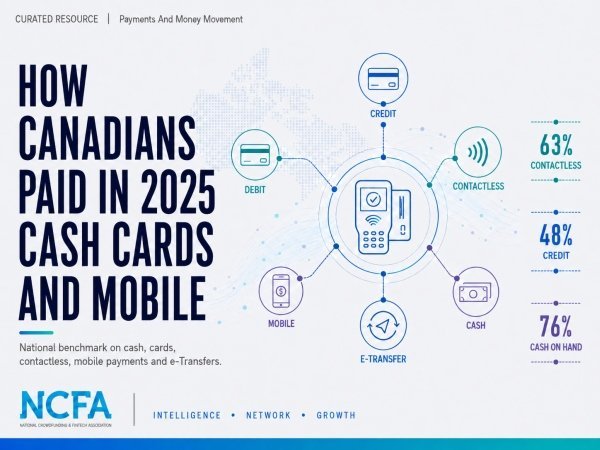
On August 20, 2026, the Bank of Canada published its 2025 Methods-of-Payment Survey, based on responses from 4,964 Canadians and payment diary data from 2,185 participants. The report measures cash holdings, card use, mobile payments, Interac e-Transfer, payment costs, merchant acceptance and how consumers rate different ways to pay.
For payments firms, banks, fintechs and policy teams, the survey provides a current national benchmark for consumer behaviour. Credit cards remain the dominant payment method, contactless now accounts for most in-person purchases, mobile devices are taking a larger share of card taps, and cash remains widely held even though its transaction share fell in 2025.
Credit cards accounted for 48% of purchase volume and 58% of purchase value in 2025. Debit represented 25% of volume and 24% of value, while cash accounted for 18% of point of sale transaction volume and 10% of value. Cash had represented 21% of volume and 11% of value in 2024, so the latest survey records a decline after several years of relative stability.
Contactless payments now dominate in person. In 2025, 63% of in-person payments were contactless, representing 61% of in-person purchase value. Most taps still used physical cards, but mobile devices accounted for one quarter of contactless credit transactions and 15% of contactless debit transactions.
The mobile figures are more useful than in previous surveys because the Bank changed its 2025 payment diary. Respondents who reported tapping a card were asked whether they used the physical card or a version stored on a mobile device. That difference helps separate adoption of mobile wallets from adoption of the underlying payment rail. A credit card stored in a phone remains a credit card transaction, but the interface through which the customer pays has changed.
The revised survey also suggests previous estimates understated mobile use. Over the previous year, 41% of Canadians reported using mobile payments, while just over half used Interac e-Transfer. About one quarter used a digital wallet app and 19% used a bank account app. Those adoption figures should not be read as transaction shares. Interac e-Transfer, for example, appears less often in the three day purchase diary because consumers frequently use it for expenses such as rent and home services that the diary does not capture.
The findings provide a useful consumer benchmark beside Canada’s financial infrastructure changes. Expanded Payments Canada membership, the Real-Time Rail, payment service provider oversight and consumer-driven banking are changing how firms can access and build on payment infrastructure. The Bank’s survey shows the payment habits those services will encounter as they reach consumers.
Cash presents a more mixed picture. About 76% of Canadians had cash on hand when surveyed, with an average of $141 and a median of $70 among people carrying it. Four out of five Canadians said they had no plans to stop using cash, while only 12% described themselves as cashless. At the same time, cash transaction share and average cash holdings both fell in 2025.
The Bank does not treat one year of weaker cash use as proof of a lasting decline. More observations are needed to separate a durable change from normal survey variation or a temporary result. Access also remains relevant: 68% of Canadians described access to an ABM as easy or very easy, compared with 61% for a bank branch.
Payment providers and fintech product teams can use the survey to test assumptions about where Canadian payment behaviour is concentrated. Credit and debit cards still account for most everyday purchases, contactless has become the normal in-person card experience, and mobile wallets are becoming a more important way of presenting those same card credentials.
Banks and financial institutions can use the findings to compare physical and digital access. Consumers are using mobile payment tools more often, but most still keep cash and report that access to ABMs and branches remains important. That combination is relevant when firms make decisions about digital channels, cash services, card products and customer support.
Investors and market researchers get a national reference point for assessing product adoption claims. The report separates annual use, recent use and actual transaction diary data, which helps distinguish a service that many people have tried from one that captures a large share of purchases.
Policy teams can read the findings alongside Canada’s consumer-driven banking rules. The survey does not measure open banking use, but it establishes how Canadians currently pay before regulated data sharing and future payment initiation services reach wider adoption.
For financial inclusion work, the cash findings are especially useful. Digital adoption does not mean all consumers have stopped using physical money. Most Canadians still keep cash, most do not plan to abandon it, and access to withdrawal infrastructure continues to affect how practical cash remains.
The survey combines two useful forms of evidence. The questionnaire captures payment ownership, cash holdings, recent use, costs and consumer perceptions, while the three day diary records purchases and withdrawals closer to when they occur. In 2025, 4,964 people completed the questionnaire and 2,185 submitted at least one day of diary data.
Its history also adds value. The Bank began the Methods-of-Payment survey in 2009 and has run annual surveys since 2021, giving readers a basis for comparing the latest results with earlier payment behaviour. That longer record is why the 2025 decline in cash should be watched rather than immediately treated as a permanent change.
The methodology has limits. The questionnaire uses quota sampling by age, gender and region, then calibrates the samples to Canadian demographic characteristics. The diary covers only three days, and not every questionnaire respondent completes it, so less frequent payments can appear more clearly in recall questions than in the transaction diary.
The new mobile measurement also affects comparisons with earlier years. Separating physical card taps from cards stored on mobile devices improves the 2025 data, but some earlier mobile figures were measured differently and should not be compared mechanically.
NCFA’s Canadian payments market coverage puts the Bank’s consumer survey beside a much larger benchmark. Payments Canada recorded 22.5 billion retail payment transactions worth $12.2 trillion in 2024. The two datasets answer different questions. The Bank of Canada focuses on how consumers hold, choose and use payment methods, while Payments Canada measures transaction volumes, values and market activity across the payment system.
2025 Methods-of-Payment Survey PDF (62 page report, tables, charts and methodology)
Methods-of-Payment Survey (Bank of Canada survey series and historical results)
2024 Methods-of-Payment Survey (previous annual consumer payment benchmark)
Canadian Payment Methods And Trends 2025 (22.5 billion retail transactions worth $12.2 trillion)
 The National Crowdfunding & Fintech Association (NCFA Canada) is a financial innovation ecosystem that provides education, market intelligence, industry stewardship, networking and funding opportunities and services to thousands of community members and works closely with industry, government, partners and affiliates to create a vibrant and innovative fintech and funding industry in Canada. Decentralized and distributed, NCFA is engaged with global stakeholders and helps incubate projects and investment in fintech, alternative finance, crowdfunding, peer-to-peer finance, payments, digital assets and tokens, artificial intelligence, blockchain, cryptocurrency, regtech, and insurtech sectors. Join Canada's Fintech & Funding Community today FREE! Or become a contributing member and get perks. For more information, please visit: [www.ncfacanada.org](http://www.ncfacanada.org)
 |  |  |
|---|---|---|
 |  |  |
Aug 19, 2026
Canada enters the second half of 2026 with two pieces of payment infrastructure arriving at once. The Real-Time Rail is scheduled to go live in the fourth quarter, and the regulations underpinning consumer-driven banking were published in the Canada Gazette in June. Both have been discussed for the better part of a decade. Neither has yet changed how a Canadian consumer actually pays for something online.
That gap between framework and behaviour matters more than either announcement. The most recent full picture of Canadian payment behaviour comes from Payments Canada's Canadian Payment Methods and Trends report, published in October 2025 and covering 2024, which counted 22.5 billion retail payment transactions worth $12.2 trillion. The market grew three per cent in both volume and value year over year. Over five years, volume rose nine per cent and value 22 per cent.
Some of the sharpest movement in that behaviour is happening in sectors where account-to-account transfer is already the preferred rail, regulated online gambling among them. Swiper online casino Canada, a casino and sportsbook brand launched into the Canadian market in 2025 and available across the country outside Ontario, is a useful illustration: it runs thousands of casino, live dealer and sports betting titles from providers such as NetEnt, Microgaming and Evolution, and lists Interac e-Transfer alongside Visa and Mastercard for deposits and withdrawals, with limits from $25 to $10,000 and e-Transfer identified as the fastest payout route for Canadian players. It is referenced here as a working example of how e-Transfer is being used commercially, which is the shift the rest of this article examines.
Cards remain the substrate. Credit cards accounted for 33 per cent of total payment volume in 2024 and debit for 30 per cent, so the two together carried 63 per cent of everything. Electronic funds transfer took 14 per cent and cash 11 per cent.
Credit card volume reached 7.5 billion transactions, a six per cent increase, against 112 million cards in circulation, up five per cent. Digital payments made up 86 per cent of total volume and contactless 58 per cent of transactions.
Those proportions have held steady long enough that outright displacement of cards looks like the wrong thing to watch for. The narrower question tells you more. Which transaction types move first, and what makes them move, is already visible in a handful of categories.
The clearest answer so far is e-Transfer. It stopped being a person-to-person convenience some time ago. Interac's own figures for its 2025 fiscal year record 1.6 billion e-Transfer transactions, with a single-month record of 149 million in October 2025. Business Request Money passed 160 million transactions, an 81 per cent year-over-year increase, which is the number that matters most for commercial adoption.
Interac Debit ran to seven billion transactions in the same period, including 1.8 billion mobile transactions and an all-time monthly high of 638 million in August 2025.
Payments Canada data puts the longer arc in context. Online transfers grew 175 per cent in volume and 219 per cent in value across five years, though the growth rate itself has been declining, which points to a service approaching maturity rather than one still finding its market.
Payments Canada confirmed that the RTR By-law and RTR Rules received all necessary approvals and come into force on 24 August 2026, with the system itself scheduled to launch in the fourth quarter. The by-law has been published in the Canada Gazette, Part II.
The RTR carries ISO 20022 messaging and settles irrevocably, around the clock. The practical consequence is that data can travel with the payment, which is what makes richer reconciliation and request-to-pay flows possible. Irrevocability also shifts the risk model. Cards provide a chargeback mechanism and the RTR does not, so fraud controls have to sit in front of the payment rather than behind it, and that changes what a payment service provider has to build before it can offer the rail to anyone.
Membership has broadened ahead of launch, with Wise, KOHO, Float, Paramount Commerce and Brim Financial joining as payment service provider members.
The Consumer-Driven Banking Regulations were published in the Canada Gazette, Part I on 27 June 2026. Responsibility for implementation and oversight is delegated to the Bank of Canada, which is a change from the earlier position placing the Financial Consumer Agency of Canada in that role.
Scope covers deposit accounts, payment products, investment accounts and lending accounts, across consumer profile data, account data and product data. Derived data, meaning enhanced information carrying additional commercial value, is excluded. Participation runs in three tiers: large banks above a retail volume threshold are mandated, other federally regulated entities may opt in, and payment service providers, fintechs and provincially regulated institutions may participate through accreditation.
Phase one is limited to read access. Write access, meaning payment initiation and account switching, is anticipated later.
The published regulations do not state an implementation date, which matters for anyone planning against this. Commentary through 2026 has variously placed phase one in early 2026 and pushed it later, and the Bank of Canada has not committed publicly to a launch. It is also worth being clear that read access without write access produces better data rather than a new payment method. The payment capability arrives with phase two, and phase two depends on the RTR being live and broadly reachable.
Ahead of any of that, demand for account-to-account payment is not evenly spread. It concentrates in categories where card acceptance is restricted, where chargeback exposure is high, or where payout speed is itself a competitive feature.
Regulated online gambling is the clearest Canadian example of all three at once. In its third year of operation, iGaming Ontario reported total wagers of $82.7 billion and gaming revenue of $3.2 billion for the year to 31 March 2025, increases of 31 and 32 per cent respectively, with casino products accounting for $69.6 billion of the wagering. Operators in the segment lean heavily on e-Transfer in both directions, using it for both deposits and withdrawals and typically presenting it as the fastest payout option for Canadian players.
That pattern is worth watching because it is where the RTR's value proposition will be tested first. Sectors already paying an operational premium for speed are the ones with a reason to move early, and their volumes are large enough to matter.
For most Canadian merchants the honest near-term answer is: not much, yet. The RTR launches in phases, banks are required to receive but not initially to send, and customer-facing services are optional in the early stages. Until sending capability is widespread, most consumers will never encounter it.
The medium-term shift is in cost structure rather than user experience. Account-to-account payment removes interchange. It also removes the economics that fund card rewards programs, and Canadian attachment to those programs is not trivial, with 112 million cards in circulation representing a substantial installed base of habit. Displacement is likelier to begin in bill payment, high-value purchases and payouts than in everyday retail.
The infrastructure question in Canada has largely been answered. What remains is distribution, and that is a slower problem.
The National Crowdfunding & Fintech Association (NCFA Canada) is a financial innovation ecosystem that provides education, market intelligence, industry stewardship, networking and funding opportunities and services to thousands of community members and works closely with industry, government, partners and affiliates to create a vibrant and innovative fintech and funding industry in Canada. Decentralized and distributed, NCFA is engaged with global stakeholders and helps incubate projects and investment in fintech, alternative finance, crowdfunding, peer-to-peer finance, payments, digital assets and tokens, artificial intelligence, blockchain, cryptocurrency, regtech, and insurtech sectors. Join Canada's Fintech & Funding Community today FREE! Or become a contributing member and get perks. For more information, please visit: www.ncfacanada.org
| | |
|---|---|---|
| | |
```html
August 18, 2026 | NCFA Insight | Artificial Intelligence And Data, Payments Infrastructure And Money Movement, Digital Assets

On August 18, 2026, Amazon Web Services made AgentCore Payments generally available, taking the capability from its May preview into production. AI agents can now encounter paid APIs, services accessed through Model Context Protocol (MCP), or other digital resources during a workflow and initiate payment through infrastructure that connects spending controls with external wallets.
AWS can enforce how much an agent is allowed to spend and for how long, manage access to wallet providers and coordinate the payment from inside the same infrastructure used to run the agent. Coinbase or Stripe's Privy provides the wallet, while external providers and blockchain networks handle signing, verification and settlement.
AWS isn't taking custody of customer money. It is taking a position earlier in the transaction, where software determines whether it has permission to buy something and which payment connection to use. That puts payment authority closer to the AI execution layer.
AgentCore Payments already supported Coinbase and Privy wallets, spending controls and x402 payments during preview. General availability adds the Machine Payments Protocol (MPP), easier Coinbase wallet setup, improved discovery of paid x402 services and an x402 pricing option called upto.
The upto model is designed for services whose final cost isn't known before use. An agent can approve a maximum amount, while the provider charges for what was actually consumed. AWS points to model inference, compute and other usage-based APIs where a flat price per request may not reflect the real cost.
That fits how autonomous software may buy digital services. Instead of establishing a subscription with every provider in advance, an agent can encounter a paid resource during a task, check whether the price fits its delegated budget, pay for it and continue.
MPP adds another payment protocol. Developed by Stripe and Tempo, it lets software exchange payment requirements during an online transaction and can support different payment models, including microtransactions and recurring payments.
x402 takes a somewhat different approach. It lets an online service respond to an agent's request by saying payment is required before the resource is released. The agent can then authorize the payment through its connected wallet and retry the request.
Stripe says MPP can support stablecoins as well as conventional payment methods, but AgentCore Payments currently documents an embedded crypto wallet as its supported payment instrument.
The architecture adds useful boundaries around the word autonomous. A user or business first provides the wallet and grants authority. AWS then applies rules around how the agent can use that authority during a payment session. NCFA's Financial Innovation Map tracks this convergence of AI agents, financial permissions and programmable infrastructure.
Those controls can include an expiry and a maximum amount the agent is permitted to spend. Before a transaction proceeds, AgentCore checks whether the request fits within that budget. A payment that exceeds the limit is rejected at the infrastructure level rather than left to the agent's judgement.
AWS also keeps the wallet-provider credentials away from the agent itself. Coinbase or Privy provides the wallet infrastructure, while AWS uses controlled access to request operations such as signing a transaction.
The result is delegated spending rather than independent control of money. The person or business sets the authority, AWS enforces part of the operating boundary and the connected wallet provider controls the financial instrument.
AWS also records payment activity through its monitoring tools, giving developers logs and transaction information they can use to review what agents attempted and what payments succeeded. That adds an audit layer around activity that would otherwise be difficult to supervise once agents begin buying resources during longer workflows.
This is where AWS gains a potentially valuable position. It doesn't need to become a bank or payment processor to influence whether an agent-side transaction can proceed.
Coinbase is one supported provider, not an exclusive requirement. Its developer infrastructure provides embedded wallets and supports x402 payments, while Coinbase's Bazaar service helps agents discover online services that accept the protocol.
Coinbase documents payments in the USDC stablecoin on Base and Solana for its AgentCore implementation. That makes digital assets a substantive part of the current product architecture rather than a side effect of Coinbase's involvement. It also connects directly to NCFA's Programmable Stablecoin Payments opportunity brief, which examines programmable money movement and payment infrastructure.
Privy provides another embedded-wallet option. The company is now part of Stripe, but its role in AgentCore is still wallet infrastructure rather than ordinary card processing through Stripe's full payments stack.
AgentCore Payments doesn't require every payment protocol to use cryptocurrency, and MPP itself can support other payment methods. But AWS's currently documented AgentCore payment instrument is still a crypto wallet.
Payment companies therefore remain important underneath the agent platform. They provide the wallet, credentials and financial infrastructure needed to execute transactions, while AWS controls more of the environment where an agent decides when to call them.
This isn't the only infrastructure model emerging. Circle's USDC infrastructure for AI agents combines policy-controlled wallets, service discovery and programmable payments under predefined guardrails.
Travala provides a useful production example because its implementation shows where the customer's authority remains. Its current Travel MCP lets an AI agent search and book hotels, with payment settled in the USDC stablecoin on Base from a Coinbase wallet connected through AgentCore.
The customer still has to authorize the spending relationship. Travala says the permission is revocable and time-limited, the company never receives the private key and the customer must explicitly confirm the hotel purchase before payment is made.
Once that permission is in place, the agent can complete the payment within the delegated limits and continue the booking workflow. That is more precise than saying an AI agent independently controls money.
AWS also names Anchor Browser, SpreadX's Incarna, Elsa AI and Heurist AI among customers or integrations using AgentCore Payments. AWS does not provide transaction volumes for those implementations, so there isn't yet enough evidence to describe agent-led payments as broadly adopted at scale.
The Travala example is still important. It shows a live consumer transaction where conversational software can search, obtain approval and complete payment without sending the customer into a separate checkout flow.
Traditional electronic payments divide responsibility among merchants, gateways, processors, acquirers, networks, issuers and customer interfaces. Agent commerce adds another decision point before many of those functions because software has to decide whether a paid service is useful, whether the price is acceptable and whether the purchase falls within the user's authority.
AWS now controls part of that decision environment. It doesn't set the merchant's price, supply the customer's money or settle the transaction. It can, however, determine whether the agent's payment request fits its permitted spending session and coordinate access to the wallet needed to proceed.
That creates a new distribution question for payment companies. A wallet provider may still own the financial relationship underneath the transaction, while the cloud or AI platform controls the environment where an agent discovers a service and decides which payment connection to use.
AgentCore Payments still has important limits. AWS isn't providing general merchant acquiring, and its documentation doesn't establish native chargebacks, universal merchant controls or a standalone fraud-screening service inside AgentCore Payments. Those functions may remain with the merchant, application, wallet provider or other payment infrastructure.
Control of the agent execution environment can still become valuable payment real estate even when the platform never holds the money. If agents increasingly choose services and initiate purchases on behalf of users, the infrastructure governing those decisions becomes another point where payment providers compete for access.
AgentCore Payments is currently available in 12 AWS regions across the United States, Europe, Singapore and Australia. AWS does not currently offer the capability from its Canadian region, even though several other AgentCore services are available there.
That creates a practical constraint for Canadian developers that want to keep this part of the stack in an AWS Canadian region. They can deploy AgentCore Payments elsewhere, but there is no Canadian region for the capability today.
The longer-term issue for Canadian fintechs and financial institutions is less about one AWS region and more about where financial authority is being placed. Agent payments combine AI governance, delegated spending, wallets and payment infrastructure inside one operating workflow.
Firms will need to decide which controls remain inside their own applications and which can be delegated to cloud, wallet and protocol providers. That becomes more important as agents gain permission to buy services during a task rather than simply recommend what a person should buy.
If AI and cloud platforms control the environment where agents receive spending authority and decide whether a transaction can proceed, while payment companies provide wallets and settlement underneath them, which layer will ultimately control distribution in agent-led commerce?
The National Crowdfunding & Fintech Association (NCFA Canada) is a financial innovation ecosystem that provides education, market intelligence, industry stewardship, networking and funding opportunities and services to thousands of community members and works closely with industry, government, partners and affiliates to create a vibrant and innovative fintech and funding industry in Canada. Decentralized and distributed, NCFA is engaged with global stakeholders and helps incubate projects and investment in fintech, alternative finance, crowdfunding, peer-to-peer finance, payments, digital assets and tokens, artificial intelligence, blockchain, cryptocurrency, regtech, and insurtech sectors. Join Canada's Fintech & Funding Community today FREE! Or become a contributing member and get perks. For more information, please visit: www.ncfacanada.org
| | |
|---|---|---|
| | |
```
Aug 17, 2026

Canada’s gaming sector has changed quickly, and payment technology has become a major part of that evolution. As more regulated online gambling markets develop, operators face growing expectations around security, speed and transparency. The payment process is no longer just about putting money into an account. It has become an essential way for players to feel confident and trust the platform.
For players, safe deposits and reliable withdrawals are becoming increasingly important. In fact, all top online casinos need payment systems that can combine convenience with strong protection. Licensed operators are increasingly using identity verification, encryption, fraud controls, and responsible gambling tools to create safer environments. These measures also include deposit limits, session reminders and self-exclusion options, giving players greater control over how they use gaming services.
Fintech is helping push these developments forward. Digital wallets, instant banking systems and improved verification processes have made deposits and withdrawals much more straightforward. Canadian gaming platforms are increasingly expected to offer near-real-time processing and reliable payouts, which reduces delays and enhances the overall payment experience for players while keeping sensitive financial information protected.
The pressure is particularly noticeable in regulated markets because payment systems have to deal with more than just transaction speed. They also need to support identity checks, fraud screening, anti-money laundering controls and detailed reporting. This creates a demanding environment for payment providers, where transactions need to be processed efficiently without compromising compliance.
Ontario provides a clear example of how regulation can influence this process. After the launch of its regulated iGaming market in April 2022, payment systems became part of a closely controlled digital environment. Operators and their technology partners have had to deal with substantial transaction volumes while maintaining secure authorisation, verification and reporting processes.
This is where fintech innovation becomes particularly interesting. Payment gateways and processors have increasingly had to become more sophisticated, with encryption, tokenisation, automated fraud detection and continuous monitoring becoming important elements of the infrastructure. The aim is to make security work quietly in the background while allowing legitimate transactions to move quickly, inspiring confidence in the future of gaming payments.
The impact can extend beyond gaming, too. Technologies developed under the pressure of regulated gambling can have wider applications across fintech. Real-time authorisation, automated risk scoring, wallet integration and secure handling of sensitive information are all relevant to other digital businesses that need to balance convenience with protection.
Reputable gaming comparison and news platforms reflect this changing environment by focusing on licensed Canadian operators, compliant payment methods and clearer information for players. The wider trend is towards greater transparency, with consumers increasingly able to assess how platforms handle payments and what safeguards are available.
Ultimately, regulation is reshaping payments in Canadian gaming. Safety, compliance and convenience now have to work together rather than being treated as separate concerns. As technology continues to advance, payment systems will need to keep adapting. Still, the direction is clear: stronger infrastructure, better protection, and greater player confidence are becoming central to the future of regulated iGaming in Canada.
The National Crowdfunding & Fintech Association (NCFA Canada) is a financial innovation ecosystem that provides education, market intelligence, industry stewardship, networking and funding opportunities and services to thousands of community members and works closely with industry, government, partners and affiliates to create a vibrant and innovative fintech and funding industry in Canada. Decentralized and distributed, NCFA is engaged with global stakeholders and helps incubate projects and investment in fintech, alternative finance, crowdfunding, peer-to-peer finance, payments, digital assets and tokens, artificial intelligence, blockchain, cryptocurrency, regtech, and insurtech sectors. Join Canada's Fintech & Funding Community today FREE! Or become a contributing member and get perks. For more information, please visit: www.ncfacanada.org
| | |
|---|---|---|
| | |
Aug 8, 2026 | NCFA Fintech Whisperer | Digital Banking And BaaS, Regulation And Policy, SME Finance And Business Banking, Digital Assets Blockchain And Tokenization, Payments Infrastructure And Money Movement, Capital Markets Infrastructure And Funding, Artificial Intelligence And Data, Wealthtech Investing And Trading, Embedded Finance, Risk Compliance And Regtech, Lending Consumer Credit And BNPL, Cybersecurity Fraud And Financial Crime

Image: Freepik
This live weekly NCFA intelligence page tracks financial technology developments that significantly affect how fintechs build, sell, raise capital, and operate under scrutiny. Coverage prioritizes Canada and includes global events that directly influence competitive conditions, market access, and execution realities across fintech sectors. This page will be updated throughout the week with market movers in a live format and then each week we'll close the prior week's contents in prep for the upcoming week, and continue on a rolling basis. (Missed prior week's Fintech Whisperer? (December 6-12, 2025, December 13-19, 2025, January 1-9, 2026, January 10-16, 2026, January 17-23, 2026, January 24-30, 2026, January 31-February 6, 2026, February 7-13, 2026, February 14-20, 2026, February 21-27, 2026, February 28-March 6, 2026, March 7-13, 2026, March 14-20, 2026, March 21-27, 2026, March 28-April 3, 2026, April 4-10, 2026, April 11-17, 2026, April 18-24, 2026, April 25-May 1, 2026, May 2-8, 2026, May 9-15, 2026, May 16-22, 2026, May 23-29, 2026, May 30-June 5, 2026, June 6-12, 2026, June 13-19, 2026, June 20-26, 2026, June 27-July 3, 2026, July 4-July 10, 2026, July 11-July 17, 2026, July 18-24, 2026, July 25-July 31 2026, August 1-August 7, 2026).
Large crypto platforms are starting to look more like multi asset investment distributors, but the infrastructure underneath them is still regulated brokerage, custody and settlement. Alpaca has been building specifically for this role, which NCFA recently examined in its global brokerage platform expansion. The competitive question is who controls that regulated layer as crypto, traditional securities and tokenized products converge inside the same customer interface.
IBQT changes where the crypto allocation decision happens. Investors choosing the fund are buying a diversified equity portfolio with bitcoin already assigned a modest strategic weight, rather than adding crypto separately. That puts bitcoin closer to conventional portfolio construction and gives Canadian advisers and investors a simple way to combine traditional markets and digital assets in one listed product.
Pay by Bank is reaching Canadian customers before regulated payment initiation does. Foreign providers are improving the experience around an existing Canadian bank rail instead of waiting for new infrastructure. That makes the commercial timing important for Canada’s open banking opportunity: future regulated access will enter a market where some of the customer experience is already being built.
Dream is taking infrastructure built by a Canadian fintech into U.S. business payment workflows where the payment can start inside the software that created the obligation. That also gives agent payment infrastructure a more concrete operating model: software can participate in the workflow, but identity, authority, approval and settlement controls still determine whether money moves.
Last year’s Moneris sale discussion has become a signed change of control. RBC and BMO are giving up ownership while preserving customer distribution, leaving Francisco Partners to decide how aggressively Moneris invests across merchant acquiring, commerce software and payments technology. The separation between infrastructure ownership and bank distribution is the more consequential part of the deal.
Canada is putting a settlement discipline framework into live measurement before imposing a financial penalty. That gives dealers, custodians and market infrastructure providers time to see where fails occur, what the operational burden looks like and whether the fee design changes settlement behaviour. The evidence from the trial will determine whether a reporting framework eventually becomes an economic incentive.
Canada's repo market now has a standardized collateral workflow running on infrastructure that the Bank of Canada also plans to use for its domestic repo operations. Wider adoption would make collateral easier to allocate and substitute across financing activity while reducing manual processing. The next evidence is usage: how much repo activity migrates onto CCMS and whether the additional baskets deepen participation beyond Government of Canada securities.
The financing connects capital directly to deployment of a physical and digital financial services network rather than funding an undefined expansion plan. PointsKash acquired more than 2,100 cryptocurrency kiosks earlier in August and now has a staged capital structure intended to refurbish and redeploy that hardware while building payments, merchant and mobile services around it. The conditional structure also keeps a clear line between near term funding and the larger amount that depends on execution.
The rule changes where settlement risk has to be dealt with. Firms must support the expectation of settlement before a short sale reaches the market, putting more responsibility on trading controls, securities availability and supervision. Difficult to borrow securities and repeated settlement failures will show how demanding the requirement becomes in practice.
RBI is pushing AI governance into the same operating disciplines banks already use for material risk. That aligns with Canadian work on regulated AI, where model oversight, vendor access, fallback plans and proof of control are becoming practical requirements. The advantage will come from deploying useful AI while being able to show who owns the risk and how the system is controlled.
Pix is starting to test whether a national instant-payment rail can connect directly into foreign payment infrastructure rather than relying only on traditional correspondent channels. NCFA’s cross border payments benchmark shows why that distinction matters: strong domestic rails don’t automatically solve international cost, speed or interoperability. The practical questions are which systems Brazil connects to first, how FX, compliance and settlement are handled across jurisdictions, and whether this becomes a repeatable model for other domestic real time rails.
USD1 could move from a stablecoin structure supported by external service providers into a federally supervised trust bank that combines issuance, redemption, reserves and custody. That would bring more of the operating stack behind a payment stablecoin inside one regulated entity, while concentrating responsibility for reserve management, safeguarding and compliance.
The Coinbase acquisition is moving from ownership into shared market infrastructure. Deribit can keep its derivatives interface while drawing on Coinbase's spot liquidity and execution stack, extending the Deribit acquisition strategy into day to day trading. That brings spot execution, collateral and derivatives closer together inside one regulated operating structure.
The significance is the combination of existing regulated market infrastructure with newly authorized crypto services. Rather than building a separate crypto venue, Perpetual Markets can extend an established MTF operating model into digital assets, giving brokers and institutions another route to offer crypto products under a European regulatory framework. The announcement authorizes expansion, but does not establish that every permitted crypto service is already live at scale.
Hong Kong's stablecoin regime has crossed from licensing into controlled distribution and commercial use. That builds on the tokenized finance strategy NCFA has been tracking through Standard Chartered and Hong Kong's regulators. HKDAP now has to prove that regulated tokenized money can attract repeat transaction flow across payments, asset settlement and institutional distribution rather than remain a licensed product with limited circulation.
The important distinction is the legal and operating structure behind the token. Coinbase is combining regulated custody, underlying shares, investor rights and blockchain transferability rather than offering price exposure alone. That puts the model inside the infrastructure test NCFA is tracking for regulated tokenized assets: whether ownership rights, custody, compliance and transfer can work together at market scale.
Bitstamp is becoming more than an acquired exchange for Robinhood. Its UK crypto infrastructure now lets Robinhood add digital assets to the same interface where customers already invest across traditional markets. The next test is whether that combination deepens customer activity and gives Robinhood a repeatable way to extend its wider investment platform into regulated crypto markets.
Bridge provides the regulated issuance while Revolut distributes EURR through its customer app. NCFA tracked Bridge’s European authorizations in July. The immediate evidence is limited to phased testing in three markets, and Revolut has not published EURR circulation, adoption or transaction-volume data.
Crypto backed lending is becoming part of the product stack offered by Canadian trading platforms. Shakepay is integrating the credit relationship directly into its own account experience, while embedded crypto lending at Netcoins uses APX to supply the lending operation behind the interface. The two models create different economics and different responsibility for underwriting, collateral controls and servicing.
General availability converts the earlier token-backed mortgage launch into an open lending product. Funded volume, borrower performance, collateral custody and the treatment of pledged assets during delinquency will show whether the model can operate at conforming-mortgage scale.
Construction lending is operationally intensive because capital is released in stages and each draw depends on current budget, progress and compliance information. Moving those controls into the loan system can reduce reconciliation work and make exceptions visible earlier, while giving private lenders a more integrated way to manage construction credit as portfolios scale.
Opening a new bank account is easier than making it the primary account. Payroll switching reduces the work required to redirect recurring income and adds an operational layer to open banking and financial portability. Competition improves when customers can act on a better banking option, not only compare one. The next measure is whether easier switching translates into more primary-account relationships and deposits.
The licence turns Revolut’s banking expansion into a two-hub European structure with a new regulated entity serving its largest regional customer base. The execution test is how quickly customers and products migrate to the French bank, and whether local licences give Revolut more room to deepen lending, business banking and other regulated services across Western Europe.
The dispute is becoming a direct test of who controls access to event contracts in the United States. The CFTC is treating Kalshi as national derivatives infrastructure while states continue to challenge parts of the market through gaming law. NCFA’s regulated event contract infrastructure brief tracks the same boundary between exchange regulation, market integrity and product access.
The FCA is making regulatory engagement part of the scale up process rather than waiting for rapid growth to create supervisory problems. NCFA’s closer look at the five firms shows how that support intersects with payments, credit, insurance and European expansion. For fintechs, the tradeoff is clearer: faster access to regulatory guidance comes with closer attention to whether governance, controls and customer protections are developing at the same rate as products, customers and market expansion.
The CLARITY Act has moved from an uncertain post-recess commitment to a scheduled Senate procedure. The September vote will test whether negotiators can assemble enough support to advance a federal market-structure framework and narrow the remaining disagreements over banking, stablecoins and digital-asset oversight.
The important change is that an AI agent can now receive its own controlled payment credential rather than only prepare a transaction for someone else. That makes permission design part of the payment product. NCFA has already tracked how AI agents use card rails; Mercury brings the same question inside company spending, where budgets and policy controls define how much authority software actually receives.
Invoice financing fraud controls are becoming shared lending infrastructure rather than checks performed inside one lender at a time. MonetaGo has been working on shared trade finance fraud controls for years; the SIDBI deployment brings that model into live MSME lending. The test is whether interoperable validation reduces duplicate financing and exceptions at scale while making cash flow credit faster and safer across multiple lenders and factoring platforms.
Mews is taking embedded finance beyond connecting hotels to outside financial providers. Its own regulated entity can now sit inside the software where hotel revenue, operations and payments already meet. That changes the regulatory boundary for embedded finance: vertical software can become part of the licensed financial infrastructure instead of remaining only the distribution layer.
AI is entering compliance as an investigation and decision support layer rather than replacing accountable human approval. That model fits the emerging market for AI powered compliance workflows where evidence, escalation, auditability and human control determine whether automation can be trusted. TransFi's operating test is whether JARVIS reduces review effort across multiple jurisdictions without weakening decision quality.
The breach shows how self custody can inherit risk from suppliers that never touch a private key. Fulfilment providers still hold enough identity and location data to expose hardware wallet owners to targeted attacks, making vendor controls and data retention part of hardware wallet security rather than a separate privacy issue.
Financial infrastructure is becoming easier to enter and harder to operate well. Bank switching is getting simpler, payments are becoming programmable, AI agents are gaining spending authority and software platforms are taking on regulated financial roles. At the same time, regulators are putting more weight on governance, settlement discipline, market access and accountability. The competitive advantage is moving toward firms that can combine better distribution with stronger control of the infrastructure underneath it.
NCFA offers various curated resources to help founders and investors stay current on developments that impact fintech markets. Get the weekly Whisperer and related market intelligence through NCFA's newsletter, view the latest fintech insights, industry research, or launch into emerging financial innovation opportunities.
The National Crowdfunding & Fintech Association (NCFA Canada) is a financial innovation ecosystem that provides education, market intelligence, industry stewardship, networking and funding opportunities and services to thousands of community members and works closely with industry, government, partners and affiliates to create a vibrant and innovative fintech and funding industry in Canada. Decentralized and distributed, NCFA is engaged with global stakeholders and helps incubate projects and investment in fintech, alternative finance, crowdfunding, peer-to-peer finance, payments, digital assets and tokens, artificial intelligence, blockchain, cryptocurrency, regtech, and insurtech sectors. Join Canada's Fintech & Funding Community today FREE! Or become a contributing member and get perks. For more information, please visit: www.ncfacanada.org
| | |
|---|---|---|
| | |
August 14, 2026 | NCFA Market Activity | Payments Infrastructure And Money Movement, SME Finance And Business Banking, Embedded Finance

On August 11, 2026, Toronto-based Dream Payments launched Dream Payouts, a U.S. real-time business payment network with J.P. Morgan Payments. The platform lets eligible U.S. businesses pay suppliers, contractors and other recipients using an email address, with qualifying payments delivered through The Clearing House RTP network.
Dream isn't building a new payment rail. It's putting bank accounts, supplier onboarding, payment controls and real-time payouts into software businesses already use.
That gives Dream a potentially valuable position between the bank infrastructure that moves the money and the business workflow that decides when, where and why it should move.
A business enters a supplier's email address. Dream then invites the recipient into its Payee Portal, where they verify their identity with multi-factor authentication, enter and maintain their own banking information and choose how they want to be paid.
The email itself never carries payment instructions or banking details. Once enrolled, a recipient can receive future payments without the payer collecting or manually updating their account information. Eligible RTP payments can arrive in under 30 seconds, including nights, weekends and holidays. ACH and wire are available when real-time delivery isn't available or isn't selected.
Businesses can fund payments through Dream Wallet, a payments account provided through J.P. Morgan subject to eligibility and account-opening requirements. Dream also separates payment requests from payment release through roles, limits and approval workflows, while transactions are tracked from initiation through settlement. That is more useful than speed alone. Supplier payments still require banking information, approvals, payment status and reconciliation. Dream is bringing those steps into one controlled workflow.
As of July 2026, The Clearing House RTP network had more than 1,322 participating financial institutions. It operates around the clock, settles payments with finality and supports transactions up to US$10 million. The network processed 142 million payments worth US$576 billion in the second quarter of 2026.
Dream Payouts identifies RTP for eligible real-time delivery. Its public launch material doesn't say FedNow is part of the current product, so the two networks shouldn't be treated as interchangeable.
Other payment infrastructure providers are also making instant-payment rails easier to access through software. The competitive question is becoming less about connecting to a rail and more about what a provider builds around it.
Dream combines a J.P. Morgan-provided payments account, recipient onboarding, payment controls and embedded distribution. Mantle shows how that can work. The family-office software platform has embedded Dream Payouts so a capital call can be reviewed, approved and paid inside the same system where the obligation is managed. The payment becomes part of the workflow instead of a separate trip to a bank portal.
Dream began in Toronto in 2014 with mobile point-of-sale technology, but its business progressively moved deeper into payment infrastructure.
In 2018, Dream and Mastercard expanded into digital insurance payouts. Northbridge Financial became the first Canadian insurer announced for the service, with Mastercard Send connecting Dream's infrastructure to claims disbursements.
In 2024, Dream launched DreamPay embedded payments across North America, bringing payment collection, payouts and orchestration into an API-based platform for financial institutions, insurers and software companies.
The J.P. Morgan relationship also predates Dream Payouts. In 2025, Dream launched a North American insurance payment network using J.P. Morgan Payments' banking infrastructure, treasury services and pay-in and payout rails.
Dream has been applying the same model in Canada. In May 2026, Dream DriverPay began rolling out with Script Runner, allowing healthcare delivery drivers to receive earnings through Interac e-Transfer for Business using an email address or mobile number.
Dream Payouts takes that operating model beyond a specific industry. The company is testing whether recipient onboarding, payment controls and bank-rail access can become reusable infrastructure for U.S. businesses and the software platforms serving them.
Dream says software platforms can use the infrastructure as a foundation for AI agents to initiate, approve and reconcile payments.
Dream Payouts already separates payment requests from payment release through roles, limits and approval workflows. Its public material doesn't establish that an AI agent can independently release company funds without those controls.
As AI agents enter payment workflows, the commercial question is practical: what can software initiate, what still requires approval and who is accountable when money leaves the account?
Dream Payouts is a U.S. product built on U.S. banking and instant-payment infrastructure, but the company behind it remains headquartered in Toronto.
Canada shouldn't be reduced to a comparison about payment speed. Dream already uses Interac e-Transfer for Business for embedded payouts here, while its U.S. products connect to different rails and banking infrastructure.
Dream doesn't need to own the underlying rail if it can make different rails easier to use inside insurance platforms, healthcare systems, family-office software and other business applications.
Banks retain the regulated accounts and payment infrastructure while companies such as Dream compete to own more of the software, controls and workflow around each transaction.
If banks own the accounts and payment rails but fintechs increasingly own the onboarding, controls and software workflow around them, which layer will own the most valuable business relationship?
Dream Payments was founded in Toronto in 2014 and initially built mobile point-of-sale technology for financial institutions and merchants.
Dream PaymentsToronto financial technology company focused on digital payments
LaunchMobile point-of-sale was the first commercial product
$6M RoundEarly venture funding supported product development
CanadaInitial commercialization centred on Canadian payments
Banks And MerchantsFinancial institutions became an important distribution channel
Bank DistributionDream supplied technology that financial institutions could put in front of business customers
Dream started by helping financial institutions modernize merchant payments. That distribution model remains visible today: the company builds around regulated financial infrastructure rather than trying to replace it.
The National Crowdfunding & Fintech Association (NCFA Canada) is a financial innovation ecosystem that provides education, market intelligence, industry stewardship, networking and funding opportunities and services to thousands of community members and works closely with industry, government, partners and affiliates to create a vibrant and innovative fintech and funding industry in Canada. Decentralized and distributed, NCFA is engaged with global stakeholders and helps incubate projects and investment in fintech, alternative finance, crowdfunding, peer-to-peer finance, payments, digital assets and tokens, artificial intelligence, blockchain, cryptocurrency, regtech, and insurtech sectors. Join Canada's Fintech & Funding Community today FREE! Or become a contributing member and get perks. For more information, please visit: www.ncfacanada.org
| | |
|---|---|---|
| | |
August 12, 2026 | NCFA Market Activity | Open Banking Open Finance And Data Sharing, Payments Infrastructure And Money Movement, Cross Border Payments And FX

On August 12, 2026, Boston-headquartered U.S. payments company Flywire expanded its partnership with Stockholm-headquartered Swedish Pay by Bank provider Trustly to offer Pay by Bank payments in Canada and the United States.
The Canadian launch is notable because two foreign payment companies are commercializing a Pay by Bank experience here before Canada has a fully operational regulated consumer-driven banking system with payment initiation. Flywire and Trustly are improving how an existing bank payment is authenticated and started rather than waiting for Canada's future open banking payment rails.
Flywire's Canadian payment instructions describe a simple flow. The payer selects Online Bank Transfer in CAD, a Trustly window opens, and the payer signs into their bank. Payment details are filled in automatically and the bank can request additional verification before the payment is authorized.
Flywire says the money is normally debited within 24 hours and delivered to the institution in about five business days. Only personal bank accounts are currently supported. Business and corporate accounts aren't.
The timing tells us the product isn't an instant payment and it isn't using Canada's Real Time Rail. Flywire's own developer documentation identifies its Canadian EFT authorization as a pre-authorized debit agreement (PAD).
Trustly adds the digital layer around that debit, using bank authentication and account data to make the payment easier to initiate inside Flywire.
Alex Gonthier, Founder and CEO, Trustly:
“Pay by Bank is a term that is too general. Generic essentially. What we really mean is Open Banking-based or -enabled payments over bank rails.”
That description fits the Canadian launch particularly well. The bank rail isn't new. The authentication, data and payment experience around it are what Trustly changes.
Flywire specializes in payments where the amount, currency or accounts receivable process can be more complicated than an ordinary checkout. It currently supports more than 5,100 clients across education, healthcare, travel and B2B markets, with payments available in more than 140 currencies across 240 countries and territories.
Its platform processed US$11.4 billion in payment volume during the first quarter of 2026 alone.
Canadian payment options work differently. Flywire lets customers use Interac e-Transfer for payments up to C$3,000, and those payments can arrive quickly. Online bill payment can handle larger amounts, but the payer has to leave Flywire, find Flywire as a biller in online banking and complete the payment there.
Trustly keeps more of that process inside Flywire. The payer signs into their bank and approves the payment without having to set up a biller or copy payment details.
That can be useful for larger payments such as tuition. Flywire hasn't published one Canada-wide Trustly limit, so the amount a payer can send depends partly on the limits set by their bank.
The terminology needs care because Trustly calls the product an open banking payment while Canada's regulated consumer-driven banking framework is still being implemented.
The federal framework is designed to replace credential sharing with regulated API-based financial data access. Payment initiation, often called write access, belongs to a later phase. As of August 2026, the government is still working on the implementation rules for Canada’s consumer-driven banking framework.
Flywire's Canadian Trustly instructions, by contrast, currently ask the payer to sign into online banking through the Trustly experience. Public documentation doesn't establish that every participating Canadian financial institution is connected through a direct API.
It shows that commercial Pay by Bank services can develop before Canada's regulated framework reaches payment initiation.
The longer-term opportunity gets more interesting when the payment experience and settlement infrastructure improve together. Canada's financial infrastructure is opening to new participants, while the Real Time Rail is intended to bring instant, data-rich clearing and settlement. Flywire and Trustly are showing what fintechs can build above the infrastructure available today.
Flywire and Trustly aren't waiting for Canadian open banking payments to become fully operational. They're bringing an international Pay by Bank model into Canada by adding bank authentication and a cleaner payment experience to PAD infrastructure that already works. For Canadian fintechs, that shows an example of how much product innovation can happen above the payment rail before the rail itself changes.
The National Crowdfunding & Fintech Association (NCFA Canada) is a financial innovation ecosystem that provides education, market intelligence, industry stewardship, networking and funding opportunities and services to thousands of community members and works closely with industry, government, partners and affiliates to create a vibrant and innovative fintech and funding industry in Canada. Decentralized and distributed, NCFA is engaged with global stakeholders and helps incubate projects and investment in fintech, alternative finance, crowdfunding, peer-to-peer finance, payments, digital assets and tokens, artificial intelligence, blockchain, cryptocurrency, regtech, and insurtech sectors. Join Canada's Fintech & Funding Community today FREE! Or become a contributing member and get perks. For more information, please visit: www.ncfacanada.org
| | |
|---|---|---|
| | |



August 26th, 2025

January 4th, 2024

June 1st, 2021

September 9th, 2020

July 9th, 2018

January 3rd, 2018

September 25th, 2017

June 20th, 2017

May 10th, 2017

December 14th, 2016
