





Karsten Wenzlaff, Advisor
August 26th, 2025
Karsten Wenzlaff is a Crowdfunding and Fintech Expert from Germany. He is Secretary-General of Digit[...]


Jun 29, 2026

Despite its importance, billing precision often falters under manual handling. Errors emerge without warning when human input governs invoicing tasks. Financial forecasts shift unpredictably due to late or incorrect payments. Coordination among carriers, brokers, and shippers grows harder with each added layer of complexity. Instead of relying on outdated routines, some firms now allow software to handle incoming documents. Approval timelines shorten once digital systems take over verification steps. Expense tracking improves when data flows continuously through connected platforms.
Financial decisions gain clarity when data comes together, tied directly to shipping operations. With current logistics platforms, automated processes reveal hidden expenses through precise tracking instead of guesswork. Unnecessary payments shrink while oversight grows stronger across spending areas. Invoice handling shifts into alignment with broader efforts to manage costs where margins matter most.
With the proper use of Invoice handling in logistics shifts when automation takes over. From carrier bills to vendor statements, manual checks become unnecessary. Data pulls automatically, cross-checked with delivery logs for accuracy. Validation happens without human input, cutting down mistakes significantly. Payments go through only when services are confirmed and terms met. Agreement fulfillment decides whether a charge is processed.
It’s important to know and understand that payment cycles shrink when automation takes over, far beyond just cutting errors. Because invoices move faster, carrier relations tend to stay stable. Penalties fade into the background where timing used to fail. With tighter control over outgoing funds, businesses handling large shipping loads find breathing room - even on narrow profit paths.
Among key factors shaping expenses in freight operations, mismatches in invoicing stand out - often tied to wrong pricing, repeated charges, or absent shipping details. When digital tools compare submitted bills with agreed terms and proof of delivery, problems surface sooner. Payments stay accurate because checks happen before funds move. Consistency in accounting data improves when all units refer to the same verified outcomes.
Administrative effort contributes significantly to overall expense. Handling invoices by hand takes hours from both accounting and logistics personnel, raising daily operating costs. With delivery management software, the burden lessens so employees can shift attention toward activities like reviewing supplier terms or assessing efficiency trends. Integrated with tools managing deliveries, companies achieve clearer visibility into shipments - this clarity streamlines how invoices are verified.
When we look at links towards wider logistics networks, automated invoicing gains capability. Through integration with transport management setups, firms match charge records to current delivery movements. A cohesive picture of supply chain actions emerges - precision strengthens alongside fiscal clarity.
Because route optimization software connects to billing records, firms gain clearer insight into transport spending. Where delivery timing meets invoice data, hidden waste often appears. Fuel reports that match up with dispatch logs reveal gaps in efficiency. Through consistent system links, pricing forecasts grow more reliable. Unexpected charges drop when navigation choices reflect financial tracking.
To lower logistics expenses, focus must shift beyond rate negotiations alone. Through precise financial oversight, operational waste declines notably. Visibility into transport expenditures, when immediate, supports informed choices. With automation handling invoices, errors decrease while efficiency rises. Manual tasks shrink as systems enforce tighter budget adherence. Stronger controls emerge across logistical operations naturally. Cost management improves without added complexity.
With growth in logistics networks comes greater reliance on data, making automation essential to cost control. Where firms implement unified platforms alongside wider technological tools, improvements emerge across accuracy and sustained output. Financial discipline follows when processes evolve beyond manual handling into coordinated digital workflows.
 The National Crowdfunding & Fintech Association (NCFA Canada) is a financial innovation ecosystem that provides education, market intelligence, industry stewardship, networking and funding opportunities and services to thousands of community members and works closely with industry, government, partners and affiliates to create a vibrant and innovative fintech and funding industry in Canada. Decentralized and distributed, NCFA is engaged with global stakeholders and helps incubate projects and investment in fintech, alternative finance, crowdfunding, peer-to-peer finance, payments, digital assets and tokens, artificial intelligence, blockchain, cryptocurrency, regtech, and insurtech sectors. Join Canada's Fintech & Funding Community today FREE! Or become a contributing member and get perks. For more information, please visit: www.ncfacanada.org
 |  |  |
|---|---|---|
 |  |  |
June 26, 2026 | NCFA Fintech Whisperer | Digital Assets Blockchain And Tokenization, Capital Markets And Market Infrastructure, Artificial Intelligence And Data, Lending Consumer Credit And BNPL, Risk Compliance And Regtech, Payments And Market Infrastructure, Regulation And Policy, Treasury Liquidity And Cash Management

Image: Freepik
This live weekly NCFA intelligence page tracks financial technology developments that significantly affect how fintechs build, sell, raise capital, and operate under scrutiny. Coverage prioritizes Canada and includes global events that directly influence competitive conditions, market access, and execution realities across fintech sectors. This page will be updated throughout the week with market movers in a live format and then each week we'll close the prior week's contents in prep for the upcoming week, and continue on a rolling basis. (Missed prior week's Fintech Whisperer? (December 6-12, 2025, December 13-19, 2025, January 1-9, 2026, January 10-16, 2026, January 17-23, 2026, January 24-30, 2026, January 31-February 6, 2026, February 7-13, 2026, February 14-20, 2026, February 21-27, 2026, February 28-March 6, 2026, March 7-13, 2026, March 14-20, 2026, March 21-27, 2026, March 28-April 3, 2026, April 4-10, 2026, April 11-17, 2026, April 18-24, 2026, April 25-May 1, 2026, May 2-8, 2026, May 9-15, 2026, May 16-22, 2026, May 23-29, 2026, May 30-Jun 5, 2026, Jun 6-12, 2026, Jun 13-19, 2026).
Credit unions now have a clearer way to test stablecoins, tokenized deposits and digital asset accounts inside member owned financial institutions. Banks, core providers, payments firms, fintechs and regulators should watch whether these early programmes become production deployments for real time settlement, deposit tokens and broader member access to digital assets.
Stablecoin issuer regulation is becoming an AML and identity control issue, not only a reserve or redemption issue. Issuers, banks, custodians, wallets, exchanges and compliance teams should prepare for customer identification, verification, recordkeeping and risk controls as payment stablecoin frameworks mature.
Stablecoin regulation is moving from policy design into operating rules for payment infrastructure. Issuers, banks, custodians, payment firms, exchanges, and fintechs should watch how reserve design, redemption rights, safeguarding, and systemic supervision shape market access for regulated digital money.
Tokenization platforms are entering public capital markets. Asset managers, broker dealers, transfer agents, custodians, exchanges and investors should watch how public company access, regulated ATS infrastructure and cross border digital securities permissions shape the next phase of tokenized fund and real world asset distribution.
Event contract markets are facing a sharper boundary test. Exchanges, brokers, prediction market platforms, sports leagues, tribal gaming authorities and regulators should watch whether Congress narrows the line between federally regulated event contracts and state regulated gambling.
Private market trading infrastructure needs audit rules that firms can apply before transactions scale. Companies, auditors, advisers, venues and investors should watch how PISCES treatment affects independence checks, audit committee planning, transaction readiness and the operating model for periodic private share trading.
Canadian issuer disclosure is becoming more digital by default. Public companies, transfer agents, investor relations teams, legal advisers and compliance staff need to adjust delivery controls, SEDAR+ workflows, investor notices and request handling before the new access model takes effect.
Canadian equity market structure remains tied to US implementation timelines. Trading venues, brokers, market makers, and technology teams need more time to adjust routing logic, fee models, tick increments, compliance controls, and systems that support trading in interlisted securities.
Tokenization is moving closer to regulated market infrastructure. Exchanges, brokers, clearing firms, custodians, digital asset platforms, and regulators should watch how traditional market operators and crypto venues build permissioned pathways for tokenized securities, futures access, custody, execution, and compliance. Similar infrastructure questions are also emerging in event contract markets as new regulated venues, distribution channels, and contract frameworks develop.
Bank AI adoption is moving from pilots to operating metrics. Financial institutions, fintech vendors, compliance teams, investors, and regulators should watch how large banks measure AI value, scale employee access, govern automation agents, and connect AI deployment to fraud control, onboarding, productivity, risk operations, and compute infrastructure markets.
Cross border payments are becoming a regulated corridor strategy. Exporters, payment firms, banks, compliance teams and fintechs should watch how RPAA registration, money services business obligations, local payout capability and bank account connectivity affect competition in Canada India payment flows.
Digital euro policy is becoming payment infrastructure design. The next test is how offline use, privacy controls, holding limits, fees, PSP distribution, and cash protection fit into a system that has to work across public money, private payment providers, and existing rails.
Mortgage distribution is becoming a stronger fraud, licensing, and consumer protection issue. Brokers, lenders, fintech mortgage platforms, compliance teams, and investors should watch how higher penalties, clearer licensing rules, and stronger supervision reshape risk controls in mortgage services.
Financial crime detection no longer depends only on what individual institutions can see. Banks, credit unions, payment service providers, securities dealers, fintechs and other reporting entities can now strengthen risk detection by sharing designated information, creating new opportunities for collaborative fraud controls, network analysis and anti money laundering investigations.
Regulatory enforcement is becoming more incentive driven. Banks, insurers, investment firms, credit unions and compliance teams should review how early investigation strategy, breach assessment, remediation evidence and senior accountability affect enforcement outcomes.
Audit reporting is becoming more focused on useful disclosure, controls evidence and investor readability. Companies, audit committees, auditors, governance advisers and compliance teams should prepare for updated report content, Provision 29 controls statements and revised audit workflows before the December effective date.
Firms need to know where encryption is used, which vendors are exposed, which systems protect high value data, and how long migration will take. Crypto inventory, procurement language, vendor assurance, and roadmap planning should start before compliance dates become delivery pressure.
A regulated operating company is using a tokenized money market fund for its own liquidity rather than presenting it as a future client product. That moves tokenization into daily treasury operations, where continuous access, settlement speed, custody controls and balance-sheet utility can be tested against conventional cash-management infrastructure.
Approval processes are becoming more transparent and predictable for eligible applicants entering or expanding within Canada's federally regulated financial sector. Banks, fintechs, federal credit union applicants and regulated financial institutions should watch how the framework affects application timelines, market entry, organizational changes and future supervisory expectations. For background, see NCFA's earlier coverage of the Streamlined Approvals Framework proposal.
Manitoba has put AI governance and cybersecurity inside the same statutory control structure for the public sector. The next test is implementation. Regulations will determine how far the province goes on human oversight, technical standards, incident reporting and vendor procurement, and whether those requirements become a practical benchmark for other Canadian governments.
Every week brings hundreds of announcements. Only a small number signal meaningful change. This week's developments point to new opportunities across payments, digital assets, AI, capital markets and regulation that could influence where innovation accelerates, investment flows and new business models emerge next.
NCFA offers various curated resources to help founders and investors stay current on developments that impact fintech markets, subscribe to NCFA weekly newsletter updates, view the latest fintech insights, industry research, or launch into emerging financial innovation opportunities.
The National Crowdfunding & Fintech Association (NCFA Canada) is a financial innovation ecosystem that provides education, market intelligence, industry stewardship, networking and funding opportunities and services to thousands of community members and works closely with industry, government, partners and affiliates to create a vibrant and innovative fintech and funding industry in Canada. Decentralized and distributed, NCFA is engaged with global stakeholders and helps incubate projects and investment in fintech, alternative finance, crowdfunding, peer-to-peer finance, payments, digital assets and tokens, artificial intelligence, blockchain, cryptocurrency, regtech, and insurtech sectors. Join Canada's Fintech & Funding Community today FREE! Or become a contributing member and get perks. For more information, please visit: www.ncfacanada.org
| | |
|---|---|---|
| | |
June 25, 2026 | NCFA Fintech Market Activity | Capital Markets And Funding, SME Finance And Business Banking, Artificial Intelligence And Data, Fintech And Innovation

On June 24, 2026, Float Financial announced a CAD $85 million all equity Series C led by Inovia Capital, with continued participation from Goldman Sachs Alternatives and Garage Capital, and new investment from BDC Capital and Northleaf. Float says the round raises its valuation by 70% and brings total capital raised since inception to CAD $300 million, including debt and equity financing.
The financing gives Float more capital to expand its AI finance workflow layer, grow across Western Canada and Quebec, and hire across product, R&D, sales, and marketing. The company now serves more than 7,500 Canadian businesses and says revenue has grown more than 120% since its Series B.
Float’s own growth data shows how quickly Canadian business finance is moving from point solutions into connected operating platforms. Business account balances are up more than 4.5x, volumes across five products are up more than 100%, and nearly one third of customers now use more than one Float product which suggests Float is expanding inside existing finance teams rather than only adding new accounts.
Float gives Canadian businesses tools for corporate cards, expense management, bill pay, reimbursements, foreign exchange, business accounts, reporting, and working capital credit. The Series C adds more fuel to Float Intelligence, the company’s AI layer for automating finance workflows.
Rob Khazzam, CEO and co-founder of Float, framed the round around infrastructure:
“We are not building a single feature. We are building the infrastructure that powers how Canada does business - and proving that the best financial tools for Canadian businesses don't have to come from somewhere else.”
Canadian businesses want fewer disconnected finance tools. They need better control over spending, faster approvals, clean reporting, cash visibility, cross border payments, and finance workflows that don't depend on manual work.
Float says its platform is trusted by companies including Cohere, Knix, Neo, Jane, and Rebel. The Jane customer quote in the release points to the same theme: Canadian companies want AP, expense, and finance tools built for the Canadian market, not adapted from U.S. systems.
If Float keeps expanding across cards, accounts, payments, credit, and AI finance workflows, Canadian businesses may get a stronger local alternative to the tools many finance teams stitch together today.
Float secured $100 million in debt financing to expand SME finance in Canada before this Series C.
EQ Bank launched a Business Card, adding spending, cashback, interest, and cash flow tools to its SME banking stack.
Relay secured $50 million to grow its SMB finance platform.
Payments Canada admitted new payment service providers, including Float, as access to payment infrastructure opens to more fintech operators.
Canadian SMB banking research highlights high fees, credit friction, and outdated financial systems as ongoing barriers for business owners.
If Canadian businesses adopt one platform for spending, payments, cash, credit, and AI finance workflows, which institution owns the primary operating relationship: the bank, the fintech, or the software layer?
The National Crowdfunding & Fintech Association (NCFA Canada) is a financial innovation ecosystem that provides education, market intelligence, industry stewardship, networking and funding opportunities and services to thousands of community members and works closely with industry, government, partners and affiliates to create a vibrant and innovative fintech and funding industry in Canada. Decentralized and distributed, NCFA is engaged with global stakeholders and helps incubate projects and investment in fintech, alternative finance, crowdfunding, peer-to-peer finance, payments, digital assets and tokens, artificial intelligence, blockchain, cryptocurrency, regtech, and insurtech sectors. Join Canada's Fintech & Funding Community today FREE! Or become a contributing member and get perks. For more information, please visit: www.ncfacanada.org
| | |
|---|---|---|
| | |
Jun 24, 2026

Canada's payment infrastructure is undergoing a structural transformation. Open banking frameworks, real-time rails, and expanded regulatory access are no longer confined to traditional retail banking. Increasingly, the architecture being built is explicitly designed to accommodate a wider set of licensed industries, from wealth management and insurance to securities trading and regulated digital platforms.
What's driving this is not just policy ambition. Consumer behaviour has already shifted dramatically. Canadian consumers and businesses conducted approximately 22.5 billion payment transactions worth $12.2 trillion in 2024, with digital payments accounting for 86% of transaction volume. That baseline demand, concentrated in electronic channels, is creating the conditions for regulated sectors beyond retail to modernize how they move money.
Canada's consumer-driven banking framework, formalized through the Consumer-Driven Banking Act (CDBA) passed via Bill C-15 in March 2026, establishes an API-based data-sharing regime with accreditation requirements for participants. Critically, the framework is designed to extend beyond major banks to registered payment service providers (PSPs), credit unions, and other regulated entities. This is not incidental. It reflects a deliberate policy choice to let licensed operators in non-traditional sectors access compliant financial data infrastructure.
The practical implication is significant for fintech operators and investors watching vertical markets. A PSP serving a regulated digital platform can, once accredited under the CDBA, access read-level financial data for affordability assessments and KYC verification. If Phase 2 write access proceeds according to current implementation targets, accredited participants could gain payment initiation capabilities beginning as early as mid-2027. This could allow them to initiate payments directly from consumer accounts over regulated rails, replacing reliance on card schemes or manual EFT processes. This vertical integration of data and payment initiation represents a substantial operational upgrade for any licensed sector managing high-frequency transactions.
Canada's Real-Time Rail (RTR), developed by Payments Canada, is a 24/7/365 instant payment system built on ISO 20022 standards. It supports irrevocable credit transfers settling within seconds and includes centralized fraud services and comprehensive auditability. These features make it particularly relevant to regulated sectors where traceability and risk controls are non-negotiable. System-level testing began in 2025, with industry-facing testing underway in early 2026 and a full launch targeted later this year.
Regulated online gaming offers an instructive early example of where this is heading. Ride-hailing apps have integrated real-time bank payouts for drivers, freelance marketplaces have replaced cheque cycles with instant wallet transfers, and subscription e-learning platforms process refunds automatically without manual intervention. Platforms categorized among the best Canadian casino sites online have followed the same path, adopting Interac e-Transfer as a core deposit and withdrawal method. Interac e-Transfer has become a common deposit and withdrawal method because it enables fast bank-linked transfers through Canadian financial institutions and operates within established authentication and security controls. In regulated sectors, these payment flows are typically combined with operator-led identity verification and compliance processes.
According to industry payment trends data, online transfers including Interac e-Transfer and PayPal rose 16% year-over-year in volume in 2024, with total value up 23%, reaching 1.4 billion Interac e-Transfer transactions. That trajectory illustrates the broader demand pull: regulated sectors are actively gravitating toward account-to-account rails ahead of RTR even being live, and the RTR rollout will accelerate that shift substantially.
The Retail Payment Activities Act (RPAA) functions as the regulatory on-ramp that makes this broader access possible. PSPs must register with the Bank of Canada, meeting requirements around fund safeguarding, operational risk management, and incident reporting. This supervisory layer establishes a regulatory framework for non-bank payment providers and may support broader participation in Canada's evolving payments ecosystem, subject to applicable access, operational, and infrastructure requirements.
The challenge is that regulatory alignment across verticals is still uneven. Provincial-level licensing regimes for sectors like gaming or insurance don't automatically map to federal PSP registration requirements. Operators building payment stacks for multiple regulated industries must navigate overlapping compliance obligations at both levels. According to DLA Piper's analysis of the new CDBA, the framework requires a public registry maintained by the Bank of Canada, with technical and security standards that participating entities must meet consistently. This adds another compliance layer that cross-vertical fintech operators need to plan for carefully.
The most pressing gap is coordination between the CDBA's phased rollout and RTR's launch timeline. Phase 1 read access under consumer-driven banking is launching in 2026, but the write access phase, where payment initiation over RTR becomes possible for accredited third parties, is targeted for mid-2027. Regulated sectors building digital payment journeys today are essentially planning for infrastructure that won't be fully available for another twelve to eighteen months, creating execution risk for operators and investors who have already made platform commitments.
Interoperability across provincial regulatory perimeters also remains unresolved. Canada's payment modernization story is largely a federal one. RTR, RPAA, and CDBA are federal instruments, but many of the regulated industries most likely to benefit operate under provincial licensing. Bridging that jurisdictional gap requires deliberate coordination, and current frameworks don't fully address it. According to Payments Canada's market data, online transfers and account-to-account methods are now the fastest-growing payment category in Canada, reinforcing that market demand will outpace regulatory readiness unless that coordination accelerates. For Canadian fintech founders and policymakers, closing that gap is the defining infrastructure challenge of the next two years.
The National Crowdfunding & Fintech Association (NCFA Canada) is a financial innovation ecosystem that provides education, market intelligence, industry stewardship, networking and funding opportunities and services to thousands of community members and works closely with industry, government, partners and affiliates to create a vibrant and innovative fintech and funding industry in Canada. Decentralized and distributed, NCFA is engaged with global stakeholders and helps incubate projects and investment in fintech, alternative finance, crowdfunding, peer-to-peer finance, payments, digital assets and tokens, artificial intelligence, blockchain, cryptocurrency, regtech, and insurtech sectors. Join Canada's Fintech & Funding Community today FREE! Or become a contributing member and get perks. For more information, please visit: www.ncfacanada.org
| | |
|---|---|---|
| | |
June 23, 2026 | NCFA Fintech Market Activity | SME Finance And Business Banking, Payments And Money Movement, Fintech And Innovation

On June 18, 2026, EQ Bank launched the EQ Bank Business Card, a reloadable prepaid Mastercard for Canadian small business owners that adds business spending tools to its digital Business Banking suite. For EQ Bank, the card turns the Business Account from a place to hold cash into something owners can use every day.
The product (unavailable in Quebec) offers:
The card extends EQ Bank’s Business Banking platform, which launched in October 2025 with a fully digital Business Account, Business GICs, free everyday transactions, up to 10 sub accounts, and Canada based customer support.
The new card connects to the Business Account and gives owners a real time view of balances and transactions. EQ Bank is trying to turn business banking into a working cash management service, not just a place to hold deposits.
Dan Broten, SVP and Head of EQ Bank:
“Canadian small businesses and entrepreneurs are managing so much in real time, from cash flow and payments to expenses and savings - and their banking needs to keep pace with the demands they're navigating.”
A prepaid business card works differently from a credit card. EQ Bank is targeting owners who want control over spend, access to existing funds, and value on balances without taking on credit checks, paperwork, monthly fees, or annual fees.
The cashback threshold signals the intended user. A business spending at least $10,000 per month is likely focused on cash flow, foreign exchange costs, and financial control rather than rewards alone.
For Canadian SMEs still dealing with high fees, credit friction, cash flow pressure, and fragmented digital workflows, the card is aligned with the push for better banking options for Canadian SMEs.
Loop and EQ Bank launched a multi currency SME credit card to help Canadian businesses manage cross border transactions.
Float’s SME banking research highlighted high fees, credit friction, and outdated financial systems as barriers for Canadian small businesses.
Canadian SME loan competition is under review as debt financing remains concentrated among incumbent financial institutions.
EQB’s PC Financial acquisition shows how the bank continues expanding its consumer banking and payments footprint.
NCFA’s Financial Innovation Map tracks SME finance and business banking opportunities, including cash management, approvals, forecasting, and liquidity gaps.
If EQ Bank can turn deposits, spending, interest, cashback, foreign exchange, and account visibility into one simple workflow, it may strengthen its claim as a challenger option for Canadian small businesses. The advantage wouldn't come from the new card, but from making daily business money management less fragmented.
The tension is that SME financial workflows are messy. Owners still rely on multiple tools for accounting, payroll, lending, payments, and reporting. A better card helps, but the bigger market question is whether digital banks can become the primary financial operating system for Canadian SMEs or whether specialized fintech tools keep owning the workflow around the bank account.
If Canadian SMEs can earn interest, spend, manage cash, and avoid fees from one digital banking stack, what else must a challenger bank add before it becomes the primary operating account?
The National Crowdfunding & Fintech Association (NCFA Canada) is a financial innovation ecosystem that provides education, market intelligence, industry stewardship, networking and funding opportunities and services to thousands of community members and works closely with industry, government, partners and affiliates to create a vibrant and innovative fintech and funding industry in Canada. Decentralized and distributed, NCFA is engaged with global stakeholders and helps incubate projects and investment in fintech, alternative finance, crowdfunding, peer-to-peer finance, payments, digital assets and tokens, artificial intelligence, blockchain, cryptocurrency, regtech, and insurtech sectors. Join Canada's Fintech & Funding Community today FREE! Or become a contributing member and get perks. For more information, please visit: www.ncfacanada.org
| | |
|---|---|---|
| | |
Jun 23, 2026

The MSB license in Canada (Money Services Business registration) is one of the most important regulatory requirements for companies operating in financial services, fintech, and crypto-related sectors. It is administered by the Financial Transactions and Reports Analysis Centre of Canada (FINTRAC) and is designed to ensure transparency, prevent money laundering, and support compliance with anti-terrorism financing laws.
As financial technologies evolve, Canada continues to refine its regulatory framework, making the MSB registration process essential for both domestic and international companies offering money-related services in the Canadian market.
An MSB (Money Services Business) in Canada is not a traditional “license” in the way gambling or banking licenses are issued. Instead, it is a mandatory registration with FINTRAC for businesses that provide specific financial services.
Once registered, a company is recognized as a regulated financial entity and must comply with Canadian AML (Anti-Money Laundering) and CTF (Counter-Terrorist Financing) regulations.
Businesses that typically fall under MSB regulation include:
If a business performs any of these activities in Canada—or serves Canadian clients—it may be required to register as an MSB.
The governing body responsible for MSB registration is FINTRAC (Financial Transactions and Reports Analysis Centre of Canada).
FINTRAC’s role includes:
Failure to comply with FINTRAC regulations can result in severe penalties, including fines, criminal charges, and business restrictions.
Many companies mistakenly believe MSB registration only applies to banks or large financial institutions. In reality, the scope is much broader.
You likely need MSB registration if your business:
If you send or receive funds on behalf of clients, including cross-border transfers, registration is mandatory.
Crypto exchanges, trading platforms, custodial wallet providers, and even some DeFi services may fall under MSB rules.
Any business converting fiat currencies (e.g., CAD to USD, EUR to CAD) must register.
Payment gateways and fintech companies handling third-party payments are typically considered MSBs.
Issuing prepaid cards, digital wallets, or stored-value accounts can also trigger MSB obligations.
Registering as an MSB is only the first step. Businesses must comply with ongoing regulatory obligations under Canadian law.
Every MSB must implement a full Anti-Money Laundering compliance program, including:
MSBs are required to maintain detailed records of transactions, including:
Records must be stored securely for a minimum period, usually five years.
Companies must report specific types of transactions to FINTRAC:
MSBs must verify customer identities using reliable documentation and risk-based approaches. This includes enhanced due diligence for high-risk clients.
The MSB registration process is relatively straightforward but requires accuracy and compliance readiness.
Before applying, the company must be legally incorporated in Canada or have a registered Canadian entity.
A full AML compliance program must be prepared, including policies, risk assessments, and reporting structures.
The business submits an online application through FINTRAC’s registration portal, providing:
FINTRAC reviews the application and may request additional information. Once approved, the company is officially registered as an MSB.
After approval, the business must continuously comply with reporting and audit requirements.
One of the most significant developments in Canadian regulation is the inclusion of cryptocurrency businesses under MSB rules.
Crypto companies must register if they:
This makes Canada one of the more structured jurisdictions for crypto regulation compared to many other countries.
However, crypto MSBs face additional scrutiny, including:
Despite strict regulations, obtaining MSB registration offers several advantages:
Companies can legally operate in Canada and serve Canadian customers.
Being registered with FINTRAC improves credibility with banks, partners, and investors.
Many financial institutions require MSB registration before opening business accounts.
Canadian MSB registration can support expansion into other regulated markets.
While beneficial, MSB compliance also presents challenges:
Businesses must invest in compliance infrastructure to avoid operational risks.
Failure to comply with MSB regulations can result in serious consequences, including:
FINTRAC actively monitors and enforces compliance, making adherence essential.
The MSB license in Canada is a critical requirement for any business involved in financial services, especially in the rapidly growing fintech and cryptocurrency sectors. While it is not a traditional license, MSB registration with FINTRAC ensures that companies operate within a transparent, secure, and regulated financial environment.
For businesses aiming to expand into Canada’s financial ecosystem, understanding MSB requirements is not optional—it is a fundamental step toward long-term success and regulatory compliance.
The National Crowdfunding & Fintech Association (NCFA Canada) is a financial innovation ecosystem that provides education, market intelligence, industry stewardship, networking and funding opportunities and services to thousands of community members and works closely with industry, government, partners and affiliates to create a vibrant and innovative fintech and funding industry in Canada. Decentralized and distributed, NCFA is engaged with global stakeholders and helps incubate projects and investment in fintech, alternative finance, crowdfunding, peer-to-peer finance, payments, digital assets and tokens, artificial intelligence, blockchain, cryptocurrency, regtech, and insurtech sectors. Join Canada's Fintech & Funding Community today FREE! Or become a contributing member and get perks. For more information, please visit: www.ncfacanada.org
| | |
|---|---|---|
| | |
Jan 23, 2026
The global iGaming market processes over $500 billion in transactions every year. Yet most of that money moves through payment infrastructure built in the 1990s. Credit cards charge 3 to 5 percent per transaction, bank wire settlements take 3 to 5 business days, and currency conversion fees add another 2 to 4 percent to cross-border transfers.
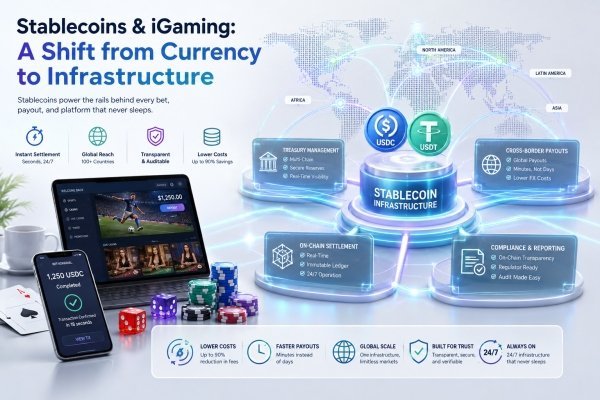
Some platforms have stopped treating this as a cost of doing business. Instead of adding stablecoins as another checkout option alongside Visa and PayPal, they have rebuilt their entire financial backend on USDC and USDT rails. Settlement, treasury management, cross-border payouts, and regulatory reporting now run on blockchain infrastructure that operates 24/7.
Stablecoins are replacing the entire payment infrastructure stack in iGaming, and fintech investors watching this space are getting an early look at the future of digital commerce.
Credit card processors treat gambling transactions like fraud risk. Visa and Mastercard classify deposits as cash advances, which means players pay immediate interest charges on top of 3 to 5 percent processing fees. Chargeback fraud compounds the problem, costing the industry over $500 million annually. Platforms absorb these losses even when they have already paid out winnings.
The problem continues at the banking level. Many retail banks refuse to process gambling-related transfers, even in jurisdictions where iGaming is fully regulated. Platforms maintain relationships with multiple payment processors just to cover different card issuers. Integrating a single payment method for a new market can take six to twelve months of regulatory paperwork.
Cross-border settlement adds another layer of cost and delay. Traditional wire transfers clear through correspondent banking networks over three to seven business days. Currency conversion fees stack on top, meaning a Canadian player withdrawing winnings to a European bank account waits a week and loses 5 to 7 percent to fees and FX spreads.
Payment processing is the single biggest operational cost and growth bottleneck for iGaming platforms trying to scale internationally.
Between 2014 and 2020, platforms added Bitcoin as a payment option alongside credit cards. It attracted crypto enthusiasts, but volatility made it impractical for mainstream use.
The stablecoin shift that started around 2021 is fundamentally different. USDT and USDC are programmable money that settle on blockchain networks operating around the clock. Platforms building on stablecoin rails are not adding a new payment method. They are replacing their entire financial backend.
Three infrastructure layers have changed.
Transactions finalize in seconds on networks like Tron or Solana, compared to three to five days for ACH bank settlements. Platforms like Moonbet process withdrawals in under five minutes using stablecoin rails. Traditional platforms take three to five business days for the same transaction.
Platforms can hold reserves in USDC across Ethereum, Solana, and Polygon without opening bank accounts in every jurisdiction they serve. Treasury management goes from months of bank onboarding and compliance paperwork to hours of wallet setup. A platform serving players in 40 countries does not need 40 banking relationships. It needs one stablecoin treasury across multiple chains.
Every stablecoin transaction is recorded on a public, immutable ledger. This creates a real-time, auditable financial record that exceeds what traditional payment processors provide. Regulators can verify transaction history without requesting data from the platform. The blockchain is the audit report.
iGaming stress tests payment infrastructure in ways no other vertical does.
Transaction volume is massive. Millions of micro-transactions happen daily across deposits, bets, payouts, and bonuses. Every transaction needs sub-second confirmation.
The user base is global by default. Players in over 100 countries transact simultaneously. Cross-border is the norm, not the exception. Settlement infrastructure must work across time zones, currencies, and regulatory regimes without degradation.
Real-time settlement is not a nice-to-have. Players expect instant deposits and withdrawals that process in minutes, not days.
Regulatory complexity adds another layer. Every jurisdiction has different payment regulations. Ontario, Curaçao, Malta, and the UK all require different compliance frameworks. Traditional banking requires separate integrations for each market. Stablecoin rails bypass most of this by operating outside correspondent banking networks while maintaining full on-chain transparency.
If stablecoin infrastructure can meet iGaming's demands, it can handle remittances, gig-economy payouts, creator platforms, and e-commerce. iGaming is the leading indicator for stablecoin adoption across digital commerce.
Regulators are not blocking stablecoins from iGaming. They are building frameworks to accommodate them.
In Canada, Ontario's AGCO currently requires licensed platforms to use regulated payment processors. Stablecoins exist in a compliance grey area. However, FINTRAC's guidance on virtual currency service providers is evolving. Crypto platforms operating in Canada must register as money services businesses and comply with AML reporting obligations. The regulatory pathway is forming.
The European Union provides more clarity. The Markets in Crypto-Assets regulation, effective 2024 and 2025, creates regulatory certainty for iGaming platforms using USDC and USDT in European markets.
Curaçao has moved even faster. The jurisdiction's updated gambling license framework now explicitly addresses cryptocurrency operations and recognizes stablecoin payment infrastructure as legitimate.
The direction across jurisdictions is consistent. Platforms that build on stablecoin infrastructure today will be positioned to meet compliance standards as they formalize.
The crypto gambling sector processes over $250 billion in annual wagers. This is the largest live deployment of stablecoin payment infrastructure in any vertical.
For fintech builders, iGaming platforms are solving problems every digital commerce business will eventually face. Real-time settlement, multi-currency treasury management, and on-chain compliance are being tested at scale. The solutions developed here will migrate to other verticals.
For regulators, stablecoin-powered platforms generate more transparent, auditable transaction data than traditional platforms. Regulation should leverage this transparency rather than restrict it.
Platforms like Moonbet represent the emerging model. Built entirely on stablecoin rails from day one, instead of retrofitting crypto onto legacy banking infrastructure.
Stablecoins in iGaming have moved past the experimental phase. They are now the infrastructure layer for settlement, treasury, accounting, and compliance.
For the Canadian fintech ecosystem, this creates both an opportunity and a policy question. How do we build regulatory frameworks that capture the benefits of stablecoin infrastructure while maintaining consumer protection?
The platforms building on stablecoin rails today are defining the financial architecture of digital entertainment for the next decade. The question is which jurisdictions will create the frameworks that allow it to scale within their borders.
The National Crowdfunding & Fintech Association (NCFA Canada) is a financial innovation ecosystem that provides education, market intelligence, industry stewardship, networking and funding opportunities and services to thousands of community members and works closely with industry, government, partners and affiliates to create a vibrant and innovative fintech and funding industry in Canada. Decentralized and distributed, NCFA is engaged with global stakeholders and helps incubate projects and investment in fintech, alternative finance, crowdfunding, peer-to-peer finance, payments, digital assets and tokens, artificial intelligence, blockchain, cryptocurrency, regtech, and insurtech sectors. Join Canada's Fintech & Funding Community today FREE! Or become a contributing member and get perks. For more information, please visit: www.ncfacanada.org
| | |
|---|---|---|
| | |



August 26th, 2025

January 4th, 2024

June 1st, 2021

September 9th, 2020

July 9th, 2018

January 3rd, 2018

September 25th, 2017

June 20th, 2017

May 10th, 2017

December 14th, 2016
