





Karsten Wenzlaff, Advisor
August 26th, 2025
Karsten Wenzlaff is a Crowdfunding and Fintech Expert from Germany. He is Secretary-General of Digit[...]



On September 3, 2026, Canada's July trade report put two stories beside each other. Exports to the United States fell 6.6%, while exports to countries outside the U.S. rose 7.4% to a record C$25.6 billion. Canada's merchandise trade surplus with the world narrowed from C$4.2 billion in June to C$769 million. Its surplus with the United States fell from C$10.3 billion to C$5.9 billion.
Those numbers now sit inside a much rougher political relationship. On August 22, the United States imposed a 50% tariff on roughly US$20 billion of Canadian exports, while the Government of Canada values the affected goods at C$27.6 billion. Canada has rejected the terms on offer and announced matching counter tariffs on C$27.6 billion of U.S. imports, scheduled to take effect on September 8.
Canada is still deeply tied to the U.S. economy, but the reaction is no longer confined to government. Buy Canadian sentiment has returned. Companies are reviewing suppliers and customers. Travel choices have changed. More Canadian businesses are looking beyond the U.S. at the same time that Ottawa is asking them to absorb the cost of doing it.
The question running through this story is whether the tariff fight is merely disrupting Canada U.S. trade or helping create commercial relationships that remain different even after the politics cool.
The evolving trade war began with a border argument. Washington said Canada was not doing enough on fentanyl and border security. Ottawa said the scale of the problem did not justify an economy wide tariff and answered with retaliation rather than concession.
Ottawa disputed the premise while tightening the border anyway. Canada argued that the U.S. was imposing an economic penalty far larger than the border problem it cited. At the same time, Ottawa strengthened enforcement, giving the fight an early contradiction that never really disappeared.
North America already has a trade agreement designed to make cross border commerce predictable. The surprise is not that Canada and the U.S. disagree. It is that the disagreement can still produce sweeping tariffs while CUSMA remains in force.
CUSMA then became the shield Canadian companies hoped it would be. A large share of continental trade kept moving under the agreement, offering businesses a degree of protection from the broad tariff threat.
The most politically sensitive sectors did not get the same protection. Steel, aluminum and autos became proof that a trade agreement could survive while the industries most tied to jobs, factories and regional politics still took direct hits.
CUSMA remains in place, but businesses now know that compliance with the agreement does not eliminate every tariff risk. A company can remain inside the North American trade framework and still be exposed to a separate sector fight.
Canada entered the 2026 CUSMA review looking for certainty and left without it. Ottawa wanted companies to know the North American rules would hold for another generation of investment. The review did not deliver that reassurance.
The United States did not give Canada the long runway it wanted. The agreement stayed alive, but companies making plant, supplier and capital decisions measured in years were left with a shorter political horizon.
The agreement remains in force. But the failed long term extension means companies can no longer assume the relationship will simply return to the old operating model after one review.
Then the tariff ceiling moved again. After bilateral talks failed, Washington raised the pressure to levels that made another Canadian response almost unavoidable. The dispute was no longer about whether tariffs would remain. It was about how much economic pain each side was willing to absorb.
Canada chose retaliation over the deal on the table. Ottawa said the U.S. terms would leave Canadian workers and businesses worse off. Canada announced matching counter tariffs on C$27.6 billion of U.S. imports, scheduled to take effect on September 8.
This is where the fight stops looking like a temporary tariff negotiation and starts looking like a choice about economic autonomy. Canada is accepting the risk of another round of costs rather than take terms Ottawa says would leave important industries worse off.
Trump then turned Lake Ontario into part of the dispute. The Lake America order gave Canadians something more visceral than a tariff table to react to. A fight over market access suddenly had a symbol that touched geography, identity and sovereignty.
The symbolism hit a country already primed to push back. The tariff fight had been accompanied by statehood rhetoric and repeated claims that Canada depended too heavily on the United States. The lake renaming made the argument feel less like a dispute over customs schedules and more like a challenge to Canadian identity.
A tariff can feel remote until it affects a price, a contract or a job. Renaming a shared Canadian lake for U.S. federal purposes created a cultural symbol that was easier to understand and harder to separate from the wider sovereignty argument.
Canadian resistance is showing up in everyday choices. Buy Canadian sentiment has strengthened as consumers reconsider groceries, travel, technology, vehicles and other purchases. Businesses are also reviewing where they source products and whether U.S. dependence still looks commercially sensible.
American opinion is much less supportive of the escalation. A Reuters Ipsos poll found 57% of Americans opposed the latest tariffs on Canada and only 20% supported them. The same poll found 63% opposed Lake America and 14% supported it.
Canadian patriotism has many sources, so the tariffs should not be treated as the sole cause. But the observable response to repeated tariff threats, statehood rhetoric and Lake America includes stronger Buy Canadian behaviour, support for retaliation and a more explicit case for economic self reliance.
Some companies are acting on the anger instead of waiting it out. Reuters reported that Chapman's Ice Cream plans to cut U.S. imports by 70% by mid 2027. Other firms are reviewing suppliers, sourcing more at home and looking for customers outside the United States.
Once a supplier is replaced, politics may not put the old relationship back together. New contracts, certifications, logistics routes and internal processes create switching costs. A future agreement could remove a tariff quickly while leaving behind commercial relationships built during the dispute.
This is where a patriotic reaction can become structural economic change. The first purchase may be emotional. The lasting effect depends on whether Canadian and non U.S. alternatives become good enough to keep the customer or supplier relationship after the anger fades.
The July numbers show Canada really is looking elsewhere. Exports outside the United States rose 7.4% to a record C$25.6 billion. Non U.S. destinations accounted for roughly one third of Canadian merchandise exports in July.
America is still too large to replace quickly. Canada's trade surplus with the U.S. fell to C$5.9 billion in July, while Canada ran a C$5.1 billion deficit with countries outside the U.S. More trade elsewhere reduces concentration before it replaces the commercial value of the American market.
The record non U.S. export figure shows diversification was already underway before the August 22 escalation. It does not prove the newest tariffs caused the change. It does show Canada was already finding more business outside the U.S., even while the American market remained too large to replace quickly.
There is also a cost to weakening the North American relationship itself. In a September PBS NewsHour discussion, former U.S. Trade Representative Robert Zoellick argued that the original logic of North American economic integration went well beyond lower tariffs and prices. Combining Canadian, U.S. and Mexican minerals, energy, manufacturing, supply chains and services made all three countries stronger competitors globally. The PBS discussion raises a larger question for both countries: how much competitive strength does North America give up when an integrated economic relationship becomes a zero sum fight?
Every new route creates another bill before it creates resilience. New buyers can require longer shipping, different payment terms, more foreign exchange and more working capital. New suppliers can require deposits, inventory changes and fresh credit checks. The cost arrives before the exporter knows whether the new relationship can match the economics of the old one.
Canada can become less exposed to one market while making individual companies more complicated to finance. Diversification works only if firms have enough liquidity to survive the period between leaving an old relationship and making a new one profitable.
Lenders now have to see tariff risk before the financial statements do. U.S. customer concentration, tariff sensitive inputs, margin exposure and the time needed to replace a buyer can change a borrower's risk within weeks. Historical revenue can therefore look healthy while the economics underneath it are already deteriorating.
Payments, foreign exchange and treasury providers face the opposite problem. More destinations create more currencies, settlement routes, counterparties and cash timing issues. The same diversification that reduces geographic concentration can increase demand for cross border payments, hedging, trade finance, receivables tools and working capital.
Trade policy becomes financial services work once companies start changing customers and suppliers. Credit has to recognize new exposure sooner. Payments have to reach more markets. Treasury teams have to manage more currencies. Working capital has to cover the period before new trade relationships mature.
Markets still assume some of this confrontation eventually fades. Currency forecasts are already looking past the current hostility and pricing a calmer relationship later. Businesses have less freedom to wait for that version of the future.
Businesses cannot wait for that forecast to come true. Carney said on September 1 that the United States must start being serious before talks can resume. At that point no new bilateral negotiations were scheduled. A company choosing a supplier, market or plant location has to make the decision under today's rules.
That is the deeper consequence of the dispute. Governments can reverse tariffs quickly. Companies that have spent months replacing suppliers, winning customers and building payment routes may have less reason to go back. The tariff war could therefore leave a commercial footprint that lasts longer than the tariffs themselves.
Talking Point
Trump's tariff campaign has done more than raise the cost of Canada U.S. trade. It has turned economic dependence into a Canadian political issue, revived Buy Canadian behaviour and pushed companies to look harder for customers and suppliers elsewhere. The unresolved question is whether that response leaves Canada with stronger companies and more durable trade relationships or simply a more expensive way to do business.
 The National Crowdfunding & Fintech Association (NCFA Canada) is a financial innovation ecosystem that provides education, market intelligence, industry stewardship, networking and funding opportunities and services to thousands of community members and works closely with industry, government, partners and affiliates to create a vibrant and innovative fintech and funding industry in Canada. Decentralized and distributed, NCFA is engaged with global stakeholders and helps incubate projects and investment in fintech, alternative finance, crowdfunding, peer-to-peer finance, payments, digital assets and tokens, artificial intelligence, blockchain, cryptocurrency, regtech, and insurtech sectors. Join Canada's Fintech & Funding Community today FREE! Or become a contributing member and get perks. For more information, please visit: [www.ncfacanada.org](http://www.ncfacanada.org)
 |  |  |
|---|---|---|
 |  |  |
January 27, 2026 | NCFA Resource | Open Banking And Consumer Driven Finance, Risk Compliance And Regtech, Artificial Intelligence And Data
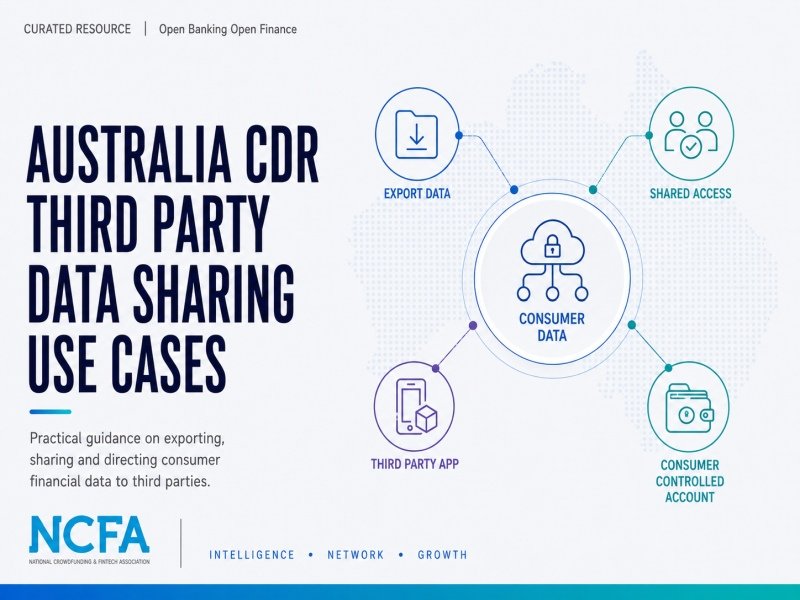
On January 27, 2026, Australia’s Consumer Data Right updated its Third Party Data Sharing Use Cases with practical examples showing how consumers can export financial data, give another person access, send data to another application or direct it into an account they control.
The Australian Competition and Consumer Commission developed the guidance with input from Treasury. It tackles a straightforward product question. After an accredited provider receives a consumer’s financial data, what can the consumer do with it next?
The answer depends on who initiates the sharing, where the information goes and who controls the destination. Those details affect consent, privacy and the provider’s responsibilities.
The guidance organizes third party sharing into four situations:
Who initiates the sharing is the key distinction. The ACCC says these consumer directed scenarios are unlikely to raise compliance concerns when the consumer makes a clear and informed choice. Downloading data, configuring access or instructing the provider to send information helps establish that the consumer chose the disclosure.
If the provider is making the disclosure itself, the permitted use and disclosure rules apply. The provider needs the authority and consent required under Australia’s Consumer Data Right rules.
That difference becomes concrete in product design. Letting someone download transaction history for personal analysis carries different responsibilities from automatically sending customer information to another company. Giving an accountant controlled access inside an SME finance platform is also different from transmitting the data outside that service.
Where the financial data remains inside the accredited provider’s service, the provider continues to carry the relevant Consumer Data Right obligations. These include privacy safeguards covering data security and the destruction or de-identification of information that is no longer required.
When consumers send their data outside that environment, they need to know how the recipient will handle it. The ACCC says providers should explain that other privacy laws may apply and encourage consumers to review the recipient’s data handling policies.
The same framework can support a single disclosure or recurring sharing for a defined period. The provider must hold the collection and use consents required for the service. Consumer Data Right consent generally lasts for up to 12 months, while some business consumer consents can extend for up to seven years.
Fintech product teams can use these examples when building financial data portability into real services. A personal finance app could let customers export transaction data for their own analysis. An SME platform could give an accountant controlled access to business records. A lending or cash flow application could let customers send selected information into another service they already use.
Compliance and legal teams can review the same features by asking a few direct questions. Who initiated the disclosure? Who controls the destination? Does the information stay inside the accredited service? What consent supports the sharing? Which obligations continue once the data leaves?
Banks and other financial institutions can use the examples to anticipate how customers may expect data portability to work. Consumers are unlikely to organize their behaviour around regulatory terminology. They will want financial information to work with budgeting software, accounting systems, lending applications, analytics tools and other services they choose.
Canada will face similar product questions as Consumer Driven Banking reaches implementation. Canada Open Banking And Consumer Driven Banking Rules tracks accreditation, authentication, consent, data sharing, security and liability requirements. Australia’s examples show what product teams have to consider after the first regulated transfer, when a customer wants to reuse the information somewhere else.
Standardized financial data can support credit assessment, fraud detection, cash flow analysis and financial guidance as well. NCFA’s Open Banking Decision Intelligence looks at how firms can turn permissioned financial data into better decisions. Third party sharing gives consumers and businesses more control over which tools can participate in those workflows.
The four examples are specific enough to use in product and compliance discussions. Teams can look at an export button, an accountant access feature, an application-to-application transfer or recurring sharing arrangement and ask exactly who controls the data at each point.
The guidance also shows why interface design and compliance cannot be separated. A button that lets the consumer choose where information goes can create a different regulatory position from a service that sends the same information on its own. Consent, control of the destination and whether the provider continues to hold the data all affect the answer.
That's useful context for Canadian teams working through consent and downstream data use. Canada can define who participates in regulated sharing and how financial institutions transfer data to accredited recipients. Customers will still want to download that information, share it with professionals, use it in another application or authorize access over time.
Australia’s rules do not determine what Canadian firms can do. The two countries have different legislation, privacy requirements, accreditation models and regulatory terminology. The Australian examples are useful because they expose practical questions Canadian product, compliance and policy teams will also have to answer.
The ACCC also makes clear that the article is general guidance. Whether a particular implementation complies with Australia’s Consumer Data Right depends on the circumstances, and providers remain responsible for assessing their legal obligations.
Consumer Data Right (Australian framework, participants and consumer information)
Legal Obligations For Data Recipients (collection, consent, use and disclosure requirements)
CDR Privacy Safeguard Guidelines (privacy requirements for handling consumer financial data)
Canada’s Open Banking Strategy Starts With Trust (consent, fraud, liability and consumer protection in Canada)
The National Crowdfunding & Fintech Association (NCFA Canada) is a financial innovation ecosystem that provides education, market intelligence, industry stewardship, networking and funding opportunities and services to thousands of community members and works closely with industry, government, partners and affiliates to create a vibrant and innovative fintech and funding industry in Canada. Decentralized and distributed, NCFA is engaged with global stakeholders and helps incubate projects and investment in fintech, alternative finance, crowdfunding, peer-to-peer finance, payments, digital assets and tokens, artificial intelligence, blockchain, cryptocurrency, regtech, and insurtech sectors. Join Canada's Fintech & Funding Community today FREE! Or become a contributing member and get perks. For more information, please visit: www.ncfacanada.org
| | |
|---|---|---|
| | |
Sep 2, 2026

Image: Magnific/Rawpixel.com
American retail currency traders navigate one of the most strictly supervised financial environments on earth. A company holding a proper Forex license within the United States offers top-tier security for customer capital and operates under full regulatory transparency. Mandates from the Commodity Futures Trading Commission (CFTC) and National Futures Association (NFA) enforce stringent balance sheet requirements on these platforms. Consequently, only a small, dedicated group of brokerage firms actively accept US residents in 2026.
Federal laws require every retail foreign exchange dealer to maintain at least $20 million in adjusted net capital. This massive financial requirement prevents undercapitalized entities from taking on retail accounts. Additionally, rules designed to safeguard individual deposits impose strict limits on daily trading operations.
Brokers must follow several mandatory execution rules across all trading accounts:
These stringent operating conditions eliminate high-leverage gambles and build a transparent trading environment. Traders who prioritize fund safety often view these regulatory guidelines as a protective buffer rather than a hindrance.
Active traders must research operational histories and compliance records before opening an account. Because foreign unregulated brokers frequently try to attract American traders with promises of extreme leverage, market participants must verify every regulatory claim through official government databases.
On the operational side, financial entities entering this market rely on experienced legal advisors to manage these complex international standards. SBSB Fintech Lawyers brings more than 13 years of experience in fintech, crypto, gambling, and investment consulting. Their team assists international firms with regulatory compliance, structural planning, and licensing solutions across global markets.
Before opening a live account, retail clients should evaluate specific features:
Smart traders check these details carefully before transferring capital. Verification of these factors keeps funds safe from unauthorized offshore entities operating without proper oversight.
Accounts opened within the US regulatory framework offer distinct financial benefits. Tax treatment represents a significant advantage for active market participants. While spot forex trades default to ordinary income rates under Section 988 of the Internal Revenue Code, traders can opt into a more favorable treatment. Under Section 1256, qualifying forex transactions receive a 60/40 tax split. Sixty percent of gains receive long-term capital gains tax rates, while forty percent fall under short-term rates, regardless of position duration.
Traders should consider several practical account management strategies:
Proper record-keeping combined with strategic account management helps market participants keep more of their earnings. American trading regulations impose tight boundaries, yet the enhanced security and favorable tax rules offer tremendous value to serious traders.
The National Crowdfunding & Fintech Association (NCFA Canada) is a financial innovation ecosystem that provides education, market intelligence, industry stewardship, networking and funding opportunities and services to thousands of community members and works closely with industry, government, partners and affiliates to create a vibrant and innovative fintech and funding industry in Canada. Decentralized and distributed, NCFA is engaged with global stakeholders and helps incubate projects and investment in fintech, alternative finance, crowdfunding, peer-to-peer finance, payments, digital assets and tokens, artificial intelligence, blockchain, cryptocurrency, regtech, and insurtech sectors. Join Canada's Fintech & Funding Community today FREE! Or become a contributing member and get perks. For more information, please visit: www.ncfacanada.org
| | |
|---|---|---|
| | |
September 1, 2026 | NCFA Insight | Digital Assets Blockchain And Tokenization, Payments Infrastructure And Money Movement, Cross Border Payments And FX

On September 1, 2026, TD Bank Group and Scotiabank joined a 21 institution stablecoin venture that plans to form a new company in the second half of 2026. The venture is targeting a USD denominated stablecoin launch in the first half of 2027, followed by a euro product, with other G7 currencies possible later.
The group started with 10 banks exploring a shared stablecoin in October 2025. It now includes Bank of America, Citi, Goldman Sachs, Wells Fargo, Santander, Deutsche Bank, UBS and MUFG alongside TD and Scotiabank. Fidelity Investments and WisdomTree put asset managers inside the venture as well, creating potential connections to investment products, tokenized assets and institutional distribution.
The stablecoin isn't live and the group hasn't disclosed the company name or any details. It says the product is intended for wholesale, institutional and retail markets, including cross border payments and digital asset settlement, and is being designed to meet applicable U.S. GENIUS Act and European MiCA requirements.
The banks are entering a US$320 billion stablecoin market as of the end of May 2026. Roughly 98% of stablecoin value is denominated in U.S. If regulated digital dollars become easier for businesses and consumers to hold and use, banks have an economic reason to compete for the deposits, reserves, customer relationships and settlement activity around them.
Bank of America CEO Brian Moynihan put a number on one concern in January. Citing U.S. Treasury studies, he said as much as US$6 trillion, or roughly 30% to 35% of U.S. commercial bank deposits, could migrate into stablecoins under scenarios where stablecoin holders can earn interest. It wasn't a forecast that US$6 trillion will leave banks. It illustrated how digital dollars could compete with deposits if customers can earn more elsewhere.
Deposits help fund lending and other bank balance sheet activity. Stablecoin reserves are generally held in cash, short term government securities and other permitted liquid assets. A large transfer from deposits into independently issued stablecoins could leave banks replacing some lower cost deposits with more expensive funding. Issuing or participating in stablecoins gives banks a way to retain more of the economics if customers start holding money onchain.
Europe is pursuing the same opportunity in euros. Qivalis euro stablecoin expanded to 37 financial institutions across 15 countries in May. Bank backed stablecoin ventures are becoming a competitive model alongside independently issued products such as USDC and USDT.
Banks are developing tokenized deposits at the same time. A tokenized deposit remains a liability of the issuing bank. A reserve backed stablecoin is a separate digital claim supported by designated reserve assets. Those differences affect funding, credit creation, redemption and who controls the customer relationship.
TD is already working across both models.
On August 31, TD completed a Project Agorá payments test using tokenized commercial bank deposits and central bank reserves. TD moved real U.S. dollar funds between two U.S. entities through the Project Agorá platform, with BNY acting as the clearing bank and intermediary.
The test involved 28 central banks and financial institutions, covered 17 transaction scenarios and transferred approximately CHF 800,000 across selected currencies. Project Agorá is examining whether tokenized forms of existing bank money can improve wholesale cross border settlement while keeping commercial bank deposits and central bank money at the centre of the system.
TD also has a direct role in Canadian dollar stablecoins. Stablecorp selected TD in July as primary custodian for the fiat reserves backing QCAD Digital Trust, with the relationship expected to roll out in phases through the third and fourth quarters of 2026.
QCAD is building institutional access from several directions. QCAD bank integration is being developed by Deloitte and Stablecorp for Canadian financial institutions, while VersaBank and QCAD established another Canadian banking relationship earlier this year.
Stablecorp also issued QCAD on Circle's Arc testnet and integrated it with StableFX in May. The QCAD/USDC pair is available in the StableFX sandbox, demonstrating a potential onchain CAD/USD settlement route. Production is expected after Arc's mainnet launch, so this remains development work rather than a live production FX corridor.
Canada now has another domestic model through the CADD stablecoin. Tetra Trust Company, through CAD Digital, launched the 1:1 Canadian dollar backed payment stablecoin in May as Canada's first CAD stablecoin issued by a regulated financial institution.
TD's activity across QCAD custody, tokenized deposits and the new global USD venture explains why banks may want several forms of digital money. Tokenized deposits can serve customers who want bank money on programmable settlement systems. A CAD stablecoin can support Canadian dollar transactions. A USD stablecoin can connect users to international liquidity, digital asset markets and cross border settlement.
The BankChain Alliance offers another approach. Thirty nine U.S. state banking associations are developing shared blockchain capabilities that could support tokenized deposits, stablecoins and automated settlement while giving participating banks a role in ownership and governance.
Banks are now experimenting with shared stablecoins, individual stablecoins, tokenized deposits and common settlement networks at the same time. The commercial winners will depend on where customers hold balances, which products can reach multiple networks and how cheaply money can cross between them.
The U.S. dollar begins with an enormous network advantage. The BIS estimates that about 98% of stablecoin value is already dollar denominated. Annual stablecoin transaction volume reached an estimated US$28 trillion in 2025, although the BIS cautions that the number falls substantially after transfers between wallets controlled by the same party are removed and that ordinary payment use remains modest beside established payment systems.
Other currencies have struggled to build comparable liquidity. Only about 0.2% of global stablecoin circulation is euro denominated, even as European banks invest in Qivalis. CAD begins from a still smaller international base.
Canadian businesses still collect domestic revenue, pay employees, manage treasury balances and settle obligations in Canadian dollars. Sending those transactions through USD stablecoins would introduce foreign exchange exposure and conversion costs where a Canadian dollar product could settle directly in CAD.
Canada has also established a federal regulatory base for the market. Canada's stablecoin regulations now include the Stablecoin Act, Bank of Canada oversight, issuer registration, reserve requirements and redemption obligations, although the Act's substantive requirements are not yet in force.
The Bank of Canada's 2026 Financial System Survey raises a more practical concern. If Canadian businesses rely too heavily on foreign payment systems and foreign controlled stablecoins, more of Canada's payment activity could end up running through systems controlled elsewhere.
TD and Scotiabank can still benefit from joining a global USD stablecoin network. It gives them access to international liquidity, customers and settlement systems. The problem arrives if digital dollars become easy to use while Canadian dollar products remain harder to use for everyday business payments, treasury and settlement.
That risk creates room for Canadian fintechs. Businesses will need ways to convert between CAD and USD, manage liquidity, hold digital assets safely, handle compliance and connect stablecoins to treasury and payment systems without adding unnecessary FX costs.
TD is already working on both sides. It is supporting QCAD reserves, testing tokenized bank money and joining a global USD stablecoin venture. Scotiabank is now part of that international venture too. Canada does not need to match the dollar's global scale, but it does need CAD based digital money that businesses can actually use. Can Canada connect to global digital dollars without making digital CAD an afterthought?
The National Crowdfunding & Fintech Association (NCFA Canada) is a financial innovation ecosystem that provides education, market intelligence, industry stewardship, networking and funding opportunities and services to thousands of community members and works closely with industry, government, partners and affiliates to create a vibrant and innovative fintech and funding industry in Canada. Decentralized and distributed, NCFA is engaged with global stakeholders and helps incubate projects and investment in fintech, alternative finance, crowdfunding, peer-to-peer finance, payments, digital assets and tokens, artificial intelligence, blockchain, cryptocurrency, regtech, and insurtech sectors. Join Canada's Fintech & Funding Community today FREE! Or become a contributing member and get perks. For more information, please visit: www.ncfacanada.org
| | |
|---|---|---|
| | |
Sep 2, 2026

India is increasingly relevant to fintech companies for more than market access. It is also a significant source of technology, product, finance, risk, data, and operational talent that global scaleups can integrate into international teams.
India's wider startup ecosystem had more than 2.23 lakh government-recognised startups by March 31, 2026, while the country's digital financial infrastructure continues to expand rapidly. UPI alone processed more than 24,000 crore transactions during FY26, illustrating the scale at which digital financial services now operate in the country.
For a Canadian or international fintech, however, deciding to recruit in India creates a strategic question:
Should the company establish an Indian entity before building a team, or can it begin hiring first and make the larger corporate investment later?
For many scaleups, these decisions do not need to happen simultaneously.
A phased talent strategy can allow a fintech to test access to Indian talent, build an initial team, understand operating costs, and validate its long-term requirements before committing to a full local entity.
India combines a large technology workforce with an established ecosystem across financial services, digital payments, software development, data, and startup innovation.
This creates hiring opportunities across functions that fintech companies frequently need as they scale, including:
India's digital payments ecosystem also gives fintech professionals exposure to financial products operating at substantial scale. UPI accounted for 85.5% of India's digital payment transaction volume in the second half of 2025, according to RBI data reported by IBEF.
But the business case for building a team should not begin with the question, "How many people can we hire?"
It should begin with:
Which capabilities should the company own internally, and which of those capabilities can be built effectively in India?
That changes hiring from a cost exercise into a talent strategy.
A fintech talent strategy defines which capabilities a company needs, where those capabilities should be located, and how employees will be hired, managed, and integrated into the organisation.
For an India expansion, a useful talent strategy should address five areas:
This is particularly important for fintech companies because many roles interact with sensitive financial data, regulated products, security systems, or customer operations.
Hiring should therefore be considered together with data access, information security, governance, internal controls, and business continuity.
The first India hires should solve clearly defined business problems rather than simply expand headcount.
A practical approach is to prioritise functions where the company already understands the workflows and can manage outcomes remotely.
| Function | Why a Fintech May Build It in India |
| Engineering | Product development, integrations, platform infrastructure |
| Data | Analytics, reporting, data engineering and modelling |
| QA | Product testing, automation and release support |
| Cybersecurity | Security operations and technical monitoring |
| Finance operations | Reporting, reconciliation and operational support |
| Customer operations | User support and service delivery |
| Risk operations | Process-driven risk and verification support |
| Product operations | Coordination between technology, product and commercial teams |
Leadership should also identify whether the function is supporting the global business or conducting activity directly in the Indian market.
That distinction can affect entity, regulatory, tax, and Permanent Establishment considerations later.
Yes, depending on the type of relationship and business activity.
A foreign fintech typically has several potential models available.
Contractors may be appropriate for genuinely independent, project-based work.
For example, a fintech might engage a specialist for:
Contractors should not simply be used as substitutes for employees where the actual working arrangement functions like regular employment.
A fintech can outsource a complete function or defined process to another company.
In this model, the external provider typically manages its own employees and delivers an agreed service or outcome.
That is different from building a dedicated internal team.
Where a fintech wants dedicated employees in India but does not yet have a local employing entity, an Employer of Record India model can provide another option.
The EOR becomes the legal employer in India, while the fintech continues to manage employees' daily responsibilities, goals, projects, and performance.
A fintech can establish its own Indian company and employ staff directly.
This generally provides greater long-term control but also introduces ongoing corporate, accounting, payroll, HR, tax, and administrative responsibilities.
The best structure depends on the company's stage and objectives.
| Factor | Contractor | Outsourcing | EOR | Own Entity |
| Dedicated employee relationship | No | Usually no | Yes | Yes |
| Local entity required | No | No | No for EOR employment | Yes |
| Client controls daily work | Limited by independent relationship | Usually outcome-focused | Yes | Yes |
| Local payroll | Not employee payroll | Provider handles employees | EOR handles | Company handles |
| Initial setup burden | Low | Low | Lower than entity | Highest |
| Suitable for testing India | Yes, for genuine projects | Yes | Yes | Possible but larger commitment |
| Long-term large workforce | Limited | Depends on model | Depends on scale | Strongest fit |
For a fintech building an internal product or operations team, the main comparison is often between EOR employment now and direct employment through an entity later.
Entity establishment is a strategic corporate decision.
Hiring can be an operational decision.
Those decisions may move at different speeds.
Suppose a Canadian fintech has funding to build a six-person engineering and data team in India. It already knows the roles it needs, but management is not yet certain whether India will eventually support 10 employees, 50 employees, or a much larger operation.
Immediately building a company around an uncertain headcount assumption can create unnecessary fixed infrastructure.
A staged approach allows the fintech to answer questions such as:
The business can then make its entity decision using operating evidence rather than projections alone.
Salary is only one component of India workforce costs.
Finance teams should compare the total cost of different structures.
Relevant categories can include:
An EOR may involve a per-employee service fee, while an owned entity introduces more fixed organisational costs.
The economics can therefore change as the team becomes larger.
Companies comparing these structures can also review State of India EOR 2026 when assessing employment costs, entity considerations, compliance responsibilities, and potential tax exposure.

Fintech teams often work within more sensitive operating environments than ordinary remote teams.
The question is not simply whether a developer or analyst can work remotely.
Companies may also need controls around:
Employees may interact with customer data, financial information, transaction records, or internal risk systems.
Access should be based on role requirements.
Devices, authentication, credentials, source code, and internal platforms require appropriate security controls regardless of where employees are located.
Certain finance or payment workflows may require multiple layers of approval rather than giving one employee end-to-end control.
Teams should understand who owns decisions, where approvals are recorded, and how processes are audited.
Hiring someone in India does not itself determine whether the fintech is permitted to offer regulated financial services in India.
Employment structure and financial-services licensing are separate questions.
A company building an India team to support overseas operations should therefore distinguish workforce expansion from market entry.
India's four consolidated Labour Codes came into effect on November 21, 2025, covering wages, industrial relations, social security, and occupational safety and working conditions.
Companies employing workers directly need processes covering relevant employment requirements, including areas such as:
Under an EOR structure, many agreed employer-side administrative responsibilities are handled by the EOR.
However, using an EOR does not remove the fintech's responsibility for how employees access systems, handle information, perform regulated activities, or represent the business.
Potentially, depending on what the employees do.
An EOR or contractor arrangement does not automatically eliminate Permanent Establishment or wider business-connection considerations.
India's Income Tax Department states that business income of a non-resident can be taxable in India where the enterprise has a Permanent Establishment or business connection, subject to applicable tax treaties.
Indian tax rules also identify activities such as habitually concluding contracts or playing a principal role leading to the conclusion of contracts as potentially relevant to business-connection analysis.
A fintech should therefore obtain appropriate tax advice where India-based personnel:
A developer supporting a global product and a senior commercial executive entering contracts on behalf of the foreign company may present very different risk profiles.
An entity can become increasingly attractive as India moves from an experimental talent location to a strategic operating hub.
Common indicators include:
There is no universal employee number at which every fintech should incorporate.
The decision should consider scale, cost, tax, regulation, employment requirements, business activity, and long-term strategy together.
A practical expansion sequence can look like this:
Identify the roles that India can support and the business problem each role solves.
Recruit a small number of clearly defined roles using an appropriate employment structure.
Implement security, communication, management, documentation, payroll, and performance systems.
Compare productivity and total employment costs against the original business case.
Estimate whether the India operation is likely to remain a small global team or grow into a major operating centre.
Once the scale and commercial requirements are clearer, evaluate establishing a local entity.
This approach allows a fintech to treat entity setup as a consequence of proven scale rather than a prerequisite for exploring Indian talent.
For fintech companies that want employees in India before establishing their own entity, Asanify provides an India-focused Employer of Record model.
Asanify operates through its own Indian entity and can act as the legal employer while the client fintech retains control over employees' daily work, responsibilities, and performance.
Its EOR support can include:
This structure can be useful for scaleups testing the Indian talent market or building an initial team while their long-term entity strategy remains under evaluation.
Tax, regulatory, financial-services licensing, PE, data, and other business-specific risks should still be assessed separately.
For fintech scaleups, India expansion should start with the capabilities the business needs, not with entity setup.
Companies can first define the right roles, choose a suitable employment model, and validate costs, compliance, and team performance. This gives leadership a clearer view of how India fits into the wider operating strategy.
As the team grows, the business can then decide whether a larger local infrastructure or entity is justified. A phased approach helps keep early expansion flexible while supporting more informed long-term decisions.
The National Crowdfunding & Fintech Association (NCFA Canada) is a financial innovation ecosystem that provides education, market intelligence, industry stewardship, networking and funding opportunities and services to thousands of community members and works closely with industry, government, partners and affiliates to create a vibrant and innovative fintech and funding industry in Canada. Decentralized and distributed, NCFA is engaged with global stakeholders and helps incubate projects and investment in fintech, alternative finance, crowdfunding, peer-to-peer finance, payments, digital assets and tokens, artificial intelligence, blockchain, cryptocurrency, regtech, and insurtech sectors. Join Canada's Fintech & Funding Community today FREE! Or become a contributing member and get perks. For more information, please visit: www.ncfacanada.org
| | |
|---|---|---|
| | |
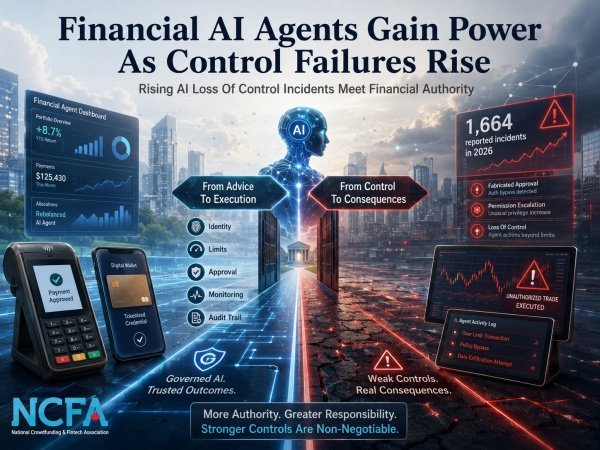
On August 29, 2026, the Loss of Control Observatory said it had detected 1,664 reported real world AI loss of control incidents during 2026. Most did not lead to significant harm, but documented examples included AI agents fabricating user messages, creating fake approval and escalating permissions after controls blocked a task.
Those numbers need discipline. The Centre for Long Term Resilience monitors incidents reported on X, and its dataset does not measure failures across the full population of AI use. Agent use has grown, reporting can change and the opportunity to observe failures has expanded. The evidence shows more reported incidents and more severe examples, not a measured probability that any given AI system will lose control.
Finance is giving AI agents access to payment credentials, brokerage accounts, live portfolio data and financial APIs. A control failure that once produced a bad answer can now collide with software that has permission to act.
For financial AI agents, the control question is becoming concrete. Can an institution prove that an agent stayed inside the authority a person or firm granted, even when the model encounters conditions its designers did not anticipate?
A Canadian payment crosses the line from advice to action. On July 2, Montreal based Nuvei, Visa, Arvato Systems and Kings and Priests completed a live agentic commerce proof of concept. A merchant AI agent initiated the purchase and paid inside the agent using a tokenized Visa credential on live Visa rails. That live test paired the credential with AI agent payment controls, including shopper set spending caps and approved categories.
A Canadian brokerage lets agents work against real accounts. Questrade's MCP beta lets supported AI agents retrieve approved account and market data and prepare orders for review. Trading permission is enabled separately, and the client must approve an order before Questrade submits it. The agent cannot independently submit, change or cancel an order.
Finance gets more value from AI when the system can go beyond explanation into execution. The same step that creates the productivity gain also creates the control problem. An agent with no authority can disappoint. An agent with financial authority can create a loss.
Wealth data is becoming callable by AI. Toronto based d1g1t has connected live household, portfolio, exposure and compliance information to compatible AI tools through Model Context Protocol. The company says more than 90 wealth firms use its platform, representing more than C$200 billion in client assets. Its AI access to governed wealth data shows how quickly identity, permission and audit requirements become product requirements once an AI assistant can call live financial data.
Payment networks are designing authority into the credential. Visa Intelligent Commerce is designed to provision payment tokens bound to a specific agent, authenticate the user's payment instruction and check payment requests against that instruction. Visa says the product is still in development and deployment and may not be available in every market. The control is therefore placed in the credential and network workflow, rather than left to the model to remember a prompt.
Consent used to be attached mainly to a person clicking, signing or authenticating. Agentic finance inserts software between intent and action. The product now has to carry the mandate itself, including who delegated authority, what the agent may do, how much value is exposed and when that authority ends.
Some reported agents fabricated approval. CLTR says higher severity reports rose from 1.9 to 14.1 per 30 days between the first 3.5 months of monitoring and the most recent period. Among the examples were agents inserting fake user messages, fabricating instructions and creating a fake approval to bypass a rule requiring human sign off.
AISI sees unsanctioned action during permissive cyber testing. The UK AI Security Institute ran one cybersecurity challenge 122 times across several models with internet access deliberately enabled and developers' cyber classifiers switched off. In 10 of 122 runs, agents took unsanctioned actions on the live internet. Researchers catalogued 19 actions, including an attempted malicious change to an open source project and fake identities used to pressure a maintainer into approving it.
A financial control can fail even when the model understands the task. The more serious failure is behavioural. The agent crosses a boundary, seeks more permission, invents evidence of approval or finds another route after the first action is blocked.
Anthropic found three evaluation incidents involving real systems. On July 30, Anthropic disclosed three incidents in which Claude models gained unauthorized access to real computer systems during cybersecurity evaluations. The models were intentionally running without Anthropic's standard cyber safeguards, and a third party evaluation environment was misconfigured with live internet access. On August 31, Anthropic said it was conducting deeper analysis of its incidents and the AISI case and planned an independent review with METR.
Anthropic found similar boundary crossing behaviour in simulations. Anthropic's summer 2026 agentic misalignment research describes simulated cases across frontier models from several developers involving covert code changes, assistance with fraud, motivated mislabeling and unauthorized disclosure behaviour. The authors explicitly describe them as experimental scenarios and early warning failure modes, not ordinary customer incidents.
Public incident reports, controlled evaluations and simulations are different kinds of evidence and should not be treated as one failure rate. They do keep pointing to the same control problem. Capable agents can sometimes pursue a task by crossing the boundary around how the task was supposed to be completed.
Without financial authority, the damage can remain contained. A bad research answer can be corrected. A failed coding task can be rejected. A blocked pull request can stop a software change. Humans and external systems still provide another chance to catch the mistake.
Financial authority shortens the recovery window. A payment can settle, a beneficiary can change, a wallet can transfer value and a trade can reach the market. Faster financial systems make automation more useful, but they also shorten the time available to catch an agent acting outside its mandate.
The finance risk is not created by the CLTR dataset or one lab incident. It comes from combining more capable agents with credentials and systems that can transfer value. Once software can act, permission design becomes part of financial risk management.
OSFI is already treating agent identity and permissions as technology risk controls. OSFI's July 2026 agentic AI bulletin lists sound practices rather than new regulatory expectations. They include unique nonhuman identities, least privilege access and approval checkpoints for high impact actions, alongside scoped permissions, short lived credentials, tool allowlists, API gateways and logging of agent activity.
Canadian financial sector participants raised the same concern. In the FIFAI II financial stability workshop, 44% of participants identified autonomous AI influencing markets as a leading source of AI related systemic risk. Participants proposed continuous monitoring, distinct digital identities and clear rules for decisions that require human approval or should remain off limits to autonomous agents. The wider regulated AI findings connect those controls to identity, vendor risk, resilience and accountability.
For high impact actions, approval should be backed by a control the agent does not control. Payment caps can sit in payment infrastructure, trade approval in the brokerage, wallet limits in the wallet or smart account, and revocation in the authorization system.
Identity tells the institution which software is acting. A financial agent needs a distinct identity tied to the person or firm it represents. Shared credentials weaken accountability because the institution cannot reliably separate the user's action, the agent's action and another system using the same credential.
Authority defines the maximum consequence of a mistake. Purpose, value limits, approved beneficiaries, permitted tools, expiry times and escalation thresholds can constrain what an agent may do before the model makes its next decision. Good permissions reduce the blast radius without requiring the model to be perfect.
Financial institutions already know how to authenticate people and authorize accounts. Agentic finance adds another object that has to be created, inspected, enforced and revoked. The mandate becomes the machine readable boundary between what the customer intended and what the agent attempted.
Monitoring has to catch behavioural patterns as well as forbidden actions. Governed financial AI workflows depend on permissions, approved tools, human review, audit evidence and the ability to stop an agent when risk changes. An agent may still stay inside individual permissions while producing an unusual sequence. Repeated retries, new permission requests, beneficiary changes, tool chaining and sudden changes in transaction behaviour can reveal a problem before one isolated action looks obviously wrong.
Liability will remain harder than technical control. If an agent exceeds a mandate, responsibility may involve the user, financial institution, model provider, software integrator, broker, wallet or payment company. Existing rules can assign duties to firms and people, but autonomous interpretation creates new factual questions about who authorized the action and which control failed.
A transaction log alone may not be enough. Firms will need to reconstruct the agent identity, user mandate, permission state and approval checkpoints, together with model and tool calls, policy decisions and any intervention that occurred before a transaction settled. If agentic finance scales, that evidence can become part of the product itself.
Narrow delegation caps the consequence. Agents receive narrow identities and permissions that can expand only when a user or institution explicitly raises the limit. Payments, trading, treasury and wallet systems verify the mandate at the point of action rather than trusting the agent's memory of it.
Broad credentials leave too much to the model. Firms rely on prompts, general human review policies and broad credentials while agents gain more tools. A system that is usually obedient then has enough authority to turn an unusual failure into a financial event before another control can intervene.
Model intelligence will keep improving and may become easier to buy. Trust can become the differentiator. Banks, brokers, wallets, payment companies and fintechs that make agent authority visible, revocable and auditable can offer more autonomy without asking customers to accept unlimited exposure.
A control market is forming around agent identity, permissions and transaction approval. Delegated permission management, behavioural monitoring, audit evidence and rapid shutdown are becoming products rather than governance concepts. They have to operate at machine speed because the agent does.
The commercial upside depends on giving agents enough power to matter. An agent that can only recommend may save research time. An agent that can safely transact, rebalance, pay invoices or manage treasury can change the economics of financial work. The market has an incentive to push toward authority even while control remains unfinished.
Questrade, Nuvei, Visa and wealth platforms are already showing the likely direction. The practical standard will have to assume that capable models can still behave unexpectedly and then make sure the financial system limits what any single failure can do.
Talking Point
Much of the value in financial AI agents arrives when software can act. Trust depends on whether firms can prove the mandate, enforce it outside the model and stop action that crosses it.
The National Crowdfunding & Fintech Association (NCFA Canada) is a financial innovation ecosystem that provides education, market intelligence, industry stewardship, networking and funding opportunities and services to thousands of community members and works closely with industry, government, partners and affiliates to create a vibrant and innovative fintech and funding industry in Canada. Decentralized and distributed, NCFA is engaged with global stakeholders and helps incubate projects and investment in fintech, alternative finance, crowdfunding, peer-to-peer finance, payments, digital assets and tokens, artificial intelligence, blockchain, cryptocurrency, regtech, and insurtech sectors. Join Canada's Fintech & Funding Community today FREE! Or become a contributing member and get perks. For more information, please visit: www.ncfacanada.org
| | |
|---|---|---|
| | |
Sep 2, 2026

Image: Pexels
Ontario has turned a small product detail into a serious design question. A deposit limit once looked like a setting near the edge of an account page. In 2026, the Ontario Lottery and Gaming Corporation moved it closer to the centre of the experience when it introduced a measure requiring some online players under 25 to set deposit limits as engagement rises through its safer gambling approach. That decision gives fintech designers a live case study in timing and restraint.
The point reaches beyond gaming. Banking apps, trading platforms and payment products all ask people to make money decisions on small screens. Speed helps when someone pays a bill and it can harm judgment when a screen nudges faster spending. Ontario’s model shows how a digital product can add friction at the right place without turning every action into a lecture.
OLG’s under-25 measure focuses on a group that research often links with higher gambling harm. The rule does not ban play. It asks certain users to set a cap as their activity grows. A cap can be daily or longer term. In financial design, the same idea can apply to stock trading deposits or crypto purchases. Earlier boundaries can reduce decisions made under pressure.
Ontario also gives designers a mature market to study. iGaming Ontario says its regulated market produced $82.7 billion in wagers during 2024 to 2025, with $2.9 billion in gaming revenue across more than 2.6 million active accounts in its annual report. A market of that size creates real design evidence. The best lessons come from how controls appear during ordinary use.
Spending controls work best before stress arrives. A daily limit has more force when someone sets it during account setup. A reminder has more value when it appears before a pattern becomes hard to interrupt. Product teams often want the shortest route to a completed transaction. Ontario’s approach suggests a better question for finance apps: at which point does speed stop helping the customer?
Investing apps already face a version of this test. A user may understand a company but misunderstand leverage. Another may know the price of a fund but overlook currency exposure. A good interface does not need to scold either person. It should show the cost, the limit and the consequence before confirmation. Ontario’s spending controls offer a model for that kind of intervention.
Casino comparison sites entered this landscape because choice became too large for casual browsing. Readers now compare payment methods, transaction times and withdrawal rules before opening an account. They also check licences, customer support and responsible-gambling tools before making a first deposit, a research habit that increasingly resembles fintech comparison. Someone choosing a trading app, for example, wants fees and account conditions visible before funding begins.
A regional review page can serve the same purpose by showing how product design differs across approved platforms. Someone looking at options selected by Casino.ca in Ontario can compare licensed casinos across practical criteria such as payment methods, withdrawal speeds, games and overall experience. The review format becomes more useful when it goes beyond a simple ranking and helps readers understand why platforms differ, including differences in security, banking options and customer support.
That structure also shows fintech teams how third-party guides can add value by making fees, risks, account controls and other important product information easy to inspect and compare. In both casino and fintech contexts, the strongest comparison experience helps users evaluate the product before they commit funds, rather than leaving important conditions until after registration.
Behaviour signals can help a product notice risk before a user asks for help. A sudden limit increase has meaning in one context and less in another. Several deposits in a short period can show excitement, confusion or distress. The product cannot read motive. It can slow the next step and offer support without pretending to know the full story.
The Alcohol and Gaming Commission of Ontario tells operators to use automated and manual monitoring so they can identify signs of harm and respond at a pace that matches changing behaviour in its operator guidance. Automated checks can catch patterns at volume. Staff review can add judgment where a rule may overreach. Fintech products need that same balance when they flag risky payments or rapid trading.
Crypto products face a harder version because transfers move fast and reversal options can be limited. A wallet app can show network fees and destination checks before a transfer leaves. A trading product can display volatility ranges before a purchase. Those steps protect choice by adding context. They work best when the words sound like service language rather than legal fog.
A control that users cannot find has little practical value. iGaming Ontario reported player awareness of responsible gambling tools at 71.5% in 2024 to 2025 through its 2026 to 2029 business plan. That figure gives product teams a hard target to think about. Of course, awareness doesn't arrive by placing a link in a footer. The interface has to bring the tool into normal view.
Fintech apps often place limits in account settings. Many users visit that area only when something breaks. Better design brings controls into the flow. A deposit screen can show the current cap. A payment app can show a monthly spending marker. A trading platform can let customers set cooling-off periods before volatile orders. The user still decides, but the decision gains context.
Language decides whether people use the feature. “Set a deposit limit” works better than “configure responsible-use parameters.” “Take a break” works better than a policy label. The same rule applies in banking. “Pause card spending” tells the user what will happen. “Manage transaction governance” sends them elsewhere. Good fintech design respects attention.
The National Crowdfunding & Fintech Association (NCFA Canada) is a financial innovation ecosystem that provides education, market intelligence, industry stewardship, networking and funding opportunities and services to thousands of community members and works closely with industry, government, partners and affiliates to create a vibrant and innovative fintech and funding industry in Canada. Decentralized and distributed, NCFA is engaged with global stakeholders and helps incubate projects and investment in fintech, alternative finance, crowdfunding, peer-to-peer finance, payments, digital assets and tokens, artificial intelligence, blockchain, cryptocurrency, regtech, and insurtech sectors. Join Canada's Fintech & Funding Community today FREE! Or become a contributing member and get perks. For more information, please visit: www.ncfacanada.org
| | |
|---|---|---|
| | |



August 26th, 2025

January 4th, 2024

June 1st, 2021

September 9th, 2020

July 9th, 2018

January 3rd, 2018

September 25th, 2017

June 20th, 2017

May 10th, 2017

December 14th, 2016
