




Karsten Wenzlaff, Advisor
August 26th, 2025
Karsten Wenzlaff is a Crowdfunding and Fintech Expert from Germany. He is Secretary-General of Digit[...]


Apr 28, 2026 | NCFA Insight | AI, Fintech And Productivity

AI Image: Jobs vs Compute
AI layoffs are becoming a capital allocation story. In April 2026, large firms across technology, retail, media, and financial services kept cutting roles while at the same time spending more on AI, automation, cloud infrastructure, and operating efficiency.
That doesn’t mean all layoffs are as a result of AI, but boards are asking a harder question now as they divert capital from labour to compute: where does the next dollar produce more output, people, platforms, or compute?
The numbers are getting harder to ignore. Big Tech AI spending could reach about $600 billion in 2026. Meta plans to cut about 10% of its workforce while guiding to $115 billion to $135 billion in capital spending driven largely by AI infrastructure. Microsoft is offering a voluntary employee buyout as it manages rising AI and cloud costs. Snap is cutting about 16% of full time staff. Nike is cutting about 1,400 jobs, with technology roles taking most of the impact.
The decision has been made in the boardroom. AI investment is competing with payroll, product teams, operations, and layers of management. Every job and role now has to show where it adds judgment, customer trust, regulatory knowledge, risk control, or revenue that automation can’t easily replace.
A fintech that can process more volume and scale without adding the same number of people has a better margin story. A fintech cost structure that needs a new team every time revenue grows will be under pressure fast.
AI usage and early labour strain is already appearing before every company announces formal cuts. Entry level roles in AI exposed fields are tightening first. That’s where the next generation of operators and compliance talent usually starts.
A recent Armstrong Economics commentary on AI costs raises a useful counterpoint: AI can reduce headcount pressure, but it doesn't remove cost. For example, the cost of compute, vendor fees, data cleanup, cybersecurity, audit trails, , human review and workflow redesign are all part of real ROI calculations. For fintechs and financial institutions, the acid test is whether the full process costs less, runs faster, and keeps risk under control.
That makes unit economics more important than AI headlines. If those metrics improve, AI is creating operating leverage. If they don't, the company may end up moving cost from payroll to infrastructure in the end.
Nike may be a clearer signal for Canada than Meta. Canada has fewer Meta sized AI infrastructure bets, but it has many established firms that added apps, data projects, digital teams, and customer platforms during the low rate years. Some of that work created real value. Some became expensive to maintain, hard to scale, or too slow to justify.
As a result, many companies are replacing older internal builds with leaner AI enabled stacks, vendor platforms, and automation tools that reduce operating cost. That’s the opening for fintech infrastructure. Companies still need modern payments, identity, credit, fraud controls, compliance tools, treasury, and customer finance.
They just don't want every capability built and staffed internally. Easier said than done but the option is goals and motivations are to buy proven tools, connect them faster, and reduce cost without adding another large costly operating layer. It’s removing friction from financial workflows. Faster onboarding. Cleaner risk checks. Less manual reconciliation. Better fraud detection. More useful cash flow data. Compliance that costs less to run.
The economics are are already visible. AI agents and return on intelligence in finance shows that 77% of financial institutions report positive ROI from AI, while nearly half plan to allocate more than half of their AI budgets to agent driven systems.
Productivity gains are now the baseline expectation, not the upside case. That changes how financial services teams are built and what gets funded.
There are limits, though. If companies eliminate too many junior roles, they risk weakening the talent pipeline. Financial services can’t automate accountability (can they?). Someone still needs to understand the customer, the regulation, and the risk.
Founders and investors should monitor operating metrics to understand where leverage is. Revenue per employee. Gross margin. Onboarding cost. Support cost. Compliance cost per customer. Fraud loss rates. A fintech that grows without adding headcount at the same pace stands out. One that talks about AI without showing better unit economics doesn’t.
Canada is earlier in this cycle, but the friction is starting to show. Statistics Canada reports that about 6% of AI adopting businesses say they've reduced employment due to AI, which suggests the adjustment is underway but not yet widespread. Firms are not always announcing large AI driven layoffs (publicly), but they are slowing hiring, tightening teams, and pushing more output through automation.
That pressure is also showing up in large Canadian incumbents, even when AI isn't named as the cause. Rogers is offering voluntary departure packages to about half of its workforce as it looks to reduce costs.
Canada also won’t follow the US pattern exactly. The country has fewer hyper-scaleup companies and less direct exposure to massive domestic AI infrastructure spending. Canadian companies are more likely to buy AI capability through partners than build it internally. That creates a different risk. The US may adjust faster. Canada may carry this margin and efficiency friction longer.
It's important because productivity remains a concern. Statistics Canada reports that business labour productivity declined in late 2025.
The labour story is not about pure job cuts but whose rebuilding their operating model and productivity structure. If large US firms trade headcount for compute, Canadian firms need to trade manual work and fragmented systems for better infrastructure.
 The National Crowdfunding & Fintech Association (NCFA Canada) is a financial innovation ecosystem that provides education, market intelligence, industry stewardship, networking and funding opportunities and services to thousands of community members and works closely with industry, government, partners and affiliates to create a vibrant and innovative fintech and funding industry in Canada. Decentralized and distributed, NCFA is engaged with global stakeholders and helps incubate projects and investment in fintech, alternative finance, crowdfunding, peer-to-peer finance, payments, digital assets and tokens, artificial intelligence, blockchain, cryptocurrency, regtech, and insurtech sectors. Join Canada's Fintech & Funding Community today FREE! Or become a contributing member and get perks. For more information, please visit: www.ncfacanada.org
 |  |  |
|---|---|---|
 |  |  |
Apr 27, 2026 | NCFA Fintech Insight | Cybersecurity And AI Risk
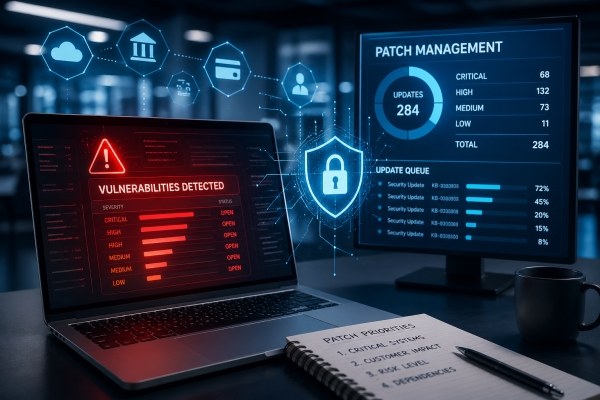
On April 21, 2026, Mozilla's Firefox team said early access to Anthropic’s Claude Mythos Preview helped identify 271 vulnerabilities in Firefox 150, after an earlier Anthropic collaboration with Opus 4.6 helped fix 22 security sensitive bugs in Firefox 148. It's a real world test Warning that AI has started to compress months of expert vulnerability research into a much shorter discovery cycle.
The deeper issue for financial services isn’t whether AI can find bugs. Mozilla’s post makes that answer fairly clear. The harder question is whether banks, fintechs, payment providers, cloud vendors, and critical infrastructure operators can test, rank, schedule, and deploy fixes fast enough once the bug volume rises?
Security teams have always fought an unfair game. That is attackers only need one weakness while defenders have to protect the full surface. Mozilla’s Bobby Holley wrote that elite security researchers find bugs that fuzzers miss by reasoning through source code, and that computers “were completely incapable of doing this a few months ago, and now they excel at it.” He also wrote that Mythos Preview was “every bit as capable” as the best security researchers Mozilla has studied.
Limited human cyber security expertise no longer limits discovery in the same way. Once AI can reason through large codebases, the volume of known vulnerabilities rises quickly. Mozilla for example jumped from 22 bugs in Firefox 148 to 271 vulnerabilities in Firefox 150. Detection capacity jumps faster than operational capacity.
For fintechs, that means security teams may see more vendor alerts, more emergency updates, more dependency risk, and more pressure to patch without breaking customer facing systems. More discovery helps defenders, but only when organizations can practically execute on the risk.
The Financial Times reported that companies with Mythos access want stronger joint defense across government and business, especially for hospitals, banks, utilities, and other critical infrastructure. It also reported that Microsoft, Fifth Third’s technology provider, has rolled out almost 150 software updates since Mythos’s release. Patching can affect numerous areas, such as customer access, payments, fraud controls, and vendor dependencies.
Financial infrastructure like core banking systems, payment gateways, and fraud engines operate on tight turnaround schedules and a bad patch or gap can interrupt service, leaving a known weakness open. And the tradeoff becomes harder when AI expands the queue of fixes beyond human capacity.
A 2026 analysis summarized on the Harvard Law School Forum on Corporate Governance found that Russell 3000 companies hit by significant cyber incidents underperformed the broader market by about 5% on average over three years. The study reviewed 176 unique cyber events from 2022 through 2024, and found that finance, banking, and health care accounted for more than half of reported incidents. That means board failures, patch delays, poor vendor oversight can damage shareholder value for years.
The old comfort of quarterly patch cycles won’t hold up well in a world where AI can surface hundreds of issues at once.
Reuters reported on April 21 that unauthorized users accessed Mythos through what Anthropic described as a third party vendor environment. Anthropic said it was investigating the report and had no evidence that the access affected Anthropic systems.
If a tool can find bugs as well as top security experts, then that tool becomes a prime target. Anyone who gets access to it could shortcut months of work and go straight to weak points. That means security is no longer just about protecting your systems. It also includes controlling who can use these AI security tools, how they’re accessed, and what they can see across your vendors and environments.
Warnings from Palo Alto Networks point to where this could go. These tools may allow attackers to link multiple weaknesses together and automate attacks. That’s why the unauthorized access issue matters even without confirmed misuse. The real risk is that the capability itself could leak.
Canadian fintechs don’t run everything themselves. They depend on cloud providers, banks, payment networks, identity services, and other vendors. That means they don’t control when fixes happen, but they still carry the risk if something goes wrong.
That puts pressure on knowing how vendors handle security. Fintech teams need to understand how quickly partners fix serious issues, how they report problems, and whether important updates get priority. Even smaller firms can push for clearer answers before relying on a vendor for critical services.
Regulators should pay attention too. AI can help find problems faster, but only if companies can act on that information in a coordinated way. If not, bigger firms with early access move ahead, while smaller ones fall behind. In Canada, where many fintechs depend on a few key providers, that gap could widen quickly.
Mozilla believes there’s a limit to how many bugs exist, and that defenders may finally be able to find them all. That could happen over time. Right now, though, things will feel messy. More bugs will show up. Fix lists will get longer. Vendors will have to decide what to fix first. Leaders will have to choose between keeping systems running and fixing issues right away. For banks and fintechs, the edge will go to those who can move faster, work closely with partners, and handle frequent updates without disrupting customers, payments, or data.
The National Crowdfunding & Fintech Association (NCFA Canada) is a financial innovation ecosystem that provides education, market intelligence, industry stewardship, networking and funding opportunities and services to thousands of community members and works closely with industry, government, partners and affiliates to create a vibrant and innovative fintech and funding industry in Canada. Decentralized and distributed, NCFA is engaged with global stakeholders and helps incubate projects and investment in fintech, alternative finance, crowdfunding, peer-to-peer finance, payments, digital assets and tokens, artificial intelligence, blockchain, cryptocurrency, regtech, and insurtech sectors. Join Canada's Fintech & Funding Community today FREE! Or become a contributing member and get perks. For more information, please visit: www.ncfacanada.org
| | |
|---|---|---|
| | |
Apr 27, 2026 | NCFA Market Activity | Payments And Market Infrastructure

On Apr 17 2026, XTM announced a court approved sale process for its assets and business operations, including the EveryDay Payments platform. The process starts on Apr 27 2026, and binding offers are due by Jun 8 2026 at 4:00 p.m. Eastern.
This is not a routine restructuring. XTM built payment infrastructure for real time payroll, tip payouts, and earned wage access. Its 2024 results showed $800M in payments to hospitality sector employees, $9.1M in revenue, 34% revenue growth, 689 new business locations, and more than 3,500 onboarded locations at year end. But that growth didn't translate into resilience.
On Mar 2 2026, XTM said it sought CCAA protection after operating in a financially strained position since inception and using restricted cash for operating expenses. The company disclosed an $18.75M trust shortfall as of Sep 30 2025. Trading in the company’s common shares remains halted on the CSE since March 2.
The Bank of Canada also stepped in. On Feb 27 2026, the Bank issued a revised temporary order that allowed XTM to restart limited retail payment activity under the supervision of the court appointed monitor and subject to conditions. XTM then restarted the EveryDay Payments platform on Mar 20 2026, with merchants resuming same day tip disbursements to employees.
The sale process adds a new layer. The court approved a SISP on Apr 10 2026 and approved a stalking horse agreement with Pateno Payments Inc., The court also approved a starting offer that sets a floor price for the business. Other buyers can now submit higher bids, which will determine whether the platform is recapitalized, sold, or broken up.
There's a direct operator lesson here. Vertical payment rails can grow fast and still fail if fund protection, liquidity discipline, and operating controls don't keep pace. Tip payout and earned wage access products are close to workers’ cash flow. When that infrastructure breaks, the issue isn't just shareholder value, but merchant trust, employee access to pay, regulator confidence, and a platform's survival are all on the table.
This raises the standard bar for Canadian fintech payment operations. Faster payouts are useful, but the money has to be handled properly. Funds need to be kept separate, records need to match, bank responsibilities need to be clear, and there has to be enough cash to handle problems. Growth does not matter if people stop trusting the system.
The National Crowdfunding & Fintech Association (NCFA Canada) is a financial innovation ecosystem that provides education, market intelligence, industry stewardship, networking and funding opportunities and services to thousands of community members and works closely with industry, government, partners and affiliates to create a vibrant and innovative fintech and funding industry in Canada. Decentralized and distributed, NCFA is engaged with global stakeholders and helps incubate projects and investment in fintech, alternative finance, crowdfunding, peer-to-peer finance, payments, digital assets and tokens, artificial intelligence, blockchain, cryptocurrency, regtech, and insurtech sectors. Join Canada's Fintech & Funding Community today FREE! Or become a contributing member and get perks. For more information, please visit: www.ncfacanada.org
| | |
|---|---|---|
| | |
April 24, 2026 | NCFA Fintech Whisperer Weekly Intelligence | Payments And Market Infrastructure, Digital Assets Blockchain And Tokenization, Regulation And Policy, Artificial Intelligence And Data

Image: Freepik
This live weekly NCFA intelligence page tracks financial technology developments that significantly affect how fintechs build, sell, raise capital, and operate under scrutiny. Coverage prioritizes Canada and includes global events that directly influence competitive conditions, market access, and execution realities across fintech sectors. This page will be updated throughout the week with market movers in a live format and then each week we'll close the prior week's contents in prep for the upcoming week, and continue on a rolling basis. (Missed prior week's Fintech Whisperer? (December 6-12, 2025, December 13-19, 2025, January 1-9, 2026, January 10-16, 2026, January 17-23, 2026, January 24-30, 2026, January 31-February 6, 2026, February 7-13, 2026, February 14-20, 2026, February 21-27, 2026, February 28-March 6, 2026, March 7-13, 2026, March 14-20, 2026, March 21-27, 2026, March 28-April 3, 2026, April 4-10, 2026, April 11-17, 2026).
RBI has moved from restriction to licence cancellation. Payments banks, wallets, sponsor banks, and fintech platforms should treat this as a hard reminder that governance, compliance controls, depositor protection, and supervisory responsiveness decide whether a regulated licence survives under stress.
Instant payments are starting to add shared, rail-level risk intelligence. Banks and vendors that can plug network signals into fraud controls and payment decisioning will gain speed without giving up control.
The UK is pulling payments reform, stablecoins, open banking, and AI-agent payments into one policy agenda. That gives banks, fintechs, and infrastructure firms a clearer build direction for the next phase of digital money and payment rails.
The PACE Act would move direct rail access from a bank only model toward a supervised nonbank pathway. Payment firms, wallets, remittance providers, and crypto platforms should watch whether Congress turns scale, reserves, and OCC oversight into the price of direct Fed access.
The fee cap changes the economics of Canadian order flow in securities traded on both sides of the border. Marketplaces, brokers, and trading firms need to revisit rebate models, routing logic, and best execution analytics before Nov 2026.
The SEC and CFTC are reducing reporting load while keeping coverage of the largest funds. That lowers compliance cost for smaller firms and shifts the reporting system toward large, systemically relevant managers.
Treasury clearing is now forcing decisions on affiliate repo, cross border booking, liquidity management, and contingency planning. That puts market structure, funding, and clearing operations under live pressure ahead of the compliance dates.
Finfluencer enforcement is now coordinated across jurisdictions and aimed at the platforms as well as the promoters. That raises the compliance and monitoring burden for firms using social channels for distribution and puts more pressure on platforms to block illegal promotions at source.
Client money control failures are still drawing fast and expensive action. Firms handling safeguarded funds need clean role separation, approval controls, reconciliations, and evidence trails that hold up under review.
SMCR reform is now moving from policy into implementation. Banks, fintechs, and regulated firms need to update role mapping, certification processes, accountability records, and reporting workflows without leaving control gaps during the transition.
The rule change is now live. Fund managers, administrators, auditors, and reporting vendors need to update related party reporting workflows and disclosure logic from this reporting cycle forward.
This gives firms a live FCA pathway for AI in production. Providers building AI for payments, risk, compliance, and customer decisioning now have a clearer read on how regulators expect live testing, monitoring, and evidence to be handled.
The UK is refining its crypto framework before implementation to ensure stablecoin payments work within regulated financial systems. For fintechs, this points to a clear direction: stablecoins are moving into formal payment rules, not operating outside them.
OSFI is aligning regulatory reporting with IFRS 18. Insurers, auditors, and regtech providers will need to update reporting systems, data classification, and validation processes ahead of the 2027 transition.
Australia is moving digital asset platforms from patchwork treatment into a licensing regime with custody, settlement, market conduct, and financial resource expectations. For exchanges, brokers, custodians, and tokenised custody platforms, this raises the operating floor before the regime starts in 2027.
N3XT puts tokenized bank money directly onto blockchain rails while retaining the deposit relationship with the issuing institution. That operating model now sits beside tokenized deposits for corporate treasury being developed by much larger banks, but N3XT entered the market with a live product built around continuous settlement from the outset. The difference between bank issued deposit tokens and reserve backed stablecoins is becoming commercially relevant as both compete for institutional payments, liquidity and onchain settlement.
This puts focus on how firms log interactions, flag risk, assign review, and retain records. See related coverage on AI escalation controls and AI chat exposure in court.
Fintech execution is getting more technical and less forgiving. Payments now need network-level risk data. Markets need tighter routing, clearing, and reporting controls. AI and social distribution need evidence, safeguards, and audit trails. The advantage belongs to firms that can turn regulatory change into product, compliance, and infrastructure readiness faster than competitors. NCFA offers various curated resources to help founders and investors stay current on developments that impact fintech markets, subscribe to NCFA weekly newsletter updates, view a rundown of current fintech news and insights, or dive into the latest fintech industry research.
The National Crowdfunding & Fintech Association (NCFA Canada) is a financial innovation ecosystem that provides education, market intelligence, industry stewardship, networking and funding opportunities and services to thousands of community members and works closely with industry, government, partners and affiliates to create a vibrant and innovative fintech and funding industry in Canada. Decentralized and distributed, NCFA is engaged with global stakeholders and helps incubate projects and investment in fintech, alternative finance, crowdfunding, peer-to-peer finance, payments, digital assets and tokens, artificial intelligence, blockchain, cryptocurrency, regtech, and insurtech sectors. Join Canada's Fintech & Funding Community today FREE! Or become a contributing member and get perks. For more information, please visit: www.ncfacanada.org
| | |
|---|---|---|
| | |
Apr 21, 2026 | NCFA Feature | Artificial Intelligence And Data

Apr 21, 2026, Florida Attorney General James Uthmeier announced a criminal investigation into OpenAI and ChatGPT following a Florida State University shooting on Apr 17, bringing AI safeguards, records, and escalation controls into a far more serious legal setting. Prosecutors issued subpoenas for materials tied to safeguards, training, and crime reporting, while AP News reports that investigators reviewing AI chat logs linked to the accused shooter. OpenAI says ChatGPT didn't promote harm and that it's cooperating with law enforcement.
For AI operators, it's no longer a question whether or not AI system can generate harmful responses. Numerous use cases and verified facts are escalating the need for strong governance and requirement to show what AI systems produced, what controls were in place, what records were kept, and what happened when risk appeared.
The Florida case stands on its own, but it also fits into a repeatable pattern that keeps building. When AI interacts with vulnerable users, influences behaviour, or operates in sensitive contexts, accountability expands beyond model output.
That includes minors and mental health. NCFA has already outlined AI protection gaps for youth and trust risks tied to AI psychosis claims. Legal claims tied to chatbot interactions and teen harm are now testing whether platforms owe a duty of care. That question isn't yet settled, but it's now active in courts and regulatory discussions.
Exposure doesn't stop with responses alone. Agentic AI systems that can act on their own are being scrutinized because they are starting to trigger workflows, retrieve data, connect tools, and influence real decisions. That expands the scope beyond what the model says. It now includes what the system does, what it initiates, what it fails to flag, and who owns the outcome.
It also raises a second layer of risk. These systems aren't only acting, but are making judgment calls inside those workflows. NCFA has explored this trend in how AI systems are moving from guardrails to judgment, where deciding outcomes is now part of system behaviour, not just model output.
As these systems connect to money, identity, and operational processes, weak controls become visible fast. Risk exposure moves beyond the prompt interface and into the infrastructure where decisions are made and executed.
The legal system doesn't yet have a stable way to classify AI. Different cases treat it as a tool, a product, or an automated process. That uncertainty affects liability, discoverability, and the standard of care expected from firms.
What investigators ask for is starting to line up across cases. Logs. Escalation triggers. Review steps. Retention policies. Safeguards. These are the records that show how a system behaved and how a firm responded. Recent NCFA coverage on AI chat exposure in court and AI escalation controls under test points to the same pressure area. The Florida probe adds another example. When outcomes are challenged, this is where scrutiny begins.
For founders, executives, and boards, responsibility doesn't stop at model performance. It extends to system design, deployment context, monitoring, and response when risk appears. That includes safeguards, escalation thresholds, human review, and whether systems should act in high risk scenarios at all.
When AI becomes central to operations, governance, oversight, and risk controls that affects diligence and board discussions. Investors with board roles or influence over strategy may face questions about what risks were understood, what controls were expected, and how oversight was exercised.
Investors are not insulated. As AI becomes embedded in core operations, governance and risk controls affect diligence and board oversight. When outcomes are challenged, companies will need to show they anticipated risk, implemented controls, and acted on signals.
Thoughts on mitigation? Systems need clear boundaries. Escalation triggers need to be defined before deployment. Logs need to capture full interaction context. Human review needs clear ownership. Agentic systems need limits on when they can act without intervention.
There are also clear red flags. The situations that will attract scrutiny first.
In the near term, markets should expect more subpoenas, more edge case litigation, and more focus on how AI interactions are recorded and reviewed. Over time, governance will tighten around system level accountability. That includes how decisions are chained, how risk is surfaced, and how AI companies demonstrate that they acted when it mattered.
The National Crowdfunding & Fintech Association (NCFA Canada) is a financial innovation ecosystem that provides education, market intelligence, industry stewardship, networking and funding opportunities and services to thousands of community members and works closely with industry, government, partners and affiliates to create a vibrant and innovative fintech and funding industry in Canada. Decentralized and distributed, NCFA is engaged with global stakeholders and helps incubate projects and investment in fintech, alternative finance, crowdfunding, peer-to-peer finance, payments, digital assets and tokens, artificial intelligence, blockchain, cryptocurrency, regtech, and insurtech sectors. Join Canada's Fintech & Funding Community today FREE! Or become a contributing member and get perks. For more information, please visit: www.ncfacanada.org
| | |
|---|---|---|
| | |
April 21, 2026 | NCFA Insight | Digital Assets Blockchain And Tokenization, Regulation And Policy

On April 21, 2026, SEC Chair Paul Atkins delivered a keynote at the Economic Club of Washington to align the agency’s crypto and capital markets agenda, calling it Advance, Clarify, Transform. The SEC is close to an innovation exemption for tokenized securities, but that exemption is not yet in the market’s hands.
That speech sets a clear claim. From January to March 2026, the SEC already put key pieces in place. It clarified how tokenized securities fit within existing law. It formalized coordination with the CFTC. It introduced a working taxonomy for crypto assets. The structure is now visible. What still matters is whether firms can use it.
In these remarks, Advance updates SEC rules for markets moving onchain. Clarify defines asset categories and jurisdictional boundaries so firms can assess compliance before launch. Transform removes constraints that limit capital formation and restrict compliant experimentation with tokenized securities.
The groundwork started in January. SEC staff outlined how tokenized securities fit within existing securities law, including issuer backed models, custodial structures, and tokenized derivatives. That same direction appears across onshore market structure discussions, where tokenized collateral, perpetuals, and retail trading models point toward a rulebook that is becoming easier to work with.
By February, the structure became clearer. Token classification and coordinated oversight came together, alongside a proposed innovation exemption for onchain activity that had not yet been published. This direction also appears across IPO burden and crypto rules, where token taxonomy and capital formation reforms begin to align.
Then in March, delivery became harder to ignore. On March 11, the SEC and CFTC formalized coordination through a memorandum of understanding. Definitions aligned. Jurisdiction became clearer. Data sharing opened up. As a result, firms operating across both regimes face less duplication and fewer conflicting requirements.
Six days later, on March 17, the SEC published its crypto asset interpretation. The release laid out a taxonomy across digital commodities, stablecoins, and digital securities. It also addressed when an asset could fall in or out of an investment contract.
The April 21 speech pulled these steps into a sequence. Define the asset. Clarify the perimeter. Align regulators. Then open a controlled lane for compliant experimentation.
One gap now matters more than the rest. The market still doesn't have a working framework for how tokenized securities can trade onchain in a compliant way.
Atkins spotlighted this issue in his recent speech and pointed to an innovation exemption that is close to release, but not yet ready for the public. Until it is, companies still lack the full mechanics needed to move from design to execution.
The taxonomy helps classify assets. Coordination reduces regulatory overlap. The March interpretation narrows legal uncertainty. Even so, firms still don’t have a clear way to bring tokenized securities to market. What remains outstatnding is whether issuers and platforms will get a clear, testable path to launch tokenized securities onchain.
This is where the competitive dynamic shows up. If the United States combines clear classification, coordinated oversight, and a usable exemption, it becomes easier for firms to decide where to build first. That affects trading infrastructure, custody rails, issuance platforms, and tokenized asset markets.
In April developments, staff guidance clarified when certain crypto interfaces did not require broker dealer registration under defined conditions. That gave firms more clarity on licensing exposure, product design, and how to bring products to market.
In Canada, regulators are now studying tokenized markets through a 2026 CSA initiative called Project Tokenization, but a unified framework for issuing or trading tokenized securities has not yet been defined.
The SEC's made the rulebook clearer. Now it has to make it usable once the innovation exemption is delivered.
The National Crowdfunding & Fintech Association (NCFA Canada) is a financial innovation ecosystem that provides education, market intelligence, industry stewardship, networking and funding opportunities and services to thousands of community members and works closely with industry, government, partners and affiliates to create a vibrant and innovative fintech and funding industry in Canada. Decentralized and distributed, NCFA is engaged with global stakeholders and helps incubate projects and investment in fintech, alternative finance, crowdfunding, peer-to-peer finance, payments, digital assets and tokens, artificial intelligence, blockchain, cryptocurrency, regtech, and insurtech sectors. Join Canada's Fintech & Funding Community today FREE! Or become a contributing member and get perks. For more information, please visit: www.ncfacanada.org
| | |
|---|---|---|
| | |
April 21, 2026

Image: Pexels
W-2 and 1099 forms filing is one of the least understood areas of running a business.
Get it wrong and the IRS will come after you. Get it right and taxes will be a breeze.
The good news? Once the differences click, it's pretty straightforward.
Both forms report income received during the year. However they are used for very different circumstances.
A W-2 form gets sent to employees. It shows wages earned and all taxes withheld (federal income tax, Social Security, Medicare). The employer automatically withheld those amounts during the year.
A 1099 form is sent to contractors and freelancers. The most familiar one is called a 1099-NEC, which stands for nonemployee compensation. With a 1099 they don't withhold taxes at all. The contractor is responsible for paying it all themselves.
Here's why getting this right matters from day one...
Accuracy is not negotiable when it comes to W-2 and 1099 forms filing. Whether processing just a few contractors or hundreds of employees, this software solution handles the guesswork of generating, filing, and distributing both W-2s and 1099s correctly — freeing up time and eliminating expensive mistakes.
This is where most businesses get tripped up.
The IRS Worker Classification Test evaluates three distinct factors. They are as follows:
If everyone says yes... then that worker is most likely an employee that requires a W-2.
If the worker gets to set their own schedule, uses their own tools and equipment, and gets paid per project... chances are they are an independent contractor that requires a 1099-NEC.
Pretty straightforward, right?
Here are a few quick examples to make it clear:
W-2 employees typically include:
1099 contractors typically include:
With over 36% of the US workforce now freelancing — that's over 70 million Americans — understanding the 1099 side of things has never been more important.
This is the part that catches a lot of people off guard.
When it comes to W-2 employees, the employer handles payroll taxes. This includes withholding federal income tax, state income tax, and paying half of the FICA tax (Social Security and Medicare taxes) while the employee pays the other half.
For 1099 contractors, it is a completely different story.
Taxes aren't automatically withheld from their paycheck. Instead, they pay estimated quarterly taxes directly to the IRS.
What's more, the self-employment tax sits at 15.3% — twice as much as what a W-2 employee pays. Why? Because 1099 workers pay both the employer and employee portion of Social Security and Medicare taxes.
Granted, 1099 workers have one benefit. Many of their work-related expenses are deductible on Schedule C. This includes home office expenses, equipment, software, mileage, etc. These write-offs lower taxable income, partially negating that higher rate.
It balances out for many contractors — but only if they track everything properly.
Missing these deadlines comes with real penalties. So mark the calendar.
January 31 is the IRS deadline for W-2 and 1099-NEC forms.
Here is what needs to happen by that date:
One final 1099-NEC tidbit... File a form for any contractor paid $600 or more. In 2026, the minimum increases to $2,000 per new law. Regardless, keep records of contractor payments all year long — not just January.
Misclassifying workers is not just a paperwork problem. It is a financial one.
Misclassification is taken very seriously by the IRS. When a company willfully misclassifies employees as contractors to evade paying payroll taxes, the penalties stack up fast:
And the IRS typically goes back three years when auditing unpaid employment taxes.
The silver lining? If there is genuine uncertainty about whether a worker is a W-2 employee or a 1099 contractor, businesses can file Form SS-8 and let the IRS make the call.
Staying compliant with W-2 and 1099 forms filing does not have to be stressful.
Here is a simple process to follow:
The biggest mistake businesses make is waiting until January. By January it is a frenzy. Start with a clean system and tax season is a non-event.
When it comes to W-2 and 1099 forms filing, there's really only one question. How is the worker classified?
W-2 employees receive W-2 forms. 1099 contractors receive 1099-NEC forms. The taxes, deadlines, and penalties are entirely different.
To quickly recap what matters most:
Classify properly, stay ahead of deadlines, and implement with the correct toolset. Those are the only things needed to stay clean and compliant year after year.
The National Crowdfunding & Fintech Association (NCFA Canada) is a financial innovation ecosystem that provides education, market intelligence, industry stewardship, networking and funding opportunities and services to thousands of community members and works closely with industry, government, partners and affiliates to create a vibrant and innovative fintech and funding industry in Canada. Decentralized and distributed, NCFA is engaged with global stakeholders and helps incubate projects and investment in fintech, alternative finance, crowdfunding, peer-to-peer finance, payments, digital assets and tokens, artificial intelligence, blockchain, cryptocurrency, regtech, and insurtech sectors. Join Canada's Fintech & Funding Community today FREE! Or become a contributing member and get perks. For more information, please visit: www.ncfacanada.org
| | |
|---|---|---|
| | |


August 26th, 2025

January 4th, 2024

June 1st, 2021

September 9th, 2020

July 9th, 2018

January 3rd, 2018

September 25th, 2017

June 20th, 2017

May 10th, 2017

December 14th, 2016