





Karsten Wenzlaff, Advisor
August 26th, 2025
Karsten Wenzlaff is a Crowdfunding and Fintech Expert from Germany. He is Secretary-General of Digit[...]


Financing | Oct 30, 2025

Image: Freepik/rawpixel.com
On October 27, 2025, Wealthsimple announced it had raised $750 million in new equity funding at a $10 billion post money valuation. The deal includes $550 million in new shares and up to $200 million from secondary sales.
Dragoneer Investment Group and GIC led the round, joined by CPP Investments, Power Corporation of Canada, IGM Financial, ICONIQ Capital, Greylock Partners, and Meritech Capital.
Crossing the $10 billion valuation milestone shows how far Canada’s fintech industry has come. Wealthsimple’s steady rise from startup to profitable platform proves that a Canadian firm can reach global scale while keeping its focus on trust, compliance, and user experience. This new round comes at a time when many fintechs worldwide are struggling to raise growth capital.
Wealthsimple has been profitable since 2024 and now manages over $100 billion in assets for more than three million Canadians.
Michael Katchen, CEO and co-founder, Wealthsimple:
“This raise reflects deep confidence from new and returning investors in our mission and our role as a defining Canadian company. We were intentional in choosing partners committed to the long-term future of Wealthsimple. These are well-respected, global leaders with a proven track record scaling category leaders, and who believe in our vision for the future of financial services.”
Choo Yong Cheen, Chief Investment Officer, Private Equity, GIC:
“We look for companies that will transform industries for decades to come, and Wealthsimple is one of them. Their track record of innovation, from investing to trading to spending, combined with deep trust from Canadians, positions them to build a defining, generational company in Canadian financial services.”
Institutional investors such as CPP Investments and Power Corporation bring more than capital. They bring credibility. Their involvement helps normalize fintech as a core part of the financial system, not a novel experiment. This type of institutional participation encourages other large funds to view Canadian fintechs as viable, well governed opportunities for long term growth. It also shows that responsible innovation can attract serious capital without sacrificing values like inclusion and transparency.
Wealthsimple’s record of profitability and compliance gives regulators a real life example that innovation and stability can work together. The company’s consistent performance may help policymakers as they work to finalize the implementation of open banking.
Wealthsimple’s growth story and impact goes beyond one company. It's an achievement that reflects how far Canada’s fintech community has evolved, from early crowdfunding to full service digital banking. It gives startups and investors a reason to believe that they can scale globally while keeping their roots in Canada. For NCFA, this success reinforces the importance of a financial ecosystem that rewards innovation, broadens access to capital, and strengthens Canada’s competitiveness on the world stage.
 The National Crowdfunding & Fintech Association (NCFA Canada) is a financial innovation ecosystem that provides education, market intelligence, industry stewardship, networking and funding opportunities and services to thousands of community members and works closely with industry, government, partners and affiliates to create aa vibrant and innovative fintech and funding industry in Canada. Decentralized and distributed, NCFA is engaged with global stakeholders and helps incubate projects and investment in fintech, alternative finance, crowdfunding, peer-to-peer finance, payments, digital assets and tokens, artificial intelligence, blockchain, cryptocurrency, regtech, and insurtech sectors. Join Canada's Fintech & Funding Community today FREE! Or become a contributing member and get perks. For more information, please visit: www.ncfacanada.org
 |  |  |
|---|---|---|
 |  |  |
AI Partnership | Oct 28 2025
On October 28 2025, PayPal announced that it will adopt the Agentic Commerce Protocol and partner with OpenAI to bring shopping and paymentsdirectly into ChatGPT. The partnership links PayPal’s merchant network with ChatGPT users so people can buy and pay instantly using PayPal.
PayPal will add its wallet to ChatGPT’s Instant Checkout so people can pay with their balance, bank, or card.
The same buyer protection, tracking, and dispute tools that PayPal already offers will apply. PayPal will also handle card payments through OpenAI’s delegated payments API, taking care of routing and security. This API supports major card networks such as Visa and Mastercard, so users can pay with their preferred card while keeping PayPal’s protection and tracking features.
Starting in 2026, PayPal plans to add product catalogues from small businesses and larger brands so people can search and buy items in ChatGPT directly. PayPal will manage payment checks, merchant validation, and fraud protection in the background. You can learn more about OpenAI’s Agentic Commerce Protocol page.
This change could help Canadian fintechs and merchants reach new customers.
For the first time, shopping could happen entirely through a chat. Instead of clicking to a website, a person could ask ChatGPT for a product, view merchant options, and pay through PayPal in seconds.
Canadian merchants who already use PayPal could soon appear in ChatGPT’s shopping results, which might help smaller businesses connect to global buyers. It also gives users a glimpse at the future of how financial technology and artificial intelligence are starting to merge.
For Canadian fintechs, there's opportunity to design new tools for agent-led payments and business services. Developers could build smart payment gateways that connect chat platforms with accounting and invoicing systems, or create plug-ins that let small businesses manage orders and inventory through AI agents. There is also room for innovation in real-time fraud detection, digital identity layers that verify both buyers and sellers inside a chat, and lending tools that assess transaction data to offer instant credit decisions. These kinds of innovations could bring Canada to the forefront of safe, responsible, and flexible conversational finance.
Regulators, such as the Financial Consumer Agency of Canada and the Office of the Privacy Commissioner, may need to consider how consumer rules apply when a purchase happens in a conversation.
Agent led commerce seems destined to become a major new layer of the digital economy. If Canadian regulators, fintechs, and industry groups like NCFA collaborate early, Canada could establish guardrails and standards to make this new type of shopping and payments, fair, transparent and inclusive.
Success will depend on building trust, clear rules for data and disclosure, and reliable systems that protect both buyers and merchants. Conversational finance is upon us and could help Canada's fintech sector grow in a way that serves both innovation and consumers.
The National Crowdfunding & Fintech Association (NCFA Canada) is a financial innovation ecosystem that provides education, market intelligence, industry stewardship, networking and funding opportunities and services to thousands of community members and works closely with industry, government, partners and affiliates to create aa vibrant and innovative fintech and funding industry in Canada. Decentralized and distributed, NCFA is engaged with global stakeholders and helps incubate projects and investment in fintech, alternative finance, crowdfunding, peer-to-peer finance, payments, digital assets and tokens, artificial intelligence, blockchain, cryptocurrency, regtech, and insurtech sectors. Join Canada's Fintech & Funding Community today FREE! Or become a contributing member and get perks. For more information, please visit: www.ncfacanada.org
| | |
|---|---|---|
| | |
Crypto | Oct 24, 2025

Image courtesy of AI
On October 23, 2025, as reported by AP News U.S. President Donald Trump issued a full and unconditional pardon to Changpeng Zhao, a Canadian citizen and founder of Binance, the world’s largest crypto exchange. The decision cleared Zhao’s 2023 conviction under U.S. anti–money laundering and sanctions laws.
According to the White House, Trump “exercised his constitutional authority” to issue the pardon, describing Zhao’s prosecution as part of “the Biden Administration’s war on cryptocurrency.” The news arrived amid a record Bitcoin record high above $120,000 earlier in July, showing renewed investor optimism in the digital asset market.
The pardon comes as global regulators assess how to balance enforcement with innovation. For Canadian fintechs, it raises questions about regulatory predictability and competitiveness. Under the current U.S. administration, regulatory enforcement appears more forgiving toward large crypto platforms, which could influence global investment decisions.
In Canada, regulators fined Binance $6 million CAD for anti–money laundering violations and Binance compliance failures in Canada.
The pardon reintroduces uncertainty over how enforcement consistency (or inconsistency) impacts capital allocation and market trust. Transparent, consistent oversight is still vital to sustaining trust and access to global markets.
Zhao’s Canadian citizenship links Canada directly to one of the most influential figures in crypto. After serving nearly four months in prison and paying a $50 million fine, Zhao retained his stake in Binance while appointing Richard Teng as CEO.
In a statement, Zhao said he was “deeply grateful for today’s pardon and to President Trump for upholding America’s commitment to fairness, innovation, and justice,” adding that he would “do everything we can to help make America the Capital of Crypto.”
As the perceived regulatory risk lowers in the U.S. due to regulatory clarity, there's renewed optimism among institutional investors. For Canadian investors, a more predictable U.S. outlook could improve confidence in cross-border partnerships if compliance frameworks remain strong.
With the pardon now in place, Binance may renew expansion in the U.S. under current CEO Richard Teng who has emphasized compliance, transparency, and rebuilding trust with regulators worldwide. Analysts note that the pardon “could pave the way for the firm’s return and reintegration into the American market.”
The Trump pardon of Changpeng Zhao is another key moment in the global crypto narrative. For Canada, it highlights the importance of credible, consistent oversight as markets respond to pro-crypto U.S. policy signals. Renewed institutional attention to digital assets could open doors for compliant fintechs, but long-term success will depend on maintaining transparency, sound governance, and global coordination.
The National Crowdfunding & Fintech Association (NCFA Canada) is a financial innovation ecosystem that provides education, market intelligence, industry stewardship, networking and funding opportunities and services to thousands of community members and works closely with industry, government, partners and affiliates to create aa vibrant and innovative fintech and funding industry in Canada. Decentralized and distributed, NCFA is engaged with global stakeholders and helps incubate projects and investment in fintech, alternative finance, crowdfunding, peer-to-peer finance, payments, digital assets and tokens, artificial intelligence, blockchain, cryptocurrency, regtech, and insurtech sectors. Join Canada's Fintech & Funding Community today FREE! Or become a contributing member and get perks. For more information, please visit: www.ncfacanada.org
| | |
|---|---|---|
| | |
AI | Oct 22, 2025

Image: Freepik/rawpixel.com
On October 13 2025, the Economist ran a story 'Can AI replace junior workers?' that analyzed a total of 300,000 companies and found that firms adopting AI hired 7.7% fewer junior employees over six quarters compared with non adopters. These research findings came from a Harvard SSRN study by Seyed Hosseini and Guy Lichtinger, who tracked the introduction of AI integrator roles across a subset of 10,600 of these firms. They found that while senior hiring remained flat, most declines came from reduced job postings rather than layoffs.
In a different study by the Yale Budget Lab review, 'Evaluating the impact of AI on the labour market', found that since 2022 the overall mix of jobs hasn’t changed much yet. Their data also revealed that AI’s effects are starting to appear inside companies now but they haven't yet shown up in national reports.
In Canada, the same early signs are visible. The Future Skills Centre found in 2025 that about half of Canadian workers hold jobs with high AI exposure, and that postings for automatable roles have fallen since 2022. (see: Right Brain Left Brain AI Brain). Statistics Canada’s September 2025 update showed youth unemployment at 14.7%, the highest rate since 2010 excluding pandemic years.
Demand for AI capability is climbing fast though. PwC’s 2025 AI Jobs Barometer found that job postings requiring AI skills made up 1.8% of all listings in Canada in 2024, the highest level recorded. Globally, PwC reported that workers with AI skills now earn a 56% wage premium. Lightcast data confirmed that postings asking for generative AI skills grew from 55 in January 2021 to nearly 10,000 by May 2025.
In 2023, IBM announced a hiring pause for administrative positions likely to be automated, estimating that about 7,800 jobs could eventually be replaced. Two years later by 2025, IBM’s chief executive said that hundreds of jobs had already been automated but new programming and sales roles were added to manage and improve AI systems (read: costs). These new positions required higher pay and technical skill, meaning that overall labour costs rose even as headcount stayed about the same.
PwC’s 2025 report described 4x increase in productivity but increased sending on advanced human oversight due to the specialized staff required to operate and oversee (rather than removing human involvement completely).
The first jobs being cut are entry level analytical roles that once helped graduates learn on the job and grow into future innovators. Without those opportunities, companies risk gaps in the talent pipeline that sustains innovation and good governance.
Among those entry level roles, mid-tier graduates are being hit hardest. They aren't highly specialized enough to keep, and not low enough cost to retain. Data from Harvard and Yale show the same pattern now appearing in Canada’s banking and software sectors, where AI can handle document review and code debugging but not creative or complex work.
Canada’s rate of AI adoption is still lower than in the United States, but the same pressures are starting to appear. Companies that don’t build structured training and mentoring around AI now will likely face skill shortages and higher rehiring costs later.
Harvard data show a 7.7% drop in junior hiring at companies that adopt AI. IBM’s experience confirms that after automating 7,800 jobs, it had to rehire more expensive employees for oversight and compliance work.
Youth unemployment has reached 14.7%, the highest since 2010 outside the pandemic. The first jobs being reduced are early analytical roles that once gave graduates the training and judgment to move into leadership positions.
Among the junior jobs being lost, graduates from mid-tier universities are at the most risk. Their work is often routine enough to automate but not low-cost enough to retain, leaving a growing gap in Canada’s talent base.
PwC found that employees with AI skills earn 56% more on average, but only 1.8% of job postings in Canada mention these skills. Fintechs that start training programs now can close that gap and strengthen their competitive edge.
AI is changing how companies build their workforce, not just how they cut costs. The data show that when junior jobs disappear, the long-term cost is a weaker talent pipeline and higher spending to rebuild skills later. Investing in AI training, early-career development, and responsible oversight will pay off later in productivity and help drive competitiveness.
The National Crowdfunding & Fintech Association (NCFA Canada) is a financial innovation ecosystem that provides education, market intelligence, industry stewardship, networking and funding opportunities and services to thousands of community members and works closely with industry, government, partners and affiliates to create aa vibrant and innovative fintech and funding industry in Canada. Decentralized and distributed, NCFA is engaged with global stakeholders and helps incubate projects and investment in fintech, alternative finance, crowdfunding, peer-to-peer finance, payments, digital assets and tokens, artificial intelligence, blockchain, cryptocurrency, regtech, and insurtech sectors. Join Canada's Fintech & Funding Community today FREE! Or become a contributing member and get perks. For more information, please visit: www.ncfacanada.org
| | |
|---|---|---|
| | |
OurCrowd | Oct 22, 2025
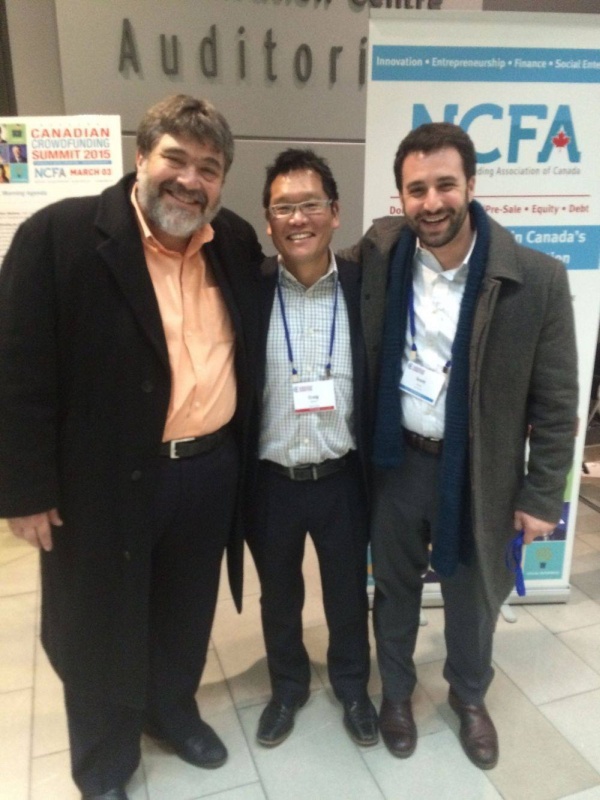
Image: Inaugural Canadian Crowdfinance Summit 2015, NCFA Craig Asano with Jon Medved CEO OurCrowd
On October 21 2025, as reported by several news outlets, OurCrowd announced on Tuesday that Founding CEO Jon Medved will move into the role of Chairman after being diagnosed with ALS, also known as Lou Gherig’s disease. OurCrowd named Cali Chill as Acting CEO and COO, a long-time executive who has led investment operations. Medved will stay active by focusing on strategy, global partnerships, and support for portfolio companies.
In his conversation with Calcalist, Medved said that after thirteen years leading the company this change was necessary but that he continues to work full days.
“A few months ago, I was hospitalized and diagnosed with ALS, a serious and terrible disease. Everything still works, but it’s very difficult for me to breathe. I’m improving and fighting it, and I still work eight to ten hours a day, which allows me to continue treatment.”
OurCrowd began in 2013 when new rules under the JOBS Act opened doors for online investment. The platform connected smaller accredited investors with venture deals that were once limited to big institutions. Under Medved’s leadership, it grew into one of the world’s largest tech investment networks, backing companies such as Anthropic, Databricks, Groq, and SpaceX.
As reported by Crowdfund Insider, OurCrowd now reports more than 2.6 billion USD in commitments across 500 portfolio companies and 68 funds with 240,000 registered investors from 195 countries.
Cali Chill said he is honoured to lead at this time and credited Medved for building the culture that drives the company. He said that by offering curated access to venture opportunities, OurCrowd bridges the gap between institutional investors and individuals who want professional access to global startups. Medved said he will keep pushing to democratize venture investing and use artificial intelligence to reach a wider community of investors.
Medved has been a returning keynote speaker at NCFA Canada events over the years, such as the 2015 Canadian Crowdfinance Summit and FFCON19: Fearless. He was known for his inspiring energy, storytelling, and ability to connect people. After his talks, crowds would often follow him as he handed out business cards and traded ideas with founders and investors. He was highly sought after and a regular guest in leading media outlets where he spoke about Israel’s technology ecosystem, global venture markets, and innovation trends. His stories about Israel’s startup culture and how necessity sparked resilience left a strong mark on the Canadian innovation community.
One memorable example came during his keynote at CCS 2015, when Medved made a spontaneous commitment on stage to open a Canadian office for OurCrowd. Within months, the firm delivered on that promise, establishing operations in Toronto and announcing a 1 million USD investment in Influitive, a Toronto-based advocate marketing leader. Ontario’s Minister of Economic Development at the time, Brad Duguid, described the move as "a landmark step for Canada’s growing technology and venture capital scene".
Even now as Jon manages ALS, he continues to work and inspire others. He remains a powerful voice for founders, investors, and countries building inclusive capital markets. His determination to keep working through adversity shows the same spirit that made OurCrowd a global success. On behalf of NCFA, we wish all the best for Jon and his team during this time.
The National Crowdfunding & Fintech Association (NCFA Canada) is a financial innovation ecosystem that provides education, market intelligence, industry stewardship, networking and funding opportunities and services to thousands of community members and works closely with industry, government, partners and affiliates to create aa vibrant and innovative fintech and funding industry in Canada. Decentralized and distributed, NCFA is engaged with global stakeholders and helps incubate projects and investment in fintech, alternative finance, crowdfunding, peer-to-peer finance, payments, digital assets and tokens, artificial intelligence, blockchain, cryptocurrency, regtech, and insurtech sectors. Join Canada's Fintech & Funding Community today FREE! Or become a contributing member and get perks. For more information, please visit: www.ncfacanada.org
| | |
|---|---|---|
| | |
Oct 17, 2025

Image: Pexels/Pixabay
More and more parts of life in Canada are shifting online. People order groceries from their phones, see doctors over video, and handle work, bills, and banking without leaving home. Some have leaned into it fully, while others are still getting used to the pace of change. The tools are here, and the habits are forming, but not everyone is moving at the same speed.
Technology has made daily life in Canada smoother and safer. Most services are now running on secure platforms that have been designed to protect users and keep things simple. Ordering food, paying bills, or setting medical appointments can be completed in a few minutes with a phone. Many Canadians now use grocery delivery apps that show real-time updates from order to door delivery. It's a little change, but one that has saved hours each week and reduced long drives.
Entertainment has followed the same path. Many new online casino sites have added cryptocurrency payments, which give users more control over how they deposit or withdraw funds. This extra layer of protection and transparency has made people more confident when playing online, especially as data safety becomes a bigger concern across the web.
Similar growth can be observed in fitness and learning platforms. People can now join live training sessions or online workshops led by professionals. Someone in Halifax can follow a yoga teacher in Vancouver, or do a little course in digital skills from home.
Most Canadians don't have to visit a branch any longer, thanks to digital banking services. Some apps even have smart alerts that can flag any odd spending patterns or suggest ways to save a bit more each month.
What’s also changing is the way financial tools understand users. Thanks to data-sharing between platforms, loan offers or tips on saving can be individually adapted to personal habits.
School is no longer associated with a building. Plenty of Canadians take courses from places they've never even been, thanks to online learning that doesn't care about distance at all.
What makes this work isn't just video lessons. Tools that allow people to talk, edit projects together, or share live screens make group work possible, even when classmates are hundreds of kilometers away.
Free courses on anything, from languages to tech skills, are helping people level up in ways that weren't accessible before. For someone restarting their career or adjusting to life in a new country, that kind of access can be the difference between feeling stuck and moving on.
The workplace doesn't look like it used to. People complete tasks from home, public spaces, or anywhere with Wi-Fi.
A large part of this change is due to the technology operating in the background. Tasks that used to require time are being automated. That could involve tasks such as filing, tracking inventory, or flagging issues before they spiral out of control. It just frees up people to get everything done that needs actual thinking.
There are many rural and Indigenous communities in Canada that do not have proper or affordable connections. Until that happens, the digital transition won't be evenly distributed.
Some people also don't feel confident using new tech. That's why local training programs and simple tools matter; they help people to catch up without feeling overwhelmed. Cost is another issue. Not everyone can afford to buy a new phone or laptop. Community efforts and tech grants are helping, but there's still work to do to make digital access fair.
At this point, the answer is yes. While there are gaps that need to be filled, the overall shift has already been established. The pieces are falling into place, and more people are finding ways to make tech fit into their world, not the other way around.
The National Crowdfunding & Fintech Association (NCFA Canada) is a financial innovation ecosystem that provides education, market intelligence, industry stewardship, networking and funding opportunities and services to thousands of community members and works closely with industry, government, partners and affiliates to create aa vibrant and innovative fintech and funding industry in Canada. Decentralized and distributed, NCFA is engaged with global stakeholders and helps incubate projects and investment in fintech, alternative finance, crowdfunding, peer-to-peer finance, payments, digital assets and tokens, artificial intelligence, blockchain, cryptocurrency, regtech, and insurtech sectors. Join Canada's Fintech & Funding Community today FREE! Or become a contributing member and get perks. For more information, please visit: www.ncfacanada.org
| | |
|---|---|---|
| | |
Quantum | Oct 16, 2025

Image: Freepik/pikisuperstar
On October 16, 2025, Canadian company BTQ Technologies announced the first public demonstration of a quantum safe Bitcoin network using post quantum cryptography approved by the US National Institute of Standards and Technology. BTQ says its new Bitcoin software replaces current encryption with ML DSA, a stronger digital signature designed to resist future quantum attacks that meets NIST’s new post quantum security standards. The firm believes this advance could protect the $2.4 trillion dollar Bitcoin market from quantum attacks expected later this decade.
Quantum computing promises huge advances, but with it comes the threat to current cryptography, including what bitcoin's network is secured by. Researchers aim for million qubit systems before 2030, a level that could make today’s digital signatures vulnerable. The Federal Reserve study on harvest now decrypt later risks explains how attackers can store blockchain data for future decryption once quantum computers mature. BTQ is raising alarm bells that more than 6.5 million Bitcoin already expose public keys, worth hundreds of billions of dollars, and could be stolen if quantum systems gain that capability.
BTQ is pushing quantum security for digital assets. Earlier in 2025 it launched the Quantum Stablecoin Settlement Network (QSSN) to protect stablecoins under quantum threats. The company also leads standard efforts and was recently appointed chair of the QuINSA standards group to help create quantum-safe blockchain policies.
In its demo, BTQ built a version of Bitcoin where every signature uses ML DSA, a NIST-standardized post quantum algorithm. Their prototype supports wallet creation, transaction signing, mining, and verification under the new scheme. To accommodate larger signatures they increased script limits and block structure. The company released details in its Quantum Safe Bitcoin press release.
Despite the excitement experts are cautious as no independent cryptographic audit or open repository has confirmed BTQ’s claims. Changing the signature scheme that secures Bitcoin would require widespread agreement among miners, developers, and exchanges, a process that historically takes years. The firm describes its system as a demonstration, not a replacement. Until peer review validates its performance and compatibility, BTQ’s project is more like a promising proof of concept rather than a verified production network.
Quantum readiness is already entering regulatory planning. The National Security Memorandum on quantum computing directs federal agencies to prepare for migration to NIST approved cryptographic standards. If BTQ’s model scales, it could guide how institutions and regulators protect digital assets. For investors this is an early look at how future value may depend on verified quantum resilience.
BTQ plans to launch its test network before the end of 2025, followed by enterprise pilots and a main network rollout in 2026. Whether Bitcoin developers adopt these standards is still uncertain, yet the announcement places Canada at the center of the conversation about safeguarding global digital wealth. The rise of quantum safe assets is evolving into a critical piece of tech that will protect and propel the next decade of digital finance.
The National Crowdfunding & Fintech Association (NCFA Canada) is a financial innovation ecosystem that provides education, market intelligence, industry stewardship, networking and funding opportunities and services to thousands of community members and works closely with industry, government, partners and affiliates to create aa vibrant and innovative fintech and funding industry in Canada. Decentralized and distributed, NCFA is engaged with global stakeholders and helps incubate projects and investment in fintech, alternative finance, crowdfunding, peer-to-peer finance, payments, digital assets and tokens, artificial intelligence, blockchain, cryptocurrency, regtech, and insurtech sectors. Join Canada's Fintech & Funding Community today FREE! Or become a contributing member and get perks. For more information, please visit: www.ncfacanada.org
| | |
|---|---|---|
| | |



August 26th, 2025

January 4th, 2024

June 1st, 2021

September 9th, 2020

July 9th, 2018

January 3rd, 2018

September 25th, 2017

June 20th, 2017

May 10th, 2017

December 14th, 2016
