





Karsten Wenzlaff, Advisor
August 26th, 2025
Karsten Wenzlaff is a Crowdfunding and Fintech Expert from Germany. He is Secretary-General of Digit[...]


August 12, 2026 | NCFA Market Activity | Artificial Intelligence And Data, Capital Markets And Market Infrastructure, Competition And Market Structure

On August 6, 2026, AMD agreed to acquire Taalas, a Toronto AI chip company that designs specialized chips to run individual AI models more efficiently. The price wasn't disclosed and the transaction hasn't closed yet, as it's subject to customary closing conditions and regulatory approvals.
AMD plans to bring Taalas technology into its accelerator portfolio alongside Instinct GPUs. That's a useful clue to the strategy. GPUs remain valuable because they can handle many models and workloads. Taalas gives AMD another option for cases where a model is used often enough that more specialized hardware could lower the cost of running it.
Running an AI model requires processors to work through huge numbers of stored parameters. On conventional accelerators, much of that data has to travel between memory and compute hardware. The transfers take time, consume power and make high bandwidth memory an expensive part of an AI system. Taalas brings more storage and computation onto the same silicon and tailors the hardware to the model being run. The design can reduce the external memory, advanced packaging and data movement required by conventional accelerator systems.
Ljubisa Bajic, Founder and CEO, Taalas:
“The production of optimal silicon for each individual model.”
Its first HC1 demonstrator runs Meta's Llama 3.1 8B model on a TSMC 6nm chip with 53 billion transistors. Taalas packages the system in a 2.5 kW server and currently provides access through a beta inference service and API.
The trade-off is straightforward. A GPU can be reprogrammed for many models. HC1 is largely built around one. It supports different context lengths and LoRA fine tuning, but a substantially different model requires another hardware implementation.
Taalas says it can turn a new model into silicon in about two months. If that process works economically at larger scale, AMD could use specialized chips for mature, heavily used models while keeping programmable accelerators for workloads that change more often.
Taalas says HC1 can generate about 17,000 output tokens per second per user on Llama 3.1 8B using a 1K input and 1K output sequence.
That's a company benchmark. Taalas ran its own HC1 result and measured the Nvidia B200 comparison itself, while several other comparison figures came from Artificial Analysis. It shows what the architecture can do on this model and configuration. It doesn't establish that Taalas hardware is faster than Nvidia or other accelerators across AI inference.
HC1 also uses a custom format combining 3-bit and 6-bit parameters. Taalas acknowledges some loss in model quality compared with GPU benchmarks and says its next generation will use standard 4-bit floating point formats.
The company also reports large advantages in power use and system cost in its comparison. Those claims haven't been independently demonstrated across a wide range of models or production environments. It makes the acquisition a calculated bet. AI companies are spending enormous amounts to train models, but every model that reaches widespread use can create an equally serious inference problem: how to serve millions of requests quickly enough and cheaply enough.
That pressure is already changing how AI infrastructure companies compete on cost and performance. Taalas gives AMD a way to explore much deeper specialization without abandoning the flexibility of Instinct.
Taalas was founded in Toronto in 2023 by Ljubisa Bajic, Drago Ignjatovic and Lejla Bajic. The team brought processor experience from AMD, Nvidia and Tenstorrent, which Ljubisa Bajic previously founded.
The company raised US$50 million before emerging from stealth in 2024 and another US$169 million in February 2026, bringing reported funding to about US$219 million. Investors included Quiet Capital, Fidelity and semiconductor investor Pierre Lamond.
Taalas says 24 people developed HC1, which shows how concentrated the engineering effort behind the first chip was.
The deal adds another company to Canada's growing AI hardware record. Toronto and Waterloo based Astrus is working on automated chip design, while Tenstorrent has built a much larger processor business from Toronto.
It also follows another major Canadian semiconductor transaction. U.S.-based Qualcomm agreed in 2025 to acquire Toronto-founded Alphawave Semi for US$2.4 billion, putting another Canadian-founded chip company under foreign ownership.
AMD will control Taalas if this acquisition closes, but it has also said it plans to retain and grow Canadian talent. There is no disclosed commitment to a specific Toronto headcount or to keeping Taalas as a separate company.
That makes the Canadian issue less about whether foreign capital is inherently good or bad and more about how much ownership, intellectual property and future economic value Canada retains as its AI companies scale. Canada's own AI strategy debate has put sovereign capital and domestic IP retention directly on the table.
Taalas raised more than US$200 million, built working silicon and attracted a strategic buyer in about three years. Canada can clearly produce teams and technology that global semiconductor companies want. The difficult question is whether enough domestic capital, procurement and infrastructure exist for more of those companies to scale further before selling.
 The National Crowdfunding & Fintech Association (NCFA Canada) is a financial innovation ecosystem that provides education, market intelligence, industry stewardship, networking and funding opportunities and services to thousands of community members and works closely with industry, government, partners and affiliates to create a vibrant and innovative fintech and funding industry in Canada. Decentralized and distributed, NCFA is engaged with global stakeholders and helps incubate projects and investment in fintech, alternative finance, crowdfunding, peer-to-peer finance, payments, digital assets and tokens, artificial intelligence, blockchain, cryptocurrency, regtech, and insurtech sectors. Join Canada's Fintech & Funding Community today FREE! Or become a contributing member and get perks. For more information, please visit: www.ncfacanada.org
 |  |  |
|---|---|---|
 |  |  |
Aug 11, 2026

After a long day, does the idea of going back out feel more exhausting than the day itself? Most people arrive home carrying the full weight of their schedule: deadlines met, commutes survived, energy reserves somewhere near zero. The instinct to collapse and scroll is understandable.
A few small, deliberate choices, though, can turn that empty stretch of evening into something worth having. From quiet hobbies like reading to a fun casual session of online games, a night in has far more range than most people bother to find out. Here are eight low-effort ways to make yours count.
Comfort food does not need to be impressive. The whole point is familiarity: champorado, a pot of arroz caldo, or even just garlic fried rice with whatever leftovers are in the fridge. The repetitive, sensory work of chopping and stirring keeps your hands occupied and your thoughts in the room rather than still back at the office. What comes out of it is almost secondary. The smell alone tends to make the whole place feel more settled.
This one small step saves more energy than you might believe. Browsing streaming menus for 20 minutes while already tired is its own kind of exhaustion; choosing before you get comfortable, on the other hand, means the evening actually starts when you sit down. Go for something familiar, something a friend has been pushing for months, or a genre you rarely try. Dim the lights, put your phone face down, and settle in to fully focus on your chosen TV show or movie.
Light interactive entertainment is good at pulling attention away from lingering work stress; there's a low-grade mental engagement to it that gives the brain something neutral to hold. This covers a lot of ground: mobile puzzle apps, a low-stakes strategy game, or a relaxed session of featured slot games on your phone or laptop. Modern online platforms have gotten genuinely good at replicating the social energy of table games and slots without having to get dressed. Keep it easy and set a limit on time for a balance of cozy fun and thrill.
A jigsaw puzzle, a sketchpad, an adult coloring book: none of these asks much of you and that is exactly the point. Holding something physical, such as a pencil or a puzzle piece, and focusing on a small, concrete task quietly clears mental clutter in a way that passive screen time rarely does. No skill required. No finished product expected. The benefit is in the doing, not the result.
Some people treat this aspect of relaxation as a chore to get through, but it does not have to be. Add Epsom salts to the tub then light a candle and place it nearby. If you don’t have a tub but have a diffuser, run it with a few drops of your favorite essential oil while you shower. Take the extra fifteen minutes.
Warm water relieves physical tension in ways that nothing else quite replicates at the end of a long day; treated as a deliberate transition rather than a quick tick on the to-do list, it becomes one of the most effective wind-down tools most people already own and consistently rush past.
After a full day at a screen, more screen time might be the last thing that actually helps. Audio entertainment solves this: a gripping podcast, a comedy series, or a well-narrated audiobook holds attention just as well as television while giving your eyes a complete break. It is also genuinely good for people who fall asleep to background noise—engaging enough to quiet a restless mind, but without the stimulating light of another glowing rectangle pointed at your face.
Desk work puts tension in the neck, shoulders, and lower back. Just 10 to 15 minutes of slow floor stretches or basic yoga before bed releases most of it. No equipment, no space requirements: just a comfortable surface, slow breathing, and a little patience. After a few nights, you’ll notice sleep tends to improve. It is one of those habits that sounds smaller than it is.
Harsh overhead lighting mimics daylight and keeps the body alert longer than necessary. Swapping it for a warm lamp, a string of fairy lights, or a couple of candles shifts the whole atmosphere of a room. Add a soft playlist in the background and you’re all set. Neither of these things takes more than two minutes to do. Together, they draw a clear line between the day that just ended and the evening you actually want.
A good night at home does not require much planning. It mostly requires stopping the accidental ones: the evenings that disappear into mindless scrolling and end with a vague sense that the time was not really yours. The small choices you make, such as what to cook, when to put the phone away, and how to light a room, shift the balance. At the end of the day, the home is already everything you need to relax.
The National Crowdfunding & Fintech Association (NCFA Canada) is a financial innovation ecosystem that provides education, market intelligence, industry stewardship, networking and funding opportunities and services to thousands of community members and works closely with industry, government, partners and affiliates to create a vibrant and innovative fintech and funding industry in Canada. Decentralized and distributed, NCFA is engaged with global stakeholders and helps incubate projects and investment in fintech, alternative finance, crowdfunding, peer-to-peer finance, payments, digital assets and tokens, artificial intelligence, blockchain, cryptocurrency, regtech, and insurtech sectors. Join Canada's Fintech & Funding Community today FREE! Or become a contributing member and get perks. For more information, please visit: www.ncfacanada.org
| | |
|---|---|---|
| | |
August 7, 2026 | NCFA Insight | Capital Markets And Market Infrastructure, SME Finance And Business Banking, Public Sector Policy And Industrial Strategy

Canadian venture capital reached $2.69 billion across 250 deals in the first half of 2026, according to the CVCA's latest market data. Capital invested rose 17% from H1 2025, the first year-over-year increase in first-half dollars since 2021.
Deal count moved the other way. It fell 8.8% from 274 to 250, marking a fifth consecutive first-half decline, while average financing size increased from $8.4 million to $11.38 million.
Canada is putting more venture capital to work without funding more companies. Larger rounds are lifting the national total while seed financing continues to weaken.
| H1 2026 | Capital | Deals | Avg. Deal | YoY |
|---|---|---|---|---|
| Total VC | $2.69B | 250 | $11.38M | Capital +17%; deals -8.8% |
| Seed | $285M | 82 | ~$3.5M | Capital -31%; deals -13% |
| Early Stage | $1.18B | 68 | ~$17.4M | Capital +29%; deals essentially flat |
| Later Stage | $984M | 18 | $54.67M | Capital +23%; eight fewer deals |
Sixteen rounds of $50 million or more absorbed $1.57 billion, or 59% of all capital invested. Five financings above $100 million alone accounted for $807 million, equal to 30% of the national total.
Most transactions were much smaller. Deals below $25 million represented 85% of disclosed financings but received only 32% of the money. Another 155 rounds closed below $5 million and collectively attracted $221 million.
The same pressure is visible on the fund side. Canadian VC fundraising became more concentrated in 2025, leaving more capital in fewer hands and raising the bar for companies trying to get into institutional portfolios.
Seed is the clearest warning in the report. Investment fell 31% to $285 million across 82 deals, while transaction count declined 13%. Pre-seed added $52 million across 56 financings, with an average round below $1 million.
Early stage looks healthier at $1.18 billion, up 29%, but the number of financings barely changed. More capital went into roughly the same number of companies, pushing the average early-stage round to about $17.4 million.
Later-stage financing is even more concentrated. The $984 million invested was spread across only 18 transactions, the lowest first-half deal count in CVCA's series. The average round reached $54.67 million.
For founders, companies with traction and scale can still attract large rounds, while the market for the first few million dollars is getting tighter.
Some of that friction is structural. Smaller Canadian financings can carry disproportionately high compliance costs because many legal, disclosure and regulatory costs do not get proportionally cheaper as the raise gets smaller. Ontario's decision to join Canada's securities passport should reduce some duplication, but it does not by itself solve the economics of small-company financing.
There is also a financing-fit problem. Merchant Growth founder David Gens argues that many smaller businesses are asset light and cash-flow driven, while traditional lending still relies heavily on assets that can be pledged as collateral. After nearly $1.5 billion deployed to about 15,000 Canadian small businesses, his point is practical: access to capital and access to financing that fits the business are not the same thing.
Those problems compound. A company may need grants, founder capital, crowdfunding, angel money, debt and venture financing at different points in its growth. Canada's small-business capital access gap is therefore less about finding one missing source of money than making it easier for companies to move from one financing stage to the next.
If fewer businesses get financed near the bottom, fewer can build the traction needed to compete for the larger rounds that are keeping Canada's headline VC numbers up.
Financial technology supplied four of the larger disclosed rounds in the first half. KOHO raised $130 million, nesto $107 million, Float $85.4 million and Relay $68.8 million. Together they represent almost $392 million in financing.
KOHO has been building toward banking scale, adding credit products and pursuing a Schedule 1 bank licence. Its $130 million Series E was one of the largest disclosed Canadian VC financings in H1.
Float has been expanding its SME finance platform across business accounts, spend management and working-capital products. Its $85.4 million H1 financing followed earlier equity financing and continued expansion into business banking and credit.
Relay has been scaling its SMB finance platform, raising US$50 million in its Series B as it expanded banking and cash-flow tools for small businesses. The CVCA records its H1 2026 financing at $68.8 million in Canadian-dollar terms.
These companies already have products, customers and operating histories. Their ability to attract larger rounds shows where capital is still available, while the weaker seed numbers show how much harder it may be for the next group to reach that point.
U.S. investors participated in 28.0% of Canadian VC transactions in H1, up from 25.9% in 2025. European participation reached 10.8%, the highest share in the six-year series, while 66.4% of transactions were financed exclusively by Canadian investors.
The money also remains geographically concentrated. Ontario, Quebec and British Columbia accounted for 91% of capital and 80% of transactions. Toronto led with $879.7 million across 64 deals, followed by Montreal with $619 million across 50.
For founders that reach scale, Canada remains connected to large domestic and international pools of capital. For investors, the concern is whether enough new companies (read: Canada's farm team) are being financed underneath them to keep producing attractive later-stage opportunities.
H1 2026 looks better than H1 2025 if the measure is dollars invested. It looks weaker if the measure is how many companies received venture financing, and weaker again at seed.
For founders, proof of traction and financing readiness carry more weight in a selective market. For investors, larger rounds remain available, but a shrinking seed base can become a sourcing problem several years down the road.
Canada needs capital at both ends. Proven companies need enough money to scale, while younger companies need financing that fits where they are today and gives them a realistic way to reach the next stage. The CVCA numbers show stronger deployment at the top of the market, but they don't show yet at the mid way point of 2026 that the pipeline feeding it is getting healthier.
The National Crowdfunding & Fintech Association (NCFA Canada) is a financial innovation ecosystem that provides education, market intelligence, industry stewardship, networking and funding opportunities and services to thousands of community members and works closely with industry, government, partners and affiliates to create a vibrant and innovative fintech and funding industry in Canada. Decentralized and distributed, NCFA is engaged with global stakeholders and helps incubate projects and investment in fintech, alternative finance, crowdfunding, peer-to-peer finance, payments, digital assets and tokens, artificial intelligence, blockchain, cryptocurrency, regtech, and insurtech sectors. Join Canada's Fintech & Funding Community today FREE! Or become a contributing member and get perks. For more information, please visit: www.ncfacanada.org
| | |
|---|---|---|
| | |
July 31, 2026 | NCFA Story Intelligence | Wealth Investing And Trading, Digital Assets Blockchain And Tokenization, Competition And Market Structure

On July 29 and 30, 2026, Robinhood and Coinbase reported second quarter results that exposed two very different ways to build a wider financial platform. Robinhood generated US$1.31 billion in quarterly revenue, up 32% from a year earlier, even though its crypto revenue fell 38%. A day later, Coinbase reported US$1.22 billion in revenue, down 19%, as both transaction revenue and subscription and services revenue declined.
Both companies have spent years trying to outgrow the products that defined them. Coinbase is adding markets and services around crypto trading, custody, stablecoins and settlement. Robinhood is adding more ways for one retail customer to invest, save, borrow and trade.
Q2 made the contrast visible. Coinbase still owns the deeper crypto stack. Robinhood is earning from a wider range of customer activity.
That is a current operating advantage, not a final verdict on which platform will become more valuable.
Coinbase begins with regulated crypto access. Founded in 2012, it gives consumers and institutions a trusted route into digital assets, then builds exchange liquidity, custody, staking, developer services and settlement infrastructure around that core.
Robinhood begins with the retail investing interface. Founded in 2013, it removes trading commissions, simplifies mobile brokerage and develops a direct relationship with a younger customer base before adding more financial products.
Coinbase earns heavily when crypto activity rises. Retail transaction fees, institutional trading and asset prices create powerful economics during active markets. The same concentration becomes visible when spot volumes and crypto prices weaken.
Robinhood earns heavily when customers trade. Equities, options and crypto activity power the early model. Payment for order flow, customer engagement and market sentiment create their own concentration risk when retail activity cools.
Coinbase builds recurring and infrastructure revenue. USDC economics, blockchain rewards, custody, Coinbase One, institutional services and developer tools are meant to reduce dependence on spot trading. Derivatives and international perpetual futures add more transaction types.
Robinhood expands across the household balance sheet. Gold subscriptions, retirement accounts, cash management, margin, securities lending, managed investing and credit create more ways to earn from customers beyond a single trade.
Coinbase adds more markets around its crypto core. The company now describes an everything exchange spanning crypto, equities, derivatives and prediction markets. Every experience is supported by custody, liquidity, stablecoin infrastructure and settlement rails.
Robinhood adds more activity inside one customer account. Its strategy joins investing, retirement, advice, cash, subscriptions, credit, crypto and event contracts. Robinhood Turns Household Finance Into A Growth Engine documented how family accounts, managed portfolios and premium credit widened that relationship before the Q2 results arrived.
Coinbase retains deeper crypto infrastructure. Secure custody, institutional execution, exchange liquidity, USDC distribution, developer services and global settlement give it positions beneath the customer interface. Those capabilities can serve institutions and other platforms as digital asset markets mature.
Robinhood retains the wider retail customer surface. A funded brokerage account can become a subscription, retirement relationship, margin balance, managed portfolio, credit card, crypto account or event contract customer without requiring a second platform decision.
Coinbase’s Q2 revenue contracts across both major groups. Total revenue falls 19% to US$1.22 billion. Transaction revenue declines to US$599 million, while subscription and services revenue falls 12.2% to US$555.1 million. The company records a US$359.5 million net loss.
Robinhood grows while crypto revenue contracts. Total revenue rises 32% to US$1.31 billion. Transaction revenue reaches US$776 million. Options produce US$342 million, equities US$129 million, event contracts and other instruments US$156 million, and crypto US$100 million.
Coinbase has built its Canadian presence directly around regulated crypto access and its global brand. The next question is whether that crypto relationship can support a wider investment platform as Canadian permissions develop.
Robinhood entered through acquisition. In May 2025, it agreed to buy WonderFi for C$250 million, gaining Bitbuy and Coinsquare and more than C$2.1 billion in assets under custody. Robinhood Acquires WonderFi for C$250M showed how regulated crypto channels could become the company’s Canadian entry point.
The acquisition gives Robinhood customers, licences, local teams and established brands. It does not bring the full US product suite with it. Brokerage, retirement, advice, credit and event contracts each require their own Canadian business case and regulatory approval.
Coinbase has the clearer Canadian crypto identity today. Robinhood has the wider global consumer finance model. Wealthsimple already combines investing, managed portfolios, cash, credit, crypto and primary market access inside an established Canadian relationship. Wealthsimple IPO Access Starts Retail Finance Fight shows why the Canadian contest will involve a strong domestic platform rather than a direct replay of the US market.
For Canadian founders and investors, the useful comparison is which model can adapt its advantage to Canadian regulation, customer expectations and market economics.
Coinbase is building more financial infrastructure around crypto. Robinhood is putting more financial activity inside one customer account.
Robinhood has the current diversification advantage, but the next few quarters will show how durable it is.
Event contracts, subscriptions, retirement, advice and credit must keep contributing when retail trading cools. Coinbase must turn stablecoins, derivatives, equities, prediction markets and institutional services into revenue that behaves differently from the crypto cycle.
Both companies are now competing for a larger share of the financial relationship. Robinhood is trying to become the account customers use for more activities. Coinbase is trying to become the market and service layer through which more assets trade.
Robinhood’s Q2 results show how quickly a broad customer relationship can absorb weakness in one asset class. Coinbase may still own the more valuable digital asset rails over time. The contest now turns on which advantage compounds faster: customer distribution or market infrastructure.
The National Crowdfunding & Fintech Association (NCFA Canada) is a financial innovation ecosystem that provides education, market intelligence, industry stewardship, networking and funding opportunities and services to thousands of community members and works closely with industry, government, partners and affiliates to create a vibrant and innovative fintech and funding industry in Canada. Decentralized and distributed, NCFA is engaged with global stakeholders and helps incubate projects and investment in fintech, alternative finance, crowdfunding, peer-to-peer finance, payments, digital assets and tokens, artificial intelligence, blockchain, cryptocurrency, regtech, and insurtech sectors. Join Canada's Fintech & Funding Community today FREE! Or become a contributing member and get perks. For more information, please visit: www.ncfacanada.org
| | |
|---|---|---|
| | |
About NCFA Canada | Craig Asano | July 24, 2026

David Gens is the Founder and CEO of Merchant Growth, a Canadian digital financing platform for small businesses. After graduating from UBC with a Bachelor of Commerce in Finance, David began his career as an analyst at private equity firm CAI Capital Partners. In 2009, at just 22 years old and in the aftermath of the global financial crisis, he founded Merchant Growth to help address the gap in access to capital for Canadian small businesses. Over the past 15 years, Merchant Growth has helped more than 15,000 businesses access over $1 billion in financing through technology enabled lending solutions. David also leads Merchant Opportunities Fund and has been recognized as a Business in Vancouver Top 40 Under 40, BC Business Top 30 Under 30, and an EY Entrepreneur Of The Year finalist.
What does it take to build a lending business that has deployed nearly $1.5 billion to small businesses over 17 years?
In episode 66 of NCFA Fintech Fridays, David Gens, Founder and CEO of Merchant Growth, shares how he built one of Canada's leading alternative small business lenders from the ground up.
We explore why many good businesses still struggle to access financing, how technology and AI are changing underwriting, what it takes to scale responsibly, and the lessons learned from serving more than 15,000 businesses. David also reflects on launching a fintech at just 22 years old, navigating changing economic cycles, building long term lending partnerships, and balancing innovation with disciplined risk management in an increasingly competitive lending market.
Whether you're building a fintech, running a growing company, investing in financial innovation, or interested in the future of small business lending, this conversation delivers practical insights on entrepreneurship, lending, risk management, AI, and long term growth. Enjoy!!
Duration: 110 mins
Intro: Welcome to fintech Friday's a weekly podcast brought to you by the National Crowdfunding and Fintech Association of Canada and partners. Covering all things fintech, blockchain, AI and alternative finance.
[00:00:30] Craig Asano: Hello everyone. It's Craig Asano, the founder and CEO of NCFA Canada, welcoming you to season 4, episode 66 of Fintech Fridays. It's a weekly podcast brought to you by NCFA and our partners featuring conversations with leading voices across fintech, funding, and financial innovation. We walk and talk to all the founders who are doing incredible things. We talk to them about their journeys, new product innovations, emerging trends in their market, and what's happening in the market right now from their perspective. So, today we're super excited to have another fantastic guest with us, and I'd like to introduce you to David Gens. He's the founder and CEO of Merchant Growth, a Canadian digital financing platform for small businesses.
So after graduating from UBC with the Bachelor of Commerce and Finance, David started his career as an analyst at a private equity firm called Kai Capital Partners. And in 2009 at the young age of 22 years old, we're going to get into this a little bit. just after the after the aftermath of the global financial crisis, he founded Merchant Growth to help address the gap in access to capital for Canadian small businesses. So during the last 15 years, I guess, Merchant Growth has helped more than 15,000 businesses access over a billion dollars in financing through technology enabled lending solutions. David also leads Merchant Opportunities Fund and has been recognized as a business in Vancouver top 40 under 40 and BC business top 30 under 30 and an EY entrepreneur of the year finalist. So David, thanks so much for joining us today to share your knowledge and expertise.
[00:02:14] David Gens: It's my pleasure to be here. Thanks for having me.
[00:02:16] Craig Asano: That is a mouthful. You have a lot of accolades there. I've always read all those.
[00:02:23] David Gens: You don't have to read all you remember the 30 under 30. You've you've been you've got a hell of a story and we're going to get into her you know, right now. But just to kick things off, I think let's get in with the first question. despite you know the advancements of technology and you know more financing for small business options than ever before small businesses it seems it's it's always you know never enough capital. There's always a struggle there to get enough capital to continue to grow. But from your perspective, what why is that gap why is it so challenging and has it changed or you know how in from where you sit in the last 15 years has it changed?
[00:03:09] David Gens: Yeah, it's changed. I mean we have obviously made a bigger dent into the problem. There's also competitors that we have in a whole industry now that you know really didn't exist when I started this. So a dent has been made but that doesn't mean the problem's solved, right? It's a big problem. It affects hundreds of thousands of businesses in Canada. and the problem is just that they don't have the kind of access to credit or capital in general that a larger company does. A larger company has the resources to spend time you know, sourcing capital in its various forms with finance teams and also on the other side of the table, banks that are providing credit and institutions etc. have the you know kind of the scale in those transactions to staff them up, be creative, have professionals look them over and figure out custom structured solutions to provide that larger business with that capital. With a small business, none of that exists in that way. And so it's it's cookie cutter solutions that traditional financial institutions look mostly at assets and whether or not they can lend against those. And if you're an asset light, cash flowing small business, you're not you know, given much credit from those traditional institutions. And if you think about most small businesses are asset light, but have cash flow. they serve customers in local communities. They might have a little bit of inventory. but at the end of the day, they typically don't have a lot of hard assets. and you know, any individual small business, by definition, they're small.
But if you add them all up, they're about half the GDP. they're two-thirds of the country's employment. So, it's a massive space when you really look at it as a whole. And so, if we can make our dent in it, we think that is you know, something worth doing and can really drive successful outcomes for more small businesses. We want to see a world where there's lots of successful small businesses. We're not all just transacting with these large behemoths. we think that's just kind of a more interesting world to be a part of and so we're we're here to support it, level the playing field. and you know and build a business ourselves out of it as well.
[00:05:20] Craig Asano: Music to my ears. I mean you're fighting the David and Goliath battle sometimes, but it's the one that many of us choose to fight. small business are innovators and we sit at the heart of where that innovation is happening from the from the financial services side. So, you know, hats off to you and to making it work, to the successes that you've had. So, let's talk a little bit for those who don't know about Merchant Growth, you know, maybe introduce Merchant Growth a little bit and, you know, that backstory, that founder story. You know, how did you get into it? You know, you were working at private equity. we had that global financial crisis, but at the ripe age of 22, you decided this I'm going to have a go at this. So, illuminate us on that founder journey a little bit.
[00:06:16] David Gens: Yeah, I was always driven to do my own business. I come from a family of entrepreneurs. My dad, brother, and uncle all had their own companies. I was, you know, I was a little bit entrepreneurial in high school. my the thing that I sort of ran in an entrepreneurial way. Wasn't very profitable was my rock band. I had a band. I played the bass and I sang. but we were booking shows, getting shirts printed. We had a van. We were going around and making a go of it. And you know, that was you know, like I said, not a not a profitable venture, but nonetheless, it was you know, getting a team aligned and making something happen. So, I knew it was a matter of time. Eventually, I wanted to sort of start my own thing and you know, work hard and hopefully, you know, see the upside of having equity and something that I build.
You know, I thought that I was going to last longer in that private equity world, but it became kind of clear to me that it wasn't scratching the itch for me. I really wanted to start my own thing sooner than later. And I got advice from my older brother who, like I said, was an entrepreneur. He said, "Kind of the sooner you get going, the better. time is on your side. things take time to build. and there's always an excuse, you know, why you might want to not do it. just ignore that and get going. So, that is what I did. And I looked at this growing market in the US for non-bank small business credit and looked at Canada and recognized the huge difference between the US and Canada. There were already a few large players in non-bank small business finance in the US there. That did not exist yet in Canada. And so I did a little more research.
I talked to some small businesses saw if you know how do you finance your growth where do you get credit and basically it was clear that they had no awareness of the space there were a few player players already in non-bank small business finance at the time in Canada but they were tiny and no one had heard of them yet so I felt like I was on to something and that Canada would play catch-up to the US you also had that backdrop of the great financial crisis and this multi-decade secular trend of less small business credit being provided by the banks that only accelerating post great financial crisis So, you know, I a way I went with a business plan and started funding those first few credits. kind of word of mouth, found some small businesses with credit needs. but it was definitely very small kind of humble beginnings.
My initial goal was just to get the business to the scale where it could pay me a salary so I could, you know, pay my cost of living. and do so being my own boss. Like that was that was goal number one. And then you kind of built it from there. One thing I liked about this business plan was it was an all or nothing. You know, it's not like either, you know, you succeed and it's something huge or it's a zero. It was more like, you know, I just need to do a good job, be responsible, do a good job of underwriting, serve investors well, you know, find more and more clients over time, and, you know, I could kind of incrementally build that business over time. and so that resonated well in terms of my own kind of risk appetite because I really wanted to, you know, find something that would work and hopefully grow over time.
[00:09:24] Craig Asano: It's awesome. I in particular I like the band part. Do you do you do you ever find yourself thinking back to those days and you know what happened to the band? Have you reconnected with the band?
[00:09:38] David Gens: So I still play music. I and I continued playing in bands even when I had the business. you know, in 2013, for example, I was 3 years into this business and I was touring with a couple different bands that year. so I Yeah. Yeah. So, I was I was I took it pretty seriously. you know, this is obviously not the topic of the podcast, but one of them had a had a had a rock radio number one in Canada, and so we opened for Guns N' Roses and Alice in Chains and a whole bunch of rock bands. So, I got to like bucket list. I was able to play on some big stages for a bit which was just so fun. but terrible way to make money. I mean horrible. those especially those bigger shows where we were opening for bigger acts. Those were also the worst paying shows we ever had because you're kind of being paid in exposure in instead of cash. So in any case, it was a lot of fun but also not profitable.
I continue to play music. I still do. Obviously it's just for fun these days. but yeah you know there is a lot of parallels for sure. you know it is a team sport you know playing in a band. and the same way that team sports you know help teach leadership and confidence and also how to kind of collaborate and have you know a team dynamic. bands certainly have all of those same elements. and you know it's yes I've got business partners in what I do today too. So equity partners, people who are like in it and on the roller coaster ride with me day-to-day the same way as back when we had the band. So you know you kind of if you want to do anything big most of the time it does take a team to do it right.
[00:11:17] Craig Asano: Well I mean you've got an appetite for some risk. Not everybody's willing to get in front of the crowd to open up for Alice in Chains and rip on a guitar.
[00:11:25] David Gens: I you know I was I was on I was on the drums for that one. Yeah. Yeah.
[00:11:29] Craig Asano: Yeah. I'm talking paid five till I got kicked out of the but those early well see it's interesting like to have that get up and go th there are some founder insights there I think as you were talking about team and collaboration and leadership but really the problem you know getting back to Merchant Growth that you were tackling is the one minus of more the traditional lending routes the capital raising routes through the banks and the options so building outside of traditional banking, you know, in those early days, like how did you make it work? How did you build the trust? you were saying you found the business model that didn't have, you know, excessive risk was something as long as you worked hard, it was sort of contained. But there must be some challenging stories you remember and some lessons there that maybe you'd like
[00:12:21] David Gens: Yeah, I think one thing that made the business model possible is that people were starting to get comfortable with financial services being done digitally. you know, applying on a website, talking to someone on the phone, not necessarily meeting them in person. the idea of going into the bank branch was starting to, slowly, fade away. obviously we still live in a world with bank branches, but there's a ton of stuff now you do digitally.
So that trend was helpful but you know I was young when I started and didn't have a track record and to your point you know why would people take me seriously and the truth is it was hard a lot of you know it took convincing so you know I think the one advantage was we were taking applications online and doing things over the phone so people maybe didn't necessarily know how young I was but I also had to you know get the trust of investors who actually funded these financings because you know I didn't have the my own money at the time. So we that part was you know as hard if not harder than finding interested borrowers. and so it that was really you know leaning on friends and family. It was small checks. Like I said the initial goal was just to get it to pay my salary. So, I wasn't trying to shoot for some crazy number.
But you know, I was willing to, you know, spend hours with someone who might potentially invest 5 grand into the fund right back then. And, and so I was, you know, just piecing it together bit by bit that way. And, and, you know, I feel a huge debt of gratitude today to those early investors because, you know, they were investing really in me. the idea that I would continue to work hard and figure it out even if I made mistakes. That's what they were investing in because there was no track record or platform or you know repeatable kind of process at the time. So you know today obviously investors are investing in you know portfolio credit portfolio financings that's at scale you know a statistical underwriting model that's been bu developed over a decade. We've got the largest data set on, you know, credit performance for these types of small businesses in the country. And so it's, you know, what you're investing in today is very different than what those early investors were having to trust to move their capital over my way back then.
[00:14:54] Craig Asano: There's a lot of excellent lessons in there having just you know heard he heard that approach but the gratitude really stands out to never forget who helped you in those early days and I can really respect that and the friends and families everybody needs some help and so that's on both sides of that I think but you know that's that's excellent because you know if you have the largest data set of the credit decisioning and maybe you know more for small businesses for the last 16 years in Canada here you would be at the heart of like are Canadian small businesses they're borrowing more are there more of these small businesses are we growing in the right direction these based on that data set I don't know if you've analyzing it in that context recently but I'm just curious to know
[00:15:49] David Gens: Yeah I mean we're obviously we're closest to any data that pertains to our own applicants and customers. Obviously, we do track industrywide stuff as well to understand how the market is developing, what our share of that is at and where it could go as we kind of continue to plan for the business. but you know, it's it hasn't been a fast growing economy. You know, in the last couple years, we've seen slowing growth, but still positive real growth rates. I will say that our average applicant is growing a fair bit quicker than the Canadian economy as a whole. So we're seeing kind of high singledigit even 10% kind of real growth rates at our underlying applicants because it just goes to show that it this business model self-selects for a higher growth borrower. The reason they're coming to Merchant Growth is because their businesses are growing. They're looking for credit to help them continue to grow. Most businesses have positive working capital which means that as they grow they need more capital. and so we are here to provide that.
[00:16:55] Craig Asano: So when it comes to Merchant Growth you know you talked a bit well clearly you know it's a digital model and you've been at it for many years and but what about the products like what exact financing solutions do you is there a huge range? can maybe break that down a little bit for our listeners.
[00:17:15] David Gens: Sure. Our products today are term financing, which is, you know, a lump sum up front and then we're getting, a payment, pardon me, a payment, daily or weekly that in most cases is based on the revenues of the overall business. so there's an ability to kind of reconcile and reset that payment level depending on how the revenues of the business are trending. That's called revenue based financing. So effectively, it's like a royalty. We're buying a portion of your future revenues. we also do term loans. So that's just a straight loan agreement. you know with an interest rate and a typical kind of term loan setup. also in that case it's an advertising product. so we're always getting principal back with each payment. and last but not least is line of credit. So we also do have a revolving product. you know how that's evolved over the years.
We started out just doing the revenue based financing and we were initially doing it based on credit card sales only, credit and debit card sales. That product is called a merchant cash advance. We started in that space then we went to overall revenue based financing and term loans. but really the biggest innovation I would say has is perhaps less visible to the customer but it's in that automated adjudication. It's in the statistical scoring model. It's in the risk based pricing and what that has allowed us to do is accurately price risk across a spectrum. And so we're able to, you know, win that very price sensitive, super high credit quality, larger business and provide product that's appealing to that customer, but also say yes to the risky customer who is, you know, much more likely to be declined no matter where they look.
And we do that by understanding the underlying risk in each applicant. You can only do that if you just do a ton of financings and you're able to study the history of that and then use, you know, machine learning techniques to build sophisticated models to, you know, figure out how to predict those outcomes going forward. And I think that's been key to our success. you know, our competitors were a little bit more like one-size-fits-all. You know, here's roughly the rate. and it just applies to whoever comes in their door. and again, that's just not precise enough. And I think we've been able to really refine that in a in a way that's allowed us to scale you know, more elegantly, I'd say, than other companies in the space.
[00:19:43] Craig Asano: Yeah. You often hear there's a lot of thin files or no files. but let's say it's an immigrant entrep entrepreneur, new immigrant to Canada, but they've got a ton of experience and you know, back where they came from. they get here and they don't they don't really exist on paper or is that would that be a good example? They come to you and what would their the journey like what would the customer journey be like? You've got advanced underwriting that adjudicates the risk and loans, but is it is it just a website? They come in and fill out some information. Walk us through the customer journey a little bit.
[00:20:14] David Gens: Yeah, that customer is potentially going to look slightly riskier to our algorithm. you know kind of all else equal, but not necessarily, right? Because the personal credit file of that individual is just one of many inputs into our own scoring model. we call it the merchant score. that's where we've used you know machine learning to really get a lot of predictive insights from a variety of different data sources. So to talk about the customer journey and what those data sources are one it's the application that customer fills out on Merchant Growth. com or through a partner of ours. that's going to tell us things like years in business industry location etc. the next is the personal credit file. do still look at that and there are predictive elements within that. But the next and most important is the bank transaction data.
And so we get at least 6 months of bank transaction data from the operating account for that small business and we run an algorithm that helps us figure out what the revenue of that business is. Remember not every deposit into an account is a revenue. It could just be you know the business owner putting money in or drawing on a loan or something else. so really detecting what the real revenues are, what the expenses are, whether they're variable or fixed, and then being able to run analysis on that. And then various other things that, you know, you can basically kind of cluster data between the bank data and applicant data and other things to sort of get a picture on a certain dimension, which that might sound really complicated, but that's kind of the way machine learning works is you try putting different data together and see if it's predictive.
And the algorithm learns over time and then you know you al also always do need to be able to explain it. You know why is a high value good or bad or what the case may be before you include in the model. But you know there is a lot going on there and it's too much to even be able to kind of talk about in a in a very short podcast. but also on top of those three, there's a fourth data source which is kind of a catch-all for all the other data we're able to pull which includes the business's online presence. So do they have a website? Do they have online reviews? And how good are those reviews? How recent are they? How many are there? How is that relative to the size of that business? Does that sort of jive all that kind of stuff? So, that's important in certain industries, less important in others, and our, you know, score understands that, all of that.
So, in other words, you know, if you're thin file on your personal credit, but you got a strong business, like, we're going to notice that and you're still going to get approved by us. and I think that's kind of one of the cool things about our business model is we're trying to solve for is this business you know, trending well, is it sustainable? Does it have the cash flow to service credit? And on that basis, we make credit available.
[00:23:14] Craig Asano: And so that would be sort of a snapshot of more like the a good customer, the ideal customer. They've got enough data. They're they're willing to share it. They need access to this capital and they go through the adjudication engine. How long does it take for that growth the merchant score to pop out? Is that something that the customer that goes to the website sets up an account and they don't even call in, they go right to the website. How long if they supplied that information, is it is it something that happens real time? Is it is it instant or is it like
[00:23:49] David Gens: Yeah. So, what I just described is filling out the application, connecting that bank transaction data that can all be done as part of a five-minute application and then our score automatically runs. So, there's no other human involvement required there. So, you know, within literally 1 minute of completing that 5-minute application, we have a yes or no, and here's what the offer could look like. Here are the terms available, etc. And at that point, one of our, representatives reaches out to the business, explains the different options, acts as an adviser, kind of figuring out what would fit their need best. And then once the business owner chooses what type of financing structure they're moving ahead with, then contracts go out for electronic signature and a few other documents may be requested.
If it's a smaller credit request, then frankly, they just need to verify their identity and away we go. If it's a larger credit request, we could ask for things like tax docs and financials, but it depends on the industry and the size of that credit request. but if you're you know if you're a small business owner and you're highly engaged with the process and you're looking to get it done fast then we regularly
[00:25:03] Craig Asano: You know fund businesses that apply in the morning by the time the afternoon funding goes out and what are the size of those numbers on average like the small ones versus the large credit requests? Is it that might take a little bit more due diligence? Where does that
[00:25:18] David Gens: So, you know, our funding amounts you know, range from 10,000 to a million. our we do a lot of small financing. So, you know, our average financing amounts about 50,000. those kind of like more tax docs, financials that those kind of asks tend to kick in around between 150 to 300,000
[00:25:41] Craig Asano: Depending on the industry, right? And so we have a picture of sort of the process and who might be suitable for it. Who's not suitable really for that you might think it's not you know it's not a good fit. We usually talk about I think it's a good question that we usually bring up on this podcast. It's like the ideal customer and it's also hey who's the not the ideal customer so people can you know understand that.
[00:26:12] David Gens: Yeah. One is just if it's day one funding, right? If it's a startup that's not in revenue yet, I wish we could help those businesses. I truly do. But without any history of cash flows, there's just nothing to bank on for us using our approach. and so that is that is one area we can't go into. The other one is just lumpy cash flow profiles. so if you're project based, you only get paid once every few months when you complete a big job. that's that's too lumpy of a cash flow profile. Again, we're banking on the fact that you have some consistency in your revenues and your cash flows to be able to service the credit we provide. so things like resource extraction, that's obviously a too lumpy of a business and not to mention commodity exposed, but often times it's exploration and pre-revenue too.
So you know we tend to fit best for those kind of consumer-facing small businesses you know restaurant retail health and wellness auto repair etc you know trades maintenance trades we do some B2B like wholesale distribution and manufacturing but it's it's a smaller part of the portfolio again just as long as the cash flow profiles are consistent then that means that you know more likely than that you know we are able to approve you if you also kind of meet just the minimum size and time and business requirements.
[00:27:35] Craig Asano: Perfect. That's a good answer. Do let's talk a little bit about since you've done you know over 10,000 financing so it's a big number to me in this manner with this approach and all those learnings and this massive experience what you must have seen a lot of sort of truths or misconceptions that maybe some small businesses have. So, it's a good opportunity to really dispel any myths that some small businesses might have that you've sort of seen as recurring patterns. You're like, you know, here it is again. Is there anything that you see in the data or in your experience that sort of pops up and you say, hey, I wish you know that we could advise them and tell them this is something that, you know, you need to learn, make the process easier for everybody.
[00:28:19] David Gens: Yeah. You know, it's going to sound like I'm I'm I'm kind of selling against myself with this comment, but you know, credit is a tool. It's a powerful tool. It's an important tool. It's allowed you know, frankly, like humans to just progress in a in meaningful ways by taking capital from savers and putting that capital to productive use in other parts of the economy. we've definitely you know advanced as a species as a result of credit to be not you know can't really overstate that but it's a so it's a it's an excellent tool but it can be abused just like any tool and it doesn't it's not the right tool in all circumstances. you know this doesn't apply to you know too many of these small businesses that we work with but some of them will take whatever's available to them and we're thoughtful about our offers. We always want to make sure they're sized appropriately and affordable.
But not everyone in the space is as organized and diligent about that. and so you know there are higher risk financing businesses that finance frankly the businesses that you know we wouldn't finance or perhaps we have financed but we've maxed out on what we would do. And so but you know these higher risk folks are still willing to lend them even more. and so you sometimes see small businesses carry multiple loans at the same time from you know the non-bank small business finance space and you know that's tough on cash flow. It's tough to kind of you know really make that work long term. It's not necessarily sustainable. You end up kind of on a treadmill with too much credit in your business. And so, that is one thing that I kind of, you know, the misconception I guess in that case is just like, oh, I'm I qualify for this credit. I should grab it.
I can use it and I can it's going to help me. It's only going to help you if you know the return profile on the investment on that you're able to make in your business as a result of getting that credit. If the return on that is greater than the cost on your credit, and even if it is greater than the cost on your credit, you got to look at the time horizon on that. If it's not going to produce cash quickly enough, you know, you're you're it's not really going to be positive for you cash flow-wise in the short run and it could potentially get you in a tough spot operationally if you're just really starved on liquidity. So that's one thing is just to be careful about having multiple financings at once and just making sure you have the right amount of credit that you feel comfortable with that allows you to take the risk that makes sense but not excessive risk.
[00:31:04] Craig Asano: There's a lot there's a lot there that's I mean I think a lot of small businesses get into that scenario. They've got their line of credit that's more personal I guess or maybe the business line of credit and then they get into those credit cards. How many times have we heard the stories and you know the single founder is using their credit card to launch a business and maybe they're telling it in retrospect or in hindsight after they've had a great success but risky days for sure. So I think that certainly good advice. You know moving sort of zooming out a little bit about the landscape the lending small business lending landscape have what have you seen that's been sort of developments that in the 15 17 years you've been at it? Because you know through my research for the podcast like one little breadcrumb trail is that competition bureau study. They're looking at is there enough competition in speed financing and so you know what trends or what are your thoughts on the amount of competition and is it efficient market where there's the right size types of businesses coming to apply and getting funded. And to your point earlier, it's the fact that credit exists has allowed humanity well the humanity of small businesses to do things they couldn't do without it. So it's an incredibly useful tool. But from that competition angle as well as some trends what you know what's happening in the SME lending landscape.
[00:32:36] David Gens: Yeah. I mean I think that study is looking at all of the financing options for a small business. So it's looking at it in the context of you know the banks, the equipment leasing businesses and you know government programs everything and everything anything and everything I think in terms of getting more credit flowing and encouraging more competition. I'm sure you've talked on your podcasts about open banking over time. so I won't, you know, beat a dead horse, I guess, but, you know, that would make it a lot easier for businesses like Merchant Growth to serve, those small businesses in a consistent cost-effective way and over time as opposed to you know, the connections we've we've had to rely on in the past that were less reliable than they would be under a proper open banking framework. So, that is you know it's been announced that's that's coming. so we're excited about that. You know I think that again the space has come a long way in terms of the number of players and how much of the market we've been able to assist. but there's still a lot of work left to do.
[00:33:56] Craig Asano: Absolutely. ju just curious so you're based in Vancouver. Do you're national. you can service any small business nationally.
[00:34:07] David Gens: Yeah, absolutely. Yeah. Yeah, we that's always really been the case. I mean, there was a time when we didn't have French contracts, so we couldn't do Quebec, but that was a long time ago. So, yeah, for all intents and purposes, we're were all over the country.
[00:34:20] Craig Asano: And do you find that I guess it's just a function where most of the small businesses I know in Toronto, GTA or Ontario there's there's a lot of activity. Montreal is pretty hot. Van Vancouver has always been a hot bed of startups, but they might not fit that exact profile based on you know what you're talking about. But where's the distribution? Is it is it heavy Ontario? Where is it?
[00:34:42] David Gens: We are overweight slightly relative to the population in Western Canada given our kind of roots and time zone and stuff. But a and you know we're probably a little underweight Quebec just cuz we have not as many French speakers on staff. but we do have them across all the different functions in the business. but apart from that, it really is kind of wherever the Canadian population is. Ontario is our biggest market. and you know, we look forward to actually doing more in Quebec in the near future as we plan to staff that up a little more. but yeah, that's kind of the makeup today.
[00:35:26] Craig Asano: Do you find, you know, after being in the business so long and building I'm not sure how large your team is, but as you scale, or do you do you still get excited about funding a particular business, you know, story, the customers come back and say, you know, David, I got to come back and thank you. This has been the best thing that's ever happened to our business. And does is that kind of partly what's motivating you? Is it is it the efficiency?
[00:35:51] David Gens: Yeah, I love it. I mean that feedback loop for me these days is looking at our online reviews. so I see it there. You know I myself am rarely on the phone with customers anymore. but sometimes I am. You know we had this big sales push during the repayment of the government program known as CEBA Canada Emergency Business Account which was a COVID relief program part of which was repayable all at the same time and in January 2024. And that was a huge push. We were just financing companies to take advantage of the government discounts that were offered. You pay out a lump summon in that January 2024 time frame. So we had all of us including me like with headsets talking to customers at that time getting that done which was actually a lot of fun. but yeah these days it's mostly looking at those reviews online. And we also have been using AI to study the conversations that we're having. You know, it's pretty interesting, right? You could have AI look at the transcript from, you know, 10,000 calls and help you understand your customers and their personas and that'll in turn help us serve them better. you know, and their so that's that's been fun and exciting. But yeah, no, absolutely. Like I love what we do because we're helping these small businesses. we're leveling that playing field like I talked about earlier between them and larger businesses. So big part of why we get up in the morning for sure.
[00:37:24] Craig Asano: So you know you touched upon the AI underwriting. You talked about you know other maybe creative uses for AI just being able to help maybe some of the customer journey or be interesting to match it against your Merchant Growth score to see if that could be even improved using AI or maybe that's giving too much secret sauce away to AI as it you know eats everyone's lunch. But you know I want to focus on that AI piece and sort of the modern underwriting. You've obviously seen tremendous changes from starting 17 years ago was manual. I caught earlier you were saying some of it you were still on the phone but they were on the website. The customer we really know is you doing the phone call thing on the back. but in you know maybe just add a little color to the use of AI and I'm I'm curious about the human oversight aspect. You know, where is the line drawn because everybody's getting jazzed up about AI agents and this is the whole autonomous and humans won't be involved and then there's a whole another camp and so where do you sit on that human oversight versus you know you know the AI engine that you've built and you must have some vision or interest in maybe taking it further integrating it further so what are your thoughts on sort of the modern how AI's modernized it and you know, people's involvement in the future here.
[00:38:53] David Gens: Yeah. I mean, I don't think it's completely black or white. there's no doubt in my mind that as a financial services business, we are more impacted and more frankly, we just have a lot more leverage to what AI can do. because it is an information business. It's information in, credit decision, pricing decision out. you know providing that customer service you know and providing a return to the investors and the credits on the back end. AI can help with a lot of all of what I just described. having said that I don't think it's going fully automated absolutely no humans you know not for a long time. So on the on the underwriting side that's where you see you know a lot of potential for sure. I think our merchant score you know it's it's a it's a kind of AI 1.0 which was machine learning.
Now with the language models to your point we could actually have the language models spit something back that we could then incorporate into our score. I think that's that's the way we would think about using LLMs in that context. LLMs are helping our underwriters get a complete summary on a deal in a way that just saves them a number of clicks and actions and kind of like research work they used to have to do manually. So that's awesome. so I think in terms of just kind of how much volume can be done per underwriter, that number is climbing and climbing and we'll continue to climb with AI. but I still, you know, it's still a ways away to the point that you don't use them at all. Now, we already have no underwriter on some files, right?
So, if it's a really small file and it's looks very normal, like there's nothing unusual about that file, then we have a separate model that kind of ask answers the question, is this the type of file that could be an automated funding? if it passes you know that model then we actually will put it through as an automated fund. Again, very cookie cutter simple scenario for a small amount of credit. if it's a larger amount of credit or if there's anything unusual then it kicks out to a manual review. So it's it's kind of like you know AI is like your autopilot. You know basically commercial airline pilots haven't really flown planes in many years. they just, you know, pull on the yolk or the stick just to take off and then they just pull on it one more time when they're landing and the rest is all automated.
But they're there just in case, you know, and they're there for that like those couple of really important moments. And I think that's that's how we think about AI and underwriting is, you know, you're going to you're going to have those edge cases and unusual scenarios, this or that, or just changing environments. So, you're always going to want someone kind of overseeing the whole thing, too. now on the sales front I think there's less leverage from AI. as exciting as voice AI is and the fact that you know sales is just it's just a conversation so it's just language and so you think just AI is going to take that over but I don't see that happening very quickly because you know there's a trust building that needs to occur and you want to get that commitment from the business owner and that commitment is really only felt in a human conversation as opposed to a machine conversation.
So I again though you can do more volume per salesperson and you know some of that kind of you know more prospecting type work lead nurturing type work you could have AI do some of that but I don't see this the you know death of the salesperson anytime soon as a result of AI
[00:42:35] Craig Asano: The death of a salesperson. Well, what about the like fraud? Is AI on the fraud desk, the fraud file? Can you see because you often hear that the can help maybe security as well, cyber security?
[00:42:51] David Gens: Yeah. Yeah. No, I think it can absolutely be helpful there. And that we're we're already, you know, I mentioned the AI summary for the underwriters. There's there's things that the AI, you know, being prompted to check for that can help there. and yeah, I mean, look, it's it's it's it's going to be in everything. It's already in a lot of things. so it's it's a fascinating dynamic time, especially if you run an information business.
[00:43:20] Craig Asano: Oh, that's true. As you were talking, it just a thought popped in my head. I say, hey, maybe I should run a fintech conference just for AIs. I wonder that would probably be not that interesting.
[00:43:34] David Gens: Just watch the AIs attend the conference.
[00:43:37] Craig Asano: AIs attend the conference and take it over. I don't I would have a role. so we're we're moving down our list of you know topics that I want to talk about and we're getting to the next one. You know, one thing is about Merchant Growth business and scaling it and you know, I in the research like a billion dollar is a pretty big number and 15,000 businesses. but are you like how much volume do you do a year annually? Is that something you'd be willing to share or is that
[00:44:06] David Gens: Yeah, you know, I'm I'm fine to share that. Yeah, I've posted it on LinkedIn before. and you know, we're we're I mean it's it's it's moving around. and we're, you know, growing, but we're only halfway through this year, so I can't tell you exactly what, you know, we're going to end the year at, but you know, we're we're in the sort of, you know, we're doing over 400 million a year.
[00:44:34] Craig Asano: 400 million a year right now. You're scaling. Beautiful. So that's exciting.
[00:44:39] David Gens: Yeah. Our since inception number is almost 1.5 now.
[00:44:44] Craig Asano: Yeah. Yeah. Wow. Fantastic. So can't even keep up with it. So the so during my research I came across the Merchant Opportunities Fund is something that you're you're leading. Could you talk a little bit about what that is and how it works and
[00:44:52] David Gens: Yeah, definitely. Craig Yeah, that's that's how we fund the portfolio. So Merchant Opportunities Fund and Merchant Growth are you know they work very closely together the two companies, right? Merchant Growth is the originator and servicer of these Canadian small business financings. but the actual risk sits with the fund. So the fund is the balance sheet. you know the contract that the borrower signs is you know with the fund because the fund is the actual holder of that credit. and you know we set it up that way for two reasons. One it's what I knew because I came out of that private equity world where I learned about funds fund structures.
But two is because I knew that if I was going to have to raise all this capital to do these financings, if I was just going to use a corporate balance sheet to do it all, I'd end up diluting my ownership in the business you know, considerably in order to accomplish that. and you know the valuable piece is the brand the ongoing origination the underwriting model the data the referral network etc so that's the that's where the value is the person funding the loan just wants a yield so it's a very different type of investor for a different purpose and so makes just separating those two made a lot of sense to me and so we've always funded the financings out of this credit fund and then the actual operating business as a separate entity. and so investors across Canada and frankly globally can actually invest in Merchant Opportunities Fund. We have over thousand investors.
Folks are getting you know last 3 to 5 years we've been consistently doing sort of 12 to 14% net returns to investors. So I think that's pretty good. We're pretty proud of that and investors seem pretty happy with that. and you know we're also distributed through some of the broker dealers and so wealth managers are also buying for their clients too at some in some cases.
[00:47:10] Craig Asano: Are you looking for more BDS like broker dealers and just you know there's bound to be some listening to the podcast. So I would throw it out there that if you are that they should come talk to you of course for
[00:47:20] David Gens: Yeah. Sure. Sure. I mean, yeah, we're we're we're approved at three good broker, you know, independent broker dealers. we are looking for more. We do it's one of those chicken or the egg things. You need to get some advisers that want the product and then they champion you internally with their product approval folks. and so you know that's a process and it took us a long time to get a few of the approvals that we do have. So right now we're more focused on just you know building relationships with the advisers at the shops where we already have approvals but obviously we're we're all ears to anyone who thinks this is an interesting asset class.
[00:48:02] Craig Asano: One interesting question here I've got on my hit list is the Canada's SME pipeline. You know, there's this idea right now that there's not a lot of I mean, small business is everybody knows is the backbone of many countries, including Canada. I mean, they're they're they're where all the jobs are, where all the GDP is. but there's a lot of talk about things have slowed down. Maybe they're talking about startups. Maybe they're not necessarily all SMEs consumer-facing that you might be integrating with for loans, but do you but it was an interesting question that I wanted to get your opinion on. You know, where do you see Canada's sort of entrepreneurial pipeline these days and because it feeds directly into your SME, you know, lending business. is that a concern?
[00:48:50] David Gens: Like are we drying up here or is there what's the future look like? from what I've gathered, you know, it could be better. I mean, obviously we have less immigration now than we did a number of years ago, as well. and, the economy generally just has been as a whole pretty sideways. you know, it hasn't been we haven't really been in a recession per se, although we did have hit a technical one this year for a couple quarters, but it really is just kind of like kind of sideways and sort of status quo. And I'd love to see it be better than it is. I one bullcase I have around AI is that it's going to be that much easier to be a business owner, right? in the past the intimidation factor of like incorporating and signing a lease and you know navigating insurance and certain regulations etc for whatever it is that you're doing like all of those types of activities are so much easier now with AI. I mean and so yeah the cost to get started is much lower and the intimidation factor is lower. So hopefully more people end up kind of embracing the potential that brings to be business owners.
[00:50:08] Craig Asano: Yeah, you still need the proper business plan, the underlying business case, but I guess the administrative the automation of that those workflows can be streamlined which through AI.
[00:50:20] David Gens: Yeah. I just think how many times has someone like just kind of randomly said, "Oh, this would be a business idea." Yeah. you know, but like it's almost never acted upon because like it's just so much work, you know, and it's like I'm and people don't have the confidence. It's like I have no I don't I don't know how to do that, you know, and maybe AI can just make a few more of those random idea conversations into real things.
[00:50:42] Craig Asano: The back of the napkin igniter. I like that. Yeah, it's an interesting perspective. So, we're going to talk a little bit about the future of alternative finance. though look you know looking ahead what excites you about alternative lending you know for small business financing in Canada the these are trends in industry that you've seen or you'd like to see development happen may maybe they're happening globally but why not here in Canada we
[00:51:13] David Gens: Often say what are your thoughts there yeah Merchant Growth has a mission to bring Canadian business owners the convenient, accessible, and trusted financing experience. convenience speaks to how easy it is, the speed, the algorithms, the AI, being able to kind of give business owners their time back because, you know, business owners wearing multiple hats. They're doing marketing, they're doing operations, they're doing finance. they want to get back to just, you know, working with their customers and doing what they're passionate about. So, we give them their time back. So, I see us continuing to execute on that. Accessibility speaks to that broad spectrum of risk appetite and being able to say yes more often than not. And then trust is kind of you know just continuing to build out brand and awareness of our entire space.
You know we did a survey of a thousand businesses and not of our customers but just random small businesses and to get a sense of how aware they are of not just Merchant Growth but non-bank small business finance and less than 10% of business owners were aware of it at all. So still a lot of work to be done there as you can imagine they all know the big bank brands and so forth. But our space still has work to do on that front. I think as we continue to gain scale, we're able to, you know, feasibly lower the rate to customers, because of just operational, economies of scale, but also our own cost of capital going down as we gain scale. And so that will allow us to, you know, move the business what I call up market, so into slightly larger businesses, slightly larger loan or credit amounts and at more competitive rates.
And that will really also allow our space to kind of move out of the kind of alternative kind of shadows. I don't know that's probably the wrong term. that sounds weird. But you know even the word alternative it says itself kind of makes us sound like you know these sort of the this higher cost higher risk credit offering and I don't think we have to be like I think that we can move more into the mainstream with scale. and so that's that's something that you know we're we're working on and you know it's not easy to do and you need to get scale and you need to do it incrementally and thoughtfully. you know there's there's been other small business finance platforms that have really tried to lead with a lowcost product to try and get the kind of lower mid-market business. but when you don't have that scale, it's really hard to actually execute on that plan and do it sustainably.
So yeah, I mean I see that you know, it's just it's just going to get easier and easier for businesses to get credit. and that's what we're here to do. And I think that's a very exciting future.
[00:54:03] Craig Asano: So if you if merchanting proat, you know, cumulatively that $1 billion figure is more like 1.5 billion. Where does that scale look like for you? and I mean it seems to be ramping up and you know to your point like there's going to be more access to credit and more awareness. We're only at 10% of education. and sometimes we're getting a bad rap calling it alternative lending or alternatives as you're saying you know we're the band members. Yeah. We're the alternative indie rock guitarists and singers, but really we're just trying to help and it's it's non-traditional, non-bank loan lending. But I is do you ever envision a point in the future where alternative lending or alternative finance is going to get so big that it will invert with traditional bank finding bank lending or that's you know it's not it's I mean it's look it's not impossible and
[00:54:59] David Gens: I mean at the end of the day the banks still play a meaningful role. I mean like at Merchant Opportunities Fund we get back leverage from BMO and a few other Canadian banks. So, you know, part of the capital that goes out with every single Merchant Growth financing is coming from banks. so, you know, they still play a play a role there. I do think like, you know, we can we can build better, you know, customer experiences. you I do think that playing field is leveling out. you know, traditionally the smaller kind of more startupy business who's building from scratch, not burdened by legacy systems is like in a better position to build, you know, elegant user experiences and stuff. I think that is actually leveling out where that advantage that the smaller startup has is going to become less just cuz everyone can like code things with AI and stuff.
But like in any event though, you know, there's even if banks start building better experiences and faster experiences for small business credit, I'm not I'm also just not overly worried about that from my standpoint just cuz there's such a big spectrum of risk and the banks are always only going to address a sliver of that spectrum kind of by design also due to regulations. So, yeah, I think that you know, the numbers can certainly continue growing here. but, you know, it's it's not easy and it's always changing. We've we've been traditionally kind of like a high growth business over our 17 year history, but you know, we went through a huge disruption during CO where our new volumes went, you know, basically almost down to zero for a little bit and slowly built back up.
So, there's, you never know, there's always things that can change and the economic cycle also, you know, does what it's going to do. So, it's a fun business in that, you know, you're you're having to think about a lot of different things at once, as you're, you know, trying to execute on growth in, you know, a space like our own.
[00:57:13] Craig Asano: Well, you're sitting in a pretty good spot. I' I'd say David, I'm quite impressed with the success you've had and you know quite frankly your perspective, your attitude on and you're still you know very vibrantly trying to help these small businesses and build and scale that business to what you know your success will look like. So you know as we move towards the end of the podcast I want to touch a little bit about the innovation and success for Merchant Growth. So, do you do you have any products or ideas that are coming in the pipeline that you're just super excited that you know you can you can mention it? I you know, don't give away the secret sauce, but you like what's what's what's coming out that you feel you can feel it vibing here over the next 3 to 5 years that's probably going to be an integral part of that scale, that growth.
[00:58:01] David Gens: We're like as busy as ever in our tech team despite AI being able to help you, you know, code. We're we've actually added developers even in that scenario. and we're shipping more and more stuff which is awesome. I would say not there's no single thing that I could say to you right now that you'd be like, "Wow, that's totally insane." It's more like it's it's a lot of little things getting a lot of little things right to make that you know to execute on that mission of bringing the most convenient accessible and trusted financing experience to those businesses. So you know the ability to refinance and access more credit as you've paid down your initial financing with us. you know that historically required a few manual steps. we're we're making that entirely self now.
We are you know re we're actually frankly we're rebuilding our loan management system which is huge project that's entirely back end right you know customers not even going to notice that but it's going to allow us to you know use AI in a more powerful way and scale our business and innovate on products faster than we historically be able to once we have that new infrastructure you know Yeah, we're we're we're launching a mobile app very soon. that's going to bring a lot of those self-s serve features, you know, right into your mobile phone and allow us to communicate with you through push notifications and all that good stuff. So, yeah, there's tons of stuff we're working on. No single thing is like totally earthshattering at the end of the day. You know, our product is to get credit flowing into Canadian small businesses. I will mention one other thing which is Merchants Market.
We have a marketplace of vendors and partners or that can be accessed on preferential terms if you're a Merchant Growth customer. anything from kind of payments, payroll, legal, insurance, etc., etc. you can you can see the different options that are out there and the pros and cons and like really kind of elegant product sheets and sign up right then and there with you know preferential pricing. So that's kind of we're trying to empower small businesses. You know, financing your growth is just the start and we're trying to give you the tools that you need to succeed in whatever vertical you operate in.
[01:00:38] Craig Asano: And do you which is an excellent idea. You've touched upon a few great ideas. I'm I'm wondering about going global. Do you ever think this is something that Merchant Growth like merchant global growth?
[01:00:54] David Gens: It's a debate we've had, you know, been we've been around long enough to have that debate a few times, right? Having been in business 17 years, we've we've always come back to just let's just stay focused on Canada. There's still so much work to do here. And we just don't want to drift our focus into, you know, multiple jurisdictions. You know, financial services don't export across borders super easily. You know, you got we're now going to have to train a model on new data. we're going to have to, you know, set up new infrastructure in many respects as it relates to, you know, banking, legal, etc., and regulations that you got to comply with, etc. So, it's a lot of work. but, I think that it's it's certainly not off the table. You know, it's something we could get to, over time. We do have some thoughts as to how we might do that if we were to do that. But, I would say that in the near term, we remain just really focused on Canada.
[01:01:42] Craig Asano: And last question before we get into the rapid fires here. five years from now, what do you think success for Merchant Growth and for Canada's small business community? What do you think it's going to look like for you from where you sit?
[01:02:01] David Gens: I think rather than yeah like more than any single KPI it would be you know I'd say we would have succeeded if we're more of a household name where it's like hey Merchant Growth is that platform that you know supports you and in financing and other ways if you're a small business owner just becoming a household name if we do that in the next 5 years I'd say that's success and across the whole space you know if you just have you know we survey the business all the time and it's like what are your main pain points etc like maybe access to capital could drift down on that list a little bit if we can solve that a little more you know I don't think it'll ever be completely solved and you know and of course you know this might sound harsh but not every business should be funded right you know it there is that adjudication overlay that you always need to have and that's the mechanism where you know capital actually flows to the right ideas that should be funded. But so you know that's that's all to say that there's always going to be some businesses complaining that they wish they had more access to capital. but nonetheless right now that complaint is you know way too frequent too often with pretty much every small business. Let's you know make that less of a less of a concern.
[01:03:22] Craig Asano: Yeah. here, here, here. And it's really sometimes a dagger to heart when that same question, that same company or a number of companies feel the pain so badly that they have to leave Canada and that really hurts and
[01:03:36] David Gens: None of us want that. So, I hear you and you know, good luck with Well, we see it and we've seen it. we don't like it and you know if we can have a hand in helping it I think we owe it to ourselves and
[01:03:54] Craig Asano: You know all the small businesses to do what we can for them but okay well let's get into these rapid fire questions. they're just going to be quick I'm expecting sort of quick answers here. so if you're ready I'm just gonna this is just something we do in the podcast just add a little fl little flavor little color.
[01:04:14] David Gens: So, are you ready for these quick questions? Okay.
[01:04:17] Craig Asano: So, first one, biggest myth about small business financing.
[01:04:25] David Gens: It'll take a long time to apply and figure out what you're able to get.
[01:04:32] Craig Asano: It's as quick as one minute from what I've heard.
[01:04:35] David Gens: Just a few minutes. Yeah, it's just a few minutes if you connect your bank account and you got it.
[01:04:41] Craig Asano: Next question. Rapid fire. one financing mistake founders make too often.
[01:04:52] David Gens: I'm I'm now going to talk not just about kind of like main street small businesses but also you know the more kind of venture startup ecosystem which is just picking the right capital solution depending on what it is you're investing in. you know, if it's going to produce cash flow predictably and quickly, go with credit. If it's risky, go with equity. Sometimes people just mix that up and then you get caught up in weird situations and sub-optimal.
[01:05:24] Craig Asano: Good answer. one technology that you're you're watching pretty closely.
[01:05:33] David Gens: I mean, how can I not say AI, man?
[01:05:37] Craig Asano: I you're not watching going to the moon with SpaceX or something.
[01:05:43] David Gens: I you know I'm just so focused on my business that I look forward to the live stream when someone's landing on Mars, but I'm not spending my days, you know, tracking that progress.
[01:05:56] Craig Asano: Yeah. Well, I am waiting for the nanobot to get into my clean my cholesterol out of my veins. I'm waiting for that one. Just clean me. Like, I don't need a pill. Apparently, these nanobots, they've been talking about it for years. Just go in and clean me out.
[01:06:13] Craig Asano: Next question. One lesson that you would give your 22-year-old self.
[01:06:21] David Gens: I get a shareholder agreement. My I didn't have one at first and I paid for it.
[01:06:32] Craig Asano: There you go. It's like getting a will. You need a shareholders agreement.
[01:06:35] David Gens: Yeah. Even if you it seems like you're getting ahead of yourself and it's like this isn't even a business yet. Like you know it's like you know what it's not that much money. Get that share agreement in case it becomes something.
[01:06:47] Craig Asano: Well it can always come something. So I think it's it's probably the biggest most salient piece of advice that an entrepre that might not know that absolutely get a get a shareholder screen. I mean yeah.
[01:07:01] Craig Asano: Last question. What still excites you the most after 17 years of being a digital lender?
[01:07:09] David Gens: Seeing people on my leadership team grow into bigger and bigger roles, looking after more and more things and they themselves leading larger and larger teams. It's been awesome to see people grow in the company.
[01:07:22] Craig Asano: Excellent. That's I can envision you know leadership team M&A buyout coming in 10 15 years when but you only started 22. You got a lot of years left. You got to keep some years on the back end of the runway. Get back into the band. Get back into the when you're when you're touring again. I'll I'll you we'll come out and you know, we'll we'll we'll see.
[01:07:46] David Gens: I'll let you know next time I'm playing. You're in Toronto, right, Craig?
[01:07:51] Craig Asano: Actually, I moved to Waterloo a number of years ago.
[01:07:59] David Gens: I don't have any gigs coming up there, but I'll let you know.
[01:08:07] Craig Asano: That's awesome. Maybe the Horseshoe Tavern, or an even bigger venue.
[01:08:16] Craig Asano: Okay. Well, this is you know wrapping up I guess for the for the benefit of listeners and I had a lot of fun on this chat with like the vibes. Want you to get your information out though like how do how do people contact you if they want to learn more information maybe you know the website, the email, all that good stuff. How do they
[01:08:37] David Gens: Yeah. If you're looking if you're a small business owner looking for credit, looking for capital to grow your business, then find us at merchantgrowth.com. And if you're an investor looking for income producing investments and you want to support small businesses in the process, then Merchant Opportunities Fund is something that you should look at. That's merchantopportunitiesfund.com.
[01:08:58] Craig Asano: Thanks so much David for joining us sitting down here valuable time. I've learned a lot as usual and as I mentioned it was a great conversation. So, kudos to you and wishing you and, you know, all the leadership team and Merchant Growth the success that you're you're looking for and all the all the help that you're providing to small businesses. So, it's absolutely fantastic.
[01:09:24] David Gens: Yeah, I had a lot of fun, Craig. Thanks a lot for the time and for having me on. Appreciate it.
[01:09:27] Craig Asano: Absolutely. So, if you're just, you know, to close things out here, if you're new to Fintech Fridays, please check out some of the incredible past episodes on the site. I think you'll be surprised with what you find. We look forward to seeing you next Friday for another episode of Fintech Fridays. Have a good weekend, everyone.
Outro : You've been listening to Fintech Fridays brought to you by NCFA and partners. Tune in weekly for the latest fintech Friday podcast by subscribing to this channel. The National crowdfunding and Fintech Association of Canada is a non-profit actively engaged with social and investment fintech sectors around the globe and provide education research industry stewardship services and networking opportunities to thousands of members and subscribers. For more information please visit ncfacanada.org.
The National Crowdfunding & Fintech Association (NCFA Canada) is a financial innovation ecosystem that provides education, market intelligence, industry stewardship, networking and funding opportunities and services to thousands of community members and works closely with industry, government, partners and affiliates to create a vibrant and innovative fintech and funding industry in Canada. Decentralized and distributed, NCFA is engaged with global stakeholders and helps incubate projects and investment in fintech, alternative finance, crowdfunding, peer-to-peer finance, payments, digital assets and tokens, blockchain, cryptocurrency, regtech, and insurtech sectors. Join Canada's Fintech & Funding Community today FREE! Or become a contributing member and get perks. For more information, please visit: www.ncfacanada.org
| | |
|---|---|---|
| | |
July 22, 2026 | NCFA Story Intelligence | Capital Markets And Market Infrastructure, Risk Compliance And Regtech, Regulation And Policy

On July 16, 2026, two prediction market integrity fights surfaced on opposite sides of the Atlantic. France ordered internet providers to block Polymarket, citing illegal gambling, potential losses and wagers that could be manipulated. In Washington, an insider trading report placed a White House teleprompter operator at the centre of the same debate.
Kalshi identified unusual activity through customer onboarding and market surveillance, froze the account before more than $90,000 in reported profits could be withdrawn and referred the trades to the U.S. Commodity Futures Trading Commission. The CFTC wouldn’t confirm or deny an investigation.
The alleged advantage was access to prepared remarks before the public heard them. Five months earlier, trader Caden Booth found a different kind of edge. He tracked travel activity, located a Super Bowl rehearsal and waited on a public sidewalk with a stopwatch. He then wagered more than $50,000 that the national anthem would finish in less than 117 seconds. It lasted 104 seconds.
Both traders acted before the crowd knew the answer. One used public observation. The other allegedly relied on privileged access. France responded to the wider integrity problem by closing access to a platform. Kalshi responded to one account by freezing funds and referring the activity.
Prediction markets need people who find information first. The market breaks down when a winning trade no longer reflects better work and instead reflects a breached duty, an illegal tip or control over the result. Their regulatory future depends on whether platforms can separate those advantages before more governments decide that some contracts are too difficult or harmful to allow.
Prediction markets reward information that other traders miss. Public records, travel data, local observation, specialist knowledge and faster interpretation can all improve a price. Removing that advantage would remove the reason informed traders participate.
The same successful trade can also expose an unfair market. Employees, government officials, contractors, advisers and event participants may know an answer because someone trusted them with information other traders cannot obtain.
The trade begins with public clues. Booth tracks when rehearsals are likely to occur, follows publicly visible travel activity and listens from a public sidewalk. His advantage comes from assembling information before the crowd.
The result still looks suspicious to people who only see the profit. A concentrated wager, unusual confidence and a successful outcome can resemble insider trading after the event. Profitability shows that the trader was right. It doesn’t show how the trader learned enough to act.
Kalshi’s investigation connects access, duty and trading. The exchange concludes that the editor likely had advance knowledge through employment or another formal affiliation and a reasonable basis exists to believe the information was misappropriated in breach of a prior duty.
The CFTC places event contracts inside federal market abuse enforcement. Its enforcement advisory says the facts could support a misappropriation case under the Commodity Exchange Act and Regulation 180.1. Related NCFA intelligence: Kalshi Fines MrBeast Editor In Insider Trading Case.
Kalshi prohibits trading where a person has direct or indirect influence. The candidate acknowledged that the trades were improper. Kalshi imposed a $2,246.36 financial penalty and a five year suspension.
The regulator now asks whether some contracts carry too much control risk. The CFTC’s prediction market rulemaking asks how contracts should be treated when one person or a small group controls the event and whether information advantages create useful prices, unfairness or manipulation.
Public records make suspicious timing visible. The blockchain preserves wallet activity, transfers and trades. Bloomberg’s flagged Polymarket trades show how analysts can find concentrated activity around sensitive events.
Onchain visibility does not reveal the source of knowledge. A wallet can show what happened without identifying the trader or proving why the trader acted. Related NCFA intelligence: When Prediction Markets Start Pricing Geopolitics.
Kalshi connects known customers to exchange enforcement. Customer onboarding, employment information, market surveillance, whistleblower reports, account interviews, freezes and referrals help the exchange determine whether unusual trading reflects access or control.
Polymarket states the boundary for its global market. Its market integrity policy prohibits trades based on stolen confidential information, illegal tips or authority sufficient to influence an outcome. It pairs public blockchain records with specialist monitoring and wallet referrals.
American enforcement starts after a contract reaches the market. The CFTC can investigate fraud, manipulation, confidential information and trading by people who influence an event. Those powers do not settle whether every political, military, weather or entertainment contract should have been listed.
Other regulators act before the trade can occur. Licensing requirements, product limits and access blocks place the regulatory decision at the market entrance. This reduces local exposure but also removes the prices, liquidity and information the platform claims to provide.
The tools make execution faster and more capable. The integration includes algorithmic order types, a block trading interface and planned data normalization across prediction venues. It shows professional infrastructure entering the category without proving broad institutional adoption.
Integrity controls have to keep pace with execution. Faster trading and larger positions improve liquidity and price formation when the advantage is legitimate. They also allow confidential information or event control to be used more efficiently when the controls fail.
A winning trade becomes an integrity problem because of how the advantage was obtained or used, not simply because the trader was right.
Prediction markets cannot treat knowledge itself as misconduct. The price improves when traders find public information faster, connect overlooked facts or understand a subject better than the crowd.
Confidential access changes that relationship. A trader who receives material information through employment, government service, a contract or another trusted position may owe duties that a public observer does not. A person who can control the event creates an additional conflict because the trade can reward conduct that changes the result.
Surveillance sits between those categories and proof. It can identify a new wallet, concentrated position, extraordinary success or trade placed minutes before an announcement. Investigators still need identity, access, communications, duties and control to determine what happened.
Contract design is the earliest control. A market on a prepared speech creates predictable access for writers, production staff and teleprompter operators. A market on a company announcement creates access for employees, advisers and vendors. A contract controlled by one person may be unsuitable without participant restrictions or other safeguards.
Market abuse rules begin after a contract exists. They do not decide whether a military, political, weather or entertainment event should be traded, whether the product is a derivative or a bet, which regulator owns the risk or whether a global platform can enforce one standard across several legal systems.
The commercial opening extends beyond the exchanges. Identity checks, conflict screening, relationship data, wallet attribution, alert scoring, case management and contract risk reviews are becoming part of the product. The harder opportunity is deciding which contracts can be supervised before liquidity arrives. NCFA Innovation Opportunity: Regulated Event Contract Infrastructure.
Canada’s regulated route is narrower, but limiting the available contracts does not remove information risk. A Canadian platform still needs to know who can access or influence the event, which information is public and what evidence supports an account restriction or referral.
Interactive Brokers Canada received the first Canadian approval, followed by Wealthsimple. Related NCFA intelligence: Prediction Markets Tighten As Wealthsimple Enters.
Before Canadian dealers add more contracts and distribution channels, they need controls that identify access, influence and unusual trading without penalizing legitimate public research.
Canada can define the information boundary during product design, connect customer and employment records to surveillance and publish clear escalation rules. Traders should know when better public work is welcome and when access, influence or a breached duty makes the trade improper.
Can prediction markets separate public intelligence from confidential access and event control well enough to keep controversial contracts open?
The National Crowdfunding & Fintech Association (NCFA Canada) is a financial innovation ecosystem that provides education, market intelligence, industry stewardship, networking and funding opportunities and services to thousands of community members and works closely with industry, government, partners and affiliates to create a vibrant and innovative fintech and funding industry in Canada. Decentralized and distributed, NCFA is engaged with global stakeholders and helps incubate projects and investment in fintech, alternative finance, crowdfunding, peer-to-peer finance, payments, digital assets and tokens, artificial intelligence, blockchain, cryptocurrency, regtech, and insurtech sectors. Join Canada's Fintech & Funding Community today FREE! Or become a contributing member and get perks. For more information, please visit: www.ncfacanada.org
| | |
|---|---|---|
| | |
July 20, 2026 | NCFA Story Intelligence | Regulation And Policy, Capital Markets And Market Infrastructure, Competition And Market Structure
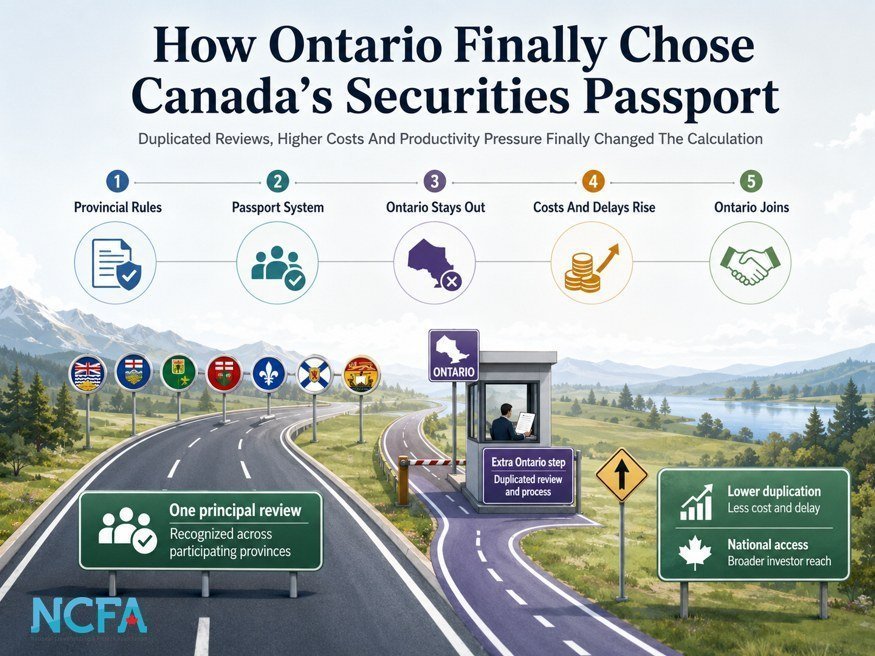
On July 15, 2026, Ontario Finance Minister Peter Bethlenfalvy announced that Ontario had committed to joining Canada’s securities regulatory passport system. The federal Finance Department highlighted the commitment following the federal, provincial and territorial finance ministers’ meeting in Charlottetown, ending almost two decades as the only jurisdiction outside the system.
Finance ministers described the decision as regulatory harmonization, removal of an interprovincial trade barrier and progress toward one Canadian economy. It also resolved a contradiction Ontario had carried for years. The province repeatedly documented duplication, delay and disproportionate compliance costs while continuing to require a separate Ontario decision where most of Canada relied on one principal regulator.
Ontario stayed outside because passport was never the prize it wanted. The province backed a single national regulator, then a cooperative authority with a wider institutional redesign. The first model failed in court. The second survived legally but never opened.
Companies carried the cost of waiting. Equity crowdfunding showed what fragmentation did at company level. A financing model designed to connect issuers and investors online became a provincial compliance exercise that excluded supporters, consumed employee time and made some smaller raises uneconomical.
The story isn’t that Ontario suddenly discovered regulatory friction in 2026. Every alternative gradually weakened while the economic cost of maintaining a separate process became harder to defend.
Canada has one capital market but several securities authorities. Each province and territory retains its legislation, regulator and enforcement powers. The Canadian Securities Administrators develops common instruments, policies and filing systems so companies don’t face entirely different frameworks in every jurisdiction.
Coordination reduces differences without eliminating repeated work. A filing, interpretation, fee or local review may appear reasonable on its own. A company raising capital or operating nationally experiences the accumulated cost through the same legal budget, employees and management time needed to build the business.
Most jurisdictions accept mutual reliance. The principal regulator can develop familiarity with the company, conduct the main review and issue a decision recognized elsewhere. The market gains a national operating mechanism without requiring provinces to surrender jurisdiction.
Ontario remains outside the compromise. An interface arrangement connects it to passport jurisdictions, but companies can still require a separate Ontario decision to access Canada’s largest capital market. The additional step remains while Ontario pursues a more ambitious institution.
The federal proposal reaches far beyond passport. The Canadian Securities Act would place registration, prospectuses, disclosure, derivatives, civil remedies and market offences within one federal regime. Ontario supports a structure that could replace the provincial coordination model rather than simply improve it.
The constitutional loss leaves Ontario without its preferred destination. In 2011, the Supreme Court rejected the proposed Act because Parliament couldn’t assume ordinary provincial securities regulation through its general trade and commerce power. Ontario loses the national model but still doesn’t join passport.
The cooperative model fixes the constitutional problem. Participating provinces would enact uniform laws administered by a common authority, while complementary federal legislation would address systemic risk and national criminal matters. Each legislature remains free to join, amend or leave.
Legal approval cannot assemble the institution. The Supreme Court approved the design in 2018, but major provinces remain outside and implementation dates recede. The first model fails because it takes too much provincial authority. The second preserves authority so carefully that no common regulator opens.
Several provincial rule books confront one digital market. Jurisdictions adopt different offering limits, investor caps, portal obligations, disclosures and filings. NCFA’s archive includes NCFA Canada Response to the Proposed Multilateral Instrument 45-108 Crowdfunding and Start-Up Prospectus Exemption.
The losses appear outside ordinary regulatory statistics. No portal initially registers under MI 45-108. More than 100 startups reportedly lose economical access to Ontario supporters, while one small firm assigns two employees for months to historical compliance work. The underlying record is available in March 1, 2019: NCFA Submission to the Ontario Securities Commission on Regulatory Burden. NI 45-110 harmonizes the market in 2021, but it cannot recover the financing, participation and productive work already lost.
The OSC confirms a pattern rather than a few difficult files. It receives 199 suggestions and identifies 34 underlying concerns, including repeated filings, difficult regulatory navigation, unclear service expectations, outdated technology and requirements that fall more heavily on smaller firms.
The response reveals the jurisdictional limit. The OSC announces 107 initiatives to improve service and remove avoidable work. Related NCFA coverage: OSC Makes Doing Business Easier for Ontario Market Participants. Ontario can improve its own processes, but it cannot eliminate national duplication while continuing to require a separate Ontario decision.
The Taskforce reaches beyond procedural burden. Its recommendations cover governance, competition, capital formation, disclosure, innovation, enforcement and investor protection. NCFA’s formal response is NCFA Response to the Modernizing Ontario’s Capital Markets Consultation Taskforce.
Ontario divides authority inside the OSC while preserving duplication outside it. Capital formation and competition enter the mandate, the Chair and CEO roles are separated and adjudication is placed within a distinct tribunal. The proposed Capital Markets Act does not replace the existing statutes, and no public tracker supports a claim that the complete 74 recommendation program was implemented.
The cooperative transition project winds down without transferring authority. Existing commissions remain responsible, the CSA continues coordinating national policy and passport keeps serving the jurisdictions that joined it. The practical system survives while the ambitious replacement recedes.
Ontario’s holdout loses its destination. The province is no longer choosing between passport and an approaching national regulator. It is choosing between passport and continued duplication with no replacement institution in sight. The original reason for waiting has disappeared, but companies still face the additional process.
The Bank of Canada turns weak productivity into an emergency. In March 2024, Senior Deputy Governor Carolyn Rogers says it is time to break the glass. Weak investment, limited competition and lengthy or unpredictable approvals discourage companies from committing capital.
Ontario’s separate review becomes part of the economic diagnosis. Every repeated filing, legal opinion and approval cycle uses the same employees, financing and management attention needed for technology, customers and expansion. Related NCFA coverage: How Competition Powers Canada’s Economic Growth. Passport doesn’t remove scrutiny. It prevents several regulators from consuming company resources to deliver substantially the same protection.
The cost of duplication is no longer only regulatory. It is productive work that doesn’t happen.
Ontario gives up duplication rather than jurisdiction. One principal regulator can conduct the main review while Ontario retains its legislation, commission, enforcement capability and voice in national policy. The province no longer has to choose between complete institutional control and surrendering its capital market.
The political commitment now faces an operating test. Industry advocates said passport can create a “single regulator experience through a principal regulator,” but harmonization in policy must also deliver harmonization in practice across legislation, policy and regulatory operations. Investment Executive reports the implementation direction and industry response. The strongest evidence of success will be fewer repeated reviews, lower compliance costs and faster interprovincial access while maintaining investor protection.
Ontario’s decision closes a long loop in Canadian capital markets policy.
The province rejected passport because it wanted a more ambitious national regulator. The first version failed constitutionally. The cooperative version survived in court but never became operational. Ontario then documented extensive burden inside its own market, implemented selected modernization reforms and continued requiring a separate provincial process after the national alternative receded.
Equity crowdfunding showed what the delay meant for companies. The market was divided before it could mature nationally. Legal work, platform controls and continuing obligations consumed a large share of modest financings. Investors were excluded by geography. Employees were assigned to compliance work instead of customers and growth.
The productivity emergency raised the stakes. Canada cannot describe weak investment, limited competition and poor productivity as urgent while treating avoidable duplication as institutionally harmless. The same capital and employee time cannot be used twice.
Passport is not a single national regulator, and it does not eliminate provincial authority. Its value is practical. One qualified regulator does the principal work while the others rely on the result.
Ontario didn’t suddenly discover regulatory friction in 2026. It gradually accepted that preserving every layer of control carried an economic cost that internal reform and an unfinished national project had not removed.
Ontario should publish an implementation schedule, identify the decisions covered by passport and report whether review periods, professional costs and duplicate regulatory interactions decline. Results for smaller firms should be reported separately because they carry fixed compliance costs most heavily.
Investor protection remains central. Reliance should remove repetition, not scrutiny. Principal regulators need the information, expertise and authority required to make decisions every participating jurisdiction can trust.
The larger question extends beyond securities regulation. Canada often pursues national economic outcomes through provincial institutions. Governments may continue debating the ideal architecture, but companies shouldn’t be required to finance avoidable friction while they wait.
When governments measure regulatory burden, should they count only compliance expenses that appear on company records, or also the financings, investment and productive work that never occur because the combined process makes them uneconomical?
Share this story → Explore related intelligence → Subscribe
The National Crowdfunding & Fintech Association (NCFA Canada) is a financial innovation ecosystem that provides education, market intelligence, industry stewardship, networking and funding opportunities and services to thousands of community members and works closely with industry, government, partners and affiliates to create a vibrant and innovative fintech and funding industry in Canada. Decentralized and distributed, NCFA is engaged with global stakeholders and helps incubate projects and investment in fintech, alternative finance, crowdfunding, peer-to-peer finance, payments, digital assets and tokens, artificial intelligence, blockchain, cryptocurrency, regtech, and insurtech sectors. Join Canada's Fintech & Funding Community today FREE! Or become a contributing member and get perks. For more information, please visit: www.ncfacanada.org
| | |
|---|---|---|
| | |



August 26th, 2025

January 4th, 2024

June 1st, 2021

September 9th, 2020

July 9th, 2018

January 3rd, 2018

September 25th, 2017

June 20th, 2017

May 10th, 2017

December 14th, 2016
