





Karsten Wenzlaff, Advisor
August 26th, 2025
Karsten Wenzlaff is a Crowdfunding and Fintech Expert from Germany. He is Secretary-General of Digit[...]


July 7, 2026 | NCFA Story Intelligence | Payments And Money Movement, SME Finance And Business Banking, Capital Markets And Market Infrastructure
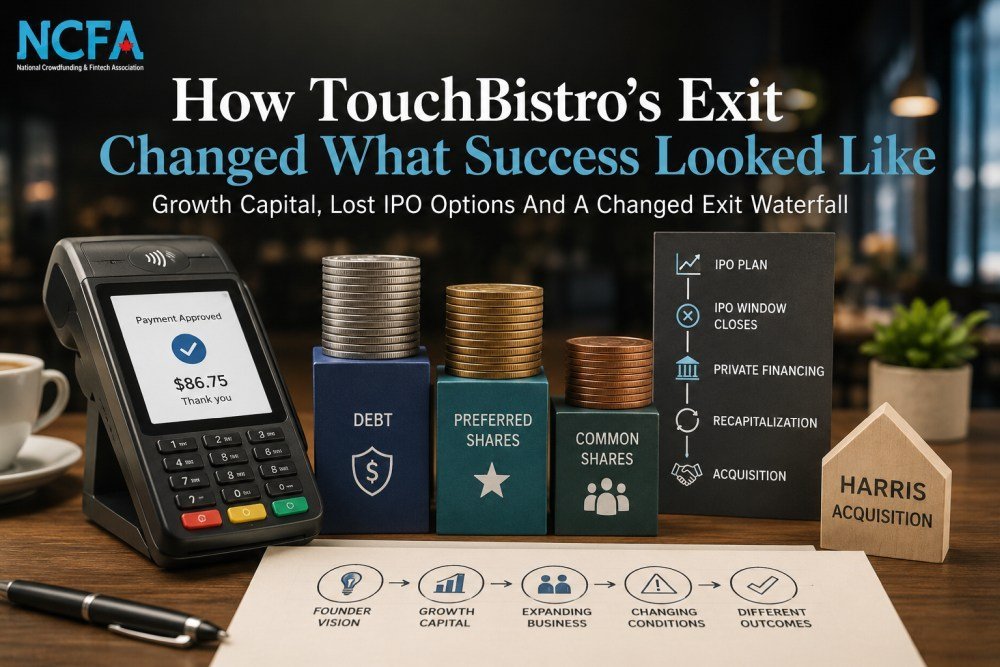
On July 7, 2026, Harris acquired TouchBistro, a Toronto restaurant technology and payments company whose point of sale, payment processing and management products serve more than 16,000 restaurants across over 100 countries. Harris, part of Constellation Software, didn’t disclose the purchase price.
The Globe and Mail later reported that Harris paid $100 million. Reporter Sean Silcoff said the transaction followed a December 2025 recapitalization that converted Francisco Partners’ debt into equity, gave the lender control of the board and reduced earlier shareholders to a minority position. He also reported a nine figure loss for OMERS and no recovery for employee common shares.
Those reported outcomes make the acquisition look like a failed exit. The operating record is more complicated. TouchBistro spent about 15 years building a global restaurant technology business, processing billions of dollars in transactions, expanding its product suite and surviving a pandemic that shut down much of its customer market.
The business had value. Its financing required more.
TouchBistro found a specific operating problem. Founder Alex Barrotti built the original product around restaurants that wanted mobile ordering, table management and point of sale software on an iPad. The narrow industry focus helped TouchBistro expand into reservations, loyalty, staff scheduling, online ordering, accounting, payments and restaurant management.
Investors saw a larger opportunity. Restaurants represented a fragmented global market with recurring software revenue, payment volume and room to sell several products into the same customer account. Venture backing could accelerate product development, international sales and acquisitions before larger competitors controlled the category.
BDC joined the shareholder base. TouchBistro’s 2017 Series C included BDC IT Venture Fund, giving the company backing from a federal Crown corporation alongside private investors. That public investment supported a Canadian company competing internationally, but it also carried a mandate to produce a financial return.
The C$72 million Series D raised the ambition. In June 2018, OMERS Ventures and JPMorgan Chase led the round, with BDC and existing investors participating. TouchBistro said it would expand research, enter more markets and double its workforce.
OMERS placed a major institutional bet. In September 2019, OMERS Growth Equity led a C$158 million Series E and invested C$85 million itself. Barclays Bank, RBC Ventures and BMO Capital Partners joined the round, while BDC, JPMorgan Chase and other existing investors participated.
The company had scale to support the pitch. OMERS said TouchBistro served more than 16,000 restaurants in over 100 countries and processed more than US$11 billion annually through its payment system. The financing supported product development, acquisitions, international expansion and hiring.
A public listing offered several advantages. It could provide new investment, establish a market price, give investors a route to sell shares and support acquisitions with public equity. It could also preserve TouchBistro as an independent Canadian company if public investors accepted the growth case.
There was no guarantee the market would cooperate. An IPO would require reliable growth, audited financial performance, predictable recurring revenue and public investor demand. The company never named an intended exchange in the sources reviewed, so the record doesn’t establish that TouchBistro rejected a Canadian listing.
The founder stepped out of the CEO role. In April 2021, Barrotti handed leadership to board chair Samir Zabaneh. He described the transition as a new stage requiring experience operating large global companies, not as a forced departure.
The operating job had changed. TouchBistro now needed to recover from the pandemic, control spending, expand payments revenue and compete with larger rivals. Leadership that was suited to founder led expansion wasn’t automatically suited to the next operating and financing phase.
A financing round doesn’t just fund the next stage of growth. It can quietly redefine which exits remain possible.
Private financing replaced the expected public route. In November 2022, Francisco Partners supplied C$150 million for product expansion, core services and acquisitions. Francisco Partners includes TouchBistro within its credit and structured solutions portfolio.
The financing bought time under new conditions. Equity absorbs losses until an exit. Debt introduces repayment, covenants, maturity dates and senior claims. Convertible instruments can later become ownership. The public announcement didn’t disclose the complete instrument, pricing, covenants or conversion terms.
The category kept getting harder. TouchBistro competed against Toast and other restaurant technology firms with their own payments, software, data and distribution advantages. Investment could finance products and acquisitions. It couldn’t guarantee that TouchBistro would outgrow a larger rival.
Cost discipline carried its own tradeoff. Silcoff reported that Zabaneh reduced costs while growth weakened. That doesn’t prove the reductions caused the later outcome. It shows the conflict management faced: preserve cash, invest against a larger competitor or raise more money into a weaker market.
A reported recapitalization reordered the company. In his public summary of the Globe investigation, Silcoff reported that Francisco Partners converted debt into equity in December 2025, took control of the board and reduced existing shareholders to a minority position.
The transaction wasn’t publicly announced at the time. TouchBistro’s full cap table, preference stack, debt balance and sale waterfall remain private. The reported control change explains the direction of the outcome, but it doesn’t provide enough information to calculate each shareholder’s recovery independently.
Venture investors judged the result against the money invested. A fund can’t treat survival, employment or customer continuity as its primary return. It needs distributions large enough to offset losses elsewhere in the portfolio and return money to its own investors.
Harris judged the operating business differently. Constellation Software and its operating groups acquire vertical software businesses that can serve specialized customers for years. They can focus on recurring revenue, customer retention, product depth, pricing and cash generation without needing a venture scale exit.
TouchBistro doesn’t prove that founders should reject venture capital. The company used institutional backing to build products, enter international markets, acquire technology and compete in a category that required significant investment. A smaller financing plan may have produced a smaller business or allowed a larger competitor to overtake it sooner.
It does show why the amount raised can’t be separated from the type of company being built and the outcomes its market can realistically support. Every round assumes a future. Higher valuations require more growth. Preferred investment adds priority. Debt adds fixed obligations and control rights. A delayed IPO, weaker market or missed target can leave a founder running the same company under very different economics.
Canada’s debate often starts with whether founders can access enough money. The early stage funding funnel is narrowing, and Canadian companies still face a limited pool of domestic investors capable of leading large rounds. Those are genuine constraints.
TouchBistro raises the question on the other side. Once money becomes available, is it structured around the company’s likely growth, customer market and exit routes? Canada’s longstanding need for flexible growth financing includes equity, debt and hybrid products. Flexibility only helps when founders and boards understand what each instrument can claim later.
Founders can’t control pandemics, public market windows or every competitive threat. They can model the consequences of a financing before signing it.
What sale price clears the preferences?
What happens if growth takes twice as long?
Which covenants transfer control after a missed target?
Could the company accept a strategic offer without leaving common shareholders with nothing?
Does the business have a credible route to the outcome its investors require?
Those questions aren’t pessimistic. They’re part of building the company.
TouchBistro built software that restaurants still use. Harris acquired its products, customer relationships and industry expertise. The work continues under a Canadian software owner.
The financial outcome followed a different logic. The expected IPO never arrived. Private credit reportedly gained control. Earlier shareholders lost priority. The eventual sale appears to have preserved the operating business without satisfying the venture investment behind it.
That is the distinction founders need to see before the next round, not after the sale.
A valuable company isn’t automatically a successful venture investment. A large exit isn’t automatically a founder win. Investment that opens the next stage can quietly close outcomes that once looked available.
Share this story → Explore related intelligence → Subscribe
 The National Crowdfunding & Fintech Association (NCFA Canada) is a financial innovation ecosystem that provides education, market intelligence, industry stewardship, networking and funding opportunities and services to thousands of community members and works closely with industry, government, partners and affiliates to create a vibrant and innovative fintech and funding industry in Canada. Decentralized and distributed, NCFA is engaged with global stakeholders and helps incubate projects and investment in fintech, alternative finance, crowdfunding, peer-to-peer finance, payments, digital assets and tokens, artificial intelligence, blockchain, cryptocurrency, regtech, and insurtech sectors. Join Canada's Fintech & Funding Community today FREE! Or become a contributing member and get perks. For more information, please visit: www.ncfacanada.org
 |  |  |
|---|---|---|
 |  |  |
July 3, 2026 | NCFA Insight | Cybersecurity And Fraud, Digital Identity And Trust, Risk Compliance And Regtech, Payments And Money Movement, Digital Assets Blockchain And Tokenization, Artificial Intelligence And Data

Governments are no longer treating post-quantum cryptography as a research topic. They're now publishing migration plans.
On June 22, 2026, the White House issued an order on advanced cryptographic attacks, including the risk that adversaries collect encrypted data today so they can decrypt it later. The same day, a separate White House order advanced U.S. quantum innovation across computing, sensing, networking, applications, and industry partnerships.
That combination is the useful development marker for fintech. Governments are funding quantum capability while also pushing organizations to prepare for the security risk that follows.
The financial sector doesn't need to know the exact year a cryptographically relevant quantum computer arrives before it starts planning. Long time customer data, payment credentials, digital identity systems, API certificates, custody systems, vendor software, archived records, and cryptographic keys may remain sensitive for years.
Quantum readiness is therefore becoming an operating requirement. Not someday. Now.
The policy picture is getting clearer.
NIST finalized its first three post quantum cryptography standards in August 2024. The standards are FIPS 203 for ML-KEM, FIPS 204 for ML-DSA, and FIPS 205 for SLH-DSA. NIST says organizations should begin migrating systems to quantum resistant cryptography.
NCFA has already tracked how post quantum cryptography is entering implementation, with payments, digital identity, secure messaging, APIs, and financial data all exposed to the migration challenge.
Canada has started, too. The Canadian Centre for Cyber Security published a roadmap for migrating Government of Canada non classified IT systems to post quantum cryptography, covering stakeholders, phases, milestones, governance, and departmental planning.
Financial authorities are paying attention too. The Bank for International Settlements published a quantum readiness roadmap for the financial system, and the G7 Cyber Expert Group issued a roadmap for the financial sector's transition to post quantum cryptography.
The practical message is this. Start with awareness, find where cryptography is used, assess risk, plan migration, and work with vendors before deadlines become urgent.
The hardest quantum risk is not only future system compromise. It is long term data.
Financial institutions protect account records, payments data, identity documents, loan files, custody records, private market documents, insurance records, tax files, transaction histories, and compliance archives. Some of that data must stay confidential for years or decades.
That creates the harvest now, decrypt later problem. An attacker can collect encrypted data now and wait for stronger decryption capability later.
For fintechs, this impacts the planning window. A company doesn't need to be systemically important to hold sensitive data. A payments provider, open banking intermediary, wallet provider, identity service, lending platform, wealthtech app, regtech vendor, or crypto custodian may all depend on cryptography that was never designed for a quantum era.
Post quantum migration starts with discovery.
Most organizations know they use TLS, certificates, signing keys, databases, cloud services, APIs, authentication systems, payment connections, and vendor platforms. Fewer have a current inventory of which cryptographic algorithms protect each system, which assets must remain confidential long term, and which vendors control the upgrade path.
That's why cryptographic inventory keeps appearing across official guidance.
A fintech should be able to answer basic questions:
Without that inventory, migration plans become guesswork.
Fintech security is rarely managed by one company anymore.
A single product may rely on cloud hosting, identity verification, payment processors, data aggregators, card issuing platforms, custodians, wallet technology, fraud systems, CRM tools, analytics software, email providers, certificate authorities, and outsourced compliance systems.
That makes post quantum readiness a vendor risk issue.
A fintech can upgrade its own code and still remain exposed through a vendor that cannot explain its cryptographic dependencies. Banks and credit unions face the same issue in reverse. They may need to ask whether fintech partners can support post quantum requirements before onboarding, renewing, or expanding contracts.
The procurement question changes from "is this vendor secure today?" to "can this vendor survive a cryptographic transition without disrupting our product, customers, or regulatory obligations?"
Quantum readiness touches more than cybersecurity teams.
In payments, cryptography protects authentication, transaction integrity, messaging, API connections, certificates, and sensitive account data.
In digital identity, it protects credentials, signatures, documents, device binding, verification records, and trust chains.
In crypto and digital assets, it touches wallets, custody, private keys, signing systems, transaction authorization, smart contract administration, and institutional key management. BTQ's quantum safe Bitcoin and stablecoin roadmap highlights one approach to preparing digital asset infrastructure for post quantum cryptography.
In open banking, it affects API security, consent records, data sharing, third party access, and customer authentication.
In capital markets, it touches trading access, fund administration, investor records, tokenized securities, transfer agency, data rooms, reporting, and long term documents.
In AI and data systems, it affects model access, training data, confidential records, synthetic data pipelines, and secure data exchange.
That breadth is why the topic belongs with executives, product leaders, compliance teams, boards, and investors, not only cryptography specialists.
Canada's Cyber Centre roadmap gives public sector organizations a starting point. It also gives fintech and financial services leaders useful guidance that migration will take planning, governance, technical discovery, budgets, and coordination.
Canada doesn't yet have a full financial sector post quantum mandate comparable to a hard compliance deadline, but that statement should not create comfort.
Canadian fintechs operate in a global market. They sell into banks, credit unions, enterprises, governments, insurers, capital markets, payment networks, and regulated financial institutions. Their buyers may start asking post quantum questions before Canadian rules require formal answers.
A fintech that can show cryptographic inventory, vendor readiness, migration planning, and crypto agility may have an advantage in enterprise sales. A fintech that cannot answer basic questions may face longer diligence, higher security friction, or blocked procurement.
The near term opportunity is not building quantum computers. It's helping financial organizations prepare for the cryptographic transition. Quantum Bridge's USD $8M raise shows Canadian capital already backing deployment ready quantum safe security for finance, telecom, government, and defence.
Product opportunities include:
These opportunities are practical because they map to work financial firms already need to do. They need to know what they use, what they protect, which systems carry the highest risk, which vendors control dependencies, and how migration can happen without breaking production systems.
These are the kinds of tools that belong on NCFA's Financial Innovation Map, such as identity, payments, custody, regtech, data governance, and cyber resilience.
Quantum readiness won't arrive as a single upgrade.
Organizations will need inventories, test environments, migration sequencing, vendor commitments, product changes, audit evidence, customer communications, and fallback plans. Some systems will be easy to update. Others will depend on old software, hardware limits, contracts, third party platforms, or regulatory approvals.
That's why waiting for a precise quantum break date is the wrong approach for operators. Ask yourself, your team, your leadership this simpler question, "If a regulator, bank partner, insurer, enterprise buyer, or board asked tomorrow where vulnerable cryptography sits in the business, could the company answer?"
For many fintechs, the honest answer is probably no. So that's the opening to start.
Takeaway: Post quantum cryptography isn't a distant science fiction story anymore. It's becoming part of how financial organizations prove they can protect data, manage vendors, maintain trust, and keep critical services running through the next security transition.
If post quantum readiness starts with knowing where cryptography lives, should fintech due diligence now include a cryptographic inventory before major bank, payments, custody, or identity partnerships?
The National Crowdfunding & Fintech Association (NCFA Canada) is a financial innovation ecosystem that provides education, market intelligence, industry stewardship, networking and funding opportunities and services to thousands of community members and works closely with industry, government, partners and affiliates to create a vibrant and innovative fintech and funding industry in Canada. Decentralized and distributed, NCFA is engaged with global stakeholders and helps incubate projects and investment in fintech, alternative finance, crowdfunding, peer to peer finance, payments, digital assets and tokens, artificial intelligence, blockchain, cryptocurrency, regtech, and insurtech sectors. Join Canada's Fintech & Funding Community today FREE! Or become a contributing member and get perks. For more information, please visit: [www.ncfacanada.org](http://www.ncfacanada.org)
| | |
|---|---|---|
| | |
June 30, 2026 | NCFA Story Intelligence | Digital Assets Blockchain And Tokenization, Capital Markets And Market Infrastructure
Tokenization promised to change capital markets for more than a decade.
The promise is still attractive. Put ownership on chain. Reduce paperwork. Automate compliance. Improve access. Speed up settlement. Make private assets easier to distribute, manage, and transfer.
But markets don’t run on promises. They run on operating models, regulation, distribution, controls, liquidity, and trust.
That’s why Securitize’s expected NYSE listing is the trigger. The listing isn’t the whole story. It’s the latest chapter in a longer path from tokenization as a market idea to tokenization as a business investors can measure.
The first wave sold a powerful idea. Security tokens, STOs, fractional assets, real estate tokens, private shares, and blockchain based markets promised to bring traditional securities into programmable digital form. The early security token field was framed as a more regulated answer to the ICO boom.
The market didn’t overhaul itself. Early security token projects ran into the same walls: unclear regulation, thin liquidity, limited distribution, custody questions, fragmented platforms, investor eligibility rules, and the simple reality that a tokenized security still has to behave like a security.
The hard work was never only technical. A tokenized fund still needs investor onboarding, KYC, AML, transfer rules, custody, servicing, reporting, distributions, tax records, corporate actions, and permissioned secondary transfers. Those aren’t marketing features. They’re the boring parts that make markets work.
Regulators kept reminding the market that labels don’t change obligations. Hester Peirce’s point that tokenized securities still have to follow securities laws captured the practical boundary. Faster settlement and automation don’t remove investor protection, disclosure, and market integrity requirements.
Real world assets changed the packaging. The market stopped asking whether everything should become tokenized and started asking which assets actually benefit. Treasuries, money market funds, private credit, private equity funds, and alternative assets became more practical test cases than vague claims about digitizing every market.
Private markets gave tokenization a clearer job. Citi, Wellington Management, and WisdomTree tested private market tokenization in 2024, showing how smart contracts could support operating efficiency in traditionally manual private market processes.
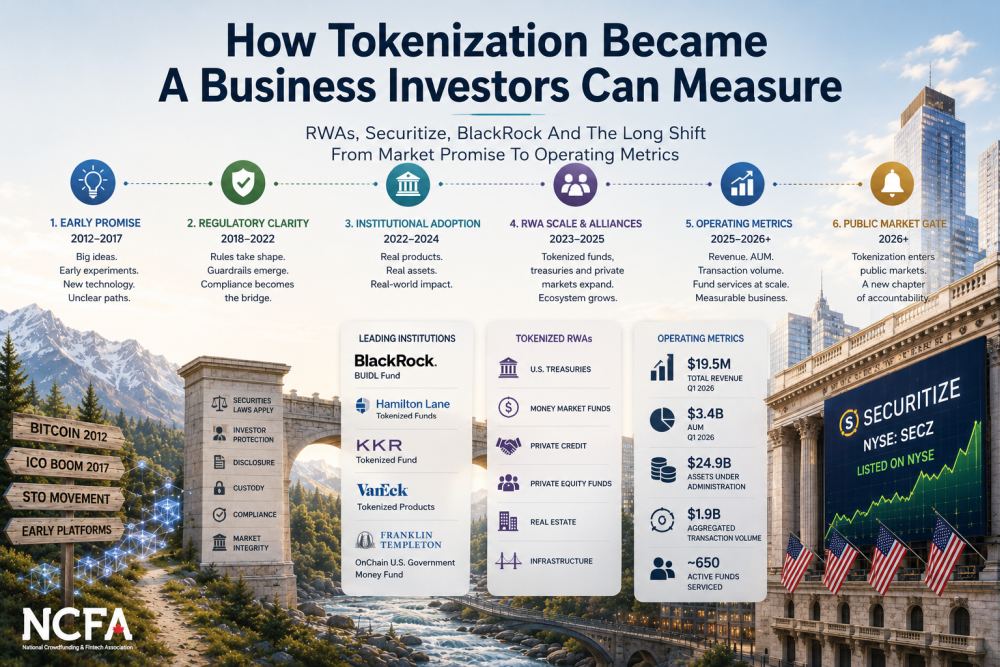
Hamilton Lane used tokenization to lower access friction. In 2022, Hamilton Lane and Securitize said qualified US investors would gain access to tokenized feeder funds tied to direct equity, private credit, and secondary transaction strategies.1 Securitize later said one Hamilton Lane fund reduced the minimum investment from about $5 million to $20,000.2
KKR showed that major alternatives managers would test the model. Securitize launched a tokenized fund offering exposure to KKR’s Health Care Strategic Growth Fund II in 2022, framing the product around broader access to alternative investments through digital ownership.3
BlackRock changed the market’s confidence level. BlackRock launched BUIDL, its first tokenized fund, on Ethereum in March 2024. The fund was backed by cash, US Treasury bills, and repurchase agreements, with BNY Mellon enabling interoperability between digital and traditional markets.4
BUIDL became a measurable adoption signal. In March 2025, Securitize said BUIDL surpassed $1 billion in AUM and identified itself as the tokenization provider for the fund.5 BlackRock’s BUIDL launch became one of the clearest institutional signals that tokenization was entering regulated asset management.
Securitize turned the thesis into operating data. In Q1 2026, Securitize reported $19.5 million in total revenue, up 39% year over year, $3.4 billion in AUM at quarter end, $24.9 billion in assets under administration, $1.9 billion in aggregated transaction volume, and roughly 650 active funds serviced through Securitize Fund Services.6
Those numbers change the conversation. Investors can ask normal operating questions: revenue mix, servicing fees, client concentration, transaction volume, fund growth, margins, profitability, operating leverage, customer retention, regulatory execution, and how much tokenization demand converts into durable revenue.
The listing is the trigger. Securitize and Cantor Equity Partners II said the business combination was expected to raise approximately $400 million in gross proceeds, close after shareholder approval and customary conditions, and list on the NYSE under ticker SECZ.7
The listing doesn’t settle the thesis. It exposes the thesis to market discipline. A listed tokenization company has to explain growth, losses, expenses, institutional demand, regulatory risk, competitive pressure, and whether tokenized fund adoption can become a durable public company business.
Canada has a practical watchlist. The opportunity isn’t to copy a US listing. Canadian firms can look across the tokenization value chain: custody, transfer services, fund administration, compliance, exempt market distribution, private market platforms, digital identity, investor onboarding, reporting, and secondary trading.
Regulated product design may decide the next chapter. The OSC’s long term asset fund project pointed to possible retail exposure to traditionally inaccessible assets and raised the opportunity for tokenized long term funds with embedded compliance, transparent records, fractional access, and guardrails.
Tokenization didn’t become measurable overnight. It moved through years of big claims, stalled experiments, regulatory pushback, operating layer buildout, institutional product design, and real world asset packaging before public markets had a company they could evaluate with ordinary business questions.
That may be the clearest test. The first tokenization wave asked investors to believe in a technology. The next wave will ask investors to evaluate execution. Revenue. Margins. Assets. Transactions. Clients. Losses. Retention. Market share. Operating leverage. That is a much harder test, and a much more useful one.
For Canada, the lesson is practical. The next winners may not be the firms issuing the tokens. They may be the firms solving everything around them: custody, compliance, investor onboarding, fund administration, reporting, liquidity, and regulated distribution. That’s where durable businesses are often built, and where Canada’s capital markets innovation map can help identify opportunities that are still taking shape.
What operating metric would convince you that tokenized markets have moved beyond promise?
Share this story → Explore related intelligence → Subscribe
The National Crowdfunding & Fintech Association (NCFA Canada) is a financial innovation ecosystem that provides education, market intelligence, industry stewardship, networking and funding opportunities and services to thousands of community members and works closely with industry, government, partners and affiliates to create a vibrant and innovative fintech and funding industry in Canada. Decentralized and distributed, NCFA is engaged with global stakeholders and helps incubate projects and investment in fintech, alternative finance, crowdfunding, peer-to-peer finance, payments, digital assets and tokens, artificial intelligence, blockchain, cryptocurrency, regtech, and insurtech sectors. Join Canada's Fintech & Funding Community today FREE! Or become a contributing member and get perks. For more information, please visit: www.ncfacanada.org
| | |
|---|---|---|
| | |
About NCFA Canada | Craig Asano | June 19, 2026

Craig Arnatt is the Founder and CEO of PGI Cover, a specialty insurance brokerage based in Vancouver. His career spans more than 20 years as a commercial broker, insurance entrepreneur, and insurtech builder. In 2012, he launched EventPolicy, a fully automated consumer facing commercial liability platform, and later founded InsureCert, an insurance technology SaaS company. In recent years, Craig has led government supported research into the use of AI and large language models in insurance. He's now introducing Personal Guarantee Insurance to Canada for the first time through PGI Cover, a new category of specialty coverage designed to help business owners, entrepreneurs, and acquisition buyers cap their personal downside when signing a personal guarantee.
Most entrepreneurs focus on building the business. Far fewer understand that a single signature on a loan agreement could put their personal savings, investments, and even their home at risk. In Season 4 Episode 65 of Fintech Fridays, Craig Asano sits down with Craig Arnatt, Founder and CEO of PGI Cover, to unpack one of the most overlooked risks in entrepreneurship: the personal guarantee.
Craig explains why lenders require them, how they affect founders, business owners, and acquisition buyers, and what can happen when a business loan goes into default. The conversation explores the launch of Personal Guarantee Insurance in Canada, why the product has gained traction internationally, and how Canada's growing business succession wave could create new demand as entrepreneurs, search fund acquirers, and M&A buyers increasingly rely on leveraged financing to acquire businesses. Craig also shares insights from more than two decades in commercial insurance and insurtech, discusses the role of AI in underwriting and risk assessment, and explains how embedded insurance and fintech partnerships could help bring protection directly into financing workflows.
Whether you're raising capital, buying a business, advising clients, or lending to entrepreneurs, this episode offers a practical look at a risk that is often buried deep inside loan agreements but can have life changing consequences when things go wrong. Enjoy!!
Duration: 108 mins
Intro: Welcome to fintech Friday's a weekly podcast brought to you by the National Crowdfunding and Fintech Association of Canada and partners. Covering all things fintech, blockchain, AI and alternative finance.
I'm Craig Asano, founder and CEO of NCFA Canada, and welcome you to Season 4, Episode 65 of Fintech Fridays, a weekly podcast brought to you by NCFA and partners, where we feature conversations with leading voices across Fintech, funding and financial innovation. In Canada as well as around the globe. We talk about the founders'journeys, new ventures, emerging trends, and really what they're seeing in the market right now. Today we have another fantastic guest with us. I'd like to introduce to you Craig Arnatt.
He's the founder and CEO of PGI Cover. A Vancouver-based specialty insurance brokerage building a new category of protection for entrepreneurs, business owners, and acquisition buyers who sign personal guarantees on business financing. Craig brings more than 20 years of experience as a commercial broker, insurance entrepreneur, and an insurtech builder. He's launched EventPolicy in 2012, and that definitely rings a bell today. To someone in my shoes, I remember that, which is a fully automated commercial liability platform.
Later, he founded InsureCert, an insurtech SaaS company, and has led a government support research into AI and large language models in insurance. So Craig, we'd like to welcome you to the show. Thanks so much for joining us today.
[00:01:43] Craig Arnatt: Yeah, thanks very much for having me, Craig. Glad to be here. Yeah, so we've got a lot of questions, and it's a very super interesting topic. But we're going to just ease our way into here with the kickoff question.
[00:02:14] Craig Asano: So first of all, I'd like to call out that you've got a pretty cool name. Yeah. And it's rare we get a couple of Craigs on the show, so it's worth saying. But the first question is really, you know, most entrepreneurs think about business risk because they live and breathe it, but many maybe don't realize that They could be putting their personal savings or investments and even maybe their home on the line when they borrow money. So for listeners hearing about PGI Cover for the first time, what is Personal Guarantee Insurance?
[00:02:51] Craig Asano: And, you know, why has this risk kind of largely going under the radar? It might be invisible to founders and business buyers for so long, of which we're hopefully unveiling today. So, you know, what is it?
[00:02:51] Craig Arnatt: Yeah, so Personal Guarantee Insurance sounds boring right up until you realize that the cover is quietly covering the scariest clause in an entire loan agreement. So here's a setup. You walk into a bank as a business owner to get a loan. They smile and they say they believe you and believe in the vision.
[00:03:25] Craig Arnatt: But then somewhere around page 38, they ask you for a personal guarantee. And that is one signature that changes everything. It means that the business, if they cannot pay the loan, they do not just take the business, but they come after you personally. So that really means the house, the savings, the kids'education fund, the lake place you've been calling an investment. So a personal guarantee can be the most expensive autograph you'll ever give. Most founders signed it as the same way they accepted terms and conditions on a new phone or software.
[00:03:55] Craig Arnatt: You click accept without really reading a single word of it. So the whole reason PGI Cover exists is that we ensure the personal guarantee clause of that loan agreement. So if the business fails and the bank calls in the guarantee, our policy steps in and covers a large part of what you would otherwise be paying out of your own pocket. So, you know, the banks always ensure their downside. We've decided that the founder deserves the same safety net. So the second part of your question is, why did it stay invisible?
[00:04:28] Craig Arnatt: I think until recently, there was simply nothing you could do about it. It's one of those items that has no risk alternative. So it has always been just the way it is. A line item that, you know, the lawyers simply say you have to sign. So the business owners must agree to that or the loan doesn't happen. Yeah, we see it all the time in emails, the number of inbounds we get in the box that say, hey, you know, you're an entrepreneur. We've got all kinds of money. And after various exchanges back and forth, of course, there it is.
[00:05:01] Craig Asano: It's a personal guarantee. So hopefully as we dig in the conversation, we're going to, it's like an onion. I like it, you know, sort of unravel the various layers and get to the real core of the Of not just the protection, but the risks and what could happen in other cases. But before we get there, because a lot of this podcast is about founder journeys, we want to talk a little bit about your background on the show. When did you launch PGI Cover? Really, what led you to focus on this aspect of insurance, like personal guarantees?
[00:05:36] Craig Arnatt: Yeah, so I think many of us in the insurance industry fall into it one way or another. And I had a chance to buy a brokerage almost 20 years ago now. And I thoroughly enjoyed the challenge, learning contract law and the process. And prior to that, I had a technology background. So I participated in a number of technology endeavors once I got into the industry, working with carriers, brokers and MGAs. And the struggle has always been how do you modernize the insurance industry?
[00:06:07] Craig Arnatt: So recently, of course, AI has done amazing things. But over the years, we've pursued other initiatives trying to streamline a very archaic industry. So it is a challenge that I have enjoyed very much. So fast forward to a few years ago when a friend called and asked if I could get him a Personal Guarantee Insurance policy. I had no clue what that was for someone who's somewhat of a veteran. So that really began my research into the product.
[00:06:39] Craig Arnatt: The original thesis was created by Todd Davidson in the UK. He started a MGA called Purbeck and together we've been working together to launch this product here in Canada with the help of Markel Canada as capacity provider. So we are very excited about bringing this very new product to Canadian SMEs. So that's how I fell into the product and we were just launching this month in June, 2026. Wow, well, fresh, fresh information.
[00:07:11] Craig Asano: And I think it's an amazing problem to tackle. And this sort of a good segue into the next question, because, you know, most founders always are looking for a problem to build a product, but you're taking on an entirely different challenge, because it doesn't exist here in Canada, as I understand. And You're the first to to tackle it so that's a brand new you know category so can you just talk a little bit about that challenge and maybe what the it's it is very early so you don't have a lot of certainly months or years or even
[00:07:45] Craig Asano: months behind your belt to talk about it but what what is the reception been what what are your thoughts like how how is that going
[00:07:45] Craig Arnatt: Yeah, so the product's been running in the UK for, I think, almost eight years now. So they've had a very good success at it. There's also a version of this product in Australia. Jeff McNally runs that, PGI Australia. So, you know, building a better product is hard. Building a market for a product nobody knew they needed is a different venture entirely.
[00:08:16] Craig Arnatt: Most founders get to say, you know, here's a better mousetrap. I have the first convinced Canadian SME owners that you have a mouse problem. So that is a new category tax. You are not competing for attention, really. You're creating for the awareness of the product in the first place. So the upside is there's no competition in the lane, but the downside is there is no lane. So we're really paving it while we drive on it, so to speak. So that's the challenge. But the good news is that overall in the other countries that it is running,
[00:08:48] Craig Arnatt: it's been very warmly successful or warmly greeted and quite successful on the insurance side.
[00:08:48] Craig Asano: So you mentioned, which kind of doesn't surprise me, that it's been eight years in the UK. We don't have it in Canada. It's been X number of years in Australia. We don't have it in Canada. They've had these positive experiences and I can only imagine that it's doing what that type of insurance is meant to do as a product.
[00:09:19] Craig Asano: And so when connecting with those names that you mentioned who are running those businesses in those countries, Did they indicate that it was such a significant challenge to start a new category there in their countries? And when you listen to that and you know how Canada can be a little conservative with something new, did you... I mean, you, you, you're taking this challenge on, you're going to market. It's brand new. We're, we're helping, you know, get this message out and, you know, encourage many as, as founders, as well as potential partners to, to connect
[00:09:56] Craig Asano: with you if they are interested to, to learn more. But, what, what did those partners in those countries say about the challenges? I'd be very interested because like any new category, It's tough. It's always an uphill battle. And then something, some traction sort of moves or an obstacle or hurdle is overcome. And I wonder what those triggers are in this case. Yeah, it's an interesting question. And I've always kind of struggled for why this product doesn't exist.
[00:10:27] Craig Arnatt: I know that in the US They had a version back in 08 by a company that gave it a go. And there was some dynamics internally that happened that just didn't really work out. There was some issues with the internalization of that product. So other than the obvious that no one carries a product, the pleasant side of that product when you're talking about it is the realization from the business owner's perspective That it's a very important solution to their problem.
[00:11:04] Craig Arnatt: On the flip side, on the insurance side, it's a very difficult thing to challenge the insurance industry to come up with a new category of insurance. When you're talking to an actuarial, they're like, they don't fully understand it. It doesn't exist. There's a huge mountain to climb to convince the insurance capacity providers that it's worthwhile. But I think once they understand the real benefit, the value of it, then they then they do warm up to it. I think more than anything for me as a as a as a founder myself,
[00:11:38] Craig Arnatt: I've signed a personal guarantee and I kind of like, oh, man, You realize that your house is up on the line, you know, so it identifies, I identified with the product right away. So, you know, some of the more surprising things about the product itself is that you're talking to a sophisticated person in the room, which would be the lawyer or the lender or a serial founder. They're the ones that most likely have something to say about it. And they had no idea that they could insure it. So when they do find out that they can, then they get quite excited about it.
[00:12:13] Craig Arnatt: The blind spot scales with experience because everybody assumes somebody already solved it. But it is quite interesting to have discussions with people who are quite knowledgeable about the aspect of that clause in loan agreements. And when you tell them that it's actually available now, they do quite get excited about it. So I guess really the lesson for the founders, if a lawyer or lender is telling you that there's nothing they can do about a personal guarantee exposure, then they need to tell them about PGI Cover.
[00:12:45] Craig Arnatt: It's here today as of June and 2026.
[00:12:45] Craig Asano: Okay, well, fantastic. So let's get more into just understanding about personal guarantees. You know, why did lenders do lenders require one and how common are they in? In Canada, as you're saying, in small business lending, it's not here yet. But how common are they in the UK then as a result? Do you have any data on, you know, what sort of volume or what sort of percentage of these small business financings, you know,
[00:13:18] Craig Asano: these loans that are accompanied with personal guarantees? So sort of, you know, what is it that the lenders really required or not? Not really. And, you know, what what sort of data can you tell us about it?
[00:13:18] Craig Arnatt: Well, in our research, it's required almost every time. I mean, there are some loan programs that are out there. In the US, they have the SBA loan program. In Canada, they've got the small business lending program. And those programs are really designed to encourage lending.
[00:13:50] Craig Arnatt: But the personal exposure is still there. At the end of the day, people think, oh, I've got a government backed loan. Well, those programs, again, are just designed really to encourage lending. Interestingly enough, the UK government published a thing late last year, an article specifically mentioning personal guarantee and how they impact a business owner. So the government in the UK has actually made an effort to draw attention to that clause. And coincidentally, they've got Purbeck that can rely on to solve that problem.
[00:14:26] Craig Arnatt: And Jeff was telling me in Australia that the Australian government is doing a very similar approach, is that they're now making business owners really identify with that clause and to understand what it means. And I think more than anything, it's because lending is up for businesses in many places in the world. And the government's job is, of course, trying to protect business owners from impacts. So the personal guarantee really personally promising to repay a business debt if the business cannot.
[00:15:03] Craig Arnatt: It quietly erases the line between you and the company. Personal guarantees, the whole point of incorporating really at the essence, if you think about business structure, you incorporate to protect you personally from liability that your business can expose you to. So as an insurance person, you're thinking, what are all the products that can protect that person who's calling me on the phone? So up until recently, there's nothing really that you can offer them as far as that personal guarantee clause. So if the bank is politely knocking on the door, then that's what this policy will do and step in.
[00:15:42] Craig Arnatt: In rare circumstances, personal guarantee may not be required, but for the vast majority of loans, they are the de facto required. Lenders require it because it aligns incentives and gives them a backstop, of course. So it is not rare. It is the norm. And for most small business loans, the vast majority of acquisition financing in Canada, a personal guarantee is simply expected. So if you have a borrower to start, run or buy a business, odds are that you will have to be signing a personal guarantee.
[00:16:18] Craig Asano: And as an entrepreneur signing, putting your name, your house, your car, your assets, whatever you might have in that personal guarantee, let's break down the risk itself from that entrepreneur's perspective. What do they stand to lose in an example? Other than the obvious, the business would be required to liquidate assets, of course, to recover that loan payment. So, you know, the loan agreement will... What is the owner going to do? All they can do is liquidate, right?
[00:16:51] Craig Arnatt: So... The honest answer is that they understand in a way that we all understand that we should, you know, use dental floss. But in theory, that most moments of signing, they're not really. People hear about personal guarantee and think it's a formality. It is not a formality. It is putting real assets on the line. So the risk to the business owner is the entire personal balance sheet. Those personal assets will be required to be liquidated if the business is unable to fulfill that loan.
[00:17:23] Craig Arnatt: So everything outside the business, most people do not feel that there is that personal guarantee that until the The bank or the lender comes knocking and that's really the impact that we're trying to solve. So again, when I brought my brokerage, I signed a personal guarantee and honestly, I just had to do it because there was no way to avoid it. But it was scary, especially to my wife. We had to put the house up as collateral. So the burden is just like, I guess, metaphorically like a boat owner.
[00:17:57] Craig Arnatt: Your most exciting days of owning a boat is the first day you buy it and then the day you sell it. So a personal guarantee acts in a very similar way. You sign the loan and the excitement that comes with it. But it's always a great thing when you pay off the loan and you do not have that personal guarantee exposure. So until that time arrives, the PGI Cover is there to help. I like that analogy. It's like a sinking ship. It's like a pool. I look outdoors because I'm working from home today and it's the same thing.
[00:18:31] Craig Asano: When you get it, it's all exciting. And then every day it's a cost and you wish you never had it and hopefully fill it in. For someone who went through that experience as your own entrepreneur, you signed this for your mortgage brokerage. And being in the business to help solve the problem, what advice would you give to founders prior to them actually putting their name there? What do you think they need to know?
[00:18:31] Craig Arnatt: Well, I guess the obvious is whether you can repay the loan or not. That's obvious. Most founders are gung-ho and they see no downside at all.
[00:19:04] Craig Arnatt: I think the smart founders out there are going to look at what is the insurance policy doing at its core, right? If you have that liability exposure... And the worst case scenario happens, what's going to happen to you personally? So, again, I think it's very important that business owners understand that, you know, your liability policy is all about the actions of the business and your employees if they cause an accident or whatever. I mean, those traditional policies are there to protect the business or the personal impact of that.
[00:19:37] Craig Arnatt: Again, incorporating is defense line number one, and line number two is the insurance policy. So the advice really is to, as you're signing that loan, think about the personal guarantee, what the impact would mean to the family. and, and not, it's not just a loan, and find out if it is secured or not. obviously there are other aspects of joint or several who's on the guarantees that one person, many persons, what is exactly covered,
[00:20:08] Craig Arnatt: who is the signatoryy. So, you know, who is actually signing that loan agreement and who is the bank going to come calling to that person? Other things that are important is negotiating the cap. So some loans can have a cap of personal guarantee, others may not. So it depends on the lender itself. There's the different levels of lending, chartered banks, Canadian mezzanine financing, and then private financing itself.
[00:20:41] Craig Arnatt: As you go down the list from charter bank to private lender, obviously the private lenders are going to be a little more rigorous and a little more, I guess, aggressive if the loan is unpaid. So the advice is really just look at that personal guarantee, understand it. And then, you know, after you do understand it, then come to pgicover.com. So the and with that stack of lenders and the variance of their terms based on their loan contracts.
[00:21:13] Craig Asano: A default is a default and they're going to come calling you and that's it. Yeah. Yeah. It really is a timely product. I think there's a lot of movement in the markets that, you know, part of part of the research for the podcast and sort of moving on to the next section. We're sort of talking about the demand in Canada. You know, you're saying personal guarantees are required in almost all loans. But it has been here for eight years, eight years behind the UK somehow.
[00:21:45] Craig Asano: So as part of that research, Canada is entering, you know, this idea that there's, there's, it's a, it's a, it's a country with an older population now. I mean, I know we have immigration and there's a big hot debate about that, but a lot of the businesses and the business founders are getting older. And so usually a group would come in and get a loan and acquire that business and try to transfer those assets and, You know, that sort of business succession cycle. And, you know, can you like who do you feel that is going to demand for these products?
[00:22:19] Craig Asano: And why do you think it's important in Canada right now?
[00:22:19] Craig Arnatt: Yeah, it's a great question. And it is becoming very, very newsworthy. So Canada is staring down one of the largest business handovers in its history, right? There's an entire generation of owners that are retiring. A new wave of buyers and search funds, individual acquirers, M&A buyers. They have that ETA entrepreneurial through acquisition program. A process that is gaining momentum. So it is really stepping in to take, you know, when people come in and take that wheel,
[00:22:53] Craig Arnatt: they're inevitably going to have a loan that they're going to have to pay back. So, and almost all of them that are financing those purchases with debt. And so with that debt comes a personal guarantee. So you have a huge number of capable people buying good businesses, but they're putting up their personal net worth that is on the line. And one day before they even have learned where the light switches are, they're signing that loan guarantee. So that is exactly where this protection matters most.
[00:23:24] Craig Arnatt: It lets a buyer step in and deal without betting the family's security on a business that they're just getting into. And may not fully appreciate all the dynamics that are behind the scenes. So there is a huge potential for things to go sideways with an acquisition, of course. So where we're seeing in Canada is a growing trend where the sellers are also carrying the note for the purchaser. It's been a very ongoing trend in the US for a number of years. But in Canada, where we see the owners are having to retain ownership simply because the acquisition party doesn't have the funds or they're
[00:24:02] Craig Arnatt: only partial funding, this kind of thing. These sellers are still keeping that skin in the game. So I think that's why it's even more important and timely for this product to come along.
[00:24:02] Craig Asano: I understand that with business loans and personal guarantees, but are there other ways that this sort of product is going to evolve, like other use cases from a demand and need perspective? What are your thoughts there? Yeah, I think for our focus, we've really been just trying to identify with the core problem.
[00:24:36] Craig Arnatt: I'm a huge advocate of looking at other ways to venture out and to expand the marketplace and look at other different types of things other than loans. You know, there's other products that exist out there other than the Personal Guarantee Insurance clause, but such as transactional liability insurance, which has been around for a few years, which is another product that people may not be aware of, is that as a, there's one product from a company out of London, CFC, and they have a product that's pretty cool. It's from a seller's perspective.
[00:25:09] Craig Arnatt: If you're a seller of a business, The buyer comes along and all of a sudden they tank the business and whatever, so on and so forth. There's a number of things that go sideways there. So there is transactional liability insurance that protects the seller. But the common thread of a personal signature or guarantee is, to be honest, I haven't really focused on other aspects of it because we're trying to solve the core problem. But if any of my any listeners that are out there, you know, come up with ideas that we could look at, we're
[00:25:42] Craig Arnatt: all willing to have those discussions with anybody.
[00:25:42] Craig Asano: Yeah, that transactional angle, I can think of a variety of examples in our own experience that have come up over the years. So I think it's an interesting sweet spot to focus, I guess, insurance that's related. And it's exciting with all the technology capabilities coming into market and What can be underwritten there as well. But it's certainly an interesting space from a PGI Cover perspective.
[00:26:15] Craig Asano: You know, the Personal Guarantee Insurance that want to get into the more details in terms of the process and, you know, how it might work for a founder and, you know, working with PGI. And so, you know, if they've been approved for a loan, but it requires a personal guarantee, what's the next step? What do they do? Sure. So you can visit the website at pgicover.com and both a lender or a borrower can come and visit the site.
[00:26:46] Craig Arnatt: The flow is pretty simple. We will give you a quick assessment of the credit score just by entering the financial numbers of the business. No confidential information is needed as far as the company name or the person or the bank or the lender or that matter. We're just looking for the raw economic numbers. THANKS FOR JOINING US. And we will give an indication of whether the loan would be acceptable to underwrite. Our platform is using AI, so we're able to scrape loan documents and extract all the answers that we need.
[00:27:17] Craig Arnatt: So the user experience, we're trying to create a very smooth, streamlined approach to the application process. I hate filling out forms personally. So one of my core beliefs is trying to use automation as much as we can. In order to apply for the coverage. So the coverage is application process. Once that comes into the platform, it is underwritten using real people to look at the business, the economics, the environment,
[00:27:55] Craig Arnatt: the geopolitical aspects of where they're doing it and what they're doing. And then we come back with a quote within a couple of days, one or two days. And then we can provide coverage if they accept the terms of the policy. So in the materials here, I think maybe I read this online, that the coverage with the PGI Cover covers up to 80% of the guarantee. So as a founder, how should they think about that in practical terms?
[00:28:26] Craig Asano: What does that mean to them? Yeah.
[00:28:26] Craig Arnatt: Right, so coverage is currently available to million dollars and the retention or the deductible is 20%, which really acts to keep some skin in the game for the owner. The bottom line is that once the claim is settled with the lender, the policy pays the balance subject to the policy terms and conditions. So it's a pretty straightforward process. We're ensuring that personal guarantee attached to a business borrowing. And the policy just sits quietly in the background doing what most valuable things in insurance ever does,
[00:29:03] Craig Arnatt: which is do nothing right up until the day you need it.
[00:29:03] Craig Asano: And so that whole flow and the number or like the minutes, the hours, the days or however long, how long does that process take using AI? But you have human oversight, right? How long does it take to actually sign up and acquire this insurance? And it can be completely done digitally online? Yeah. Yes, absolutely. We can give an indication instantly. So there's a bit of a, yeah, it's a small widget that, again, you don't have to enter in any personal information in there.
[00:29:39] Craig Arnatt: You're just really looking at the raw economic numbers that you're looking at, your revenue, your overhead, the loan amount. We're going to ask you what the business category is, so the NAICS code. And then we'll be able to give you an indication right away. If the business is in a kind of a bad segment or some segments may not be qualifying, some pharmaceutical areas, cannabis, Bitcoin, there's some sectors that we just did not underwrite. But the indicator comes in very quickly.
[00:30:12] Craig Arnatt: It's just within a few minutes. And then the application process is a couple of business days. It's simply because it's not fully automated. We don't want to be taking an automated approach to this. We kind of want to understand who that business owner is, where they are, what they're doing, and take an honest assessment of that. So it is very much a human endeavor of the underwriting process, and that has to play through. Most of the times we're really trying to avoid back and forth because, again, I just really loathe that within the industry where some surprise question comes out of left field.
[00:30:47] Craig Arnatt: We're trying to cover all the bases, trying to make sure that every question that an underwriter is going to need is answered. So we look at the application as a number of gates that you can't get through unless the answers are there. So that's why we're trying to introduce the AI structure and that if something is missing, we can suggest a number of documents where that's going to be. Some loans actually have a separate personal guarantee system. Contract, a separate file, if you will. And so if something is missing from the original loan agreements that's not there,
[00:31:21] Craig Arnatt: the AI will suggest a certain kind of document you can try uploading. Everything is kept strictly confidential. This AI thing is running through an internal mechanism that's looking at trying to extract the answer. So it's trying to solve the number of questions. And once it gets all green on all the answers, then it can be sent off for underwriting. So the underwriting process is, again, that's a day or two, just because there is a person behind that underwriting. And then once that comes back with a quote, the indication of the premium,
[00:31:58] Craig Arnatt: the business owner or the borrower can accept that term right away. So our platform will guide them through that purchase workflow. They can sign up for monthly payments, pay for all at once. There's a number of different billing options that they can do. And then once that purchase is made, then the policy is issued right away. So there's no waiting and wondering what's going to happen with the policy issuance. It can be immediately bound. And coverage can be invoked right away. Well, that's good to know.
[00:32:29] Craig Asano: So it's all digital and about two days for the good human oversight that in 2026 we still cling on to. What about the costs? Is that a tricky question? The costs, you know, you're covering up to 80% of, let's say, a million-dollar financing, or maybe that's... That's a fair number. Maybe on the upper end of that scale, because your coverage goes up to a million, I believe you said earlier.
[00:32:59] Craig Asano: So what would the cost be to cover that?
[00:32:59] Craig Arnatt: Right. It is a huge variation on that cost, as you can well appreciate. Some businesses are more likely to have no problems versus others. So there's riskier endeavors, of course. And the price can widely vary between the amount of the loan and the personal guarantee. And so there's a number of factors that go into that pricing. Historically, you can look at, say, 1.8% to up to 3% of the guarantee. And that's really a ballpark for cost.
[00:33:34] Craig Asano: Yeah, that's fair, given the job that it's doing. And you hope it's just silent and you don't have to trigger it. But on that, if something bad happens, what are those triggers for a claim? And what is the claim process? Just to take this whole example right to both ends here. So what are the trigger claims and how would a claim work? Right. So in the loan, the technical term is a serious default.
[00:34:08] Craig Arnatt: That's where you get into beyond a month of not making the payment. And that is where you're getting the phone calls. So the serious breach of that loan agreement will be the impetus for the borrower may want to trigger that claim. It is important to note that buying the PGI Cover includes a number of benefits, even without the bank calling. We have a number of triage areas of the policy in the claims department that will lend assistance to a business owner.
[00:34:44] Craig Arnatt: So an example would be if a supply chain completely collapses and then there's a real problem with the business. We partner with a number of legal business advisors, accountants to look at that business structure, which kind of makes sense because the insurance industry or the insurance company doesn't want the claim in the first place. So we will make every effort to help that business owner weather a bad storm. Think of alternatives, talk with the lenders.
[00:35:17] Craig Arnatt: And so at the end of the day, where that claim is triggered, it is very much a negotiation with the lender to look at the big picture. So there'll be a negotiation of a claim to talk with the lender and discuss the business as a whole, discuss the liquidation of that business, if it's really coming down to it, where they need to liquidate. And then to provide comfort, the important aspect of the policy is to give comfort to the business owner. So if anybody's familiar with cyber insurance, it's treated very much a similar fashion is that cyber insurance isn't going to restore the data,
[00:35:56] Craig Arnatt: right? You can't put the genie back in the bottle if the data is compromised or you've been hacked. But what you can do is look at the restorative aspect of the claim. And so with cyber insurance, they're going to assure the customer that the company is taking steps to remediate any issues. They're taking all these steps and they're going to be doing this and that and so on and so forth. So with PGI Cover, it's done in a similar manner where the business owner isn't bombarded with a massive headache.
[00:36:28] Craig Arnatt: So it's going to take a lot of the pain And frustrations off their plate and give it to a claims department to deal with.
[00:36:28] Craig Asano: That's fantastic. I didn't realize that sort of level of support. I recognize that nobody wants it to happen, but to have that bridge of support and expertise will just help streamline in a difficult situation, a difficult time. So I think that's a great level of service in addition to the product. And, you know, so what are the other common misconceptions about, you know,
[00:37:02] Craig Asano: the coverage or how it works or what might be the top misconceptions? Let's see if we can alleviate some of them. Well, it's not a get out of business jail free card. So, you know, it's not going to pay off a vendor or, you know, kind of keep the business afloat. Right. There's there might be a misconception about Personal Guarantee Insurance. Oh, my business is going to stay in the game. It very much is that is predicated upon the calling of the loan itself.
[00:37:34] Craig Arnatt: It's gone beyond the business. It's now in the trajectory of that signatoryy, right? They're coming after that person. The business is defunct. There's no chance of restoration. And now they're coming knocking on your door. So the other misconceptions about it may be in a complicated process to get coverage. We're trying to make it very streamlined. We're trying to make it not a burden to get covered. It's not relatively expensive in the big picture of things. It's not personally, when you're thinking about structure of the premiums, it can be very much treated as a business expense.
[00:38:11] Craig Arnatt: so, you know, the reality is the cost of the coverage is small next to the thing that, that it really protects, which is the personal assets of that business owner, which is everything really, if you think about it at the end of the day, you know, a venture is, is only so good until that, that person is their personal assets are on the line. So that's what it's protecting. Yeah. The, the 1.8 to say 3% of, of the cost is, And the trade-off is you could lose up to the value of that loan that's being insured 100% of your personal assets,
[00:38:48] Craig Asano: which is the trade-off. So I think it's a good buy. I mean, insurance, I'm one typically, and I'll give you an example. When I buy a new washer dryer, they say, do you want insurance? And I'm like, oh, no, I don't need insurance. But my wife has got me on to, yes, you need insurance. And so-We have tapped into that insurance. Things break down. Things go go wrong. And at that point, you're like, man, I'm glad I've got insurance. And then I finally could find the documents. But no, so it's a good explanation of the restorative process, the recovery.
[00:39:25] Craig Asano: The support, but at the same time, how far, what it can do for you, but really what it's not as well, a little bit. I mean, the business still has an issue and, you know, tough decisions have to be made, but at least there'll be some protection of your personal assets, which is huge, I think, you know, these days. So, yeah. In this section of questions, the last one is really who's the ideal customer and who's like this product's not really for, who's the opposite.
[00:39:55] Craig Arnatt: So, you know, we can kind of get the message out to the right people who need it, who are going to benefit. And it's a right fit and it's a right product, product to market fit, as opposed to, you know, who's this is not really suitable for? Yeah. That's a good question. I think, you know, if I'm running an insurance brokerage and saying who'd want it, of course, I'm going to say, well, everybody would want it. Who wouldn't want that? So there's always that challenge to make someone identify with the need or to make them aware of it. I think the ideal customer, of course, is anyone who has signed that or is about to sign that personal guarantee.
[00:40:31] Craig Arnatt: I think in the big picture of things that have been with a weather storm, there's two aspects. Number one is do you have the wherewithal to liquidate your own business, be able to get out of that loan quickly. If you have a capital pool, you can pay that loan off. And you're willing to absorb that loss, then obviously the personal guarantee is not really worth it. You're just going to pay it and bite the bullet. On the other hand, there are more sophisticated buyers who, as I was earlier explaining about the hassles and the headache, honestly,
[00:41:05] Craig Arnatt: it's a big deal to deal with all that negotiation, the lending and all the phone calls and the harassments and all that kind of stuff. There is an aspect of some customers who just want to buy it just simply for the convenience. They may be able to afford it, but they just want to have that in their back pocket. So I think at the end of the day, it's going to work for anybody that's buying a venture that may be somewhat unknown or untested waters. As we were earlier talking about in the acquisition arena, you don't ever know what's really behind the scenes.
[00:41:39] Craig Arnatt: The vendor could be concealing something and there's a million things that can go sideways, of course. So I think at the end of the day, if you're in a business that has any uncertainty, whether it be supply chain or hidden risks, the most common thing to me, if I'm signing that loan agreement as a signatoryy, Why would I not want to take that policy and just put that in my back pocket? And again, when I was buying my brokerage, I just thought that it was a real pain point that had no solution up until
[00:42:14] Craig Asano: now. A little bit earlier in the show, you talked about an exclusion, which was crypto from, are there other exclusions? Or you said Bitcoin, but I'm assuming that's all crypto.
[00:42:14] Craig Arnatt: Yeah. Yeah. The exclusions are, well, not really technically with exclusions of the wording. Exclusion would be something like, you know, obviously fraud or illegal activities or no insurance policy to protect you from that. But there are certain industries that are untouchable as far as London capacity is going, right?
[00:42:49] Craig Arnatt: So when it comes to Bitcoin or crypto, that kind of stuff, it's very difficult to get that coverage. It's very speculative. That kind of thing can wipe a business owner out in a day, right? So with anything that's uncertain. And then, of course, legality of it. Cannabis has a lot of stigma in other countries. Obviously, Canada doesn't. But it's still a thing in other parts of the world, especially London, right? And then, you know, pharmaceutical stuff.
[00:43:19] Craig Arnatt: I mean, there's certain categories of industries that are kind of left untouched. But The encouraging part about this product is that we will look at startups. Even though a startup is the most riskiest venture that's out there, we will look at a startup as long as there is a funded element and they're revenue generating. We're not going to be looking at a startup that has no proven track record.
[00:43:51] Craig Arnatt: But for the big picture, we will look at any industry that is a viable, functioning, profitable business.
[00:43:51] Craig Asano: Okay. You know, that's all fair. So I want to talk a little bit about, you know, you mentioned earlier in the show about AI. And I know from our research, you call the kind of work that you've done on your product, the core, because I guess it's part of the core underwriting. But since you touched on it before, what I find more interesting,
[00:44:22] Craig Asano: Kind of very interesting for this next question is that in your bio, you talked a little bit about doing some work with the government on research on insurance related products and AI and large language models as well. Was there any interesting, what did you learn from that research that may be applicable to this conversation? And then You know, we can go from there. But really, it's a discussion around what sort of innovations, obviously, AI is a big part of that, that you
[00:44:54] Craig Asano: can see evolving the category. And, you know, what are your thoughts on that?
[00:44:54] Craig Arnatt: Well, the big takeaway is AI hallucinates. So I don't think it's surprising anybody. You know, the AI is not infallible, right? There's things that are going to go sideways. So we came up with the acronym CORE, and it's really just the Client Optimized Risk Engine. It takes inputs and it tries to guess at outcomes. It's really that simple.
[00:45:26] Craig Arnatt: And so we've adapted the core as an onboarding risk engine, which is the initial scoring of a risk. So instead of burying you in forms, you can upload the loan documents, balance sheets, so on and so forth. Certain documents are required to answer all these questions. So it reads the shape of the business, the boring, and it quickly tells us where the risk sits. So AI assistants are great at underwriting by doing repetitive reading or data scraping so that it helps underwriters make the decisions faster and they're
[00:46:00] Craig Arnatt: more consistent. So I think at the end of the day, AI is fantastic at parts humans find tedious and repetitive. And so generally bad things happen They're great at doing. so it'll analyze, you know, a hundred documents about complaining, right. And then, and completely miss the one piece of common sense that a person catches in seconds. So, so the magic is not AI replaced the underwriter. It's AI handing the underwriter superpowers and getting out of the way on that judgment call.
[00:46:31] Craig Arnatt: Yeah. So I think at the end of the day, our goal or our mission is to try to take the drudgery out of things when it comes to AI. It helps massively with the research. What's the trend lines out there? So I think in a time saving aspect, it's massively beneficial. But it's just a worry of letting these AI things take over in certain decisions or judgments. And that in itself has been a bone of contention with discussions.
[00:47:02] Craig Arnatt: Like you're thinking, oh, it won't be bias, right? It'll be completely honest. But sometimes that honesty can bring a very big risk. So sometimes bias, when it comes to humans anyways, can serve to cut down those losses, if you will. So I guess the AI, again, it can be beneficial to the workflows, right? But we still need the people to be really the gatekeepers, if you will, to make those underwriting decisions, the hard decisions,
[00:47:33] Craig Arnatt: and just put a personal spin on it. It's not always black and white. There's a lot of gray area with a number of businesses, of course, and the dynamics. AI can't guess the future, but it can completely help you understand the past.
[00:47:33] Craig Asano: Mm-hmm. Yeah, no, that's certainly fair. In the research, I saw the word embedded insurance as part of sort of PGI Cover.
[00:48:04] Craig Asano: And I'd like you to kind of Talk a little bit about that. What does that mean to you? And is this part of the embedded finance more about distributing the products? And is it an API? Is that the future? Everybody's going to be selling these products through their platforms?
[00:48:04] Craig Arnatt: Yeah. Yeah, it's interesting. When I first started getting insurance, so you remember Expedia had the travel insurance when you're checking out, right? Yeah. So I think most people recognize that that's what I call embedded insurance.
[00:48:39] Craig Arnatt: It's, you know, you're buying that washing machine, right? And at that moment of the impulse moment, you're trying to make that decision. Do I really need the insurance when I'm buying this? Oh, I never even thought of that. And that's a great idea. Yeah. To buy that coverage. So, you know, embedded insurance means the protection shows up at the exact moment you need it. That's inside that process, you're already inside. Instead of being separate, Aaron, you run later, never do or forget to do. The API, yes, the API is able to do that. So if it's a lending platform, there's a number of Fintech things that are out there, of course.
[00:49:14] Craig Arnatt: But so when it comes to the initial score or an indication, we can provide that right away to somebody on any platform. So we do have the APIs published that anyone can code into. And we'll be able to give that product offering to someone at that moment. So, you know, a founder is kind of maybe wondering, you know, you never even thought about that, that personal guarantee. In a lot of cases, deals collapse because they don't want to take on that risk. So when it comes to these platforms, the fintech platforms, I mean, it's very easy to offer someone a loan.
[00:49:50] Craig Arnatt: But if we are able to inject that solution, it hopefully will grease the wheels of these deals. And as an entrepreneur myself, I love those kinds of solutions where it's going to help someone overcome any hesitation. to execute a deal and and in all these kind of discussions that we've been having i've talked to business owners like man if i wish i had that before because i said no to a deal and you know so i think in in the big picture it's trying to solve a real problem and hopefully be very beneficial and economically to a entrepreneur
[00:50:29] Craig Arnatt: Who may hesitate? So if we can embed that offer inside systems, you know, it's one of those kinds of products that no one would probably specifically go seek out because they just don't even understand it's there or they don't know about it. So I think at the end of the day, the embedded solution is really key for us. We're very much willing to or looking forward to talking to partners in the fintech space and leverage our APIs.
[00:50:29] Craig Asano: So that is a good bridge to the referral program because who are the partners you're looking for and how maybe that referral program
[00:51:08] Craig Asano: that they can code into the APIs and it's like that point of sale insurance pop-up as part of the workflow. Who would be the ideal partners? Because some of them might be listening right today and how would it work from their perspective?
[00:51:08] Craig Arnatt: Right. So referral, the term referral in the US, it's one of those phrases that the insurance industry frowns upon. Up until recently in Canada, the referral mechanism has been frowned upon.
[00:51:45] Craig Arnatt: They don't want to be perceived as sharing premiums with a third party that has nothing to do with insurance. So it's a very tight fisted endeavor. And I think a number of years ago, brokers started saying, well, what's the difference between me paying Google X dollars a month for ad spend, right? And then they refer a customer to me because I'm giving an advertising company a bunch of money. So referrals are very much a thing nowadays. And these partners can get a referral fee for simply recommending the product.
[00:52:24] Craig Arnatt: We don't want to have any of our partners talking about the policy wordings. You don't want the insurance element of insurance. You're not legally allowed to start talking about coverage and things like that. That's the job of a broker. But we very much want to encourage anybody in the industry to come and talk to us and discuss how that can work. So in the sense of business mortgage or, you know, borrowing mortgage partners, agents who go out and seek funds for businesses,
[00:52:57] Craig Arnatt: those people are very much on the front line of borrower between borrowers and lenders. They're right in the middle. So that's kind of our sweet spot. And they should, you know, they should get... Rewarded for encouraging that product and it and it's going to protect that buyer the borrower from that impact so it could be lenders brokers fintechs accountants all advisors are a perfect fit for us because they are in the room with that when the personal guarantee gets
[00:53:27] Craig Arnatt: signed or they may be a part of that discussion So they're there to help their clients. They're adding value and they're sharing in the growth of that category. So everybody wins, especially the founders who get told that there is an option finally.
[00:53:27] Craig Asano: Yeah, it seems that a lot of this is awareness, you know, partner onboarding, obviously, you know, on the right side of what all the regulations that exist and whoever might be on the front line with their licenses to be
[00:54:00] Craig Asano: the suitable partners in this case. So from a... Because I recognize, I mean, we're... Our time's being burning through, but we've got a few more questions that we'd love to cover with you here. And one is sort of your vision for PGI in the future and maybe a bit about scaling this new category challenge and You know how the the strategy of what you you see there and you know how that's going to ramp up and and you
[00:54:36] Craig Asano: know what is it going to look like in you know three to five years and what would you call success because it's a big challenge but i think it's a big opportunity so it's it's a very interesting project
[00:54:36] Craig Arnatt: Yeah, so I think what excites me most is talking about a new product that doesn't exist. It is very encouraging when you're talking about that product and then there is an immediate identification with the need. And then this spills over to the earlier products that I mentioned about transactional liability.
[00:55:09] Craig Arnatt: So we want to position PGI Cover as a go-to entrepreneurial platform for insurance with not just PGI, but transactional. And the common products, commercial general liability, directors and officers, errors and omissions. These are all the core products that we're going to bring forward. So in the acquisition space, you're going to be acquiring a business and there's a lot of that and insurance uncertainty. So we want to be the go-to place where you can get certainty of transactions.
[00:55:41] Craig Arnatt: And we're trying to build a one-stop shop for the executive board of a business, both startups and well-established businesses looking to expand. And five years out, that's a good question. I think success is really where Personal Guarantee Insurance is a normal line item, not just a novelty. When a buyer is closing a deal, expects it. When a lender is offering it by default and when a founder somewhere keeps their home because they've had it, it makes us look good and helps businesses win and succeed and grow.
[00:56:16] Craig Arnatt: So even if we can make a few of those real stories happen, I think we've done a good job.
[00:56:16] Craig Asano: You know, we've talked a lot about the need and, you know, the product and how it works and all these great things. And, you know, you're excited to be in the category. And, you know, as a builder and insurtech builder here in Canada, what... You talked about expanding it to all the other more common insurance product lines, I guess.
[00:56:51] Craig Asano: From a technology perspective, because this is really a fintech show, what are you going to focus on building next from a fintech perspective that you think would be exciting to talk about here?
[00:56:51] Craig Arnatt: Right. So when you're talking about a personal guarantee application, I've looked through all the different products, and if you're thinking extrapolating that information to other areas, we're building a profile that's very easily extendable into other products. So I think in other areas that you're looking at when you're bombarded with forms and hassles and all this kind of stuff,
[00:57:29] Craig Arnatt: we're very much building a complete risk model for a business. And as AI grows and we're able to look at trends, we want to build in these kinds of key elements within the structure of that profile for a customer's dashboard that gives them an understanding of all that risk elements and then trying to provide those solutions. So if PGI has already been done, they've completed that transaction, What are the other areas that are going to bring them risk? And what are those easy solutions? And I say easy because, you know, in many years of the business, it's always a challenge to get information out of the customer,
[00:58:05] Craig Arnatt: right? It's like you're always chasing after, you know... Questions that come up and renewals and the harassment around the insurance. There's always that element of harassing a customer to complete answers and whatnot. So we very much wanted to take the strategy that build it once and then that can be extended into different areas. And then opening up those APIs for other platforms and to build that confidence into other areas of the business and be that one place where we can use technology in a very much advantage to us.
[00:58:39] Craig Arnatt: Streamlining, quoting, purchasing, and then making that risk analysis a complete picture for the business. I mean, it seems that a lot of, with the advent of AI and how it's sort of proliferating into everyone's lives, that personalized risk profile, individual or company, as you're saying, it is the future because once you have that built and it's continuously improving and layering new data based on all sorts of transactional
[00:59:14] Craig Asano: inputs, then You can start to suggest in a decisioning engine, Okay, well, we've seen this before. Why don't we get a little ahead of it and get yourself some insurance? Because it's going to happen everything all at once. And so I think it's a very smart play. And hopefully you get that bill before anyone else does, or there's maybe a shared model in the future. So that's an exciting day to look out for.
[00:59:48] Craig Asano: It's sort of like Robinhood, the company that is in BNPL payments and all these companies are expanding to be, again, all things of financial services. They're into the same business. Building personalized Fintech services for the family. And to do that, they need that same profile. So eventually everyone's building these profiles because AI wants to consume that data And then service up and match us into, you know, all sorts of interesting products.
[01:00:25] Craig Asano: And in this case, you know, PGI Cover insurance products, which I think is a very exciting goal to have. So on that note, I think we're going to move to our rapid fire questions, which sort of signal we're wrapping up and there's a little fun part of the show. So We're not expecting long, elaborate answers. We're just short, rapid fire questions. So are you ready? Okay, go ahead. These are questions that are kind of expecting rapid fire responses.
[01:00:59] Craig Asano: So let's go. What's one risk entrepreneurs spend too much time worrying about? Competitors. Most businesses are not killed by a rival. They're killed by running out of road or just internal issues, partnerships, issues, supply chain, that kind of thing. So a tight ship is probably the best thing that an entrepreneur can focus on. The competition. And then, you know, the flip side of that is what's one risk that they don't spend enough time worrying about?
[01:01:30] Craig Arnatt: Well, a personal guarantee, of course. Yeah. Yeah, I've learned a lot about the product, but it's the need and the triggers to that decision to say, yes, it's worth the 2% or the 1.8 to 3% because it's going to save me a whole lot of hassle in the future and I could sleep at night. And I think that's really where the rubber hits the road. It doesn't matter if you're a founder or what the insurance product might be for, but that's really what it's for now.
[01:02:02] Craig Asano: That peace of mind, right? So next question. What's one thing most founders misunderstand about insurance?
[01:02:02] Craig Arnatt: That is a cost. Good insurance is not a cost. It's a permission to take the risk in the first place. It's very much a risk mitigation product. And if you're thinking about the cost versus the impact that not having it can bring is a real challenge. Absolutely.
[01:02:33] Craig Asano: What's one tech trend in insurance that you're watching closely? And I will add that we haven't talked about yet in the show that much.
[01:02:33] Craig Arnatt: Yeah. Well, you know, I think AI is the trend that we're focusing on is really bringing the big picture, as I was mentioning before, about the whole thing. And so in M&A space, there is a lot of people who may be buying the business, have no idea about all the different aspects of that business that can bring them real problems. So I think the AI moving in the sense that it can be a trusted advisor.
[01:03:06] Craig Arnatt: And I'll tell you one more thing. I've decided to cover that aspect. We're seeing in a trend with insurance brokerages acquisition, you know, these big box companies come along and buy up all the mom and pop brokers. So in a lot of cases, you're missing that personalized advice that a broker brings. Insurance brokers, their job is really to inform. And the problem we're seeing this trend where these frontline agents are not understanding. They may be new. They don't fully understand the business.
[01:03:36] Craig Arnatt: They don't even know the person. So the business owner might not even know their agent's name anymore. So I think what we want to try to do is use AI in the sense of, okay, here's all the kind of stuff that's happened traditionally, and here's the things you should know. And then when it comes to the risk analysis of a business, the trends, the geopolitical aspects of it all, these things can play an important role in the M&A space, which I think will be very beneficial to the acquisition people that are out there. Mm-hmm.
[01:04:08] Craig Asano: Yeah, the bots will do the drudgery of data collection. Yeah, very true. What's one prediction you have for business lending over the next five years?
[01:04:08] Craig Arnatt: Prediction is that everybody who's lending money will know about our PGI product and recommend it. And recommend it. It's exciting. I think if you, if you, you're, you're first to market, there's a, an advantage, but there's also international jurisdictions have a lot of,
[01:04:38] Craig Asano: experience and, and transactional data, that have been built up. So I, and it sounds like that has been, you know, working. So there's no reason why I can't work here in Canada, which is, A remarkable thing. But before we move to the close, is there anything you'd like to, you know, that we might have missed or that you'd like to cover or you'd like to leave the audience with as we move to close the show?
[01:04:38] Craig Arnatt: I think we covered a lot of good ground. Just maybe how to reach out to us.
[01:05:09] Craig Arnatt: Is that is that up next or should we? Well, absolutely. I mean, like I know you talked about PGI Cover, but and we'll put up links in the show notes when we publish this and and put it online. But yeah, how do they contact you? Sure. The easiest way to contact us is to visit the pgicover.com. You can see all the documents and we have a pretty extensive blog talking about different aspects of the product and see if it's a fit. And the process of getting that initial score is online there, of course.
[01:05:45] Craig Arnatt: But I also love talking directly with people. So you can reach me directly through my email at craig at pgicover.com. I'm also on LinkedIn, as well as x at craigarnatt_pgi.
[01:05:45] Craig Asano: Yeah, yeah, absolutely. So, yeah, no, Craig, it's been an excellent conversation. As always, I've learned a lot. I want to thank you on behalf of the NCFA community and all our listeners here about sharing your expertise. And you're welcome, you know, anytime in the future.
[01:06:18] Craig Asano: So it's been great. It's been great. So any last thoughts? Nothing. It's always a tough thing because after an hour's conversation, there's almost not much more to say. But, you know, I just want to say we do welcome you back in a few years time and what we're going to check in and see the growth, the traction, see what you've built based on, you know, that that original vision, if that's Okay with you. Absolutely. I really appreciate your time having me on.
[01:06:49] Craig Arnatt: And I do look forward to, to connecting with you in the future and hopefully we can talk about our, our trajectory in Canada and how we're helping the, helping the entrepreneurs win out there.
[01:06:49] Craig Asano: Yeah. And if any, you know, potential partners for PGI Cover or founders, that might be interesting product. Please do get in touch with Craig Arnatt. He he's a, You know, wealth of information and sure tech. And he has this incredible product that you absolutely need. So with that, I will just say if as we close the show, if you're new to Fintech Fridays, please check out some of the incredible past episodes, which are all up on the site. And we look forward to seeing you next Friday for another episode of Fintech Friday. So have a good weekend, everyone. Thank you. You've been listening to Fintech Fridays, brought to you by NCFA and Partners. Tune in weekly for the latest Fintech Friday podcast by subscribing to this channel. The National Crowdfunding and Fintech Association of Canada is a nonprofit actively engaged with social and investment Fintech sectors around the globe and provides
Outro : you've been listening to Fintech Fridays brought to you by NCFA and partners. Tune in weekly for the latest fintech Friday podcast by subscribing to this channel. The National crowdfunding and Fintech Association of Canada is a non-profit actively engaged with social and investment fintech sectors around the globe and provide education research industry stewardship services and networking opportunities to thousands of members and subscribers. For more information please visit ncfacanada.org.
The National Crowdfunding & Fintech Association (NCFA Canada) is a financial innovation ecosystem that provides education, market intelligence, industry stewardship, networking and funding opportunities and services to thousands of community members and works closely with industry, government, partners and affiliates to create a vibrant and innovative fintech and funding industry in Canada. Decentralized and distributed, NCFA is engaged with global stakeholders and helps incubate projects and investment in fintech, alternative finance, crowdfunding, peer-to-peer finance, payments, digital assets and tokens, blockchain, cryptocurrency, regtech, and insurtech sectors. Join Canada's Fintech & Funding Community today FREE! Or become a contributing member and get perks. For more information, please visit: www.ncfacanada.org
| | |
|---|---|---|
| | |
June 16, 2026 | NCFA Story Intelligence | Fraud, Cybersecurity And Trust
The phone rings. Many people no longer answer.
Not because they’re too busy. Because they’re not sure who is calling, what’s real, or whether the message is safe to trust. That small behaviour change tells a bigger story about finance, fraud, identity, and technology.
For years, financial trust relied on familiar signals: a voice, a face, a password, a bank name, a phone number, a regulator, a delay before money moved. AI clones, biometric breaches, deepfakes, cyberattacks, weak AML controls, and faster payments are now breaking those signals at the same time.
Financial trust used to have more time. Branch visits, paper signatures, settlement delays, call centre checks, account holds, and human review gave institutions more room to spot problems before money moved too far. The system was slower, but that slowness created time to verify.
Consumers learned to trust familiar signals. A bank logo felt official. A caller who knew account details sounded credible. A voice sounded personal. A password felt private. Those signals were never perfect, but they worked well enough when fraud was slower, less automated, and easier to recognize.
Online finance moved trust away from the branch. Banking, investing, lending, crypto, payments, and onboarding shifted into screens and apps. That created better access and faster service, but it also made customers depend on passwords, text codes, device checks, email links, and remote identity tools.
Fraudsters followed the customer online. Phishing, fake websites, account takeover, crypto wallet scams, approval phishing, QR abuse, and spoofed support channels made digital convenience feel less certain. Operation Avalanche showed how coordinated fraud response is becoming part of the market.
Voice used to feel personal. Then AI cloning made it copyable. Cloned voices bypassed Voice ID tests at Santander and Halifax, exposing weakness in systems that treated a voice as a reliable authentication signal.1
The scam no longer has to sound like a scam. A cloned voice can sound calm, familiar, urgent, or official. That changes the risk for banks, call centres, families, executives, seniors, and anyone asked to approve a transfer or share information after hearing a voice they think they know.
Biometrics raise the stakes because they cannot be replaced easily. A major India breach exposed fingerprints, facial scans, and sensitive records tied to police officers and applicants.2 A password can be reset. A fingerprint can’t.
Fintech products increasingly depend on biometric convenience. Face ID, Touch ID, palm payment, device based onboarding, and selfie checks reduce friction. They can also concentrate risk if biometric templates, face scans, or identity documents are stored poorly or exposed through vendors.
Deepfakes make fraud feel human. Deepfake scams have used AI generated voices, fake identities, digital banks, and crypto rails to trick victims and move funds quickly.3
AI makes deception cheaper to personalize. Fraudsters can imitate an executive, a family member, a bank employee, a support agent, or an investment promoter. The scam can be written better, timed better, targeted better, and delivered through channels that look more legitimate than old phishing emails.
Faster money gives fraud less time to fail. Real Time Rail, instant payments, request to pay, and faster settlement can improve cash flow and customer experience. They also shrink the window for fraud teams to stop a bad payment before it settles.
Fraud controls become part of the payment product. Real Time Rail analysis connects instant payments with centralized fraud capability, payment finality, and trust.4 Faster money only works if participants believe the system can manage faster mistakes.
Institutions are not only defenders. They are targets. CIRO confirmed approximately 750,000 Canadian investors were affected by a cybersecurity incident after a 9,000 hour forensic review.5 When regulated bodies are breached, trust damage extends beyond one account.
Third party systems can carry hidden risk. SaaS vendors can create concentration risk across fintech and financial services. A startup may inherit risk through a vendor, API, data processor, onboarding tool, cloud provider, or fraud vendor it does not fully control.
AML failure shows how controls can become business risk. TD’s more than $3 billion US AML penalty and leadership fallout showed how weak controls can limit strategy, growth, reputation, and trust.6
Canada is trying to organize the response. Canada’s first National Anti Fraud Strategy and Financial Crimes Agency push point toward more public and private collaboration on cyber risk, data sharing, and proceeds of crime recovery.7
Fraud didn’t break trust all at once. It weakened the signals people and institutions used to verify reality. The phone call. The voice. The face. The fingerprint. The login. The bank name. The official looking message. The settlement delay. The regulated institution. Each one still matters, but none can carry trust on its own anymore.
That’s the hard part for financial innovation. Canada is moving toward faster payments, consumer driven banking, digital identity discussions, AI adoption, crypto market controls, and more automated financial services. None of those systems succeed simply because they’re fast or digital. They succeed because people trust what they’re seeing, hearing, approving, and authorizing.
What trust signal do you question now that you wouldn’t have questioned five years ago?
Share this story → Explore related intelligence → Subscribe
The National Crowdfunding & Fintech Association (NCFA Canada) is a financial innovation ecosystem that provides education, market intelligence, industry stewardship, networking and funding opportunities and services to thousands of community members and works closely with industry, government, partners and affiliates to create a vibrant and innovative fintech and funding industry in Canada. Decentralized and distributed, NCFA is engaged with global stakeholders and helps incubate projects and investment in fintech, alternative finance, crowdfunding, peer-to-peer finance, payments, digital assets and tokens, artificial intelligence, blockchain, cryptocurrency, regtech, and insurtech sectors. Join Canada's Fintech & Funding Community today FREE! Or become a contributing member and get perks. For more information, please visit: www.ncfacanada.org
| | |
|---|---|---|
| | |
Jun 16, 2026 | NCFA Insight | Payments And Market Infrastructure, Digital Assets Blockchain And Tokenization

On June 14, 2026, the Financial Times reported that China is preparing mBridge for commercial rollout (subscription needed), with central banks from mainland China, Hong Kong, Thailand, the United Arab Emirates and Saudi Arabia involved.
The participating central banks haven't yet published a matching launch announcement. The Bank for International Settlements said mBridge reached minimum viable product stage in 2024 and that more central banks and commercial banks could join the legal framework and perform real transactions on the platform.
mBridge is important to watch because it tests a different model for cross border settlement. Instead of routing payments through long correspondent banking chains, participating central banks and commercial banks use a shared multi CBDC platform for payment and foreign exchange settlement. That makes the project a practical test of whether wholesale CBDC rails can reduce cost, settlement delay and liquidity friction in trade corridors where participating jurisdictions already have strong commercial ties.
mBridge began in 2021 with the BIS Innovation Hub, the Hong Kong Monetary Authority, the Bank of Thailand, the Central Bank of the UAE and the Digital Currency Institute of the People’s Bank of China. Saudi Arabia joined as a full participant in 2024. BIS also identified more than 26 observing members, including the European Central Bank, IMF, World Bank, Reserve Bank of India, Bank of Korea, Bank of France and the Federal Reserve Bank of New York’s New York Innovation Center.
The project has already gone beyond lab testing. The HKMA said the 2022 pilot involved 20 banks across four jurisdictions and completed more than 160 payment and foreign exchange transactions totaling over HK$171 million. It was among the first multi CBDC projects to settle real value cross border transactions on behalf of corporates.
BIS later said the MVP platform allowed participating jurisdictions to undertake real value transactions, subject to their own readiness. The project also created a governance and legal framework, including a rulebook, to match its decentralized operating model. That's why the current story isn't whether CBDCs can be piloted. It's whether participating jurisdictions can turn mBridge into operating payment infrastructure?
mBridge should be read alongside Project Agorá tests real money bank settlement rails. Agorá is testing tokenized commercial bank deposits and wholesale central bank money with major Western central banks and more than 40 commercial banks. mBridge is testing a direct multi CBDC settlement network among participating jurisdictions.
The difference is important for Canadian banks, exporters, fintechs and policymakers. Agorá is closer to upgrading existing correspondent banking through tokenized deposits and shared workflows. mBridge is closer to building a parallel wholesale settlement arrangement for selected currency corridors. Both are trying to reduce payment friction, but they reflect different governance choices, legal assumptions and geopolitical incentives.
The commercial test is liquidity, compliance and repeat usage. If real trade flows begin routing through mBridge, banks and payment firms will have to assess whether lower cost and faster settlement justify the legal, operational and supervisory work needed to connect to a new network.
The sensitive issue is whether a new wholesale settlement network can preserve anti money laundering controls, sanctions compliance, legal certainty and supervisory visibility across jurisdictions with different policy goals. Debate around mBridge's geopolitical implications has followed the project for years. See: mBridge could affect sanctions enforcement and payment routing.
In 2024, BIS General Manager Agustín Carstens said the BIS handoff of mBridge to participating central banks was not politically driven and was not a sign of project failure. He also said mBridge was not mature enough to operate commercially at that time and rejected the claim that it was designed as a BRICS sanctions workaround.
That tension remains central. If mBridge enters commercial use, participating institutions will need to prove that faster settlement isn't at the expense of enforceable controls, transaction monitoring, governance accountability or cross border legal clarity.
If wholesale CBDC networks start carrying real trade flows, how should Canada position payment modernization so Canadian banks, exporters and fintechs can participate in the infrastructure race instead of only reacting to it?
CBDCTracker, these Central Banks have Launched a CBDC or Pilot Initiative
The National Crowdfunding & Fintech Association (NCFA Canada) is a financial innovation ecosystem that provides education, market intelligence, industry stewardship, networking and funding opportunities and services to thousands of community members and works closely with industry, government, partners and affiliates to create a vibrant and innovative fintech and funding industry in Canada. Decentralized and distributed, NCFA is engaged with global stakeholders and helps incubate projects and investment in fintech, alternative finance, crowdfunding, peer-to-peer finance, payments, digital assets and tokens, artificial intelligence, blockchain, cryptocurrency, regtech, and insurtech sectors. Join Canada's Fintech & Funding Community today FREE! Or become a contributing member and get perks. For more information, please visit: www.ncfacanada.org
| | |
|---|---|---|
| | |
June 10, 2026 | NCFA Insight | Regulation And Policy, Capital Markets And Market Infrastructure

On June 10, 2026, the CFTC opened public consultation on proposed prediction market rules and the related 267-page pre-publication rule document. The proposal would create a formal review process for event contracts that touch sensitive areas such as gaming, war, terrorism, assassination, or unlawful activity.
The market is now large enough to force a real line-drawing exercise. The CFTC says total trading volume across registered prediction markets exceeded $25 billion in 2025. That remains small beside the roughly $31 trillion notional value of the broader futures market the agency regulates, but it is no longer a niche category.
The proposal targets event contracts covered by Section 5c(c)(5)(C) of the Commodity Exchange Act. The CFTC wants to amend Regulation 40.11, add Appendix F to part 40, define when a contract “involves” a listed activity, define “gaming,” and apply public interest factors to each contract under review.
Currently, a registered exchange can self-certify a contract, and contracts may begin trading quickly. The proposed framework gives the CFTC a 90-day review period for contracts that may involve one of the listed activities. The agency can request that trading pause during review, but the proposal says prediction markets are not required to follow that request. Some contracts could trade during review and later be blocked or delisted if the CFTC finds them contrary to the public interest.
The public interest test is practical. The CFTC would look at price discovery, information value, market integrity, and whether the platform can supervise the contract. That puts contract design, settlement data, surveillance, and trader controls at the centre of the review.
Sports are a key test case. The proposal treats contracts based on broad, objective sports outcomes more favourably, including final scores, point differentials, win-loss results, tournament advancement, team or individual statistics, and season-long performance metrics. The CFTC says these contracts can create useful price information when they use objective settlement criteria and are supported by suitable oversight and coordination with sports integrity bodies.
The CFTC is stricter around contracts tied to player injuries, officiating decisions, youth sports, cheating incentives, and misconduct. Injury contracts can create harmful incentives and expose medical information. Officiating contracts can put pressure on a small number of identifiable decision makers. Youth sports markets raise participant protection concerns.
DraftKings highlights why this rulemaking is needed commercially. Barron’s reports that annualized consumer trading volume on DraftKings Predictions reached $1.3 billion, up 24% from April 2026. Annualized total trading volume reached $3.1 billion, up 34%. Note, the numbers are early and based on company data.
DraftKings brings sports users, mobile distribution, pricing, promotions, and live event engagement. Kalshi and Polymarket bring event contracts, exchange style trading, collateral, liquidity, and surveillance. The CFTC proposal now pulls those models into the same regulatory conversation.
The user experience may look similar on a phone, but the rulebooks are different. Sportsbooks operate under gaming law. Prediction markets argue they are federally regulated event contract markets that support price discovery and information aggregation. The CFTC proposal tests where that argument holds, especially when sports contracts that are towing the line of integrity.
NCFA recently looked at trust questions around Polymarket influencer payments, including disclosure, paid promotion, and market credibility after a market goes live. The CFTC proposal moves the issue upstream. It asks which markets should be allowed to list in the first place.
Canada should watch closely. DraftKings already operates in Ontario’s regulated iGaming market, while prediction markets continue to test the line between financial contracts, gaming products, and information markets. The U.S. approach won't cleanly transfer into Canada, but it gives Canadian regulators, exchanges, fintechs, and other stakeholders an early view of the policy questions surrounding the table..
Will sports prediction markets become regulated financial products, sportsbook extensions, or a new category that forces regulators to redraw the line between trading, gaming, and market information?
The National Crowdfunding & Fintech Association (NCFA Canada) is a financial innovation ecosystem that provides education, market intelligence, industry stewardship, networking and funding opportunities and services to thousands of community members and works closely with industry, government, partners and affiliates to create a vibrant and innovative fintech and funding industry in Canada. Decentralized and distributed, NCFA is engaged with global stakeholders and helps incubate projects and investment in fintech, alternative finance, crowdfunding, peer-to-peer finance, payments, digital assets and tokens, artificial intelligence, blockchain, cryptocurrency, regtech, and insurtech sectors. Join Canada's Fintech & Funding Community today FREE! Or become a contributing member and get perks. For more information, please visit: www.ncfacanada.org
| | |
|---|---|---|
| | |



August 26th, 2025

January 4th, 2024

June 1st, 2021

September 9th, 2020

July 9th, 2018

January 3rd, 2018

September 25th, 2017

June 20th, 2017

May 10th, 2017

December 14th, 2016
